Water Purifier Market Statistics, Trends & Forecasts for 2026
Introduction
Clean water is not a commodity — it is a civilizational imperative. Yet as of 2025, the world's most authoritative health institutions confirm that this imperative remains unmet for billions of people. The water purifier market sits at the intersection of a deepening global water crisis, accelerating technological innovation, and an increasingly complex regulatory environment — making it one of the most consequential and commercially dynamic sectors in the global consumer and industrial landscape.
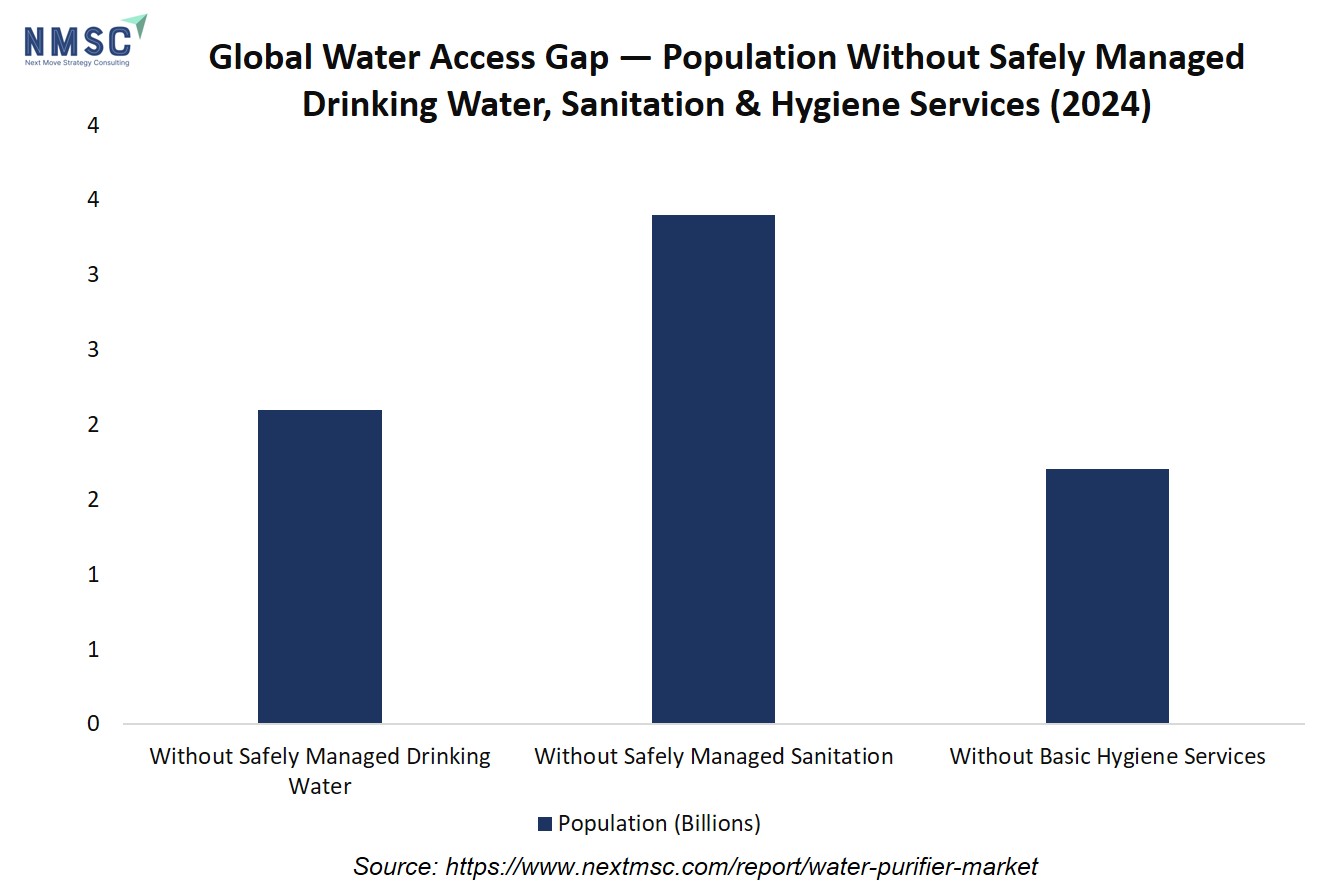
The scale of the challenge is staggering. A landmark report published by the WHO and UNICEF during World Water Week in August 2025 revealed that 1 in 4 people globally — or 2.1 billion individuals — still lack access to safely managed drinking water, including 106 million who drink directly from untreated surface sources. Meanwhile, the UN's 2025 SDG Progress Report warns that at the current rate of progress, the world will not achieve sustainable water management until at least 2049 — nearly two decades beyond the 2030 SDG deadline.
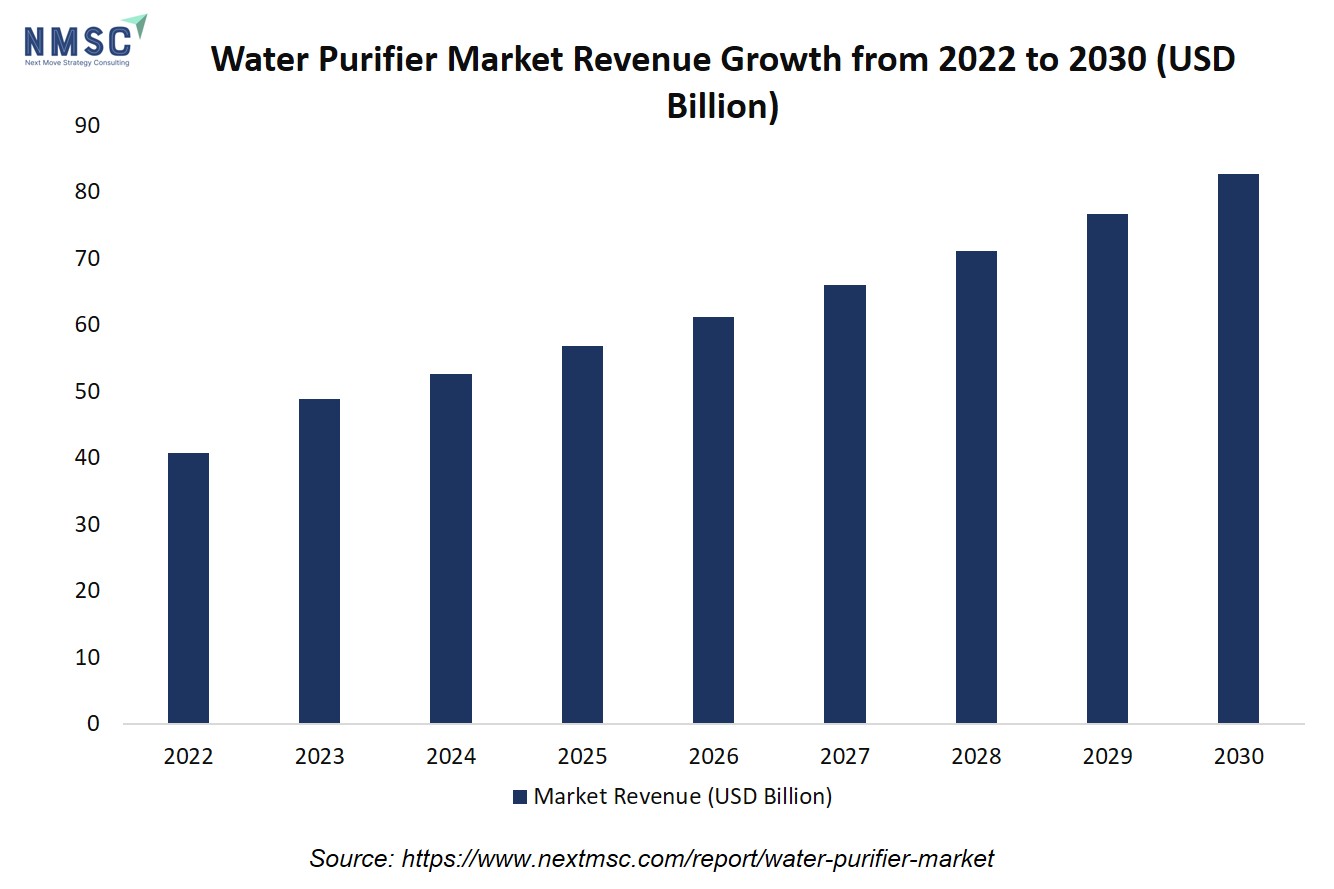
Against this backdrop, the global Water Purifier Market is experiencing sustained, structurally driven growth. According to Next Move Strategy Consulting (NMSC), the is projected to reach USD 82.66 billion by 2030, registering a CAGR of 7.8% from 2023 to 2030. This trajectory reflects not merely rising consumer awareness, but a fundamental shift in how governments, industries, and households worldwide are responding to the convergence of water scarcity, contamination, and public health imperatives.
For More Information: Download FREE Sample on Water Purifier Market Report
A Crisis Accelerating Demand: The Global Water Emergency of 2025–2026
WHO-UNICEF Report Redefines the Urgency of Water Purification
The most consequential development shaping the water purifier market in 2025–2026 is the publication of the WHO/UNICEF Joint Monitoring Programme's landmark report — Progress on Household Drinking Water and Sanitation 2000–2024: Special Focus on Inequalities — released during World Water Week in August 2025. The report's findings constitute a structural demand catalyst for the water purifier market of the highest order.
Beyond the headline figure of 2.1 billion people lacking safely managed drinking water, the report documents that 3.4 billion people still lack safely managed sanitation and 1.7 billion lack basic hygiene services at home. In fragile contexts, safely managed drinking water coverage is 38 percentage points lower than in other countries. Rural safely managed drinking water coverage rose from just 50% to 60% between 2015 and 2024 — a pace wholly insufficient to meet 2030 SDG targets.
"Water, sanitation and hygiene are not privileges, they are basic human rights," stated Dr. Ruediger Krech, Director a.i. of Environment, Climate Change and Health at WHO. "We must accelerate action, especially for the most marginalized communities, if we are to keep our promise to reach the Sustainable Development Goals."
The UN's 2025 SDG Progress Report reinforces this urgency with additional data: in 2024, 2.2 billion people lacked safely managed drinking water, only 56% of global domestic wastewater was safely treated, and 83% of freshwater species populations have declined since 1970. Agriculture accounts for 72% of global freshwater withdrawals, making it both a primary driver and a casualty of water stress.
The PFAS Contamination Crisis: A Regulatory Inflection Point for the Water Purifier Market
The second major development reshaping the water purifier market in 2025–2026 is the escalating regulatory response to per- and polyfluoroalkyl substances (PFAS) — the so-called "forever chemicals" — in drinking water supplies across North America and Europe.
In April 2024, the U.S. Environmental Protection Agency (EPA) finalized the first-ever National Primary Drinking Water Regulation for PFAS, setting Maximum Contaminant Levels (MCLs) for PFOA and PFOS at 4.0 parts per trillion (ppt) — among the most stringent drinking water standards ever established. On May 18, 2026, EPA proposed two significant rule modifications: first, retaining the 4.0 ppt MCLs for PFOA and PFOS while establishing a federal exemption framework allowing eligible public water systems to request up to two additional years — until April 26, 2031 — to achieve compliance; and second, proposing to rescind regulatory requirements for PFHxS, PFNA, HFPO-DA (commonly known as GenX chemicals), and the Hazard Index for PFAS mixtures.
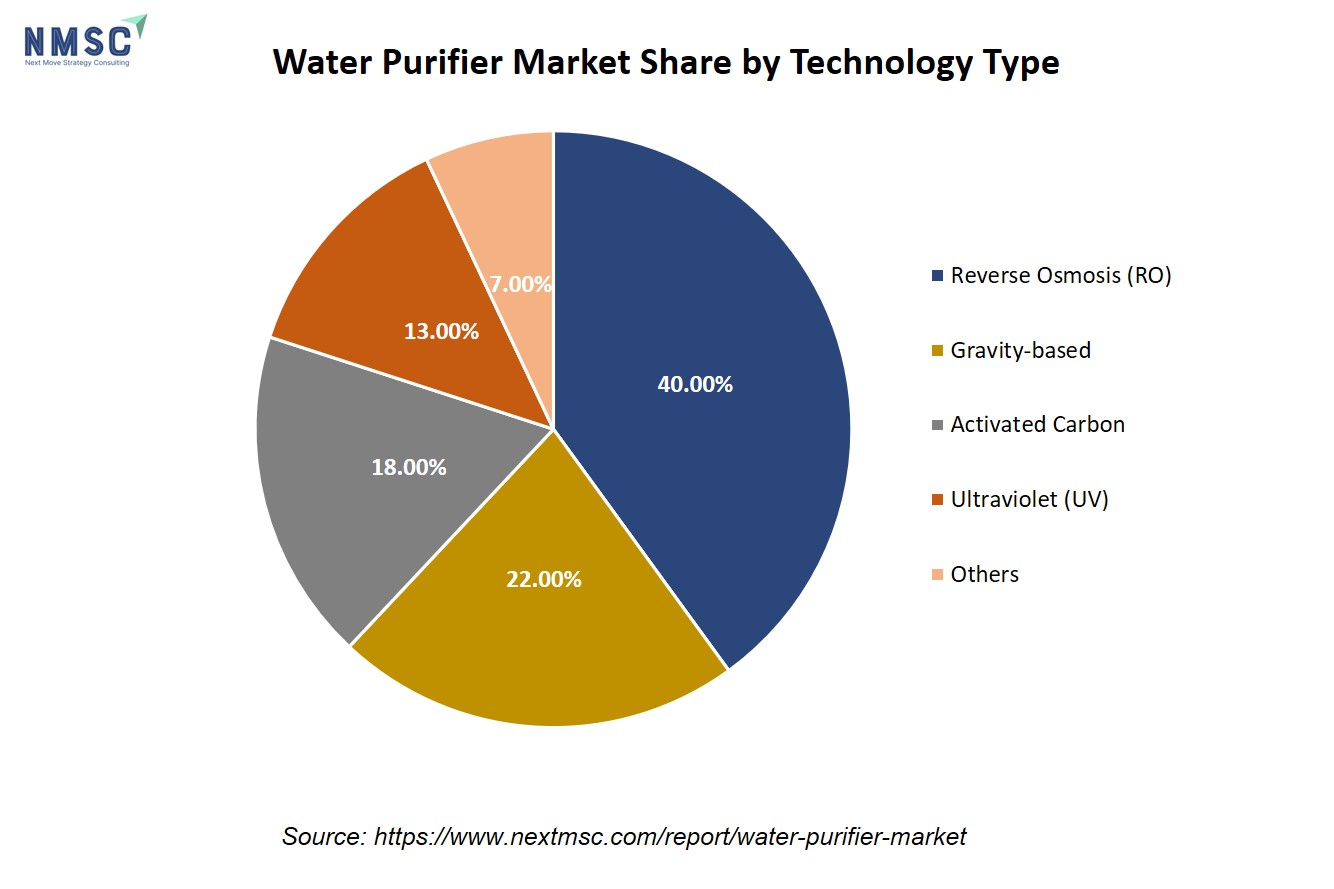
The practical consequence for the water purifier market is significant: PFAS contamination has elevated consumer and institutional demand for advanced point-of-use and point-of-entry purification systems capable of removing PFOA, PFOS, and related compounds. Reverse osmosis (RO) systems — the leading technology segment in the water purifier market — are among the most effective available technologies for PFAS removal, creating a direct regulatory tailwind for RO purifier adoption across North America.
CES 2025: Technology Innovation Signals the Smart Purification Era
At CES 2025 in Las Vegas, VIOMI — a NASDAQ-listed company operating under the corporate vision of "AI For Better Water" — unveiled two groundbreaking water purification systems that exemplify the market's technological trajectory. The Vortex 8 features 0.0001 micron RO filtration precision capable of removing PFOA, PFOS, viruses, heavy metals, and microplastics; a 3:1 wastewater ratio; a 4-year long-life filter; and a tankless integrated design. The Kunlun Water Purifier delivers a 7-layer filtration system enriching water with six essential minerals — strontium, potassium, sodium, calcium, magnesium, and metasilicic acid — through a 1200G high-volume flow rate system with a smart faucet for real-time water quality monitoring.
VIOMI's CES 2025 showcase — backed by over 4,000 patents and a 100,000-square-meter automated production facility — signals that the water purifier market is undergoing a fundamental product evolution: from basic filtration appliances to intelligent, connected health systems that monitor, adapt, and communicate in real time.
NMSC Strategic Perspective: What These Converging Forces Mean for the Market
From NMSC's analytical standpoint, the water purifier market is being shaped by three structurally reinforcing forces that distinguish this growth cycle from prior periods of demand expansion:
First, the WHO-UNICEF 2025 report has elevated water purification from a consumer preference to a documented public health emergency, creating non-discretionary demand in emerging markets — particularly across Asia-Pacific, Sub-Saharan Africa, and Latin America — where institutional water infrastructure remains inadequate.
Second, the PFAS regulatory framework in the United States and analogous regulations in the European Union are creating compliance-driven procurement cycles for advanced purification technologies in both residential and commercial segments, with RO systems positioned as the primary beneficiary.
Third, the integration of AI, IoT, and nanotechnology into water purification systems — as demonstrated at CES 2025 — is expanding the addressable market beyond traditional price-sensitive segments, creating premium product categories with higher margins and stronger brand differentiation potential.
NMSC assesses that vendors capable of delivering solutions across all three demand vectors — affordability for emerging markets, regulatory compliance for developed markets, and smart technology for premium segments — are best positioned to capture disproportionate market share through 2030.
Section Summary: The water purifier market is being driven by a convergence of a documented global water access crisis, escalating PFAS contamination regulations, and rapid smart technology innovation — all of which are structurally reinforcing demand across geographies and consumer segments.
Key Takeaways:
-
The WHO-UNICEF August 2025 report confirms 2.1 billion people globally lack safely managed drinking water, establishing a massive and persistent demand foundation for water purification solutions.
-
The UN SDG 2025 report warns the world will not achieve sustainable water management until at least 2049 at the current pace, underscoring the long-term structural nature of market demand.
-
EPA's May 2026 PFAS drinking water rule proposals — retaining 4.0 ppt MCLs for PFOA/PFOS with extended compliance timelines — are creating regulatory-driven demand for advanced RO purification systems in North America.
-
VIOMI's CES 2025 showcase of AI-enabled, mineral-enriching smart purifiers signals the market's transition from commodity appliances to intelligent health systems.
Industry Impact Analysis
The Water Stress Dimension: Scarcity Amplifies Purification Demand
Water stress is not merely an environmental concern — it is a direct commercial driver for the water purifier market. The UN's 2025 SDG Progress Report documents that global water stress remained at 18% in 2022, with stark regional disparities: countries in Northern Africa, Western Asia, and Central and Southern Asia face critical water stress levels exceeding 75%, and Northern Africa and Western Asia have experienced a 12% increase in water stress since 2015. Approximately 10% of the global population now lives under high or critical water stress.
In water-stressed regions, the quality of available water deteriorates alongside its quantity — increasing the concentration of contaminants, heavy metals, and biological pathogens in remaining water sources. This dynamic directly elevates demand for point-of-use purification systems capable of addressing a broader spectrum of contaminants than conventional municipal treatment provides.
Asia-Pacific: The Market's Dominant Growth Engine
Asia-Pacific holds the largest share of the global water purifier market and is expected to maintain its dominance through 2030. The region's leadership is driven by a combination of acute water quality challenges, rapid urbanization, and rising health awareness. According to the NMSC report, more than 369 million people in the Asia-Pacific region lack access to basic sanitation services, and 165 million lack access to drinking water. In China, only 14% of water is suitable for basic use including hydration, sanitation, and cooking. Studies conducted by the Indian Institute of Technology, Kharagpur, found pesticide levels in water 46 times higher than WHO permissible limits.
These conditions create a structural, non-discretionary demand for water purification solutions across both residential and commercial segments in the region's most populous markets — China, India, Indonesia, and Southeast Asia.
The Colorado River Crisis: A Western U.S. Demand Catalyst
A July 2026 analysis by Beveridge & Diamond highlights a critical water supply emergency in the western United States that is directly relevant to the water purifier market. The Colorado River Basin faces an approximately 2.59 million acre-foot gap between the river's natural supply and consumptive use, with persistent aridity, reduced snowpack, and shrinking reservoir storage increasing the likelihood of curtailments and supply disruptions. The Rio Grande Basin faces similar challenges, with Elephant Butte Reservoir oscillating around 13% capacity.
As municipal water supply reliability declines in western U.S. states, consumer and commercial demand for point-of-use and whole-home water purification systems is accelerating — particularly for systems capable of addressing both contaminant removal and water quality consistency during supply disruptions.
Key Industry Developments: Corporate Momentum in 2025–2026
The water purifier market's commercial momentum is reflected in a series of significant corporate actions in 2025–2026:
-
A.O. Smith Corporation (April 2025): Opened a new Product Development Center to enhance collaboration, sustainability, and innovation in water-related products, and acquired Atlantic Filter Corporation — a Florida-based water treatment provider — to extend its portfolio into new geographic and product segments.
-
Kent RO Systems Ltd. (June 2025): Received initial approval from SEBI for its IPO, signaling capital market confidence in the water purifier sector's growth trajectory. The company is expanding beyond water purifiers into adjacent appliance categories, targeting new segments to contribute approximately 50% of revenue over time.
-
3M Company: Continues to market under-sink, whole-house, and cartridge filtration systems in its consumer line, maintaining its position as a leading player in the home water purification segment.
Section Summary: The water purifier market's industry impact is being amplified by water stress, acute regional contamination challenges, western U.S. supply crises, and strong corporate investment activity — all reinforcing the market's structural growth trajectory.
Key Takeaways:
-
10% of the global population lives under high or critical water stress, directly elevating demand for point-of-use purification in affected regions.
-
Asia-Pacific's acute water quality challenges — including pesticide contamination 46 times above WHO limits in India and only 14% of water suitable for use in China — create non-discretionary purification demand.
-
The Colorado River Basin's 2.59 million acre-foot supply deficit is accelerating residential and commercial water purifier adoption in the western United States.
-
A.O. Smith's acquisition of Atlantic Filter Corporation and Kent RO's SEBI-approved IPO reflect strong institutional confidence in the market's long-term growth fundamentals.
Pros and Cons of Recent Market Developments
|
Recent Development |
Pros |
Cons |
|
WHO-UNICEF August 2025 Report: 2.1 billion lack safe water |
Elevates water purification to a global policy priority; accelerates government procurement and subsidy programs for purification solutions in emerging markets |
Highlights the scale of the affordability gap — the populations most in need of purification are often least able to afford advanced systems |
|
EPA PFAS MCL Rule (4.0 ppt for PFOA/PFOS, May 2026 compliance extension) |
Creates regulatory-driven demand for advanced RO purification systems in North America; raises consumer awareness of tap water contamination risks |
Extended compliance timeline (to 2031) may delay urgency of institutional procurement; rescission of requirements for some PFAS compounds creates regulatory uncertainty |
|
VIOMI Vortex 8 & Kunlun launch at CES 2025 |
Demonstrates AI/IoT integration as a viable product differentiator; expands the premium segment; raises consumer expectations for smart purification features |
Premium pricing may limit addressable market in price-sensitive geographies; rapid technology evolution risks product obsolescence for existing installed base |
|
A.O. Smith acquisition of Atlantic Filter Corporation (April 2025) |
Expands geographic reach and product portfolio; strengthens competitive positioning in the U.S. residential and commercial segments |
Integration costs and operational complexity may weigh on near-term margins |
|
Kent RO Systems SEBI IPO approval (June 2025) |
Signals capital market confidence in the sector; provides growth capital for product and geographic expansion |
IPO proceeds may be directed toward diversification beyond water purifiers, potentially diluting core market focus |
|
Colorado River Basin water supply crisis (2026) |
Accelerates residential and commercial water purifier adoption in western U.S. markets; creates demand for portable and emergency purification solutions |
Infrastructure-level water scarcity may exceed the capacity of point-of-use purification to address — requiring systemic solutions beyond consumer products |
|
Nanotechnology integration in water purifiers |
Superior contaminant removal including heavy metals, bacteria, and viruses; energy efficiency; compact design suitable for rural deployment |
High development costs; regulatory approval timelines for novel nanomaterials; limited consumer awareness of nanotech-based solutions |
Key Data & Statistics
|
Parameter |
Details |
|
Water Purifier Market Size (2022) |
USD 40.75 Billion |
|
Water Purifier Market Forecast (2030) |
USD 82.66 Billion |
|
CAGR (2023–2030) |
7.8% |
|
Analysis Period |
2022–2030 |
|
Dominant Region |
Asia-Pacific |
|
Leading Technology Segment |
Reverse Osmosis (RO) |
|
End User Segments |
Commercial & Residential |
|
Distribution Channels |
Retail Sales, Direct Sales, Online Sales |
|
Key Players Profiled |
20 |
|
Report Pages |
476 |
|
Metric |
Data Point |
|
Global population lacking safely managed drinking water (2024) |
2.1–2.2 Billion (1 in 4 people) |
|
Population drinking from untreated surface sources |
106 Million |
|
Global population lacking safely managed sanitation (2024) |
3.4 Billion |
|
Global population lacking basic hygiene services (2024) |
1.7 Billion |
|
Projected year for achieving sustainable water management (current pace) |
2049 |
|
Global domestic wastewater safely treated (2024) |
56% |
|
Agriculture's share of global freshwater withdrawals (2022) |
72% |
|
Freshwater species population decline since 1970 |
83% |
|
EPA PFAS MCL for PFOA and PFOS |
4.0 parts per trillion (ppt) |
|
EPA proposed PFOA/PFOS compliance extension deadline |
April 26, 2031 |
|
Colorado River Basin water supply deficit |
~2.59 million acre-feet |
|
VIOMI patents secured (water purification technology) |
4,000+ |
|
Vortex 8 RO filtration precision |
0.0001 micron |
|
Asia-Pacific: Population lacking basic sanitation |
369 Million+ |
|
India: Pesticide levels in water vs. WHO limits |
46× above permissible limits |
Future Outlook & Forecast for the Water Purifier Market
Market Trajectory: From USD 40.75 Billion to USD 82.66 Billion
According to NMSC's proprietary research, the global water purifier market is on a sustained growth trajectory, projected to more than double in value from USD 40.75 billion in 2022 to USD 82.66 billion by 2030, at a CAGR of 7.8% from 2023 to 2030. This growth is underpinned by the convergence of an unresolved global water access crisis, expanding regulatory mandates for contaminant removal, and the rapid integration of smart technologies into purification systems.
Regional Outlook
Asia-Pacific currently holds the largest share of the global water purifier market and is expected to maintain its dominance through 2030. The region's leadership is driven by acute water quality challenges, rapid urbanization, rising disposable incomes, and government-led public health initiatives. The prevalence of waterborne diseases, industrial contamination, and pesticide runoff in major markets including China, India, Indonesia, and Southeast Asia creates persistent, non-discretionary demand for residential and commercial purification solutions.
Europe is expected to show a steady rise in water purifier market share, driven by rising awareness of waterborne diseases, skin health concerns, and the growing incidence of PFAS contamination in municipal water supplies. Regulatory frameworks including the EU Drinking Water Directive (recast 2021) are compelling member states to strengthen monitoring and treatment standards, creating compliance-driven demand for advanced purification technologies.
North America is experiencing accelerating demand driven by PFAS contamination concerns, the western U.S. water supply crisis, and growing consumer awareness of tap water quality risks. The EPA's PFAS MCL framework — setting PFOA and PFOS limits at 4.0 ppt — is creating a regulatory demand floor for advanced RO purification systems across residential, commercial, and institutional segments.
Technology and Product Evolution
The water purifier market is evolving rapidly across multiple technology dimensions:
-
Smart and AI-enabled purification: IoT-connected purifiers with real-time water quality monitoring, adaptive purification modes, and mobile app integration are transitioning from premium novelties to mainstream product expectations — as demonstrated by VIOMI's CES 2025 launches and the broader industry trend toward intelligent home water management.
-
Nanotechnology: Nanotech-based purifiers offer superior performance in removing bacteria, viruses, heavy metals, and microplastics with greater energy efficiency and compact form factors — making them particularly suited for both urban premium segments and rural deployment in emerging markets.
-
Reverse Osmosis advancement: RO technology remains the leading purification method, with innovations in membrane efficiency, wastewater reduction (as demonstrated by VIOMI's 3:1 ratio), and filter longevity (4-year filter life) driving adoption across residential and commercial segments.
-
Mineral enrichment: The integration of mineral addition technology — as featured in VIOMI's Kunlun purifier — reflects a market shift from pure contaminant removal toward holistic hydration and wellness positioning, expanding the product's value proposition beyond safety to health optimization.
Competitive Landscape
Key players operating in the global water purifier market include 3M Company, A.O. Smith Corporation, Brita LP, Kent RO Systems Ltd., LG Electronics Inc., Panasonic Corporation, Pentair Plc, Whirlpool Corporation, Honeywell International Inc., Midea Group Co. Ltd., Livpure, Coway Co. Ltd., Havells, Urban Company, V-Guard, Philips, Aquafresh RO, Tata Swach, Jaipan Industries Ltd., and Puricom Water Industrial Corp. These organizations are actively pursuing product innovation, geographic expansion, and strategic acquisitions to maintain competitive positioning in a rapidly evolving market.
Section Summary: The water purifier market is positioned for sustained, near-doubling growth through 2030, driven by an unresolved global water crisis, PFAS regulatory mandates, and rapid smart technology integration across all major geographies.
Key Takeaways:
-
NMSC projects the global water purifier market to reach USD 82.66 billion by 2030, growing at a CAGR of 7.8% from 2023 to 2030.
-
Asia-Pacific leads the market, driven by acute water quality challenges and rising health awareness across China, India, and Southeast Asia.
-
North America's PFAS regulatory framework — with PFOA/PFOS MCLs at 4.0 ppt and compliance extended to 2031 — is creating a sustained regulatory demand floor for advanced RO purification systems.
-
AI/IoT integration, nanotechnology, and mineral enrichment are the defining product differentiation vectors through 2030, expanding the market's value proposition from safety to holistic wellness.
Next Steps for Stakeholders
For C-Level Executives and Business Leaders:
-
Align product strategy with the PFAS regulatory timeline. The EPA's PFAS MCL framework — with PFOA/PFOS limits at 4.0 ppt and compliance extended to April 2031 — creates a defined procurement window for advanced RO purification systems in North America. Organizations should position RO-based solutions as the compliance-ready technology of choice for both residential and commercial customers.
-
Prioritize Asia-Pacific market penetration. The region's combination of acute water quality challenges, rising disposable incomes, and government health initiatives creates the most favorable demand environment globally. Localized product strategies — addressing specific contaminants prevalent in target markets (pesticides in India, industrial pollutants in China) — will be critical for market share capture.
-
Invest in smart technology integration. The CES 2025 launches by VIOMI demonstrate that AI-enabled, IoT-connected purifiers are becoming the new product standard in premium segments. Organizations that delay smart technology integration risk ceding premium market share to technology-forward competitors.
-
Develop affordable solutions for emerging markets. The WHO-UNICEF 2025 report confirms that the populations most in need of water purification are concentrated in low-income and fragile contexts. Gravity-based and low-cost UV purifiers — designed for off-grid and price-sensitive deployment — represent a significant and underserved market opportunity, particularly in Sub-Saharan Africa and rural Asia.
-
Monitor the evolving PFAS regulatory landscape. EPA's May 2026 proposals — including the potential rescission of requirements for certain PFAS compounds — create regulatory uncertainty that may affect product specification and marketing claims. Organizations should maintain close engagement with regulatory developments and ensure product certifications remain current.
For Investors and Market Participants:
-
Track Kent RO Systems' IPO trajectory. The company's SEBI approval for an IPO in June 2025 signals capital market confidence in the Indian water purifier segment — one of the highest-growth markets globally. The IPO represents a potential entry point for investors seeking exposure to Asia-Pacific water purification growth.
-
Evaluate nanotechnology-focused vendors. Nanotech-based purification represents the next frontier in water purifier performance, with superior contaminant removal, energy efficiency, and compact design. Vendors with proprietary nanotechnology platforms and regulatory approval pathways are positioned for above-market growth as the technology matures.
-
Monitor western U.S. water infrastructure developments. The Colorado River Basin's 2.59 million acre-foot supply deficit and the Rio Grande Basin's capacity crisis are creating structural demand for residential and commercial water purification in high-income western U.S. markets — a premium segment with strong margin potential.
Conclusion
The water purifier market is no longer a discretionary consumer category — it is a global public health imperative backed by institutional data, regulatory mandates, and technological momentum. The WHO-UNICEF August 2025 report's confirmation that 2.1 billion people lack safely managed drinking water, combined with the UN's warning that sustainable water management will not be achieved until 2049 at the current pace, establishes the structural demand foundation for this market with unambiguous clarity.
Simultaneously, the EPA's PFAS drinking water regulations, the western U.S. water supply crisis, and the rapid integration of AI and nanotechnology into purification systems are reshaping the market's competitive dynamics and expanding its addressable opportunity across geographies and consumer segments. NMSC's market data confirms the industry's response: the global water purifier market is on track to reach USD 82.66 billion by 2030, growing at a CAGR of 7.8% as enterprises, governments, and households worldwide recognize that access to clean, safe water requires active, technology-enabled intervention.
Organizations that invest decisively in advanced purification technologies, smart product integration, and regulatory alignment will be best positioned to lead in a market where the stakes — human health, environmental sustainability, and long-term commercial growth — have never been higher.
About the Author
 Sanyukta Deb
— Sanyukta Deb is Digital Marketing Team Lead at Next Move Strategy Consulting, where she has led content strategy and technical SEO for the firm's B2B market research publications for over 2 years. Her editorial process translates NextMSC's primary and secondary research — spanning technology, industrial, and consumer sectors — into commercial narratives, backed by search-intent, keyword, and competitive analysis. She brings 5 years of overall experience in digital marketing and content strategy.
Sanyukta Deb
— Sanyukta Deb is Digital Marketing Team Lead at Next Move Strategy Consulting, where she has led content strategy and technical SEO for the firm's B2B market research publications for over 2 years. Her editorial process translates NextMSC's primary and secondary research — spanning technology, industrial, and consumer sectors — into commercial narratives, backed by search-intent, keyword, and competitive analysis. She brings 5 years of overall experience in digital marketing and content strategy.
About the Reviewer
 Debashree Dey
— Debashree Dey is Assistant Manager at Next Move Strategy Consulting, where she supports cross-vertical market content and communications across diverse industries for 6 years. Her professional background includes senior content writing, communications, and published manuscript authorship, with experience developing audience-focused business narratives and maintaining clear, consistent messaging. Her role supports research-led content development and editorial quality across NextMSC publications.
Debashree Dey
— Debashree Dey is Assistant Manager at Next Move Strategy Consulting, where she supports cross-vertical market content and communications across diverse industries for 6 years. Her professional background includes senior content writing, communications, and published manuscript authorship, with experience developing audience-focused business narratives and maintaining clear, consistent messaging. Her role supports research-led content development and editorial quality across NextMSC publications.


















Add Comment