Alcoholic Beverages Market: Why Growth Is Moving Beyond the US | NextMSC
Introduction
On August 20, 2026, Gallup reported that 54% of U.S. adults drink alcohol, matching 2025 as the lowest reading since its survey began in 1939. Two weeks earlier, Diageo plc had reported a 2.0% organic decline in net sales for the year ended June 30, 2026, and on August 27, 2026, Pernod Ricard reported a 3.9% organic decline for the same fiscal period. Yet AB InBev grew third-quarter revenue by 4.9% on October 29, 2026. One consumer pullback is penalizing some categories and countries while rewarding others.
According to Next Move Strategy Consulting's Alcoholic Beverages Market report, the global alcoholic beverages market was valued at USD 1,560 billion in 2020 and is projected to reach USD 1,860 billion by 2030, growing at a CAGR of 1.8% from 2021 to 2030. That pace is modest by consumer-goods standards, and the 2026 company disclosures explain why: growth is concentrated in premium beer, ready-to-drink formats, no-alcohol lines and selected emerging countries, while the United States and China account for the sharpest declines in the 2026 spirits results.
For More Information: Download FREE Sample on Alcoholic Beverages Market Report
Record-Low U.S. Drinking Meets Diverging Company Results: How the Alcoholic Beverages Market Is Being Rebalanced
Gallup's August 2026 Poll: Drinking Holds at a Record-Low 54%
Gallup's Consumption Habits survey, conducted July 1-19, 2026 among 1,200 U.S. adults and published on August 20, 2026, found that 54% of adults drink alcohol, unchanged from 2025. Self-reported drinking had fallen from 62% in 2023 to 58% in 2024 and 54% in 2025 before stabilizing. The share of adults aged 18 to 34 who drink fell from 58% in 2023 to 50% in 2026.
Attitudes explain the persistence. Gallup found that 51% of adults now consider one or two drinks a day bad for health, only the second time since 2001 that a majority has held that view, and 86% have heard at least something about recent research on the long-term health effects of drinking, up from 79% in 2024. 17% of adults substituted a nonalcoholic beer, wine or spirit for an alcoholic drink in the past year, including 20% of drinkers. Among drinkers, 36% name beer as the beverage they drink most often, 32% liquor and 30% wine; liquor has gained 12 percentage points since 2016 while beer has lost seven.
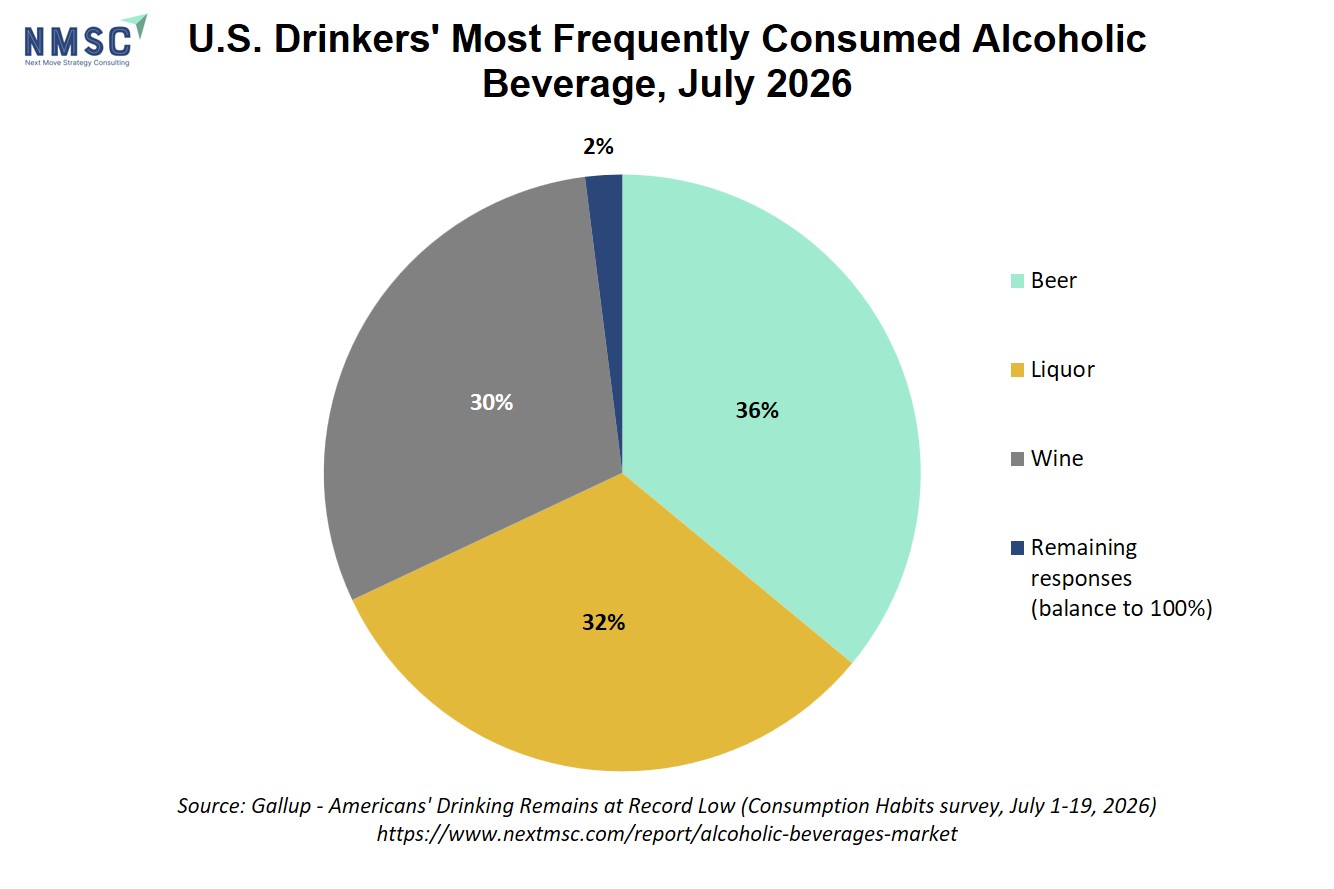
Gallup's Consumption Habits survey, conducted July 1-19, 2026, reports that among U.S. drinkers 36% name beer as the beverage they drink most often, 32% name liquor and 30% name wine. The remaining 2% is the balance to 100% after the three published categories. The results for drinkers rest on 701 respondents, with a maximum margin of sampling error of plus or minus 5 percentage points.
Diageo and Pernod Ricard: Spirits Absorb the Reset
Diageo plc reported on August 6, 2026 that net sales for the year ended June 30, 2026 were USD 19,643 million, down 2.0% organically, with volume down 0.4% and price and mix down 1.6 percentage points. The decline was concentrated in North America, where organic net sales fell 8.4%, and in Asia Pacific, where they fell 6.3%. In the United States, spirits net sales fell 11.5% as volume dropped 9.0%; tequila fell 21.1%, with Don Julio down 19.2% and Casamigos down 27.7%, and Crown Royal whisky fell 15.9%. U.S. ready-to-drink and cocktail net sales grew 35.1%, driven by the Casamigos ready-to-serve launch for the FIFA World Cup and by Bulleit and Ketel One cocktails.
China is the second drag. Diageo's Greater China net sales fell 34.9% after policy changes reduced consumption occasions for Chinese white spirits, whose volume fell 41.9%, and Diageo reported that the category reduced group organic net sales by about 1.5%. Offsetting growth came from Africa at 13.3%, Latin America and the Caribbean at 7.7% and Europe at 3.4%, and India grew 7.1%. Organic operating profit still rose 2.0% because marketing investment fell 13.1% organically, while organic gross margin declined by 141 basis points on adverse mix, cost inflation and tariffs.
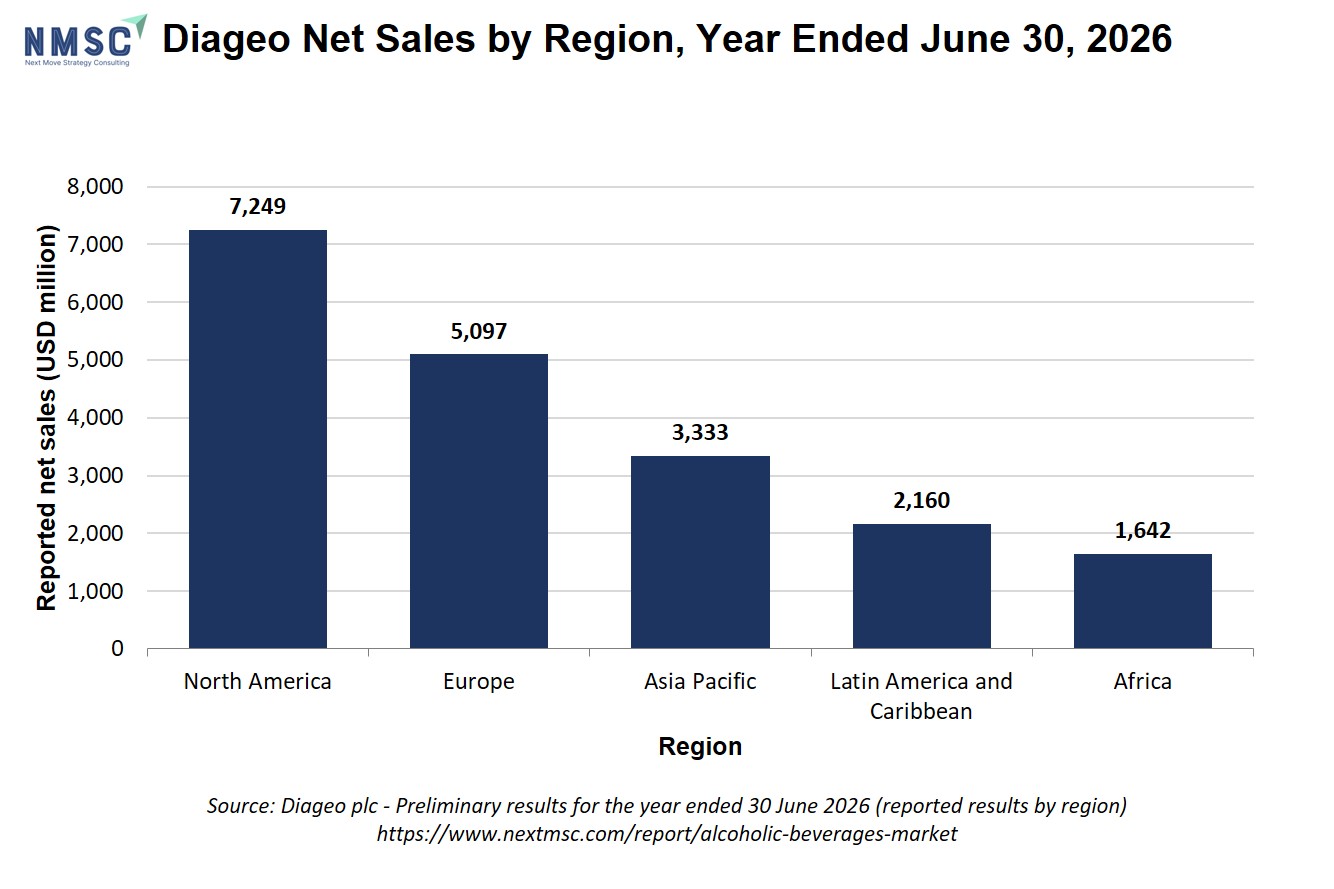
Diageo plc reported net sales of USD 7,249 million in North America, USD 5,097 million in Europe, USD 3,333 million in Asia Pacific, USD 2,160 million in Latin America and the Caribbean and USD 1,642 million in Africa for the year ended June 30, 2026. The five regions plus USD 162 million of corporate and other net sales make up the group total of USD 19,643 million. North America, the region with an 8.4% organic net sales decline, remains the largest at 37% of group net sales.
Pernod Ricard's results on August 27, 2026 followed the same geography. Net sales for fiscal 2026 were EUR 9,404 million, an organic decline of 3.9%, with the United States down 14% and China down 19%; excluding those two countries, organic net sales rose 0.5%. Momentum improved within the year, from an organic decline of 5.9% in the first half to 1.3% in the second, and ready-to-drink sales grew 12% on strong results in Canada, Australia and Western Europe. Organic profit from recurring operations fell 5.2% to EUR 2,423 million, and the company guided to broadly stable organic net sales in fiscal 2027.
AB InBev, Heineken and Constellation Brands: Beer Grows Through Premium and No-Alcohol
Brewers reported a different pattern. AB InBev's third-quarter 2026 results, published on October 29, 2026, showed revenue up 4.9% on volume growth of 0.4% and revenue per hectoliter growth of 4.2%. Above-core beer revenue grew 8.6%, Corona grew revenue 20% outside its home market, no-alcohol beer revenue rose 35% and the Beyond Beer portfolio grew 19%, while the company described a challenging industry in China that offset broad-based growth elsewhere.
Heineken N.V. reported first-half 2026 results on August 5, 2026, with organic net revenue growth of 2.7% and total volume growth of 1.6%. Premium volume rose 6%, beyond-beer products 8% and low- and no-alcohol volume 12%, and organic operating profit rose 6.7%. Europe was flat, with net revenue up 0.1%, so volume momentum came from Asia Pacific and from Africa and the Middle East.
Constellation Brands' fiscal second-quarter results, reported on October 6, 2026 for the quarter ended August 31, 2026, show how sell-in and sell-out can diverge. Net sales rose 6% to USD 2.63 billion and beer shipments rose 5.5%, yet beer depletions, which measure distributor sales to retailers, declined 0.6%. Wine and spirits net sales rose 17% to USD 159.4 million, and the company acquired SpikedAde, a spirits-based ready-to-drink brand, after the quarter closed.
UK-India Free Trade Agreement: A Tariff Cut in the Largest Whisky Market
The UK-India Free Trade Agreement came into force on July 15, 2026, and The Drinks Business reported on July 23, 2026 that India's import tariff on Scotch whisky fell immediately from 150% to 75%, with a scheduled decline to 40% over ten years. The Spirits Business reported on July 15, 2026 that India is the world's biggest Scotch whisky market by volume, so even a partial cut changes landed-cost arithmetic for international brand owners.
The agreement met friction within three months. The Week reported on October 24, 2026 that Diageo and Pernod Ricard had pointed out that bulk Scotch imports remain excluded from the tariff reduction, citing a letter from the International Spirits and Wines Association of India to the commerce minister, and the Scotch Whisky Association told Reuters that bulk imports are central to Scotch's success in India.
NMSC Strategic Perspective: Why Value Growth Now Depends on Mix and Geography
NextMSC primary research and analysis frames the 2026 evidence around one conclusion: the alcoholic beverages market is shifting from a volume-led to a mix-led and geography-led growth model. NextMSC's projection of USD 1,560 billion in 2020 rising to USD 1,860 billion by 2030 implies an absolute addition of USD 300 billion, or 19.2% cumulatively, over ten years. The company results show how that addition is being earned: price and mix subtracted 1.6 percentage points from Diageo's growth while revenue per hectoliter added 4.2% at AB InBev, and the difference lies in category exposure, with tequila and Chinese white spirits shrinking while premium beer, no-alcohol beer and ready-to-drink expand.
NextMSC's regional analysis identifies Asia-Pacific as the largest region in the alcoholic beverages market, with India and China expected to record significant demand increases as disposable incomes rise, and North America as the second-largest region. The 2026 disclosures qualify that view by country: Greater China contracted sharply at Diageo and Pernod Ricard while India grew at Diageo and gains tariff access under the UK-India agreement. NextMSC therefore reads Asia-Pacific's leadership as increasingly dependent on India and on selected markets such as Japan, and North America's position as dependent on whether zero-alcohol, ready-to-drink and premium beer can offset the decline in spirits.
Section Summary:
The 2026 evidence separates winners from laggards by category and country rather than by the alcoholic beverages market as a whole.
-
Gallup's July 2026 survey holds U.S. drinking at 54%, and 51% of adults consider one or two daily drinks bad for health.
-
Diageo plc and Pernod Ricard lost 2.0% and 3.9% of organic net sales as the United States and China contracted.
-
AB InBev, Heineken N.V. and Constellation Brands grew through premium, no-alcohol and beyond-beer formats.
Industry Impact Analysis
Trade Policy and Excise Rules: India Opens While China Contracts
Policy now moves volume more than marketing does. In India, two measures pull in opposite directions: the UK-India agreement reduces the tariff on imported Scotch from 150% to 75%, while Maharashtra's excise changes, which raised duties and introduced state-made liquor, weighed on Diageo's McDowell's brand and reduced Pernod Ricard's sales from July 2025. International Scotch gains price access just as state-level taxation shifts advantage toward locally made spirits, yet Diageo's India net sales still grew 7.1%.
In China, regulation altered consumption occasions instead of prices. Diageo attributed the 41.9% volume decline in Chinese white spirits to market policy changes, and Pernod Ricard cited regulatory measures and weak consumer sentiment behind a 19% organic sales decline in China, with the premium cognac Martell under particular pressure.
In the United States, tariffs add to mix pressure on margins. Diageo's organic gross margin fell 141 basis points in fiscal 2026 on adverse mix, cost inflation and tariffs, and it cut organic marketing investment by 13.1% to protect operating profit.
Health Perception and Product Mix: Why Zero-Alcohol and Ready-to-Drink Absorb the Shift
Health awareness is the demand-side variable that company data confirm. With 86% of Americans having heard about research on drinking and health, according to Gallup, brand owners are widening the occasions they serve rather than defending a single category. AB InBev's no-alcohol beer revenue rose 35% in the third quarter of 2026, Heineken N.V.'s low- and no-alcohol volume rose 12% in the first half, and Guinness 0.0 grew volume and net sales by double digits in Great Britain, where Diageo identified it as the fastest-growing no-alcohol beer. Ready-to-drink formats serve the other path, convenience: Diageo's U.S. cocktail net sales grew 35.1%, Pernod Ricard's ready-to-drink sales grew 12%, and Constellation Brands bought SpikedAde immediately after a quarter in which its beer depletions declined.
The practical implication for the alcoholic beverages market is that category lines are blurring. Gallup found that among young adults liquor is essentially tied with beer as the preferred beverage, and AB InBev reports that its Beyond Beer portfolio grew 19%, led by Cutwater in the United States. Portfolio breadth now determines which suppliers can reallocate marketing as occasions shift.
Section Summary:
Policy and health perception are redistributing growth within the alcoholic beverages market rather than removing it.
-
India's tariff cut and Maharashtra's excise changes create opposing forces for imported and domestic spirits.
-
Policy changes cut Diageo's Greater China net sales by 34.9% and drove a 19% organic decline in Pernod Ricard's China sales.
-
No-alcohol beer revenue grew 35% at AB InBev and low- and no-alcohol volume grew 12% at Heineken N.V.
Pros and Cons of Recent Market Developments
|
Pros |
Cons |
|
Above-core beer revenue grew 8.6% at AB InBev in the third quarter of 2026, lifting revenue per hectoliter by 4.2%. |
Diageo's U.S. spirits net sales fell 11.5% in fiscal 2026, with tequila down 21.1%. |
|
India's Scotch tariff fell from 150% to 75% on July 15, 2026, with a scheduled path to 40%. |
Bulk Scotch imports remain excluded from the reduced tariff, according to The Week's October 24, 2026 report. |
|
No-alcohol beer revenue grew 35% at AB InBev and low- and no-alcohol volume grew 12% at Heineken N.V. |
Gallup's 2026 survey shows 54% of U.S. adults drink, matching the lowest reading since 1939. |
|
Diageo's organic operating profit rose 2.0% as marketing investment fell 13.1%. |
Diageo recorded USD 1.5 billion of impairments, largely tied to Türkiye and the Don Papa brand. |
|
Ready-to-drink sales grew 12% at Pernod Ricard and 35.1% for Diageo in the United States. |
Constellation Brands' beer depletions fell 0.6% as shipments rose 5.5%. |
Key Data & Statistics
Diageo Fiscal 2026: Organic Net Sales Movement by Category
|
Category |
Organic net sales movement |
Share of reported net sales |
|
Spirits (total) |
-5% |
75% |
|
Scotch |
+2% |
24% |
|
Tequila |
-16% |
12% |
|
Vodka |
Flat |
8% |
|
Canadian whisky |
-15% |
6% |
|
Chinese white spirits |
-47% |
2% |
|
Beer |
+9% |
18% |
|
Ready-to-drink |
+15% |
4% |
Company Results Across the Alcoholic Beverages Market, 2026
|
Company |
Period and release date |
Key result |
|
AB InBev |
Third quarter 2026, October 29, 2026 |
Revenue +4.9%; volume +0.4%; no-alcohol beer revenue +35% |
|
Heineken N.V. |
First half 2026, August 5, 2026 |
Organic net revenue +2.7%; total volume +1.6%; low- and no-alcohol volume +12% |
|
Constellation Brands |
Fiscal second quarter 2027, October 6, 2026 |
Net sales +6% to USD 2.63 billion; beer shipments +5.5%; beer depletions -0.6% |
Gallup Consumption Habits Survey: U.S. Indicators, July 2026
|
Indicator |
Result |
|
U.S. adults who drink alcohol |
54% |
|
Adults aged 18 to 34 who drink |
50% |
|
Adults who consider one or two drinks a day bad for health |
51% |
|
Adults who have heard about research on drinking and health |
86% |
|
Adults who sometimes drink too much |
13% |
|
Adults who substituted nonalcoholic beer, wine or spirits in the past year |
17% |
|
Drinkers' most frequent beverage |
Beer 36%, liquor 32%, wine 30% |
Future Outlook & Forecast
Alcoholic Beverages Market Outlook: The Path from USD 1,560 Billion to USD 1,860 Billion
NextMSC projects the alcoholic beverages market to grow from USD 1,560 billion in 2020 to USD 1,860 billion by 2030 at a CAGR of 1.8% from 2021 to 2030. NextMSC's research identifies a rising young-adult population, premium product demand, higher disposable income, and innovation in vodka, cocktails, flavored wine and beer as supporting forces, and the health effects and high cost of alcoholic beverages as restraining forces.
The 2026 disclosures test each of those forces. Premium demand is visible in AB InBev's 8.6% above-core revenue growth and Heineken N.V.'s 6% premium volume growth. The restraint is visible in Gallup's finding that 51% of adults consider moderate drinking bad for health. Flavored and canned ready-to-drink formats, which fall within NextMSC's flavor and packing segments, are growing faster than core spirits: Diageo's ready-to-drink net sales rose 15% globally against a 5% decline in spirits.
Three variables will determine whether growth tracks NextMSC's trajectory. First, fiscal 2027 guidance: Pernod Ricard guided to broadly stable organic net sales, and Diageo's Capital Markets Day guidance of August 6, 2026 points to flat organic net sales. Second, the pace at which India's Scotch tariff falls from 75% toward 40%. Third, whether U.S. drinking, which held at 54% in Gallup's 2026 survey, stays stable in 2027.
Africa, Latin America and Asia-Pacific: Where Volume Growth Is Concentrated
Regional volume growth is concentrated outside the United States and Europe. Diageo's organic volume rose 14.0% in Africa and 3.1% in Latin America and the Caribbean while falling 6.7% in North America, and Heineken N.V. credited Asia Pacific and Africa and the Middle East for its first-half volume momentum. NextMSC's regional analysis, which places Asia-Pacific first and the Middle East last by revenue, should be read alongside company disclosures showing strong 2026 volume growth in Africa and Latin America.
Section Summary:
NextMSC projects the alcoholic beverages market to reach USD 1,860 billion by 2030 at a 1.8% CAGR, and the 2026 evidence shows where that value is being earned.
-
Premium beer and low- or no-alcohol lines are growing faster than core spirits.
-
India, Africa and Latin America supply volume growth while the United States and China contract.
-
Fiscal 2027 guidance from Pernod Ricard and Diageo plc points to stable rather than rising organic net sales.
Next Steps for Stakeholders
For C-Level Executives and Portfolio Leaders
Executives at spirits and beer companies should rebalance portfolios toward the formats that grew in 2026. The evidence supports directing capital to premium beer, ready-to-drink and no-alcohol lines, as Constellation Brands did by acquiring SpikedAde, and testing price repositioning where a brand has lost share, as Diageo is doing with Casamigos.
Executives with India exposure should model the tariff and excise changes together. A Scotch tariff of 75% falling toward 40% improves import economics, but Maharashtra's excise changes and the bulk-import exclusion flagged by Diageo and Pernod Ricard mean that sourcing and bottling choices matter as much as the headline duty.
For Institutional Investors
Investors should separate cost-led from demand-led earnings. Diageo's organic operating profit rose 2.0% on a 13.1% organic cut in marketing investment, and its new operating framework targets about USD 850 million of savings over two years, while Pernod Ricard delivered half of its EUR 1 billion efficiency program in fiscal 2026. Neither replaces net sales growth, so evidence of volume stabilization in the United States and China is a more informative signal than cost savings alone.
Investors should also track balance-sheet repair as a signal of strategy. Diageo's net debt fell to USD 20.5 billion, or 3.1 times adjusted EBITDA, and its dividend was reset to 50 cents per share. AB InBev, by contrast, set an interim dividend of EUR 0.40 per share, up from EUR 0.15.
Conclusion
The alcoholic beverages market is not shrinking uniformly; it is sorting winners from laggards by category, region and consumer occasion. Gallup's 2026 survey confirms that U.S. drinking has stopped falling at 54% but has not recovered, Diageo plc and Pernod Ricard show how spirits portfolios absorb that pressure, and AB InBev and Heineken N.V. show how premium and no-alcohol beer convert the same consumer into revenue growth.
NextMSC's projection of USD 1,860 billion by 2030 at a 1.8% CAGR describes a mature, value-led trajectory in which India, Africa and Latin America add volume while the United States and China reset. Stakeholders who monitor policy, health sentiment and sell-out data will see shifts in the alcoholic beverages market before revenue shows them.
About the Author
 Priyanshu Das
— Priyanshu Das is SEO Executive at Next Move Strategy Consulting, where he has led on-page and off-page SEO, keyword research, and SEO audits for the firm's B2B market research publications for 2 years. His audit process combines technical crawl analysis, backlink profile review, and competitor keyword gap mapping — using tools including Screaming Frog and Google Search Console — to prioritize fixes by organic search-visibility impact, informed by his own prior in-house and agency SEO experience.
About the Reviewer
 Sanyukta Deb
— Sanyukta Deb is Digital Marketing Team Lead at Next Move Strategy Consulting, where she has led content strategy and technical SEO for the firm's B2B market research publications for over 2 years. Her editorial process translates NextMSC's primary and secondary research — spanning technology, industrial, and consumer sectors — into commercial narratives, backed by search-intent, keyword, and competitive analysis. She brings 5 years of overall experience in digital marketing and content strategy.











Add Comment