Collagen Market Enters the GLP-1 Era as Nextida Reshapes Supply | NextMSC

Introduction
The global collagen peptide and gelatin market is undergoing a structural transformation — one driven not merely by incremental consumer demand, but by a convergence of pharmaceutical-grade clinical validation, landmark supply-side consolidation, and the emergence of collagen as a functional metabolic health ingredient. According to Next Move Strategy Consulting's Collagen Peptide and Gelatin Market report, the global collagen peptide and gelatin market was valued at USD 4.61 billion in 2022 and is projected to reach USD 7.25 billion by 2030, growing at a CAGR of 6.1% from 2023 to 2030.
This trajectory is no longer anchored solely to the confectionery and cosmetics sectors that historically defined gelatin and collagen peptide demand. The market is being reshaped by two simultaneous forces: a USD 1.5 billion supply-side merger that will consolidate nearly 200,000 metric tons of global production capacity under a single joint venture, and a clinically validated collagen peptide composition that has demonstrated the ability to naturally stimulate GLP-1 hormone secretion — placing collagen squarely within the fastest-growing segment of the global nutraceutical industry. For C-level executives and institutional investors evaluating this space, the strategic window is narrowing.
For More Information: Download FREE Sample on Collagen Peptide and Gelatin Market Report
The Nextida Formation and the GLP-1 Collagen Breakthrough: Two Forces Redefining the Market
A USD 1.5 Billion Consolidation Reshapes Global Supply
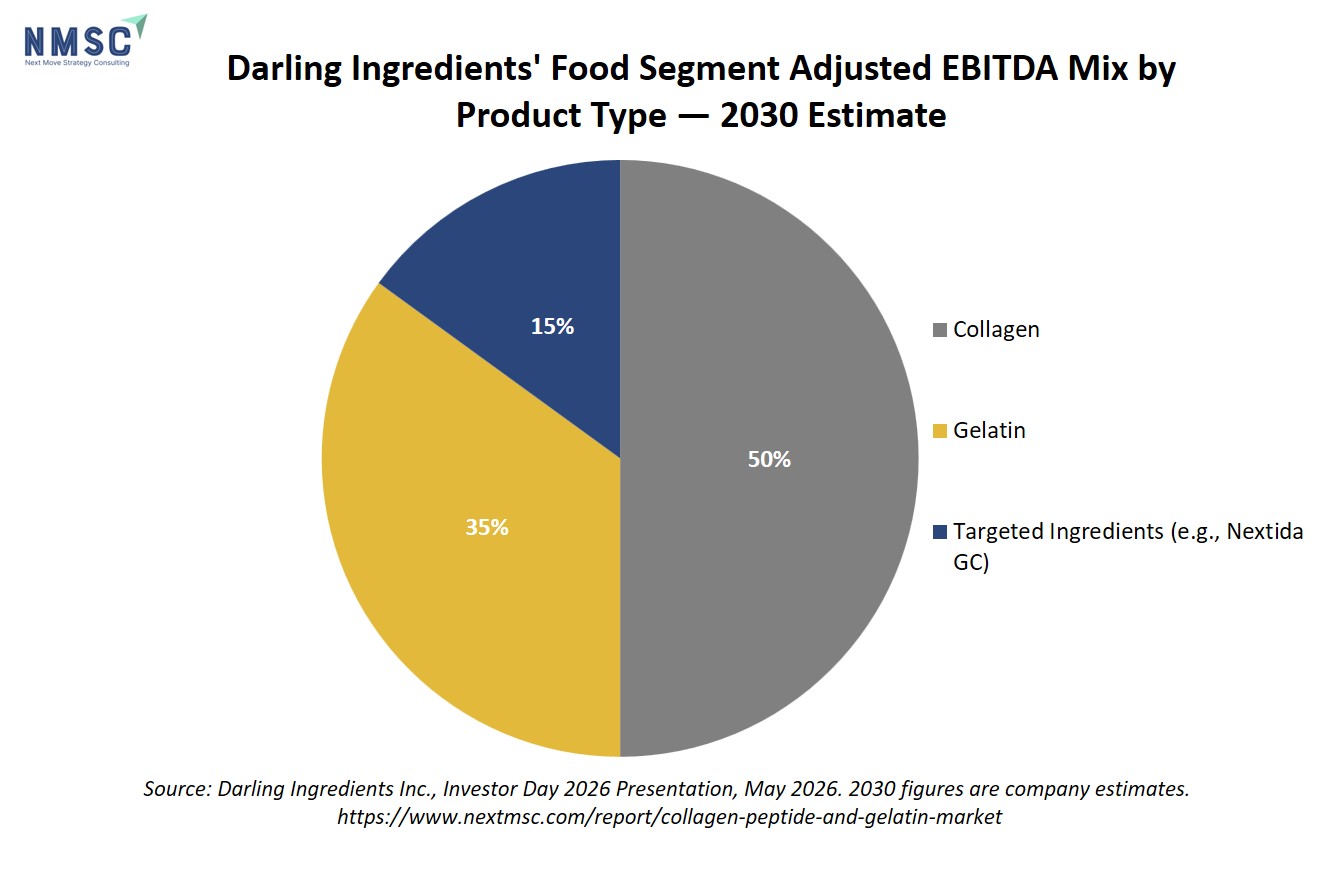
On May 12, 2025, Darling Ingredients and Tessenderlo Group announced a non-binding term sheet to combine their collagen and gelatin businesses into Nextida. The parties signed the definitive agreement on December 10, 2025— Rousselot and PB Leiner — into a new joint venture named Nextida™. Darling Ingredients holds an 85% majority stake, with Tessenderlo Group retaining the remaining 15%. The transaction requires no cash outlay from either party, combining assets, capabilities, and geographic infrastructure rather than financial consideration.
The resulting entity will command approximately USD 1.5 billion in annual revenue and approximately 200,000 metric tons of combined gelatin and collagen production capacity across 23 facilities spanning South America, North America, Europe, and Asia — a geographic footprint that no single competitor currently matches.
"Collagen has represented the fastest-growing area of Darling Ingredients' food segment business over the past several years, and with the addition of PB Leiner's people, assets and products, we are well positioned to increase scale and focus in this rapidly growing segment," said Randall C. Stuewe, Chairman and Chief Executive Officer of Darling Ingredients, in the company's official announcement on May 12, 2025.
Luc Tack, Chief Executive Officer of Tessenderlo Group, added: "With this combination, we will have the best new ownership possible. We will benefit from each other by sharing technology expertise and providing a complementary offering for our global customer base. This includes many in-demand products, such as gelatin and collagen peptides."
The transaction is pending regulatory approvals and was expected to close in 2026. Its significance extends beyond scale: by eliminating the commercial and logistical redundancies between two of the world's largest collagen producers, Nextida is positioned to redirect capital toward targeted product development — a strategic pivot that directly intersects with the market's most consequential emerging application.
Nextida GC: Collagen Enters the GLP-1 Era
At Natural Products Expo West 2026 in Anaheim, California (March 3–6), Rousselot showcased its Nextida GC collagen peptide composition alongside its established Peptan brand, with a specific focus on metabolic health applications and GLP-1 support. The event marked a pivotal moment for the collagen peptide and gelatin market: for the first time, a specific collagen peptide composition had completed two human clinical studies demonstrating measurable effects on postprandial glucose control and incretin hormone secretion.
Lauretta Katsriku, Global Category Leader, Collagen at Rousselot, confirmed at Expo West 2026 that the second clinical study validated findings from the first: "This study actually confirms that the consumption of Nextida GC prior to a carb heavy meal actually has specific postprandial glucose control benefits. It actually also shows an increase in GLP-1 secretion upon intake, as well as a sustained GLP-1 level up to about two hours after intake. Very interesting enough as well, this study actually confirmed that there was a significant delay in gastric emptying in a specific pre-diabetic cohort."
The clinical protocol involved participants consuming either 5 grams or 10 grams of Nextida GC 30 minutes before a carbohydrate-heavy meal. The composition was also granted a U.S. patent protecting its specific bioactive collagen peptide formulation for metabolic health applications — a development that Katsriku described as substantiating Rousselot's "strategy in advancing beyond collagen peptides in structural applications to targeted, specific health, functional benefits."
The commercial implications are direct. According to a Kaiser Family Foundation Health Tracking Poll cited by Florencia Moreno Torres, Global Marketing Manager at Rousselot, approximately 1 in 8 adults (12%) in the United States are currently taking a GLP-1 drug for weight loss, diabetes, or another condition — a figure that has risen substantially over the preceding 18 months. A Rousselot consumer survey conducted in 2025 found that among individuals who discontinued GLP-1 treatments, 31% reported that most of the weight they had lost returned, and 32% reverted to prior eating habits — identifying a substantial post-treatment maintenance market for functional collagen formulations.
NMSC Strategic Perspective: What These Developments Signal for Market Structure
NextMSC primary research and analysis identifies the Nextida formation and the Nextida GC clinical validation as structurally linked events, not coincidental developments. The consolidation of Rousselot and PB Leiner under a single entity creates the production scale and R&D investment capacity required to commercialize clinically validated, patent-protected collagen compositions at the volumes that mass-market nutraceutical and functional food applications demand. The GLP-1 adjacency is particularly significant: it repositions collagen peptides from a passive structural ingredient — consumed for skin hydration or joint support — into an active metabolic health ingredient with a measurable, patented mechanism of action. This distinction matters for pricing power, regulatory positioning, and the addressable customer base. Brands formulating GLP-1 companion products represent a new buyer category that did not exist in the collagen peptide market three years ago.
Section Summary:
-
Darling Ingredients and Tessenderlo Group are forming Nextida™, a ~USD 1.5 billion revenue joint venture combining Rousselot and PB Leiner, with 200,000 metric tons of capacity across 23 global facilities.
-
Rousselot's Nextida GC received a U.S. patent and completed a second human clinical study confirming postprandial glucose control, GLP-1 secretion stimulation, and delayed gastric emptying in prediabetic participants.
-
Approximately 1 in 8 U.S. adults currently use GLP-1 drugs, and a Rousselot 2025 consumer survey found 31% of those who stopped treatment regained most of their lost weight — defining a new addressable market for functional collagen formulations.
-
NMSC analysis identifies the Nextida consolidation as the supply-side infrastructure required to scale clinically validated, patent-protected collagen compositions into mass-market functional food and nutraceutical channels.
Industry Impact Analysis
The Aging Population Imperative
The structural demand case for collagen peptide and gelatin products is reinforced by demographic data that is both well-established and accelerating. According to the World Health Organization, the number of persons aged 80 years or older is expected to triple between 2020 and 2050, reaching 426 million globally. This demographic shift directly expands the addressable market for collagen-based bone, joint, and skin health products, as collagen synthesis in the human body declines measurably with age.
The International Osteoporosis Foundation reports that osteoporosis — a condition in which collagen-rich bone matrix deteriorates — affects 1 in 3 women and 1 in 5 men over the age of 50 globally. Gelatin's lysine content, which supports calcium absorption and bone density maintenance, positions it as a functional ingredient in the pharmaceutical and nutraceutical formulations targeting this population. As the over-50 demographic expands across North America, Europe, and Asia-Pacific simultaneously, the demand for collagen peptide and gelatin products in healthcare and nutraceutical applications is structurally supported rather than trend-dependent.
Marine Collagen: The Fastest-Growing Source Segment
Within the collagen peptide and gelatin market, the marine source segment is registering the highest growth velocity. Marine collagen — derived from fish skin, scales, and bones — addresses two converging consumer demands: the preference for non-bovine and non-porcine collagen sources among Muslim, Jewish, and vegetarian-adjacent consumers, and the growing emphasis on sustainability and traceability in ingredient sourcing.
The marine collagen segment's growth is also being reinforced by the pharmaceutical sector's interest in its bioavailability profile. Marine collagen peptides, with their lower molecular weight compared to bovine-derived equivalents, demonstrate faster absorption rates — a characteristic that is increasingly relevant as clinical applications of collagen peptides expand beyond cosmetics into metabolic health and wound care.
The Functional Food and Beverage Channel: Blurring the Supplement Boundary
Florencia Moreno Torres, Global Marketing Manager at Rousselot, articulated a structural shift in consumer behavior at Expo West 2026: "For consumers, the line between supplements and functional food and beverages is blurring. As a result, people are showing increased interest in food and beverages that offer the benefits they would have normally received from supplements." The launch of Byon — a beauty-and-performance beverage combining Peptan and Nextida GC, first introduced in Austria — exemplifies this convergence, demonstrating that collagen peptide formulations can simultaneously carry beauty-from-within and metabolic health claims within a single consumer product.
This channel shift has direct implications for distribution strategy. E-commerce platforms — including Amazon, Walmart, and iHerb — have materially lowered the barrier to entry for collagen supplement brands, enabling smaller, science-backed brands to reach health-conscious consumers without the shelf-space constraints of traditional retail. According to NextMSC primary research and analysis, the e-commerce distribution channel represents one of the most significant structural growth levers for the collagen peptide and gelatin market through 2030.
Section Summary:
-
The WHO projects the global population aged 80+ will triple to 426 million by 2050, directly expanding the addressable market for collagen-based bone, joint, and skin health formulations.
-
The International Osteoporosis Foundation estimates osteoporosis affects 1 in 3 women and 1 in 5 men over 50 globally, reinforcing pharmaceutical and nutraceutical demand for gelatin and collagen peptide ingredients.
-
Marine collagen is the fastest-growing source segment, driven by religious dietary compliance, sustainability preferences, and superior bioavailability in clinical applications.
-
The functional food and beverage channel is absorbing demand previously served by standalone supplements, with multi-claim collagen beverages like Byon demonstrating the commercial viability of this convergence.
Pros and Cons of Recent Market Developments
|
Development |
Pros |
Cons |
|
Nextida JV Formation (Darling Ingredients + Tessenderlo Group) |
Creates a ~USD 1.5B revenue entity with 200,000 MT capacity across 23 facilities; eliminates commercial redundancies between Rousselot and PB Leiner; provides scale for accelerated R&D investment |
Pending regulatory approvals introduce execution risk; consolidation may reduce competitive pricing pressure for downstream buyers; integration of two large organizations carries operational complexity |
|
Nextida GC U.S. Patent & GLP-1 Clinical Validation |
Establishes a defensible IP position for a clinically validated metabolic health application; opens a new buyer category (GLP-1 companion product brands); supports premium pricing for patent-protected compositions |
Clinical evidence is specific to Nextida GC's proprietary composition — not transferable to generic collagen peptides; prediabetic cohort focus limits immediate mass-market positioning |
|
GLP-1 Drug Adoption (1 in 8 U.S. Adults) |
Generates demand for collagen as a nutritional support ingredient for GLP-1 users experiencing muscle loss, skin changes, and digestive discomfort; creates post-treatment maintenance market |
GLP-1 drug market is subject to regulatory and reimbursement changes; if drug side-effect profiles improve, the nutritional support rationale may weaken |
|
Marine Collagen Segment Growth |
Addresses religious dietary compliance (halal, kosher), sustainability preferences, and superior bioavailability; expands the addressable consumer base beyond bovine/porcine-dependent markets |
Higher production costs relative to bovine and porcine sources; supply chain dependent on fisheries management and MSC certification availability |
|
E-Commerce Distribution Expansion |
Lowers market entry barriers for science-backed brands; enables direct-to-consumer margin capture; supports global reach without traditional retail infrastructure |
Increases competitive intensity from private-label and unverified products; quality control and traceability concerns in unregulated online channels |
|
Vegan/Plant-Based Consumer Trend |
Stimulates innovation in animal-free bioidentical collagen (e.g., fermentation-derived collagen); opens adjacent market segments |
Directly constrains the addressable market for animal-derived collagen peptide and gelatin products; PETA-endorsed veganism advocacy creates reputational pressure on traditional producers |
Key Data & Statistics
Key Industry Developments and Competitive Events (2025–2026)
|
Event |
Company / Entity |
Details |
|
Nextida™ JV Formation — Definitive Agreement |
Darling Ingredients (NYSE: DAR) & Tessenderlo Group (XBRU: TESB) |
Combines Rousselot and PB Leiner into a ~USD 1.5B revenue JV; 200,000 MT capacity across 23 facilities; Darling holds 85% stake; expected to close 2026 |
|
Nextida GC U.S. Patent Granted |
Rousselot (Darling Ingredients) |
Patent protects specific bioactive collagen peptide composition for metabolic health applications, including GLP-1 and GIP secretion stimulation |
|
Second Clinical Study — Nextida GC |
Rousselot (Darling Ingredients) |
Confirmed postprandial glucose control, sustained GLP-1 elevation up to 2 hours post-intake, and delayed gastric emptying in prediabetic participants at 5g and 10g doses |
|
Byon Beverage Launch |
Rousselot / Byon Brand |
First commercial product combining Peptan and Nextida GC; launched in Austria; carries simultaneous beauty-from-within and metabolic health claims |
|
Expo West 2026 Showcase |
Rousselot (Darling Ingredients) |
Featured Peptan and Nextida GC for GLP-1 user support and natural GLP-1 stimulation; highlighted post-treatment maintenance market |
|
GLP-1 Drug Adoption — Consumer Survey |
Rousselot / Kaiser Family Foundation |
1 in 8 U.S. adults (12%) currently taking a GLP-1 drug; 31% of those who stopped treatment regained most lost weight |
Future Outlook & Forecast
NMSC Market Forecast
According to NextMSC primary research and analysis, the global collagen peptide and gelatin market is projected to grow from USD 4.61 billion in 2022 to USD 7.25 billion by 2030, at a CAGR of 6.1%. This growth trajectory is underpinned by three structurally durable demand drivers: the global aging population's expanding need for bone, joint, and skin health interventions; the integration of collagen peptides into functional food and beverage formulations as the supplement-food boundary dissolves; and the emergence of clinically validated, patent-protected collagen compositions targeting metabolic health — a category that did not exist at meaningful commercial scale at the beginning of the forecast period.
North America: Sustained Dominance
North America holds the dominant share of the global collagen peptide and gelatin market, according to NextMSC primary research and analysis, driven by the pharmaceutical, cosmetics, and nutraceutical industries' sustained demand for skin hydration and anti-aging products, and by the region's large and growing population of adults over 50. The GLP-1 drug adoption trend — concentrated in the United States — is now adding a new demand vector for collagen peptides as companion nutritional products, further reinforcing North America's market leadership through the forecast period.
Asia-Pacific: Accelerating Growth
Asia-Pacific is positioned for steady growth through 2030, according to NextMSC primary research and analysis, supported by rapid expansion in the food processing industry, growing consumer awareness of collagen's functional benefits, and ongoing innovation in animal-free bioidentical collagen products. The region's large Muslim consumer base also supports demand for marine and halal-certified collagen sources, as porcine-derived gelatin faces religious dietary restrictions across significant population segments in Indonesia, Malaysia, and the broader Middle East.
The Metabolic Health Application: A New Growth Frontier
The clinical validation of Nextida GC's GLP-1 stimulation mechanism represents the most consequential near-term growth catalyst for the collagen peptide segment specifically. As the global GLP-1 drug market continues to expand — with the Kaiser Family Foundation reporting 12% of U.S. adults currently using these medications — the demand for nutritional products that support GLP-1 users, provide natural GLP-1 stimulation, and assist post-treatment weight maintenance will grow in direct proportion. Collagen peptides are uniquely positioned within this space: they are clean-label, protein-dense, and now clinically validated for a mechanism that directly addresses the metabolic concerns of GLP-1 users.
Section Summary:
-
NMSC projects the global collagen peptide and gelatin market to reach USD 7.25 billion by 2030 at a 6.1% CAGR, supported by aging demographics, functional food integration, and metabolic health applications.
-
North America retains market leadership, with GLP-1 drug adoption adding a new demand vector for collagen peptides as companion nutritional products.
-
Asia-Pacific growth is supported by food processing expansion, rising consumer awareness, and demand for halal-certified and marine collagen sources.
-
The clinical validation of Nextida GC's GLP-1 mechanism opens a new commercial frontier for collagen peptides in metabolic health — a category that will scale in direct proportion to GLP-1 drug adoption rates.
Next Steps for Stakeholders
For Ingredient Manufacturers and Producers:
The Nextida formation signals that scale and clinical differentiation are the two non-negotiable competitive requirements in the collagen peptide and gelatin market through 2030. Producers without the capacity to invest in human clinical trials and IP protection for specific collagen compositions will face increasing commoditization pressure as patent-protected, clinically validated ingredients command premium positioning. Manufacturers should evaluate whether their current R&D investment levels are sufficient to develop proprietary compositions with measurable, defensible health claims — or whether strategic partnerships with research institutions can accelerate this capability.
For Brand Owners and Formulators:
The GLP-1 adjacency is the most time-sensitive commercial opportunity in the collagen peptide market. Brands formulating companion products for GLP-1 users — addressing muscle loss, skin changes, digestive discomfort, and post-treatment weight maintenance — should evaluate Nextida GC and Peptan as clinically substantiated ingredient options. The Byon beverage model demonstrates that multi-claim formulations combining beauty-from-within and metabolic health positioning are commercially viable and consumer-resonant.
For Institutional Investors:
The Nextida joint venture, pending regulatory closure, represents the most significant supply-side consolidation event in the collagen peptide and gelatin market in over a decade. Investors should monitor the regulatory approval timeline and the post-merger integration strategy, particularly Nextida's stated intention to redirect capital toward targeted product development. The intersection of collagen peptides with the GLP-1 drug market — a sector attracting substantial pharmaceutical and consumer health investment — creates a valuation re-rating opportunity for collagen ingredient producers with defensible clinical and IP positions.
For Retailers and E-Commerce Operators:
The blurring boundary between supplements and functional foods is creating new shelf and digital merchandising opportunities. Collagen-fortified beverages, functional snacks, and beauty-from-within products are increasingly purchased through the same consumer journey as food products rather than supplements. Retailers should evaluate category placement strategies that reflect this convergence, and e-commerce operators should invest in educational content that communicates the clinical evidence behind premium collagen peptide products to differentiate them from unverified private-label alternatives.
Conclusion
The global collagen peptide and gelatin market is at an inflection point that is structural rather than cyclical. The formation of Nextida — combining Rousselot and PB Leiner into a USD 1.5 billion joint venture with 200,000 metric tons of global production capacity — consolidates the supply side of a market that NMSC projects will reach USD 7.25 billion by 2030. Simultaneously, the clinical validation of Nextida GC's GLP-1 stimulation mechanism and the granting of its U.S. patent have repositioned collagen peptides from a passive structural ingredient into an active metabolic health tool — one that addresses the fastest-growing consumer health concern of the current decade.
For decision-makers across the value chain, the strategic imperative is clear: the collagen peptide and gelatin market is no longer a commodity ingredients business. It is a clinical nutrition market in which IP protection, human clinical evidence, and supply-side scale determine competitive position. The organizations that recognize this transition earliest — and invest accordingly — will define the market's next chapter.
About the Author
 Sanyukta Deb
— Sanyukta Deb is Digital Marketing Team Lead at Next Move Strategy Consulting, where she has led content strategy and technical SEO for the firm's B2B market research publications for over 2 years. Her editorial process translates NextMSC's primary and secondary research — spanning technology, industrial, and consumer sectors — into commercial narratives, backed by search-intent, keyword, and competitive analysis. She brings 5 years of overall experience in digital marketing and content strategy.
Sanyukta Deb
— Sanyukta Deb is Digital Marketing Team Lead at Next Move Strategy Consulting, where she has led content strategy and technical SEO for the firm's B2B market research publications for over 2 years. Her editorial process translates NextMSC's primary and secondary research — spanning technology, industrial, and consumer sectors — into commercial narratives, backed by search-intent, keyword, and competitive analysis. She brings 5 years of overall experience in digital marketing and content strategy.
About the Reviewer
 Debashree Dey
— Debashree Dey is Assistant Manager at Next Move Strategy Consulting, where she supports cross-vertical market content and communications across diverse industries for 6 years. Her professional background includes senior content writing, communications, and published manuscript authorship, with experience developing audience-focused business narratives and maintaining clear, consistent messaging. Her role supports research-led content development and editorial quality across NextMSC publications.
Debashree Dey
— Debashree Dey is Assistant Manager at Next Move Strategy Consulting, where she supports cross-vertical market content and communications across diverse industries for 6 years. Her professional background includes senior content writing, communications, and published manuscript authorship, with experience developing audience-focused business narratives and maintaining clear, consistent messaging. Her role supports research-led content development and editorial quality across NextMSC publications.


















Add Comment