Challenges and Opportunities in the Agriculture Food Labeling System Market
Introduction
On August 13, 2026, a two-judge bench of India's Supreme Court, Justices J B Pardiwala and K Vinod Chandran, pressed government counsel on whether the Centre would introduce front-of-pack warning labels on its own or wait for a court order, according to a Press Trust of India report published by ThePrint on August 14, 2026. Sixteen days later, Reuters reported on August 29, 2026 that the Food Safety and Standards Authority of India (FSSAI) had reversed its earlier position and proposed a red hexagonal warning label for packaged foods high in two or more of saturated fat, sugar or salt. The sequence shows how quickly a label, once treated as a design choice, can become a statutory requirement that reaches every pack, shelf and supply chain.
According to Next Move Strategy Consulting's Agriculture Food Labeling System Market report, the global agriculture food labeling system market was valued at USD 77.6 million in 2021 and is projected to reach USD 116.7 million by 2030, growing at a CAGR of 4.5%. These figures come from NextMSC primary research and analysis. Because the base year is 2021, the regulatory events of 2026 described below are best read as external evidence against which that trajectory can be tested.
For More Information: Download FREE Sample on Agriculture Food Labeling System Market Report
This article follows the evidence in sequence: India's court-driven shift, the delayed U.S. front-of-package rule, and the traceability and Nutri-Score debates in the European Union. Each external fact is attributed in the text to its publisher, and NextMSC's own analysis is identified separately.
From Courtrooms to Barcodes: How Disclosure Mandates Are Rewiring the Agriculture Food Labeling System Market
India: A Supreme Court Hearing Turns Warning Labels Into a Compliance Deadline
The August 13, 2026 hearing arose from a public interest petition filed by the charitable trust 3S and Our Health Society, which asks for mandatory front-of-package warning labels on packaged foods across India. Press Trust of India reported that the bench observed there had been no progress on its earlier order, and that Justice J B Pardiwala of the Supreme Court of India said, “Will you do it on your own or should we pass an order?” The petition, as reported by Press Trust of India, cites non-communicable diseases as responsible for over 6 million deaths annually in India and states that diabetes affects nearly one in four Indians.
The regulator's response followed within weeks. Reuters reported on August 29, 2026, that the Food Safety and Standards Authority of India (FSSAI) initially proposed a red hexagonal front-of-pack warning label for packaged foods high in two or more of added sugar, salt or saturated fat, with declarations such as HIGH FAT, HIGH SUGAR, HIGH SALT or HIGHLY SWEETENED BEVERAGE. However, Reuters reported on September 23, 2026, that FSSAI had revised its proposal to adopt a single-phase rollout, under which a red warning symbol would apply when even one nutrient of concern—salt, sugar or fat—exceeded the applicable threshold. FSSAI also proposed that the draft regulations undergo public and industry consultation, with approximately four months for finalisation, followed by a 365-day voluntary compliance period. The final requirements and implementation timeline remain subject to the regulatory process.
The two reports differ on sequencing. Reuters described a phased implementation on August 29, while All India Radio described a single-phase rollout on September 23, so the order in which product categories must comply is still an open point. Reuters reported that Coca-Cola, and industry groups representing Nestlé and PepsiCo, have long opposed such labels as confusing, and that Mili Bhattacharya, a senior Coca-Cola India executive, called the approach “very simplistic” at a March 19 meeting. Reuters cited India's packaged food market as worth over USD 100 billion, and a Lancet study projecting that about 450 million Indians could be obese or overweight by 2050.
United States: The Nutrition Info Box Waits for a Final Rule
The U.S. Food and Drug Administration proposed on January 14, 2025 to require a Nutrition Info box on the front of most packaged foods, rating saturated fat, sodium and added sugars as Low, Med or High. Under the proposal, businesses with USD 10 million or more in annual food sales would comply three years after the final rule's effective date, and smaller businesses four years after. In its announcement, the agency noted that 60% of Americans have at least one chronic disease and that chronic disease drives USD 4.5 trillion in annual U.S. health care costs.
The rule has not been finalised. Packaging Digest reported on May 21, 2026 that the agency had projected a final rule for May 2026 but that the timeline had slipped, and that the agency had received tens of thousands of public comments. The U.S. Food and Drug Administration's Human Foods Program 2026 priority deliverables, dated February 10, 2026, commit staff to prepare options for leadership decisions on the content of a final regulation, and list draft guidance on food labeling for online grocery shopping and recommendations on transparency for allergens and gluten. Packaging Digest also reported a UC Davis study in which multiple “high in” labels outperformed the proposed design in helping shoppers choose healthier foods, which keeps the design question open.
European Union: Traceability Data and a Nutri-Score Court Case
In Brussels, two separate files show how labeling is migrating from print to data. The first is Regulation (EU) 2023/1115 on deforestation-free products. On May 4, 2026, the European Commission published its simplification review, COM(2026) 191 final, which keeps December 30, 2026 as the application date for most companies and June 30, 2027 for most micro and small operators. The review projects annual compliance costs falling by about 75%, from EUR 8.1 billion to EUR 2.0 billion, once all simplifications apply. It assigns the due diligence statement to the first operator placing a product on the EU market or exporting it, and requires downstream operators to retain basic contact details of their direct business partners. Covered commodities include cocoa, coffee, palm oil, soy and cattle, and the Commission's EUDR Information System was scheduled to reopen in stages from June 2026.
The second file concerns consumer-facing labels. FoodNavigator reported on June 25, 2026 that Lactalis has taken its challenge to Nutri-Score to the Court of Justice of the European Union after France's Conseil d'État referred the questions. Lactalis seeks annulment of France's 2025 decree adopting the updated algorithm and argues that the scheme unlawfully combines nutrients and energy value, which Regulation (EU) No 1169/2011 treats separately. FoodNavigator noted that no hearing date is confirmed and that preliminary rulings usually take about 18 months to two years. Danone left the scheme in 2024 after the algorithm change moved liquid dairy into the beverage category, where semi-skimmed milk fell from A to B and whole milk from B to C. In a July 29, 2026 analysis, FoodNavigator wrote that mandatory adoption across the European Union is now looking a lot less likely.
NMSC Strategic Perspective: Where Regulation Becomes Label Demand
NextMSC primary research and analysis identifies four mechanisms that connect these developments to the agriculture food labeling system market, which NextMSC segments by type (organic and inorganic) and by distribution channel (supermarkets, retail stores and others). The first is content volatility. A warning label tied to nutrient thresholds changes with every reformulation, so a manufacturer facing the FSSAI proposal must be able to alter label content by product line without re-tooling the packaging line. In NextMSC's assessment, that favours variable-data printing and label-management software over pre-printed stock, and it is the most direct route by which regulation raises spend per pack.
The second mechanism is geographic. NextMSC's report identifies North America as the dominant region and Asia-Pacific as a region of steady growth, with agricultural production in India and China cited as a driver. India's regulator is moving under judicial pressure toward a mandatory red-label format, whereas the U.S. design is still being finalised, so North American spend continues to rest on existing disclosure requirements and retailer standards.
The third mechanism is traceability. The deforestation regulation does not prescribe a consumer label, but it requires a due diligence statement, with plot-level origin data, for covered commodities, which turns an identifier on a pack or pallet into a compliance record. NextMSC's reading is that exporters of coffee, cocoa and palm oil will treat label and code infrastructure as part of customs and due diligence workflows rather than as marketing material.
The fourth is a caution on scale. NextMSC's forecast adds USD 39.1 million of market value between 2021 and 2030, a small figure beside the EUR 145.0 billion of global organic food and drink retail sales that FiBL reported for 2024. NextMSC's view is that regulatory deadlines, more than discretionary demand, set the timing of purchases.
Section Summary:
Court orders in India, a postponed rule in the United States and a litigated scheme in Europe all point the same way: label content is becoming a regulated data field, and spend follows each jurisdiction's calendar.
-
India: FSSAI's red hexagon proposal moves to consultation.
-
United States: the Nutrition Info box remains a proposal.
-
European Union: December 30, 2026 is the application date for most companies under the deforestation regulation.
Industry Impact Analysis: Compliance Cost, Data Discipline and Consumer Trust
Compliance cost is the first transmission channel. The European Commission's May 4, 2026 review shows how seriously regulators now weigh administrative burden: it projects annual compliance costs falling from EUR 8.1 billion to EUR 2.0 billion once the simplifications apply. The review also concentrates the due diligence statement at the first operator placing a product on the market, which moves the data workload to that first point of entry.
Fraud and trust form the second channel. NextMSC's report names the rise in food fraud, in which sellers mislead consumers through false package claims, as a restraint on the market. The European Commission's Alert and Cooperation Network 2025 annual report, published in 2026, recorded 10,490 notifications, an increase of 11% on 2024, and identified 713 Administrative Assistance and Cooperation notifications and 1,042 Rapid Alert System for Food and Feed notifications as potentially resulting from intentional actions. The report groups these suspicions into product tampering, record tampering and other non-compliances, and states that fraud-related notifications declined by almost half compared with 2024.
Consumer data forms the third channel. GS1 US reports from its 2025 consumer survey that 79% of consumers are more likely to buy products carrying a scannable QR code that provides additional product information, 77% say product information matters when they buy, and 62% are willing to spend more on a product that offers detailed information. The same GS1 US Sunrise 2027 resource describes the retail transition from 1D UPC barcodes to 2D barcodes and advises brands to encode the Global Trade Item Number and follow GS1 Digital Link standards, so one printed code can carry regulatory, retail and consumer data.
Organic certification is the fourth channel, and it maps directly to the type segmentation in NextMSC's report. FiBL and IFOAM Organics International reported in The World of Organic Agriculture 2026 that global organic food and drink retail sales reached EUR 145.0 billion in 2024, an increase of EUR 6.9 billion, that organic farmland stood at 98.9 million hectares with 4.8 million producers, and that combined organic imports into the European Union and the United States rose 12.3% to 5.9 million metric tons. An organic claim is only as credible as the label that carries it, which links certification growth to labeling demand.
Section Summary:
Regulation, fraud control and consumer information each add a requirement to the label and shift work toward data accuracy at the point of packing.
-
Compliance burden is being moved toward the first operator placing a product on the market.
-
Fraud suspicions linked to tampering with products and records keep label integrity on the compliance agenda.
-
Scannable 2D codes align regulatory, retail and consumer data on one printed symbol.
Pros and Cons of Recent Market Developments
The table below compares the gains and uncertainties created by these developments, using facts attributed earlier in this article.
Recent labeling developments: gains and uncertainties
|
Pros |
Cons |
|
India's red hexagon proposal gives manufacturers a defined design target, with finalisation expected about four months after consultation (All India Radio, September 23, 2026). |
Sequencing in India is unsettled: Reuters reported a phased implementation, while All India Radio reported a single-phase rollout. |
|
U.S. compliance windows are long: three years for larger businesses and four years for smaller ones after the effective date. |
The U.S. final rule slipped past its projected May 2026 date, delaying design decisions (Packaging Digest, May 21, 2026). |
|
The European Commission projects a 75% fall in annual deforestation-regulation compliance costs. |
The Nutri-Score case before the Court of Justice may take about 18 months to two years (FoodNavigator, June 25, 2026). |
|
Under GS1 Sunrise 2027, one 2D barcode can carry product data for retailers and consumers. |
Coca-Cola and industry groups representing Nestlé and PepsiCo oppose red warning labels as confusing (Reuters, August 29, 2026). |
|
Organic retail sales rose by EUR 6.9 billion to EUR 145.0 billion in 2024 (FiBL, February 2026). |
Parallel regimes force market-specific label variants on exporters. |
Key Data & Statistics Shaping the Agriculture Food Labeling System Market
The first table below shows NextMSC's own market model. The second lists externally reported statistics, each tied to a named publisher and date.
Externally reported statistics linked to labeling demand
|
Indicator |
Reported value |
Publisher and date |
|
Alert and Cooperation Network notifications, 2025 |
10,490, up 11% on 2024 |
European Commission (2026) |
|
Fraud-suspicion notifications, 2025 |
713 plus 1,042 notifications |
European Commission (2026) |
|
Consumers more likely to buy with a scannable code |
79% |
GS1 US, 2025 survey |
|
Annual EUDR compliance cost after simplification |
EUR 2.0 billion, from EUR 8.1 billion |
European Commission, May 4, 2026 |
|
Global organic farmland, 2024 |
98.9 million hectares |
FiBL, February 2026 |
Organic markets give the clearest measurable link between certified claims and labeled product flow. FiBL and IFOAM Organics International reported that Switzerland recorded the highest organic share of total food sales at 12.3% and the highest per-capita consumption at EUR 481 per person in 2024.
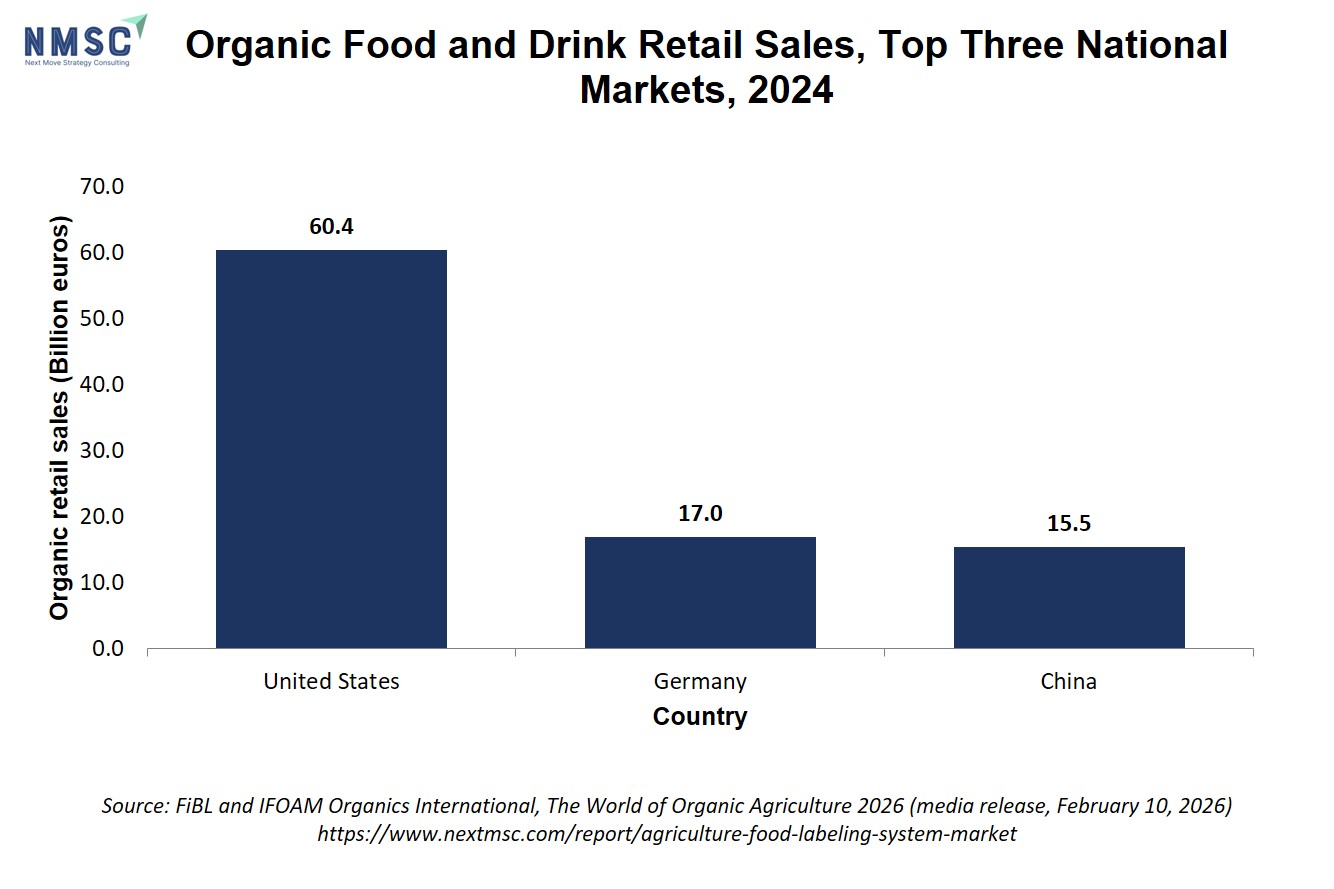
FiBL and IFOAM Organics International reported that global organic food and drink retail sales reached 145.0 billion euros in 2024, an increase of 6.9 billion euros. The United States recorded 60.4 billion euros, Germany 17.0 billion euros and China 15.5 billion euros, the three largest national markets. The chart is limited to these three countries, the only national values published in the source material used for this chart.
Organic production is geographically distinct from consumption, so certified product often crosses borders before it reaches a shelf. FiBL and IFOAM Organics International reported that Australia held the largest organic agricultural area at 53.0 million hectares in 2024, and that Liechtenstein had the highest organic share of farmland at 43.5%.
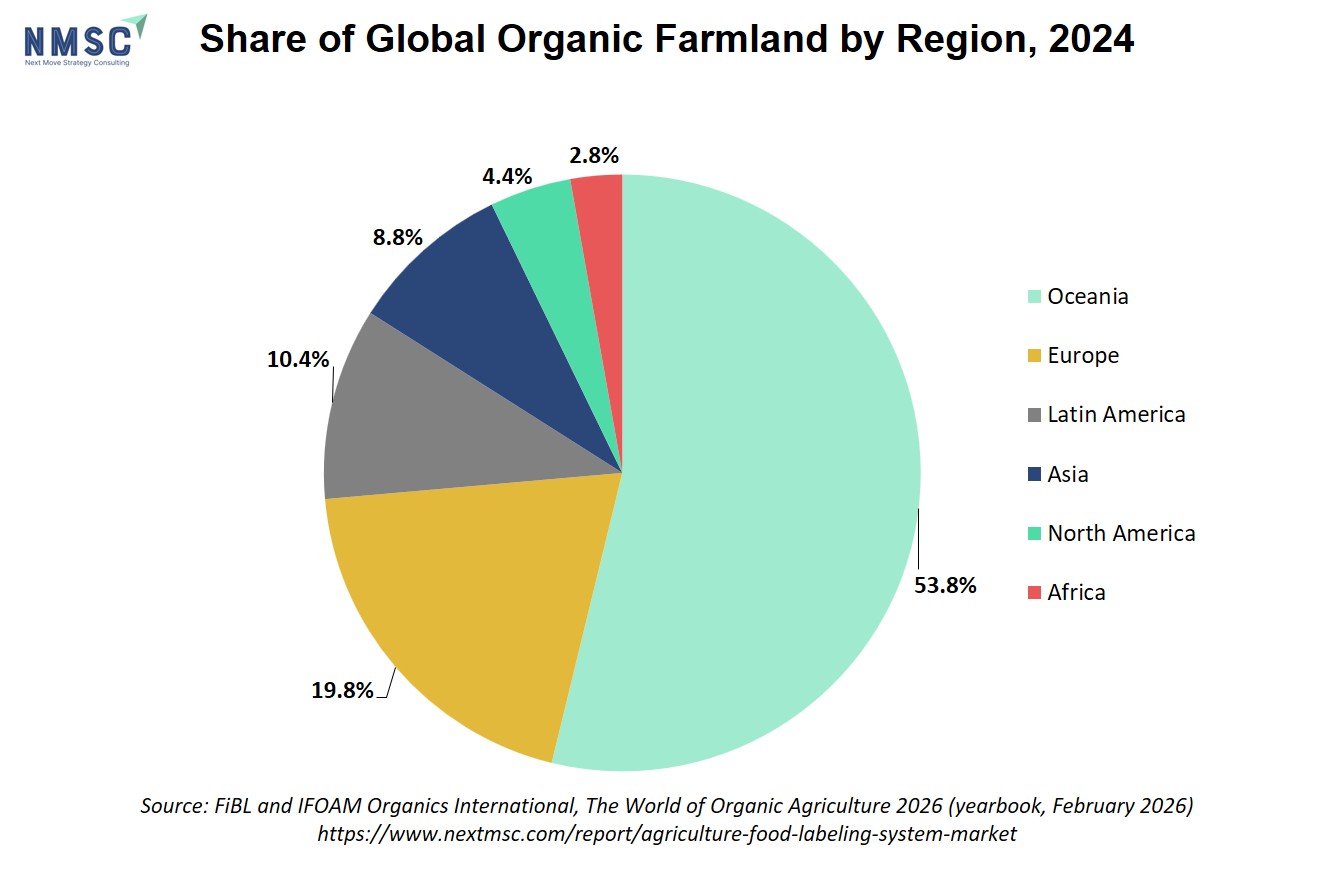
FiBL and IFOAM Organics International reported 98.9 million hectares of organic farmland worldwide in 2024, equal to 2.1% of total farmland. Oceania held 53.2 million hectares, Europe 19.6 million (19.8%), Latin America 10.3 million (10.4%), Asia 8.7 million (8.8%), North America 4.3 million (4.4%) and Africa 2.8 million (2.8%). The source states Oceania's share only as more than half of the world's organic agricultural land; the 53.8% shown is the remainder after the five published percentages and matches 53.2 million of 98.9 million hectares.
Future Outlook & Forecast for the Agriculture Food Labeling System Market
NextMSC's forecast, set out in its Agriculture Food Labeling System Market report, places the market at USD 116.7 million by 2030, a CAGR of 4.5% over the 2022-2030 forecast period. The regulatory calendar gives investors dated checkpoints against which to test that path: FSSAI's finalisation about four months after consultation, the December 30, 2026 and June 30, 2027 application dates of the deforestation regulation, the 2027 target in GS1's Sunrise programme, and the U.S. decisions on the content of the front-of-package rule.
The strategic implications differ by role. Label and printing suppliers face a design question in each jurisdiction, because the red hexagon, the Nutrition Info box and Nutri-Score call for different artwork and data fields. Retailers face a data question, because 2D barcodes allow one scan to deliver several data points. Exporters of agricultural commodities face a documentation question, because due diligence statements and origin records travel with the product.
NextMSC cautions that the forecast base year predates the 2026 developments, and that the absence of final rules in India and the United States limits how precisely their effect can be sized today. With Court of Justice preliminary rulings usually taking about 18 months to two years, a settled European front-of-pack position is not imminent.
Section Summary:
The forecast is modest in absolute terms but sits against a dense calendar of dated decisions, which will show whether the 4.5% CAGR is conservative or demanding.
-
NextMSC projects USD 116.7 million by 2030 at a 4.5% CAGR.
-
India, the United States and the European Union each have a pending decision that sets label design and timing.
-
Data-bearing 2D codes tie labeling to retailer systems and customs documentation.
Next Steps for Stakeholders
Executives and investors can convert the regulatory calendar into concrete actions.
-
Manufacturers of packaged and organic foods: map every stock keeping unit against the FSSAI two-nutrient test and prepare label artwork that can change by product line without new tooling.
-
Exporters of cocoa, coffee, palm oil, soy, rubber, cattle and wood products: confirm which entity acts as the first operator placing products on the EU market before December 30, 2026.
-
Retailers and distributors: test point-of-sale readiness for 2D barcodes under GS1 Digital Link.
-
Label, ink and printing suppliers: build separate regulatory packs for India, the United States and the European Union.
-
Investors: track FSSAI's finalisation, the FDA's final rule, the December 30, 2026 EUDR date and the Court of Justice timetable.
Conclusion
The agriculture food labeling system market is small in NextMSC's model, at USD 77.6 million in 2021 and USD 116.7 million by 2030, but the events of 2026 show that its demand is set by law and litigation rather than by packaging fashion. India's Supreme Court pressed the regulator within weeks, the United States is still deciding the content of a final rule, and the European Union is balancing traceability data against a court challenge to Nutri-Score. For executives and investors, the practical guidance is to follow the dated checkpoints, build label data flexibility into packaging lines, and treat label integrity as part of fraud and traceability control.
About the Author
 Priyanshu Das
— Priyanshu Das is SEO Executive at Next Move Strategy Consulting, where he has led on-page and off-page SEO, keyword research, and SEO audits for the firm's B2B market research publications for 2 years. His audit process combines technical crawl analysis, backlink profile review, and competitor keyword gap mapping — using tools including Screaming Frog and Google Search Console — to prioritize fixes by organic search-visibility impact, informed by his own prior in-house and agency SEO experience.
About the Reviewer
 Sanyukta Deb
— Sanyukta Deb is Digital Marketing Team Lead at Next Move Strategy Consulting, where she has led content strategy and technical SEO for the firm's B2B market research publications for over 2 years. Her editorial process translates NextMSC's primary and secondary research — spanning technology, industrial, and consumer sectors — into commercial narratives, backed by search-intent, keyword, and competitive analysis. She brings 5 years of overall experience in digital marketing and content strategy.














Add Comment