Frozen Potato Market: Simplot Deal and Asia-Pacific QSR Growth | NextMSC

Introduction
The global frozen potato market is undergoing one of its most consequential structural shifts in decades — simultaneously navigating a historic European oversupply crisis, a landmark cross-continental acquisition, and accelerating demand from Asia-Pacific's fast-growing quick-service restaurant (QSR) sector. These forces are not moving in isolation; they are collectively redefining where frozen potato volume is produced, who controls processing capacity, and which geographies will anchor the next phase of growth.
According to Next Move Strategy Consulting's Frozen Potato Market report, the global frozen potato market is projected to reach USD 90.52 billion by 2030, expanding at a CAGR of 4.6% from 2022 to 2030. This trajectory reflects sustained structural demand from foodservice operators, rising household penetration of convenience food formats, and the deepening integration of frozen potato products into global supply chains — from Belgian processing plants to QSR kitchens in Jakarta and Mumbai.
For More Information: Download FREE Sample on Frozen Potato Market Report
Consolidation, Oversupply, and the Race for Scale: What Is Reshaping the Frozen Potato Industry
Simplot's €2.5 Billion Clarebout Acquisition Redraws the European Map
The single most consequential competitive event in the frozen potato industry in recent memory closed on October 31, 2025: J.R. Simplot Company, the U.S.-based agribusiness giant, completed its acquisition of Clarebout Potatoes, Belgium's largest family-owned frozen potato processor, in a deal valued at approximately €2.5 billion (roughly USD 2.9 billion).
The strategic logic is precise: Clarebout operates multiple processing facilities in West Flanders, one of Europe's highest-density potato-growing regions, giving Simplot immediate access to established European customer relationships, processing infrastructure, and a raw material base that — as of 2026 — is structurally oversupplied. By acquiring Clarebout at a moment when European potato prices have fallen sharply, Simplot effectively locked in a low-cost input environment while simultaneously eliminating a major European competitor from the independent processor category.
This acquisition positions Simplot as a genuinely global frozen potato processor — with scale in North America, Australia, and now continental Europe — directly challenging McCain Foods and Lamb Weston for leadership in the European foodservice channel.
Northwest Europe's Structural Oversupply: A Market-Altering Pressure Point
The backdrop to Simplot's acquisition is a European potato market in acute structural imbalance. By 2026, potato availability in Northwest Europe is estimated to be approximately 5 million tonnes above regional demand, driven by a sustained expansion of planted acreage across Belgium, the Netherlands, Germany, and France. In 2025 alone, potato prices in the EU fell by 22% compared to the prior year, with some spot prices turning negative in certain regional markets.
This oversupply is not a temporary weather-driven anomaly — it reflects a deliberate acreage expansion by European growers responding to the high-price environment of 2022–2023, which has now overcorrected. The consequence for processors is a short-term input cost advantage, but for growers it represents a severe margin compression that is already triggering contract renegotiations and farm-level financial distress across the region.
Meanwhile, North American processors — led by Lamb Weston and Simplot — have maintained tighter contract discipline, avoiding the acreage overexpansion that has destabilized European supply chains. Lamb Weston's fiscal year 2025 results, reported in July 2025, reflected improving customer volume trends in North America, with the company reaffirming its fiscal year 2026 outlook despite ongoing pricing headwinds in international markets.
McCain Foods' Regenerative Agriculture Pivot: Redefining the Supply Chain Standard
McCain Foods — which produces approximately 1 in every 4 frozen fries consumed globally — has advanced its regenerative agriculture program to the point where 69% of its contracted potato acreage globally was operating under its regenerative framework as of 2025. In February 2025, the company launched its "Regen Fries" product line in the United States, directly linking its sustainability investment to a consumer-facing premium product category.
This is not a peripheral sustainability initiative. By committing to 100% regenerative acreage by 2030 and launching a branded product line that commands a premium price point, McCain is structurally differentiating its supply chain in a way that smaller processors cannot easily replicate — raising the barrier to entry for any competitor seeking to serve sustainability-conscious QSR and retail buyers at scale.
Asia-Pacific: The Demand Engine That Is Rebalancing Global Trade Flows
While Europe grapples with oversupply, Asia-Pacific is consolidating its position as the fastest-growing demand region for frozen potato products. The rapid expansion of QSR networks — McDonald's, KFC, Domino's, and regional chains — across China, India, Indonesia, and Vietnam is generating sustained volume growth that European and North American processors are actively competing to serve. Lamb Weston's decision to showcase its Snap Fries, Frenzy Fries, and Original Mash Cup innovations at WOFEX 2026 in Manila underscores how seriously the major processors are treating Asia-Pacific as a strategic growth frontier.
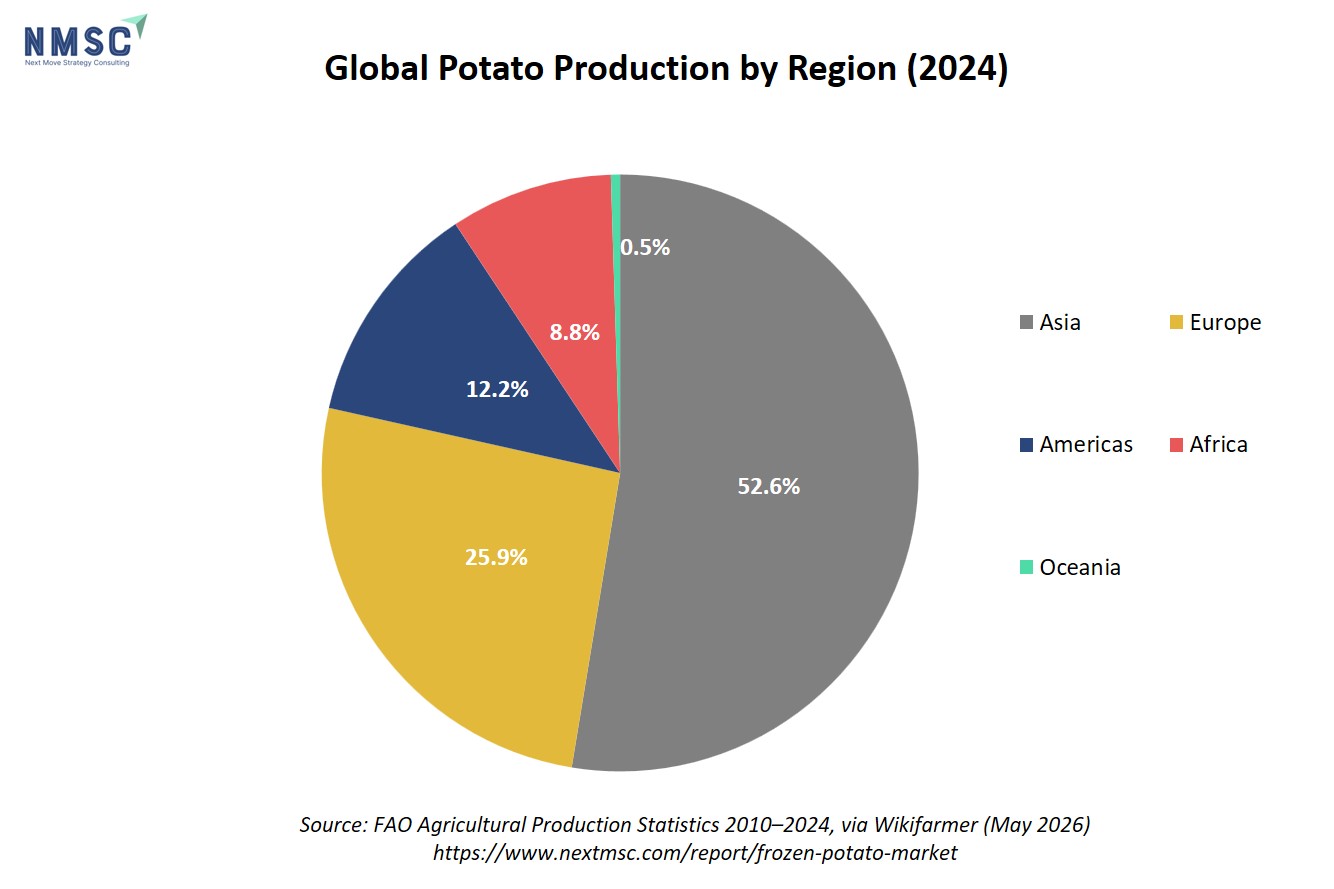
Global potato production reached 390,428,972 tonnes in 2024, a 0.95% increase over 2023, according to FAOSTAT data — providing the raw material base to support this demand expansion.
NMSC Strategic Perspective: Consolidation as the Defining Market Dynamic
NextMSC primary research and analysis identifies consolidation — not demand softness — as the defining structural dynamic in the frozen potato market through 2030. The Simplot-Clarebout transaction is the clearest expression of a broader trend: scale is becoming the primary competitive moat in frozen potato processing, because only processors with multi-continental sourcing, processing, and distribution infrastructure can absorb the input cost volatility that characterizes the current European supply environment while simultaneously serving the volume requirements of global QSR chains.
The market's 4.6% CAGR through 2030, as projected in NMSC's proprietary analysis, is underpinned by three converging forces: the structural growth of QSR networks in Asia-Pacific, the continued premiumization of frozen potato products in North American and European retail, and the operational leverage that large-scale processors are extracting from a low-cost European raw material environment. Smaller, regionally focused processors that cannot access these dynamics face meaningful margin pressure over the forecast period.
Section Summary:
-
J.R. Simplot's USD 2.9 billion acquisition of Clarebout Potatoes (completed October 2025) is the largest cross-continental consolidation event in the frozen potato industry in recent years, giving Simplot immediate European processing scale.
-
Northwest Europe's structural oversupply — estimated at 5 million tonnes above demand by 2026 — has driven a 22% price decline in EU potato markets, compressing grower margins while temporarily benefiting processors.
-
McCain Foods has enrolled 69% of its global potato acreage in its regenerative agriculture framework, using sustainability as a supply chain differentiator and launching a premium "Regen Fries" product line.
-
Asia-Pacific's QSR expansion is the primary demand growth engine, with major processors actively investing in product innovation and market presence across the region.
Industry Impact Analysis
Trade Policy Friction and the Tariff Variable
The frozen potato trade is not insulated from the broader geopolitical trade environment. U.S. potato exports totaled approximately 3.1 million metric tonnes, on a fresh-weight-equivalent basis, from July 2024 through June 2025, a figure that reflects both the volume of international trade and its sensitivity to tariff and non-tariff barriers. Any escalation in trade barriers between major producing and consuming regions — particularly between the EU and key Asian import markets — would directly affect the ability of European processors to export their way out of the current oversupply situation.
Colombia’s anti-dumping measures on frozen fries from Belgium, Germany and the Netherlands were revoked in March 2026, restoring market access for EU exporters planning export-led volume growth strategies.
Food Safety Regulation: FDA's FSMA Traceability Rule Extension
On the regulatory front, the U.S. Food and Drug Administration proposed extending the compliance date for its Food Safety Modernization Act (FSMA) Final Rule on Additional Traceability Records by 30 months, to July 20, 2028. For frozen potato processors and distributors operating in the U.S. market, this extension provides additional time to implement end-to-end traceability systems — but it does not eliminate the compliance obligation. Processors that invest in traceability infrastructure ahead of the deadline will be better positioned to serve large retail and foodservice buyers who are increasingly mandating supply chain transparency as a procurement condition.
Climate Risk and Crop Yield Volatility
Lamb Weston explicitly flagged price risks arising from heat-impacted potato crops in Europe during its fiscal 2026 communications, noting that European crop tightening would likely result in a "slightly less-than-normal average crop" and upward pressure on input costs. This is a structurally important signal: even in a period of aggregate oversupply, localized heat events can rapidly tighten specific regional supply chains, creating price spikes that processors with diversified sourcing geographies are better equipped to absorb than those dependent on a single growing region.
Section Summary:
Global potato export volumes of 3.1 million tonnes (July 2024–June 2025) reflect the scale of international trade and its vulnerability to tariff escalation, particularly for European processors seeking to export surplus volume to Asia.
-
The FDA's FSMA traceability compliance deadline extension to July 2028 gives U.S.-market processors additional runway but does not remove the obligation — early movers on traceability infrastructure will gain a procurement advantage with major retail and QSR buyers.
-
Climate-driven crop yield volatility — even within a structurally oversupplied European market — creates localized price spikes that reward processors with geographically diversified raw material sourcing.
Pros and Cons of Recent Market Developments
|
Development |
Pros |
Cons |
|
Simplot–Clarebout Acquisition (Oct 2025) |
Simplot gains immediate European processing scale and customer relationships; consolidation reduces fragmentation and improves pricing discipline |
Reduces competitive choice for European QSR and retail buyers; integration risk and labor relations challenges (staff strike during transition) |
|
Northwest Europe Structural Oversupply |
Processors benefit from lower raw material input costs; export-competitive pricing for Asian markets |
Severe margin compression for European potato growers; risk of farm-level financial distress and long-term acreage reduction |
|
McCain's Regenerative Agriculture Program |
Differentiates supply chain for sustainability-conscious buyers; "Regen Fries" opens a premium retail price tier |
High upfront investment in farm transition; 31% of acreage not yet enrolled, creating supply chain inconsistency |
|
FDA FSMA Traceability Extension to 2028 |
Additional compliance runway for processors to build traceability infrastructure without disrupting operations |
Delays full supply chain transparency; processors that defer investment risk being deprioritized by major buyers ahead of the deadline |
|
Asia-Pacific QSR Expansion |
Largest addressable demand growth pool globally; drives volume for both European and North American exporters |
Requires significant logistics and cold chain investment; local regulatory and import tariff variability across markets |
|
Lamb Weston's North American Volume Recovery |
Improving customer volume trends signal demand stabilization in the world's largest single frozen potato market |
International segment remains under pricing pressure; European heat-driven crop tightening may increase input costs |
Key Data & Statistics
Key Competitive Events in the Frozen Potato Market (2025–2026)
|
Company |
Event |
Strategic Significance |
|
J.R. Simplot Company |
Completed acquisition of Clarebout Potatoes (Belgium) for ~€2.5B (~USD 2.9B) |
Establishes Simplot as a tri-continental frozen potato processor; eliminates a major independent European competitor |
|
McCain Foods |
Enrolled 69% of global potato acreage in regenerative agriculture framework; launched "Regen Fries" in the U.S. |
Creates a sustainability-linked supply chain differentiator and opens a premium retail product tier |
|
Lamb Weston |
Reported fiscal year 2025 results; reaffirmed fiscal year 2026 outlook; showcased innovations at WOFEX 2026 (Manila) |
Signals North American volume stabilization and active Asia-Pacific market development |
|
European Potato Growers (NW Europe) |
Structural oversupply of ~5 million tonnes above demand; potato prices fell 22% in 2025 |
Compresses grower margins; creates low-cost input environment for processors with European sourcing |
|
U.S. FDA |
Extended FSMA traceability compliance deadline by 30 months to July 20, 2028 |
Provides additional runway for U.S.-market processors to build end-to-end traceability systems |
Future Outlook & Forecast
NMSC Proprietary Forecast: USD 90.52 Billion by 2030
NextMSC primary research and analysis projects the global frozen potato market to reach USD 90.52 billion by 2030, growing at a CAGR of 4.6% from the 2021 base of USD 61.82 billion. This growth trajectory is supported by three structural demand pillars that are each independently verifiable and market-specific.
Pillar 1 — QSR Network Densification in Asia-Pacific: The continued rollout of McDonald's, KFC, Domino's, and regional QSR chains across Tier 2 and Tier 3 cities in China, India, Indonesia, and Vietnam is generating incremental frozen fry volume that cannot be served by local fresh potato supply chains. Each new QSR outlet in these markets represents a recurring, standardized demand unit for frozen potato products — a demand structure that is fundamentally different from the discretionary retail purchase patterns that characterize mature Western markets.
Pillar 2 — Premiumization in Retail: The launch of McCain's "Regen Fries" and Lamb Weston's Snap Fries and Frenzy Fries innovations at WOFEX 2026 illustrate a deliberate industry strategy to move frozen potato products up the value chain. Premium, sustainability-linked, and format-differentiated products command higher retail price points and generate better margin per unit than commodity frozen fries — expanding the total addressable market in value terms even in geographies where volume growth is moderate.
Pillar 3 — Online Channel Penetration: The NMSC report identifies online channels as a structurally growing distribution segment, driven by the expansion of food delivery platforms — Swiggy, Uber Eats, Zomato, and their regional equivalents — that deliver frozen potato-based dishes directly to consumers. This channel bypasses traditional retail shelf constraints and opens frozen potato products to a consumer segment that previously accessed them only through foodservice.
Supply Chain Reconfiguration as a Medium-Term Variable
The Simplot-Clarebout integration will take 18–24 months to fully operationalize, during which time European processing capacity allocation, customer contract structures, and raw material sourcing agreements will be renegotiated. This transition period creates both risk (integration disruption) and opportunity (rationalization of excess capacity) for the broader market. Processors that can offer supply continuity during this period — particularly to European QSR chains that were previously Clarebout customers — will gain durable customer relationships.
The North American frozen processing supply situation, which has faced oversupply conditions for two consecutive years, is expected to gradually normalize as processors exercise contract discipline and acreage adjustments take effect.
Section Summary:
-
NMSC's proprietary forecast projects the global frozen potato market to reach USD 90.52 billion by 2030 at a 4.6% CAGR, underpinned by QSR expansion in Asia-Pacific, retail premiumization, and online channel growth.
-
The Simplot-Clarebout integration will reshape European processing capacity allocation over the next 18–24 months, creating both supply continuity risk and rationalization opportunity.
-
North American supply normalization, driven by processor contract discipline, is expected to gradually reduce the oversupply conditions that have characterized the market for the past two years.
-
Climate-driven crop yield volatility remains a persistent medium-term risk that rewards processors with geographically diversified raw material sourcing strategies.
Next Steps for Stakeholders
For C-Level Executives at Frozen Potato Processors:
-
Evaluate European sourcing exposure in light of the structural oversupply and the Simplot-Clarebout consolidation. Processors that previously competed with Clarebout for European QSR contracts should reassess their customer retention strategies and pricing positions before Simplot completes its integration.
-
Accelerate investment in traceability infrastructure ahead of the FDA's FSMA compliance deadline of July 2028. Early compliance positions processors as preferred suppliers to major U.S. retail and QSR buyers who are increasingly mandating supply chain transparency.
-
Develop a dedicated Asia-Pacific commercial strategy. The region's QSR-driven demand growth is the most durable volume growth opportunity in the global frozen potato market through 2030, and it requires localized product formats, cold chain investment, and regulatory navigation that cannot be managed from a North American or European headquarters alone.
For Institutional Investors and Private Equity:
-
The Simplot-Clarebout transaction has reset the valuation benchmark for European frozen potato processing assets. Remaining independent European processors — particularly those with established QSR customer relationships and modern IQF processing infrastructure — represent potential consolidation targets at a moment when strategic buyers have demonstrated willingness to pay premium multiples for scale.
-
Monitor Lamb Weston's fiscal year 2026 results closely. The company's ability to sustain North American volume recovery while managing European input cost volatility will be a leading indicator of whether the broader market's 4.6% CAGR trajectory is tracking to NMSC's forecast.
-
Assess the regenerative agriculture premium as an emerging value driver. McCain's "Regen Fries" launch demonstrates that sustainability-linked supply chain investment can be monetized at the retail level — a dynamic that will increasingly differentiate the equity stories of processors that have made this investment from those that have not.
For QSR Operators and Foodservice Buyers:
-
Diversify frozen potato supplier relationships in Europe. The Simplot-Clarebout consolidation reduces the number of large independent European processors, increasing buyer concentration risk. Establishing or deepening relationships with Aviko, Farm Frites, Agristo, and other independent processors provides supply chain resilience.
-
Engage with suppliers on traceability readiness. The FDA's FSMA traceability rule — even with its extended compliance date — will eventually require end-to-end supply chain documentation. Buyers that begin requiring traceability data from suppliers now will be better positioned to meet their own regulatory obligations when the rule takes effect.
Conclusion
The global frozen potato market is not simply growing — it is being structurally reorganized. The Simplot-Clarebout acquisition has created a new tri-continental processing giant, Northwest Europe's 5-million-tonne oversupply is forcing a painful but necessary market correction, and Asia-Pacific's QSR expansion is generating the demand volume that will absorb the industry's growing production capacity over the next decade.
Against this backdrop, NextMSC primary research and analysis projects the market to reach USD 90.52 billion by 2030 at a 4.6% CAGR — a trajectory that reflects not just aggregate demand growth, but the compounding effect of premiumization, online channel penetration, and the operational leverage that scale-advantaged processors are extracting from a structurally favorable input cost environment. For executives, investors, and foodservice operators, the strategic imperative is clear: scale, supply chain diversification, and sustainability-linked differentiation are no longer optional competitive attributes in the frozen potato market — they are the conditions of durable participation.
About the Author
 Sanyukta Deb
— Sanyukta Deb is Digital Marketing Team Lead at Next Move Strategy Consulting, where she has led content strategy and technical SEO for the firm's B2B market research publications for over 2 years. Her editorial process translates NextMSC's primary and secondary research — spanning technology, industrial, and consumer sectors — into commercial narratives, backed by search-intent, keyword, and competitive analysis. She brings 5 years of overall experience in digital marketing and content strategy.
Sanyukta Deb
— Sanyukta Deb is Digital Marketing Team Lead at Next Move Strategy Consulting, where she has led content strategy and technical SEO for the firm's B2B market research publications for over 2 years. Her editorial process translates NextMSC's primary and secondary research — spanning technology, industrial, and consumer sectors — into commercial narratives, backed by search-intent, keyword, and competitive analysis. She brings 5 years of overall experience in digital marketing and content strategy.
About the Reviewer
 Debashree Dey
— Debashree Dey is Assistant Manager at Next Move Strategy Consulting, where she supports cross-vertical market content and communications across diverse industries for 6 years. Her professional background includes senior content writing, communications, and published manuscript authorship, with experience developing audience-focused business narratives and maintaining clear, consistent messaging. Her role supports research-led content development and editorial quality across NextMSC publications.
Debashree Dey
— Debashree Dey is Assistant Manager at Next Move Strategy Consulting, where she supports cross-vertical market content and communications across diverse industries for 6 years. Her professional background includes senior content writing, communications, and published manuscript authorship, with experience developing audience-focused business narratives and maintaining clear, consistent messaging. Her role supports research-led content development and editorial quality across NextMSC publications.


















Add Comment