Alexa+ and Gemini for Home: The Battle Reshaping the Voice Assistant Market

Introduction
The global voice assistant market has entered a defining phase in 2026, as the world's largest technology companies race to convert conversational interfaces from novelty features into enterprise-grade productivity engines. What began a decade ago as a consumer convenience for setting timers and playing music has evolved into a foundational layer of enterprise AI investment, customer engagement strategy, and smart device architecture.
Two developments in the last several weeks alone illustrate how quickly this landscape is shifting. Amazon completed the full rollout of Alexa+ across Canada and expanded the assistant into Brazil, extending its generative AI-powered assistant beyond U.S. borders for the first time at scale. Simultaneously, Google shipped its first-ever hardware built natively for its Gemini for Home voice assistant, signaling that the era of static, rules-based voice assistants is over. For B2B decision-makers, investors, and technology leaders, understanding these shifts is essential to correctly positioning enterprise voice AI strategy, customer service automation, and smart device investment for the remainder of the decade.
In February 2025, Amazon introduced Alexa+, a generative AI-powered reimagining of its assistant built on large language models running through Amazon Bedrock, with the ability to orchestrate tasks across tens of thousands of third-party services and devices. At the time of that announcement, more than 600 million Alexa-enabled devices were already in circulation worldwide, giving Amazon an unmatched installed base to convert to its new agentic assistant. By mid-2025, Alexa+ had surpassed one million active users as Amazon steadily widened access beyond its early-access cohort. Throughout the first half of 2026, Amazon extended Alexa+ availability to all Prime members in the U.S. at no additional cost, then completed international rollouts to Canada and Brazil, marking the assistant's first major global expansion beyond domestic markets.
Google has responded with its own hardware-software convergence strategy. After a multi-year deprecation of the legacy Google Assistant, the company rolled out Gemini for Home as its next-generation voice assistant, and in mid-2026 launched the Google Home Speaker, the first audio device purpose-built for Gemini, priced at $99.99. Google has confirmed that the Gemini for Home rollout remains concentrated in the U.S. for now, with international expansion planned to begin in subsequent phases.
NMSC Strategic Perspective
From NMSC's vantage point, the Alexa+ and Gemini for Home rollouts represent the clearest evidence yet that the voice assistant market is bifurcating into two distinct competitive layers: the hardware-and-installed-base incumbents (Amazon, Google, Samsung, Apple) and the underlying generative AI model providers increasingly embedded within them (Anthropic, OpenAI, and proprietary large language models). This convergence of hardware distribution and generative AI capability is precisely why hardware continues to command the largest offering share within the global voice assistant market, while smart speakers are emerging as the single fastest-growing device category. Enterprises evaluating voice-enabled AI solutions should treat this bifurcation as a signal to prioritize platform interoperability and API-level flexibility over single-vendor lock-in, since the underlying model layer is likely to change faster than the hardware refresh cycle.
For More Information – Download FREE Sample on Voice Assistant Market Report
Section Summary: Amazon's international Alexa+ expansion and Google's Gemini-powered hardware launch mark a turning point where voice assistants are shifting from single-device tools to cross-platform, agentic AI systems capable of completing multi-step tasks autonomously.
-
Alexa+ has scaled from early access to full Prime-member availability across the U.S., Canada, and Brazil within roughly 18 months of its generative AI relaunch.
-
Google's shift from Google Assistant to Gemini for Home, backed by dedicated hardware, confirms that generative AI is now a prerequisite for competitive smart speaker technology.
-
Enterprises should evaluate voice AI vendors on interoperability rather than committing to a single hardware ecosystem, given the pace of underlying model change.
Industry Impact Analysis
The rapid consumerization of generative voice assistants is accelerating a parallel transformation inside the enterprise. According to Deloitte's 2026 "State of AI in the Enterprise" report, based on a survey of more than 3,000 director-to-C-suite leaders, workforce access to sanctioned AI tools — including conversational and voice-enabled AI systems — has grown from fewer than 40% to approximately 60% of employees in just one year. The same report found that close to three-quarters of companies plan to deploy agentic AI capabilities, which underpin many conversational AI platforms, within the next two years, although only 21% currently have a mature governance model in place for these systems.
PwC's AI Agent Survey reinforces this trajectory from an investment standpoint. Among senior U.S. executives surveyed, 88% said their business function plans to increase AI-related budgets due to agentic AI capabilities, and 79% reported that AI agents are already being adopted somewhere within their organization. Of those already using AI agents, 66% reported measurable productivity gains, while 57% cited cost savings and 54% cited faster decision-making as tangible benefits. Customer service remains the leading enterprise function for AI agent deployment, cited by 57% of adopting organizations, closely followed by sales and marketing at 54% and IT and cybersecurity at 53%. This pattern directly mirrors the enterprise application segments most relevant to voice-enabled customer service and conversational AI platforms.
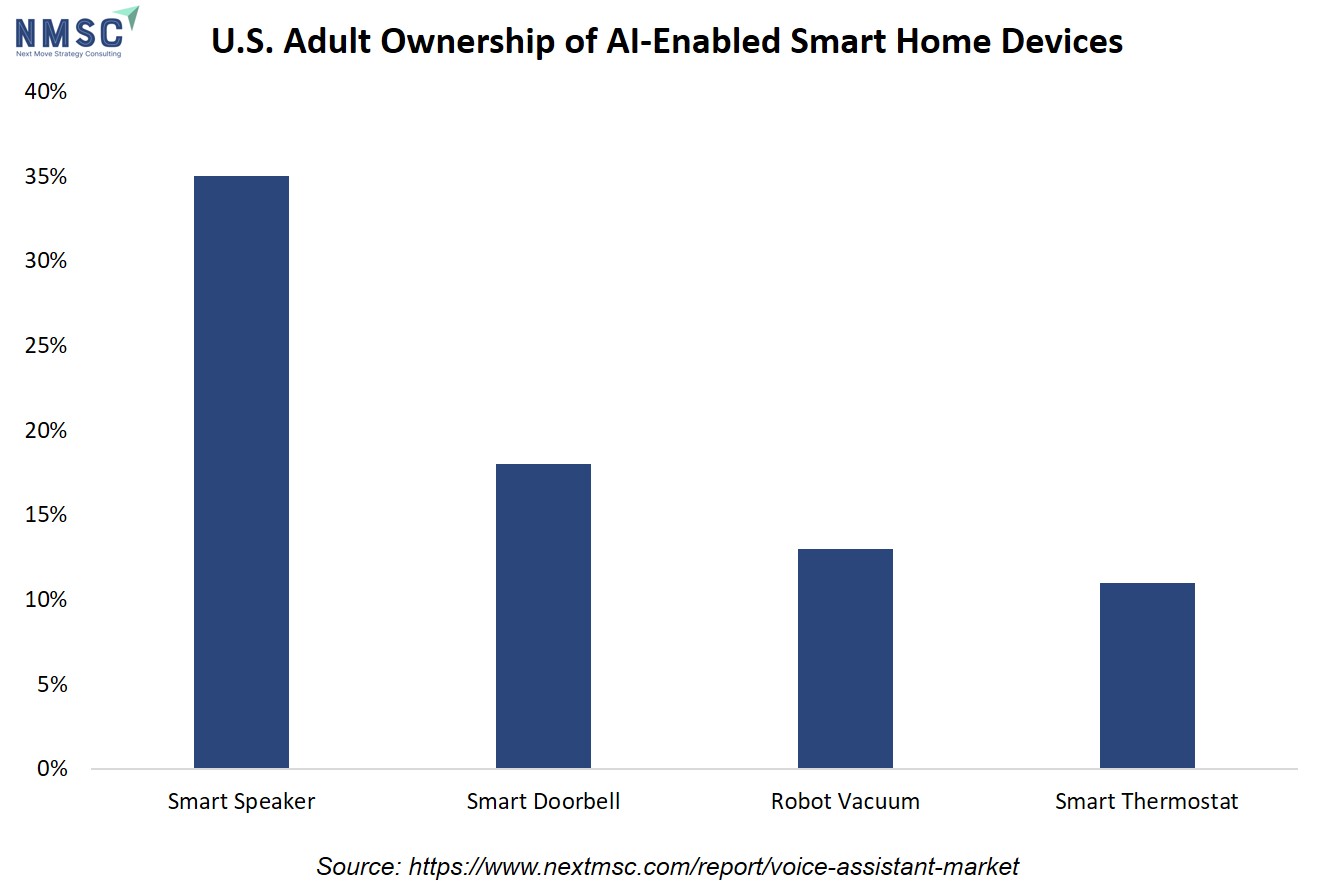
On the consumer side, adoption is following a similar upward curve. Pew Research Center's June 2026 survey of U.S. adults found that 35% now own a smart speaker, making it the most widely adopted AI-enabled smart home device, ahead of smart doorbells at 18%, robot vacuums at 13%, and smart thermostats at 11%.
Section Summary: Regulatory caution has not slowed enterprise appetite for voice-enabled and agentic AI systems; investment and workforce access are both scaling faster than governance maturity, creating both opportunity and risk for early movers.
-
Workforce access to sanctioned AI tools rose by roughly 20 percentage points in a single year, according to Deloitte.
-
Nearly nine in ten U.S. executives plan to increase AI budgets specifically because of agentic AI capabilities, per PwC.
-
Governance remains an unresolved gap, with only 21% of enterprises reporting a mature AI agent governance model.
-
Smart speakers remain the most widely owned consumer AI device category in the U.S., reinforcing hardware's central role in the ecosystem.
Enterprise AI Adoption and Investment Indicators (2026)
|
Enterprise AI Adoption Metric |
Reported Value (2026) |
|
Workforce with sanctioned AI tool access |
~60% (up from under 40% in 2025) |
|
Companies planning agentic AI deployment within 2 years |
~74% |
|
Companies with a mature AI agent governance model |
21% |
|
Companies already using physical AI in operations |
58% |
|
Executives planning to increase AI-related budgets |
88% |
|
Organizations reporting AI agents already adopted |
79% |
Future Outlook & Forecast
According to NMSC projections, the global voice assistant market is set to expand to USD 33.74 billion by 2030, reflecting a compound annual growth rate of 26.5% across the 2025–2030 forecast period. Hardware is expected to retain the largest share of offering-based revenue given the continued need for advanced microphones, processors, and edge computing components, while smart speakers are forecast to post the fastest device-level growth at a CAGR of 28.7%, driven by deepening smart home integration and continued generative AI upgrades. North America is expected to remain the dominant regional market, supported by high smart device penetration and sustained government investment in artificial intelligence infrastructure, while Asia-Pacific is projected to post the fastest regional growth as smartphone penetration and localized voice assistant products, such as Samsung's next-generation Bixby, continue to expand.
Strategically, the convergence of enterprise agentic AI investment with consumer voice assistant upgrades suggests that the next growth wave will be driven less by novelty consumer features and more by measurable enterprise ROI in customer service, IT operations, and productivity tooling. Organizations that pair voice AI deployment with clear governance frameworks are best positioned to convert current momentum into durable competitive advantage.
Section Summary: The voice assistant market's growth trajectory through 2030 is underpinned by hardware innovation, smart speaker proliferation, and expanding enterprise use cases, though execution discipline around governance will determine which organizations capture the full value of this expansion.
-
NMSC projects the global voice assistant market will nearly quintuple in value between 2024 and 2030, reaching USD 33.74 billion.
-
Smart speakers are the fastest-growing device segment, with a projected CAGR of 28.7%.
-
North America leads in market share; Asia-Pacific leads in growth rate.
-
Enterprise-grade agentic capabilities, rather than consumer novelty, are expected to drive the next phase of market expansion.
Next Steps for Stakeholders
C-level executives and institutional investors evaluating exposure to the voice assistant market should prioritize three actions. First, assess vendor and platform interoperability before committing to a single hardware or model ecosystem, given the rapid pace at which underlying generative AI capabilities are being upgraded across Alexa+, Gemini for Home, and competing platforms. Second, invest in AI agent governance frameworks in parallel with deployment, since the gap between adoption (79% per PwC) and governance maturity (21% per Deloitte) represents the single largest operational risk facing enterprise voice and conversational AI rollouts. Third, prioritize voice-enabled customer service and IT automation use cases first, as these functions currently show the strongest adoption rates and clearest measurable ROI, before expanding into higher-stakes autonomous functions such as financial transactions.
Conclusion
The voice assistant market has moved decisively beyond its consumer-novelty origins into a core pillar of enterprise AI strategy. Amazon's international Alexa+ expansion and Google's Gemini-powered hardware launch confirm that generative AI is now table stakes for competitive positioning in this space, while Deloitte and PwC data confirm that enterprises are matching this momentum with sustained budget increases and workforce access expansion. With NMSC forecasting the global voice assistant market to reach USD 33.74 billion by 2030 at a CAGR of 26.5%, the opportunity is substantial, but organizations that pair adoption with disciplined governance will be the ones that convert this growth into lasting value.
About the Author
 Sanyukta Deb
— Sanyukta Deb is Digital Marketing Team Lead at Next Move Strategy Consulting, where she has led content strategy and technical SEO for the firm's B2B market research publications for over 2 years. Her editorial process translates NextMSC's primary and secondary research — spanning technology, industrial, and consumer sectors — into commercial narratives, backed by search-intent, keyword, and competitive analysis. She brings 5 years of overall experience in digital marketing and content strategy.
Sanyukta Deb
— Sanyukta Deb is Digital Marketing Team Lead at Next Move Strategy Consulting, where she has led content strategy and technical SEO for the firm's B2B market research publications for over 2 years. Her editorial process translates NextMSC's primary and secondary research — spanning technology, industrial, and consumer sectors — into commercial narratives, backed by search-intent, keyword, and competitive analysis. She brings 5 years of overall experience in digital marketing and content strategy.
About the Reviewer
 Debashree Dey
— Debashree Dey is Assistant Manager at Next Move Strategy Consulting, where she supports cross-vertical market content and communications across diverse industries for 6 years. Her professional background includes senior content writing, communications, and published manuscript authorship, with experience developing audience-focused business narratives and maintaining clear, consistent messaging. Her role supports research-led content development and editorial quality across NextMSC publications.
Debashree Dey
— Debashree Dey is Assistant Manager at Next Move Strategy Consulting, where she supports cross-vertical market content and communications across diverse industries for 6 years. Her professional background includes senior content writing, communications, and published manuscript authorship, with experience developing audience-focused business narratives and maintaining clear, consistent messaging. Her role supports research-led content development and editorial quality across NextMSC publications.


















Add Comment