Top Energy Technology Consulting Firms for AI and Automation

Factories are shifting from automation to autonomy, and the numbers show it. According to the Industrial Automation Market report from Next Move Strategy Consulting, the global market was valued at USD 191.28 billion in 2023 and is projected to reach USD 363.31 billion by 2030, growing at a CAGR of 9.60% from 2024 to 2030.
That growth is playing out through a wave of corporate restructuring as much as through new factory deployments. In 2026 alone, Honeywell completed a three-way corporate split, ABB agreed to sell its entire robotics division, and Schneider Electric moved to acquire an industrial AI software company for $3.1 billion all signs that the market's largest suppliers are repositioning around AI-enabled autonomy rather than traditional automation hardware.
What's Driving the Industrial Automation Market?
The Industrial Automation Market's growth is being pulled by a few concentrated forces. Automotive and electronics manufacturing remain the largest demand centers, particularly across Asia-Pacific, where China's vehicle production is on pace to reach 35 million units by 2025, according to the U.S. International Trade Administration, and where China alone accounts for 46% of the Asia-Pacific semiconductor market, per the Semiconductor Industry Association. Layered on top is the buildout of AI infrastructure: data centers need automated, energy-efficient production capacity, and several of the market's largest suppliers are now investing directly in that infrastructure rather than only selling into it.
North America's growth looks different driven less by manufacturing volume and more by labor shortages and reshoring, with water and wastewater treatment automation a notable growth pocket as utilities modernize aging systems. Across regions, the throughline is the same: manufacturers are shifting from automation executing pre-programmed tasks toward autonomy, where AI-enabled systems sense, decide, and act with less human input.
In short: the Industrial Automation Market's growth is following where manufacturing capacity and AI infrastructure investment are concentrating, not spreading evenly across regions.
-
Automotive and semiconductor manufacturing in Asia-Pacific remain the largest demand drivers
-
AI data center buildout is pulling major automation suppliers into direct infrastructure investment
-
North America's growth is driven more by labor shortages and reshoring than by manufacturing volume
-
The common thread across regions is a shift from pre-programmed automation to AI-enabled autonomy
Industry Leader Moves: Restructuring Around AI and Autonomy
No part of the Industrial Automation Market illustrates this shift more clearly than the strategic moves underway at its largest suppliers in 2026. Several are narrowing their portfolios; others are buying their way into industrial AI outright.
Honeywell
Honeywell completed the most extensive restructuring in the group, spinning off Honeywell Aerospace as an independent, Nasdaq-listed company (HONA) on June 29, 2026, and renaming the remaining business Honeywell Technologies a pure-play automation company organized around Building Automation, Process Automation and Technology, and Industrial Automation. On July 17, 2026, the company acquired Johnson Matthey's Catalyst Technologies business for £1.325 billion, and ten days later completed the sale of its Warehouse and Workflow Solutions business operating under the Intelligrated and Transnorm brands to American Industrial Partners. Together, the moves sharpen Honeywell's focus on what CEO Vimal Kapur has called the industrial sector's "transition from automation to autonomy."
Schneider Electric
Schneider Electric agreed on June 30, 2026 to acquire industrial AI software provider Cognite for $3.1 billion in an all-cash deal its largest move yet to pair energy-management hardware with industrial AI software. Once regulatory approvals clear, Cognite will be folded into AVEVA and reported within Schneider's Industrial Automation business. The company followed with a smaller acquisition of grid-AI specialist AiDASH on July 30, 2026. Both deals remain pending completion, subject to customary closing conditions.
Siemens
Siemens has committed more than $665 million in new manufacturing capacity so far in 2026 $165 million for U.S. factories announced in March, €300 million for a German switchgear and supplier facility in July, and over $200 million for two new U.S. plants in Georgia and Texas announced in August, expected to add 1,500 jobs. The investments target electrical infrastructure for AI-driven data centers, a category Siemens' Digital Industries automation arm has flagged as a growth driver alongside its expanding NVIDIA partnership on industrial AI and digital twins.
ABB
ABB posted record Q2 2026 results in July orders up 30% year-over-year to $12.0 billion and operational EBITA margin up 90 basis points to 20.2% and used the earnings call to highlight its acquisition of flow-control specialist Rotork, expected to become earnings-accretive within two years, alongside a planned $200 million medium-voltage manufacturing investment in Europe. The results come as ABB works through the largest change to its portfolio in years: an October 2025 agreement to divest its entire Robotics division to SoftBank Group for $5.375 billion, abandoning an earlier plan to spin the unit off separately. The transaction, still pending regulatory clearance in the EU, China, and the U.S., is expected to close in the second half of 2026.
Emerson
Emerson beat Wall Street estimates and raised its full-year outlook in fiscal third-quarter results reported August 4, 2026, with Software & Systems revenue up 11% and Test & Measurement sales up 23%, on what CEO Lal Karsanbhai described as a fourth consecutive quarter of strong underlying orders growth. The company also named Rudy Sengupta who joined via its National Instruments acquisition as its first Chief Technology and AI Officer, effective August 15, 2026, formalizing its push into AI-enabled automation.
Rockwell Automation
Rockwell Automation reported 10% organic sales growth in its fiscal third quarter, announced August 4, 2026, with double-digit earnings growth driven by continued strength in semiconductor, data center, and warehouse automation. The company also completed the dissolution of its Sensia joint venture with SLB on April 1, 2026, divesting certain businesses to its partner as it narrows its focus back toward its core automation portfolio.
The Japanese Majors: FANUC, Mitsubishi Electric, Yokogawa, and Omron
FANUC posted record fiscal 2026 net sales of ¥857.8 billion (up 7.6%), driven by robot-division demand from Chinese EV makers and CNC demand from India and China, and in March 2026 announced a $90 million investment in a new 840,000-square-foot Michigan facility to expand U.S. robot manufacturing. Mitsubishi Electric likewise posted record fiscal 2026 revenue and operating profit, helped by growth in its factory automation systems business, and entered a strategic partnership with Sony Semiconductor Solutions to form a joint venture, Advanced Vision Solutions, aimed at automating manufacturing equipment and manual operations. Yokogawa Electric continued a string of digital-software bolt-on deals, increasing its stake in Finnish digital-twin specialist Semantum in January 2026 and acquiring optimization-technology provider Dublix in August 2026. Omron reported higher first-quarter sales and net income in August 2026 and raised its full-year guidance, with its Industrial Automation Business flagged as the primary driver of the improved outlook.
Mid-Sized Leaders: KUKA, Bosch Rexroth, Phoenix Contact, Delta Electronics, and Keyence
Several mid-sized suppliers moved to strengthen their AI and regional manufacturing positions. KUKA unveiled an "Automation 2.0" strategy at NVIDIA's GTC event in April 2026, centered on integrating AI into industrial robotics, backed by a record €213 million in 2025 R&D spending and China revenue that surpassed €1 billion for the first time. Bosch Rexroth has been opening its ctrlX OS automation platform to competitors, including a planned ecosystem link with KUKA's Robotic Republic platform, in a push toward open, modular automation architecture. Phoenix Contact announced a $95 million connector-and-sensor manufacturing plant in Querétaro, Mexico in March 2026 to serve the U.S. market. Delta Electronics opened a new R&D center in Soest, Germany in 2026 to develop high-efficiency power solutions for AI data centers and electric vehicles, while Keyence continued its steady cadence of AI-enabled machine-vision launches, including a new AI-powered vision sensor line in September 2026.
In short: the Industrial Automation Market's largest suppliers are restructuring around AI-enabled software and precision robotics, not just adding factory capacity.
-
Honeywell and ABB are both narrowing toward focused, pure-play automation portfolios
-
Schneider Electric, Emerson, and Siemens are each making AI-specific acquisitions, executive hires, or capacity investments
-
The Japanese majors posted record results tied directly to automation and robotics demand
-
Mid-sized suppliers are competing on open platforms and regional manufacturing footprint rather than scale alone
Robotics Deployment and the Race for Density
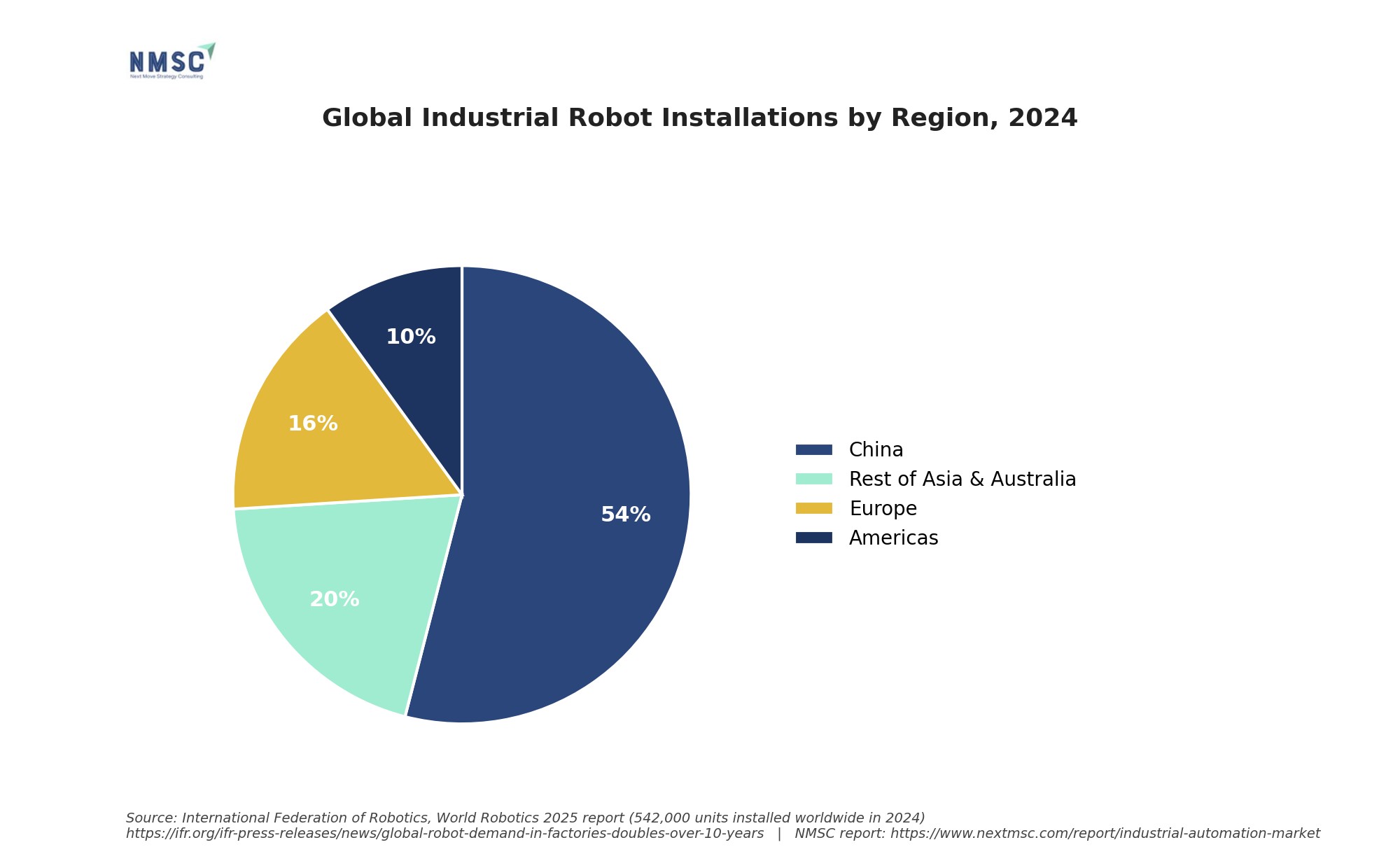
Nowhere is the shift from automation to autonomy more measurable than in industrial robotics, one of the Industrial Automation Market's fastest-growing hardware categories. According to the International Federation of Robotics' (IFR) World Robotics 2025 report, 542,000 industrial robots were installed worldwide in 2024, bringing the global operational stock to 4,664,000 units a 9% increase year-over-year. China alone accounted for 295,000 of those installations, or 54% of the global total, and for the first time Chinese manufacturers outsold foreign suppliers in their own domestic market.
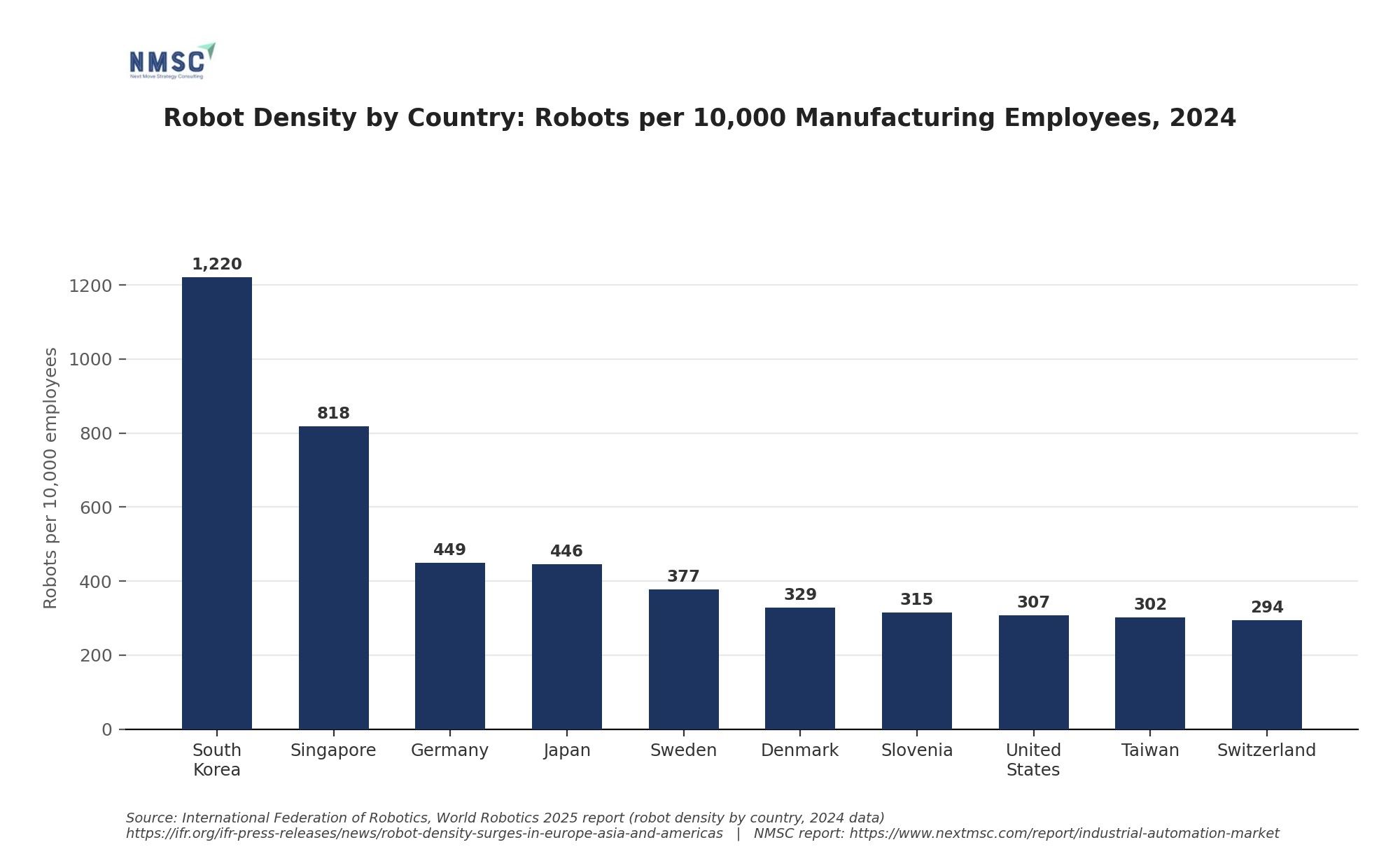
Robot density installations per 10,000 manufacturing employees tells a different story about where automation is most deeply embedded rather than where it's growing fastest. South Korea leads the world by a wide margin, powered by its electronics and automotive industries, followed by Singapore and Germany. The United States, despite ranking eighth globally, has recorded four consecutive years of robot-density growth as reshoring investment and labor shortages push manufacturers toward automation even where deployment volumes remain modest next to Asia's manufacturing base. For manufacturers evaluating the machine tools and control systems that these robots run on, NMSC's Factory and Warehouse Automation Market report tracks the adjacent equipment side of this same shift in detail.
Global Industrial Robot Installations, 2021–2024
|
Year |
Installations (units) |
|
2021 |
517,385 |
|
2022 |
552,946 |
|
2023 |
541,302 |
|
2024 |
542,000 |
Robot Density by Region, 2024 (robots per 10,000 manufacturing employees)
|
Region |
Robot Density |
|
Western Europe |
267 |
|
EU-27 average |
231 |
|
North America |
204 |
|
Global average |
132 |
|
Asia |
131 |
In short: installation volume and robot density measure different things, and they point to different countries.
-
Global robot installations grew to 542,000 units in 2024, with China accounting for 54% of the total
-
Robot density a better measure of automation depth than raw installation counts is highest in South Korea, Singapore, and Germany
-
The U.S. ranks eighth globally on density but has posted four straight years of growth
-
Density and installation-volume leaders aren't the same countries, reflecting different stages of automation maturity
Industrial Automation Market Outlook: What's Next Through 2030
Through 2030, the Industrial Automation Market's trajectory looks tied to how quickly AI moves from pilot projects to production deployment. The restructuring underway at Honeywell and ABB both narrowing toward more focused automation portfolios suggests the market's largest players expect the most durable margins to sit in AI-enabled software and precision robotics rather than in the industrial-conglomerate model that dominated the last two decades. Schneider Electric's pending acquisition of Cognite and Emerson's new AI leadership role point the same direction: control over industrial data, not just industrial hardware, is becoming the competitive battleground. For manufacturers still early in their automation journey particularly small and medium-sized enterprises facing the market's persistent high upfront costs the near-term opportunity looks less like buying more automation and more like buying automation that can act on its own data.
In short: the market's biggest suppliers are betting that AI and industrial data, not additional hardware, will define the next phase of competition.
-
Industrial data and AI software are becoming as strategically important as automation hardware itself
-
Portfolio restructuring at the market's largest suppliers signals where they expect margins to concentrate
-
High upfront costs remain a barrier for SME adoption, even as AI lowers the operating cost of automation once deployed
Ready to dig into the full segment-by-segment forecast? Download Free Sample of NMSC's Industrial Automation Market report for the complete market sizing, CAGR breakdown, and competitive analysis.
Conclusion
The Industrial Automation Market is no longer just a story about robots on a factory floor it's a story about which companies control the data those robots generate. With the market on track to grow from USD 191.28 billion in 2023 to USD 363.31 billion by 2030, the portfolio moves underway at Honeywell, ABB, and Schneider Electric this year all point toward the same conclusion: the industry's center of gravity is shifting from selling automation hardware to selling the AI and software that make that hardware autonomous.
About the Author
 Sanyukta Deb
— Sanyukta Deb is Digital Marketing Team Lead at Next Move Strategy Consulting, where she has led content strategy and technical SEO for the firm's B2B market research publications for over 2 years. Her editorial process translates NextMSC's primary and secondary research — spanning technology, industrial, and consumer sectors — into commercial narratives, backed by search-intent, keyword, and competitive analysis. She brings 5 years of overall experience in digital marketing and content strategy.
About the Reviewer
 Debashree Dey
— Debashree Dey is Assistant Manager at Next Move Strategy Consulting, where she supports cross-vertical market content and communications across diverse industries for 6 years. Her professional background includes senior content writing, communications, and published manuscript authorship, with experience developing audience-focused business narratives and maintaining clear, consistent messaging. Her role supports research-led content development and editorial quality across NextMSC publications.















Add Comment