Alpelisib Market: How a Rival's Trial Data Is Splitting Demand | NextMSC

Introduction
On June 2, 2026, Celcuity presented the first Phase 3 comparison of two PI3K/AKT/mTOR pathway inhibitors at the American Society of Clinical Oncology Annual Meeting in Chicago, and the drug it measured itself against was alpelisib, the active ingredient in Novartis's Piqray. In the PIK3CA-mutant cohort of the VIKTORIA-1 trial, Celcuity reported a median progression-free survival of 11.1 months for its gedatolisib triplet against 5.6 months for alpelisib plus fulvestrant. Six weeks later, on July 15, 2026, a conditional marketing authorisation took effect in the European Union for Vijoice, the alpelisib brand for PIK3CA-related overgrowth spectrum, which the European Medicines Agency describes as the first medicine authorised there for that condition. The alpelisib market therefore enters the final weeks of 2026 pulled in two directions at once: a contested breast cancer franchise and a newly opened rare-disease franchise.
According to Next Move Strategy Consulting's Alpelisib Market report, the global alpelisib market is segmented by product type (Piqray and Vijoice), by application (oncology, postmenopause and others), by distribution channel (drug stores, mail order pharmacies and online) and by geography across North America, Europe, Asia-Pacific and the rest of the world. NextMSC primary research and analysis identifies North America as the leading region, a position linked to the number of U.S. Food and Drug Administration approvals for alpelisib-based drugs, including the April 2022 approval of Vijoice for severe manifestations of PIK3CA-related overgrowth spectrum. This article does not restate headline sizing. It examines what the latest regulatory decisions, trial readouts and company disclosures mean for that segment structure.
For More Information: Download FREE Sample on Alpelisib Market Report
From ASCO to ESMO: The Head-to-Head Data Pressuring the Alpelisib Market
A First Phase 3 Contest Between Two Pathway Inhibitors
The design of the June 2, 2026 presentation is what makes it consequential. According to Celcuity's announcement that day, filed as Exhibit 99.1 with the U.S. Securities and Exchange Commission, VIKTORIA-1 is the first Phase 3 trial to compare two PI3K/AKT/mTOR pathway inhibitors in patients whose HR-positive, HER2-negative breast cancer progressed on a CDK4/6 inhibitor combined with an aromatase inhibitor. The trial enrolled 701 patients regardless of PIK3CA status. In the PIK3CA-mutant cohort, 350 patients were randomised 3:3:1 to gedatolisib with fulvestrant and palbociclib (the triplet), alpelisib with fulvestrant (the control) or gedatolisib with fulvestrant (the doublet). Alpelisib is therefore the standard against which every efficacy figure below is measured.
Celcuity reported a median progression-free survival of 11.1 months for the triplet against 5.6 months for alpelisib plus fulvestrant, a hazard ratio of 0.50 (95% confidence interval 0.37 to 0.68; p<0.0001) assessed by blinded independent central review. The doublet reached 11.3 months against the same 5.6-month control (hazard ratio 0.51; descriptive p=0.0013). Objective response rates were 48.9% for the triplet and 35.7% for the doublet against 26.0% for alpelisib plus fulvestrant, and median duration of response was 15.7 months, 24.2 months and 7.5 months respectively.
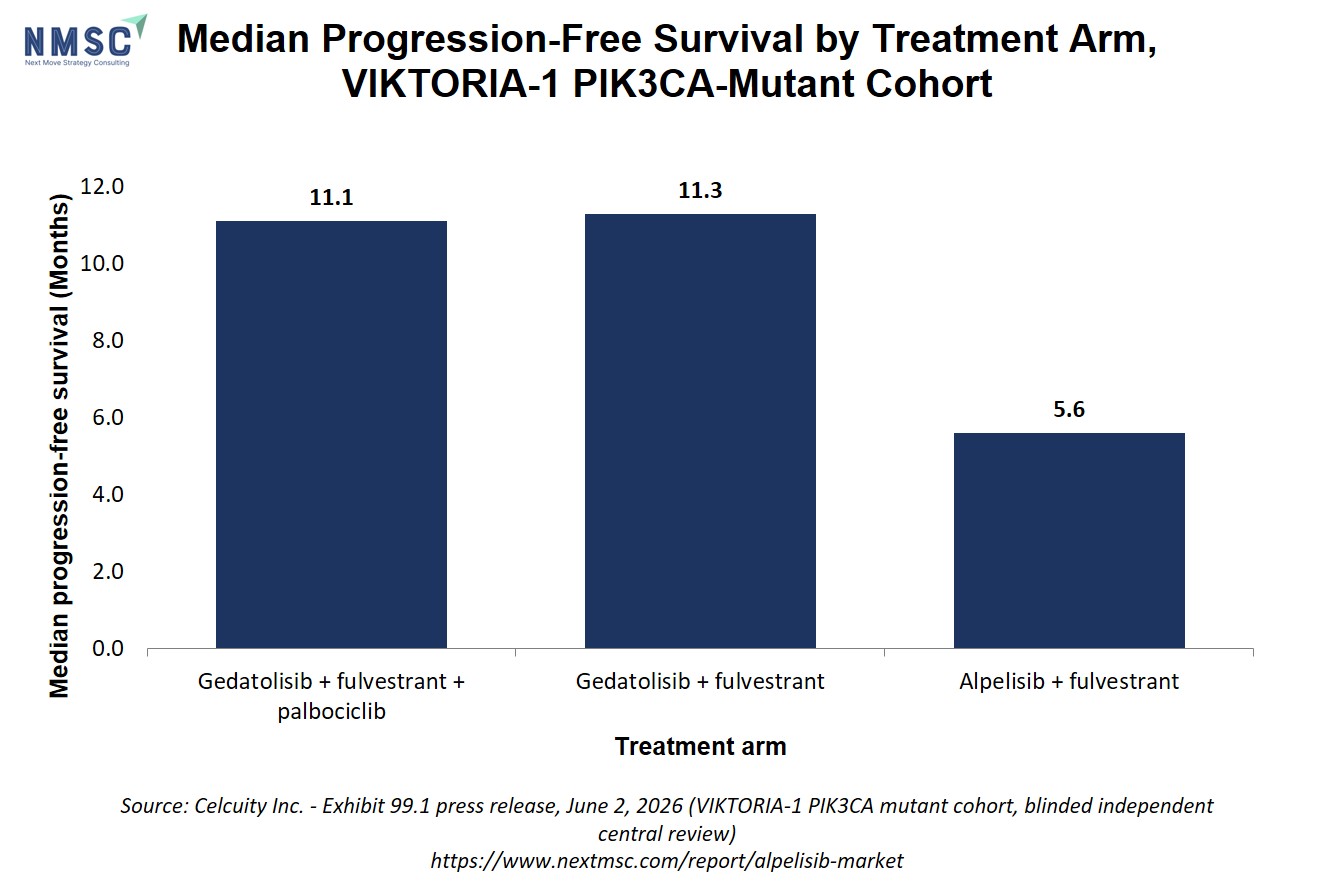
The chart plots the three median progression-free survival values from Celcuity's June 2, 2026 filing for the PIK3CA-mutant cohort of VIKTORIA-1: 11.1 months for gedatolisib with fulvestrant and palbociclib, 11.3 months for gedatolisib with fulvestrant, and 5.6 months for alpelisib with fulvestrant. The values reflect the sponsor's primary analysis assessed by blinded independent central review in an open-label trial, and they are reported results rather than forecasts.
Tolerability also favoured gedatolisib on the measures clinicians watch most closely. Grade 3 or higher hyperglycemia, a recognised alpelisib risk, occurred in 14.5% of patients on alpelisib plus fulvestrant against 2.6% on the triplet and none on the doublet, and grade 3 or higher rash occurred in 15.1% against 6.5% and 5.8%. Treatment-related adverse events led to discontinuation in 7.1% of the alpelisib group against 2.6% and 3.8%. The triplet carried its own burden: grade 3 or higher neutropenia affected 58.8% of triplet patients, compared with 0.7% on alpelisib plus fulvestrant.
Three caveats govern how far these results travel. The trial was open-label, and the figures come from the sponsor's own announcement. Overall survival, a key secondary endpoint, was described by Celcuity as immature at the time of analysis. And the PIK3CA-mutant cohort answers a question about one comparator and one treatment line, not about every PI3K-alpha option under development.
From Conference Slide to Label: The Regulatory Clock After ASCO
Regulatory momentum followed quickly. In its second-quarter 2026 results release, Celcuity reported that the FDA approved gedatolisib, branded Revtorpyk, on July 14, 2026 for adults with HR-positive, HER2-negative advanced breast cancer without a detected PIK3CA mutation, a population outside alpelisib's PIK3CA-mutated label. The step that matters more for alpelisib came on November 9, 2026, when Celcuity announced that the FDA had accepted a supplemental application covering the PIK3CA-mutated population. As reported by CancerNetwork on November 10, 2026, the agency set a target action date of June 25, 2027, and the announcement did not specify which gedatolisib regimen is under review.
Updated data presented at the European Society for Medical Oncology Congress in Madrid, held October 23 to 27, 2026, widened the contrast. CancerNetwork reported response rates of 59% for the triplet, 43% for the doublet and 33% for alpelisib plus fulvestrant, with median duration of response of 19.4, 27.8 and 7.5 months. Discontinuation because of treatment-emergent adverse events was 5% on the triplet and 4% on the doublet against 19% on alpelisib. Among patients without liver metastases, median progression-free survival was 21.5 months on the triplet against 9.1 months on the control, and among patients with liver metastases it was 9.1 months against 4.6 months.
Vijoice in Europe: A Rare-Disease Label Outside the Breast Cancer Contest
While oncology attracted the headlines, the European Medicines Agency recorded a different kind of milestone for the same molecule. Its Committee for Medicinal Products for Human Use adopted a positive opinion on May 21, 2026, and the marketing authorisation was issued on July 15, 2026, for adults and children aged two years and older with severe or life-threatening manifestations of PIK3CA-related overgrowth spectrum who need systemic therapy. According to the agency's medicine overview, no other medicine had been authorised for the condition before Vijoice, and care had consisted of supportive measures, surgery and procedures to block overgrown blood vessels.
The evidence base is deliberately modest, which is why the authorisation is conditional. The main study was a retrospective review of medical records from 57 patients aged two years and older treated through a compassionate use programme, and 12 of the 32 patients with a 24-week assessment, or 37.5%, achieved at least a 20% reduction in the size of one to three abnormal growths. The European Medicines Agency requires Novartis to submit final results of an ongoing study in adults and children with the condition, will review new information every year and lists the medicine under additional monitoring. The assessment history also includes a published document recording a divergent committee position.
NMSC Strategic Perspective: Two Demand Pools Inside One Molecule
NextMSC primary research and analysis reads the 2026 evidence as the start of a two-pool structure inside a single molecule. The first pool is PIK3CA-mutated, HR-positive, HER2-negative advanced breast cancer after endocrine-based therapy, which corresponds to the oncology application in NMSC's segmentation. Volume there is large, because breast cancer is common, but it is now contestable: the comparator role in VIKTORIA-1 exposes alpelisib to a regimen with better reported efficacy and tolerability on every headline endpoint cited above, and the FDA's decision date of June 25, 2027 gives that contest a calendar.
The second pool is PIK3CA-related overgrowth spectrum, where the European authorisation covers patients for whom no other medicine had been authorised. Volume is far smaller, but the competitive logic is different. In this pool alpelisib competes against supportive care, surgery and vascular procedures rather than against a rival pathway inhibitor, and its timeline is governed by post-authorisation obligations rather than a head-to-head readout. NMSC's view is that these pools differ in size, evidence thresholds, pricing logic and competitive clocks, and that treating them as one demand curve will misstate both risks and opportunities.
This is also why Novartis's reported sales line needs careful reading. The combined Piqray and Vijoice figure does not separate oncology from rare disease, so NMSC treats it as a blended indicator. The question for the next several quarters is whether growth increasingly comes from rare-disease uptake and geographic expansion while the breast cancer share becomes more contestable. Cross-trial and sponsor-reported comparisons also warrant restraint, and NMSC's position is that the direction of the evidence is clear while its final magnitude is not.
Section Summary:
The June to November 2026 sequence produced two separate verdicts on alpelisib. In breast cancer, a sponsor-reported head-to-head trial and a dated FDA review window raised competitive pressure. In rare disease, the European Union opened a new label with conditions attached.
-
VIKTORIA-1 reported 11.1 and 11.3 months of median progression-free survival for gedatolisib regimens against 5.6 months for alpelisib plus fulvestrant.
-
The FDA's target action date for gedatolisib in the PIK3CA-mutated population is June 25, 2027.
-
Vijoice received a conditional EU authorisation on July 15, 2026 for severe or life-threatening PIK3CA-related overgrowth spectrum.
Industry Impact Analysis: Regulators, Rivals and Disease Burden in the Alpelisib Market
Regulation is now shaping the alpelisib market in opposite directions. The European Medicines Agency used a conditional pathway on the grounds that the medicine addresses an unmet need and the benefit of immediate availability outweighs the risk of less comprehensive data. That pathway lowers the entry barrier for a rare-disease label but attaches obligations: annual reviews, additional monitoring and a requirement to deliver final study results. For manufacturers, the regulatory asset is real, but it is not yet a settled one.
On the competitive side, Roche's pipeline update of July 23, 2026 shows that the contest around alpelisib is broader than a single trial. Roche lists its PI3K-alpha inhibitor Itovebi, known as inavolisib, as approved in the United States in the third quarter of 2024 and in the European Union in July 2025. The same update describes INAVO121, a Phase 3 study of 400 patients comparing Itovebi plus fulvestrant directly with alpelisib plus fulvestrant after CDK4/6 inhibitor therapy, with progression-free survival as the primary endpoint and recruitment completed in the fourth quarter of 2024. Roche reported no readout in that document, so the comparison remains open and a second head-to-head result against alpelisib is a live possibility.
Novartis's own disclosures show a franchise that is growing from a small base. In its third-quarter 2026 results published on October 27, 2026, Novartis reported Piqray and Vijoice net sales of USD 122 million for the quarter, up 36% in U.S. dollars and 37% in constant currencies, and USD 326 million for the first nine months, up 8%. The same release shows Kisqali, the company's CDK4/6 inhibitor, at USD 1,821 million for the quarter, up 37% in constant currencies, and describes a six-year follow-up from the NATALEE trial showing a reduction in the risk of death of nearly 20% in high-risk early breast cancer. Novartis did not attribute the Piqray and Vijoice increase to a specific indication or region.
Disease burden remains the demand foundation. The International Agency for Research on Cancer, in its GLOBOCAN 2024 estimates, counted 2,434,087 new cases of female breast cancer and 693,660 deaths worldwide in 2024, equal to 11.8% of all cancer cases and 7.1% of all cancer deaths. Breast cancer ranks first for incidence among women in 164 countries. In the United States, the National Cancer Institute's Surveillance, Epidemiology, and End Results program carries the American Cancer Society's projection of 321,910 new cases of female breast cancer in 2026, with 6% of cases diagnosed at the distant stage and a five-year relative survival of 33.8% for that stage. Celcuity's announcement, citing the same federal program, adds that HR-positive, HER2-negative disease accounts for approximately 70% of all breast cancers.
Distribution is the least visible layer of the alpelisib market and arguably the most stable. NMSC's segmentation separates drug stores, mail order pharmacies and online channels, and the oral formulations for both brands, including the tablets and granules recorded in the European summary of opinion for Vijoice, favour pharmacy-based dispensing over hospital infusion. That structure is one reason rare-disease uptake can be tracked through specialty channels even when volumes are small.
Section Summary:
Regulators, rivals and epidemiology are each moving the alpelisib market in a different direction. Regulators are opening a conditional rare-disease label, rivals are testing alpelisib in head-to-head trials, and the underlying disease burden continues to support oncology demand.
-
Roche's INAVO121 trial compares Itovebi with alpelisib directly and had not reported by July 23, 2026.
-
Novartis reported USD 122 million of Piqray and Vijoice sales in the third quarter of 2026, up 36% in U.S. dollars.
-
GLOBOCAN 2024 counted 2,434,087 new female breast cancer cases worldwide, keeping the oncology demand base large.
Pros and Cons of Recent Market Developments
|
Pros |
Cons |
|
The EU opened a conditional rare-disease label for Vijoice on July 15, 2026, where no medicine was previously authorised. |
That authorisation rests on a retrospective review of 57 patients, with annual reviews and additional monitoring. |
|
Novartis reported Piqray and Vijoice sales of USD 122 million in the third quarter of 2026, up 36%. |
Nine-month growth was 8%, and the sales line does not separate oncology from rare disease. |
|
Alpelisib remains the reference comparator in both the Celcuity and Roche trials. |
VIKTORIA-1 reported 5.6 months of median progression-free survival for alpelisib plus fulvestrant. |
|
Breast cancer incidence stays high, with 2,434,087 new female cases worldwide in 2024. |
The FDA's June 25, 2027 gedatolisib action date creates a dated threat. |
Key Data & Statistics
The tables below consolidate the dated events, trial results, company sales and disease burden figures referenced in this article. Each source is named beneath its table.
Dated Events Affecting Alpelisib, May to November 2026
|
Date |
Event |
|
May 21, 2026 |
CHMP positive opinion for Vijoice |
|
June 2, 2026 |
VIKTORIA-1 PIK3CA-mutant cohort presented at ASCO |
|
July 14, 2026 |
FDA approval of gedatolisib in PIK3CA wild-type disease |
|
July 15, 2026 |
Conditional EU authorisation for Vijoice |
|
October 27, 2026 |
Novartis third-quarter 2026 results |
|
November 9, 2026 |
FDA accepts gedatolisib application for PIK3CA-mutated disease |
VIKTORIA-1 PIK3CA-Mutant Cohort: Primary Analysis by Arm
|
Measure |
Gedatolisib triplet |
Gedatolisib doublet |
Alpelisib plus fulvestrant |
|
Median progression-free survival (months) |
11.1 |
11.3 |
5.6 |
|
Objective response rate |
48.9% |
35.7% |
26.0% |
|
Median duration of response (months) |
15.7 |
24.2 |
7.5 |
|
Grade 3 or higher hyperglycemia |
2.6% |
0% |
14.5% |
|
Grade 3 or higher rash |
6.5% |
5.8% |
15.1% |
Novartis Piqray and Vijoice Net Sales, 2026
|
Period |
Net sales (USD million) |
Change in USD |
Constant currencies |
|
Third quarter 2026 |
122 |
+36% |
+37% |
|
Nine months 2026 |
326 |
+8% |
+8% |
Breast Cancer Burden Behind Alpelisib Demand
|
Measure |
Value |
Geography and period |
|
New female breast cancer cases |
2,434,087 |
Worldwide, 2024 |
|
Projected new female breast cancer cases |
321,910 |
United States, 2026 |
|
Cases diagnosed at distant stage |
6% |
United States, SEER stage data |
Future Outlook & Forecast: Milestones That Will Define the Alpelisib Market Through 2027
This outlook rests on dated regulatory and clinical milestones rather than a market-size projection. Four events in the next 12 to 18 months will matter most to the alpelisib market, and each has a source-backed date or status.
The first is the FDA's action on gedatolisib in the PIK3CA-mutated population, with a target date of June 25, 2027. An approval would make a regimen with reported median progression-free survival of 11.1 to 11.3 months available in alpelisib's core oncology population, and the new application follows the July 14, 2026 approval in PIK3CA wild-type disease, which means the same sponsor would then cover patients regardless of mutation status. The second is any readout from INAVO121, where Roche's July 23, 2026 update gave no result and no date.
The third is Novartis's post-authorisation work on Vijoice in Europe, where the agency requires final results of an ongoing study and reviews new information each year. Those reviews will test whether a retrospective evidence base can be converted into a full authorisation. The fourth is first-line competition: CancerNetwork reported that Celcuity's VIKTORIA-2 programme is evaluating gedatolisib combinations in treatment-naive patients, which would move pathway inhibition earlier in the treatment sequence than alpelisib's current label.
For the alpelisib market, the implication is a gradual rebalancing rather than a single inflection point. Oncology demand will remain anchored by disease burden, but its competitive terms are being renegotiated in public. Rare-disease demand will be smaller and slower, but it carries a different risk profile. NextMSC primary research and analysis expects the weight of strategic attention to shift toward whichever pool produces the next dated decision.
Section Summary:
The next 18 months are defined by four dated or status-based milestones, not by one forecast number. Each one tests a different part of the alpelisib franchise.
-
FDA action on gedatolisib in PIK3CA-mutated disease is targeted for June 25, 2027.
-
INAVO121 remains the second pending head-to-head trial against alpelisib.
-
Vijoice must convert its conditional authorisation through final study results and annual reviews.
Next Steps for Stakeholders in the Alpelisib Market
-
Pharmaceutical manufacturers: track oncology and rare-disease demand separately, because the competitive clock for breast cancer is now dated while the rare-disease clock depends on post-authorisation obligations.
-
Institutional investors: treat the June 25, 2027 FDA action date and any INAVO121 readout as scheduled catalysts, and read the combined Piqray and Vijoice sales line as a blended indicator until Novartis discloses more detail.
-
Hospital pharmacy and procurement leaders: prepare for a second PI3K-pathway option in PIK3CA-mutated disease, and compare hyperglycemia and rash management costs across regimens using the trial data available.
-
Regional strategy teams: follow European reimbursement decisions for Vijoice, since a conditional authorisation does not by itself determine national access.
-
Corporate development teams: weigh partnerships or acquisitions that add rare-disease evidence in PIK3CA-related conditions, because that evidence base is currently thin.
Conclusion
The alpelisib market closes 2026 with two stories that no longer move together. In breast cancer, a sponsor-reported Phase 3 trial placed alpelisib plus fulvestrant behind two gedatolisib regimens on progression-free survival, response and several tolerability measures, and the FDA has scheduled its decision for June 25, 2027. In rare disease, the European Union authorised the first medicine for PIK3CA-related overgrowth spectrum on conditional terms, giving Vijoice a new label and new obligations. NextMSC primary research and analysis concludes that stakeholders should evaluate the alpelisib market as two demand pools with different evidence standards and different clocks, and should let the next dated regulatory events, rather than a single trend line, guide their decisions. Readers who want segment-level detail on product type, application, distribution channel and regional structure can find it in the full Alpelisib Market report, which also covers the segmentation summarised above and the regions that NextMSC research tracks.
About the Author
 Sanyukta Deb
— Sanyukta Deb is Digital Marketing Team Lead at Next Move Strategy Consulting, where she has led content strategy and technical SEO for the firm's B2B market research publications for over 2 years. Her editorial process translates NextMSC's primary and secondary research — spanning technology, industrial, and consumer sectors — into commercial narratives, backed by search-intent, keyword, and competitive analysis. She brings 5 years of overall experience in digital marketing and content strategy.
About the Reviewer
 Debashree Dey
— Debashree Dey is Assistant Manager at Next Move Strategy Consulting, where she supports cross-vertical market content and communications across diverse industries for 6 years. Her professional background includes senior content writing, communications, and published manuscript authorship, with experience developing audience-focused business narratives and maintaining clear, consistent messaging. Her role supports research-led content development and editorial quality across NextMSC publications.

















Add Comment