Aluminum Flat-Rolled Products Market: How Gulf Shocks Hit Mills | NextMSC
Introduction
On November 5, 2026, Novelis Inc., which describes itself as the world leader in aluminum rolling and recycling, reported that net sales for the quarter ended September 30, 2026 rose 25% to $5.9 billion while rolled product shipments fell 2% to 919 kilotonnes. Revenue climbed because metal cost more, not because mills shipped more, and that gap between price and tonnage now defines the aluminum flat-rolled products market. Constellium SE reported record third-quarter earnings on 1% lower shipments, and Norsk Hydro ASA reported higher earnings on firm metal prices.
According to Next Move Strategy Consulting's Aluminum Flat-Rolled Products Market report, the global aluminum flat-rolled products market was valued at USD 52.04 billion in 2025 and is projected to reach USD 116.48 billion by 2035, growing at a CAGR of 7.90% from 2026 to 2035. NextMSC primary research and analysis places the 2026 value at USD 56.15 billion, spanning plates, sheets, foil, coil and other products across the 1xxx, 3xxx, 5xxx and 6xxx alloy series.
For More Information: Download FREE Sample on Aluminum Flat-Rolled Products Market Report
This article examines how the 2026 Gulf smelter outage, United States tariff policy and Chinese semi-finished exports are redistributing margin and volume among rolling mills, and what the third-quarter 2026 results from Novelis, Constellium and Hydro reveal about the years to 2035.
Gulf Smelter Outages Meet Tariff Walls: What Q3 2026 Reveals About the Aluminum Flat-Rolled Products Market
Gulf Smelters Under Fire: A Supply Gap of 2.8 Million Tonnes
The disruption began on March 28, 2026, when Iranian missile and drone attacks damaged Aluminium Bahrain's facility and Emirates Global Aluminium's Al Taweelah smelter in the United Arab Emirates. The U.S. Geological Survey recorded in its Mineral Industry Surveys: Aluminum in December 2025 bulletin, published in April 2026, that Emirates Global Aluminium estimated full restoration of Al Taweelah could take up to 12 months. The same bulletin noted that Norsk Hydro's Qatalum joint venture in Qatar was holding output at roughly 60% of capacity because of energy supply disruption, and that Aluminium Bahrain had shut three reduction lines, cutting its output by 19% of a 1,623,000 tonne annual capacity.
Nearly seven months later the damage remains measurable. A Reuters column published on October 14, 2026 reported that Gulf primary aluminum production slumped by an annualized 2.8 million tonnes between February and May, according to the International Aluminium Institute. Reuters reported on September 2, 2026 that Gulf production was down 44% year on year in July, according to the International Aluminium Institute. Global output has stabilized rather than recovered: International Aluminium Institute data show primary production of 18.377 million tonnes in the third quarter of 2026, up 2.1% from 18.003 million tonnes in the second quarter, yet September's 6.014 million tonnes was the lowest September since 2023.
For rolling mills the consequence is cost and availability rather than demand. Norsk Hydro reported that its three-month aluminum price rose from USD 3,076 per tonne at the start of the third quarter of 2026 to USD 3,170 per tonne at the end, and attributed the increase to renewed Middle East tensions after signs of a possible end to the conflict at the end of the second quarter. Mills that pass metal costs to can makers, automakers and aerospace customers report higher revenue without shipping a single additional tonne.
Novelis and Constellium: Price-Led Revenue, Flat Volumes
The two largest Western rolled product specialists show the effect clearly. Novelis Inc. reported on November 5, 2026 that adjusted EBITDA rose 20% to $508 million and adjusted EBITDA per tonne shipped rose 23% to $553, even though shipments declined 2%. Higher beverage packaging and aerospace shipments were offset by lower automotive and specialty volumes. Insurance recoveries tied to the 2025 fires at its Oswego, New York plant contributed $39 million of business interruption income in the quarter, and cumulative recoveries reached $519 million.
North America is where Novelis sees the tightest supply. Steve Fisher, president and CEO of Novelis Inc., said in the company's November 5, 2026 results release that Bay Minette is "increasing our ability to serve the undersupplied North American market." The Alabama plant produced its first coil on the cold mill in September 2026, with commercial shipments targeted for the first quarter of fiscal year 2028. Capital expenditure for the first six months of fiscal 2027 reached $1,543 million, against $913 million a year earlier, which, with weaker operating cash flow, left adjusted free cash flow at an outflow of $1.8 billion.
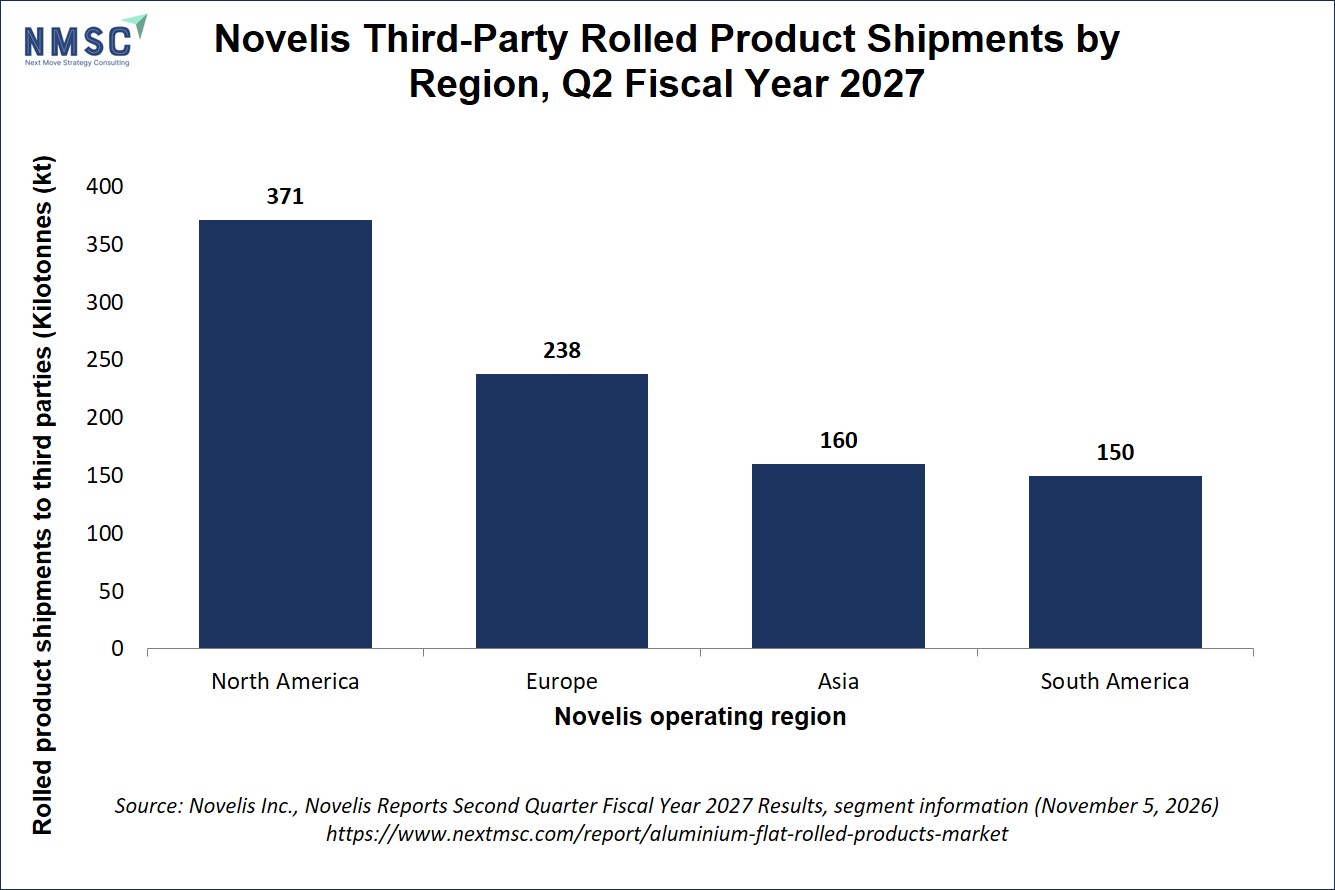
Novelis reported third-party rolled product shipments of 371 kilotonnes in North America, 238 kilotonnes in Europe, 160 kilotonnes in Asia and 150 kilotonnes in South America in the quarter ended September 30, 2026, a total of 919 kilotonnes. North America therefore accounted for the largest share of the company's shipments, which is the region Novelis describes as undersupplied.
Regional profitability followed a different order from volume. Novelis reported segment adjusted EBITDA of $160 million in South America, $146 million in North America, $101 million in Europe and $101 million in Asia, against $108 million, $134 million, $81 million and $99 million a year earlier. South America's adjusted EBITDA rose 48%, the largest regional increase, even though it ships the smallest third-party volume of the four regions.
Constellium SE reported on October 28, 2026 that third-quarter shipments of 368 kilotonnes were 1% lower than a year earlier while revenue rose 22% to $2.6 billion. Its Packaging & Automotive Rolled Products segment nearly doubled adjusted EBITDA to $162 million. Management said on the earnings call that automotive rolled shipments grew 9%, helped by supply shortages of aluminum automotive body sheet in North America, while packaging shipments declined 7% despite healthy underlying can sheet demand in North America and Europe. Aerospace and Transportation shipments rose 18% to 59 kilotonnes, and Constellium raised its full-year 2026 guidance.
Hydro's Third Quarter: How Metal Prices Transmit Through the Chain
Norsk Hydro ASA reported on October 23, 2026 that adjusted EBITDA reached NOK 9,089 million, up from NOK 5,996 million a year earlier, with higher all-in metal prices the main driver. Hydro stated that global primary aluminum consumption was slightly higher year on year, led by a 3.0% increase in Asia, while consumption in the world excluding China was estimated to be lower. For rolling mills outside China, that split means price strength is not matched by demand growth.
Hydro also described diverging automotive signals. European extrusion demand rose 1% in the quarter, supported by growth in battery electric vehicle production, while North American demand was broadly unchanged with automotive demand subdued by weaker electric vehicle output. Constellium's results add a different angle: automotive rolled sheet is short in North America even as its automotive structures business softened.
NMSC Strategic Perspective: Why Price-Led Growth Must Convert to Volume-Led Growth
NextMSC primary research and analysis reads the third-quarter 2026 results as evidence of a two-speed market. Value is expanding faster than volume: Novelis grew net sales 25% on 2% lower shipments, and Constellium grew revenue 22% on 1% lower shipments. The NextMSC valuation of USD 56.15 billion for 2026, 7.9% above the USD 52.04 billion recorded for 2025, is therefore consistent with metal price pass-through rather than a step change in tonnage.
The 7.90% CAGR that NextMSC projects through 2035 will need volume to carry more of the load. NextMSC analysis identifies three conversion points. The first is North American mill capacity, where Novelis describes the market as undersupplied and Constellium reported body sheet shortages. The second is aerospace and transport plate and sheet, where Constellium's shipments rose 18%. The third is beverage packaging, where Novelis shipments grew while Constellium's fell 7%, a divergence that shows packaging gains depend on customer contracts and plant location rather than on category growth alone.
Regional evidence supports two findings in the NextMSC report: Asia-Pacific holds the largest share of the aluminum flat-rolled products market, and North America is the fastest-growing region. China's July 2026 export growth is consistent with the first finding, and the North American premium and mill shortages are consistent with the second. NextMSC primary research and analysis expects margin to accrue to mills that combine local metal access, recycling capacity and proximity to customers.
Section Summary:
Four 2026 developments explain why revenue is outrunning tonnage across rolling mills.
-
Gulf smelter damage from March 28, 2026 removed an annualized 2.8 million tonnes of primary supply and lifted benchmark prices.
-
Novelis and Constellium both grew revenue by more than 20% while shipments fell by 1% to 2%.
-
North America is the tightest region, with Bay Minette first coil produced in September 2026 and body sheet shortages reported.
-
NextMSC primary research and analysis treats volume conversion in aerospace, packaging and automotive sheet as the test of the 7.90% CAGR.
Industry Impact Analysis: Tariffs, Trade Flows and Regional Divergence
United States: Section 232 Tariffs and the Midwest Premium
S&P Global Commodity Insights reported on June 3, 2026 that the Section 232 tariff on aluminum imports was doubled to 50% in June 2025 and that the Platts-assessed Midwest Premium rose 297.6% between the start of 2025 and the start of 2026, to more than four times its pre-tariff level. For a rolling mill that buys primary metal in the United States, that premium is a direct cost line, and mills with recycling loops can reduce their exposure, as Novelis' favorable metal benefit from higher scrap consumption shows.
Policy shifted again in July 2026. ING Research reported on July 21, 2026 that the administration amended its Section 232 aluminum tariffs so that companies building, expanding or refurbishing U.S. smelting capacity can import qualifying volumes at 25% instead of 50%, provided they meet approved investment milestones. ING noted that the United States is down to four operating smelters from more than 20 at the start of the century, and that the proposed 750 kilotonne per year smelter in Oklahoma, a project involving Emirates Global Aluminium and Century Aluminum, is unlikely to deliver meaningful supply before 2030. ING expects the Midwest premium to remain well supported.
The import data explain why. The U.S. Geological Survey reported that U.S. aluminum imports for consumption totaled 4.83 million tonnes in 2025, 13% less than in 2024, with Canada supplying 52% and the United Arab Emirates 10%. Imports of semi-fabricated products, a category that includes plates, sheets and strip, totaled 1.21 million tonnes, led by the Republic of Korea at 20%, Canada at 14% and China including Hong Kong at 7%. Gulf attacks therefore struck a supplier that the United States relies on for one tonne in every ten.
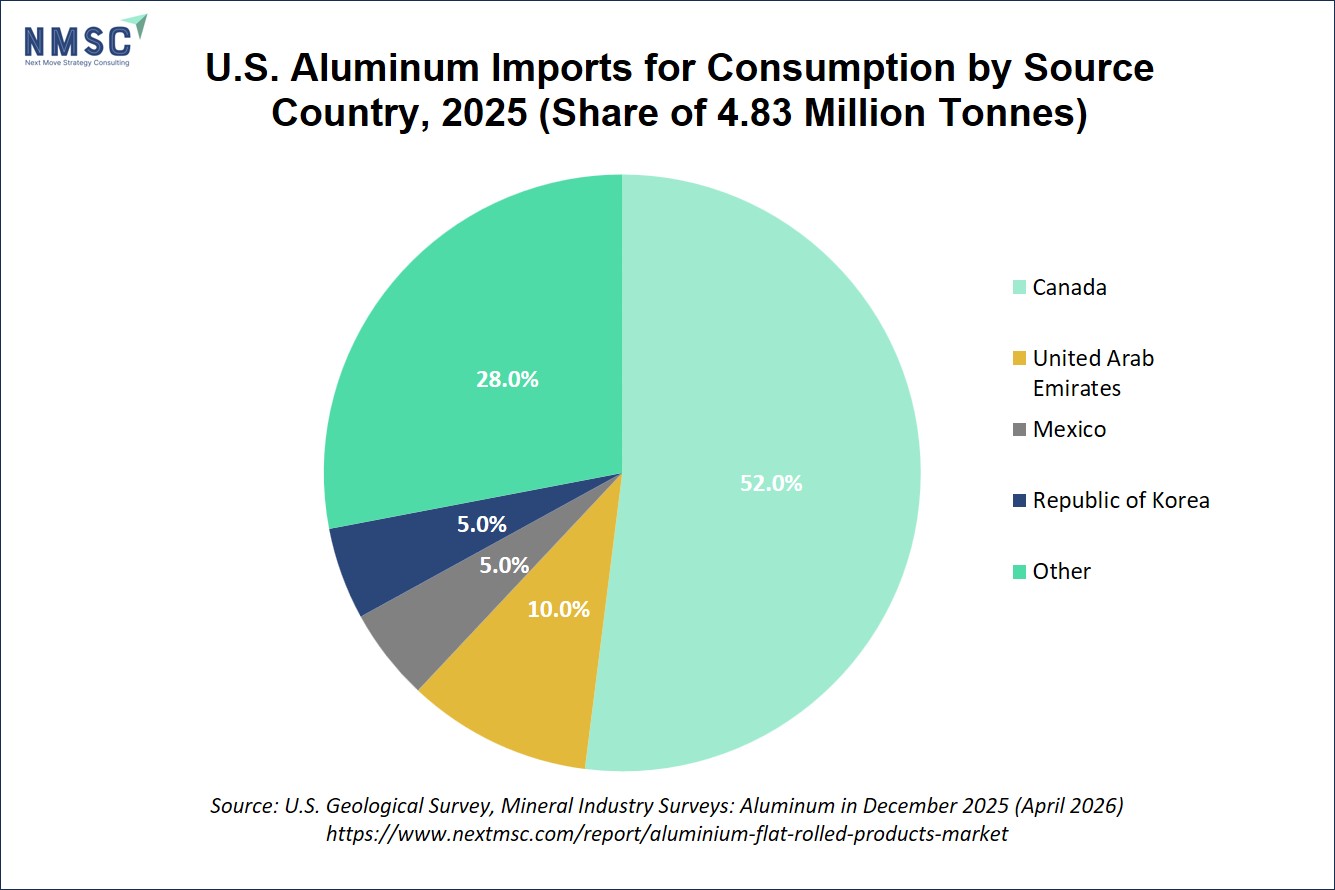
The U.S. Geological Survey reports that Canada supplied 52%, the United Arab Emirates 10%, Mexico 5% and the Republic of Korea 5% of U.S. aluminum imports for consumption in 2025. The remaining 28% is the balance of the 100% total after the four named sources, and covers all other supplying countries.
China: Semi-Finished Exports Fill the Gap
The General Administration of Customs of China reported that exports of aluminum plates, strips and sheets reached 321,900 tonnes in July 2026, down 9.07% from June but up 24.33% from July 2025, with foil exports at 118,800 tonnes, up 8.59% year on year, according to data published by Mysteel on August 21, 2026. Reuters reported on October 14, 2026 that traders expect rising output in Indonesia, which exported a record 114,000 tonnes of primary metal in July, and higher Chinese product exports to bridge the supply gap until the Gulf smelters are repaired.
For Western rolling mills this adds a competitive overlay to the cost shock, because Chinese export volumes grew while Western shipments slipped. NextMSC analysis indicates that mills with tariff-protected domestic positions benefit from the price umbrella, while mills dependent on imported coil absorb the full duty.
Section Summary:
-
Tariffs and trade flows are splitting the market into protected and exposed producers.
-
Section 232 duties of 50% and a Midwest premium up 297.6% have made U.S. aluminum the most expensive in the world.
-
The July 2026 amendment offers a 25% rate for smelter investors, but ING Research sees imports and premiums persisting.
-
China's plate, strip and sheet exports rose 24.33% year on year in July 2026, intensifying competition for flat-rolled volumes.
Pros and Cons of Recent Market Developments
|
Pros |
Cons |
|
Novelis adjusted EBITDA rose 20% to $508 million and adjusted EBITDA per tonne rose 23% to $553 despite a 2% volume decline. |
Shipments fell at both leading Western mills: Novelis by 2% to 919 kilotonnes and Constellium by 1% to 368 kilotonnes. |
|
Constellium Aerospace & Transportation shipments rose 18% to 59 kilotonnes. |
Constellium packaging rolled shipments fell 7%, and its Automotive Structures & Industry segment EBITDA fell 36%. |
|
North American body sheet shortages lifted Constellium automotive rolled shipments by 9%. |
Novelis shipped less to automotive and specialty customers, and Hydro called North American automotive demand subdued. |
|
Bay Minette produced its first coil in September 2026, with commercial shipments targeted for fiscal 2028. |
Novelis net leverage reached 4.7x at September 30, 2026, against 4.1x in March 2026, with negative $1.8 billion adjusted free cash flow. |
|
The July 2026 amendment lets qualifying U.S. smelter investors import at 25% instead of 50%. |
ING Research expects Midwest premiums to stay elevated, and new U.S. smelter capacity is unlikely before 2030. |
|
Higher scrap use and lower scrap prices gave Novelis a favorable metal benefit. |
China's plate, strip and sheet exports rose 24.33% year on year in July 2026, adding competitive pressure. |
Key Data & Statistics
The two tables below set out the quarterly figures behind the price-versus-volume pattern at the two leading Western rolling mills.
Table 1: Novelis Inc. Results for the Quarter Ended September 30, 2026
|
Metric |
Q2 FY2027 |
Q2 FY2026 |
Change |
|
Net sales (USD million) |
5,942 |
4,744 |
+25% |
|
Adjusted EBITDA (USD million) |
508 |
422 |
+20% |
|
Adjusted EBITDA per tonne (USD) |
553 |
448 |
+23% |
|
Rolled product shipments (kilotonnes) |
919 |
941 |
-2% |
|
Net income attributable to common shareholder (USD million) |
210 |
163 |
+29% |
Table 2: Constellium SE Results for the Third Quarter of 2026
|
Metric |
Q3 2026 |
Q3 2025 |
Change |
|
Total shipments (kilotonnes) |
368 |
373 |
-1% |
|
Revenue (USD million) |
2,639 |
2,166 |
+22% |
|
Adjusted EBITDA (USD million) |
276 |
235 |
+41 million |
|
Packaging & Automotive Rolled Products shipments (kilotonnes) |
266 |
275 |
-3% |
|
Aerospace & Transportation shipments (kilotonnes) |
59 |
50 |
+18% |
Future Outlook & Forecast: Aluminum Flat-Rolled Products Market to 2035
NextMSC primary research and analysis values the aluminum flat-rolled products market at USD 56.15 billion in 2026 and projects USD 116.48 billion by 2035 at a CAGR of 7.90%. The evidence gathered in 2026 suggests the first years of that path will be set by metal prices and supply recovery, and the later years by volume growth in packaging, automotive sheet and aerospace.
Demand estimates from the producers themselves support a volume-led second phase. In its annual report on Form 10-K for the fiscal year ended March 31, 2026, Novelis stated that its management expects global aluminum beverage packaging demand outside China to grow at a compound annual rate of about 4% from fiscal 2026 to fiscal 2031, automotive aluminum sheet demand at 3% to 5%, and aerospace aluminum plate and sheet demand at about 4%. These are company management estimates, not NextMSC figures, and they sit alongside the NextMSC forecast as an independent reference point.
Constellium SE's third quarter 2026 earnings materials point the same way for 2027: growth in aerospace and can sheet, stable North American automotive demand and continued weakness in European automotive. On the supply side, Emirates Global Aluminium's own estimate puts Al Taweelah's restoration up to 12 months from the March 28, 2026 attack, and ING Research does not expect new U.S. smelting capacity before 2030. Hydro told investors on October 23, 2026 that it expects the premium it earns above the benchmark aluminum price to fall to between USD 550 and USD 600 per tonne in the fourth quarter, from USD 673 in the third quarter, a sign that the premiums supporting 2026 earnings are expected to ease. If Gulf metal returns during 2027, prices would face downward pressure, which would slow price-led revenue growth just as Bay Minette begins commercial shipments in the first quarter of Novelis' fiscal 2028.
Two scenarios frame the range. If Gulf supply normalizes while tariffs remain, North American mills keep a structural premium and imports of Asian semi-finished products stay constrained by duties. If the July 2026 tariff amendment draws smelter investment faster than ING Research expects, the premium could narrow earlier, and mills without recycling or local metal access would lose their relative cost advantage.
Section Summary:
The path to 2035 runs through supply recovery first and volume growth second.
-
NextMSC projects USD 56.15 billion in 2026 and USD 116.48 billion by 2035, a CAGR of 7.90% from 2026.
-
Novelis management expects beverage packaging demand outside China to grow about 4% a year and automotive sheet 3% to 5% through fiscal 2031.
-
Al Taweelah restoration, new U.S. smelter capacity after 2030 and Bay Minette commercial shipments in fiscal 2028 set the supply timeline.
Next Steps for Stakeholders
Executives and investors can translate the 2026 evidence into five concrete actions, each tied to a figure reported in the third-quarter results.
-
Audit metal pass-through clauses. Confirm which contracts index to the London price, the Midwest premium and scrap, because Novelis and Constellium both showed revenue rising 22% to 25% on flat volumes.
-
Track Gulf restoration monthly. Use the International Aluminium Institute's monthly release and Al Taweelah repair milestones to time purchasing.
-
Screen balance sheets against capital programs. Novelis' net leverage of 4.7x and negative $1.8 billion adjusted free cash flow show how capacity investment ahead of commercial shipments strains financing.
-
Weight portfolios toward conversion segments. Aerospace and transport plate and sheet, can sheet and North American automotive body sheet are the areas where shipments or shortages are visible in the data.
-
Evaluate the Section 232 investment route. Companies considering U.S. smelting or rolling capacity should test whether the 25% qualifying rate changes project economics, given ING Research's 2030 supply timeline.
Conclusion
The aluminum flat-rolled products market entered the final quarter of 2026 with a clear divergence: revenue and earnings at the leading Western mills are rising on metal prices while tonnage slips. The Gulf smelter damage of March 2026, the Section 232 tariffs and a surge in Chinese semi-finished exports are redistributing margin toward mills with local metal, recycling loops and North American footprints. NextMSC primary research and analysis supports a market of USD 116.48 billion by 2035, and the 2026 results show that reaching it will depend on turning today's price-led growth into volume-led growth across packaging, automotive sheet and aerospace. Investors should therefore watch tonnage, not only revenue, in every upcoming quarterly report.
About the Author
 Priyanshu Das
— Priyanshu Das is SEO Executive at Next Move Strategy Consulting, where he has led on-page and off-page SEO, keyword research, and SEO audits for the firm's B2B market research publications for 2 years. His audit process combines technical crawl analysis, backlink profile review, and competitor keyword gap mapping — using tools including Screaming Frog and Google Search Console — to prioritize fixes by organic search-visibility impact, informed by his own prior in-house and agency SEO experience.
About the Reviewer
 Sanyukta Deb
— Sanyukta Deb is Digital Marketing Team Lead at Next Move Strategy Consulting, where she has led content strategy and technical SEO for the firm's B2B market research publications for over 2 years. Her editorial process translates NextMSC's primary and secondary research — spanning technology, industrial, and consumer sectors — into commercial narratives, backed by search-intent, keyword, and competitive analysis. She brings 5 years of overall experience in digital marketing and content strategy.












Add Comment