The Ultimate Guide to the Precious Metals Market in 2026
Introduction
The global Precious Metals Market is undergoing one of its most consequential structural transformations in decades. A convergence of geopolitical shocks, accelerating industrial demand from clean energy technologies, and a fundamental shift in central bank reserve strategies has propelled gold, silver, platinum, and palladium to historic price levels across 2025 and into 2026. For institutional investors, C-level executives, and strategic decision-makers, understanding the forces reshaping this market is no longer optional — it is a prerequisite for sound capital allocation and long-term competitive positioning.
The precious metals market sits at the intersection of monetary policy, geopolitical risk, and the global energy transition. As of early 2026, gold surpassed $5,000 per troy ounce for the first time in history, silver delivered a 148% return in 2025, and the World Bank's precious metals price index advanced 84% from 2025Q1 to 2026Q1. These are not cyclical anomalies. They reflect deep structural shifts that are redefining the role of precious metals in global portfolios, industrial supply chains, and sovereign reserve frameworks.
For More Information: Download FREE Sample on Precious Metals Market Report
A Historic Shock: How Geopolitics and Green Energy Are Rewriting the Precious Metals Market in 2026
The most consequential event reshaping the precious metals market in 2026 is the outbreak of war in the Middle East, which the World Bank's April 2026 Commodity Markets Outlook described as "a historic shock to commodity markets, resulting in the largest oil supply loss on record." The near-cessation of shipping through the Strait of Hormuz — a critical artery for global commodity trade — triggered an unprecedented simultaneous surge in energy, fertilizer, and metals prices.
For precious metals specifically, the conflict acted as a powerful accelerant to an already elevated market. Gold prices rose by 17% in 2026Q1 on a quarter-on-quarter basis, reaching a monthly high above $5,000 per troy ounce in February before easing in April. Silver prices leapt by 55% in 2026Q1, reaching record nominal highs in January. Platinum prices rose by 30% in 2026Q1, also reaching an all-time high in January. The World Bank projects the precious metals price index to rise by 42% year-on-year in 2026, reaching an all-time annual high, before moderating by 8% in 2027.
According to the World Bank's April 2026 Commodity Markets Outlook, gold prices are projected to average $4,700 per troy ounce in 2026 — up 36.6% from the 2025 average of $3,442 — while silver is forecast at $70 per troy ounce (up 75.9% from $39.8 in 2025) and platinum at $1,950 per troy ounce (up 52.5% from $1,278 in 2025). These projections are subject to considerable upside risk if geopolitical tensions escalate further.
However, the precious metals market also demonstrated its inherent complexity in 2026Q2. According to the World Bank's Data Blog published on June 26, 2026, precious metal prices declined in 2026Q2 after 14 consecutive months of gains through February, including a 24% increase in 2026Q1. By June, gold was approximately 15% below its February peak, while silver and platinum were approximately 25% below their January record highs. This pullback reflected strengthening U.S. interest rate expectations, a rising U.S. dollar, and profit-taking after an extraordinary rally — underscoring the inherent volatility of this asset class even within a structurally bullish environment.
Simultaneously, the structural demand from the global energy transition continues to intensify. Silver industrial use reached a record 680.5 million ounces in 2024, driven by photovoltaic manufacturing, grid buildouts, and higher electronics content in data centres. The International Energy Agency expects photovoltaic installations to account for most renewable capacity growth to 2030, which raises potential silver demand from the solar sector further.
NMSC Strategic Perspective: Structural Realignment, Not a Cyclical Spike
From Next Move Strategy Consulting's analytical standpoint, the current precious metals market dynamics represent a structural realignment rather than a transient cyclical event. The convergence of geopolitical safe-haven demand, persistent central bank accumulation, and accelerating industrial consumption from the energy transition creates a multi-layered demand architecture that is fundamentally different from previous bull cycles.
NMSC's analysis identifies three structural pillars underpinning the long-term trajectory of the precious metals market: first, the de-dollarization trend driving sovereign gold accumulation; second, the electrification megatrend creating durable industrial demand for silver and platinum-group metals (PGMs); and third, the growing financialization of metals through ETFs, tokenized instruments, and digital platforms. These pillars collectively support a market that is transitioning from a purely cyclical commodity to a strategic asset class with both monetary and industrial dimensions. Stakeholders who recognize this transition early will be best positioned to capture the structural value creation ahead.
Section Summary: The Middle East conflict of 2026 delivered an unprecedented shock to global commodity markets, accelerating an already elevated precious metals rally. Despite a Q2 pullback, the structural demand drivers — from the energy transition to central bank accumulation — remain firmly intact.
Key Takeaways:
-
The World Bank's precious metals price index is projected to rise 42% year-on-year in 2026, reaching an all-time annual high.
-
Gold surpassed $5,000/toz in February 2026; silver and platinum also reached record nominal highs in January 2026.
-
A Q2 2026 pullback of 15–25% across metals reflects profit-taking and rising rate expectations, not a structural reversal.
-
NMSC identifies de-dollarization, electrification, and financialization as the three structural pillars of long-term precious metals demand.
Industry Impact Analysis
Central Bank Demand: A Structural Shift in Reserve Strategy
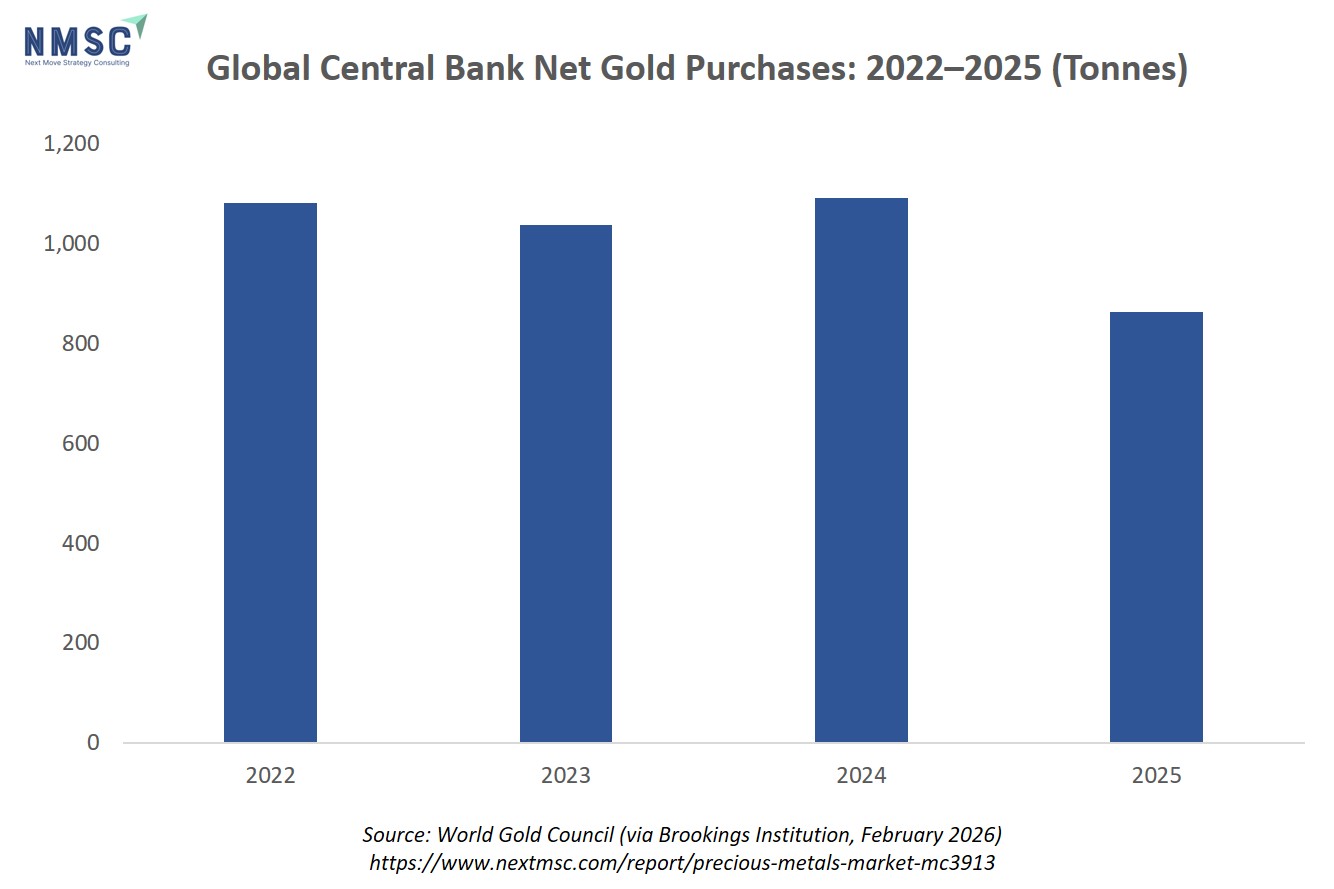
One of the most consequential demand drivers reshaping the precious metals market is the sustained accumulation of gold by central banks globally. According to CME Group's January 2026 Precious Metals Outlook, a World Gold Council survey of central bankers confirmed that 95% of respondents expected global central bank gold reserves to increase in the next 12 months — a figure that represents a fundamental shift in reserve management strategy, driven by a broader institutional desire to diversify away from U.S. dollar-denominated assets.
BlackRock's March 2026 analysis reinforces this trend, noting that gold overtook U.S. Treasuries as the largest share of global reserves for the first time in 30 years. Central banks, which hold approximately 20% of all mined gold, increased their gold reserves steadily from 2022 through 2025. With economies such as China and Brazil still holding less than 10% of their reserves in gold, the structural runway for continued central bank accumulation remains substantial. Furthermore, private wealth allocations to gold remain approximately 50% below levels seen a decade ago, suggesting meaningful room for incremental demand from Western institutional and retail investors.
Silver's Industrial Transformation: From Monetary Metal to Technology Essential
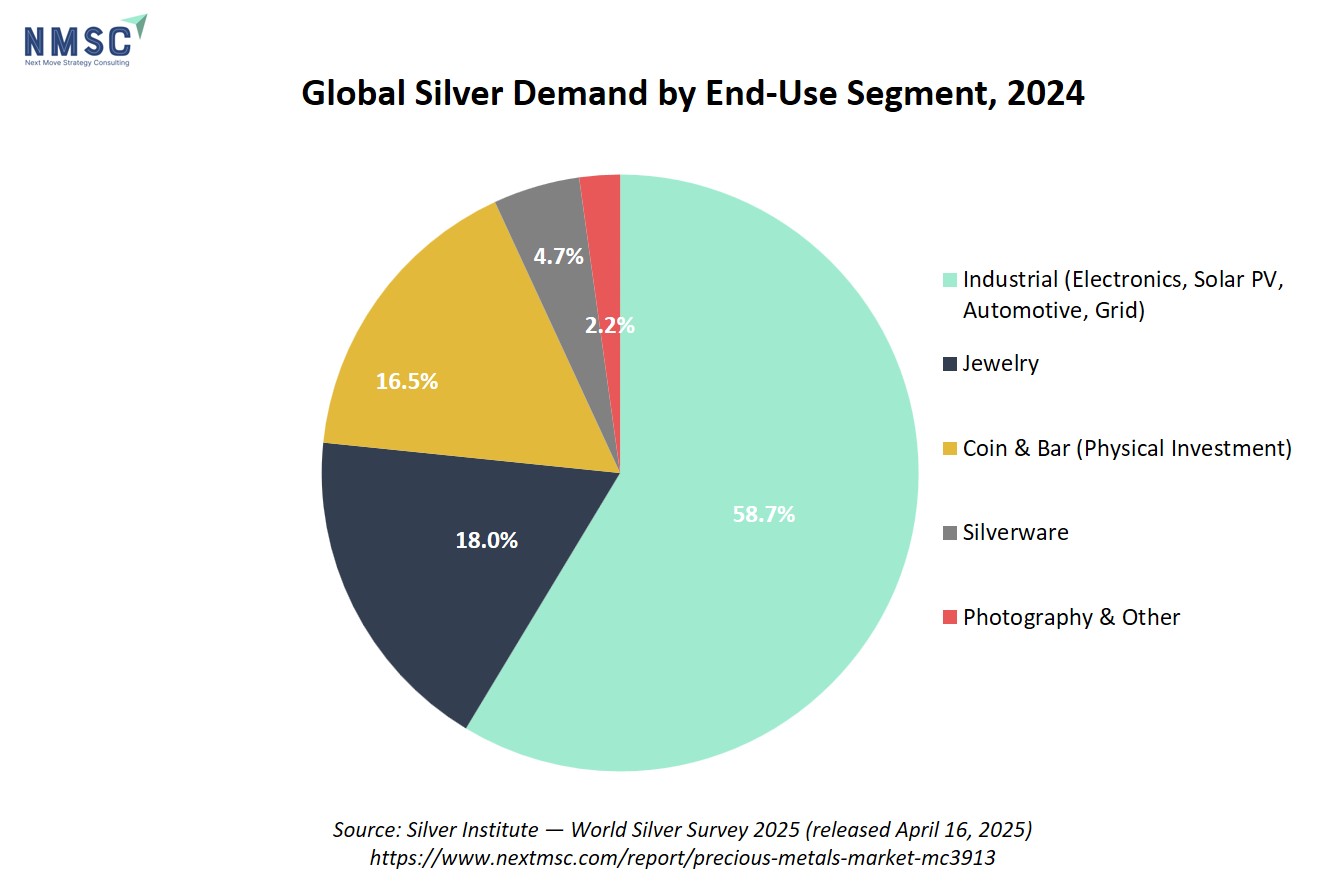
Silver's role in the precious metals market has undergone a fundamental transformation. According to BlackRock's March 2026 analysis, approximately 60% of annual silver consumption is tied to electronics, solar panels, and semiconductors, with electronics alone accounting for roughly 445 million ounces of silver demand per year. The ongoing buildout of data centers, rising power demand from artificial intelligence workloads, and broader electrification trends add a structurally growing industrial component to silver demand that is largely decoupled from purely investment-driven cycles.
CME Group's January 2026 Precious Metals Outlook highlighted that the silver market is navigating a fifth consecutive year of structural deficit, with industrial consumption continuing to outpace mine supply. Supply elasticity remains critically low, as most silver is mined as a by-product of copper, lead, or zinc production, meaning supply responses to price signals are inherently slow and insufficient to close the demand gap in the near term.
Platinum Group Metals: Supply Concentration and Green Energy Demand
Platinum and palladium face a distinct set of market dynamics. PGMs are critical inputs for automotive catalytic converters, hydrogen fuel cells, and emissions control technologies. The World Bank's April 2026 Commodity Markets Outlook projects platinum prices to average $1,950 per troy ounce in 2026 — a 52.5% increase from 2025 — reflecting both speculative demand and tight supply conditions. Global platinum production is projected to increase only slightly through 2026–27, reflecting limited gains in mine output in South Africa — the world's largest producer — and Zimbabwe. The platinum market is expected to remain in deficit in 2026, drawing down above-ground stocks further.
Section Summary: The industry impact of current market dynamics spans monetary policy, industrial supply chains, and geopolitical risk management. Central bank accumulation, silver's industrial transformation, and PGM supply constraints are collectively reshaping the competitive landscape of the precious metals market.
Key Takeaways:
-
95% of central banks surveyed expect global gold reserves to increase in 2026, per the World Gold Council.
-
Silver is in its fifth consecutive year of structural market deficit, with industrial demand outpacing mine supply.
-
Approximately 60% of annual silver consumption is tied to electronics, solar panels, and semiconductors.
-
Platinum prices are projected to average $1,950/toz in 2026, a 52.5% increase from 2025, per the World Bank.
World Bank Precious Metals Price Forecasts (2024–2027)
|
Metal |
Unit |
2024 (Actual) |
2025 (Actual) |
2026 (Forecast) |
2027 (Forecast) |
2026 % Change (y/y) |
|
Gold |
$/toz |
2,388 |
3,442 |
4,700 |
4,300 |
+36.6% |
|
Silver |
$/toz |
28.3 |
39.8 |
70.0 |
65.0 |
+75.9% |
|
Platinum |
$/toz |
955 |
1,278 |
1,950 |
1,700 |
+52.5% |
Future Outlook & Forecast
Precious Metals Market Trajectory: 2026–2035
The long-term outlook for the precious metals market remains constructive, underpinned by structural demand from the energy transition, continued institutional adoption, and supply constraints across key producing regions. According to the World Bank's April 2026 Commodity Markets Outlook, the precious metals price index is projected to rise by 42% year-on-year in 2026 before moderating by 8% in 2027, as geopolitical tensions ease and speculative positions unwind. The World Bank notes that risks remain tilted to the upside, particularly from renewed geopolitical tensions, policy uncertainty, and financial market volatility.
According to Next Move Strategy Consulting's proprietary research, the global precious metals market was valued at USD 390.53 billion in 2025 and is expected to reach USD 422.56 billion in 2026. Looking further ahead, the market is projected to expand significantly, reaching USD 858.87 billion by 2035, registering a compound annual growth rate (CAGR) of 8.2% from 2026 to 2035. This growth trajectory reflects the market's transition toward a more technology-driven, sustainability-focused, and investment-diversified future.
Key growth drivers identified by NMSC include the accelerating electrification of global economies, which is driving record industrial demand for silver and PGMs; the continued expansion of renewable energy capacity, particularly solar photovoltaic installations; and the growing adoption of digital trading platforms and tokenized metal products that are broadening investor participation. On the supply side, the expansion of secondary recycled supply through advanced e-waste recovery and hydrometallurgical processing is expected to partially offset primary mining constraints, while also meeting growing buyer and regulator demand for lower-carbon and ethically sourced inputs.
The competitive landscape is also evolving rapidly through strategic M&A activity. In April 2025, Northern Star Resources completed a USD 3.28 billion takeover of De Grey Mining, gaining control of the high-grade Hemi gold project, which is expected to boost its production to 2.5 million ounces per year by 2028–29. In September 2025, Barrick Gold released an updated preliminary economic assessment for the Fourmile project, projecting long-life production of 600–750 thousand ounces per year at very low costs of approximately USD 650–750 per ounce. These strategic moves signal that major producers are positioning for a sustained period of elevated prices and strong demand.
Section Summary: The precious metals market is positioned for sustained long-term growth, driven by structural demand from the energy transition, institutional adoption, and supply constraints. Near-term volatility from geopolitical developments and monetary policy shifts will create both risks and opportunities for strategic investors.
Key Takeaways:
-
The World Bank projects the precious metals price index to rise 42% year-on-year in 2026, with risks tilted to the upside.
-
According to NMSC, the global precious metals market is projected to reach USD 858.87 billion by 2035, at a CAGR of 8.2% from 2026 to 2035.
-
Northern Star's USD 3.28 billion acquisition of De Grey Mining and Barrick's Fourmile project update signal major producers' confidence in long-term market strength.
-
Silver's structural deficit — now in its fifth consecutive year — and PGM supply concentration will continue to support price premiums through the forecast period.
Next Steps for Stakeholders
For C-Level Executives and Corporate Procurement Leaders:
-
Establish multi-year offtake contracts for silver and PGMs to mitigate supply disruption risk, particularly given the structural deficits and geographic concentration of primary production in a small number of jurisdictions.
-
Invest in or partner with proven recycling technology providers to secure secondary supply streams that offer both cost advantages and ESG compliance benefits, as regulatory and corporate sustainability pressure intensifies across major markets.
-
Develop procurement strategies that account for the growing premium on traceable, responsibly sourced metals, and engage with upstream recyclers to build traceability so recycled content can be marketed at a premium.
For Institutional Investors and Portfolio Managers:
-
Reassess precious metals allocations in the context of the structural de-dollarization trend and the evolving role of gold as a reserve asset. BlackRock's analysis indicates that private wealth allocations to gold remain approximately 50% below levels seen a decade ago, suggesting meaningful room for incremental demand.
-
Consider differentiated exposure across the precious metals complex: gold as a strategic diversifier and store of value, silver as a higher-volatility metal with meaningful industrial demand exposure, and PGMs as a play on the green energy transition.
-
Monitor the development of tokenized metal products and gold-backed digital instruments as emerging channels for accessing precious metals exposure with improved liquidity and lower transaction costs.
For Mining Companies and Exploration-Stage Producers:
-
Prioritize assets in politically stable jurisdictions with strong regulatory frameworks and established processing infrastructure, as institutional capital increasingly rewards jurisdictional quality and ESG transparency.
-
Accelerate ESG integration and supply chain traceability initiatives, as end-users and regulators in major markets are raising premiums for certified, lower-carbon-footprint metals.
-
Evaluate M&A opportunities in the current environment, where elevated metal prices are improving project economics and enabling the conversion of resources to reserves at scale, as demonstrated by Northern Star's acquisition of De Grey Mining.
Conclusion
The precious metals market in 2026 is defined by a rare convergence of forces: a historic geopolitical shock from the Middle East conflict, structural industrial demand from the global energy transition, and a fundamental realignment of central bank reserve strategies. These forces have driven gold, silver, and platinum to record price levels, while simultaneously exposing the fragility of concentrated supply chains and the growing strategic importance of secondary recycled supply.
For decision-makers across the investment, industrial, and mining sectors, the key insight is that the precious metals market is no longer a purely cyclical commodity play. It has become a strategic asset class at the intersection of monetary policy, geopolitical risk management, and the technology-driven energy transition. The near-term volatility of 2026 — including the Q2 pullback from record highs — should be understood within this broader structural context rather than as a signal of trend reversal.
According to NMSC's proprietary research, the global precious metals market is projected to nearly double from USD 422.56 billion in 2026 to USD 858.87 billion by 2035, at a CAGR of 8.2%. Stakeholders who align their strategies with the structural demand drivers, supply chain resilience imperatives, and sustainability expectations of this evolving market will be best positioned to capture long-term value in one of the world's most strategically significant commodity sectors.
About the Author
 Sanyukta Deb
— Sanyukta Deb is Digital Marketing Team Lead at Next Move Strategy Consulting, where she has led content strategy and technical SEO for the firm's B2B market research publications for over 2 years. Her editorial process translates NextMSC's primary and secondary research — spanning technology, industrial, and consumer sectors — into commercial narratives, backed by search-intent, keyword, and competitive analysis. She brings 5 years of overall experience in digital marketing and content strategy.
Sanyukta Deb
— Sanyukta Deb is Digital Marketing Team Lead at Next Move Strategy Consulting, where she has led content strategy and technical SEO for the firm's B2B market research publications for over 2 years. Her editorial process translates NextMSC's primary and secondary research — spanning technology, industrial, and consumer sectors — into commercial narratives, backed by search-intent, keyword, and competitive analysis. She brings 5 years of overall experience in digital marketing and content strategy.
About the Reviewer
 Debashree Dey
— Debashree Dey is Assistant Manager at Next Move Strategy Consulting, where she supports cross-vertical market content and communications across diverse industries for 6 years. Her professional background includes senior content writing, communications, and published manuscript authorship, with experience developing audience-focused business narratives and maintaining clear, consistent messaging. Her role supports research-led content development and editorial quality across NextMSC publications.
Debashree Dey
— Debashree Dey is Assistant Manager at Next Move Strategy Consulting, where she supports cross-vertical market content and communications across diverse industries for 6 years. Her professional background includes senior content writing, communications, and published manuscript authorship, with experience developing audience-focused business narratives and maintaining clear, consistent messaging. Her role supports research-led content development and editorial quality across NextMSC publications.

















Add Comment