Howmet’s Forged Wheel Sales Rise as Falling Volumes Expose Market Pressures
Introduction
On August 6, 2026, Howmet Aerospace reported second-quarter revenue of USD 316 million for its Forged Wheels segment, a 14% increase on the same quarter of 2025, even though commercial transportation volumes fell 8%. The difference came from aluminum and other inflationary cost pass-through, which raised the price billed on each wheel while fewer wheels shipped. A reader who saw only the revenue line would conclude that demand for forged aluminum products was accelerating. The volume line points the other way, and the gap between those two readings is the reason businesses pay for independent market research instead of relying on headline growth rates.
According to Next Move Strategy Consulting's Aluminum Forging Market report, the global aluminum forging market was valued at USD 16.6 billion in 2025 and is projected to reach USD 33.92 billion by 2035, growing at a CAGR of 6.90% from 2026 to 2035. NextMSC primary research and analysis places the 2026 value at USD 17.75 billion. For an investor, a procurement head or a strategy team, the practical question is how much of that growth reflects shipped tonnage, how much reflects metal price, and which segments carry each.
For More Information: Download FREE Sample on Aluminum Forging Market Report
This article uses the 2026 aluminum forging cycle as a working test of what a market research provider must deliver. Each section sets a verified event from the last six months against a decision it complicates, and shows why businesses choose NextMSC to resolve it: transparent methodology, segment depth that matches how buyers decide, event-aware forecasting and direct analyst access.
Price Without Volume: What the 2026 Aluminum Forging Market Cycle Reveals
Howmet Aerospace: Forged Wheels Revenue Up 14% on 8% Lower Volumes
In its second-quarter 2026 results, published on August 6, 2026, Howmet Aerospace reported Forged Wheels third-party sales of USD 316 million against USD 276 million a year earlier. The company attributed the 14% increase to aluminum and other inflationary cost pass-through, which more than offset 8% lower volumes in the commercial transportation market. Segment Adjusted EBITDA margin rose approximately 30 basis points to 27.8%, which Howmet Aerospace's Form 10-Q for the quarter ended June 30, 2026 links to cost reductions, including lower net headcount.
The first quarter followed the same pattern. Howmet Aerospace's first-quarter 2026 results showed Forged Wheels revenue up 17% to USD 295 million with 11% lower commercial transportation volumes, and the second-quarter Form 10-Q states that demand in those markets is expected to remain low in 2026. Three conclusions follow. Revenue growth in forged aluminum products is currently a pricing event. Margin is being protected by cost action rather than by volume. And any model that extrapolates revenue without separating metal price from shipped units will overstate underlying demand.
The divergence inside Howmet Aerospace is equally instructive. The same release shows total revenue up 24% to USD 2.55 billion, with commercial aerospace up 28% and defense aerospace up 11%, so aluminum forging moves as a set of end-use markets, not as one market.
Alcoa and the Midwest Premium: A Price Signal Set by Tariffs and Supply Disruption
Alcoa Corporation's third-quarter 2026 results, issued on October 15, 2026, report an average realized third-party price of USD 4,527 per metric ton of aluminum, down USD 225 from USD 4,752 in the second quarter but well above USD 3,374 in the third quarter of 2025. Aluminum segment production rose for a sixth consecutive quarter to 649,000 metric tons, while total aluminum shipments fell 5% sequentially. Alcoa Corporation's Form 10-Q for the second quarter of 2026 recorded a 15% sequential rise in average aluminum prices, a 10% rise in the Midwest premium and a 47% rise in the Rotterdam premium, and attributed the increases to low inventory levels and supply disruptions, including those linked to the Middle East conflict.
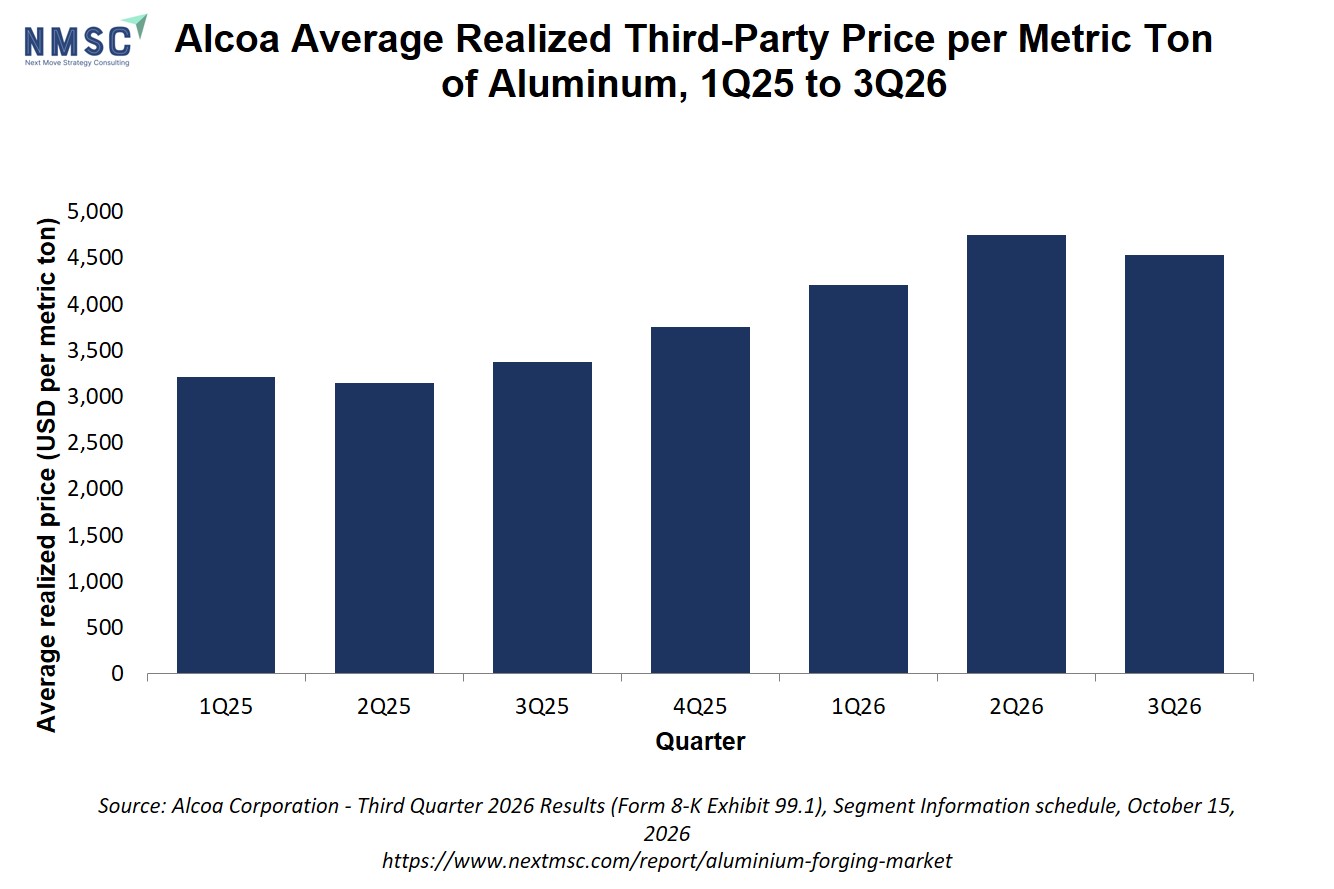
Alcoa Corporation's third-quarter 2026 results report an average realized third-party price per metric ton of aluminum of USD 3,213 in 1Q25, USD 3,143 in 2Q25, USD 3,374 in 3Q25, USD 3,749 in 4Q25, USD 4,209 in 1Q26, USD 4,752 in 2Q26 and USD 4,527 in 3Q26. The series fell in 2Q25, rose in each of the next four quarters and eased in 3Q26. Alcoa defines the realized price as the sum of the London Metal Exchange base metal component, the regional premium and the product premium.
The regional premium matters to forgers because it is the price a US buyer pays above the London Metal Exchange benchmark for physical metal. Reuters reported on September 10, 2026 that the Midwest premium stood at USD 1.09 per pound, or USD 2,403 per metric ton, after easing from a record USD 1.19 in June on hopes that the 50% import tariff on Canadian metal could be halved. Alcoa Corporation's chief financial officer, Molly Beerman, told Reuters that a lower Canadian rate alone would not return the premium to pre-tariff levels, because the United States imports about 4 million metric tons a year and Canada can supply 3 million. Alcoa pays more than USD 1 billion in tariffs on about 900,000 metric tons a year from Canada, which the Midwest premium compensates.
SIFCO Industries and Bharat Forge: Defense and Aerospace Orders Reshape Forging Demand
SIFCO Industries, a producer of forgings and machined components that NextMSC profiles among the key players in the aluminum forging market, announced third-quarter fiscal 2026 results on August 10, 2026. Net sales rose 18.3% to USD 26.1 million, and backlog at June 30, 2026 reached USD 164.2 million against USD 130.4 million a year earlier. SIFCO Industries' Form 10-Q attributes military net sales growth of USD 5.7 million to munitions, V-22 Osprey and UH-60 Black Hawk programs, while commercial net sales fell USD 1.7 million on reduced procurement for power generation and commercial space, partly offset by higher commercial aerospace demand. A USD 3.2 million LIFO expense effect from higher inventory costs held earnings near break-even.
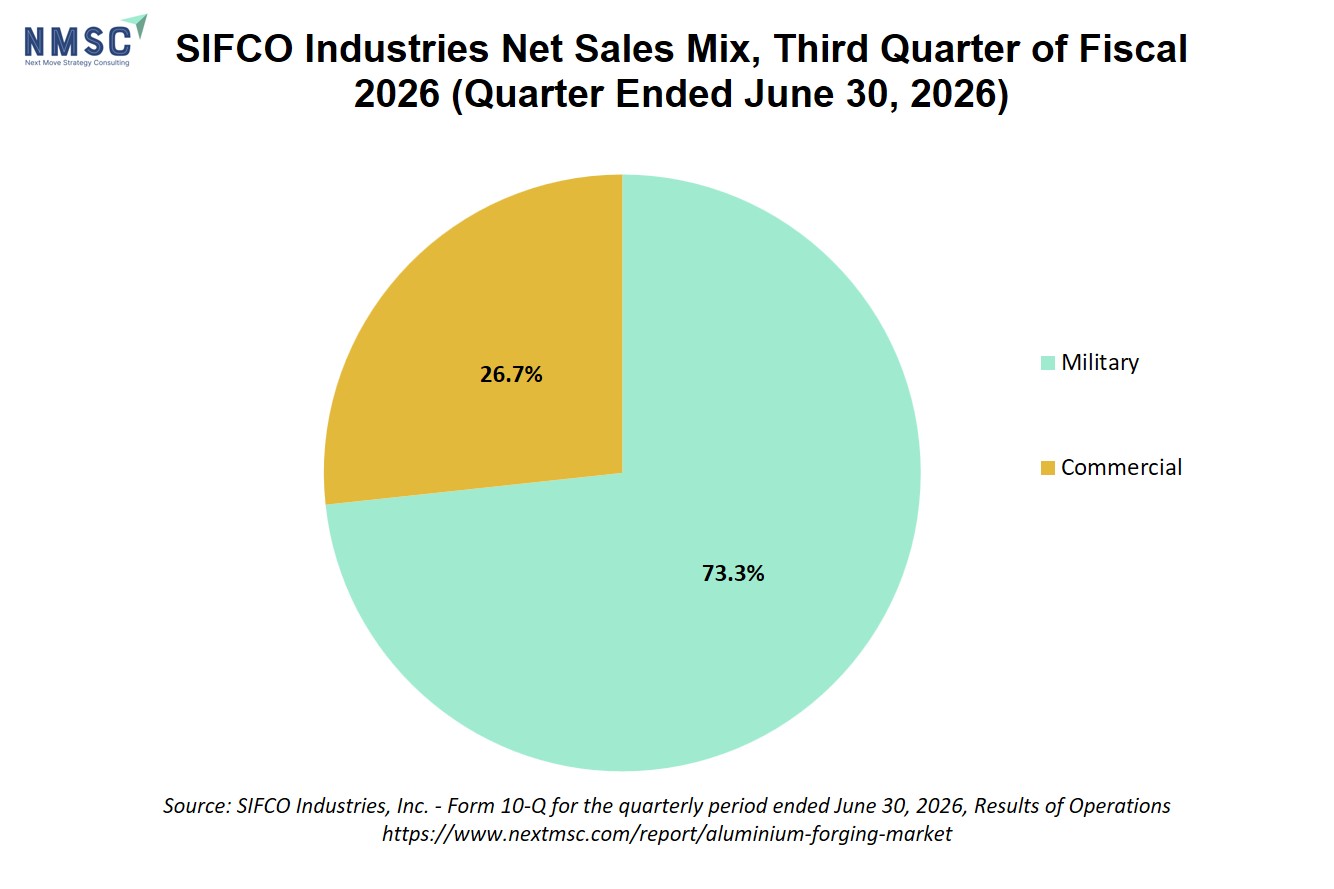
SIFCO Industries' Form 10-Q for the quarter ended June 30, 2026 reports that military net sales were 73.3% and commercial net sales were 26.7% of total net sales in the third quarter of fiscal 2026. In the third quarter of fiscal 2025 the split was 60.7% military and 39.3% commercial. Military net sales rose USD 5.7 million to USD 19.1 million, while commercial net sales fell USD 1.7 million to USD 7.0 million.
Bharat Forge Limited reported first-quarter fiscal 2027 results on August 10, 2026. Consolidated revenue from operations rose 18.7% to INR 4,640 crore, with the forgings segment up 7.7% and the defense business up 87.5%. Raw material costs rose 22.5%, and a restructuring provision for its German subsidiary produced an exceptional charge of INR 358 crore and a net loss of about INR 90 crore. Management attributed the quarter to inventory restocking, a rebound in North American truck production, and strong execution in aerospace and engine programs.
NMSC Strategic Perspective: Why Decision-Makers Choose NextMSC to Read the Aluminum Forging Market
NextMSC primary research and analysis reads these four disclosures as one pattern: price, volume and product mix moved in different directions at the same time, across different end markets. Howmet Aerospace's wheel revenue rose on pass-through while volumes fell, Alcoa Corporation's realized price eased in the third quarter while output kept rising, and SIFCO Industries and Bharat Forge show defense and aerospace orders absorbing capacity that commercial transportation and power generation left open. A single top-down growth rate cannot describe that picture, which is the practical reason businesses select NextMSC research: segment-level and price-tier evidence shows which layer produces the headline.
Four features of the NextMSC approach matter here, each drawn from the published scope and methodology of the Aluminum Forging Market report. First, market size is built with both top-down and bottom-up approaches, and the bottom-up build uses the revenue of the top 10 key players, so company disclosures such as those above feed the model directly. Second, the segmentation follows purchasing decisions: eight alloy series from 1000 to 8000, four forging types (open die, closed die, roll forging and extrusion), seven end-user categories and 28 countries. Third, the forecasting model applies multilinear regression, exponential smoothing, moving averages, ARIMA and Monte Carlo simulation, and its econometric layer attributes values to short-term and long-term event impacts from regulation, economic factors and market events. Fourth, analyst access and customization hours come with each license, so a buyer can test a scenario against its own assumptions.
A fifth point is specific to 2026. The report's Premium Insights chapter includes a tariff and geopolitical impact assessment, trade analysis of import and export dynamics and a value chain assessment. When the Midwest premium moves on a proclamation rather than on demand, a buyer needs that layer inside the forecast, not appended to it. NextMSC primary research and analysis also identifies Asia-Pacific as the dominant region and the high capital cost of forging equipment as the main barrier to entry, so capacity decisions require segment-level evidence rather than a global average.
Section Summary:
Four company disclosures from the last three months show revenue, price and orders diverging across forged aluminum end markets.
-
Howmet Aerospace's Forged Wheels revenue rose 14% in the second quarter of 2026 while commercial transportation volumes fell 8%, so pass-through, not demand, produced the growth.
-
Alcoa Corporation's realized aluminum price eased to USD 4,527 per metric ton in the third quarter of 2026 after four consecutive quarterly increases.
-
SIFCO Industries' military share of net sales reached 73.3% and Bharat Forge's defense revenue grew 87.5%, moving capacity toward defense programs.
-
NextMSC research is chosen because its method, segmentation and event-aware forecasting separate these layers instead of averaging them.
Industry Impact Analysis
US Section 232 Revisions: Full-Value Tariffs Reach the Aluminum Forging Market
Innovation, Science and Economic Development Canada set out the scale of the change in Question Period Note IND-2026-OP-00014, dated May 20, 2026. The United States revised its Section 232 tariff treatment of steel, aluminum and copper products by proclamation on April 2, 2026, effective April 6, 2026, sorting products into categories. Annex I-A goods generally face a 50% tariff on the full customs value of the imported good, while Annex I-B goods, a broader range of derivative and downstream manufactured products, generally face 25% on full value. The note adds that many derivative goods previously assessed on metal content alone now carry full-value treatment, and that some goods left the regime entirely.
For forged aluminum components, the consequence is a change in the tariff base. A part that once paid duty on its aluminum content can now pay on its whole value, so landed cost can rise even when the metal price falls. Whether a specific forging sits in Annex I-A, Annex I-B or outside the regime changes its cost, so product-level classification belongs inside a market model.
IEA Global EV Outlook 2026: Electric Car Demand Splits by Region
The International Energy Agency (IEA) published its Global EV Outlook 2026 in May 2026. It reports that electric car sales grew 20% in 2025 to exceed 20 million, lifting the share of new cars sold to 25%, and that global sales fell 8% in the first quarter of 2026 after policy changes in China and the United States. The Outlook expects 23 million electric car sales in 2026 and states that Chinese automakers supplied 60% of global electric car sales in 2025.
NextMSC primary research and analysis links automotive demand for forged aluminum to components such as pistons, suspension systems and chassis parts, where strength, durability and corrosion resistance matter. The IEA data shows why a global vehicle growth rate is a poor input: policy changes cut sales in two large markets in the first quarter of 2026 while others grew, and forged aluminum demand follows where vehicles are built and sold.
Airbus Deliveries: Aerospace Output Rises but Trails the Year's Required Pace
Reuters reported on October 8, 2026 that Airbus delivered 72 aircraft in September, bringing nine-month deliveries to 547, up 8% on the same point of 2025. Airbus is targeting about 870 deliveries for the full year, up 10% on 793 in 2025, which implies about 323 deliveries in the fourth quarter. The company recorded 17 gross orders in September and 1,105 net orders for the first nine months after cancellations.
Aluminum forgings feed airframe structures ahead of final delivery, so the gap between the year-to-date pace and the annual target is a timing risk for parts suppliers. A model that tracks only orders would miss that sequencing.
Section Summary:
Tariff design, regional vehicle policy and aircraft delivery timing each change forged aluminum demand in ways a single global average hides.
-
The April 2026 Section 232 revisions apply 50% or 25% duty on the full value of many goods, so tariff base and product classification now drive landed cost.
-
The IEA expects 23 million electric car sales in 2026 despite an 8% decline in the first quarter, so regional evidence outweighs a global rate.
-
Airbus needs about 323 deliveries in the fourth quarter to reach its 870 target, which makes timing a live risk for forged parts suppliers.
Pros and Cons of Recent Market Developments
|
Pros |
Cons |
|
Aerospace and defense order books are growing: SIFCO Industries' backlog reached USD 164.2 million at June 30, 2026 from USD 130.4 million. |
Commercial transportation volumes remain weak: Howmet Aerospace reports 8% lower second-quarter 2026 volumes and expects low demand through the year. |
|
Pass-through clauses protect forger margins: Howmet Aerospace's Forged Wheels margin reached 27.8%. |
Pass-through lifts revenue without lifting units, and SIFCO Industries' USD 3.2 million LIFO expense effect shows inventory costs still compress earnings. |
|
Regional premiums reward primary production: Alcoa Corporation says the Midwest premium compensates more than USD 1 billion of Canadian tariffs. |
US forgers pay that premium: USD 2,403 per metric ton in September 2026, on top of the London Metal Exchange price. |
|
Defense programs broaden demand: Bharat Forge's defense revenue rose 87.5% in the first quarter of fiscal 2027. |
Costs outpace forging revenue at some producers: Bharat Forge's raw material costs rose 22.5% and its forgings segment grew 7.7%. |
|
Electrification sustains lightweight component demand: the IEA expects 23 million electric car sales in 2026. |
Policy risk is real: global electric car sales fell 8% in the first quarter of 2026 after policy changes in China and the United States. |
Key Data & Statistics
Company Disclosures, 2026
|
Company |
Period |
Metric |
Reported Value |
|
Howmet Aerospace |
Q2 2026 |
Forged Wheels third-party sales |
USD 316 million (up 14%) |
|
Alcoa Corporation |
Q3 2026 |
Average realized aluminum price |
USD 4,527 per metric ton |
|
SIFCO Industries |
Q3 fiscal 2026 |
Net sales |
USD 26.1 million (up 18.3%) |
|
Bharat Forge Limited |
Q1 fiscal 2027 |
Revenue from operations |
INR 4,640 crore (up 18.7%) |
|
Airbus |
January to September 2026 |
Aircraft deliveries |
547 (up 8%) |
Future Outlook & Forecast
NextMSC primary research and analysis projects the aluminum forging market to rise from USD 17.75 billion in 2026 to USD 33.92 billion in 2035, a CAGR of 6.90% over the forecast period, which nearly doubles the market in value over nine years. Because the NextMSC model is built on value, the 2026 evidence on price pass-through matters to how the early years are read. Part of the near-term revenue growth in forged products is metal price, and the outlook depends on whether tonnage in aerospace, defense and automotive components grows enough to carry the market once metal prices settle.
Three conditions will determine whether the forecast path holds. The first is aircraft output: Airbus must deliver about 323 aircraft in the fourth quarter to reach about 870 for the year. The second is metal supply. Alcoa Corporation reaffirmed 2026 Aluminum segment production of 2.4 to 2.6 million metric tons and shipments of 2.6 to 2.8 million, expects higher production and shipments in the fourth quarter, and targets closing its South32 asset acquisition in the first half of 2027. The third is policy. The Section 232 regime and any Canadian tariff relief will set the US premium that forgers pay.
On the technology side, NextMSC primary research and analysis identifies computer-aided design and finite element analysis as tools that let forgers shorten die development and preview complex geometries before tooling. The restraint is capital: specialized forging presses and dies demand large upfront investment, so producers adding capacity need evidence on which alloy series, forging types and regions will carry demand. That is the second reason businesses choose NextMSC: a forecast is useful only if it can be tested against the capital decision it supports.
Section Summary:
The 6.90% CAGR is a value forecast, and the 2026 evidence shows that price, tonnage and policy each need to be tracked inside it.
-
NextMSC projects USD 33.92 billion by 2035 from USD 17.75 billion in 2026.
-
Airbus' fourth-quarter requirement of about 323 deliveries and Alcoa Corporation's reaffirmed 2026 output ranges are the near-term checkpoints.
-
Capital intensity makes segment-level evidence a precondition for new forging capacity.
Next Steps for Stakeholders
-
Executives: ask every research provider how its figure was built, including which company revenues feed the bottom-up estimate, and to separate price effects from volume effects before approving capacity plans.
-
Procurement leaders: map each forged component to the April 2026 Section 232 annexes and model landed cost under at least two Midwest premium scenarios, using USD 2,403 per metric ton (September 2026) as a reference.
-
Investors: treat revenue growth in forged products with caution when pass-through is rising, and check volume disclosures such as Howmet Aerospace's Forged Wheels data and backlog trends such as SIFCO Industries' USD 164.2 million.
-
Strategy teams: request the free sample to test segment depth against your product mix, then use customization hours for scenarios such as Canadian tariff relief or an Airbus delivery shortfall.
Conclusion
The 2026 aluminum forging market shows why a headline number is never a decision. Howmet Aerospace's wheel revenue rose 14% on 8% lower volumes, Alcoa Corporation's realized price rose and then eased, and SIFCO Industries and Bharat Forge moved toward defense work. Each fact points to a different layer of the same market, and each layer needs its own evidence.
That is why businesses choose NextMSC for market research: transparent top-down and bottom-up methodology, segmentation by alloy, forging type, end user, region and country, event-aware forecasting and analyst access. With NextMSC valuing the aluminum forging market at USD 16.6 billion in 2025 and USD 33.92 billion by 2035, the task for decision-makers is to know what each dollar of that growth is made of.
About the Author
 Sanyukta Deb
— Sanyukta Deb is Digital Marketing Team Lead at Next Move Strategy Consulting, where she has led content strategy and technical SEO for the firm's B2B market research publications for over 2 years. Her editorial process translates NextMSC's primary and secondary research — spanning technology, industrial, and consumer sectors — into commercial narratives, backed by search-intent, keyword, and competitive analysis. She brings 5 years of overall experience in digital marketing and content strategy.
About the Reviewer
 Debashree Dey
— Debashree Dey is Assistant Manager at Next Move Strategy Consulting, where she supports cross-vertical market content and communications across diverse industries for 6 years. Her professional background includes senior content writing, communications, and published manuscript authorship, with experience developing audience-focused business narratives and maintaining clear, consistent messaging. Her role supports research-led content development and editorial quality across NextMSC publications.












Add Comment