Augmented Reality and Virtual Reality Headset: Why Glasses Win | NextMSC
Introduction
On October 21, 2026, Meta Platforms reported that its Reality Labs segment generated USD 443 million of revenue in the third quarter, a 6% decline that the company attributed to lower Quest headset sales, while AI glasses revenue kept growing strongly enough to cover part of the gap. On the same earnings call, Chief Executive Officer Mark Zuckerberg said Meta will ship new virtual reality devices only when it has major breakthroughs. For hardware makers, component suppliers and investors, that statement is the clearest signal yet that immersive hardware is shifting from headsets worn for a session toward lightweight glasses worn through the day.
According to Next Move Strategy Consulting’s Augmented Reality and Virtual Reality Headset Market report, the global augmented reality and virtual reality headset market was valued at USD 4.48 billion in 2021 and is projected to reach USD 105.69 billion by 2030, growing at a CAGR of 35.3% from 2022 to 2030. NextMSC primary research and analysis also projects global extended reality headset shipments rising from 11 million units in 2021 to 271 million units in 2030, which explains why every large platform owner now competes on form factor as well as on price.
For More Information: Download FREE Sample on Augmented Reality and Virtual Reality Headset Market Report
This blog reviews what changed between mid-May and mid-November 2026 across five fronts: Meta’s retreat from frequent headset launches, the wearables revenue reported by EssilorLuxottica, Valve Corporation’s entry into standalone virtual reality, the first Android XR eyewear from Google and Samsung, and a finding by the U.S. Government Accountability Office on military augmented reality goggles. It then tests each development against NextMSC’s forecast logic and closes with practical steps for executives and investors.
Meta Pulls Back on VR Launches While Glasses Scale: What It Means for the Augmented Reality and Virtual Reality Headset Market
Meta’s third-quarter 2026 results, published on October 21, 2026, show how uneven the immersive hardware business has become. Reality Labs revenue was USD 443 million, compared with USD 470 million a year earlier, and Chief Financial Officer Susan Li attributed the 6% decline to lower Quest headset sales, partly offset by continued strong growth in AI glasses revenue. The segment’s operating loss was USD 4.13 billion, against USD 4.43 billion a year earlier, and Meta Platforms guided to a 2026 Reality Labs loss of USD 18 billion to USD 19 billion. Reality Labs contributed less than 1% of Meta’s USD 64.60 billion of group revenue, which is why the company can pace its headset investment without putting group earnings at risk.
Mark Zuckerberg said on the October 21, 2026 earnings call that Meta is changing its approach to virtual reality to ship new devices only when it has “major breakthroughs”, and he cited the Meta VR Glasses announced at Connect in September 2026 as the example. Meta describes those glasses as weighing about 100 grams, which it says is five times lighter than Meta Quest 3, with the processor and battery moved into a separate pack. They will sell for USD 1,299.99 when they launch in spring 2027. Zuckerberg added that Meta will pace virtual reality spending behind its personal superintelligence priority.
The glasses side of the portfolio is where reported revenue is growing. EssilorLuxottica, the eyewear group that builds Meta’s AI glasses, reported on October 20, 2026 that its wearables category, which combines AI glasses and Nuance Audio hearing glasses, grew revenue by 20% at constant exchange rates in the third quarter, despite an increasingly challenging comparison base. Wearables revenue reached €486 million in the quarter and €1,261 million across the first nine months, against group revenue of €7,486 million and €22,304 million respectively. At 5.65% of nine-month group revenue, wearables remain small beside the traditional eyecare and medtech business, but they are now a separate reported line that investors can track every quarter.
Valve Corporation is the newest entrant in standalone virtual reality. On September 14, 2026, Valve opened reservations for Steam Frame, a standalone headset built on a Snapdragon 8 Gen 3 processor that runs SteamOS and can stream PC games. It is priced at USD 1,059 for 256 GB and USD 1,299 for 1 TB, and Valve allocated units through a randomized reservation lottery instead of first-come orders. The USD 240 gap between the two configurations buys an additional 768 GB of storage, so storage is priced as a major upgrade rather than an afterthought.
Valve’s own Steam Hardware & Software Survey for October 2026, published on November 2, 2026, shows how concentrated the PC-connected installed base remains. Meta-built devices occupy the top three rows of the survey’s headset table, and Steam Frame already appears in the table in its first full month on sale.
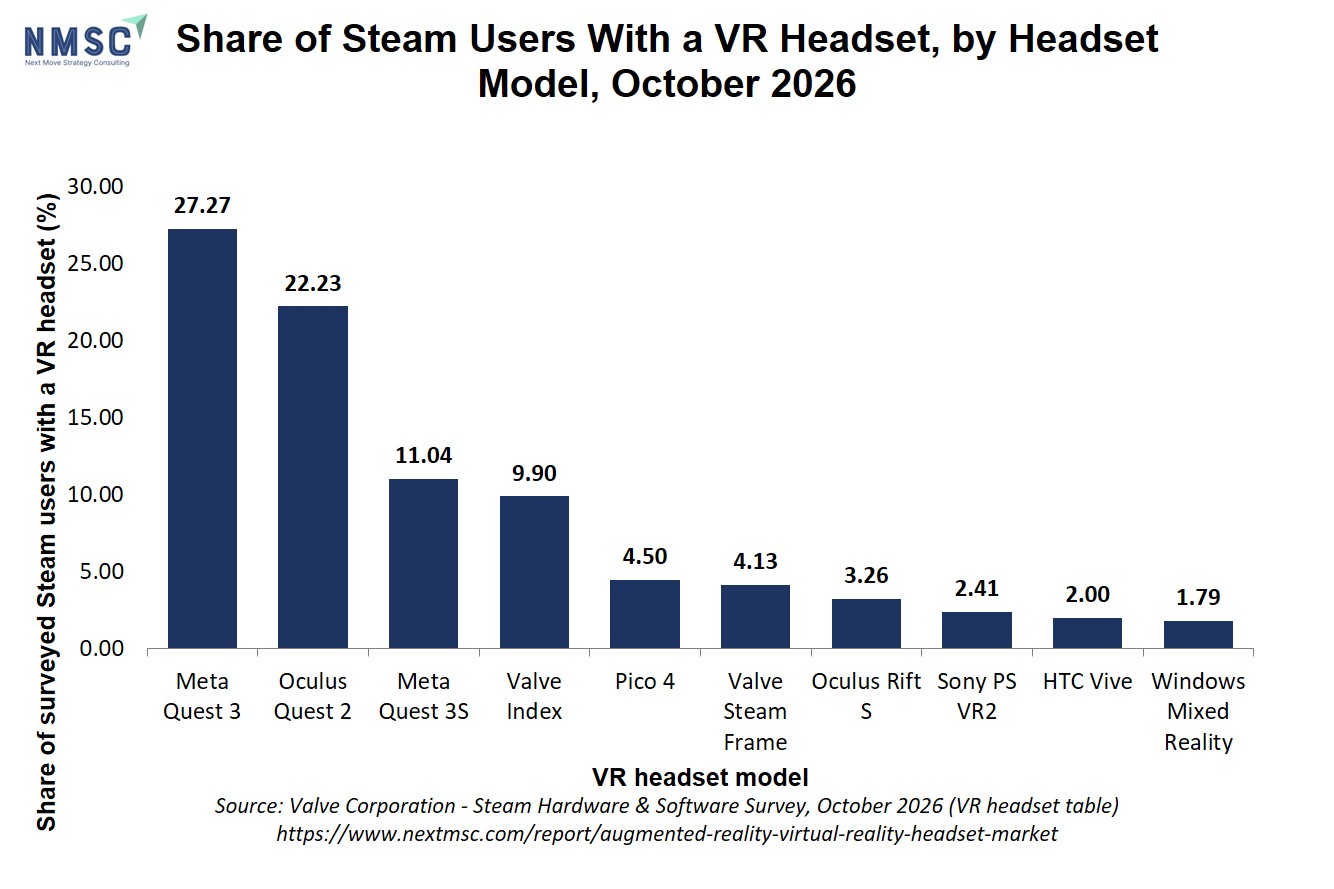
In Valve’s October 2026 survey, Meta Quest 3 holds 27.27%, Oculus Quest 2 holds 22.23% and Meta Quest 3S holds 11.04%, which together total 60.54% of surveyed Steam users with a VR headset. Valve Steam Frame appears at 4.13% in its first full month on sale. Valve states that survey participation is optional and anonymous, and the table covers only headsets connected to Steam.
Google and Samsung opened pre-orders for the first Android XR eyewear on November 12, 2026, with sales starting on December 10, 2026 in the United States and South Korea. Warby Parker frames start at USD 395 and Gentle Monster frames range from USD 449 to USD 489. The glasses are display-free audio glasses with Gemini assistance, run on a Qualcomm Snapdragon AR1 Gen 1 processor with 2 GB of RAM and 64 GB of storage, and pair with Android phones and with iPhone 13 Pro and later models. Google also stated that the glasses redact bystanders’ faces before Gemini processes camera images.
At the other end of the price range, Snap Inc. announced on June 16, 2026, at the Augmented World Expo in Long Beach, that its consumer Specs augmented reality glasses will cost USD 2,195, with a USD 200 refundable deposit for pre-orders and shipments planned for fall 2026 in the United States, the United Kingdom and France. The self-contained glasses use two Snapdragon processors and offer a 51-degree field of view. Between a USD 395 audio frame and a USD 2,195 display device, Meta’s USD 1,299.99 VR Glasses and Valve’s USD 1,059 headset now fill the middle of a visible price ladder.
NMSC Strategic Perspective: Form Factor Now Sets the Growth Curve in the Augmented Reality and Virtual Reality Headset Market
NextMSC primary research and analysis reads the second half of 2026 as a form-factor transition inside the augmented reality and virtual reality headset market rather than a contraction of it. NextMSC’s segmentation covers virtual reality, augmented reality and extended reality headsets, and the 271 million unit shipment trajectory for 2030 holds only if lighter devices absorb the volume that bulkier headsets no longer capture.
The evidence now points in that direction on three measurable fronts. First, Meta reported lower Quest sales and higher AI glasses revenue in the same quarter. Second, the three launches announced since September, Meta VR Glasses, Steam Frame and Android XR eyewear, carry prices between USD 395 and USD 1,299.99, a band of entry points instead of a single flagship price. Third, in military augmented reality, a segment where users were asked to accept a heavy headset for professional work, soldiers told evaluators the devices were difficult to wear and no better than existing equipment, as the U.S. Government Accountability Office reported.
NextMSC’s view is that value is migrating toward the lighter augmented reality and extended reality categories within its segmentation, not disappearing. Suppliers of micro-OLED displays, low-power processors and optics gain from that migration, while makers of heavy tethered headsets face a narrower base.
Section Summary:
Immersive hardware has split into three tiers in 2026: audio glasses from USD 395, mid-priced VR and standalone headsets from USD 1,059 and display glasses at USD 2,195. Meta’s own results show the demand shift, with Quest sales lower and AI glasses revenue higher.
-
Meta Reality Labs revenue fell 6% to USD 443 million in Q3 2026 on lower Quest sales.
-
EssilorLuxottica wearables revenue reached €486 million in Q3 2026, up 20% at constant exchange rates.
-
Valve, Google, Samsung and Snap have all announced new devices since June 2026.
Industry Impact Analysis: Memory Costs, Defense Procurement and Platform Commitments in the Augmented Reality and Virtual Reality Headset Market
Memory pricing is the cost pressure that touches every form factor. On June 3, 2026, trade groups including the Alliance for Automotive Innovation, the National Retail Federation, the Medical Device Manufacturers Association, NCTA and the Telecommunications Industry Association wrote to the U.S. Treasury and Commerce departments, as reported by Reuters, warning of an “unprecedented surge in the price of memory chips” caused by AI data center consumption. Valve’s USD 240 premium for the 1 TB Steam Frame shows that this cost reaches standalone headsets, where memory and storage sit inside the device, and the 2 GB and 64 GB specification of the Android XR eyewear shows how a smaller memory footprint fits a USD 395 entry price.
Defense procurement offers the sharpest cautionary example. The U.S. Government Accountability Office’s annual weapon systems assessment, reported by Military Times on July 8, 2026, found that nearly 10,000 Integrated Visual Augmentation System headsets produced between 2018 and 2025 are obsolete and will remain in storage. The report said soldiers found the headsets difficult to wear and that they did not perform better than existing equipment. The program’s effort now continues under Soldier Borne Mission Command, a contract held by Anduril, which will use about 400 version 1.2 goggles to inform its design. For enterprise buyers, the finding shows that weight, comfort and field testing decide whether an augmented reality headset reaches users, regardless of how advanced its display is.
Apple is positioning visionOS as a professional platform. At its “Meet with Apple” developer session held in November 2026, Yuri Imoto, a product manager in Apple’s Spatial Computing division, said Apple is “very committed to the platform”, as reported by Road to VR on November 13, 2026. Apple highlighted surgery, healthcare, education, training and immersive film as the areas where spatial computing is growing in importance. Road to VR noted that Apple’s most recent headset release was the M5 refresh of Vision Pro in October 2025, which it described as an incremental upgrade, so Apple’s near-term influence on the augmented reality and virtual reality headset market runs through software and enterprise use cases more than through new hardware.
Platform strategy is also being rewritten at Meta. Zuckerberg said on the October 21, 2026 call that Meta’s Muse personal agent will reach Meta Glasses starting in November 2026, and that Meta priced its devices to build a software and superintelligence business on top of them rather than to earn large hardware margins. Meta Platforms also stated that its catalog across Ray-Ban, Oakley and Meta Glasses will pass 100 styles by the end of 2026.
Section Summary:
Memory costs, procurement discipline and platform choices are now shaping where hardware investment goes. Each of the three favors lighter, cheaper and better-tested devices.
-
Reuters reported a June 3, 2026 industry letter warning of price increases from the memory chip shortage.
-
The U.S. Government Accountability Office found nearly 10,000 IVAS headsets obsolete and in storage.
-
Apple reaffirmed its visionOS commitment in November 2026 while naming healthcare and training as priorities.
Pros and Cons of Recent Market Developments
The developments since mid-May 2026 bring clear gains in choice and price access, and clear constraints in cost and volume. The table below sets them side by side.
|
Pros |
Cons |
|
A price ladder from USD 395 to USD 2,195 lets buyers choose a form factor by budget. |
Devices at USD 1,059 and above limit volume to enthusiasts and professionals. |
|
Meta’s AI glasses growth offsets part of the Quest decline inside Reality Labs. |
Reality Labs revenue still fell 6% to USD 443 million, and the segment lost USD 4.13 billion in the quarter. |
|
EssilorLuxottica reports wearables as a separate line, which improves revenue visibility. |
Wearables grew 20% at constant exchange rates on an increasingly challenging comparison base. |
|
Valve and Google add credible platform rivals to Meta. |
Valve rations Steam Frame through a reservation lottery, which limits near-term volume. |
|
Apple reaffirms its visionOS commitment for healthcare, education and training. |
The U.S. Government Accountability Office found nearly 10,000 IVAS headsets obsolete, a caution for enterprise augmented reality procurement. |
Key Data & Statistics
The tables below consolidate the launch prices, financial indicators and NextMSC forecast figures cited in this blog, so that procurement teams and investors can compare them in one place.
Selected Headset and Glasses Launches Announced Since May 2026
|
Company |
Device |
Form Factor |
Announced Price (USD) |
Availability |
|
Meta Platforms |
Meta VR Glasses |
VR glasses with separate processor pack |
1,299.99 |
Spring 2027 |
|
Valve Corporation |
Steam Frame (256 GB / 1 TB) |
Standalone VR headset |
1,059 / 1,299 |
Reservations opened September 14, 2026 |
|
Snap Inc. |
Specs |
Standalone AR glasses |
2,195 |
Fall 2026 (US, UK, France) |
|
Google and Samsung with Warby Parker |
Android XR Intelligent Eyewear |
Display-free AI glasses |
From 395 |
December 10, 2026 (US, South Korea) |
|
Google and Samsung with Gentle Monster |
Android XR Intelligent Eyewear |
Display-free AI glasses |
449 to 489 |
December 10, 2026 (US, South Korea) |
Reported Financial and Program Indicators
|
Indicator |
Reported Value |
Period |
Reporting Organisation |
|
Reality Labs revenue |
USD 443 million (USD 470 million a year earlier) |
Q3 2026 |
Meta Platforms |
|
Reality Labs operating loss |
USD 4.13 billion (USD 4.43 billion a year earlier) |
Q3 2026 |
Meta Platforms |
|
Reality Labs loss guidance |
USD 18 billion to USD 19 billion |
Full year 2026 |
Meta Platforms |
|
Reality Labs loss outlook |
About USD 15 billion |
2027 |
Meta Platforms |
|
Wearables revenue |
€486 million (up 20% at constant exchange rates) |
Q3 2026 |
EssilorLuxottica |
|
Wearables revenue |
€1,261 million |
First nine months of 2026 |
EssilorLuxottica |
|
IVAS headsets left in storage |
Nearly 10,000 units |
Produced 2018 to 2025 |
U.S. Government Accountability Office |
NextMSC Forecast Summary
|
Metric |
Base Year Value |
Forecast Value |
Period and CAGR |
|
Global market value |
USD 4.48 billion (2021) |
USD 105.69 billion (2030) |
2022 to 2030, CAGR of 35.3% |
|
Global XR headset shipments |
11 million units (2021) |
271 million units (2030) |
2021 to 2030 |
EssilorLuxottica’s nine-month revenue mix puts the wearables shift in proportion. Eyecare and medtech still account for the large majority of the group’s revenue, while wearables have grown into a category that the company now reports on its own.
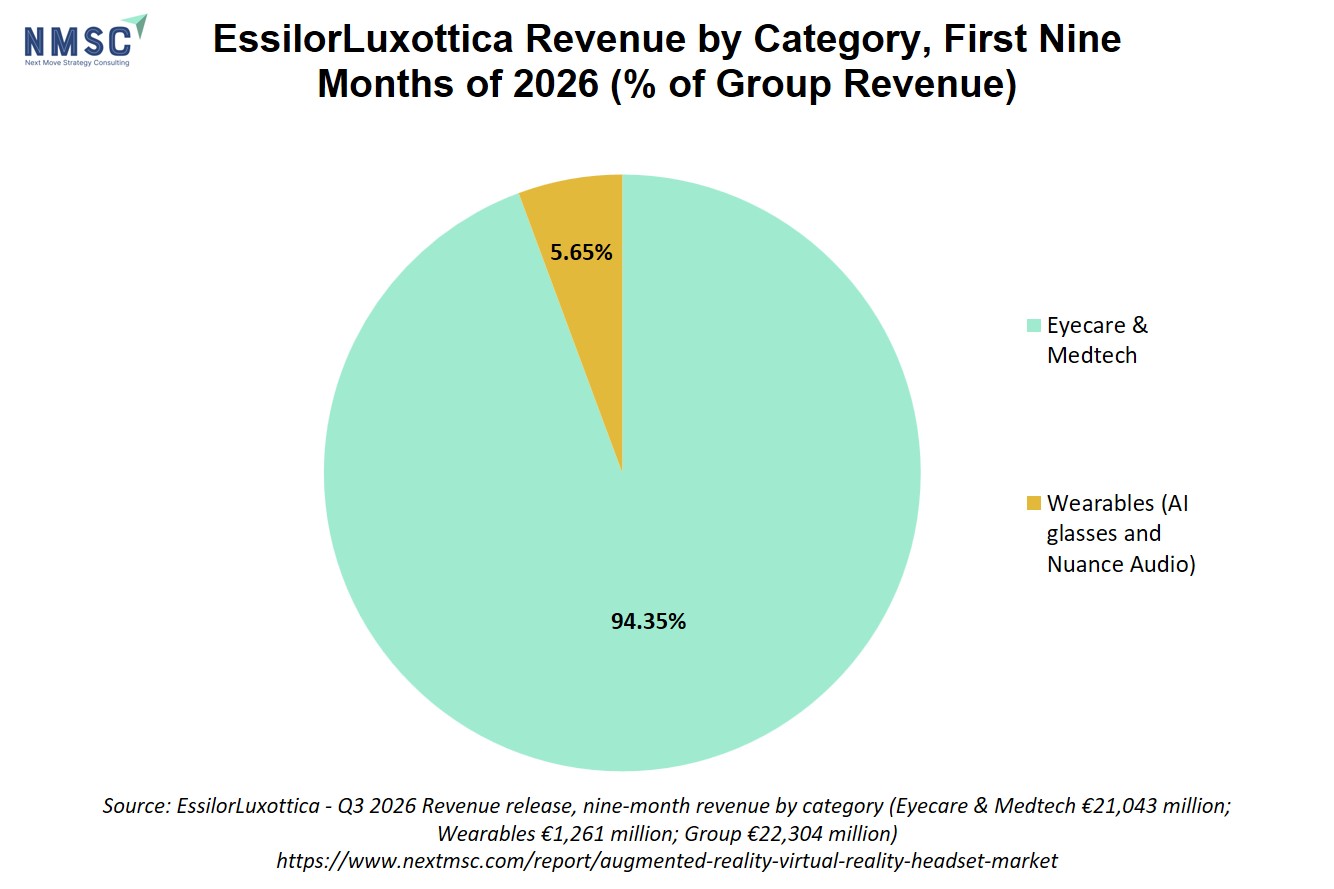
EssilorLuxottica reported nine-month 2026 revenue of €22,304 million, of which Eyecare & Medtech contributed €21,043 million and Wearables contributed €1,261 million. The shares shown are calculated from those reported amounts and total exactly 100.0%.
Future Outlook & Forecast for the Augmented Reality and Virtual Reality Headset Market
NextMSC primary research and analysis projects the global market to grow from USD 4.48 billion in 2021 to USD 105.69 billion by 2030, a CAGR of 35.3% from 2022 to 2030 and a rise of nearly 24 times over the period. Shipments are projected to climb from 11 million units to 271 million units. Meta’s decision to slow VR launches does not by itself contradict that trajectory, because NextMSC’s segmentation spans virtual reality, augmented reality and extended reality headsets, so volume can move between categories inside the forecast scope.
The next twelve months contain a dated sequence of company commitments. Google and Samsung eyewear goes on sale on December 10, 2026. Snap has said Specs will ship in fall 2026. Meta’s Muse agent reaches Meta Glasses in November 2026, and Meta VR Glasses launch in spring 2027. Meta Platforms has also stated that it expects Reality Labs losses to narrow to about USD 15 billion in 2027 and to trend toward profitability afterwards, as spending is reallocated toward AI. Each date gives investors a checkpoint against which to test NextMSC’s volume assumptions.
Three variables will decide the pace. Memory costs will determine whether entry prices such as USD 395 hold. Privacy design will determine whether camera-equipped glasses can enter workplaces and public venues, and Google’s face-redaction feature is an early answer. Software ecosystems will determine retention, which is why Valve, Apple and Meta position SteamOS, visionOS and Muse as reasons to buy.
Section Summary:
NextMSC’s forecast remains anchored on lighter devices absorbing volume as heavy headsets plateau. Company-stated launch dates from November 2026 to spring 2027 provide a practical test of that view.
-
NextMSC projects USD 105.69 billion in 2030 at a 35.3% CAGR from 2022.
-
Meta expects Reality Labs losses to narrow to about USD 15 billion in 2027.
-
Memory costs, privacy design and software ecosystems are the three variables to monitor.
Next Steps for Stakeholders
The developments above call for different actions from hardware leaders, enterprise buyers and investors.
-
Hardware and component executives: map each product line to the three price tiers (USD 395 to USD 489, USD 1,059 to USD 1,299.99, and USD 2,195) and decide which tier your display, optics and processor supply can serve at current memory costs.
-
Chief procurement officers in healthcare, manufacturing and training: require field testing in operating conditions, including wear time and low-light performance, before approving large headset orders, using the IVAS outcome as the reference case.
-
Chief financial officers: model memory pricing as a standing variable in device bills of materials, since Valve’s USD 240 storage premium and the Reuters-reported June 3, 2026 industry letter both point to persistent cost exposure.
-
Investors: track EssilorLuxottica’s reported wearables revenue each quarter alongside Meta’s Reality Labs revenue, because the two together show whether glasses growth is outpacing the Quest decline.
-
Platform and software teams: prioritize SteamOS, Android XR and visionOS compatibility, since Valve, Google and Apple are all competing on software reach as much as on hardware.
-
Strategy leaders: schedule decision reviews around the December 10, 2026 Android XR launch, Snap’s fall 2026 Specs shipments and Meta’s spring 2027 VR Glasses launch.
Conclusion
The augmented reality and virtual reality headset market is changing shape faster than its headline numbers suggest. Meta’s lower Quest sales and higher AI glasses revenue, EssilorLuxottica’s separately reported wearables line, Valve’s USD 1,059 entry, Google and Samsung’s December 10, 2026 eyewear launch, Snap’s USD 2,195 Specs and the Government Accountability Office’s IVAS finding all point to the same conclusion: weight, price and software decide adoption. NextMSC’s forecast of USD 105.69 billion by 2030 depends on lighter devices absorbing the volume that heavy headsets no longer capture, and the next four quarters of company disclosures will show how quickly that happens.
About the Author
 Sanyukta Deb
— Sanyukta Deb is Digital Marketing Team Lead at Next Move Strategy Consulting, where she has led content strategy and technical SEO for the firm's B2B market research publications for over 2 years. Her editorial process translates NextMSC's primary and secondary research — spanning technology, industrial, and consumer sectors — into commercial narratives, backed by search-intent, keyword, and competitive analysis. She brings 5 years of overall experience in digital marketing and content strategy.
About the Reviewer
 Debashree Dey
— Debashree Dey is Assistant Manager at Next Move Strategy Consulting, where she supports cross-vertical market content and communications across diverse industries for 6 years. Her professional background includes senior content writing, communications, and published manuscript authorship, with experience developing audience-focused business narratives and maintaining clear, consistent messaging. Her role supports research-led content development and editorial quality across NextMSC publications.













Add Comment