How AI and Robotics Are Reshaping Modern Intralogistics Software | NextMSC
Introduction
The global warehouse is no longer a passive storage facility — it is a software-orchestrated operating environment where autonomous robots, real-time sensor networks, and AI-driven decision engines must function in precise coordination. At the center of this transformation sits the intralogistics software market, which is scaling at a pace that reflects the structural urgency enterprises now place on internal logistics intelligence.
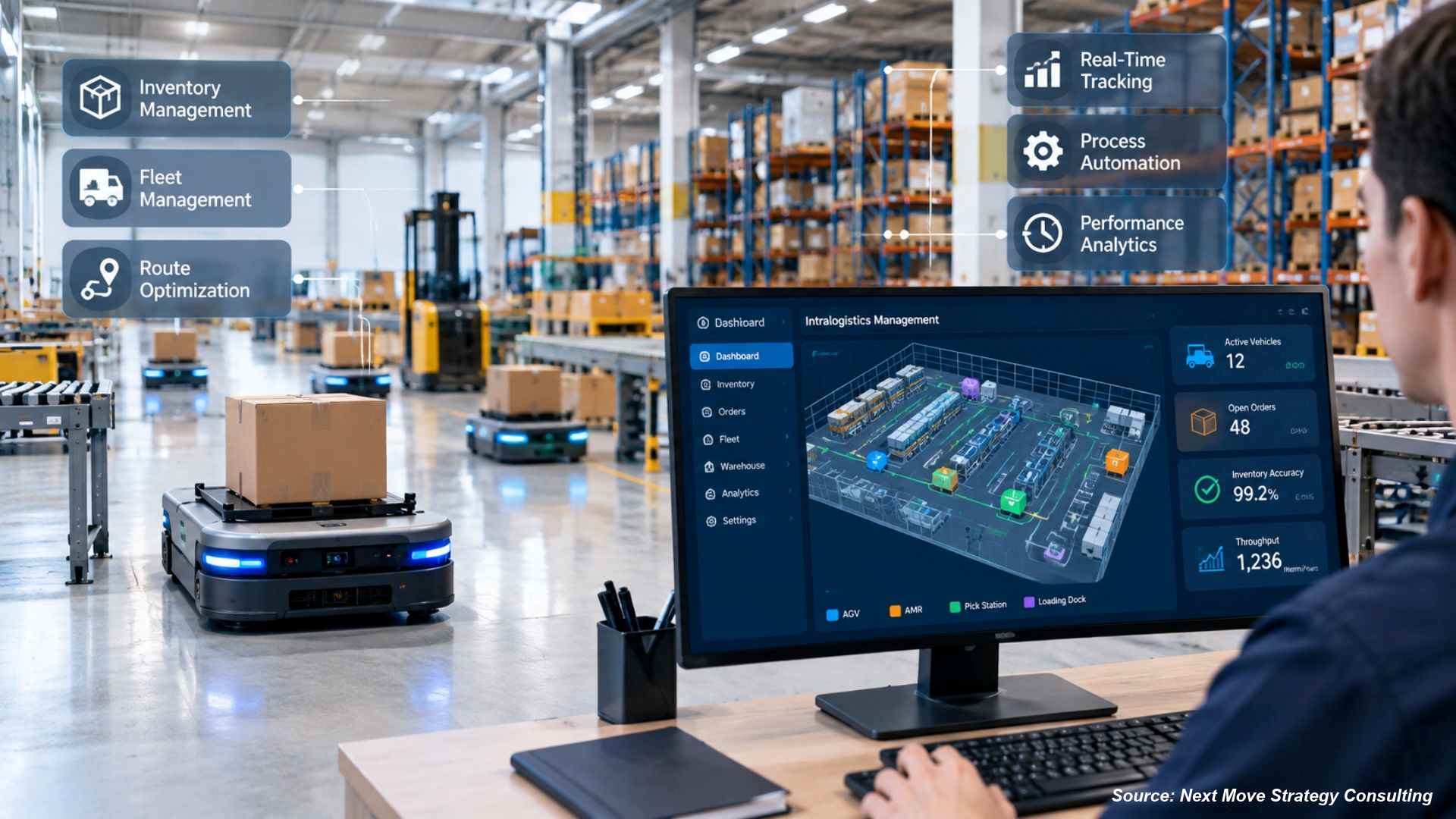
According to Next Move Strategy Consulting's Intralogistics Software Market report, the global intralogistics software market was valued at USD 11.30 billion in 2025 and is projected to reach USD 49.12 billion by 2035, growing at a CAGR of 15.83% between 2026 and 2035. NMSC's model — which applies primary enterprise consultations, bottom-up segment analysis, and proprietary deployment-mode weighting across 33 countries — places the market at USD 13.22 billion by the end of 2026. This trajectory is not driven by incremental digitalization; it is driven by the convergence of chronic labor shortages, the explosive growth of omnichannel fulfilment, and the maturation of AI-enabled warehouse orchestration platforms that can coordinate AMRs, AS/RS systems, conveyors, and human workers within a single execution layer.
For More Information: Download FREE Sample on Intralogistics Software Market Report
Software as the New Warehouse Infrastructure: Key Trends Reshaping the Market
The Dematic–Hai Robotics European Partnership: A Blueprint for Software-Led AMR Integration
In January 2026, Dematic and Hai Robotics signed a formal Europe-wide integration partnership, combining Dematic's warehouse automation solutions with Hai Robotics' Autonomous Case-handling Robots (ACRs) to deliver scalable goods-to-picker systems across European distribution centres. The significance of this agreement extends beyond hardware: the integration requires Dematic's warehouse execution software to natively orchestrate Hai's ACR fleets alongside existing conveyor and sortation infrastructure — a direct demonstration of how intralogistics software has become the binding layer that determines whether multi-vendor automation environments function cohesively or fragment into isolated silos.
This partnership reflects a broader structural shift that NMSC's primary research has identified across enterprise warehouse deployments: procurement decisions are increasingly evaluated not on the capabilities of individual automation components, but on the software platform's ability to manage real-time task allocation, exception handling, and robot orchestration across heterogeneous equipment fleets. Vendors that cannot demonstrate seamless multi-vendor interoperability — through open protocols such as MQTT, OPC-UA, and RESTful APIs — are being systematically excluded from enterprise shortlists in Europe and North America.
The Dematic–Hai Robotics agreement also signals a competitive reconfiguration in the European intralogistics software market, where NMSC's analysis attributes 27.87% of global market share to the region. As European enterprises face tightening GDPR compliance requirements alongside rising e-commerce fulfilment complexity, software platforms that can simultaneously manage robotics orchestration, data governance, and real-time inventory synchronisation across multi-site networks are commanding premium positioning.
Honeywell's Cloud-Native WES: Redefining the Cost Architecture of Warehouse Execution
In March 2025, Honeywell announced that its Momentum Warehouse Execution Software (WES) is now available as a cloud-based platform, enabling distribution and fulfilment operations to access real-time warehouse data, AI-powered analytics, and remote configuration without the capital burden of on-premises IT infrastructure. "Today's complex global supply chain is seeing a growing need for cloud-based solutions that can store and make data accessible across both users and locations," said Chad Briggs, President of Honeywell Intelligrated, in the company's official press release dated March 18, 2025. "Honeywell is leading the market by launching a cloud-based WES that will give customers the ability to access real-time warehouse data from anywhere, enhancing operational efficiency and increasing agility in managing the supply chain, while keeping data secure."
This launch directly addresses the cost barrier that has historically constrained mid-sized warehouse operators from adopting enterprise-grade execution software. By shifting WES to a cloud-native architecture, Honeywell eliminates the upfront server infrastructure investment, enables remote security patch deployment, and allows AI model integration — including predictive labour allocation and throughput optimisation — without requiring on-site computing upgrades. This is precisely the deployment model that NMSC's proprietary research identifies as the dominant adoption pathway: cloud-based deployments currently hold a 68.60% share of the intralogistics software market, preferred for scalability, lower upfront costs, and seamless integration with existing enterprise ecosystems.
Two months later, in May 2025, Honeywell extended this cloud-native strategy by partnering with Teradyne Robotics to deploy Autonomous Mobile Robots (AMRs) and collaborative robots in conjunction with the Momentum WES platform, enabling intelligent material transport and scalable warehouse automation across the Americas and Europe. The combination of a cloud-native WES and a validated AMR integration framework positions Honeywell to capture enterprise accounts that require both software intelligence and hardware orchestration from a single accountable vendor.
SSI Schaefer's RackBot System Elevate: Expanding the Software Addressable Market into Semi-Automated Environments
In April 2025, SSI Schaefer introduced the RackBot System Elevate, a robotic solution featuring ClimbBots that operate both horizontally and vertically within high-bay racking systems up to 12 metres, enabling semi-automated picking in environments that previously required full AS/RS investment. The strategic implication for the intralogistics software market is direct: every RackBot System Elevate deployment requires warehouse execution software to manage ClimbBot task allocation, rack-level inventory synchronisation, and goods-to-picker workflow coordination. By making high-bay automation accessible to mid-sized warehouses — facilities that previously operated on manual or semi-manual systems — SSI Schaefer is expanding the addressable market for WES and WMS platforms into a segment that NMSC's analysis identifies as a significant transition opportunity.
NMSC Strategic Perspective: Software Intelligence as the Primary Competitive Differentiator
NMSC's primary research and analysis indicates that the intralogistics software market is undergoing a fundamental competitive reorientation. Vendors that originated as material handling hardware providers — including Jungheinrich, Dematic, SSI Schaefer, and Daifuku — are now competing primarily on software intelligence, analytics depth, and system interoperability rather than on equipment specifications alone. Jungheinrich's January 2025 completion of its acquisition of Storage Solutions, a U.S.-based provider of racking and warehouse automation solutions, exemplifies this strategy: the acquisition was explicitly framed as establishing a strategic foothold in the U.S. warehouse automation market aligned with Jungheinrich's Strategy 2025+ goals, with software integration capabilities cited as a core value driver.
NMSC's evaluation of enterprise deployments further reveals that AI holds the largest technology segment share at 36.90%, enabling predictive analytics, autonomous decision-making, and intelligent process automation across warehouse environments. This concentration of AI investment is not incidental — it reflects the specific operational problem that enterprises are trying to solve: how to maintain throughput accuracy and labour productivity in distribution centres where order volumes are rising, SKU complexity is increasing, and qualified warehouse staff are structurally scarce.
Section Summary:
The intralogistics software market is being reshaped by a set of concurrent, mutually reinforcing developments: cloud-native WES platforms that lower the adoption barrier for mid-market operators, AMR integration partnerships that make software the binding layer of multi-vendor automation environments, and hardware innovations that expand the addressable market into previously manual warehouse segments.
-
Dematic and Hai Robotics formalised a Europe-wide AMR integration partnership in January 2026, requiring intralogistics software to orchestrate heterogeneous robot fleets across European distribution networks.
-
Honeywell's cloud-based Momentum WES, launched in March 2025, eliminates on-premises IT infrastructure costs and enables AI model integration for mid-sized and enterprise operators alike.
-
SSI Schaefer's RackBot System Elevate (April 2025) extends semi-automated picking into high-bay environments up to 12 metres, creating new WES and WMS deployment opportunities in previously manual facilities.
-
AI commands 36.90% of the technology segment per NMSC's proprietary analysis, reflecting enterprise prioritisation of predictive analytics and autonomous decision-support over legacy rule-based execution systems.
Industry Impact Analysis
Labour Shortages Are Structurally Accelerating Software Adoption
The labour dynamics driving intralogistics software adoption are not cyclical — they are structural. According to SPS Commerce's 2026 Supply Chain Trends report, 78% of warehouse facilities report significant difficulty in hiring and retaining qualified staff, with nearly 500,000 warehouse positions currently unfilled across the United States. A 2025 Gartner survey found that 40% of warehouse operators ranked labour shortages as their top operational risk. These figures translate directly into software procurement decisions: enterprises that cannot hire sufficient warehouse staff are deploying intelligent task allocation, voice-directed picking, and AR-overlay guidance systems to extract higher throughput from smaller workforces — all capabilities embedded within modern WMS and WES platforms.
NMSC's primary research confirms that labour optimisation has become a central procurement criterion, with buyers prioritising platforms that reduce manual intervention, improve picking accuracy, and streamline end-to-end workflows. The software market's response has been to embed labour management modules directly into WES platforms, enabling real-time workload balancing, dynamic task reassignment, and productivity dashboards that allow supervisors to identify and address bottlenecks without manual floor observation.
E-Commerce Fulfilment Complexity Is Raising the Software Specification Floor
The cited retail e-commerce forecast estimates USD 6.88 trillion in 2026, up 7.2% from USD 6.42 trillion in 2025. The ITA page cited for e-commerce forecasts the global B2B e-commerce market at USD 36 trillion by 2026; it does not substantiate the article’s retail figures. This volume growth is not the primary driver of intralogistics software demand — the complexity growth is. Same-day and next-day delivery commitments require warehouse software to execute intelligent order batching, dynamic slotting, and real-time inventory synchronisation across distributed fulfilment networks simultaneously. A warehouse management system that was adequate for processing 5,000 orders per day with 48-hour delivery windows is categorically insufficient for processing 50,000 orders per day with 4-hour delivery windows — the software specification floor has risen, and enterprises are investing accordingly.
NMSC's analysis identifies Wholesale/Retail/E-commerce as the leading end-user segment with 23.50% market share, driven by the need for efficient order fulfilment, inventory accuracy, and same-day delivery capabilities. Healthcare/Pharma/Hospitals is identified as the fastest-growing segment, driven by increasing regulatory mandates for traceability, serialisation, and cold-chain compliance — requirements that demand software-level precision that manual or semi-automated systems cannot reliably deliver.
Robotics Deployment Is Creating a Software Integration Imperative
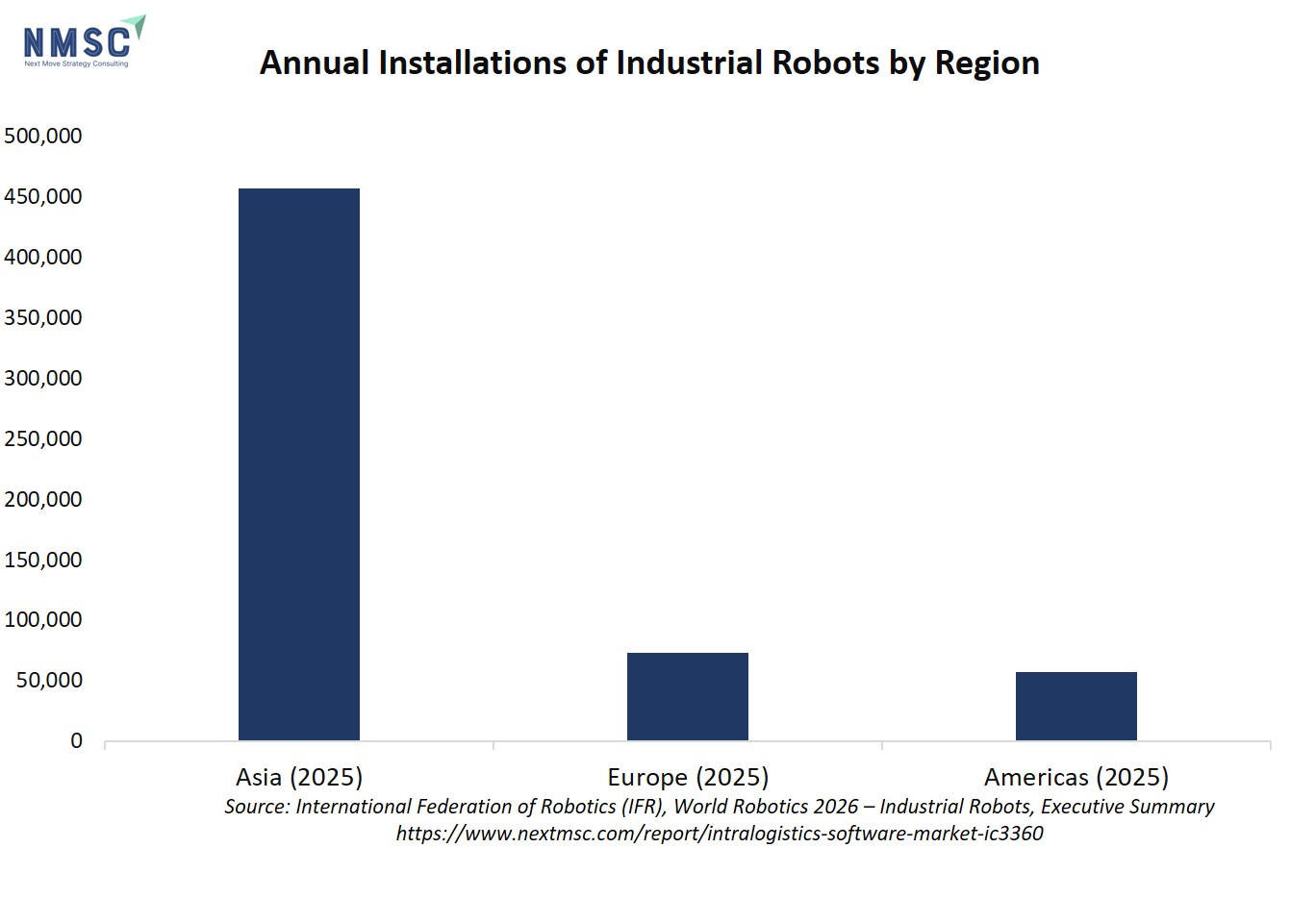
The International Federation of Robotics (IFR) reported in its World Robotics 2025 publication that global industrial robot installations are expected to grow 6% to 575,000 units in 2025, with installations forecast to rise a further 9% to 655,000 units in 2026. In the United States specifically, robot installations grew 11% to reach 38,000 units in 2025, with materials handling and mobile robots among the primary growth categories. Each new robot installation in a warehouse environment creates a corresponding demand for software capable of orchestrating that robot within the broader workflow — managing task assignment, exception handling, charging cycle coordination, and performance monitoring. The IFR's data therefore functions as a leading indicator for intralogistics software demand: as robot density in warehouses increases, the software layer required to manage those robots becomes more complex and more commercially valuable.
Regulatory and Cybersecurity Pressures Are Shaping Platform Architecture
Europe's GDPR framework and evolving data localisation requirements across Asia-Pacific are directly influencing intralogistics software architecture decisions. Enterprises operating cross-border distribution networks must ensure that warehouse data — including inventory records, worker productivity metrics, and robotics telemetry — is processed and stored in compliance with jurisdiction-specific regulations. This requirement is accelerating the adoption of hybrid deployment models, which NMSC's analysis shows hold an 8.58% market share and are expected to gain traction as enterprises seek to balance cloud flexibility with on-premises data control. Cloud security holds a 31.41% share of the technology segment, reflecting the enterprise-level investment in securing cloud-native intralogistics platforms against the cybersecurity risks that accompany increased connectivity.
Section Summary:
The industry impact of current market developments is measurable and multi-directional: labour shortages are converting software from an operational tool into a strategic necessity; e-commerce volume growth is raising the minimum software specification required for competitive fulfilment; and robotics deployment is creating a structural demand for orchestration platforms that can manage increasingly dense automation environments.
-
78% of warehouse facilities report significant difficulty hiring and retaining qualified staff, per SPS Commerce's 2026 Supply Chain Trends report, directly accelerating WMS and WES adoption as a labour productivity multiplier.
-
Global e-commerce sales are projected to reach USD 7.41 trillion in 2026 (U.S. International Trade Administration), raising the software specification floor for order batching, dynamic slotting, and real-time inventory synchronisation.
-
IFR projects 655,000 robot installations globally in 2026, each creating a corresponding demand for orchestration software capable of managing task allocation, exception handling, and performance monitoring.
-
Cloud security holds 31.41% of the technology segment (NMSC proprietary analysis), reflecting enterprise investment in securing cloud-native platforms against cybersecurity risks inherent in connected warehouse environments.
Key Industry Developments — Intralogistics Software Market (2025–2026)
|
Date |
Company/Parties |
Development |
Market Implication |
|
January 2025 |
Jungheinrich AG |
Completed acquisition of Storage Solutions (U.S.) |
Strengthened U.S. WMS/WES deployment capabilities; expanded software-hardware integration portfolio |
|
March 2025 |
Honeywell International |
Launched cloud-based Momentum WES platform |
Lowered adoption barrier for mid-market operators; enabled AI model integration without on-premises infrastructure |
|
April 2025 |
SSI Schaefer |
Introduced RackBot System Elevate (ClimbBots for high-bay picking up to 12m) |
Expanded WES addressable market into semi-automated high-bay environments |
|
May 2025 |
Honeywell & Teradyne Robotics |
Partnership to deploy AMRs with Momentum WES across Americas and Europe |
Created validated AMR-WES integration framework; reduced enterprise deployment risk |
|
January 2026 |
Dematic & Hai Robotics |
Europe-wide AMR integration partnership |
Established software as the orchestration layer for multi-vendor AMR deployments in European distribution centres |
Future Outlook & Forecast
The Path to USD 49.12 Billion: What the Growth Trajectory Signals
According to NMSC's proprietary research and estimates, the global intralogistics software market is projected to grow from USD 13.22 billion in 2026 to USD 49.12 billion by 2035, at a CAGR of 15.83%. This trajectory is underpinned by three structural forces that NMSC's analysis identifies as durable rather than cyclical: the continued expansion of e-commerce fulfilment infrastructure, the accelerating deployment of warehouse robotics that require software orchestration, and the maturation of AI-enabled decision-support systems that are transitioning from pilot deployments to enterprise-wide rollouts.
The technology segment composition will shift materially over the forecast period. Digital Twins — currently at 5.99% of the technology segment — are expected to gain significant traction as enterprises seek to simulate warehouse process changes, evaluate slotting optimisation strategies, and stress-test automation configurations without disrupting live operations. NMSC's analysis indicates that vendors offering integrated digital twin simulation tools alongside WMS and WES platforms will achieve stronger enterprise engagement and longer contract cycles, as the simulation capability reduces the operational risk of system upgrades and layout changes.
The Healthcare/Pharma/Hospitals segment is identified by NMSC as the fastest-growing end-user category, driven by increasing regulatory mandates for serialisation, traceability, and cold-chain compliance. As pharmaceutical supply chains face tightening regulatory scrutiny across the U.S. (DSCSA compliance), Europe (EU Falsified Medicines Directive), and Asia-Pacific, the software layer required to manage lot-level traceability, temperature monitoring, and expiry date management is becoming a compliance necessity rather than an operational preference.
Regional Outlook: Asia-Pacific's Acceleration and North America's Deepening
Asia-Pacific, currently representing 22.18% of the global market, is identified by NMSC as the fastest-growing region. China's high-volume e-commerce fulfilment centres, Japan's precision-driven production logistics environments, and South Korea's robotics-intensive distribution networks are each creating distinct but substantial demand pools for intralogistics software. Government-backed smart manufacturing initiatives across the region — including China's "Made in China 2025" successor programmes and South Korea's Smart Factory initiative — are accelerating enterprise adoption of WMS, WES, and warehouse control platforms at a pace that NMSC's regional analysis indicates will narrow the gap with North America's market share over the forecast period.
North America, holding 40.77% of global market share, will deepen rather than plateau. The U.S. market is characterised by distribution centre modernisation programmes, high-volume e-commerce fulfilment, and the integration of cloud-native WES platforms with ERP, TMS, and MES systems. The IFR's data showing U.S. robot installations growing 11% to 38,000 units in 2025 signals that the software orchestration layer required to manage these deployments will continue to expand in commercial value.
The SaaS Transition and Its Revenue Model Implications
NMSC's investment analysis indicates that the transition from perpetual-licence WMS deployments to SaaS-based subscription models is a defining commercial trend for the forecast period. Investors are prioritising vendors with predictable recurring revenue streams, high net revenue retention, and demonstrated ability to expand contract value through analytics modules, robotics fleet management add-ons, and labour management extensions. Vendors that can demonstrate measurable warehouse productivity gains — reduced picking error rates, improved throughput per labour hour, lower cost per order — are achieving higher enterprise valuations and longer contract cycles.
Section Summary:
The intralogistics software market's growth trajectory to USD 49.12 billion by 2035 is supported by structural demand drivers that are intensifying rather than moderating. The SaaS transition, AI maturation, and Asia-Pacific acceleration are the three forces most likely to determine which vendors capture disproportionate market share over the forecast period.
-
USD 49.12 billion by 2035 at a 15.83% CAGR (NMSC proprietary research and estimates), driven by robotics orchestration demand, e-commerce fulfilment complexity, and AI-enabled decision-support maturation.
-
Healthcare/Pharma/Hospitals is the fastest-growing end-user segment, driven by serialisation, traceability, and cold-chain compliance mandates across the U.S., Europe, and Asia-Pacific.
-
Digital Twins (currently 5.99% technology share) are expected to gain traction as enterprises adopt simulation tools to reduce the operational risk of warehouse layout changes and automation upgrades.
-
Asia-Pacific is the fastest-growing region, with China, Japan, and South Korea each presenting distinct but substantial demand pools for WMS, WES, and warehouse control platforms.
Next Steps for Stakeholders
For C-Level Executives and Operations Leaders:
-
Audit your WES interoperability architecture now. The Dematic–Hai Robotics partnership and Honeywell–Teradyne collaboration demonstrate that the market is moving toward multi-vendor AMR environments orchestrated by a single software layer. Enterprises operating heterogeneous automation stacks should evaluate whether their current WES supports open protocols (MQTT, OPC-UA, RESTful APIs) or whether proprietary middleware is creating integration debt that will constrain future automation investments.
-
Accelerate cloud WES evaluation for multi-site operations. Honeywell's March 2025 cloud WES launch has reset the cost-benefit calculus for mid-market operators. Enterprises still operating on-premises WES across multiple distribution centres should model the total cost of ownership differential — including infrastructure maintenance, security patch management, and AI model integration costs — against cloud-native alternatives before the next capital planning cycle.
-
Prioritise AI-enabled labour management modules in your next WMS upgrade. With 78% of facilities reporting significant difficulty hiring and retaining warehouse staff (SPS Commerce, 2026), the ROI case for AI-driven task allocation, dynamic workload balancing, and productivity dashboards is now measurable and defensible at board level. Vendors that embed labour management as a native WES capability — rather than a third-party add-on — should be prioritised in RFP processes.
For Investors and Capital Allocators:
-
Weight SaaS-native intralogistics software vendors over perpetual-licence incumbents. NMSC's investment analysis indicates that recurring revenue models, high net revenue retention, and analytics module expansion are the primary value drivers in the current market. Vendors with demonstrated ability to expand contract value through robotics fleet management, digital twin simulation, and predictive maintenance modules are better positioned for long-term capital appreciation.
-
Monitor Asia-Pacific deployment velocity as a leading indicator. China's high-volume fulfilment centre modernisation, Japan's labour-shortage-driven automation investment, and South Korea's robotics-intensive distribution networks are creating demand pools that will materially shift regional market share over the forecast period. Early-stage investments in Asia-Pacific-focused WMS and WES vendors — particularly those with government-backed smart manufacturing alignment — carry asymmetric upside relative to mature North American market positions.
-
Evaluate M&A targets with validated AMR orchestration capabilities. The Jungheinrich–Storage Solutions acquisition and the Dematic–Hai Robotics partnership both demonstrate that the strategic premium in this market is attached to software platforms that can orchestrate multi-vendor AMR fleets. Acquisition targets with proven AMR integration frameworks, open API architectures, and established enterprise customer bases in e-commerce and 3PL verticals represent the highest-value consolidation opportunities.
Conclusion
The intralogistics software market is not expanding because warehouses are becoming more digital in a general sense — it is expanding because the specific operational problems that enterprises face in 2026 can only be solved by software. Chronic labour shortages require intelligent task allocation and workforce augmentation tools. E-commerce fulfilment complexity requires real-time inventory synchronisation and dynamic order batching. Robotics density requires orchestration platforms that can manage heterogeneous AMR fleets without creating integration bottlenecks. These are not problems that hardware alone can address.
The market developments of the past eighteen months — Honeywell's cloud WES launch, the Dematic–Hai Robotics European partnership, SSI Schaefer's RackBot System Elevate, and Jungheinrich's U.S. market expansion — collectively demonstrate that the competitive frontier in intralogistics has shifted from equipment capability to software intelligence. According to NMSC's proprietary research and estimates, the market will grow from USD 13.22 billion in 2026 to USD 49.12 billion by 2035 at a 15.83% CAGR — a trajectory that reflects not optimism, but the structural inevitability of software becoming the primary operating layer of the modern warehouse.
Enterprises and investors that recognise this shift early — and position their procurement, partnership, and capital allocation decisions accordingly — will be best placed to capture the operational and financial returns that this market's growth trajectory makes available.
About the Author
 Sanyukta Deb
— Sanyukta Deb is Digital Marketing Team Lead at Next Move Strategy Consulting, where she has led content strategy and technical SEO for the firm's B2B market research publications for over 2 years. Her editorial process translates NextMSC's primary and secondary research — spanning technology, industrial, and consumer sectors — into commercial narratives, backed by search-intent, keyword, and competitive analysis. She brings 5 years of overall experience in digital marketing and content strategy.
Sanyukta Deb
— Sanyukta Deb is Digital Marketing Team Lead at Next Move Strategy Consulting, where she has led content strategy and technical SEO for the firm's B2B market research publications for over 2 years. Her editorial process translates NextMSC's primary and secondary research — spanning technology, industrial, and consumer sectors — into commercial narratives, backed by search-intent, keyword, and competitive analysis. She brings 5 years of overall experience in digital marketing and content strategy.
About the Reviewer
 Debashree Dey
— Debashree Dey is Assistant Manager at Next Move Strategy Consulting, where she supports cross-vertical market content and communications across diverse industries for 6 years. Her professional background includes senior content writing, communications, and published manuscript authorship, with experience developing audience-focused business narratives and maintaining clear, consistent messaging. Her role supports research-led content development and editorial quality across NextMSC publications.
Debashree Dey
— Debashree Dey is Assistant Manager at Next Move Strategy Consulting, where she supports cross-vertical market content and communications across diverse industries for 6 years. Her professional background includes senior content writing, communications, and published manuscript authorship, with experience developing audience-focused business narratives and maintaining clear, consistent messaging. Her role supports research-led content development and editorial quality across NextMSC publications.

















Add Comment