Automated Truck/Trailer Loading: Why Smart Docks Are Taking Over | NextMSC
Introduction
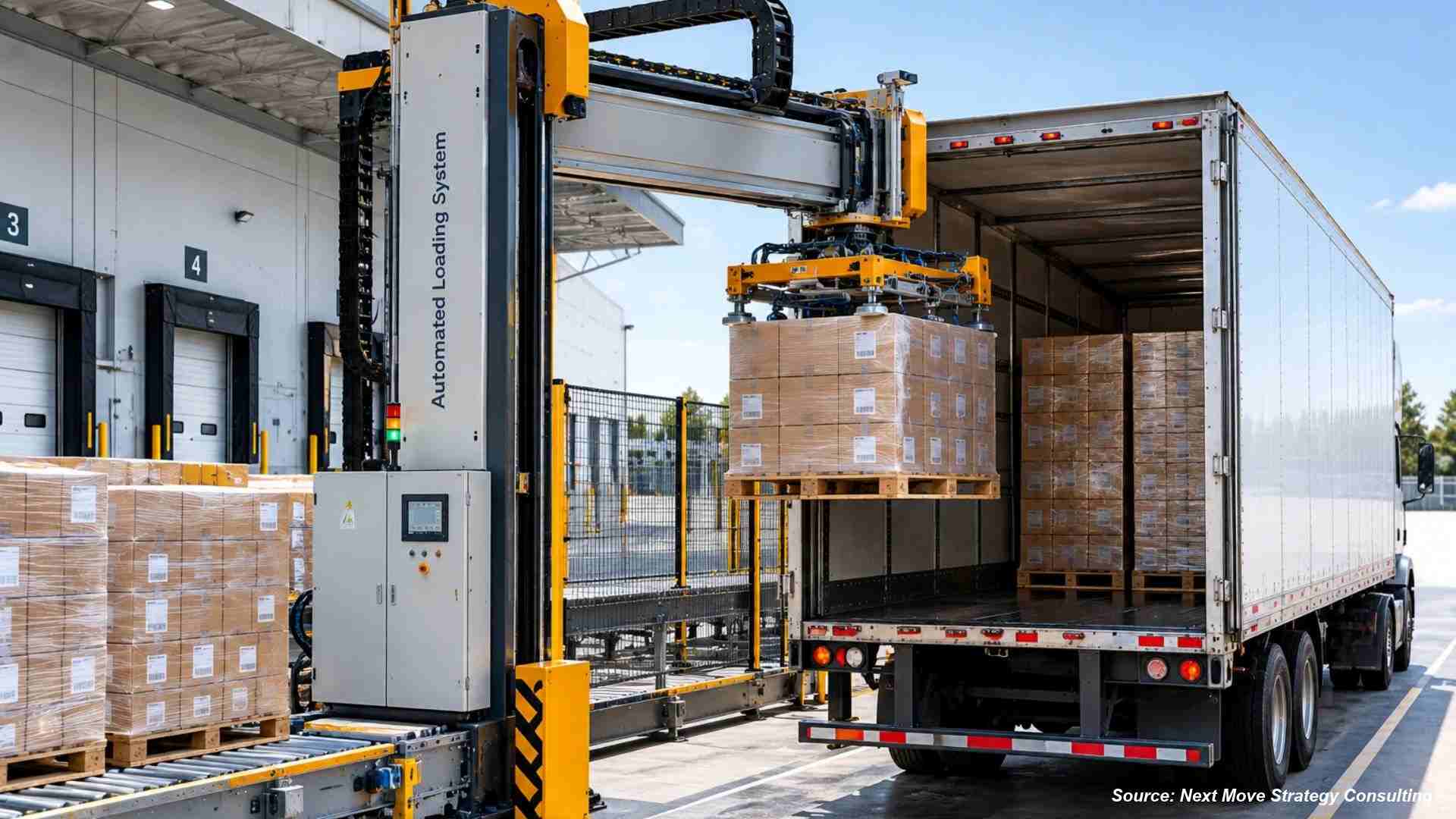
The global loading dock — long treated as a fixed cost of doing business — is undergoing a structural transformation. As labor scarcity tightens across manufacturing and logistics corridors and global goods trade reaches record volumes, operators can no longer afford the 30-to-45-minute manual loading cycles that have defined freight handling for decades. Automated Truck/Trailer Loading Systems (ATLS) — integrated platforms combining conveyor technology, sensor arrays, and intelligent control systems — are emerging as the operational backbone of next-generation distribution infrastructure.
According to Next Move Strategy Consulting's Automated Truck/Trailer Loading System (ATLS) Market report is projected to reach USD 1,168 million by 2030, growing at a CAGR of 8.9% by 2030. This trajectory reflects a fundamental shift in how warehouses, distribution centers, and manufacturing facilities approach end-of-line logistics — not as a labor-intensive afterthought, but as a precision-engineered, data-driven process.
For More Information: Download FREE Sample on Automated Truck/Trailer Loading System (ATLS) Market Report
The Loading Bay's Last Frontier: From Manual Bottleneck to Intelligent Dock
The Industry's "Best-Kept Secret" Goes Mainstream
For decades, the loading bay remained the most conspicuously manual node in an otherwise increasingly automated supply chain. Factories deployed robotic arms on assembly lines; warehouses installed automated storage and retrieval systems; yet the final act — loading a trailer — still relied on forklift operators navigating a high-pressure, accident-prone environment. That gap is now closing at an accelerating pace.
In March 2025, Actiw — a subsidiary of the Joloda Hydraroll Group — launched the LoadMatic Lite, a compact automated loading system engineered specifically to bridge the gap between manual forklift operations and full-scale dock automation. The system loads a full, standard, non-modified truck or trailer in six minutes — compared to the 30-to-45 minutes typical of manual operations — and is designed to integrate into both greenfield and brownfield sites with minimal dock modifications. Critically, it is compatible with standard, non-modified trailers, eliminating the fleet-modification barrier that has historically deterred mid-market operators from adopting ATLS technology. The system delivers an average return on investment within one to two years, according to Joloda Hydraroll's official announcement.
Wouter Satijn, Chief Revenue Officer at Joloda Hydraroll, articulated the market gap the product addresses: "The Joloda Hydraroll Group is committed to helping all companies solve their specific loading and unloading challenges, and that's why we developed LoadMatic Lite. The system offers businesses a versatile, lower-cost alternative to a fully automated loading system in their manufacturing facilities and distribution centers, which will reduce loading time and improve accuracy and consistency while they prepare for future automation. It's a smart investment for growing companies to stay competitive."
The LoadMatic Lite launch is commercially significant beyond its product specifications. It signals that ATLS vendors are deliberately expanding their addressable market downward — from large-scale distribution centers with dedicated trailer fleets to mid-sized manufacturers and regional logistics operators who previously lacked a cost-justified entry point into dock automation.
BEUMER Group Doubles Down on Data-Driven Sortation and Robotics
Simultaneously, the upper end of the ATLS and intralogistics automation market is being reshaped by the convergence of sortation technology, mobile robotics, and real-time data analytics. BEUMER Group — one of the sector's most established players — used two major industry events in early 2026 to demonstrate this convergence in practice.
At LogiMAT 2026 (March 24–26, Stuttgart), BEUMER Group presented its approaches to mobile robotics for intralogistics, showcasing how cognitive robotics and machine vision can support loading and sortation operations. The company's Innovation Corner at the event focused on how robotics, machine vision, advanced software, and real-time analytics are being integrated into material handling workflows — a direct signal that the boundary between ATLS and broader warehouse robotics is dissolving.
At MODEX 2026 (April 13–16, Atlanta), BEUMER Group — celebrating its 90th anniversary — showcased data-driven sortation solutions designed to help warehousing, fulfillment, and distribution businesses increase operational resilience under persistent labor pressure. Markus Schmidt, CEO & President of BEUMER Corporation, stated: "Our customers trust us when it comes to automating their high-speed sortation operations, as our technology delivers and our company culture supports successful implementation." In North America alone, BEUMER's high-speed sortation systems now serve customers at more than 100 sites.
NMSC Strategic Perspective: The Convergence of Accessibility and Intelligence
NextMSC primary research and analysis identifies two parallel forces reshaping the ATLS competitive landscape in 2025–2026. The first is democratization: the introduction of entry-level, brownfield-compatible systems like LoadMatic Lite is expanding the ATLS addressable market beyond the large-scale distribution centers that have historically dominated adoption. The second is intelligence integration: leading vendors are embedding AI-driven predictive maintenance, IoT-based real-time monitoring, and AGV/AMR interoperability directly into loading system architectures — transforming ATLS from a standalone mechanical solution into a node within a connected logistics intelligence network.
These two forces are not in tension; they are complementary. As entry-level systems build operator familiarity with automated loading, the upgrade pathway toward fully integrated, AI-enabled dock ecosystems becomes commercially viable for a broader range of enterprises. This dynamic is a key structural driver behind the market's sustained 8.9% CAGR trajectory through 2030, as projected by NMSC's proprietary research and analysis.
Section Summary:
The ATLS market is transitioning from a niche, capital-intensive technology to a scalable, accessible automation layer across the logistics value chain. Key developments in 2025–2026 confirm this shift:
-
Joloda Hydraroll's LoadMatic Lite (March 2025) reduces loading time from 30–45 minutes to 6 minutes and delivers ROI within 1–2 years, opening ATLS adoption to mid-market operators previously priced out of dock automation.
-
BEUMER Group's dual presence at LogiMAT 2026 and MODEX 2026 demonstrates that leading vendors are converging sortation, mobile robotics, and real-time data analytics into unified intralogistics platforms.
-
NMSC analysis identifies democratization and intelligence integration as the two structural forces sustaining the market's 8.9% CAGR through 2030.
-
The loading bay — historically the last manual frontier in warehouse operations — is now the primary battleground for next-generation logistics automation investment.
Industry Impact Analysis
Rising Labor Costs Make the ROI Case Undeniable
The financial calculus behind ATLS adoption has shifted decisively in favor of automation as labor costs continue to escalate across the EU and North America — the two regions that collectively represent the largest share of ATLS demand.
According to Eurostat's Labour Cost Index, hourly labour costs in the euro area rose by 3.1% in Q2 2026 compared with the same quarter of the previous year, while EU-wide hourly labour costs rose by 3.2% over the same period. In Q4 2025, the EU-wide figure was 3.7%, indicating that while the rate of increase has moderated slightly, the structural upward pressure on labor costs remains firmly in place. In the United States, the Bureau of Labor Statistics reported that manufacturing sector unit labor costs increased 3.4% year-on-year in Q2 2026.
For logistics operators running multiple loading shifts, these cost increases compound rapidly. A distribution center operating 20 manual loading docks, each requiring two to three workers per shift across three shifts, faces a labor cost base that ATLS can structurally reduce — not through one-time savings, but through permanent reallocation of headcount to higher-value tasks.
Wouter Satijn of Joloda Hydraroll captured the operational reality precisely: "We really call it a danger zone… forklifts are under pressure to be loading or unloading in a quick timeframe to turn around those trailers quickly. There's a lot of operational pressure. That's where there are a lot of near misses and serious accidents happening, in and around the cargo space." Beyond the direct labor cost reduction, ATLS eliminates the liability exposure and insurance costs associated with loading bay accidents — a financial benefit that rarely appears in headline ROI calculations but is material to total cost of ownership.
Global Trade Volumes Amplify Throughput Pressure
The demand-side pressure on loading infrastructure is being amplified by record global trade volumes. According to UNCTAD's Global Trade Update (July/August 2026), global goods trade reached approximately USD 13.7 trillion in the first half of 2026, up 12.5% from the same period in 2025. UNCTAD's Key Statistics and Trends in International Trade 2025 further confirmed that global trade in goods and services surpassed USD 35 trillion in 2025 — a new all-time high.
This volume growth translates directly into throughput pressure at distribution centers and manufacturing loading docks. When trailer turnaround times are measured in hours rather than minutes, the bottleneck is not the truck — it is the loading process. ATLS systems that compress a 45-minute manual loading cycle into two to six minutes effectively multiply the productive capacity of existing dock infrastructure without requiring additional physical expansion.
Joloda Hydraroll's Satijn quantified this capacity multiplier: "We load a trailer within two minutes. That trailer can be used 20-30 times in a day… whereas in other operations, where there's manual loading going on, it takes 30-45 minutes." The implication for fleet utilization is significant: a single automated dock can process the same daily volume as 10 to 15 manual docks, enabling operators to reduce physical dock footprint while increasing throughput.
Industrial Robotics Integration Expands the ATLS Ecosystem
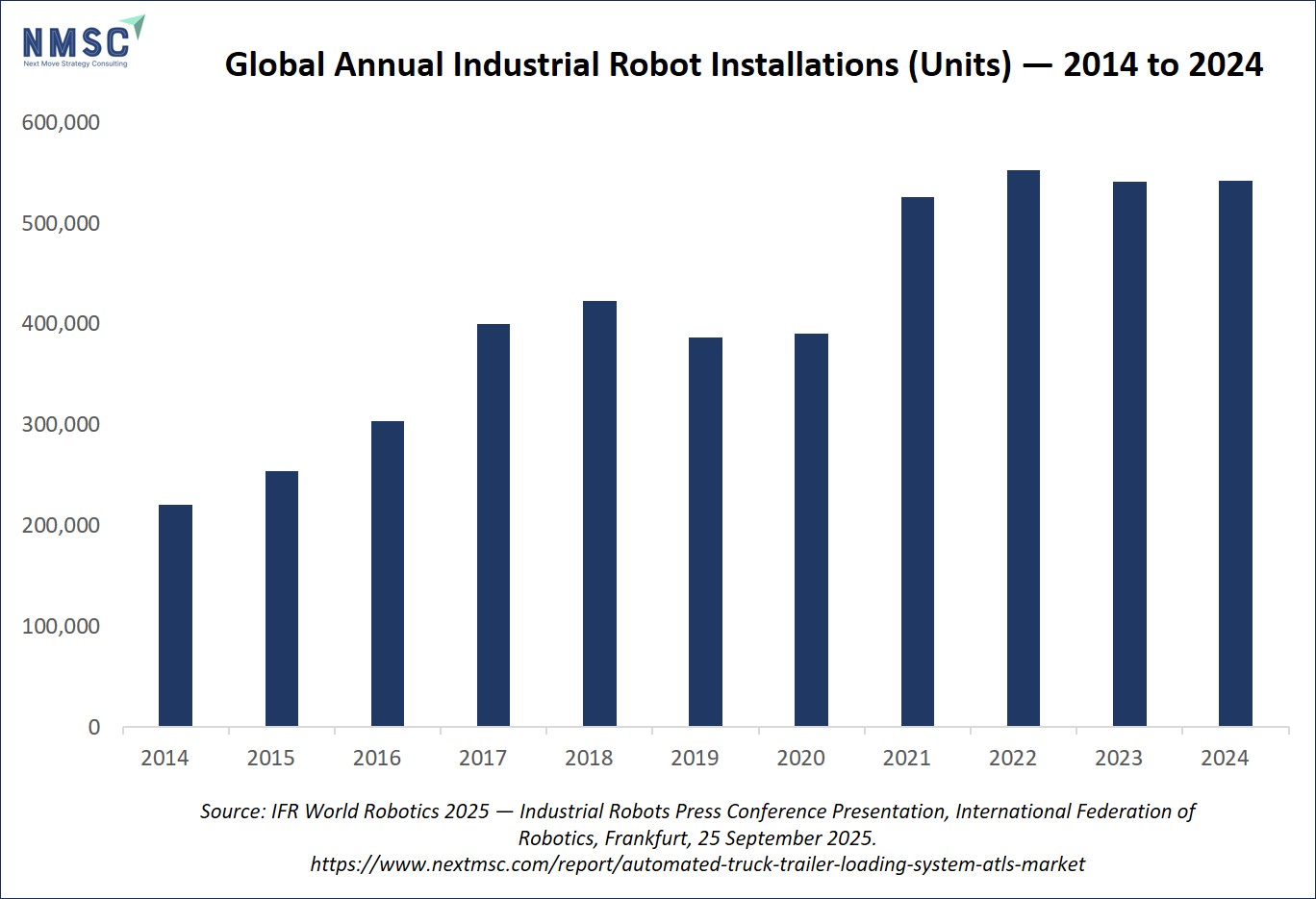
The International Federation of Robotics (IFR) World Robotics 2025 report recorded 542,000 industrial robots installed globally in 2024 — more than double the installations recorded a decade earlier. In the United States specifically, robotics installations grew 11% in 2025 to reach 38,000 units, with materials handling among the primary application categories driving growth.
This robotics proliferation is directly relevant to the ATLS market because modern loading systems are increasingly designed to interface with AGVs, AMRs, and robotic forklifts. Satijn noted this integration trend explicitly: "We integrate more and more with robotic forklifts, AGVs, AMRs… to get pallets fed from production lines directly onto our loading machines." As the installed base of warehouse robotics expands, the business case for connecting those robots to an automated loading system at the dock door strengthens — because the efficiency gains of robotic inbound handling are negated if the outbound loading process remains manual.
ESG Mandates Create a New Procurement Driver
A dimension of ATLS adoption that is gaining commercial weight in 2025–2026 is the ESG compliance imperative. Automated loading systems reduce truck idle time at docks, compress the number of dock doors required for a given throughput volume, and in some configurations allow building footprints to be reduced by up to 60%. These outcomes translate directly into measurable CO₂ reductions — a metric that large FMCG, pharmaceutical, and automotive manufacturers are now requiring from their logistics suppliers as part of ESG audit and reporting frameworks.
Satijn observed: "I think that's a big shout out to all the big companies that really drive that environmental agenda, because it starts with them… already in audit or an ESG report is requested from the suppliers." This means ATLS adoption is no longer driven solely by operational ROI — it is increasingly a prerequisite for maintaining supply chain relationships with Tier 1 manufacturers and retailers who have committed to Scope 3 emissions reduction targets.
Section Summary:
The industry impact of current ATLS market dynamics extends across four interconnected dimensions:
-
Labor cost escalation — EU hourly labour costs rose 3.2% in Q2 2026 (Eurostat) and US manufacturing unit labor costs rose 3.4% year-on-year (BLS Q2 2026) — is compressing margins in logistics-intensive industries and accelerating the ROI timeline for ATLS investment.
-
Record global trade volumes — USD 13.7 trillion in goods trade in H1 2026 (UNCTAD) — are generating throughput pressure that manual loading infrastructure cannot absorb without proportional headcount increases.
-
Industrial robotics proliferation — 542,000 units installed globally in 2024 (IFR) — is creating an expanding ecosystem of AGVs and AMRs that require automated loading interfaces to deliver end-to-end dock efficiency.
-
ESG procurement mandates from Tier 1 manufacturers are converting ATLS from an operational efficiency tool into a supply chain compliance requirement, broadening the buyer base beyond pure cost-optimization decisions.
Key External Indicators Driving ATLS Demand
|
Indicator |
Value / Finding |
Source |
Relevance to ATLS |
|
EU Hourly Labour Cost Growth (Q2 2026) |
+3.1% (euro area); +3.2% (EU) year-on-year |
Eurostat Labour Cost Index, 2026 |
Compresses logistics operator margins; accelerates ATLS ROI timelines |
|
EU Hourly Labour Cost Growth (Q4 2025) |
+3.3% (euro area); +3.7% (EU) year-on-year |
Eurostat, December 2025 |
Sustained multi-quarter upward trend confirms structural, not cyclical, labor cost pressure |
|
US Manufacturing Unit Labor Costs (Q2 2026) |
+3.4% year-on-year |
U.S. Bureau of Labor Statistics, 2026 |
Reinforces North American ATLS demand as the dominant regional market |
|
Global Industrial Robot Installations (2024) |
542,000 units — more than double the installations of a decade ago |
IFR World Robotics 2025 Report |
Expanding AGV/AMR installed base creates integration demand for automated loading interfaces |
|
US Robotics Installations Growth (2025) |
+11% to 38,000 units |
Manufacturing Dive / IFR, Automate 2026 |
Materials handling is a primary growth category, directly adjacent to ATLS applications |
|
Global Goods Trade (H1 2026) |
USD 13.7 trillion, up 12.5% year-on-year |
UNCTAD Global Trade Update, July/August 2026 |
Record trade volumes amplify throughput pressure at distribution center loading docks |
|
Global Trade in Goods & Services (2025) |
Surpassed USD 35 trillion — all-time high |
UNCTAD Key Statistics and Trends in International Trade 2025 |
Validates long-term structural demand for loading infrastructure automation |
Future Outlook & Forecast
NMSC Forecast: Doubling Market Value by 2030
NextMSC primary research and analysis projects the global ATLS market to more than double in value from USD 553.9 million in 2022 to USD 1,168 million by 2030, at a CAGR of 8.9%. This trajectory is underpinned by three structural forces that NMSC's proprietary model identifies as durable through the forecast period.
First, the labor cost floor is rising permanently. The multi-quarter Eurostat data — showing EU labour cost growth of 3.1% to 3.7% across 2025 and 2026 — reflects demographic trends (aging workforces in Germany, Japan, and South Korea), minimum wage legislation, and tightening immigration policy that will not reverse within the forecast window. For logistics operators, this means the payback period on ATLS investment will continue to shorten as the labor cost baseline rises.
Second, the technology integration curve is accelerating. The convergence of AI, IoT, and predictive maintenance with ATLS hardware — as demonstrated by BEUMER Group's robotics presentations at LogiMAT 2026 and MODEX 2026 — is transforming loading systems from mechanical assets into data-generating infrastructure. As these systems generate operational data, they enable predictive maintenance schedules that reduce unplanned downtime — a capability that further strengthens the total cost of ownership case for ATLS over manual alternatives.
Third, the Asia-Pacific market is entering a structural growth phase. China's warehouse stock — with more than 18,310 warehouses and storage facilities, representing approximately 45% of total global warehouse building stock alongside the United States — represents a substantial and largely underpenetrated ATLS opportunity, according to NextMSC primary research and analysis. Government-backed automation initiatives in Australia (the National Robotics Strategy) and China are providing policy tailwinds that will accelerate private sector ATLS adoption in the region through 2030.
The Fully Automatic Segment: The High-Growth Frontier
Within the ATLS market, the fully automatic segment is positioned to outpace the semi-automatic segment over the forecast period, as operators who have gained familiarity with entry-level systems like LoadMatic Lite migrate toward higher-throughput, fully integrated dock automation. This upgrade pathway — from semi-automatic to fully automatic — is a structural feature of the market that NMSC's analysis identifies as a key driver of sustained revenue growth beyond the initial adoption phase.
The integration of ATLS with AGVs and AMRs — as highlighted by Joloda Hydraroll's Satijn in the Logistics Business Conversations podcast — means that fully automatic systems are increasingly positioned not as standalone loading solutions but as the terminal node of an end-to-end automated material flow. This repositioning expands the addressable budget for ATLS procurement from the loading dock capital expenditure line to the broader warehouse automation investment envelope.
Section Summary:
The ATLS market's growth trajectory through 2030 is supported by durable structural forces, not cyclical demand:
-
NMSC projects the market to reach USD 1,168 million by 2030 at an 8.9% CAGR, driven by rising labor costs, global trade volume growth, and technology integration — per NextMSC primary research and analysis.
-
The fully automatic segment is positioned to accelerate as operators upgrade from entry-level systems, with AGV/AMR integration expanding the procurement budget available for ATLS investment.
-
Asia-Pacific represents the market's highest-potential underpenetrated geography, with China's 18,310+ warehouses and government-backed automation mandates creating a structural demand pipeline.
-
ESG compliance requirements from Tier 1 manufacturers are converting ATLS from a cost-optimization tool into a supply chain qualification criterion, broadening the buyer base and reducing price sensitivity among enterprise purchasers.
Next Steps for Stakeholders
For C-Level Executives and Operations Leaders:
-
Conduct a dock-by-dock throughput audit before the next capital planning cycle. The LoadMatic Lite's 1-to-2-year ROI profile means that even mid-sized distribution centers with 5–10 active loading docks can justify ATLS investment without requiring enterprise-scale capital approval processes. Quantify current loading cycle times, labor costs per dock, and accident/near-miss frequency to build a site-specific business case.
-
Evaluate ATLS as part of your AGV/AMR integration roadmap, not as a standalone procurement. The IFR's data showing 542,000 industrial robot installations in 2024 — and 11% US growth in 2025 — confirms that the warehouse robotics ecosystem is expanding rapidly. ATLS vendors who offer native AGV/AMR interoperability (as Joloda Hydraroll and BEUMER Group both demonstrated in 2025–2026) should be prioritized in vendor selection to avoid integration debt.
-
Incorporate ATLS into your Scope 3 emissions reduction strategy. As ESG audit requirements cascade from Tier 1 manufacturers to their logistics suppliers, the ability to document reduced truck idle time, lower dock footprint, and decreased forklift fuel consumption will become a commercial differentiator — not merely a compliance checkbox.
For Institutional Investors:
-
Monitor the mid-market ATLS segment as the primary growth vector through 2027. The launch of entry-level systems like LoadMatic Lite signals that the market is expanding its addressable base beyond large-scale distribution centers. Companies that successfully capture mid-market adoption — particularly in North America and Western Europe where labor cost pressure is most acute — will disproportionately benefit from the market's 8.9% CAGR trajectory.
-
Track Asia-Pacific government automation policy as a leading indicator of regional demand. Australia's National Robotics Strategy and China's warehouse automation incentives are policy-level signals that precede private sector capital deployment. Vendors with established Asia-Pacific distribution networks — including Joloda Hydraroll's 35+ country footprint — are positioned to convert policy tailwinds into commercial contracts.
Conclusion
The automated truck/trailer loading system market is at an inflection point. The convergence of structurally rising labor costs, record global trade volumes, expanding warehouse robotics ecosystems, and ESG compliance mandates has transformed ATLS from a niche capital investment into a mainstream logistics infrastructure requirement. The product launches and industry events of 2025–2026 — from Joloda Hydraroll's LoadMatic Lite to BEUMER Group's robotics demonstrations at LogiMAT and MODEX — confirm that the market's leading vendors are actively expanding their addressable base while simultaneously raising the technological ceiling of what automated loading systems can deliver.
According to NextMSC primary research and analysis, the global ATLS market is on a clear trajectory from USD 553.9 million in 2022 to USD 1,168 million by 2030. For operators still relying on manual loading docks, the question is no longer whether to automate — it is how quickly the business case can be built and which technology partner is best positioned to deliver it.
About the Author
 Sanyukta Deb
— Sanyukta Deb is Digital Marketing Team Lead at Next Move Strategy Consulting, where she has led content strategy and technical SEO for the firm's B2B market research publications for over 2 years. Her editorial process translates NextMSC's primary and secondary research — spanning technology, industrial, and consumer sectors — into commercial narratives, backed by search-intent, keyword, and competitive analysis. She brings 5 years of overall experience in digital marketing and content strategy.
Sanyukta Deb
— Sanyukta Deb is Digital Marketing Team Lead at Next Move Strategy Consulting, where she has led content strategy and technical SEO for the firm's B2B market research publications for over 2 years. Her editorial process translates NextMSC's primary and secondary research — spanning technology, industrial, and consumer sectors — into commercial narratives, backed by search-intent, keyword, and competitive analysis. She brings 5 years of overall experience in digital marketing and content strategy.
About the Reviewer
 Debashree Dey
— Debashree Dey is Assistant Manager at Next Move Strategy Consulting, where she supports cross-vertical market content and communications across diverse industries for 6 years. Her professional background includes senior content writing, communications, and published manuscript authorship, with experience developing audience-focused business narratives and maintaining clear, consistent messaging. Her role supports research-led content development and editorial quality across NextMSC publications.
Debashree Dey
— Debashree Dey is Assistant Manager at Next Move Strategy Consulting, where she supports cross-vertical market content and communications across diverse industries for 6 years. Her professional background includes senior content writing, communications, and published manuscript authorship, with experience developing audience-focused business narratives and maintaining clear, consistent messaging. Her role supports research-led content development and editorial quality across NextMSC publications.















Add Comment