Automotive Audio System Market Global Industry Analysis and Forecast (2026–2035)

Automotive Audio System Market size was USD 13.59 Billion in 2026, projected to reach USD 25.70 Billion by 2035, growing at a CAGR of 7.34% from 2026 to 2035. Key drivers include premium audio fitment, electric vehicle cabin design, and software-defined sound, with Asia-Pacific leading the market.
Download Free Sample PDF
Base Year (2025)
$12.24 Billion
Forecast (2035)
$25.70 Billion
CAGR (2026-2035)
7.3%
Top Region
Asia-Pacific

What Is the Automotive Audio System Market Size?

The Automotive Audio System Market was valued at USD 12.24 Billion in 2025 and is estimated at USD 13.59 Billion in 2026. It is forecast to reach USD 25.70 Billion by 2035, growing at a CAGR of 7.34% from 2026 to 2035. Asia-Pacific holds about 41% share, and Complete Audio Systems lead the offerings with about 28%.

Based on our market analysis, we observed that premium fitment, vehicle electrification, and software upgrades are shifting market value toward higher-content audio platforms. The table below summarises the leading and fastest growing segments.

Automotive Audio System Market Global Industry Analysis and Forecast (2026–2035) Revenue Forecast
Values in USD Billion

2025 $12.24 Billion
2025
2026 $13.59 Billion
2026
2027 $14.59 Billion
2027
2028 $15.66 Billion
2028
2029 $16.81 Billion
2029
2030 $18.04 Billion
2030
2031 $19.37 Billion
2031
2032 $20.79 Billion
2032
2033 $22.31 Billion
2033
2034 $23.95 Billion
2034
2035 $25.70 Billion
2035

Key Takeaways

By Offering: Complete Audio Systems held the largest share, expanding from USD 3.48 Billion in 2025 to USD 6.17 Billion by 2035. Dedicated Audio Software is the fastest-growing segment at a 16.82% CAGR from 2026 to 2035.

By Vehicle Type: Passenger Vehicles held the largest share, expanding from USD 10.54 Billion in 2025 to USD 21.85 Billion by 2035; Commercial Vehicles is the fastest growing at 8.16% CAGR from 2026–2035.

By System Positioning: Standard Audio held the largest share, expanding from USD 7.78 Billion in 2025 to USD 12.34 Billion by 2035; Premium Audio is the fastest growing at 11.15% CAGR from 2026–2035.

By Propulsion Type: ICE held the largest share, expanding from USD 7.07 Billion in 2025 to USD 7.71 Billion by 2035; Fuel Cell Electric is the fastest growing at 24.69% CAGR from 2026–2035.

By Sales Channel: OEM Factory Fit held the largest share, expanding from USD 8.73 Billion in 2025 to USD 20.05 Billion by 2035; Optional Fit is the fastest growing at 13.31% CAGR from 2026–2035.

Dominant Region: Asia-Pacific held the largest regional market size at USD 4.94 Billion in 2025. It is projected to reach USD 11.95 Billion by 2035.

Fastest-Growing Region: Middle East & Africa is expanding at 9.51% CAGR from 2026–2035.

Dominant Country: China led with USD 2.59 Billion in 2025 and is projected to reach USD 5.73 Billion by 2035.

Fastest-Growing Country: India is advancing at 14.34% CAGR from 2026–2035, reaching USD 1.67 Billion by 2035.

The Automotive Audio System Market offers an absolute opportunity of about USD 12.11 Billion between 2026 and 2035, which makes audio content per vehicle a clear investment priority.

According to NMSC analysis, Premium Audio is projected to overtake Standard Audio by value before 2035, rising from USD 5.16 Billion in 2026 to USD 13.36 Billion.

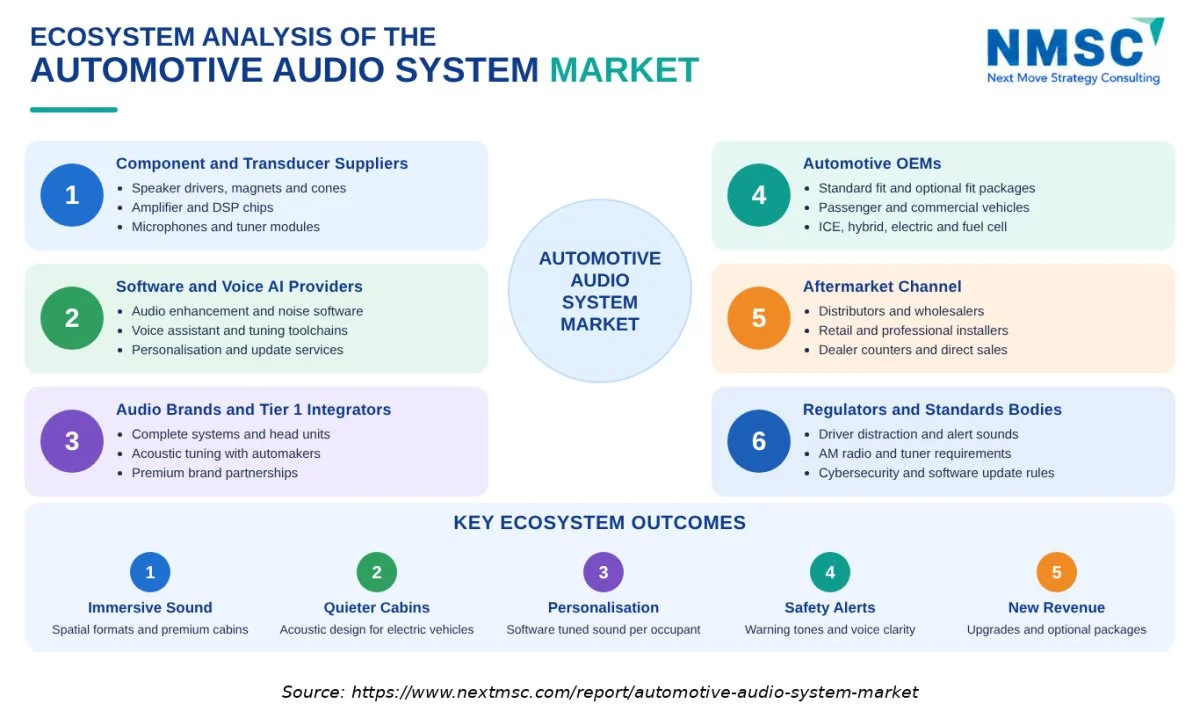
Ecosystem Analysis of the Automotive Audio System Market

The above infographic maps the Automotive Audio System Market ecosystem across six stakeholder groups. Component suppliers, software providers and Tier 1 integrators build the sound stack. Automakers and aftermarket channels bring it to buyers, while regulators set alert sound and radio rules. Together they deliver immersive sound, quieter cabins, personalisation, safety alerts and new revenue streams.

What does the Automotive Audio System Market Encompass?

The Automotive Audio System Market covers factory fitted and aftermarket sound systems used in passenger and commercial vehicles. Scope includes complete audio systems, head units, speakers and acoustic transducers, amplifiers, digital signal processing, microphones, tuners, audio control electronics and dedicated audio software. Personal headphones, home audio and generic cockpit displays without an audio function stay outside scope.

Structural change is moving audio from standalone hardware to software tuned experiences. Regulation also shapes demand. From 7 July 2026, new vehicles registered in the EU must carry an audible driver distraction warning under the General Safety Regulation. In the United States, the House approved the AM Radio for Every Vehicle Act on 15 September 2026, and the Senate has yet to act. These rules keep tuners and warning sound functions inside the vehicle design brief.

Market Drivers & Dynamics

Interactive Dataset
Premium and branded audio fitment driver +1.40% Europe, Asia-Pacific, North America 2026–2035
Electric vehicle cabin quietness and sound design driver +1.25% China, Europe, North America 2026–2032
Software defined audio and over the air upgrades driver +1.10% Global 2027–2035
Display based infotainment and spatial formats driver +0.85% Asia-Pacific, North America 2026–2030
Voice assistants and cabin communication driver +0.60% Global 2026–2033
Chip and rare earth magnet supply risk restraint −0.70% Global 2026–2028
Smartphone mirroring limits spend on factory audio restraint −0.50% North America, Europe 2026–2031
Cost pressure in mass market vehicles restraint −0.45% India, Latin America, Middle East & Africa 2026–2030
Source: Next Move Strategy Consulting

Growth Drivers

What Is the Primary Growth Driver?

Rising content per vehicle is the primary growth driver. OICA reports that 99.8 million vehicles were sold worldwide in 2025, which gives suppliers a large installed base for richer systems. Optional Fit packages grow at 13.31% CAGR from 2026 to 2035, as automakers bundle premium sound into trim upgrades. Each added speaker, amplifier channel or processing feature lifts revenue per vehicle.

How Is Premium Audio Demand Driving the Automotive Audio System Market Growth?

Premium Audio expands from USD 5.16 Billion in 2026 to USD 13.36 Billion by 2035, a CAGR of 11.15%. Branded partnerships with audio houses help automakers justify higher trim prices. Advances in automotive semiconductor capability let digital signal processing run richer tuning at lower cost. Buyers increasingly rate sound quality as a cabin feature, not an accessory.

Growth Inhibitors

What Is Restraining Automotive Audio System Market Growth?

Supply concentration is the primary market restraint. USGS estimates world rare earth mine output at 390,000 tonnes in 2025, with permanent magnets representing the primary end-use application. IEA places China's share of rare earth refining at 85% in 2025. Speaker makers that depend on neodymium face price swings and delays. CLEPA also warned in October 2025 that the Nexperia chip dispute could hit components across European vehicles. A rare earth magnet shortage would slow output.

What Are the Growth Opportunities?

Can Optional Fit Premium Packages Unlock Higher Content per Vehicle?

Tiered option packs let automakers sell richer sound on mid range trims. Optional Fit grows from USD 2.93 Billion in 2026 to USD 9.02 Billion by 2035. Premium Audio suppliers and branded partners benefit most, because buyers pay for sound as a visible trim feature. Dealers gain margin from selling the packs at delivery.

Is Commercial Vehicle Cabin Audio an Underserved Segment?

Fleet operators want clearer driver communication and passenger announcements. Buses and Coaches grow at 10.54% CAGR, the fastest among vehicle types. Microphone, amplifier and DSP suppliers can serve urban transit and intercity coaches. Demand in the commercial vehicle segment also favours rugged, serviceable designs. Operators value systems that survive vibration and long duty cycles.

Will Audio Personalisation Software Create Recurring Revenue?

Personalisation Software grows from USD 0.24 Billion in 2026 to USD 1.15 Billion by 2035. Audio carried over in vehicle Ethernet lets suppliers push sound profiles and zone controls through updates. Software vendors and Tier 1 integrators gain subscription style income, and automakers gain a new way to keep owners engaged after purchase.

Segmentation Analysis

2025 (USD Billion)
2035 (USD Billion)
Complete Audio Systems 2025: $3.48 Billion | 2035: $6.17 Billion
Complete Aud
Head Units 2025: $2.51 Billion | 2035: $3.98 Billion
Head Units
Speakers and Acoustic Transducers 2025: $2.11 Billion | 2035: $3.86 Billion
Speakers and
Amplifiers 2025: $1.10 Billion | 2035: $2.31 Billion
Amplifiers
Digital Signal Processing 2025: $0.71 Billion | 2035: $2.06 Billion
Digital Sign
Microphones 2025: $0.47 Billion | 2035: $1.29 Billion
Microphones
Tuners 2025: $0.51 Billion | 2035: $0.64 Billion
Tuners
Audio Control Electronics 2025: $0.60 Billion | 2035: $1.54 Billion
Audio Contro
Dedicated Audio Software 2025: $0.75 Billion | 2035: $3.85 Billion
Dedicated Au
Complete Audio Systems $3.48 Billion $6.17 Billion 5.50%
Head Units $2.51 Billion $3.98 Billion 4.32%
Speakers and Acoustic Transducers $2.11 Billion $3.86 Billion 5.87%
Amplifiers $1.10 Billion $2.31 Billion 7.35%
Digital Signal Processing $0.71 Billion $2.06 Billion 10.78%
Microphones $0.47 Billion $1.29 Billion 10.16%
Tuners $0.51 Billion $0.64 Billion 1.91%
Audio Control Electronics $0.60 Billion $1.54 Billion 9.51%
Dedicated Audio Software $0.75 Billion $3.85 Billion 16.82%

Which Offering Segment Leads the Automotive Audio System Market?

Complete Audio Systems lead with USD 3.48 Billion in 2025, because automakers buy tuned systems as single packages. Dedicated Audio Software grows fastest at 16.82% CAGR, driven by noise management and personalisation features. Digital Signal Processing and Microphones follow at 10.78% and 10.16%. Tuners grow slowly at 1.91%, since single standard units give way to multi standard designs.

2025 (USD Billion)
2035 (USD Billion)
Passenger ca
SUVs and cro
MPVs
Light commer
Medium and h
Segment Item 2025 (USD Billion) 2035 (USD Billion) CAGR
Passenger cars $10.0 USD Billion $40.0 USD Billion 26.0%
SUVs and crossovers $17.1 USD Billion $51.1 USD Billion 16.0%
MPVs $24.2 USD Billion $62.2 USD Billion 18.0%
Light commercial vehicles $31.3 USD Billion $73.3 USD Billion 8.0%
Medium and heavy commercial vehicles $38.4 USD Billion $84.4 USD Billion 27.0%

Segment-wise data is locked

Unlock complete segment-wise numbers for By Vehicle Type.

Unlock Full Data

By Vehicle Type: Passenger Vehicles held the largest share, expanding from USD 10.54 Billion in 2025 to USD 21.85 Billion by 2035; Commercial Vehicles is the fastest growing at 8.16% CAGR from 2026–2035.

2025 (USD Billion)
2035 (USD Billion)
Standard aud
Premium audi
Segment Item 2025 (USD Billion) 2035 (USD Billion) CAGR
Standard audio $10.0 USD Billion $40.0 USD Billion 12.0%
Premium audio $17.1 USD Billion $51.1 USD Billion 26.0%

Segment-wise data is locked

Unlock complete segment-wise numbers for By System Positioning.

Unlock Full Data

By System Positioning: Standard Audio held the largest share, expanding from USD 7.78 Billion in 2025 to USD 12.34 Billion by 2035; Premium Audio is the fastest growing at 11.15% CAGR from 2026–2035.

2025 (USD Billion)
2035 (USD Billion)
ICE
Hybrid
Battery elec
Fuel cell el
Segment Item 2025 (USD Billion) 2035 (USD Billion) CAGR
ICE $10.0 USD Billion $40.0 USD Billion 12.0%
Hybrid $17.1 USD Billion $51.1 USD Billion 18.0%
Battery electric $24.2 USD Billion $62.2 USD Billion 20.0%
Fuel cell electric $31.3 USD Billion $73.3 USD Billion 22.0%

Segment-wise data is locked

Unlock complete segment-wise numbers for By Propulsion Type.

Unlock Full Data

By Propulsion Type: ICE held the largest share, expanding from USD 7.07 Billion in 2025 to USD 7.71 Billion by 2035; Fuel Cell Electric is the fastest growing at 24.69% CAGR from 2026–2035.

2025 (USD Billion)
2035 (USD Billion)
Standard fit
Optional fit
Distributor
Independent
Professional
Segment Item 2025 (USD Billion) 2035 (USD Billion) CAGR
Standard fit $10.0 USD Billion $40.0 USD Billion 24.0%
Optional fit $17.1 USD Billion $51.1 USD Billion 10.0%
Distributor and wholesaler $24.2 USD Billion $62.2 USD Billion 8.0%
Independent retail $31.3 USD Billion $73.3 USD Billion 14.0%
Professional installation $38.4 USD Billion $84.4 USD Billion 13.0%

Segment-wise data is locked

Unlock complete segment-wise numbers for By Sales Channel.

Unlock Full Data

By Sales Channel: OEM Factory Fit held the largest share, expanding from USD 8.73 Billion in 2025 to USD 20.05 Billion by 2035; Optional Fit is the fastest growing at 13.31% CAGR from 2026–2035.

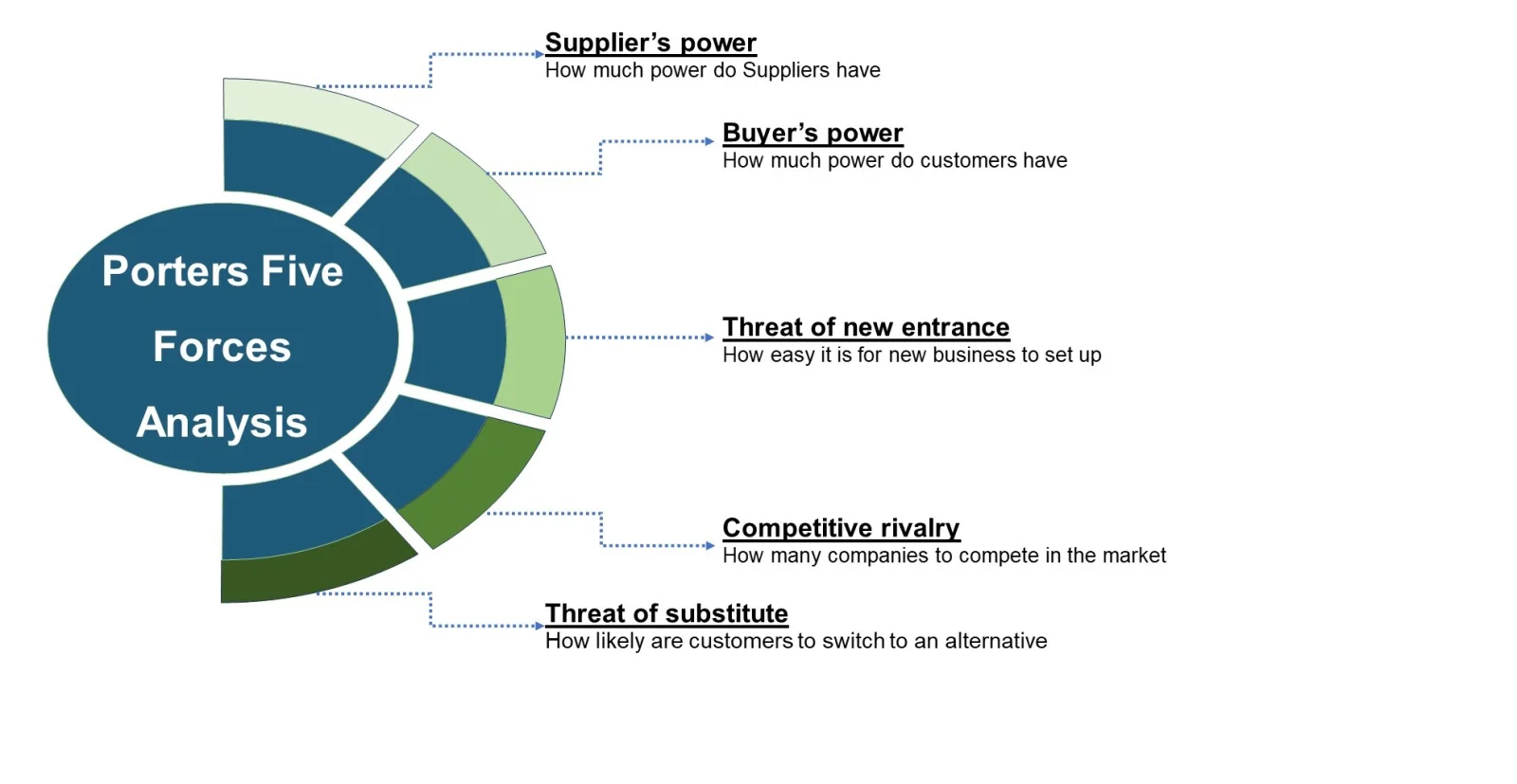
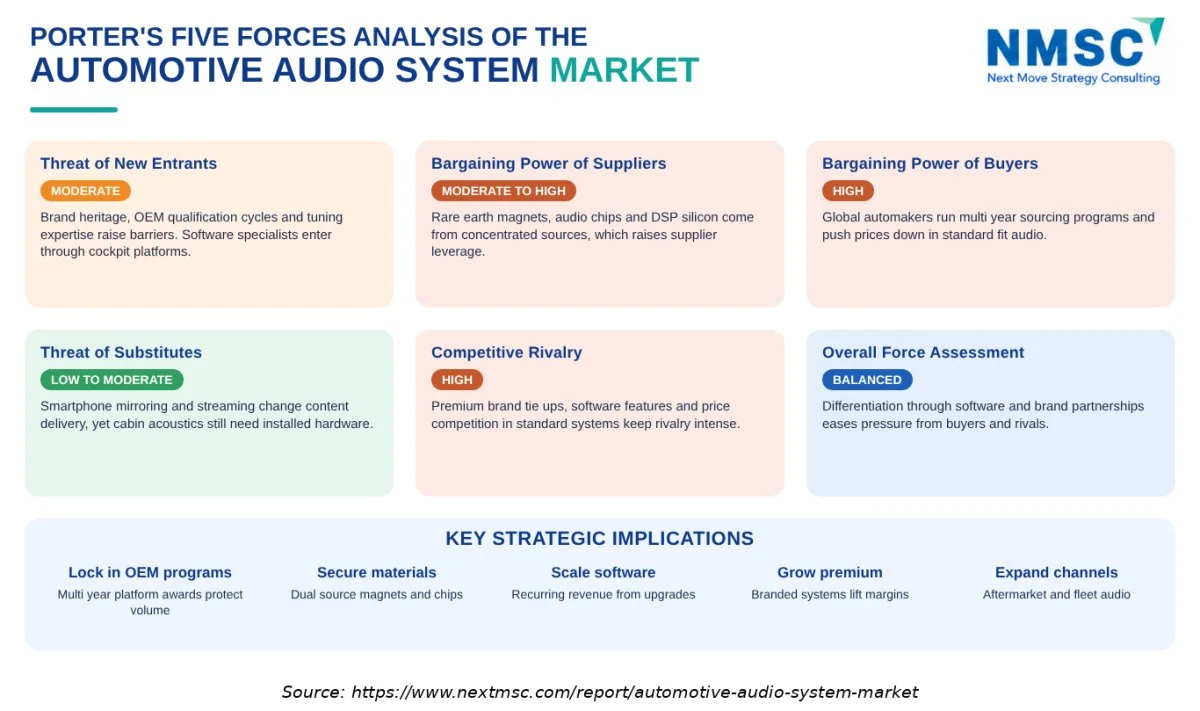
Porter's Five Forces Analysis of the Automotive Audio System Market

The above infographic rates the five competitive forces shaping the Automotive Audio System Market. Buyer power and rivalry are high, because automakers run large sourcing programs and brands compete on software and partnerships. Supplier power is moderate to high, driven by magnet and chip concentration. Entrants face moderate barriers, and substitutes pose a low to moderate threat.

Growth Opportunities

Our analysis shows that three whitespace areas can add revenue beyond baseline vehicle growth.

Can Optional Fit Premium Packages Unlock Higher Content per Vehicle?

Tiered option packs let automakers sell richer sound on mid range trims. Optional Fit grows from USD 2.93 Billion in 2026 to USD 9.02 Billion by 2035. Premium Audio suppliers and branded partners benefit most, because buyers pay for sound as a visible trim feature. Dealers gain margin from selling the packs at delivery.

Is Commercial Vehicle Cabin Audio an Underserved Segment?

Fleet operators want clearer driver communication and passenger announcements. Buses and Coaches grow at 10.54% CAGR, the fastest among vehicle types. Microphone, amplifier and DSP suppliers can serve urban transit and intercity coaches. Demand in the commercial vehicle segment also favours rugged, serviceable designs. Operators value systems that survive vibration and long duty cycles.

Will Audio Personalisation Software Create Recurring Revenue?

Personalisation Software grows from USD 0.24 Billion in 2026 to USD 1.15 Billion by 2035. Audio carried over in vehicle Ethernet lets suppliers push sound profiles and zone controls through updates. Software vendors and Tier 1 integrators gain subscription style income, and automakers gain a new way to keep owners engaged after purchase.

Regional Outlook

2025 (USD Billion)
2035 (USD Billion)
North Americ
Asia-Pacific
Europe
Middle East
Latin Americ
Region 2025 (USD Billion) 2035 (USD Billion) CAGR (%)
North America $10.0 USD Billion $40.0 USD Billion 9.0%
Asia-Pacific $17.1 USD Billion $51.1 USD Billion 27.0%
Europe $24.2 USD Billion $62.2 USD Billion 25.0%
Middle East & Africa $31.3 USD Billion $73.3 USD Billion 23.0%
Latin America $38.4 USD Billion $84.4 USD Billion 12.0%

Regional data is locked

Unlock complete regional numbers for this market.

Unlock Full Data

Competitive Landscape

Our assessment indicates that the Automotive Audio System Market industry blends global Tier 1 suppliers, branded audio houses and consumer electronics groups.

Dimension Description
Market Structure Moderately concentrated. Global Tier 1 suppliers and branded audio houses hold most factory fit programs.
Innovation Focus Software defined audio, spatial formats, noise management and voice integration on central compute.
M&A Activity Selective. Deals target software, premium audio brands and cockpit platforms rather than hardware scale.

How Do Companies Compete in the Automotive Audio System Market?

Companies compete on acoustic quality, OEM program wins, software features and cost. Long platform cycles reward suppliers with proven tuning and quality records. Global reach helps, as automakers expect the same system on several continents. Geographic expansion follows automaker plants, and pricing is tiered by trim, with standard systems under heavy cost pressure.

Which Competitive Archetypes Dominate the Industry?

Three archetypes stand out. Branded audio specialists, such as HARMAN, Bose and Premium Sound Solutions, sell a sound signature. Cockpit and infotainment Tier 1 suppliers, such as Panasonic Automotive Systems, Visteon, AUMOVIO, FORVIA and Hyundai Mobis, bundle audio with displays and compute. Electronics groups, such as Sony, JVCKENWOOD, Pioneer and Alps Alpine, bring components and aftermarket products.

What Innovation and Differentiation Strategies Are Companies Pursuing?

We found that leaders invest in tuning toolchains, spatial audio and noise management. Pioneer launched Dolby Atmos playback through Apple CarPlay in January 2026. Cerence AI joined its audio suite with HARMAN AudioworX in August 2025. Hyundai Mobis revealed rotating dashboard speakers in February 2025. These steps shift differentiation from hardware to software and system design.

What M&A and Partnership Activity Is Shaping the Market?

Based on research conducted by NMSC, partnerships dominate over large deals. Panasonic Automotive Systems and Qualcomm Technologies expanded work on cockpit platforms in January 2025. Software integrations and automaker supply agreements keep spreading development cost. Acquisitions focus on premium audio brands and software, and consolidation among cockpit suppliers remains a watch item.

Key Market Players

Our analysis shows that the following companies shape supply, tuning and distribution in the industry.

HARMAN International Industries, Incorporated Panasonic Automotive Systems Co., Ltd. AUMOVIO SE FORVIA SE DENSO TEN Limited Alps Alpine Co., Ltd. Visteon Corporation Huizhou Desay SV Automotive Co., Ltd. Hyundai Mobis Co., Ltd. Marelli Holdings Co., Ltd. JVCKENWOOD Corporation Sony Corporation Mitsubishi Electric Corporation Pioneer Corporation Lear Corporation Foster Electric Company, Limited Premium Sound Solutions Belgium NV Bose Corporation Vervent Audio Holding Meridian Audio Limited

Latest Developments

We observed that recent activity centres on spatial audio, tuning software and cockpit platforms.

Date Event
April 2026 HARMAN introduced Sing Drive, an in-vehicle karaoke platform combining real-time AI vocal removal, vehicle-system integration and premium audio engineering. The platform transforms conventional music playback into an interactive passenger experience, expanding the role of automotive audio systems in connected entertainment.

Expert Insights

Dave Schneider

Vice President, Car Audio Portfolio Management | HARMAN

"Personalization is where consumers feel the difference most—when the cabin adapts to the people inside, the content they love, and the context of the journey."

Analyst Interpretation

The statement highlights the growing transition from conventional automotive audio systems towards software-defined and personalised in-cabin sound experiences. Automakers are increasingly focusing on adaptive audio technologies that adjust sound characteristics according to passenger preferences, seating positions, entertainment content and cabin conditions. This shift is increasing the importance of digital signal processing, intelligent audio tuning, multi-zone sound distribution and software-based acoustic optimisation. Consequently, automotive audio suppliers are gaining opportunities to differentiate their offerings through integrated hardware and software solutions, while supporting automakers' efforts to enhance passenger comfort, entertainment quality and overall vehicle experience.

Investment Opportunities

Where Are Capital Inflows Heading in the Automotive Audio System Market?

Capital is flowing toward software, digital signal processing and premium audio brands. Dedicated Audio Software and Digital Signal Processing grow at 16.82% and 10.78% CAGR. Cockpit platform partnerships, such as the Panasonic and Qualcomm effort, draw further funding. Investors favour suppliers with multi year automaker awards, because secured volume lowers funding risk for new tooling and software teams.

How Is Infrastructure Investment Supporting the Automotive Audio System Market?

Suppliers are adding acoustic test chambers, tuning studios and regional engineering centres near automaker plants. Central compute and audio over Ethernet need new validation labs. Magnet and chip dual sourcing needs capital for qualification. Regional plants in India, Southeast Asia and Mexico shorten delivery and reduce tariff exposure, which makes local capacity a clear priority for suppliers.

What ESG Considerations Matter for Investors?

Material choices matter, since neodymium magnets carry mining and supply chain concerns. Lighter speakers and efficient amplifiers reduce vehicle weight and energy use, which supports electric vehicle range. Recycled plastics, cones and wiring are gaining attention. Software updates extend product life and cut replacement waste, so funds that screen for sustainability can find suitable targets.

Key Benefits for Stakeholders

How Does This Report Help Automakers and Tier 1 Suppliers?

Automakers and Tier 1 suppliers receive segment forecasts that guide trim strategy and platform planning. The report shows that Premium Audio reaches USD 13.36 Billion by 2035 and that Optional Fit grows at 13.31% CAGR. Regional and country estimates support plant, sourcing and pricing decisions across all five regions, which helps planners match capacity with demand.

How Does This Report Help Investors and Financial Analysts?

Investors gain a reconciled view of value pools, from a USD 13.59 Billion base in 2026 to USD 25.70 Billion in 2035. Segment CAGRs show where growth outpaces the 7.34% market rate. Competitive analysis and development tracking help screen acquisition targets and partnership candidates, and the figures give a clear base for valuation work.

How Does This Report Help Technology Vendors and Product Teams?

Software, chip and component vendors can map demand by offering, vehicle type and propulsion type. Insights on spatial audio, noise management and voice integration guide product roadmaps. Channel analysis shows where aftermarket and direct consumer sales can complement factory programs, which helps teams decide where to launch first and how to price.

Key Market Segments Evaluated

By Offering

  • Complete audio systems
  • Head units 
    • Audio receivers without integrated display
    • Display-based head units
  • Speakers and acoustic transducers 
    • Coaxial speakers
    • Component speaker sets
    • Subwoofers
    • Single-driver speakers
    • Acoustic exciters
    • Other audio transducers
  • Amplifiers
  • Digital signal processing
  • Microphones
  • Tuners 
    • Single-standard tuners
    • Multi-standard tuners
  • Audio control electronics 
    • Audio control modules
    • Audio interface modules
    • Other dedicated audio electronics
  • Dedicated audio software 
    • Audio enhancement software
    • Noise management software
    • Audio personalisation software
    • Other audio software

By Vehicle Type

  • Passenger vehicles 
    • Passenger cars
    • SUVs and crossovers
    • MPVs
  • Commercial vehicles 
    • Light commercial vehicles
    • Medium and heavy commercial vehicles
    • Buses and coaches

By System Positioning

  • Standard audio
  • Premium audio

By Propulsion Type

  • ICE
  • Hybrid
  • Battery electric
  • Fuel cell electric

By Sales Channel

  • Oem factory fit 
    • Standard fit
    • Optional fit
  • Aftermarket 
    • Distributor and wholesaler
    • Independent retail
    • Professional installation
    • Dealer parts counter
    • Direct consumer sales

By Region

  • North America 
    • U.S.
    • Canada
    • Mexico
  • Europe 
    • UK
    • Germany
    • France
    • Italy
    • Spain
    • Sweden
    • Denmark
    • Finland
    • Netherlands
    • Rest of Europe
  • Asia-Pacific 
    • China
    • India
    • Japan
    • South Korea
    • Taiwan
    • Indonesia
    • Vietnam
    • Australia
    • Philippines
    • Malaysia
    • Rest of APAC
  • Middle East & Africa 
    • Saudi Arabia
    • UAE
    • Egypt
    • Israel
    • Turkey
    • Nigeria
    • South Africa
    • Rest of MEA
  • Latin America 
    • Brazil
    • Argentina
    • Chile
    • Colombia
    • Rest of LATAM

Conclusion & Recommendations

What Is the Long-Term Outlook for the Automotive Audio System Market?

The Automotive Audio System Market is set to grow from USD 13.59 Billion in 2026 to USD 25.70 Billion by 2035, a CAGR of 7.34%. Growth rests on premium content, electric vehicle acoustics and software features. Asia-Pacific stays the volume centre, while Middle East & Africa and India grow fastest. Value will shift gradually from hardware to software and system integration.

What Strategic Positioning Recommendations Does NMSC Offer?

Suppliers should secure multi year automaker platforms and build tuning toolchains that work across vehicle architectures. Brand partnerships and spatial audio support premium pricing. Dual sourcing of magnets and chips protects delivery. Regional engineering in Asia-Pacific helps win local automakers, and aftermarket channels can balance factory cycles. Suppliers should also track regulation, since alert sound and radio rules can change content requirements.

How Does Investment Attractiveness Look for the Market?

Investment appeal is strongest in software, digital signal processing and optional premium packages. The absolute opportunity of USD 12.11 Billion between 2026 and 2035 supports sustained funding. Returns are better where suppliers hold long program awards and recurring software income. Mass market hardware offers thinner margins, and buyers should expect price pressure there.

What Are the Market Shifts and Key Risks in the Automotive Audio System Market?

Key shifts include central compute, spatial audio and rising battery electric share. Risks include rare earth and chip supply disruption, smartphone mirroring that cuts factory audio spend, and cost pressure in price sensitive regions. Regulatory change, such as the US AM radio bill, could also alter tuner content. Suppliers should plan for both outcomes.

What Are the Primary Growth Pathways Through 2035?

Three pathways stand out. Premium and optional fit packages lift content per vehicle. Software and personalisation create recurring income at 16.82% CAGR. Emerging regions and commercial vehicles add volume. Suppliers that combine these pathways can outgrow the market. Each path also supports the others, because premium content needs software, and software needs installed hardware.

Delivered Customizations

We have successfully delivered the following deep-dive customizations:

Client Request Customization Delivered Value Adds
Import-Export Trade Assessment
  • Country-wise import and export analysis of automotive audio components such as speakers, amplifiers, and head units, using UN Comtrade and WITS data.
  • Identifies sourcing hubs and export-dependent markets to guide supply chain and localization decisions.
Historical Market Growth Analysis
  • Historical revenue and unit shipment analysis of automotive audio systems across offering, vehicle type, and sales channel segments.
  • Shows which segments drove past growth, supporting prioritization of investment and capacity planning.
Company-Level Product Share Analysis
  • Company-level share analysis by system positioning and offering, based on disclosed revenue and product line data.
  • Reveals competitive positioning gaps across standard, mid-range, and premium systems to inform portfolio strategy.
EV Acoustic Content Opportunity Mapping
  • Demand mapping of audio and acoustic system content by propulsion type and vehicle type, including EV-specific sound requirements such as AVAS compliance.
  • Pinpoints where electrified platforms create new audio content opportunities and where regulatory acoustic mandates add system value.
OEM Fitment and Aftermarket Replacement Assessment
  • Analysis of OEM-fitted versus aftermarket audio penetration by sales channel and vehicle age, using national vehicle registration and fleet data.
  • Quantifies installed-base replacement potential to support aftermarket channel and upgrade product strategy.
System Positioning Content-per-Vehicle Benchmarking
  • Benchmarking of audio system content per vehicle across standard, mid-range, and premium positionings by vehicle type and region.
  • Supports pricing and feature-content decisions by showing value captured at each system tier.

FAQs

Sources & References

1.

OICA, Auto industry growth shifted east in 2025 (April 2026)

oica.net
2.

OICA, 2025 vehicle production table, hosted by AFIA (April 2026)

afia.pt
3.

IEA, Global EV Outlook 2026 release (May 2026)

iea.org
4.

IEA, Global Critical Minerals Outlook 2026 release (2026)

iea.org
5.

ACEA, New car registrations 2025 (January 2026)

acea.auto
6.

Service-Public.gouv.fr, EU driver distraction warning from 7 July 2026 (July 2026)

service-public.gouv.fr
7.

US Senate Committee on Commerce, AM Radio for Every Vehicle Act (September 2026)

commerce.senate.gov
8.

SIAM, Auto industry performance December 2025 (January 2026)

siam.in
9.

USGS, Mineral Commodity Summaries 2026, Rare Earths (February 2026)

pubs.usgs.gov
10.

CLEPA, Press release on Nexperia supply (October 2025)

clepa.eu
11.

S&P Global Mobility AutoTechInsight, Cerence AI and HARMAN AudioworX (August 2025)

autotechinsight.spglobal.com
12.

S&P Global Mobility AftermarketInsight, Pioneer CES 2026 receiver (January 2026)

aftermarketinsight.spglobal.com
13.

The Korea Herald, Hyundai Mobis movable sound system (February 2025)

koreaherald.com/article/10418371
14.

Automotive World, Panasonic Automotive Systems and Qualcomm collaboration (January 2025)

automotiveworld.com

About the Author

Jayanta Das

Jayanta Das

Jayanta Das is Senior Analyst at Next Move Strategy Consulting, where he has spent 4.5 years covering the firm's full industry taxonomy — spanning aerospace and defense, healthcare, BFSI, energy and power, semiconductors, and beyond — rather than one specialization. His work follows NextMSC's research model, combining data mining, analytics, and secondary research to build market sizing and forecasts behind NextMSC's 2,000-plus research reports, trusted by more than 3,000 organizations globally.

About the Reviewer

Supradip Baul

Supradip Baul

Supradip Baul is an accomplished business consultant and strategist with over a decade of rich experience in market intelligence, strategy, technology, and business transformation. His work has included rigorous qualitative and quantitative analysis across multiple industries, helping clients shape investment decisions and long-term roadmaps. Earlier in his career, he was associated with Gartner, where he contributed to industry-leading reports and market share analyses. He has worked with leading global companies and holds an MBA with a dual specialization in Marketing and Finance.

Download Free Sample

Rishabh Jogani

RISHABH JOGANI

Strategy Analyst

Accenture Japan

We are incredibly impressed with the market report on the real estate market in India provided by Next Move Strategy Consulting. The report was thorough, insightful, and well-structured, offering deep analysis and actionable recommendations. It not only captured the current trends and dynamics but also provided a forward-looking perspective that has been invaluable for our strategic planning. Their team demonstrated exceptional professionalism, attention to detail, and a profound understanding of the industry. The data-driven insights and clarity of presentation exceeded our expectations, making complex market trends easy to understand. We highly recommend Next Move Strategy Consulting to anyone looking for reliable and comprehensive market research services. Their expertise has given us the confidence to navigate the complexities of the Indian real estate market with clarity and foresight.

Pratyush Kumar Das

PRATYUSH KUMAR DAS

Assistant Manager

Polycab India Limited

We would like to express our appreciation for the data and insights provided by nextmsc. We are very pleased with the quality and depth of the information, which has proven to be highly valuable and beneficial for our business decision-making.

Kishu Kanda

KISHU KANDA

Strategy Analyst

Accenture

We purchased the AI Consumer Market Report from this company. Not only did they customize the report to meet our specific requirements, but they also showed great flexibility in accommodating our budget. The report we received fully met our expectations. Additionally, they provided prompt and thorough responses to both our pre-purchase and follow-up questions. We look forward to working with this company again in the future.

Nishant Awate

NISHANT AWATE

Business Development Global Sales

Zehnder Group Deutschland GmbH

Our experience working with Next Move Strategy Consulting was positive. The team was responsive, professional, and open to incorporating our specific requirements throughout the project. The India AHU market study was comprehensive and well structured, covering market value and volume forecasts, product and application segments, and key industry trends. The inclusion of both AHU and residential MVHR market insights made the study particularly relevant for our strategic market assessment. Overall, the report provides a solid foundation for evaluating market potential, identifying priority segments, and supporting business-development decisions in India.

Henri Knyphausen

HENRI KNYPHAUSEN

Partner at Singulier [Ex-BCG]

Singulier

I recently engaged NEXTMSC.com for a commercial due diligence project within the intralogistics sector, and I am pleased to provide a reference based on my experience. In utilizing NEXTMSC.com's services, I found their report to offer valuable insights into market dynamics and key industry players. The initial report provided a solid foundation for our analysis. However, as we were investigating a smaller target in the market, and I had specific customization requests requiring additional research. These requests included detailed information on product portfolios of various players and sub-market sizes, both inclusive and exclusive of certain product categories. NEXTMSC.com demonstrated commendable responsiveness and agility in accommodating these customization requests. Within a timeframe of 1-2 weeks, they delivered a revised report that met our specific needs. Furthermore, they were receptive to my follow-up inquiries, ensuring clarity and understanding of the data provided. The final deliverable significantly contributed to our due diligence efforts. One of NEXTMSC.com's notable strengths lies in their qualitative research capabilities. However, for future engagements, I would recommend the inclusion of a quantified market model in Excel format. Such a model would offer the ability to conduct in-depth analyses and explore various market segments, including country-specific data and subcomponent breakdowns. Based on my positive experience, I would not hesitate to work with NEXTMSC.com again. Their responsiveness, willingness to accommodate customization requests, and commitment to delivering actionable insights make them a reliable partner for commercial research projects.

Custom Market Research Services

We will customize the research for you if the listed report does not fully match your requirements.

Get 30% Free Customization

Select License

This website uses cookies to ensure you get the best experience on our website. Learn more

✖