Autonomous Trucks Market: Driverless Freight Scales Up in 2026 | NextMSC
Introduction
The global freight industry is undergoing a structural transformation that no amount of incremental logistics optimization could have produced — autonomous trucks are moving from controlled pilots to commercial-scale deployment on public highways, and the financial stakes have never been higher. According to Next Move Strategy Consulting's Autonomous Truck Market report, the global autonomous trucks market was valued at USD 28.4 billion in 2022 and is projected to reach USD 85.4 billion by 2030, growing at a CAGR of 12.77% from 2023 to 2030. This trajectory is being driven not by speculative technology roadmaps, but by verifiable commercial deployments, a structural driver shortage that the U.S. freight industry cannot resolve through conventional hiring, and a federal regulatory environment that — for the first time — is actively accelerating rather than constraining autonomous vehicle deployment.
The convergence of these forces in 2026 has produced a market inflection point. Aurora Innovation launched its second-generation driverless trucks in July 2026, with manufacturing partner Roush targeting an annual production run-rate of 1,000 trucks by year-end. PepsiCo formalized a multi-year autonomous freight partnership with Gatik in June 2026, deploying driverless trucks across three U.S. states inside one of the world's largest consumer goods supply chains. Volvo has committed to fully driverless operations in Texas by Q1 2027 and more than 300 autonomous trucks on U.S. highways by end of 2027. The question for institutional investors and C-level logistics executives is no longer whether autonomous trucking will scale — it is how quickly the economics, regulation, and operational integration will align to determine who captures the value.
For More Information: Download FREE Sample on Autonomous Trucks Market Report
From Pilots to Payload: The Commercial Deployment Inflection of 2026
Aurora's Second-Generation Fleet Signals Industrial-Scale Intent
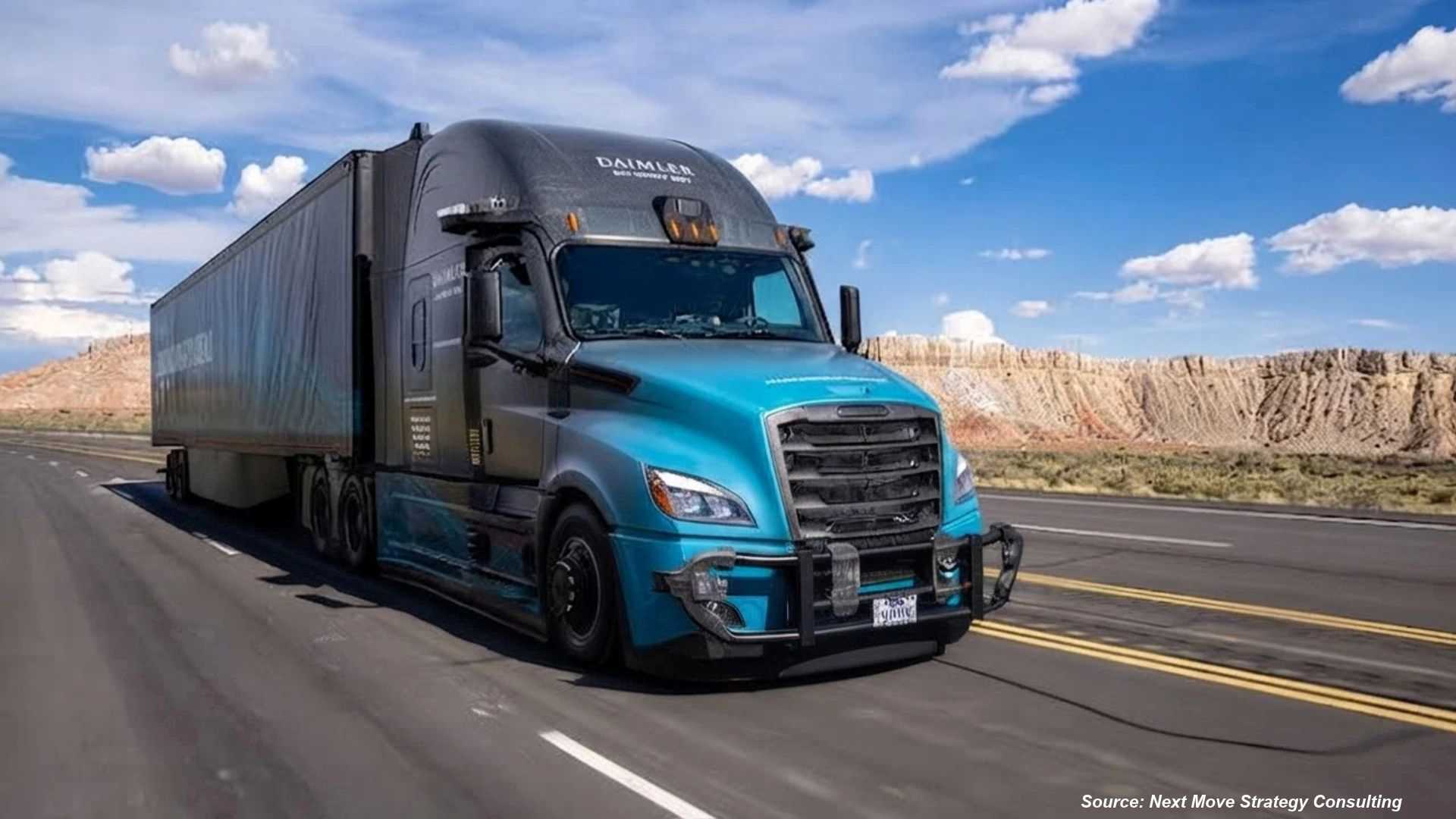
The most consequential single development in the autonomous trucks market in 2026 was Aurora Innovation's July 22 launch of its second-generation driverless trucks — a move that shifted the company's posture from technology demonstration to volume manufacturing. The new fleet, built on the International® LT® Series vehicle platform and powered by Aurora's next-generation hardware — engineered to last one million miles — is being integrated by manufacturing partner Roush at a dedicated production facility, with a target annual run-rate of 1,000 trucks by the end of 2026. As of the end of June 2026, the Aurora Driver had completed nearly 440,000 driverless miles across 10 commercial routes throughout the U.S. Sun Belt, and a leading carrier had committed to purchasing 500 Aurora Driver-powered trucks.
"Last year's driverless launch proved our technology could operate safely on public roads — our new platform now provides the foundation to deliver at scale," said Chris Urmson, CEO and co-founder of Aurora Innovation, in the company's July 22, 2026 press release via Business Wire. "Deploying our second-generation truck allows us to put hundreds of autonomous trucks on the road and ultimately into the hands of more customers."
The safety case underpinning this expansion is grounded in real-world evidence. Aurora's analysis of 29 fatal crashes on Interstate 45 in Texas — recreated in simulation — found that the Aurora Driver would have avoided every single collision, a finding that directly supports the regulatory argument that autonomous trucks reduce the human-error-driven fatalities that account for the majority of large-vehicle crash deaths.
PepsiCo and Gatik: Autonomous Freight at Consumer-Goods Scale
On June 8, 2026, PepsiCo and Gatik announced a multi-year strategic partnership that brought autonomous freight into PepsiCo's North America food and beverage supply chain — the largest commercial autonomous freight deployment to date. Gatik's driverless trucks are already operating across Texas, Arizona, and Arkansas, delivering PepsiCo products across high-frequency, time-sensitive regional networks with more than 98% on-time delivery performance.
"Serving our vast network of customers requires a supply chain that is safe, reliable, and built for the future," said Jim Farrell, Senior Vice President of Supply Chain at PepsiCo, in the company's June 8, 2026 press release. "Gatik is already operating inside our networks and brings the autonomous freight technology, commercial experience, and scale we need to strengthen service, add capacity, and move products more consistently for our customers."
"Autonomous trucking has reached commercial scale when it operates inside one of the most demanding supply chains on the planet," said Gautam Narang, CEO and Co-Founder of Gatik, in the same press release. "Our autonomous trucks are already moving products every day across Texas, Arizona, and Arkansas, and this partnership is proof that Gatik is becoming central to how the world's largest companies move goods."
The PepsiCo-Gatik deployment is significant not merely for its scale, but for what it reveals about the addressable market structure. Gatik's trucks are designed for end-to-end deliveries across highways and surface streets, with dynamic route orchestration that allows PepsiCo to modify route plans in response to daily operational needs — adding or removing stops, responding to demand shifts, and adapting to distribution center activity levels. This operational flexibility, rather than simple point-to-point automation, is what makes autonomous freight viable inside complex, high-volume consumer goods supply chains.
Volvo's Commercial Roadmap and the Economics of Autonomous Utilization
Volvo Group has moved beyond strategic announcements to binding operational milestones. According to a Forbes analysis published July 14, 2026, Volvo has outlined fully driverless operations in Texas in Q1 2027, more than 300 autonomous trucks on U.S. highways by end of 2027, and industrial-scale deployment from 2028 onwards. The Volvo-Aurora partnership's Dallas–Oklahoma City lane is already operational, extending the commercial network beyond the original Dallas–Houston corridor.
The economic argument Volvo presents is built on asset utilization rather than driver-cost elimination alone. Volvo's estimate is that autonomy can roughly double truck utilization — enabling a single autonomous truck to exceed 200,000 miles per year, compared to a human-driven truck constrained by hours-of-service rules. Combined with smoother, more fuel-efficient driving, the total cost of operation is projected to fall from approximately USD 2.25–2.30 per mile today to USD 1.15–1.35 per mile at scale — roughly halving the per-mile cost of freight transport.
"The most important thing is uptime, because when a vehicle stands still, you're losing around 2,000 dollars a day," said Peter Voorhoeve, President of Volvo Trucks North America, as quoted in Forbes on July 14, 2026. Volvo reports a 24% reduction in unplanned stops across its connected truck fleet, while approximately 16,000 over-the-air software updates were delivered in May, illustrating the parallel development of connected fleet-management capabilities alongside autonomous driving technology.
NMSC Strategic Perspective: Why the 2026 Deployment Wave Validates the Long-Term Forecast
NextMSC primary research and analysis identifies the current commercial deployment wave as the critical validation event that underpins the market's trajectory toward USD 85.4 billion by 2030. The NMSC model accounts for three compounding dynamics that are now simultaneously active: the structural driver shortage that makes autonomous capacity addition economically necessary rather than merely desirable; the maturation of Level 4 autonomy hardware to the point where per-unit costs are declining toward commercial viability; and the regulatory normalization that is converting state-by-state patchwork permissions into a coherent national framework.
The NMSC segmentation analysis identifies heavy-duty trucks as the dominant segment by revenue, driven by the long-haul highway use case where the economics of continuous operation are most compelling. The Level 4 autonomy segment is the fastest-growing by technology tier, as the commercial deployments by Aurora, Gatik, and Volvo are all operating at or near this level. North America retains the largest regional share, supported by the regulatory environment, highway infrastructure density, and the concentration of technology investment — but Asia-Pacific, particularly China and Japan, is accelerating through mandated ADAS adoption and rapid logistics sector expansion. NextMSC proprietary research and estimates project that the interplay between these regional dynamics will sustain the 12.77% CAGR through 2030, with the steepest growth curve occurring in the 2026–2028 window as fleet sizes cross the threshold required for operational cost parity.
Section Summary:
-
Aurora Innovation's second-generation driverless trucks, targeting a 1,000-unit annual production run-rate by end of 2026, represent the clearest signal yet that autonomous trucking has crossed from demonstration to manufacturing scale.
-
PepsiCo's multi-year partnership with Gatik — delivering across three U.S. states with 98%+ on-time performance — establishes that autonomous freight is operationally viable inside the most demanding consumer goods supply chains.
-
Volvo's projection of halving per-mile costs from ~USD 2.25–2.30 to USD 1.15–1.35 at scale, combined with doubled asset utilization, reframes the investment case from cost-reduction to capital-efficiency transformation.
-
NextMSC proprietary research and estimates identify the 2026–2028 window as the period of steepest market growth, as fleet sizes cross the operational cost-parity threshold.
Industry Impact Analysis
The Driver Shortage as a Structural Market Accelerant
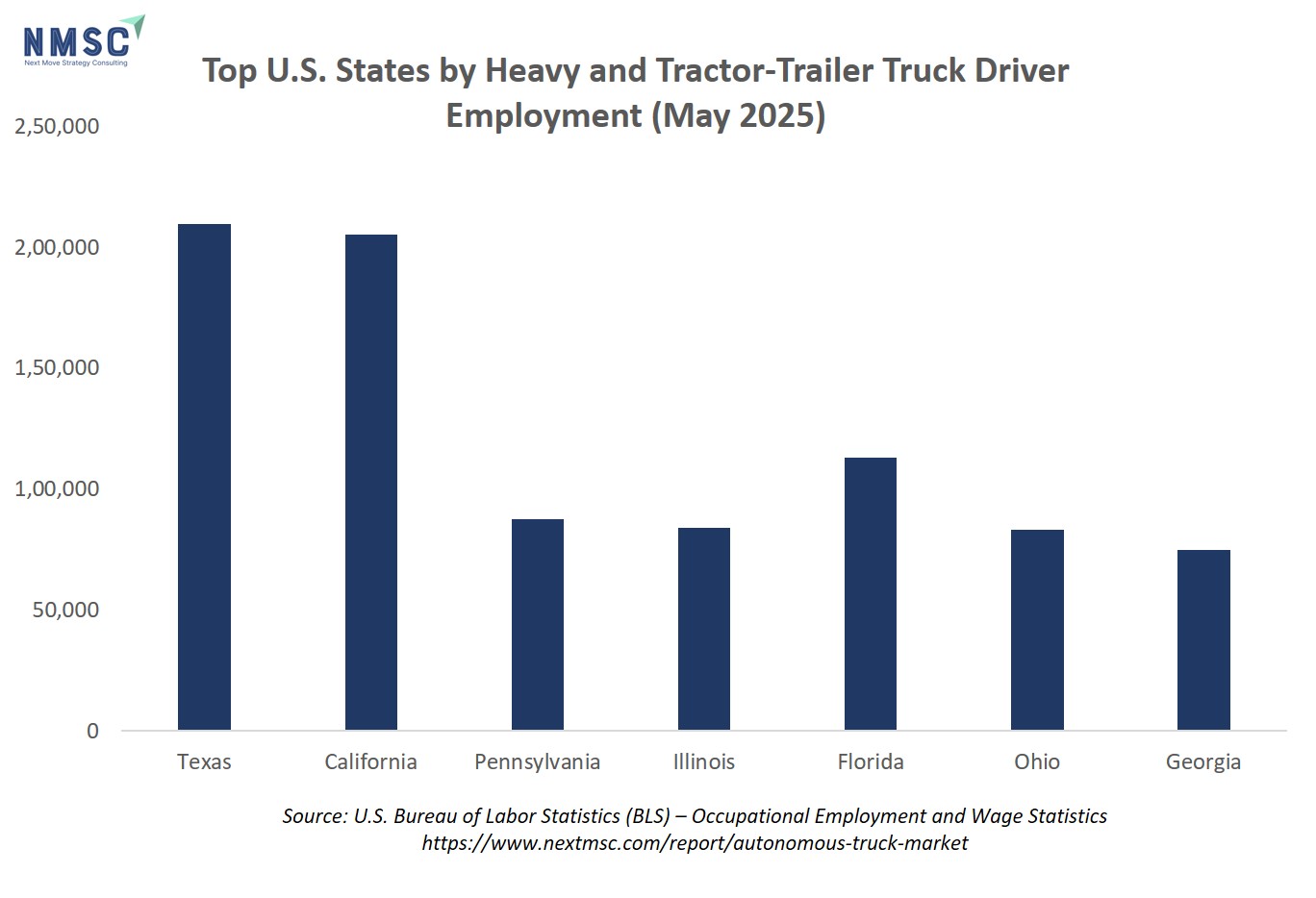
The U.S. trucking industry's labor constraint is not a cyclical staffing problem — it is a structural demographic and economic mismatch that autonomous trucks are uniquely positioned to address. According to the U.S. Bureau of Labor Statistics, there were nearly 2.1 million heavy and tractor-trailer truck drivers in the United States as of May 2025, with an annual mean wage of USD 59,710. The American Trucking Associations estimates a current driver shortage of approximately 60,000, alongside a projected need for roughly 1.2 million new drivers over the next decade to cover retirements and industry growth, while turnover at large truckload carriers runs close to 90%.
This shortage is not being resolved by wage increases alone. The BLS projects approximately 214,500 openings per year for heavy and tractor-trailer drivers, a volume that the existing training pipeline cannot fill at current rates. Autonomous trucks, positioned as an additional source of capacity on specific long-haul highway corridors rather than a wholesale replacement of the driver workforce, directly address the segments of the network where the shortage is most acute and where the economics of continuous operation are most favorable.
The Federal Regulatory Shift: From Barrier to Enabler
The regulatory environment for autonomous trucks in the United States underwent a decisive shift in 2026. On July 7, 2026, the U.S. Department of Transportation released its 2026 unified rulemaking agenda, which lists no fewer than 15 separate NHTSA and FMCSA rulemakings focused on autonomous vehicles — a concentration of regulatory activity that signals the Trump Administration's explicit prioritization of AV deployment over other transportation policy objectives. These rulemakings are updating Federal Motor Vehicle Safety Standards to accommodate vehicles that operate without a human driver — adjusting standards on rear visibility, electronic stability control, and occupant crash protection to reflect the physical reality of driverless operation.
At the legislative level, the BUILD America 250 Act — the bipartisan surface transportation reauthorization bill advanced by the House Transportation Committee — would establish the first-ever national regulatory framework for autonomous commercial vehicles, including safety standards for interstate commerce, manufacturer safety cases, cybersecurity policies, crash reporting requirements, and rules governing the ratio of autonomous trucks to human dispatchers. The SELF-DRIVE Act and AMERICA DRIVES Act are also under Congressional consideration as part of the surface transportation reauthorization process.
"Manufacturers support a clear and consistent federal framework for autonomous commercial vehicles," said Kirbie Ferrell, NAM Director of Transportation and Infrastructure Policy, as quoted by the National Association of Manufacturers. "Providing regulatory certainty for emerging technologies can encourage innovation, strengthen supply chains and improve the efficient movement of goods across the national freight network."
At the state level, 35 states now allow autonomous truck testing or deployment, according to U.S. Representative Vince Fong (R-CA), who has advanced federal legislation to preempt state-level driver-in mandates for commercial vehicles. California's DMV has cleared the way for testing of autonomous trucks on state roads, requiring manufacturers to complete 500,000 miles for heavy-duty trucks across two phases — totaling 1 million miles — and to prepare a structured safety case.
Labor Opposition and the Litigation Dimension
The deployment acceleration has not proceeded without organized resistance. In August 2026, Teamsters California filed suit against the California DMV, challenging the new autonomous vehicle regulations for heavy-duty trucks and alleging that the DMV violated state law by failing to properly evaluate economic impacts or allow adequate public feedback. "Such a critical decision with life-and-death consequences must involve public input and transparency," said Peter Finn, Teamsters California co-chair, in an August 5, 2026 statement announcing the lawsuit.
A March 2026 poll from Advocates for Highway and Auto Safety found that 85% of respondents were concerned about sharing the road with autonomous trucks — a public sentiment figure that state legislators in Alaska, Alabama, and Iowa have attempted to translate into restrictive legislation, though most such bills have failed to advance. California Governor Gavin Newsom and Colorado Governor Jared Polis have each vetoed driver-in bills, with Polis stating that such legislation "risks preventing Coloradans from being on the cutting edge of innovation that would improve safety in the future."
Environmental Impact: Quantified Efficiency Gains
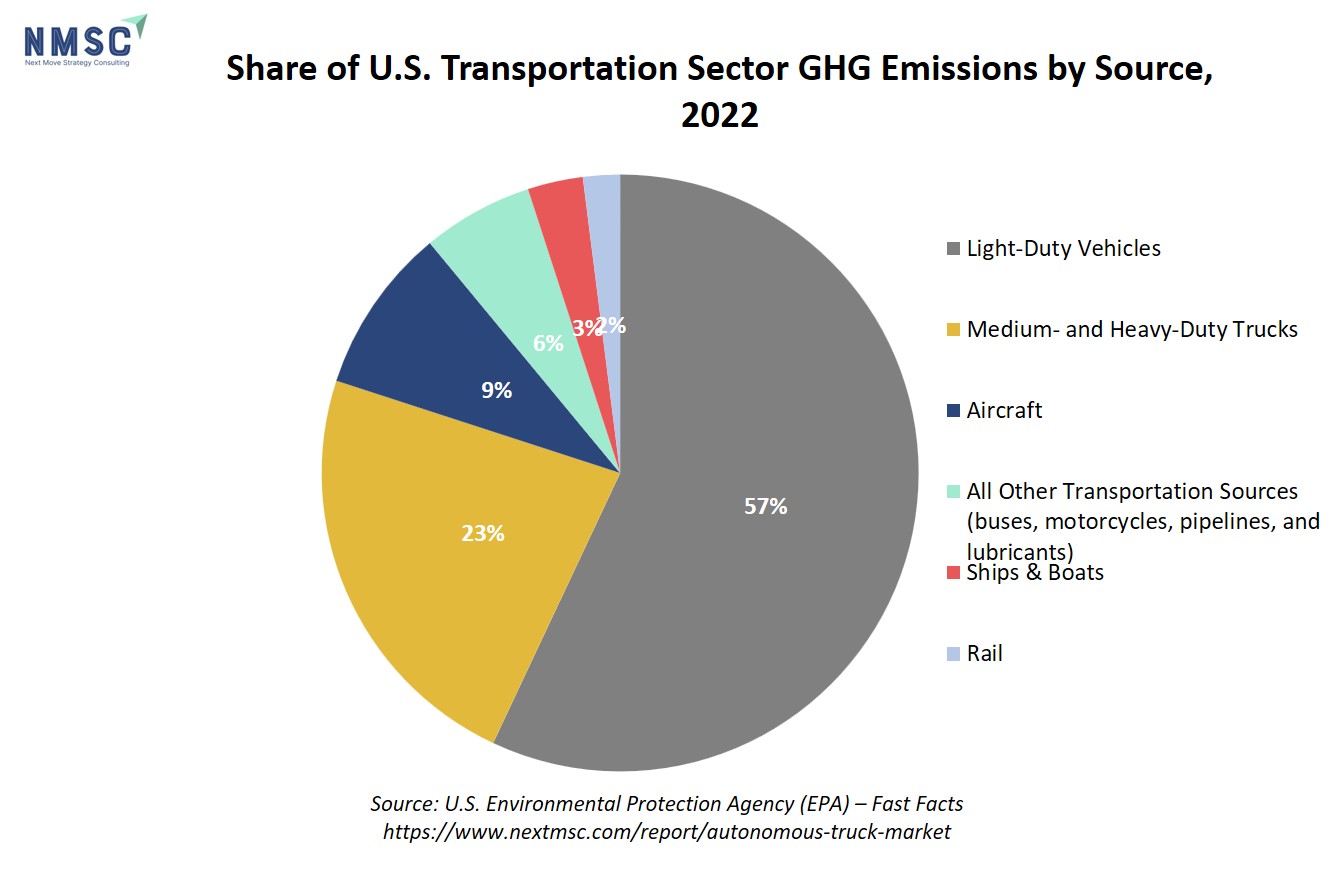
The environmental case for autonomous trucks is supported by Aurora Innovation's white paper, which found that autonomous trucking could increase energy efficiency by up to 32% relative to traditional trucking. The mechanisms are specific and measurable: operating at 65 mph rather than 70–75 mph reduces highway fuel consumption by 9%–17%; eliminating driver rest-related idling removes 4%–9% of fuel consumption; and strategic eco-driving — optimizing acceleration, braking, and coasting — can deliver an additional 9.5% fuel saving. These gains are material in the context of the U.S. Environmental Protection Agency's finding that transportation accounts for approximately 29% of U.S. greenhouse gas emissions, with medium and heavy-duty trucks contributing 23% of that transportation total.
Section Summary:
-
The U.S. driver shortage — approximately 60,000 positions currently unfilled, with 1.2 million new drivers needed over the next decade — is a structural constraint that autonomous trucks address by adding capacity on long-haul highway corridors without competing for the same labor pool.
-
The DOT's July 2026 regulatory agenda, with 15 AV-focused rulemakings, and the BUILD America 250 Act's proposed national framework represent the most concentrated federal regulatory support the autonomous trucking industry has received.
-
Labor opposition, led by the Teamsters' August 2026 California DMV lawsuit, introduces litigation risk that could delay state-level deployment timelines, even as federal preemption legislation advances.
-
Aurora's white paper quantifies a 32% energy efficiency improvement potential, directly reducing the freight sector's contribution to U.S. GHG emissions — a regulatory compliance benefit that strengthens the business case for fleet operators subject to state and federal emissions mandates.
Pros and Cons of Recent Market Developments
|
Development |
Pros |
Cons |
|
Aurora's 2nd-Gen Fleet Launch (July 2026) |
1,000-unit annual production run-rate signals manufacturing scalability; 1M-mile hardware durability reduces lifecycle cost |
Hardware still close to hand-built; cost parity with conventional trucks unlikely before end of decade |
|
PepsiCo-Gatik Multi-Year Partnership (June 2026) |
98%+ on-time delivery validates operational reliability in high-volume consumer goods supply chains; dynamic route orchestration adds flexibility |
Deployment limited to three states; regulatory patchwork constrains rapid national expansion |
|
DOT 2026 Regulatory Agenda (July 2026) |
15 AV-focused rulemakings accelerate FMVSS modernization; federal framework reduces state-by-state compliance burden |
Substantive AV performance standards remain in pre-rule stage; final standards unlikely before end of current Administration |
|
BUILD America 250 Act |
First-ever national framework for autonomous commercial vehicles; preempts restrictive state driver-in mandates |
Bill not yet enacted; timeline to passage and implementation uncertain |
|
Teamsters California DMV Lawsuit (August 2026) |
Forces transparency in regulatory process; may strengthen long-term public trust if resolved in industry's favor |
Introduces litigation-driven deployment delays in California, the largest U.S. trucking market by employment |
|
Volvo's 2027 Driverless Operations Target |
Committed OEM milestones provide supply chain certainty for fleet operators; 24% reduction in unplanned stops already demonstrated |
Industrial-scale deployment not targeted until 2028; early fleet economics remain above long-run cost projections |
|
California DMV Autonomous Truck Testing Clearance |
Opens the largest U.S. state market to heavy-duty AV testing; 1M-mile safety case requirement sets a credible industry standard |
1M-mile testing requirement extends time-to-commercial-deployment; Teamsters lawsuit creates regulatory uncertainty |
Key Data & Statistics
Autonomous Trucks Market — Key Metrics and Milestones
|
Metric |
Data Point |
|
Global Market Value (2022) |
USD 28.4 billion |
|
Global Market Forecast (2030) |
USD 85.4 billion |
|
CAGR (2023–2030) |
12.77% |
|
Aurora Driver Driverless Miles (as of June 2026) |
~440,000 miles |
|
Aurora 2nd-Gen Production Target (2026) |
1,000 trucks/year run-rate |
|
PepsiCo-Gatik On-Time Delivery Rate |
98%+ |
|
Volvo Autonomous Trucks Target (end of 2027) |
300+ trucks on U.S. highways |
|
Projected Per-Mile Cost Reduction (at scale) |
USD 2.25–2.30 → USD 1.15–1.35 |
|
U.S. Heavy Truck Driver Workforce (May 2025) |
~2.1 million |
|
Current U.S. Driver Shortage Estimate |
~60,000 |
|
Drivers Needed Over Next Decade |
~1.2 million |
|
Large-Fleet Driver Turnover Rate |
~90% |
|
States Allowing AV Truck Testing/Deployment |
35 states |
|
Private Capital Invested in AV Industry (since 2018) |
USD 6 billion+ |
|
Autonomous Trucking Energy Efficiency Gain Potential |
Up to 32% |
|
U.S. GHG Emissions from Transportation |
~29% |
|
Medium/Heavy Trucks' Share of Transport Emissions |
23% |
|
Potential Transportation Cost Savings (University of Illinois) |
35% |
|
DOT 2026 AV-Focused Rulemakings |
15 separate rulemakings |
Key Autonomous Truck Deployments and Commercial Milestones (2025–2026)
|
Company / Partnership |
Deployment Detail |
Geography |
Status |
|
Aurora Innovation |
2nd-gen driverless Class 8 trucks; 10 commercial routes; 440,000 driverless miles |
U.S. Sun Belt (TX, AZ, OK) |
Commercial — scaling to 1,000 trucks/year |
|
Gatik + PepsiCo |
Multi-year autonomous freight partnership; 35+ driverless trucks; 98%+ on-time delivery |
Texas, Arizona, Arkansas |
Commercial — multi-year agreement |
|
Volvo Autonomous Solutions + Aurora |
Dallas–Oklahoma City autonomous lane; fully driverless TX operations targeted Q1 2027 |
Texas, Oklahoma |
Commercial pilot → full driverless 2027 |
|
Gatik + Walmart / Tyson Foods |
Autonomous box truck deliveries for major retail and food supply chains |
Multiple U.S. states |
Commercial |
|
Kodiak AI |
Autonomous oil field sand hauling in Permian Basin; California DMV testing permit received |
New Mexico, Texas, California |
Commercial (Permian) + Testing (CA) |
|
Einride |
Driverless short-haul freight operations |
Marysville, Ohio |
Commercial |
|
Indiana + Ohio DOT Platooning |
U.S. DOT grant-funded platooning on I-70 between Columbus and Indianapolis |
Indiana, Ohio |
Pilot |
|
Gatik AI (Canada) |
Plans to operate 50 self-driving freight trucks in Canada by end of 2026 |
Canada |
Planned deployment |
Future Outlook & Forecast
The Path to USD 85.4 Billion: Structural Drivers and Scaling Constraints
According to NextMSC proprietary research and estimates, the global autonomous trucks market is on a trajectory to reach USD 85.4 billion by 2030, growing at a CAGR of 12.77% from a 2022 base of USD 28.4 billion. The growth curve is not linear — NextMSC analysis identifies the 2026–2028 period as the steepest phase of expansion, as the commercial deployments now underway generate the operational data, insurance frameworks, and supply chain integration models that will enable fleet operators to commit to large-scale procurement.
The long-term market potential extends well beyond the 2030 forecast horizon.A 2024 McKinsey analysis projected that the autonomous heavy-duty trucking market could reach approximately USD 616 billion by 2035, driven by the potential for lower total cost of ownership, reduced driver-related costs, and the emergence of driver-as-a-service (DaaS) and capacity-as-a-service business models. A University of Illinois study released in August 2026 estimated that driverless trucks could save 35% in transportation costs — a figure that, applied to the USD 800+ billion U.S. trucking industry, represents a structural cost reduction of historic proportions. Aurora Innovation's own analysis projects that self-driving trucks could deliver USD 9 billion in annual consumer savings.
Technology Maturation: From Level 4 to Industrial Scale
The Level 4 autonomy segment — where the vehicle handles all driving tasks within a defined operational design domain without any human intervention — is the commercial frontier in 2026. Aurora, Gatik, and Kodiak are all operating at or near Level 4 on specific highway corridors. The next phase of market development will be determined by three variables: the rate at which hardware costs decline from the current well-above-USD 100,000 per truck toward a fraction of that figure; the speed at which the federal regulatory framework provides the legal certainty needed for large fleet operators to commit capital; and the development of remote supervision, insurance, and risk-pricing models that remain unsettled in the current early-fleet environment.
The ADAS features segment — encompassing adaptive cruise control, automatic emergency braking, lane keeping assist, and blind spot detection — represents the near-term revenue base that bridges the gap between today's partially automated fleets and tomorrow's fully driverless operations. NHTSA's pending supplemental notice of proposed rulemaking for automatic emergency braking on heavy trucks, which has been in development for three years, will mandate AEB adoption across the heavy-duty fleet — a regulatory requirement that directly expands the addressable market for ADAS hardware and software suppliers.
Regional Dynamics: North America Leads, Asia-Pacific Accelerates
North America retains the dominant share of the global autonomous trucks market, supported by the concentration of technology investment, the regulatory momentum described above, and the geographic characteristics of the U.S. freight network — long interstate highway corridors, established logistics hubs, and a regulatory environment that has moved faster than any other major economy to permit commercial driverless operations. Texas, with 209,680 heavy truck driver jobs as of May 2025 and a regulatory stance that has made it the primary proving ground for autonomous freight, is the single most important state market for near-term deployment.
Asia-Pacific is the fastest-growing regional market, driven by China's mandated ADAS adoption requirements and Japan's rapid progress in mining and delivery truck automation. The logistics sector across Asia-Pacific is expanding in direct proportion to e-commerce growth, creating demand for autonomous freight capacity that the existing driver workforce cannot satisfy at the required scale. NextMSC proprietary research and estimates project that Asia-Pacific will narrow the gap with North America through the forecast period, with China's regulatory framework and domestic OEM investment playing a decisive role in the region's trajectory.
Section Summary:
-
NextMSC proprietary research and estimates project the global autonomous trucks market will reach USD 85.4 billion by 2030 at a 12.77% CAGR, with the 2026–2028 period representing the steepest growth phase as commercial deployments generate the operational data needed for large-scale fleet procurement.
-
A University of Illinois study released in August 2026 estimates 35% transportation cost savings from driverless trucks — a figure that, applied to the U.S. trucking industry, represents a structural cost reduction that will reshape carrier economics and shipper contract structures.
-
Hardware cost reduction from above USD 100,000 per truck toward commercial parity, federal regulatory framework finalization, and the development of viable insurance and risk-pricing models are the three variables that will determine the pace of scaling through 2030.
-
North America leads by market share; Asia-Pacific leads by growth rate, with China's ADAS mandates and logistics sector expansion driving the regional acceleration.
Next Steps for Stakeholders
For Fleet Operators and Carriers:
The commercial deployments of 2026 have produced sufficient operational data — Aurora's 440,000 driverless miles, Gatik's 98%+ on-time delivery performance for PepsiCo — to move beyond pilot evaluation and into structured procurement planning. Operators should identify the specific long-haul highway corridors in their networks where the hub-to-hub autonomous model is immediately applicable, model the utilization economics using Volvo's framework of 200,000+ miles per year per autonomous truck, and begin vendor qualification processes with Aurora, Gatik, Kodiak, and Einride before fleet availability becomes constrained by production run-rate limits.
For Technology Investors:
The Autonomous Vehicle Industry Association reports that more than USD 6 billion in private capital has been invested in the autonomous trucking industry since 2018. The current investment thesis should focus on the enabling infrastructure layer — remote supervision platforms, AV-specific insurance products, LIDAR and sensor hardware at scale, and the software stack for dynamic route orchestration — rather than the autonomous driving system itself, where the competitive landscape is already consolidating around Aurora, Gatik, Kodiak, and Waabi.
For Logistics and Supply Chain Executives:
The PepsiCo-Gatik model demonstrates that autonomous freight integration does not require a wholesale redesign of existing supply chain operations. The entry point is the regional transportation network — high-frequency, time-sensitive, hard-to-staff routes between distribution centers — where autonomous trucks add capacity without displacing the human drivers who handle first- and last-mile operations. Executives should begin workforce transition planning now, in parallel with autonomous freight procurement, to ensure that the organizational and labor relations dimensions of deployment are managed proactively rather than reactively.
For Policymakers and Regulators:
The BUILD America 250 Act's proposed national framework — with its safety case requirements, cybersecurity standards, and crash reporting mandates — represents the appropriate model for federal preemption of the current state-by-state patchwork. Policymakers should prioritize passage of the surface transportation reauthorization bill and ensure that the FMCSA's pending NPRM on autonomous truck safety is finalized with sufficient specificity to give fleet operators the legal certainty needed for large-scale capital commitment.
Conclusion
The autonomous trucks market has moved decisively past the threshold where its trajectory can be questioned — the commercial deployments of 2026 have answered the technology question. Aurora's second-generation driverless fleet, PepsiCo's multi-state autonomous freight operation with Gatik, and Volvo's committed 2027 milestones collectively demonstrate that Level 4 autonomous trucking is not a future capability but a present commercial reality. The market's path to USD 85.4 billion by 2030, as projected by NextMSC proprietary research and analysis at a 12.77% CAGR, is now being shaped by the speed of regulatory normalization, the rate of hardware cost reduction, and the ability of fleet operators to integrate autonomous capacity into existing supply chain operations without disrupting the human workforce that remains essential to regional and last-mile freight.
The structural driver shortage — 60,000 positions currently unfilled, 1.2 million needed over the next decade — ensures that the demand for autonomous freight capacity will not abate regardless of short-term economic cycles. The DOT's 15 AV-focused rulemakings and the BUILD America 250 Act's proposed national framework are converting regulatory tailwinds into durable market infrastructure. For institutional investors, fleet operators, and supply chain executives, the strategic question is no longer whether to engage with autonomous trucking — it is how quickly to move from evaluation to commitment before the most capable platforms reach production capacity constraints.
About the Author
 Sanyukta Deb
— Sanyukta Deb is Digital Marketing Team Lead at Next Move Strategy Consulting, where she has led content strategy and technical SEO for the firm's B2B market research publications for over 2 years. Her editorial process translates NextMSC's primary and secondary research — spanning technology, industrial, and consumer sectors — into commercial narratives, backed by search-intent, keyword, and competitive analysis. She brings 5 years of overall experience in digital marketing and content strategy.
Sanyukta Deb
— Sanyukta Deb is Digital Marketing Team Lead at Next Move Strategy Consulting, where she has led content strategy and technical SEO for the firm's B2B market research publications for over 2 years. Her editorial process translates NextMSC's primary and secondary research — spanning technology, industrial, and consumer sectors — into commercial narratives, backed by search-intent, keyword, and competitive analysis. She brings 5 years of overall experience in digital marketing and content strategy.
About the Reviewer
 Debashree Dey
— Debashree Dey is Assistant Manager at Next Move Strategy Consulting, where she supports cross-vertical market content and communications across diverse industries for 6 years. Her professional background includes senior content writing, communications, and published manuscript authorship, with experience developing audience-focused business narratives and maintaining clear, consistent messaging. Her role supports research-led content development and editorial quality across NextMSC publications.
Debashree Dey
— Debashree Dey is Assistant Manager at Next Move Strategy Consulting, where she supports cross-vertical market content and communications across diverse industries for 6 years. Her professional background includes senior content writing, communications, and published manuscript authorship, with experience developing audience-focused business narratives and maintaining clear, consistent messaging. Her role supports research-led content development and editorial quality across NextMSC publications.















Add Comment