Bullet Train Evolution 2026: Speed, Scale & Resilience
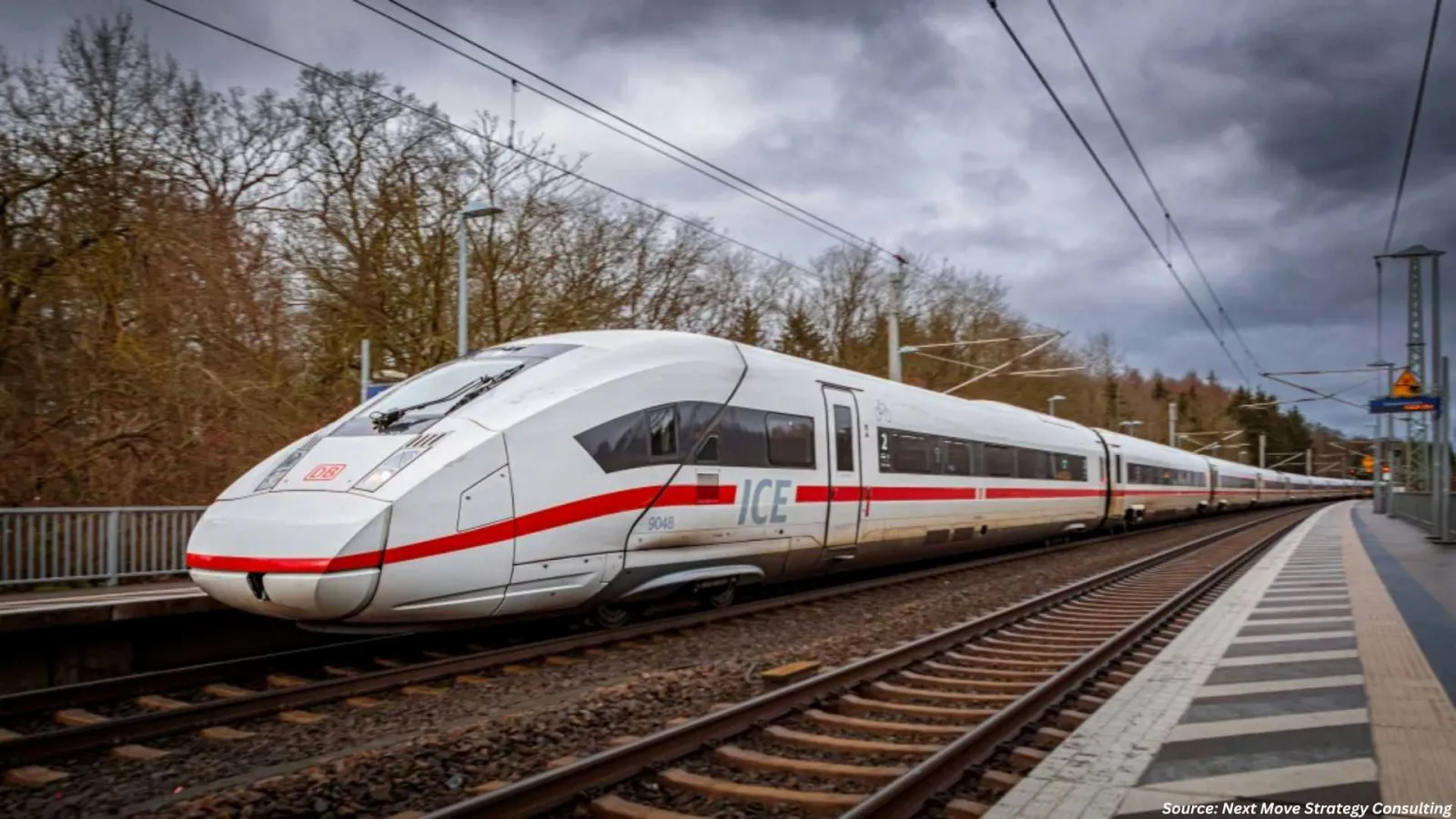
The bullet train industry is entering a new phase where engineering ambition, extreme infrastructure, and natural risk management are shaping global high-speed rail development. In 2026, two major developments stand out: China’s underwater tunnel breakthrough for ultra-fast trains and Japan’s earthquake-induced service disruption.
China Bullet Train Innovation: 11 km Underwater Tunnel & CR450 Push
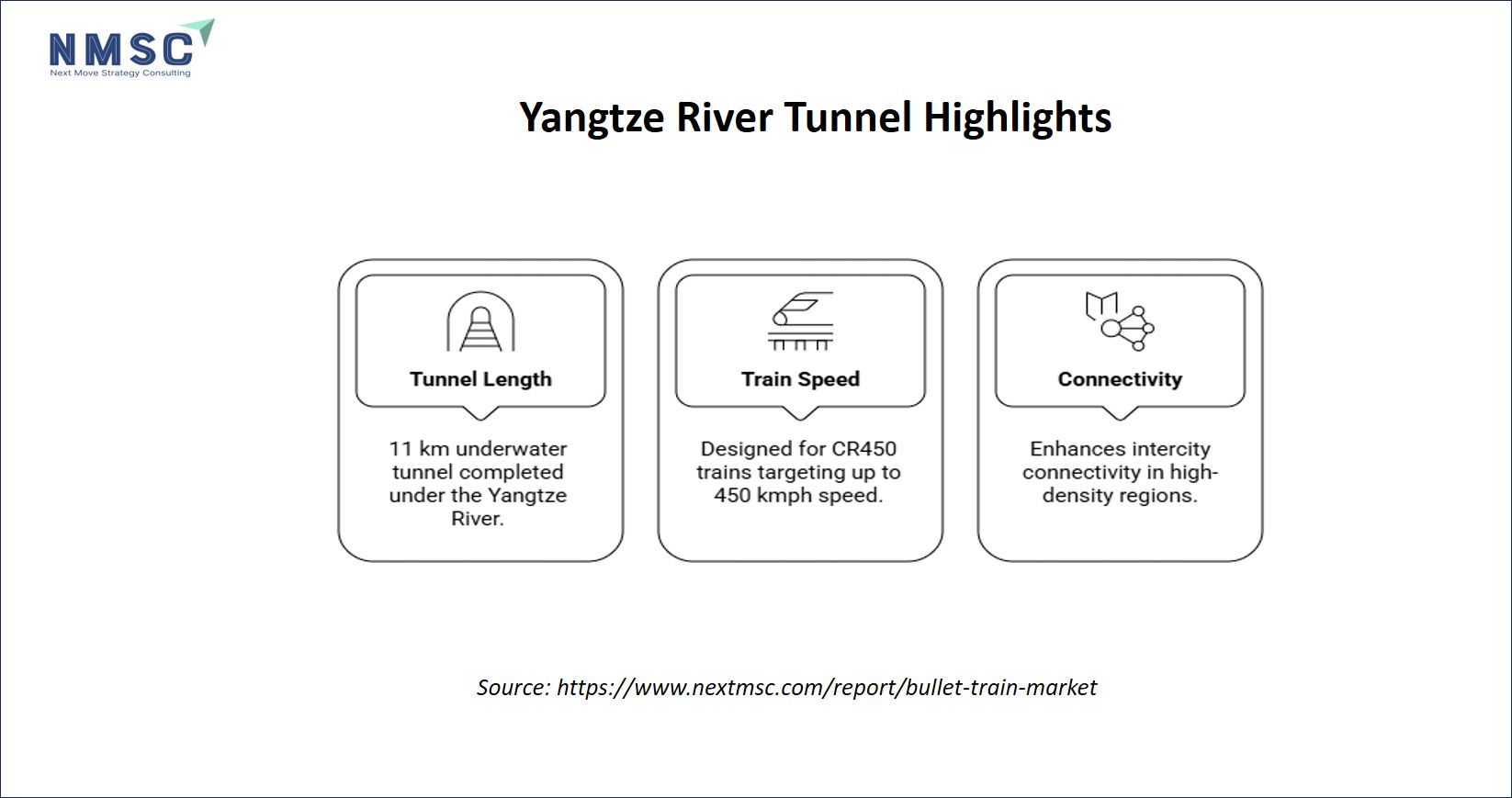
China has completed an 11 km underwater tunnel beneath the Yangtze River, marking a major step in expanding high-speed rail engineering limits. The project is designed to support next-generation trains capable of reaching speeds up to 450 kmph under the CR450 program.
This development reflects how infrastructure is being redesigned to support ultra-high-speed rail corridors, particularly in dense river-crossing geographies. The CR450 initiative also signals a shift toward commercializing faster-than-previous-generation bullet trains with improved aerodynamics and stability systems.
Key Highlights
-
11 km underwater tunnel completed under the Yangtze River
-
Designed for CR450 trains targeting up to 450 kmph speed
-
Enhances intercity connectivity in high-density regions
Our observations at Next Move Strategy Consulting indicate that China’s underwater rail engineering reflects a broader strategy of integrating extreme infrastructure with next-generation mobility. The focus is not only speed but also geographic problem-solving in urbanized and water-heavy regions, setting a benchmark for future rail corridors.
Japan Bullet Train Disruption: Earthquake Halts Tokyo-Aomori Services
In Japan, bullet train operations between Tokyo and Aomori were temporarily halted following a seismic event. The disruption highlights the sensitivity of high-speed rail networks to natural disasters, even in countries with advanced rail resilience systems.
Japan’s Shinkansen network is globally recognized for safety and precision timing, but earthquake-triggered suspensions remain a critical operational safeguard. The incident reinforces how safety-first protocols override speed and efficiency in real-time disaster conditions.
Key Highlights
-
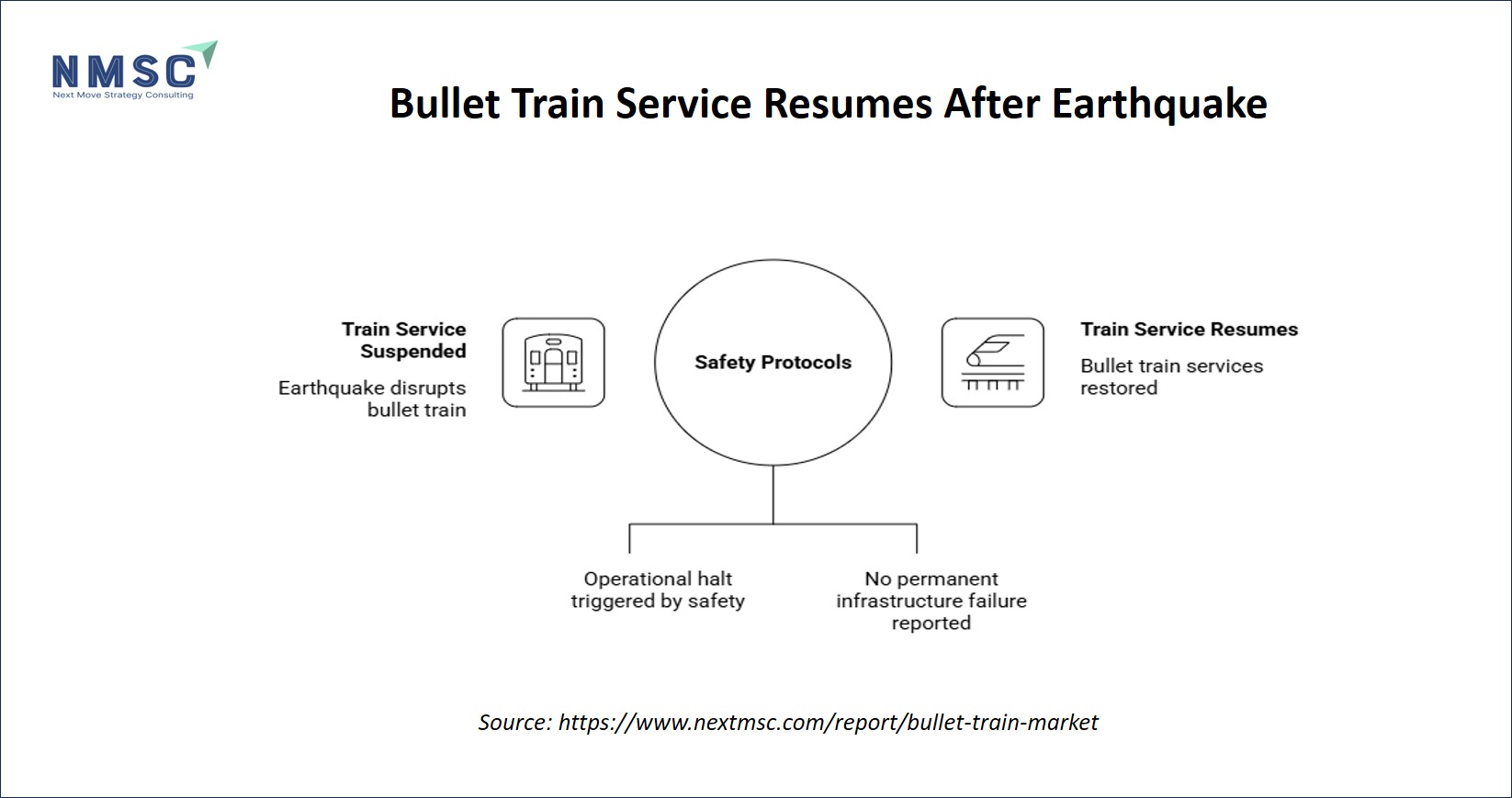
Tokyo–Aomori bullet train services suspended after earthquake
-
Safety protocols triggered immediate operational halt
-
No permanent infrastructure failure reported in the disruption
We observe that Japan’s response-driven rail management demonstrates how resilience engineering is as important as speed innovation. The system prioritizes passenger safety and structural integrity, which strengthens long-term trust in high-speed rail networks despite recurring seismic risks.
Bullet Train Technology: Speed vs Safety Balance
The two developments highlight a global duality in bullet train evolution:
|
Region |
Development Focus |
Key Outcome |
|
China |
Speed + infrastructure expansion |
450 kmph CR450 + underwater tunnel |
|
Japan |
Safety + seismic response systems |
Rapid suspension during earthquake |
This contrast illustrates how high-speed rail systems are optimized differently based on geography, risk exposure, and national infrastructure strategy.
Industry trends indicate a widening gap between speed-centric innovation and safety-centric optimization. While China accelerates infrastructure scale and velocity, Japan continues to refine resilience frameworks that ensure system reliability under environmental stress.
What This Means for Global Rail Markets
According to Next Move Strategy Consulting:
The bullet train industry is transitioning into a dual-growth model driven by:
-
Hyper-speed rail expansion in infrastructure-heavy economies
-
Advanced safety engineering in disaster-prone regions
-
Cross-border technology benchmarking between Asia’s rail leaders
These developments are expected to influence future rail investment decisions, particularly in emerging markets evaluating high-speed connectivity versus infrastructure risk management.
The industry impact is not limited to transportation alone. It extends into urban planning, energy optimization, and regional economic integration, where bullet trains increasingly act as backbone infrastructure.
Next Steps: Key Takeaways for the Industry
-
Monitor CR450 deployment timelines and real-world operational performance
-
Study underwater tunnel engineering for replication in similar geographies
-
Strengthen seismic resilience frameworks in high-speed rail systems
-
Balance speed innovation with disaster response capabilities
-
Invest in hybrid models combining infrastructure scale and safety intelligence
Conclusion
The 2026 bullet train landscape shows a clear split between speed-driven innovation and safety-driven resilience. China’s underwater tunnel and CR450 ambition highlight engineering scale, while Japan’s earthquake response reinforces operational discipline. Together, they define the next phase of global high-speed rail evolution.
About the Author
 Sanyukta Deb
— Sanyukta Deb is Digital Marketing Team Lead at Next Move Strategy Consulting, where she has led content strategy and technical SEO for the firm's B2B market research publications for over 2 years. Her editorial process translates NextMSC's primary and secondary research — spanning technology, industrial, and consumer sectors — into commercial narratives, backed by search-intent, keyword, and competitive analysis. She brings 5 years of overall experience in digital marketing and content strategy.
Sanyukta Deb
— Sanyukta Deb is Digital Marketing Team Lead at Next Move Strategy Consulting, where she has led content strategy and technical SEO for the firm's B2B market research publications for over 2 years. Her editorial process translates NextMSC's primary and secondary research — spanning technology, industrial, and consumer sectors — into commercial narratives, backed by search-intent, keyword, and competitive analysis. She brings 5 years of overall experience in digital marketing and content strategy.
About the Reviewer
 Debashree Dey
— Debashree Dey is Assistant Manager at Next Move Strategy Consulting, where she supports cross-vertical market content and communications across diverse industries for 6 years. Her professional background includes senior content writing, communications, and published manuscript authorship, with experience developing audience-focused business narratives and maintaining clear, consistent messaging. Her role supports research-led content development and editorial quality across NextMSC publications.
Debashree Dey
— Debashree Dey is Assistant Manager at Next Move Strategy Consulting, where she supports cross-vertical market content and communications across diverse industries for 6 years. Her professional background includes senior content writing, communications, and published manuscript authorship, with experience developing audience-focused business narratives and maintaining clear, consistent messaging. Her role supports research-led content development and editorial quality across NextMSC publications.















Add Comment