Axial Fans Market Statistics, Trends & Forecasts for 2026
Introduction
The global axial fans market is undergoing one of its most consequential transformations in decades. Two forces are converging simultaneously: a landmark regulatory overhaul in the European Union and an unprecedented surge in energy demand from AI-powered data centers. Together, these developments are redefining what it means to design, manufacture, and procure axial fans at an industrial scale.
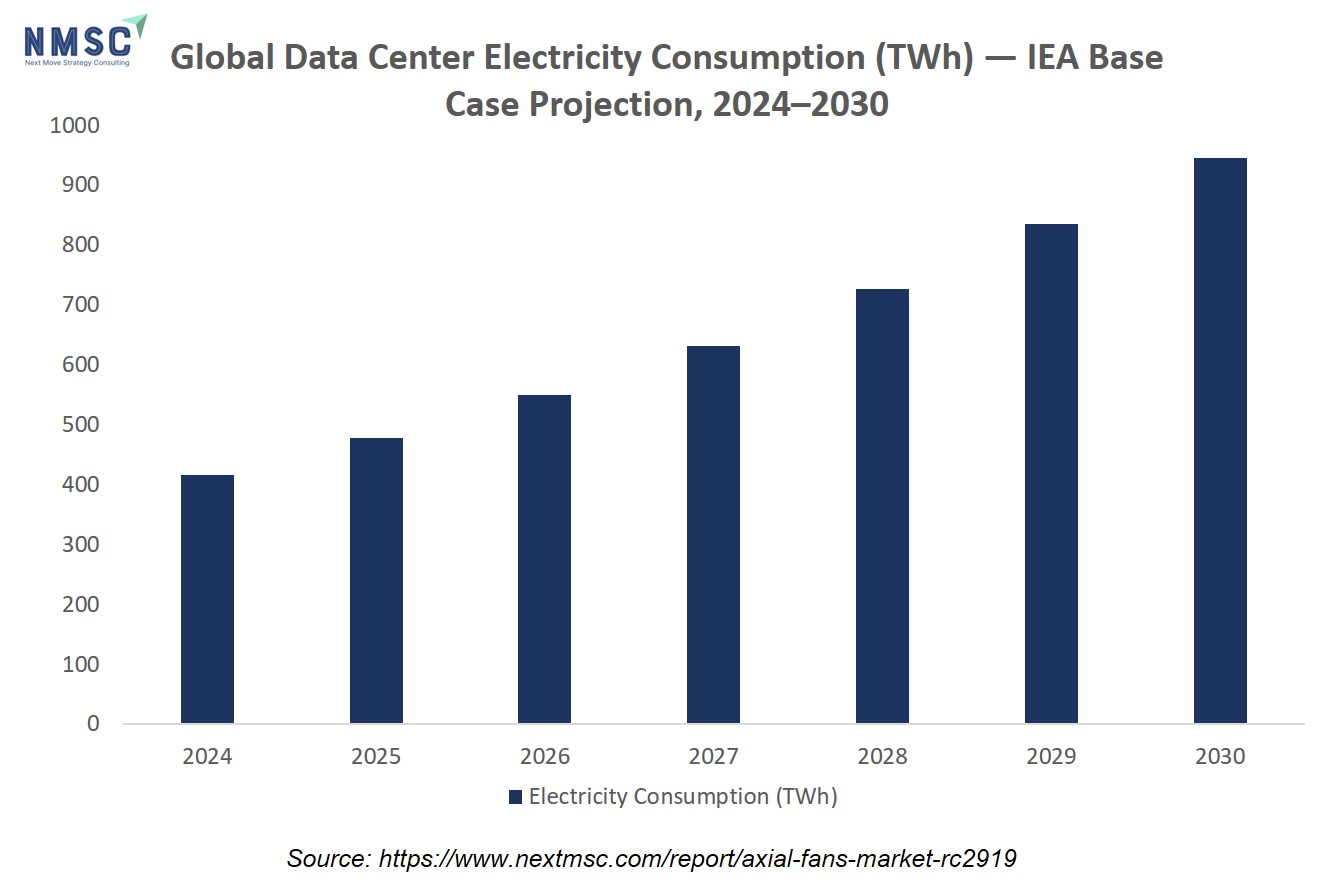
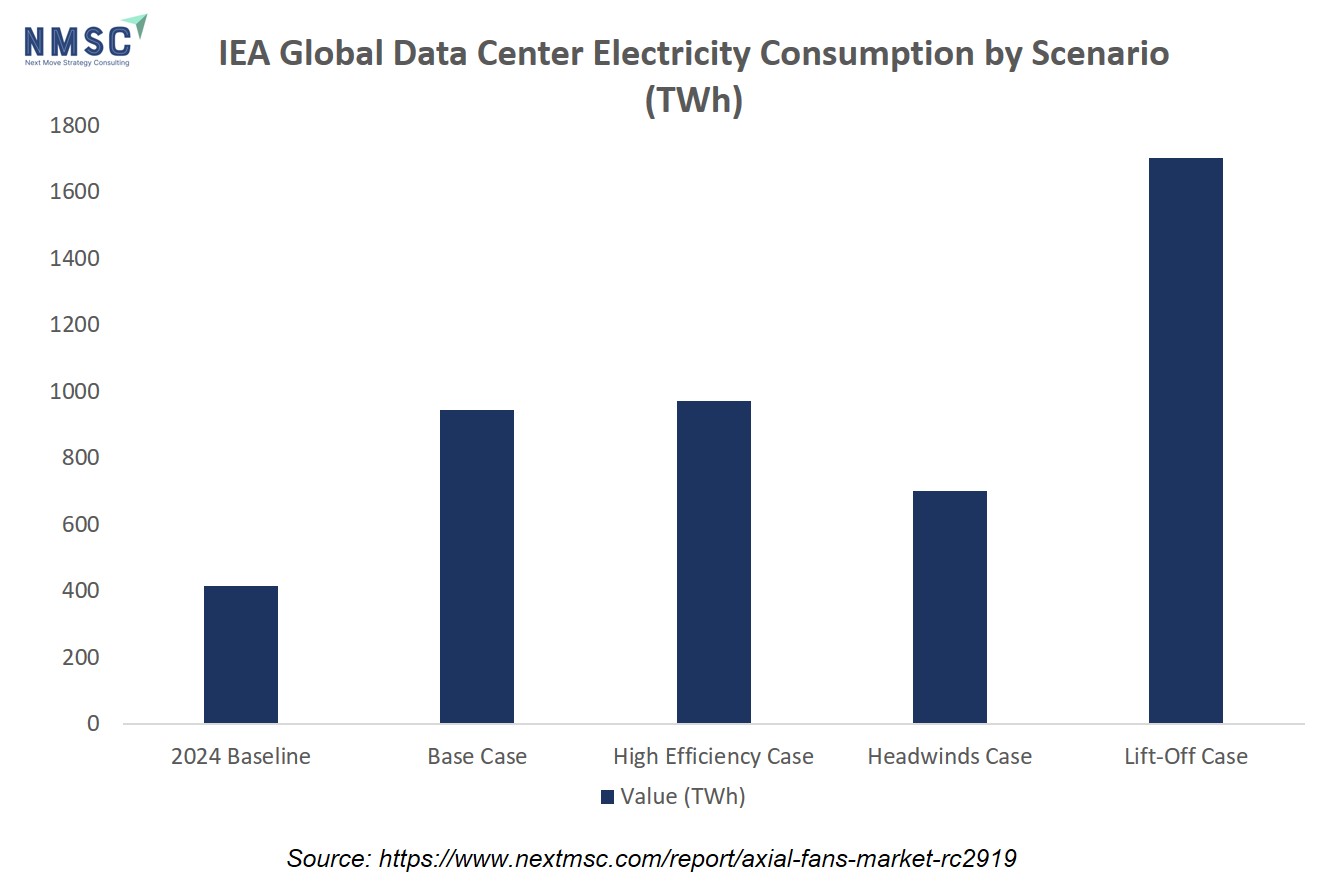
As of July 24, 2026, the European Union's Ecodesign Regulation (EU) 2024/1834—widely referred to as ErP 2026—officially entered into force, replacing the previous Fan Regulation (EU) 327/2011 that had governed the sector for fifteen years. Simultaneously, the International Energy Agency (IEA) has confirmed that global data center electricity consumption reached approximately 415 terawatt-hours (TWh) in 2024—equivalent to 1.5% of total global electricity consumption—and is projected to nearly double to around 945 TWh by 2030. For the axial fans market, these are not peripheral developments. They are structural demand catalysts that will shape procurement strategies, product portfolios, and investment decisions for years to come.
For More Information – Download FREE Sample on Axial Fans Market Report
The Dual Catalyst: EU ErP 2026 and the AI Data Center Surge
The EU ErP 2026 Regulation: A Structural Reset for the Industry
On July 24, 2026, Commission Regulation (EU) 2024/1834 came into force across all EU member states, marking the most significant regulatory reset for the industrial fan sector in over a decade. The regulation applies to fans driven by electric motors with an input power between 125 W and 500 kW—a range that covers approximately 5% of the nearly 4 billion fans in use across the EU, yet accounts for 80% of total fan electricity consumption.
The new framework introduces substantially stricter minimum efficiency thresholds. For axial fans specifically, a minimum Fan Efficiency Grade (FEG) of 50% now applies, assessed at the best efficiency point based on total static efficiency. Beyond efficiency limits, the regulation introduces a holistic definition of the "complete fan" as a functional system comprising stator, impeller, and motor—a change with far-reaching consequences for OEMs, importers, and plant manufacturers who integrate fan components into larger assemblies. Any entity that completes and places such a system on the market under its own name is now classified as a manufacturer, with full obligations regarding conformity assessment, CE marking, and documentation.
The regulation also mandates that spare parts remain available for up to ten years after product discontinuation, and that product information be stored digitally for up to 20 years—requirements that significantly increase organizational and documentation obligations across the supply chain.
The economic rationale for this regulatory tightening is compelling. The European Commission estimates that by replacing less efficient industrial fans with highly efficient models, end users can save approximately 20% of running costs over a 15-year operational lifetime. The EU's existing efficiency measures already saved 28 TWh of electricity and avoided 11 million tonnes of CO₂ emissions in 2020 alone—equivalent to the total annual energy use of approximately 8 million homes. By 2030, these savings are projected to reach 50 TWh, with half of those gains attributable specifically to improvements in axial fans.
The AI Data Center Boom: A New Frontier for Axial Fan Demand
Concurrent with the regulatory shift, the global proliferation of AI infrastructure is generating a structural uplift in demand for high-performance cooling solutions, of which axial fans are a critical component. The IEA's Energy and AI report confirms that data center electricity consumption has grown at approximately 12% per year over the last five years, with cooling systems accounting for between 7% and over 30% of total data center electricity consumption, depending on facility type and efficiency.
In response to this demand, leading fan manufacturers are accelerating innovation. In December 2025, ebm-papst unveiled its AxiBlade.Perform axial fans—available in 860 mm and 950 mm sizes—specifically engineered for data center applications including chillers, evaporators, and condensers. The company simultaneously introduced NEXAIRA, an AI-supported cloud connectivity platform that enables cooling system optimization with energy savings of up to 50% through digital twins and adaptive control.
NMSC Strategic Perspective: Navigating Convergent Market Forces
From Next Move Strategy Consulting's analytical standpoint, the simultaneous arrival of ErP 2026 and the AI-driven data center expansion represents a rare convergence of regulatory push and demand pull that will accelerate market consolidation and technology differentiation. Manufacturers that have proactively aligned their product portfolios with the new efficiency thresholds will gain a decisive competitive advantage, particularly in the EU market where non-compliant products face restricted market access. At the same time, the data center segment—historically a secondary application for axial fans—is rapidly emerging as a primary growth vertical, driven by the thermal management requirements of high-density GPU server racks. NMSC's analysis indicates that the industrial end-user segment, which encompasses data centers within its broader scope, will continue to command the largest share of axial fan demand through 2030, supported by rapid industrialization across Asia-Pacific and sustained infrastructure investment in North America and Europe.
Section Summary: The axial fans market is being reshaped by two concurrent forces: the EU ErP 2026 regulation (effective July 24, 2026) and the AI-driven data center energy surge. These developments are accelerating the transition toward high-efficiency, electronically commutated (EC) axial fan solutions.
Key Takeaways:
-
EU Regulation (EU) 2024/1834 mandates a minimum 50% Fan Efficiency Grade for axial fans from July 24, 2026, rendering many legacy low-efficiency models non-compliant.
-
Global data center electricity consumption reached ~415 TWh in 2024 and is projected to nearly double to ~945 TWh by 2030, per the IEA.
-
Cooling systems account for 7–30% of total data center electricity consumption, creating sustained demand for high-performance axial fans.
-
Leading manufacturers such as ebm-papst are integrating AI-based optimization platforms capable of reducing cooling energy consumption by up to 50%.
Industry Impact Analysis
Impact on Manufacturers and the Supply Chain
The ErP 2026 regulation is fundamentally altering the competitive landscape for axial fan manufacturers. Products that do not meet the new minimum efficiency thresholds may no longer be placed on the EU market as standard commercial offerings. This creates an immediate bifurcation: manufacturers with compliant, high-efficiency portfolios—particularly those utilizing electronically commutated (EC) motor technology—are positioned to capture market share, while those reliant on legacy AC motor designs face accelerated product obsolescence.
The regulation's expanded definition of manufacturer responsibility is particularly consequential for OEMs and system integrators. As Dr. Julien Grilliat, Director of Regulatory Affairs at ebm-papst, has noted: "Many companies underestimate how quickly they can become fan manufacturers in regulatory terms through integration or completion." This regulatory exposure is prompting procurement teams across HVAC, refrigeration, and industrial automation sectors to reassess their supplier relationships and component sourcing strategies.
Electric Vehicle Thermal Management: A Sustained Growth Driver
The rising global adoption of electric vehicles (EVs) continues to generate structural demand for axial fans in thermal management applications. Electric motors in EVs generate significant heat during operation, necessitating reliable airflow solutions to regulate battery and motor temperatures, prevent overheating, and ensure optimal performance. The NMSC report identifies rising EV adoption as one of the primary growth drivers for the axial fans market through 2030.
Oil, Gas, and Industrial Process Cooling
The oil and gas sector represents another significant demand vertical for axial fans, where they are deployed in cooling equipment such as compressors, heat exchangers, and furnaces to prevent overheating and maintain optimal operating temperatures. The NMSC report notes that the accelerating growth of the oil and gas industry is a key driver of axial fan market demand for efficient airflow management systems.
Asia-Pacific: The Dominant Regional Market
Asia-Pacific holds the dominant share of the global axial fans market and is projected to maintain this position throughout the forecast period to 2030. The region's large and rapidly expanding automotive sector—particularly in China and India—drives significant demand for efficient cooling solutions. The food and beverage industry's growth across the region further propels demand for axial fans in drying, cooling, and odor control applications.
Key Takeaways:
-
ErP 2026 is accelerating the obsolescence of low-efficiency AC motor-based axial fans across the EU market.
-
OEMs and system integrators now face expanded regulatory obligations under the new "complete fan" definition.
-
Asia-Pacific remains the dominant regional market, underpinned by automotive, food processing, and industrial manufacturing growth.
-
The oil and gas sector continues to represent a significant and stable demand vertical for industrial axial fan applications.
Pros and Cons of Recent Market Developments
|
Recent Development |
Pros |
Cons |
|
EU ErP 2026 Regulation (EU) 2024/1834 |
Drives adoption of high-efficiency EC fans; reduces lifecycle operating costs by ~20%; projected EU-wide savings of €7.7 billion by 2030 |
Increases compliance burden for OEMs and importers; accelerates product obsolescence for legacy AC fan portfolios; raises documentation and spare parts obligations |
|
AI Data Center Cooling Demand Surge |
Creates a high-growth application vertical for large-diameter, high-performance axial fans; drives innovation in smart fan systems |
Requires significant R&D investment in AI-integrated cooling platforms; increases pressure on supply chains for specialized EC motor components |
|
AI-Integrated Fan Optimization (e.g., NEXAIRA) |
Enables up to 50% reduction in cooling energy consumption; supports predictive maintenance and real-time monitoring |
High upfront integration cost; requires digital infrastructure and connectivity capabilities from end users |
|
Variable Speed Technology Adoption |
Enables precise airflow control matched to actual cooling needs; reduces energy consumption and operational costs |
Higher unit cost compared to fixed-speed alternatives; requires more sophisticated control systems and commissioning expertise |
|
Rising EV Production |
Generates sustained demand for axial fans in battery and motor thermal management |
Thermal management requirements for next-generation high-density battery packs may demand more specialized fan configurations |
Key Data & Statistics
EU Industrial Fan Efficiency Regulation – Key Impact Metrics
|
Metric |
2020 (Actual) |
2030 (Projected) |
|
Regulated industrial fans in EU27 |
214 million units |
— |
|
Total electricity consumed by regulated fans |
281 TWh/year |
294 TWh/year |
|
Average fan efficiency (in-use stock) |
44.5% |
~52% (est.) |
|
Electricity savings due to Ecodesign measures |
19 TWh (-6%) |
50 TWh (-15%) |
|
CO₂ emissions avoided |
11 million tonnes |
— |
|
User cost savings due to Ecodesign |
€1.8 billion (-3%) |
€7.7 billion (-10%) |
|
Share of 2030 savings from axial fan improvements |
— |
~50% |
Future Outlook & Forecast
NMSC Market Forecast: Steady Growth Anchored by Industrial Demand
According to Next Move Strategy Consulting, the global axial fans market is forecast to USD 3.85 billion by 2030, at a CAGR of 4.9% over the 2025–2030 period. This growth trajectory is underpinned by rapid industrialization across emerging economies, the accelerating adoption of electric vehicles, and the sustained expansion of the oil and gas sector. The industrial end-user segment—encompassing automotive, aerospace, oil and gas, construction, and food processing applications—is expected to remain the primary demand driver throughout the forecast period.
The incorporation of variable speed technology into axial fan systems represents a significant opportunity for market expansion. By enabling precise control of fan speed to match real-time cooling requirements, variable speed drives optimize energy consumption and reduce operational costs—a value proposition that resonates strongly with industrial operators facing rising energy prices and tightening sustainability mandates.
Technology Trajectory: EC Motors, Digital Twins, and Smart Integration
The technology roadmap for the axial fans market is increasingly defined by the convergence of aerodynamic optimization, electronically commutated motor technology, and digital connectivity. The IEA's Base Case scenario projects that data center electricity consumption will grow at approximately 15% per year from 2024 to 2030—more than four times faster than the growth of total electricity consumption from all other sectors. This trajectory will sustain demand for high-performance axial fans capable of operating efficiently under variable load conditions, with integrated monitoring and control capabilities.
The ErP 2026 regulation's requirement for detailed documentation of partial load behavior is accelerating the adoption of aerodynamically optimized impellers, low-loss motor technologies, and precise electronic control systems—precisely the technologies that define the next generation of compliant, high-efficiency axial fans.
Competitive Landscape
The axial fans market features a diverse competitive landscape. Key players profiled in the NMSC report include Omron Corporation, Thermaco Inc., Mainstream Corporation, Sofasco, Pelonis Technologies, Delta Fan, Fulltech Electric, Halifax Fan, Nidec Corporation, Cleantek, Enviro Tech Industrial Products, Kruger Ventilation, Systemair AB, Rosenberg Ventilatoren GmbH, and Woods Air Movement. These companies are actively pursuing product innovation, strategic partnerships, and portfolio realignment to address the dual imperatives of regulatory compliance and application-specific performance.
Section Summary: The axial fans market is on a steady growth trajectory to USD 3.85 billion by 2030, driven by industrial demand, EV adoption, and data center expansion. Technology differentiation—particularly in EC motor integration, AI-based optimization, and ErP 2026 compliance—will be the primary competitive battleground.
Key Takeaways:
-
Asia-Pacific will maintain regional dominance, while North America shows steady growth driven by chemical and mining sector demand.
-
Variable speed technology and EC motor integration represent the most significant near-term opportunity for market differentiation.
-
Data center electricity consumption is projected to grow at ~15% per year through 2030, sustaining long-term demand for high-performance axial cooling solutions.
Next Steps for Stakeholders
For C-Level Executives and Procurement Leaders:
1.Conduct an immediate ErP 2026 compliance audit. Any axial fan product placed on the EU market after July 24, 2026 must meet the new minimum efficiency thresholds under Regulation (EU) 2024/1834. Organizations that have not yet assessed their installed base and procurement specifications against the new Fan Efficiency Grade requirements should treat this as a priority action. Non-compliance carries the risk of restricted EU market access and legal exposure.
2.Reassess OEM and integration responsibilities. The regulation's expanded definition of "manufacturer" means that companies integrating fan components into larger assemblies may now bear full regulatory obligations. Legal and technical teams should review product integration workflows to determine whether new conformity assessment, CE marking, or documentation obligations apply.
3. Prioritize EC motor-based axial fan procurement. Electronically commutated motor technology offers the most direct pathway to ErP 2026 compliance while delivering measurable energy savings. Procurement strategies should be realigned to favor EC fan solutions, particularly for HVAC, data center, and industrial process cooling applications.
4. Evaluate AI-integrated cooling optimization platforms. For organizations operating or investing in data center infrastructure, AI-supported fan optimization systems—capable of reducing cooling energy consumption by up to 50%—represent a compelling return on investment, particularly as data center electricity costs continue to rise.
5. Align capital expenditure with Asia-Pacific growth opportunities. Investors and manufacturers should evaluate strategic positioning in Asia-Pacific markets, where automotive, food processing, and industrial manufacturing growth is generating sustained demand for axial fan solutions through 2030.
6. Engage with the NMSC Axial Fans Market report for granular segment intelligence. For detailed market sizing, segment-level forecasts, competitive benchmarking, and regional analysis, the full NMSC report provides the proprietary data infrastructure required for informed strategic planning.
Conclusion
The axial fans market in 2026 is defined by a rare alignment of regulatory imperative and demand-side expansion. The entry into force of EU Regulation (EU) 2024/1834 on July 24, 2026 has fundamentally reset the efficiency standards and compliance obligations governing the sector across Europe, while the AI-driven data center boom is generating structural, long-term demand for high-performance cooling solutions globally. These forces are not transient; they represent durable structural shifts that will shape the axial fans market through the end of the decade and beyond.
For manufacturers, the path forward requires investment in EC motor technology, aerodynamic optimization, and digital integration. For investors, the convergence of regulatory tailwinds and data center demand creates a compelling long-term growth thesis. For procurement and operations leaders, ErP 2026 compliance is no longer a future consideration—it is an immediate operational requirement. Organizations that act decisively on these imperatives will be best positioned to capture value in the evolving axial fans market.
About the Author
 Sanyukta Deb
— Sanyukta Deb is Digital Marketing Team Lead at Next Move Strategy Consulting, where she has led content strategy and technical SEO for the firm's B2B market research publications for over 2 years. Her editorial process translates NextMSC's primary and secondary research — spanning technology, industrial, and consumer sectors — into commercial narratives, backed by search-intent, keyword, and competitive analysis. She brings 5 years of overall experience in digital marketing and content strategy.
Sanyukta Deb
— Sanyukta Deb is Digital Marketing Team Lead at Next Move Strategy Consulting, where she has led content strategy and technical SEO for the firm's B2B market research publications for over 2 years. Her editorial process translates NextMSC's primary and secondary research — spanning technology, industrial, and consumer sectors — into commercial narratives, backed by search-intent, keyword, and competitive analysis. She brings 5 years of overall experience in digital marketing and content strategy.
About the Reviewer
 Debashree Dey
— Debashree Dey is Assistant Manager at Next Move Strategy Consulting, where she supports cross-vertical market content and communications across diverse industries for 6 years. Her professional background includes senior content writing, communications, and published manuscript authorship, with experience developing audience-focused business narratives and maintaining clear, consistent messaging. Her role supports research-led content development and editorial quality across NextMSC publications.
Debashree Dey
— Debashree Dey is Assistant Manager at Next Move Strategy Consulting, where she supports cross-vertical market content and communications across diverse industries for 6 years. Her professional background includes senior content writing, communications, and published manuscript authorship, with experience developing audience-focused business narratives and maintaining clear, consistent messaging. Her role supports research-led content development and editorial quality across NextMSC publications.


















Add Comment