Beverage Stabilizers Market: FDA Rules Reshape 2026
Introduction
The global beverage industry is undergoing a structural transformation, driven by converging forces of regulatory reform, evolving consumer health priorities, and accelerating demand for functional, clean-label, and plant-based drinks. At the center of this transformation lies the Beverage Stabilizers Market — a strategically critical segment of the food ingredients industry that ensures product consistency, texture, shelf life, and sensory appeal across a wide range of beverage categories.
From xanthan gum and carrageenan to pectin and gum arabic, beverage stabilizers serve as the invisible backbone of modern drink formulation. As manufacturers navigate an increasingly complex landscape of regulatory scrutiny, supply chain volatility, and consumer health consciousness, the strategic importance of these ingredients has never been greater. According to Next Move Strategy Consulting (NMSC), the global beverage stabilizers market was valued at USD 148.5 million in 2021 and is projected to reach USD 220.7 million by 2030, registering a CAGR of 5.8% during the forecast period 2022–2030. This report examines the most impactful trends, regulatory developments, and market dynamics shaping the beverage stabilizers market in 2026 — providing actionable intelligence for C-level executives, investors, and industry stakeholders.
For More Information: Download FREE Sample on Beverage Stabilizers Market Report
The FDA's 2026 GRAS Overhaul: A Watershed Moment for the Beverage Stabilizers Market
A Landmark Regulatory Shift
On August 10, 2026, the U.S. Food and Drug Administration (FDA) proposed a landmark rule to enhance oversight of substances added to human and animal food that are claimed to be Generally Recognized as Safe (GRAS). The proposed rule, published under docket number FDA-2025-N-3262, seeks to strengthen transparency and consumer protection by tightening the evidentiary standards required for GRAS self-determinations — a mechanism that has historically allowed food ingredient manufacturers to bypass formal FDA premarket review.
This development carries profound implications for the beverage stabilizers market. A significant proportion of widely used stabilizers — including xanthan gum, carrageenan, pectin, gum arabic, and carboxymethyl cellulose (CMC) — currently operate under GRAS status. A more rigorous oversight framework could require manufacturers to substantiate the safety of these ingredients with greater scientific rigor, potentially increasing compliance costs and reformulation timelines.
The FDA's Human Foods Program (HFP), which consolidated the Center for Food Safety and Applied Nutrition (CFSAN) and related offices under a single reporting structure, is expected to be fully operational by mid-2026. This consolidation is designed to streamline decision-making and accelerate enforcement, meaning that beverage manufacturers relying on GRAS-classified stabilizers should anticipate shorter timelines between inspectional findings and regulatory action.
Simultaneously, the European Food Safety Authority (EFSA) launched its second pilot data collection under the monitoring program for food additives and flavorings, with a submission deadline of June 30, 2026. The program prioritizes substances including sorbic acid/potassium sorbate (E 200-202) and butylated hydroxytoluene (BHT) (E 321), and the data collected will inform future risk assessments across the European food supply chain.
In Asia, China's revised National Food Safety Standards for food additives — jointly released by the National Health Commission (NHC) and the State Administration for Market Regulation (SAMR) — officially entered into force on March 2, 2026. The revised standards cover several key beverage stabilizers, including xanthan gum and L-Malic Acid, establishing updated specifications for their use in food products.
Adding further complexity, California Assemblymember Jesse Gabriel introduced AB 2244 on March 24, 2026 — a bill that would establish a state certification program for non-ultra-processed foods (UPFs). The proposed legislation explicitly identifies stabilizers, thickening agents, and emulsifiers as markers of UPF status, creating a direct regulatory incentive for beverage manufacturers to reformulate with naturally derived alternatives.
NMSC Strategic Perspective: Navigating the Regulatory Inflection Point
From Next Move Strategy Consulting's analytical standpoint, the convergence of regulatory tightening across the United States, European Union, and Asia-Pacific represents a defining inflection point for the beverage stabilizers market. The FDA's proposed GRAS rule, EFSA's enhanced monitoring program, and China's updated food additive standards collectively signal a global shift toward greater ingredient transparency and accountability.
For market participants, this regulatory convergence presents both a challenge and a strategic opportunity. Companies that proactively invest in robust safety substantiation, clean-label reformulation, and regulatory compliance infrastructure will be better positioned to capture market share as the compliance bar rises. Conversely, manufacturers that rely on legacy GRAS determinations without updated scientific documentation face heightened exposure to enforcement action, product recalls, and reputational risk.
NMSC's analysis indicates that the clean-label movement — amplified by regulatory pressure — is a primary demand driver for naturally derived stabilizers such as pectin, gum arabic, and plant-based hydrocolloids. As California's AB 2244 and similar UPF certification frameworks gain legislative traction, the pressure on manufacturers to reformulate with naturally sourced alternatives will intensify across both domestic and export markets.
Section Summary:
The FDA's August 2026 GRAS proposed rule marks the most significant regulatory development for the beverage stabilizers market in recent years, with cascading implications across global supply chains and formulation strategies.
-
The FDA proposed enhanced GRAS oversight on August 10, 2026, directly impacting stabilizers such as xanthan gum, carrageenan, and pectin.
-
EFSA's food additives monitoring program (deadline June 30, 2026) is expanding scrutiny of key stabilizer-adjacent substances across Europe.
-
China's revised food additive standards (effective March 2, 2026) updated specifications for xanthan gum and other stabilizers.
-
California's AB 2244 bill (March 2026) identifies stabilizers as UPF markers, accelerating demand for naturally derived alternatives.
Industry Impact Analysis
Clean Label, Functional Beverages, and GLP-1 Trends Reshaping Formulation Strategies
The regulatory tightening described above is unfolding against a backdrop of powerful consumer-driven trends that are simultaneously expanding the addressable market for beverage stabilizers. Univar Solutions' 2026 Food & Beverage Industry Trends analysis identifies several macro-level shifts directly influencing stabilizer demand:
The GLP-1 Effect on Beverage Formulation: The widespread adoption of GLP-1 weight-loss medications is reshaping consumer expectations around portion size, caloric density, and nutritional value. Consumers on these medications require calorie-conscious, nutrient-dense beverages that maintain satisfying texture and mouthfeel despite reduced sugar and fat content. Starches, gums, and stabilizers are playing a critical role in maintaining product quality in these reformulated beverages — creating a new and growing demand vector for the beverage stabilizers market.
The Clean Label Imperative: The clean label movement has evolved from a consumer preference to a regulatory and commercial necessity. Shorter ingredient lists, natural colors and flavors, and heritage preservation techniques are now considered baseline requirements for competitive beverage brands. This is driving formulators toward plant-based stabilizers such as pectin (derived from citrus peel and apple pomace), gum arabic (sourced from Acacia trees), and carrageenan (derived from red seaweed) — all of which carry strong natural positioning.
Gut Health and Fiber Fortification: The "fibermaxxing" phenomenon — driven by growing consumer awareness of digestive wellness — is fueling demand for fiber-forward beverage formulations. Gums, cellulose ethers, and soluble fibers are increasingly being incorporated into ready-to-drink (RTD) beverages, functional drinks, and fortified juices, expanding the application scope for beverage stabilizers beyond traditional texture and stability functions.
Supply Chain Volatility and Reformulation: Widespread avian influenza outbreaks in 2025 caused significant egg price spikes, while cocoa supply disruptions from West Africa drove record-high cocoa prices. These pressures forced beverage and food manufacturers to reformulate with alternative ingredients — including citrus fibers, modified starches, and gums — accelerating adoption of stabilizer blends and creating new demand for versatile, multi-functional stabilizer systems.
Functional Foods Going Mainstream: Collagen, adaptogens, probiotics, and prebiotics are moving from niche wellness categories to mainstream beverage formulations. As consumers seek wellness benefits in RTD formats, the technical demands on stabilizer systems — which must maintain product stability, clarity, and mouthfeel across diverse functional ingredient matrices — are increasing substantially.
Regulatory Developments Across Key Markets
Beyond the FDA and EFSA actions, the global regulatory landscape for beverage stabilizers is evolving rapidly across multiple jurisdictions:
-
South Korea notified the World Trade Organization of proposed revisions to its Food Additives Standards and Specifications (March 2026), including revised sweetener usage standards and strengthened management requirements for flavoring substances, with WTO members invited to submit comments by May 2, 2026.
-
MERCOSUR (Argentina, Brazil, Uruguay, Paraguay) proposed a comprehensive overhaul of nutritional labeling regulations (comment period closed March 8, 2026), including stricter ingredient declaration requirements that lower the composite ingredient disclosure threshold from 25% to 5% — a change that will require more granular labeling of stabilizer components in packaged beverages.
-
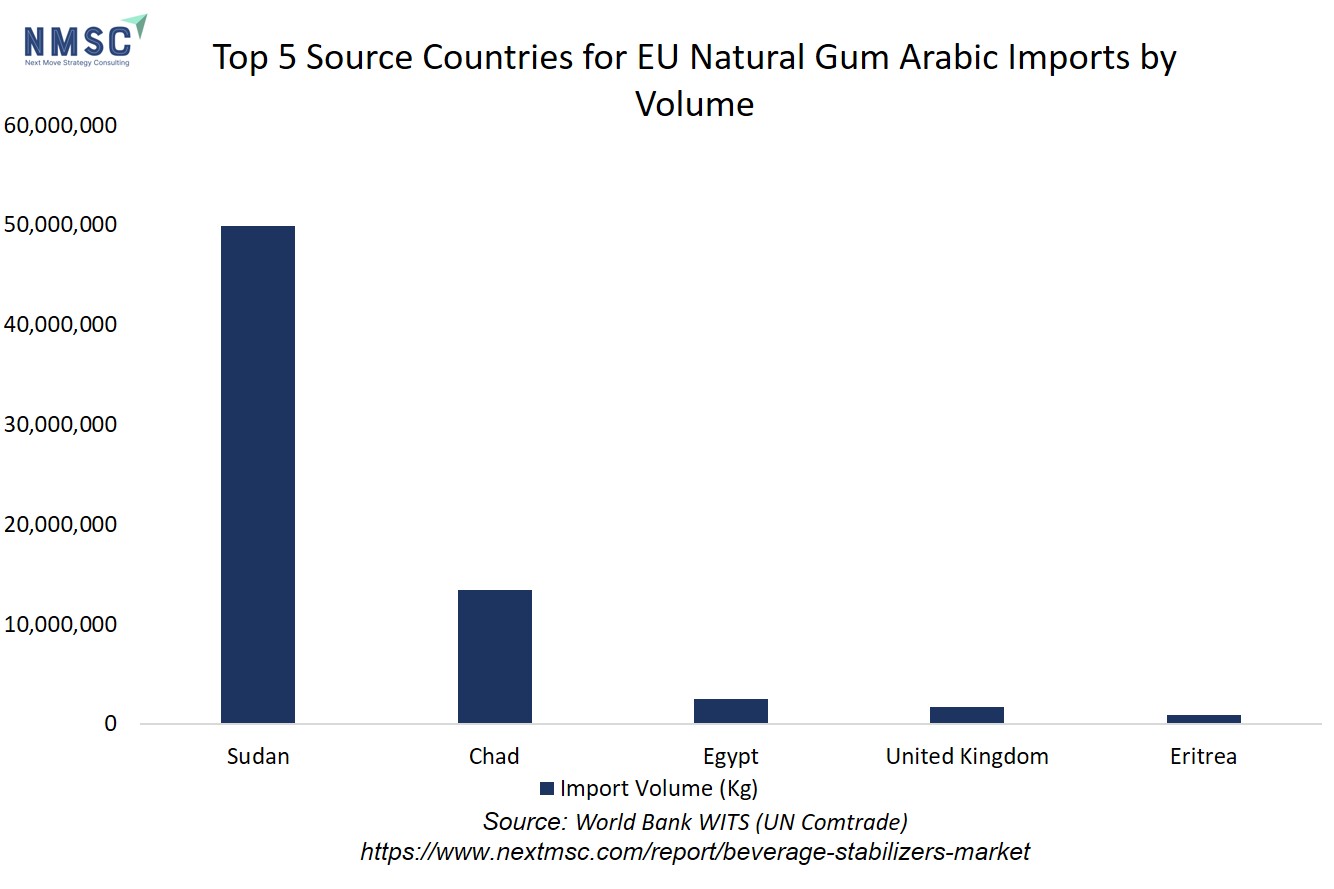
East African Community (EAC) released draft standards for gum arabic (DEAS 1326:2026 and DEAS 1327:2026) in March 2026 — the region's first unified standards for food-grade gum arabic — establishing strict quality parameters including gum arabic total content ≥95% (dry basis), pH range of 4.5–7.0, and microbiological limits requiring total plate count ≤10³ CFU/g.
-
Japan proposed revisions to food additive standards under the Food Sanitation Act (March 2026), amending usage standards for sulfites and zinc gluconate — processing aids used across the beverage sector — with the revisions set to take effect as soon as possible after publication.
-
European Union proposed stricter MOAH (Mineral Oil Aromatic Hydrocarbons) contaminant limits for food products, including food additives themselves, with the regulation scheduled to take effect on January 1, 2027 — adding a new compliance dimension for stabilizer manufacturers supplying the EU market.
Section Summary:
The beverage stabilizers market is being shaped by a dual force of regulatory tightening and consumer-driven demand for clean-label, functional, and health-forward beverages.
-
GLP-1 drug adoption is creating new demand for stabilizers in reduced-calorie, texture-maintained beverage formulations.
-
The clean label movement is accelerating the shift toward naturally derived stabilizers such as pectin, gum arabic, and plant-based hydrocolloids.
-
Supply chain disruptions in eggs and cocoa are driving reformulation with gums, starches, and stabilizer blends.
-
Regulatory developments across South Korea, MERCOSUR, EAC, Japan, and the EU are raising the compliance bar for stabilizer manufacturers globally.
Global Regulatory Developments Impacting the Beverage Stabilizers Market (2025–2026)
|
Region / Authority |
Regulatory Action |
Effective / Key Date |
Key Stabilizers / Additives Affected |
|
United States (FDA) |
Proposed GRAS Oversight Enhancement Rule |
August 10, 2026 (proposed) |
Xanthan Gum, Carrageenan, Pectin, CMC, Gum Arabic |
|
European Union (EFSA) |
Food Additives & Flavorings Monitoring Program (2nd Pilot) |
Submission Deadline: June 30, 2026 |
Sorbic Acid/Potassium Sorbate (E 200-202), BHT (E 321) |
|
China (NHC & SAMR) |
Revised National Food Safety Standards for Food Additives |
March 2, 2026 |
Xanthan Gum, L-Malic Acid, Ammonium Carbonate |
|
South Korea (MFDS) |
Revised Food Additives Standards & Specifications |
Pending (WTO notified March 2026; comments due May 2, 2026) |
Sweeteners, Sulfites, Phosphates, Flavoring Substances |
|
East African Community (EAC) |
Draft Gum Arabic Standards (DEAS 1326:2026 & DEAS 1327:2026) |
Public Comment Period: Until May 15, 2026 |
Gum Arabic (food-grade) |
|
MERCOSUR (Argentina, Brazil, Uruguay, Paraguay) |
Comprehensive Nutritional Labeling Overhaul (GMC Resolution No. 05/25) |
Staggered compliance: 12–60 months |
All food additives including stabilizers; composite ingredient threshold lowered to 5% |
|
Japan (Consumer Affairs Agency) |
Revised Food Additive Standards (Food Sanitation Act) |
Effective upon publication (March 2026) |
Sulfites, Zinc Gluconate, Processing Aids |
|
European Union (EC) |
MOAH Contaminant Limits Proposal for Food Additives |
Scheduled: January 1, 2027 |
Food additives including stabilizer-adjacent substances |
|
California, USA |
AB 2244 Non-UPF Certification Bill (proposed) |
Pending legislative approval (introduced March 24, 2026) |
Stabilizers, Thickening Agents, Emulsifiers |
Future Outlook & Forecast
NMSC Market Projections and Strategic Implications
According to Next Move Strategy Consulting, the global beverage stabilizers market is projected to grow from USD 148.5 million in 2021 to USD 220.7 million by 2030, at a CAGR of 5.8% during the forecast period 2022–2030. This steady growth trajectory reflects the enduring demand for stabilizers across a diversifying range of beverage applications — from traditional fruit drinks and dairy beverages to emerging functional drinks, plant-based milks, and low-alcohol beverages.
-
North America is expected to maintain its dominant market position throughout the forecast period, driven by a large and sophisticated consumer base, a strong quick-service restaurant (QSR) sector, and the presence of major industry players including Cargill, Kerry Group, Archer Daniels Midland Company, and DuPont. The region's regulatory environment — now further shaped by the FDA's proposed GRAS rule and the HFP's enhanced enforcement posture — will continue to set global formulation standards.
-
Asia-Pacific is positioned for the most dynamic growth, underpinned by rising disposable incomes, rapid urbanization, and expanding beverage consumption across China, India, Indonesia, and Vietnam. The proliferation of smoothie bar chains, juice franchise outlets, and functional beverage brands across the region is creating sustained demand for stabilizer ingredients. China's revised food additive standards (effective March 2, 2026) will simultaneously raise the quality bar for stabilizers used in this critical market.
-
Europe faces a more complex regulatory environment, with EFSA's enhanced monitoring program and the EU's proposed MOAH contaminant limits (effective January 1, 2027) adding compliance layers for stabilizer manufacturers. However, the region's strong clean-label culture and premium beverage market continue to support demand for high-quality, naturally derived stabilizers.
Looking ahead, several structural trends will define the beverage stabilizers market through 2030 and beyond:
-
Premiumization of Functional Beverages: The mainstreaming of functional ingredients — adaptogens, probiotics, prebiotics, and nootropics — in RTD beverages will require increasingly sophisticated stabilizer systems to maintain product stability, clarity, and mouthfeel across complex ingredient matrices.
-
AI-Driven Formulation Innovation: Artificial intelligence is accelerating beverage formulation cycles, enabling manufacturers to optimize stabilizer blends for specific texture, stability, and clean-label outcomes with greater speed and precision — reducing time-to-market and improving cost efficiency.
-
Sustainability and Upcycled Ingredients: Growing pressure for carbon labeling and sustainable sourcing will favor stabilizers derived from upcycled agricultural byproducts — such as pectin from citrus peel and apple pomace — over synthetically produced alternatives. As 2026 continues to unfold, upcycled ingredients and carbon labeling are becoming much more than nice-to-haves.
-
Customized Stabilizer Blends: The rise of personalized nutrition and beverage customization is driving demand for tailored stabilizer systems that can deliver specific functional outcomes — from enhanced mouthfeel in reduced-sugar beverages to particle suspension in protein-fortified drinks — across diverse beverage matrices.
-
Regulatory-Driven Portfolio Rationalization: As GRAS oversight tightens and UPF certification frameworks gain traction, manufacturers will increasingly rationalize their stabilizer portfolios around ingredients with the strongest safety substantiation and natural sourcing credentials — concentrating market share among established, well-documented stabilizer types.
Section Summary:
The beverage stabilizers market is on a sustained growth trajectory through 2030, supported by functional beverage expansion, clean-label demand, and Asia-Pacific market development.
-
NMSC projects the global beverage stabilizers market to reach USD 220.7 million by 2030, at a CAGR of 5.8% (2022–2030).
-
North America will maintain market leadership, while Asia-Pacific will register the fastest growth driven by urbanization and rising beverage consumption.
-
AI-driven formulation and sustainability imperatives will reshape stabilizer sourcing and development strategies through the forecast period.
-
Functional beverage premiumization and GLP-1-driven reformulation will drive demand for advanced, multi-functional stabilizer systems.
Next Steps for Stakeholders
For C-level executives, investors, and procurement leaders operating in or adjacent to the beverage stabilizers market, the following strategic priorities are recommended:
-
Conduct a GRAS Compliance Audit Immediately: In light of the FDA's August 2026 proposed rule, manufacturers should review all GRAS self-determinations for stabilizer ingredients used in their beverage formulations. Ensuring that safety substantiation documentation meets the heightened evidentiary standards proposed by the FDA will be critical to avoiding enforcement exposure as the HFP becomes fully operational.
-
Accelerate Clean-Label Reformulation: Companies should prioritize the transition from synthetic or chemically modified stabilizers to naturally derived alternatives — particularly pectin, gum arabic, and plant-based hydrocolloids — to align with both regulatory trends and consumer demand. This is especially urgent for brands targeting markets where California's AB 2244 or similar UPF certification frameworks may gain legislative traction.
-
Diversify Stabilizer Sourcing Across Regions: Supply chain volatility underscores the importance of multi-source procurement strategies for key stabilizer raw materials. The EAC's new gum arabic standards (March 2026) provide an opportunity to qualify East African suppliers under a standardized quality framework, reducing dependence on single-region sourcing.
-
Monitor and Engage with Asia-Pacific Regulatory Developments: China's revised food additive standards (effective March 2, 2026) and South Korea's proposed revisions to food additive specifications represent significant compliance requirements for manufacturers exporting to Asia-Pacific markets. Proactive engagement with local regulatory authorities and investment in regional compliance infrastructure will be essential to maintaining market access.
-
Invest in Functional Beverage Partnerships: The convergence of GLP-1 drug adoption, gut health trends, and functional beverage premiumization creates a compelling investment thesis for stabilizer manufacturers that can offer specialized solutions for reduced-calorie, fiber-fortified, and probiotic-enhanced beverage formulations. Strategic partnerships with functional beverage brands represent a high-growth channel for stabilizer suppliers.
-
Leverage AI for Formulation Optimization: Manufacturers should explore AI-powered formulation platforms to accelerate the development of clean-label stabilizer blends that meet evolving regulatory and consumer requirements — reducing time-to-market and improving cost efficiency in an increasingly competitive landscape.
Conclusion
The beverage stabilizers market stands at a critical juncture in 2026. The FDA's landmark proposed GRAS oversight rule, EFSA's enhanced monitoring program, China's revised food additive standards, and a wave of regulatory actions across South Korea, MERCOSUR, East Africa, Japan, and the European Union are collectively redefining the compliance landscape for stabilizer manufacturers and beverage brands worldwide.
At the same time, powerful consumer-driven forces — the clean-label imperative, GLP-1-driven reformulation, functional beverage premiumization, and gut health awareness — are expanding the strategic importance of beverage stabilizers beyond their traditional role as texture and stability agents. According to Next Move Strategy Consulting, the global beverage stabilizers market is projected to reach USD 220.7 million by 2030, reflecting a CAGR of 5.8% — a trajectory that underscores the sector's resilience and long-term growth potential.
For stakeholders across the value chain, the path forward requires a dual commitment: rigorous regulatory compliance and proactive innovation. Companies that invest in clean-label reformulation, robust safety substantiation, and AI-driven formulation capabilities will be best positioned to capture the opportunities that this evolving market presents.
About the Author
 Sanyukta Deb
— Sanyukta Deb is Digital Marketing Team Lead at Next Move Strategy Consulting, where she has led content strategy and technical SEO for the firm's B2B market research publications for over 2 years. Her editorial process translates NextMSC's primary and secondary research — spanning technology, industrial, and consumer sectors — into commercial narratives, backed by search-intent, keyword, and competitive analysis. She brings 5 years of overall experience in digital marketing and content strategy.
Sanyukta Deb
— Sanyukta Deb is Digital Marketing Team Lead at Next Move Strategy Consulting, where she has led content strategy and technical SEO for the firm's B2B market research publications for over 2 years. Her editorial process translates NextMSC's primary and secondary research — spanning technology, industrial, and consumer sectors — into commercial narratives, backed by search-intent, keyword, and competitive analysis. She brings 5 years of overall experience in digital marketing and content strategy.
About the Reviewer
 Debashree Dey
— Debashree Dey is Assistant Manager at Next Move Strategy Consulting, where she supports cross-vertical market content and communications across diverse industries for 6 years. Her professional background includes senior content writing, communications, and published manuscript authorship, with experience developing audience-focused business narratives and maintaining clear, consistent messaging. Her role supports research-led content development and editorial quality across NextMSC publications.
Debashree Dey
— Debashree Dey is Assistant Manager at Next Move Strategy Consulting, where she supports cross-vertical market content and communications across diverse industries for 6 years. Her professional background includes senior content writing, communications, and published manuscript authorship, with experience developing audience-focused business narratives and maintaining clear, consistent messaging. Her role supports research-led content development and editorial quality across NextMSC publications.















Add Comment