Can Artificial Tissues Transform Healthcare as We Know it?
The Promise of Artificial Tissues
Healthcare is entering a transformative era where science fiction is steadily becoming reality. Advances in artificial tissue and organ engineering are not only alleviating donor shortages but also offering new solutions for patients suffering from burns, organ failure, and congenital disorders.
Professor Dr. Prihartini Widiyanti from Universitas Airlangga (UNAIR) emphasizes the urgency of this innovation, noting that every day, 19 people die due to a lack of organ donors. According to her, tissue engineering provides a vital lifeline and renewed hope for these patients. Next Move Strategy Consulting highlights that artificial tissue innovation is redefining healthcare delivery by reducing dependence on donor organs and improving patient outcomes through biomimetic solutions. It is clear that artificial tissues are not merely experimental they are becoming essential tools in modern medicine.
Biomaterials Driving the Revolution in Tissue Engineering
The backbone of artificial tissue development is advanced biomaterials. These engineered substances are designed to replicate the properties of natural tissues, enabling their application in cartilage regeneration, bioactive skin reconstruction, and cell-based artificial organs. By using a patient’s own cells, these materials significantly reduce the risk of rejection, offering safer, long-term solutions.
Through UNAIR’s Tissue Engineering and Artificial Organ Study Group, Prof. Widiyanti and her team have pioneered several innovations, including artificial blood vessels, synthetic meninges, corneas, and ear prosthetics. These innovations are not only life-saving but also promote local self-reliance, reducing Indonesia’s dependence on imported medical devices. Next Move Strategy Consulting emphasizes that the use of biomaterials to create patient-specific tissues is setting a precedent for personalized medicine, where therapies are tailored to individual patients rather than generic solutions.
Innovations Emerging from UNAIR
UNAIR’s Tissue Engineering and Artificial Organ Study Group is pioneering solutions that extend beyond the laboratory:
|
Innovation |
Application |
Significance |
|
Artificial blood vessels |
Cardiovascular repair |
Reduces dependency |
|
Synthetic meninges |
Neurosurgery |
Supports brain protection |
|
Artificial corneas |
Ophthalmology |
Restores vision |
|
Ear prosthetics |
Reconstructive surgery |
Non-allergenic, |
|
Chitosan-based |
Surgical procedures |
Enhances wound healing |
|
Polyurethane-collagen |
Neurological repair |
Promotes nerve |
Stem Cell-Based Ureter Tissue Breakthrough
Researchers at Kumamoto University have achieved a major milestone in regenerative medicine by creating functional ureter tissues from pluripotent stem cells. The ureter, a tube that carries urine from the kidneys to the bladder, had previously been missing from lab-grown kidney models, limiting the functional utility of organoids. By integrating ureteral stromal progenitor cells with epithelial components derived from mouse embryos or induced pluripotent stem cells, the team was able to produce three-layered ureter structures capable of peristaltic contraction. Some organoids even demonstrated rhythmic movements similar to natural urine flow.
Furthermore, this approach allowed researchers to model genetic ureteral disorders, such as those caused by TBX18 mutations, which impair tissue development. This achievement represents the first time a ureteral structure has been fully built from pluripotent stem cells. Next Move Strategy Consulting views this breakthrough as a critical step toward fully functional transplantable organs, highlighting the potential for next-generation regenerative therapies that combine artificial ureters with kidney organoids.
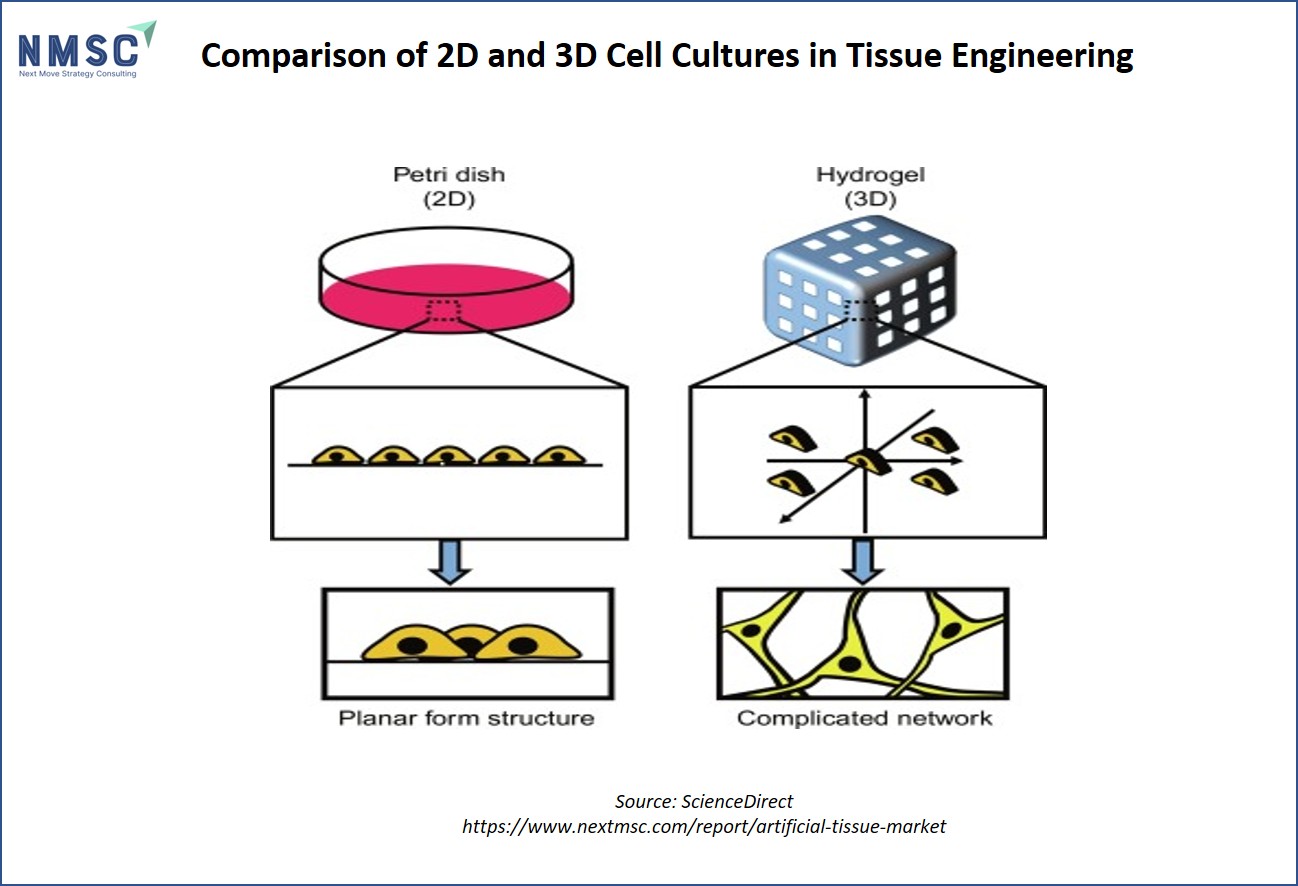
Structural Differences Between 2D and 3D Cell Cultures in Tissue Engineering
The structural differences between traditional two-dimensional (2D) cell cultures and three-dimensional (3D) hydrogel-based cell cultures used in tissue engineering.
On the left, cells grown in a Petri dish (2D) align in a single planar layer, resulting in a simple, flat structure referred to as a planar form structure. This method limits natural cell interactions and does not fully replicate the complexity of tissue environments.
On the right, cells cultured within a 3D hydrogel scaffold form a complicated network, where cells interact in multiple directions, creating more physiologically relevant tissue-like structures. The 3D environment supports enhanced cell-to-cell communication, mimics natural extracellular matrices, and enables more accurate modeling of tissue growth and function. This comparison highlights the importance of 3D culture systems in advancing tissue engineering, regenerative medicine, and organoid development, providing a closer approximation to real tissue behavior than conventional 2D cultures.
UNAIR’s Broader Innovations in Tissue Engineering
UNAIR’s work extends across multiple areas of healthcare innovation. The development of artificial blood vessels addresses the critical need for cardiovascular repair, while synthetic meninges provide protective solutions in neurosurgery. Artificial corneas restore vision without relying on donor tissues, and ear prosthetics offer non-allergenic, biocompatible reconstructive solutions. The team has also produced chitosan-based hemostatic sponges that enhance wound healing and polyurethane-collagen nerve conduits to promote nerve regeneration.
Prof. Widiyanti emphasizes the importance of moving these innovations from laboratory research to real-world applications. Her vision is to establish UNAIR as a leading hub for tissue engineering and artificial organ development in Southeast Asia. Next Move Strategy Consulting observes that institutions focusing on localized research can generate globally impactful healthcare solutions, providing safer and more accessible alternatives to imported medical devices.
Implications for Healthcare and Policy
Artificial tissue technologies are poised to address three major challenges in global healthcare. They can mitigate the shortage of organ donors, reducing mortality rates associated with delayed transplantation. They offer patient-specific therapies that minimize immune rejection and improve long-term outcomes. Additionally, locally produced tissues strengthen national healthcare infrastructure and reduce dependence on imported solutions.
According to Next Move Strategy Consulting, realizing these benefits requires a combination of scientific excellence, robust healthcare policies, and cross-disciplinary collaboration to ensure that tissue engineering solutions are scalable and widely accessible.
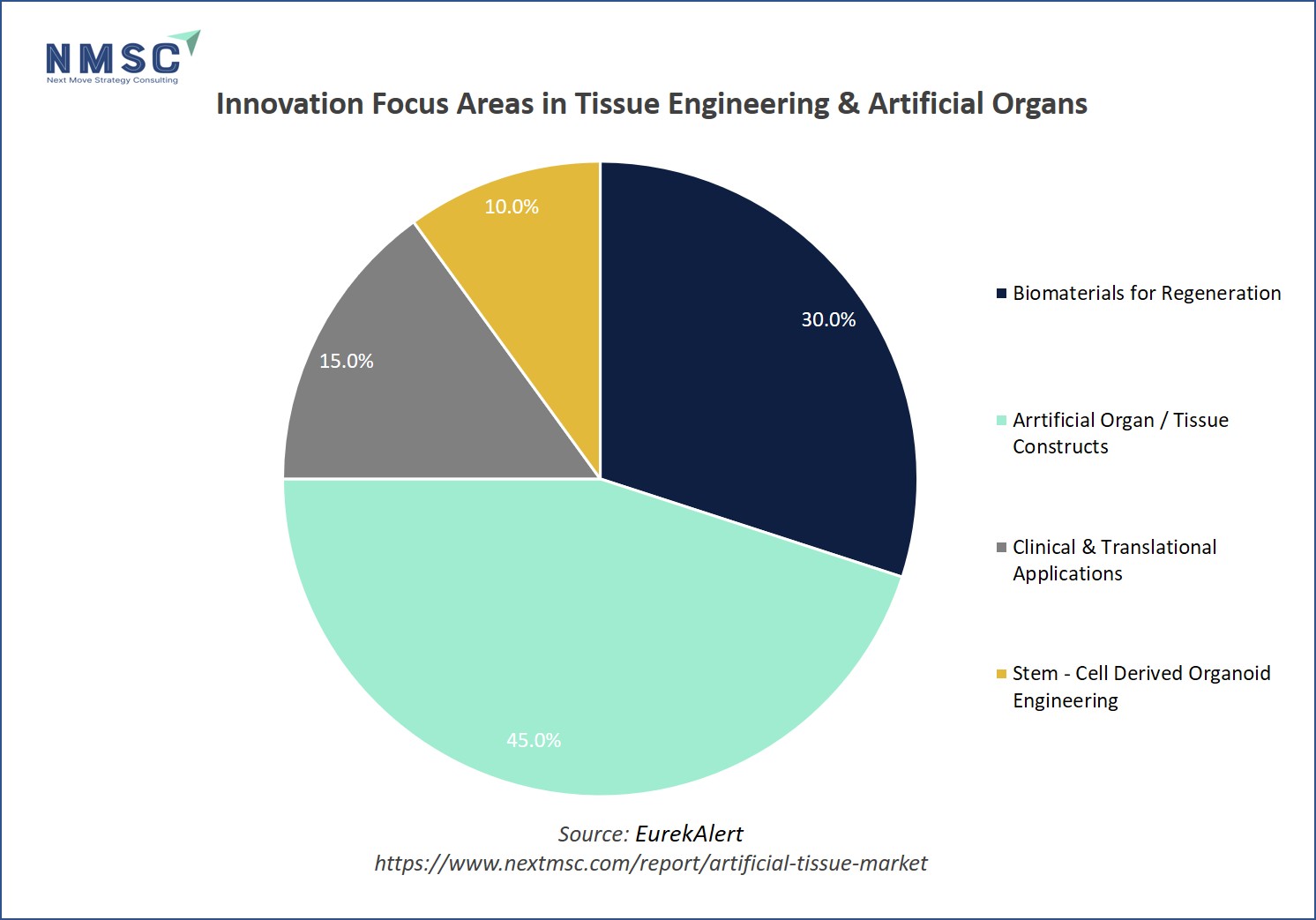
Innovation Focus Areas in Tissue Engineering and Artificial Organs
The main areas of innovation in tissue engineering and artificial organs. Biomaterials for regeneration focus on creating materials that mimic natural tissues to support repair and reduce organ rejection. Artificial organ and tissue constructs involve developing functional organs, like ureter organoids and artificial corneas, that can replace damaged body parts. Stem-cell derived organoid engineering uses pluripotent stem cells to grow miniature organ models, paving the way for personalized and transplantable organs. Finally, clinical and translational applications emphasize turning these lab innovations into real-world treatments, improving healthcare access and reducing dependence on imported medical devices. Together, these areas show how research is moving from materials and lab-grown tissues to practical solutions that can save lives.
Challenges and Considerations
Despite the rapid advances, several challenges remain. Regulatory approval for new tissues must meet stringent safety and efficacy standards. Scaling up production to serve large patient populations continues to be a challenge. Integrating artificial tissues with existing organs requires meticulous research to ensure compatibility and functionality. Next Move Strategy Consulting notes that strategic partnerships between academia, industry, and policymakers will be critical to overcoming these obstacles and accelerating the adoption of artificial tissues in clinical practice.
Key Players of Artificial Tissue Market Through Innovation
The artificial tissue market features prominent companies such as Tissue Regenix Group plc, Baxter International, Integra LifeSciences Corporation, Allergan Plc, Zimmer Biomet Holdings, Inc., Becton, Dickinson and Company, Wright Medical Group, Taxus Cardium Pharmaceuticals, American CryoStem, and Asterias Biotherapeutics. Market leaders are prioritizing continuous product innovation and ramping up investments in research and development to strengthen their market position.
Next Steps for Stakeholders
To accelerate progress in artificial tissue development, research institutions and healthcare organizations should invest in cross-disciplinary collaboration, combining the expertise of engineers, biologists, and clinicians. Supporting local innovation through funding and policy initiatives will reduce dependency on imports and stimulate homegrown solutions. Streamlining regulatory pathways is essential for faster clinical adoption. Finally, prioritizing patient-centered design and leveraging organoid and stem cell technologies will help translate scientific breakthroughs into therapies that truly improve lives.
Next Move Strategy Consulting View:
Next Move Strategy Consulting sees the artificial tissue market as a transformative frontier in healthcare, where innovation and strategic foresight can redefine patient care and medical device development. The firm emphasizes that artificial tissue technologies ranging from bioengineered skin and cartilage to fully functional organoids offer not only clinical benefits but also substantial strategic opportunities for healthcare providers, biotech companies, and policy-makers. By leveraging cross-disciplinary research, investing in scalable biomaterial manufacturing, and integrating digital platforms for tissue modeling and patient monitoring, organizations can accelerate adoption while reducing costs and dependency on traditional organ donors. Furthermore, the consulting firm highlights the importance of regulatory readiness and global collaboration, noting that aligning R&D with evolving international standards will be critical for market leadership. In essence, Next Move Strategy Consulting positions artificial tissue not just as a scientific advancement but as a strategic market driver capable of reshaping the healthcare ecosystem in the coming decade.
Conclusion
Artificial tissues are transforming healthcare by addressing organ shortages, providing patient-specific solutions, and promoting local self-reliance. From biomaterials to stem cell organoids, institutions like UNAIR and Kumamoto University are demonstrating that the future of medicine is here. With sustained research, policy support, and strategic collaboration, artificial tissues are poised to become a cornerstone of regenerative and personalized healthcare.
Next Steps for Stakeholders
-
Invest in Cross-Disciplinary Collaboration: Combine the expertise of engineers, biologists, and clinicians to accelerate innovation in artificial tissue development.
-
Support Local Innovation: Fund domestic tissue engineering initiatives to reduce reliance on imported medical devices and stimulate homegrown solutions.
-
Streamline Regulatory Pathways: Develop efficient approval processes for clinical trials and adoption of artificial tissues.
-
Prioritize Patient-Centered Design: Ensure tissue engineering products are biocompatible and tailored to individual patient needs.
-
Leverage Stem Cell Technologies: Expand organoid research to create fully functional, transplantable organs and study congenital disorders.
About the Author
 Sanyukta Deb
— Sanyukta Deb is Digital Marketing Team Lead at Next Move Strategy Consulting, where she has led content strategy and technical SEO for the firm's B2B market research publications for over 2 years. Her editorial process translates NextMSC's primary and secondary research — spanning technology, industrial, and consumer sectors — into commercial narratives, backed by search-intent, keyword, and competitive analysis. She brings 5 years of overall experience in digital marketing and content strategy.
Sanyukta Deb
— Sanyukta Deb is Digital Marketing Team Lead at Next Move Strategy Consulting, where she has led content strategy and technical SEO for the firm's B2B market research publications for over 2 years. Her editorial process translates NextMSC's primary and secondary research — spanning technology, industrial, and consumer sectors — into commercial narratives, backed by search-intent, keyword, and competitive analysis. She brings 5 years of overall experience in digital marketing and content strategy.
About the Reviewer
 Debashree Dey
— Debashree Dey is Assistant Manager at Next Move Strategy Consulting, where she supports cross-vertical market content and communications across diverse industries for 6 years. Her professional background includes senior content writing, communications, and published manuscript authorship, with experience developing audience-focused business narratives and maintaining clear, consistent messaging. Her role supports research-led content development and editorial quality across NextMSC publications.
Debashree Dey
— Debashree Dey is Assistant Manager at Next Move Strategy Consulting, where she supports cross-vertical market content and communications across diverse industries for 6 years. Her professional background includes senior content writing, communications, and published manuscript authorship, with experience developing audience-focused business narratives and maintaining clear, consistent messaging. Her role supports research-led content development and editorial quality across NextMSC publications.
















Add Comment