Cosmetics Packaging Market: How Sustainability Is Reshaping Beauty | NextMSC

Introduction
The global cosmetics packaging market is undergoing a structural transformation — one driven not by incremental product updates, but by the simultaneous convergence of regulatory mandates, material science breakthroughs, and a fundamental redefinition of what packaging must accomplish for a beauty brand. According to Next Move Strategy Consulting's Cosmetics Packaging Market report, the global cosmetics packaging market was valued at USD 53.25 billion in 2025 and is projected to reach USD 92.52 billion by 2035, growing at a CAGR of 5.68% from 2026 to 2035.
This trajectory is not simply a function of rising beauty consumption. It reflects a market in which packaging has been elevated from a protective vessel to a strategic asset — one that must simultaneously satisfy premium aesthetic expectations, survive the scrutiny of extended producer responsibility (EPR) legislation, perform on social commerce platforms, and meet the recyclability benchmarks now embedded in law across the European Union and seven U.S. states. For C-level executives and institutional investors, the cosmetics packaging market in 2026 presents a landscape where competitive advantage is increasingly determined by material innovation, regulatory agility, and the ability to scale sustainable formats without sacrificing brand equity.
For More Information: Download FREE Sample on Cosmetics Packaging Market Report
The Regulatory Inflection Point Reshaping Every Packaging Decision
EU Regulation (EU) 2025/40: The Most Consequential Packaging Law in a Generation
On August 12, 2026, Regulation (EU) 2025/40 on packaging and packaging waste became fully applicable across all 27 EU member states — a milestone that has already begun to cascade through global beauty supply chains. The regulation, which entered into force on February 11, 2025, mandates that all packaging placed on the EU market must be designed for material recycling, capable of being collected, sorted, and recycled at scale by 2035, and free of design features that artificially inflate perceived product volume, such as double walls and false bottoms.
For cosmetics brands, the implications are immediate and structural. The regulation prohibits single-use plastic packaging for small cosmetic and toiletry products used in hotels — a format that has historically represented a significant volume segment for contract manufacturers. It also requires that by 2030, large retailers dedicate 10% of their sales area to refill stations, and that 40% of transport packaging be reusable. Plastic packaging must contain minimum recycled content recovered from post-consumer plastic waste, with recyclability performance grades applicable from 2030 and stricter obligations from 2038.
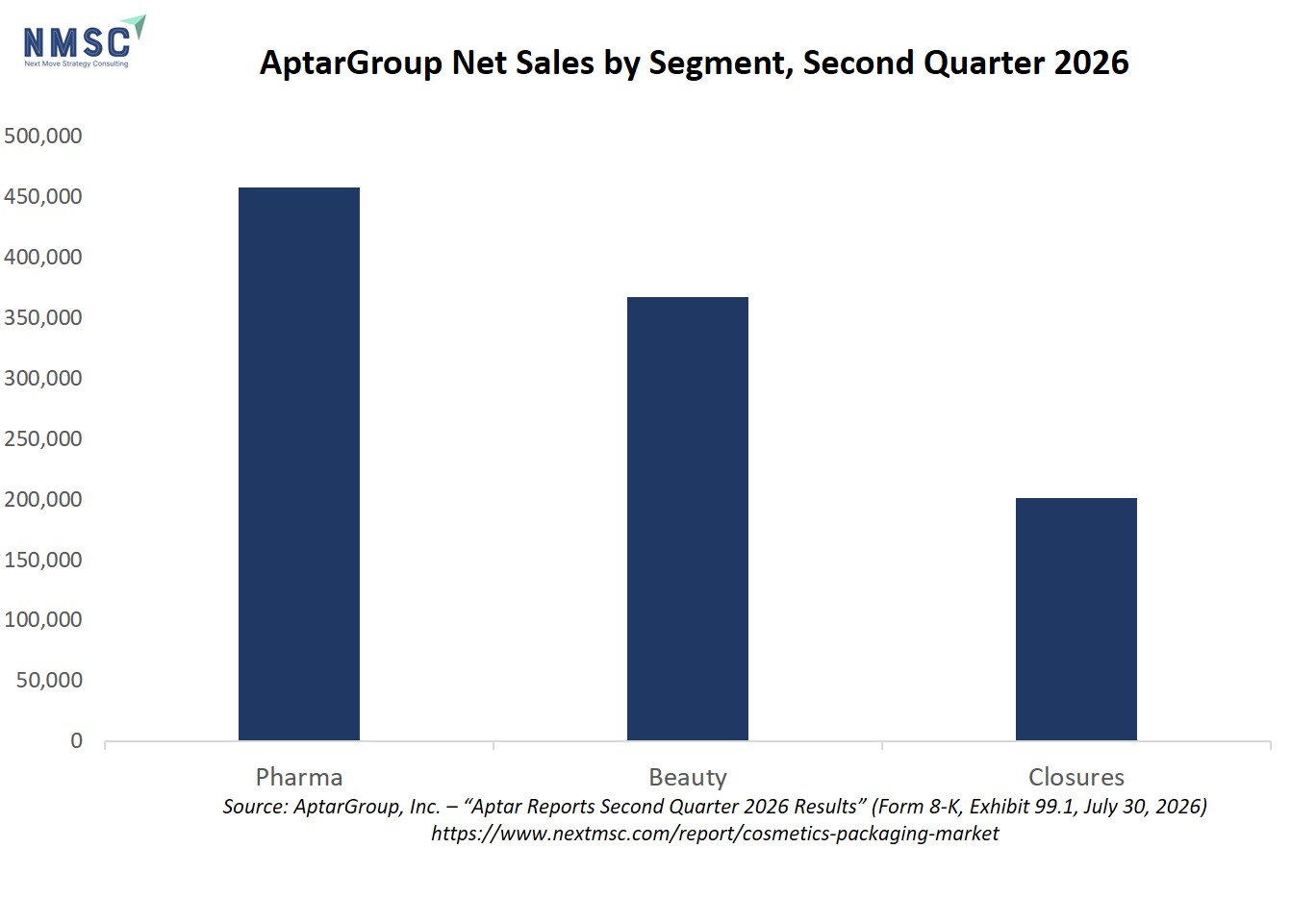
The extended producer responsibility (EPR) framework embedded in the regulation places the full lifecycle cost of packaging — collection, sorting, and recycling — on producers, with eco-modulation fees that penalise hard-to-recycle formats. For beauty brands whose packaging portfolios are characterised by multi-material pumps, metallised finishes, and componentised compacts, this fee structure creates a direct financial incentive to redesign toward mono-material architectures.
NMSC Strategic Perspective: How Regulation (EU) 2025/40 Restructures the Competitive Landscape
NMSC's primary research and analysis indicates that Regulation (EU) 2025/40 is not merely a compliance event — it is a competitive restructuring mechanism. Packaging converters and brand owners that have invested early in mono-material engineering, refillable platform architectures, and post-consumer recycled (PCR) polymer integration are positioned to absorb the regulation's requirements at lower incremental cost, while competitors that deferred sustainable material transitions now face simultaneous redesign, retesting, and recertification cycles. The regulation's prohibition on packaging that increases perceived volume directly targets a design convention that has been widespread in premium skincare and fragrance — specifically, the use of heavy glass bases and oversized secondary cartons to signal luxury. Brands that have already pivoted toward lightweight luxury formats, where prestige is conveyed through surface texture and silhouette rather than material mass, are structurally advantaged under the new framework.
Furthermore, NMSC's analysis of regional investment flows confirms that Europe's regulatory discipline is functioning as a global design standard-setter. Multinational beauty brands operating across the EU, North America, and Asia-Pacific are increasingly applying EU recyclability criteria to their entire global packaging portfolios, rather than maintaining separate regional specifications — a dynamic that is accelerating sustainable packaging adoption in markets where local regulation remains less prescriptive.
U.S. EPR Fragmentation: A Compliance Burden That Is Becoming a Design Signal
In the United States, the absence of a federal packaging EPR law has produced a patchwork of state-level frameworks that is generating significant operational complexity for national beauty brands. As of 2026, seven states — California, Colorado, Maine, Maryland, Minnesota, Oregon, and Washington — have enacted comprehensive packaging EPR laws, each with distinct reporting requirements, timelines, and fee structures. Five additional states, including New Jersey, New York, and Illinois, introduced EPR bills in 2025–2026, and ten states have conducted formal policy development studies.
Pamela Gill-Alabaster, Former Chief Sustainability Officer and Adjunct Professor at Columbia University, articulated the specific challenge for beauty brands: "In beauty, packs are often small-format, multi-material, and highly componentised: pumps, caps, actuators, overcaps, mirrors, magnets, metallised finishes, sleeves, labels, decoration, tinted resins, and secondary packaging. These features support aesthetics, dosing, protection, and shelf impact, but they can reduce recyclability or increase cost under an EPR fee structure that penalises hard-to-recycle formats."
Under California's SB 54, producers must fund recycling systems, with lower fees for recyclable formats and higher costs for complex, multi-material packaging. The Circular Action Alliance has been approved as the Producer Responsibility Organisation (PRO) in multiple states, including California, Colorado, Maryland, Minnesota, Oregon, and, as of March 2026, Washington.
Section Summary: The dual regulatory pressure of EU Regulation (EU) 2025/40 and U.S. state-level EPR frameworks is fundamentally restructuring cosmetics packaging design, procurement, and compliance operations. Brands that treat these frameworks as design signals rather than compliance burdens are converting regulatory pressure into competitive differentiation.
Key Takeaways:
-
EU Regulation (EU) 2025/40 applies from August 12, 2026, mandating recyclability, reuse, and EPR for all packaging on the EU market.
-
Seven U.S. states have enacted packaging EPR laws, with fee structures that directly penalise multi-material beauty packaging formats.
-
Mono-material engineering, refillable architectures, and PCR polymer integration are the primary design responses to both regulatory frameworks.
-
Brands applying EU recyclability criteria globally — rather than maintaining regional specifications — are reducing long-term compliance costs and accelerating sustainable packaging adoption in less-regulated markets.
Industry Impact Analysis
The Amcor–Berry Global Combination: Redefining Scale in Beauty Packaging Supply
On April 30, 2025, Amcor completed its all-stock acquisition of Berry Global at a fixed exchange ratio of 7.25 Amcor ordinary shares per Berry share, creating one of the largest global packaging entities with materially enhanced capabilities in flexible film, rigid containers, and beauty and personal care packaging. The transaction, valued at approximately USD 8.4 billion, was expected to generate USD 650 million in annual synergies and has positioned the combined entity to serve multinational beauty brands across both flexible and rigid format requirements from a single supplier relationship.
For cosmetics brand procurement teams, this consolidation has two immediate implications. First, it reduces the number of tier-one packaging suppliers capable of serving global beauty portfolios at scale, increasing the negotiating leverage of the combined Amcor entity. Second, it accelerates the availability of recycle-ready flexible formats — including AmPrima™ recycle-ready pouches — for beauty applications, as Berry's flexible film capabilities are integrated into Amcor's beauty and personal care portfolio. Amcor had previously partnered with AVON China on AmPrima™ recycle-ready pouches for shower gel products, as part of AVON's commitment to 100% reusable, recyclable, or compostable packaging by 2030.
Material Innovation at Cosmoprof Bologna 2026: Five Formats That Signal Where the Market Is Heading
With more than 255,000 visitors and over 3,100 exhibitors, Cosmoprof Worldwide Bologna 2026 provided the most concentrated view of where cosmetics packaging innovation is concentrating. Five developments from the event's Cosmopack section are particularly instructive for strategic planning:
-
Berlin Packaging's Xoco: A polypropylene material derived from upcycled hazelnut shells, developed in collaboration with Krill Design. Composed of a PP base blended with 10% hazelnut shell content, Xoco maintains full recyclability while delivering a distinctive organic aesthetic — directly addressing the brand demand for sustainability narratives that are visually legible rather than label-dependent.
-
Geka's 100% PCR Mascara Collection: Six mascaras in which the bottle, cap, wiper, and stem are constructed entirely from 100% post-consumer recycled plastic, decorated using Geka's Shadow Printing technique — a 360° decoration method that requires no additional ink or foil and reduces CO₂ emissions by up to 26%.
-
HCP Packaging's FusionFibre Technology: An applicator fibre made from regenerated cellulose derived from FSC-certified Swedish pine and spruce, offering a renewable alternative to synthetic mascara brush materials. The fibre's micro-porous structure captures more formula per dip and releases it in controlled layers, combining sustainability credentials with measurable performance improvement.
-
Pennelli Faro's Futura Sculpture: A 3D-printed applicator collection that demonstrates how additive manufacturing is enabling highly customisable, architecturally distinctive formats without the tooling investment traditionally required for novel geometries.
-
Shinkwang M&P's Air Mist Gas-Free Spray System: A Cosmopack Award winner that eliminates aerosol propellants through mechanical air compression, removing flammability risks and transport restrictions while maintaining stable 360° atomisation — a format with direct relevance to the growing number of beauty brands seeking aerosol-free alternatives for e-commerce and air freight distribution.
Mono-Material Momentum: From Design Aspiration to Commercial Requirement
The shift toward mono-material packaging — formats constructed from a single polymer type, typically requiring at least 90–95% of that material by weight — has accelerated from a sustainability aspiration to a commercial requirement in 2026. Brandon Frank, CEO of Pacific Packaging Components, identified three converging forces: supply chain infrastructure improvements, retailer standards that now require mono-material formats, and technology investment that has made mono-material pumps and airless systems viable at scale.
In October 2025, Quadpack released a mono-material PET liquid makeup bottle with customisable design and PCR content, specifically targeting masstige and niche makeup brands seeking to improve circularity and design flexibility simultaneously. This launch is representative of a broader portfolio shift: historically, pumps and airless packaging have been among the most difficult components to recycle due to mixed materials and complex assemblies. Advances in material engineering are now making mono-material alternatives commercially scalable across large product portfolios.
The Social Commerce Dimension: Packaging as a Real-Time Sales Instrument
The beauty industry generates over 120 billion units of packaging annually, the majority of which ends up in landfills due to material complexity and inadequate recycling infrastructure. Yet simultaneously, packaging is being asked to perform a new commercial function: converting viewers into buyers in real time on TikTok Shop and live commerce platforms. Allison Kent-Gunn Garibay, founder of 3E Beauty Consulting, noted that "packaging that demonstrates value and novelty instantly on camera will consistently outperform those designed solely for retail shelves or DTC aesthetics." This dynamic is driving demand for soft-touch finishes, precision dispensing systems with visible payoff, and tactile materials that translate sensory experience through a screen — a requirement that sits in productive tension with the simplification imperative of EPR compliance.
Section Summary: The cosmetics packaging industry in 2026 is being reshaped by three simultaneous forces: supply-side consolidation (Amcor–Berry Global), material innovation concentrated in mono-material and bio-based formats, and the emergence of social commerce as a packaging performance criterion that operates alongside — not instead of — sustainability requirements.
Key Takeaways:
-
Amcor's April 2025 completion of the Berry Global acquisition creates a dominant tier-one supplier for beauty packaging across flexible and rigid formats, with USD 650 million in projected annual synergies.
-
Cosmoprof Bologna 2026 confirmed that bio-based materials (hazelnut shell PP, FSC-certified cellulose), 100% PCR formats, and gas-free dispensing systems have moved from concept to commercial availability.
-
Mono-material pumps and airless systems are now commercially scalable, driven by retailer standards, EPR fee structures, and material engineering advances.
-
Social commerce platforms are creating a new packaging performance criterion — on-camera sensory impact — that must be balanced against the simplification requirements of EPR compliance.
Pros and Cons of Recent Market Developments
|
Development |
Pros |
Cons |
|
EU Regulation (EU) 2025/40 (applies August 2026) |
Harmonises recyclability standards across 27 EU markets, reducing multi-jurisdiction compliance complexity; creates a level playing field that rewards early sustainable packaging investment |
Prohibits established premium design conventions (double walls, false bottoms); imposes EPR cost burden on producers; recyclability-at-scale requirement (2035) requires long-term capital commitment |
|
U.S. State-Level EPR Expansion (7 states enacted) |
Incentivises mono-material and recyclable format adoption through eco-modulation fee structures; funds recycling infrastructure development |
Fragmented state-by-state requirements create significant data management and reporting complexity for national brands; fee schedules remain uncertain, complicating long-term planning |
|
Amcor–Berry Global Combination (completed April 2025) |
Creates a single-source supplier for flexible and rigid beauty packaging at global scale; accelerates availability of recycle-ready flexible formats |
Reduces tier-one supplier competition, potentially increasing pricing leverage against beauty brand buyers; integration complexity may temporarily disrupt service continuity |
|
Mono-Material Packaging Adoption |
Improves recyclability and EPR fee positioning; reduces end-of-life complexity; increasingly viable at scale for pumps and airless systems |
Performance trade-offs in some applications (e.g., barrier properties, chemical compatibility); higher unit cost than conventional multi-material formats at current production volumes |
|
Smart Packaging (QR, NFC, RFID) |
Enables supply chain traceability, anti-counterfeiting, and consumer engagement; supports EPR reporting data collection; barrier to entry is now negligible |
Requires investment in backend data infrastructure; consumer adoption of NFC/RFID interactions remains uneven across markets |
|
Sensory-Supercharged & On-the-Go Formats |
Drives conversion on social commerce platforms; extends packaging lifecycle through wearable/reusable formats |
Small-format packaging (keychains, lockets) presents recycling challenges due to size constraints in material recovery facilities |
Key Data & Statistics
Key Regulatory & Industry Milestones Shaping the Cosmetics Packaging Market
|
Event / Regulation |
Date / Timeline |
Direct Impact on Cosmetics Packaging |
|
EU Regulation (EU) 2025/40 enters into force |
February 11, 2025 |
Mandates recyclability, reuse, refill, and EPR for all packaging on EU market |
|
EU Regulation (EU) 2025/40 becomes applicable |
August 12, 2026 |
Prohibits volume-inflating packaging; requires minimum PCR content in plastic packaging |
|
Amcor completes Berry Global acquisition |
April 30, 2025 |
Creates dominant tier-one beauty packaging supplier; accelerates recycle-ready flexible format availability |
|
Quadpack releases mono-material PET liquid makeup bottle |
October 2025 |
Demonstrates commercial viability of mono-material formats for masstige makeup brands |
|
Aptar Beauty expands Airless Portfolio in LATAM |
April 2025 |
Extends premium sustainable dispensing formats into high-growth Latin American markets |
|
U.S. EPR: 7 states enact packaging EPR laws |
2025–2026 |
Imposes eco-modulation fees penalising multi-material beauty packaging; drives mono-material adoption |
|
Cosmoprof Bologna 2026: 600+ packaging exhibitors |
2026 |
Confirms commercial availability of bio-based (hazelnut PP), 100% PCR, and gas-free spray formats |
|
EU recyclability performance grades applicable |
From 2030 |
Introduces tiered recyclability scoring that will directly affect EPR fee levels for beauty brands |
Future Outlook & Forecast
NMSC Market Trajectory: USD 92.52 Billion by 2035
NMSC's primary research and analysis projects the global cosmetics packaging market to expand from USD 56.27 billion in 2026 to USD 92.52 billion by 2035, at a CAGR of 5.68%. This growth trajectory is underpinned by four structural drivers that NMSC's analysis identifies as durable across the forecast period: premiumisation in skincare and fragrance packaging, accelerating sustainability mandates that are expanding the addressable market for recyclable and refillable formats, the continued expansion of e-commerce channels that require transit-optimised packaging innovation, and the rise of smart packaging technologies that are converting packaging from a one-way brand communication tool into a two-way consumer engagement platform.
Asia-Pacific: Production Scale Meets Consumption Acceleration
NMSC's regional analysis identifies Asia-Pacific as the largest and fastest-growing cosmetics packaging market, driven by rapid urbanisation, rising disposable incomes, and mobile-first e-commerce adoption across China, India, Japan, South Korea, and Southeast Asia. China represents the largest single market in the region, supported by an extensive beauty and personal care manufacturing base and growing regulatory scrutiny on chemical safety and recyclability. India's market is expanding rapidly, with brands balancing sustainability commitments against price sensitivity in mass and mid-range segments.
McKinsey's State of Beauty analysis projects the global beauty market to grow by 5% annually through 2030, with major disruptions driven by digital commerce, ingredient transparency, and sustainability expectations — all of which translate directly into packaging specification requirements.
The Refillable Architecture Opportunity
NMSC's analysis confirms that refillable packaging systems are gaining strategic traction in premium skincare and fragrance lines, enhancing customer retention while reducing material intensity per unit sold. Amcor's January 2026 beauty packaging trends analysis confirmed that refillable packs will continue to grow in popularity through 2026 and beyond, driven by both consumer preference and the EU's requirement that large retailers dedicate 10% of sales area to refill stations by 2030. For brands, refillable architectures represent a structural shift in the customer relationship — from transactional to subscription-like — with measurable implications for lifetime value and packaging material cost per use.
Smart Packaging: From Gimmick to Functional Infrastructure
Brandon Frank, CEO of Pacific Packaging Components, noted that "the barrier to entry for QR, NFC, and RFID is essentially gone — these technologies are now easy to implement, cost-effective, and the benefits far outweigh the incremental costs for brands." NMSC's analysis confirms that smart packaging integration is strengthening supply chain transparency, supporting EPR reporting data collection, and enabling anti-counterfeiting mechanisms — functions that are becoming operationally necessary rather than differentiating features as regulatory reporting requirements tighten.
Section Summary: The cosmetics packaging market's path to USD 92.52 billion by 2035 is structurally supported by premiumisation, sustainability mandates, e-commerce expansion, and smart packaging adoption — with Asia-Pacific driving volume growth and Europe setting the design and regulatory standards that are being adopted globally.
Key Takeaways:
-
NMSC projects the market to grow at a 5.68% CAGR from 2026 to 2035, reaching USD 92.52 billion — driven by premiumisation, sustainability mandates, and e-commerce channel expansion.
-
Asia-Pacific is the largest and fastest-growing regional market, with China, India, and South Korea as primary demand centres.
-
Refillable packaging architectures are transitioning from a premium niche to a mainstream commercial format, supported by EU regulatory requirements and consumer preference.
-
Smart packaging (QR, NFC, RFID) is shifting from a brand differentiation tool to a compliance and supply chain infrastructure requirement.
Next Steps for Stakeholders
For C-Level Executives at Cosmetics Brands:
-
Conduct an immediate EPR portfolio audit. Map every SKU's packaging bill of materials against the recyclability criteria of EU Regulation (EU) 2025/40 and the EPR fee structures of the seven U.S. states with enacted laws. Identify which formats carry the highest eco-modulation fee exposure and prioritise redesign toward mono-material alternatives in those categories first.
-
Treat the EU's 2030 refill station mandate as a product architecture decision, not a retail operations question. Brands that design refillable primary packaging systems now — with standardised refill formats compatible with in-store infrastructure — will be positioned to capture the 10% sales area allocation that large EU retailers must dedicate to refill stations by 2030.
-
Evaluate the Amcor–Berry Global combination's implications for your supplier concentration risk. The consolidation of two major tier-one packaging suppliers into a single entity warrants a review of supplier diversification strategy, particularly for brands with significant flexible packaging requirements.
-
Invest in packaging data infrastructure before EPR reporting deadlines arrive. As Pamela Gill-Alabaster noted, EPR is "not just a packaging-design issue; it becomes a data, governance, and compliance issue." Brands managing hundreds of SKUs across multiple markets need SKU-level packaging composition data, component weights, and recyclability classifications by jurisdiction — capabilities that require investment now to be operational when reporting obligations activate.
For Institutional Investors:
-
Prioritise packaging suppliers with demonstrated mono-material engineering capabilities and PCR polymer integration. These capabilities are the primary technical requirements for EU and U.S. EPR compliance, and suppliers that have invested in them early are positioned to capture the redesign mandates that brands will be executing through 2030.
-
Assess M&A targets in the refillable and smart packaging segments. NMSC's analysis identifies refillable architectures and connected packaging technologies as structural growth opportunities — segments where mid-sized specialists with proprietary platform solutions represent attractive acquisition targets for larger packaging groups seeking to expand their sustainable format portfolios.
-
Monitor Asia-Pacific regulatory convergence. As China, South Korea, and India progressively tighten chemical safety and recyclability standards, the regulatory-driven demand for sustainable packaging formats that has characterised European market growth will replicate across the region's high-volume manufacturing and consumption base.
Conclusion
The cosmetics packaging market is not simply growing — it is being restructured. The simultaneous activation of EU Regulation (EU) 2025/40, the expansion of U.S. state-level EPR frameworks, the Amcor–Berry Global consolidation, and the commercial maturation of mono-material and smart packaging formats have collectively created a market environment in which the competitive hierarchy is being reset. Brands and packaging suppliers that have invested in recyclable material platforms, refillable architectures, and EPR-compliant design processes are converting regulatory pressure into structural advantage. Those that have deferred these investments now face the compounding costs of simultaneous redesign, recertification, and compliance reporting.
NMSC's primary research and analysis projects the global cosmetics packaging market to reach USD 92.52 billion by 2035, at a CAGR of 5.68% — a trajectory that reflects not just rising beauty consumption, but the expanding economic value of packaging that can satisfy premium aesthetics, regulatory compliance, and circular economy requirements within a single format. For executives and investors, the strategic question is no longer whether to invest in sustainable packaging innovation, but how quickly that investment can be scaled to capture the demand that regulation and consumer expectation are jointly creating.
About the Author
 Sanyukta Deb
— Sanyukta Deb is Digital Marketing Team Lead at Next Move Strategy Consulting, where she has led content strategy and technical SEO for the firm's B2B market research publications for over 2 years. Her editorial process translates NextMSC's primary and secondary research — spanning technology, industrial, and consumer sectors — into commercial narratives, backed by search-intent, keyword, and competitive analysis. She brings 5 years of overall experience in digital marketing and content strategy.
Sanyukta Deb
— Sanyukta Deb is Digital Marketing Team Lead at Next Move Strategy Consulting, where she has led content strategy and technical SEO for the firm's B2B market research publications for over 2 years. Her editorial process translates NextMSC's primary and secondary research — spanning technology, industrial, and consumer sectors — into commercial narratives, backed by search-intent, keyword, and competitive analysis. She brings 5 years of overall experience in digital marketing and content strategy.
About the Reviewer
 Debashree Dey
— Debashree Dey is Assistant Manager at Next Move Strategy Consulting, where she supports cross-vertical market content and communications across diverse industries for 6 years. Her professional background includes senior content writing, communications, and published manuscript authorship, with experience developing audience-focused business narratives and maintaining clear, consistent messaging. Her role supports research-led content development and editorial quality across NextMSC publications.
Debashree Dey
— Debashree Dey is Assistant Manager at Next Move Strategy Consulting, where she supports cross-vertical market content and communications across diverse industries for 6 years. Her professional background includes senior content writing, communications, and published manuscript authorship, with experience developing audience-focused business narratives and maintaining clear, consistent messaging. Her role supports research-led content development and editorial quality across NextMSC publications.


















Add Comment