Home Textile Market: Key Statistics & Forecasts for 2026

Introduction
The global Home Textile Market stands at a defining crossroads in 2026. Valued at USD 173.09 billion in 2025 and projected to reach USD 245.04 billion by 2030, this sector is no longer driven solely by aesthetic preferences or seasonal demand cycles. Today, the home textile market is being fundamentally reshaped by a convergence of forces: sweeping sustainability mandates from regulatory bodies, escalating trade policy pressures, rapid e-commerce penetration, and the emergence of smart fabric technologies that are redefining what a household textile product can do.
For C-level executives, institutional investors, and procurement strategists, understanding these structural shifts is not optional — it is a prerequisite for competitive positioning. The decisions made in boardrooms today regarding supply chain diversification, material sourcing, and digital retail investment will determine which organizations capture the market's projected USD 72 billion expansion over the next five years. This analysis synthesizes the most consequential developments shaping the home textile market in 2026, grounded in institutional data and verified industry intelligence.
For More Information: Download FREE Sample on Home Textile Market Report
Sustainability Mandates, Trade Disruptions, and Smart Innovation: The Forces Reshaping the Home Textile Market
The Chatham House Water Footprint Report: A Watershed Moment for the Industry
In July 2026, Chatham House — one of the world's foremost international affairs think tanks — published a landmark research paper titled "The Water Footprints of Global Textiles Trade," which has sent significant reverberations across the global home textile market. The report reveals that every textile product carries a hidden "water footprint" — an indicator of the volume of water embedded across its entire production life cycle, from raw material sourcing to manufacturing, use, and disposal.
The findings are stark: global fibre production has nearly quadrupled over the last 50 years and is expected to reach approximately 169 million tonnes by 2030 if current production trajectories continue. The textile industry currently employs around 90 million people worldwide, more than half of whom are women, and in countries such as Bangladesh, the apparel sector contributed 81.5% of total export earnings in 2024/25. However, this economic significance is increasingly entangled with water insecurity risks that threaten the long-term viability of major producing regions.
The Chatham House report calls on governments, investors, and private sector actors to embed water stewardship and circularity criteria into trade policy frameworks, and to build standardized water footprint metrics into trade agreements. For home textile manufacturers and retailers, this represents a material operational and reputational risk that can no longer be deferred.
The EU's Ecodesign for Sustainable Products Regulation (ESPR): Compliance Becomes Mandatory
Compounding the sustainability imperative, the European Union has accelerated its regulatory agenda for textiles. On 16 April 2025, the European Commission formally adopted its Ecodesign Working Plan under the new ESPR (Ecodesign for Sustainable Products Regulation), which prioritizes textiles as a key product group requiring enhanced durability, repairability, and recyclability standards. The ESPR also introduces a ban on the destruction of unsold consumer products, specifically targeting textiles, apparel, and footwear.
Furthermore, the revised EU Waste Framework Directive (WFD), which entered into force in October 2025, makes Extended Producer Responsibility (EPR) mandatory for textiles across EU member states. Since January 2025, EU member states are also required to collect textiles separately for re-use and recycling. These regulatory developments are not peripheral compliance exercises — they are fundamentally restructuring product design, supply chain transparency requirements, and end-of-life responsibilities for every home textile brand operating in or exporting to the European market.
US Tariff Escalation: Supply Chain Reconfiguration Underway
On the trade policy front, the escalation of US import tariffs has created significant turbulence for home textile supply chains. According to data published by the Federal Reserve, tariffs have not manifested as a one-time price spike but rather as a gradual, sustained increase in retail prices throughout 2025. India's home textile sector has been identified as among the hardest hit, with buyers reportedly demanding price concessions from suppliers in response to elevated US tariff rates.
Despite this headwind, India's home textile exports demonstrated resilience, growing 10% in the nine-month period of FY2025. Indian exporters are now actively pivoting toward the European Union, with Reuters reporting in January 2026 that the India-UK Free Trade Agreement — expected to take effect in 2026 and eliminating tariffs on 99% of Indian goods — is being viewed as a critical alternative market access route.
The Rise of Smart and Sustainable Fabrics
Technological innovation is simultaneously opening new product frontiers within the home textile market. The global smart textile market is currently valued at USD 9.61 billion, with next-generation fabrics now capable of harvesting energy from movement, actively regulating temperature, and integrating sensor-enabled health monitoring functions. In 2026, innovation is increasingly merging with sustainability, as smart fabrics are being designed to be biodegradable or recyclable, addressing both performance and environmental objectives simultaneously.
Meanwhile, Textile Exchange's Materials Market Report 2025 confirms that global fiber production reached 132 million tonnes in 2024, up from 125 million tonnes in 2023. Polyester remains the dominant fiber, constituting 59% of total global fiber output, of which 88% is fossil-based — a finding that underscores the urgency of transitioning toward certified and recycled alternatives. On a positive note, 34% of global cotton production now originates from certified sources, reflecting measurable progress in responsible sourcing.
NMSC Strategic Perspective: Navigating the Convergence of Regulation, Trade, and Innovation
According to Next Move Strategy Consulting's analysis of the home textile market, the sector's growth trajectory through 2030 will be defined by the ability of market participants to simultaneously navigate regulatory compliance, supply chain resilience, and consumer-driven premiumization. The NMSC report identifies rising disposable incomes, the consumer shift toward comfort and personalized home environments, and the accelerating expansion of e-commerce as the three primary structural growth drivers.
Critically, NMSC's analysis highlights that brands investing in eco-friendly production, circular economy models, and transparent supply chains are positioned to capture a rapidly expanding premium market segment. The convergence of the EU's ESPR mandates, the Chatham House water footprint findings, and consumer demand for certified sustainable products creates a strategic imperative — not merely a reputational one — for manufacturers and retailers to accelerate their sustainability transitions.
Key Takeaways:
-
The Chatham House July 2026 report has elevated water footprint accountability to a board-level risk for home textile manufacturers and investors.
-
The EU's ESPR and mandatory EPR framework are restructuring product design and supply chain transparency requirements across the European market.
-
US tariff escalation is accelerating supply chain diversification, with Indian exporters pivoting toward EU and UK markets.
-
Certified fiber sourcing is gaining traction, with 34% of global cotton now from certified sources, signaling a measurable shift in raw material standards.
Industry Impact Analysis
Impact on Manufacturers and Exporters
The dual pressure of US tariff escalation and EU sustainability mandates is compelling home textile manufacturers — particularly those based in India, Bangladesh, and China — to undertake significant operational restructuring. India's total textile and apparel exports, including handicrafts, stood at ₹2,68,951.5 crore during April 2025 to January 2026, according to the Press Information Bureau of India. However, the home textile sub-segment faces disproportionate exposure to US tariff volatility, necessitating urgent market diversification strategies.
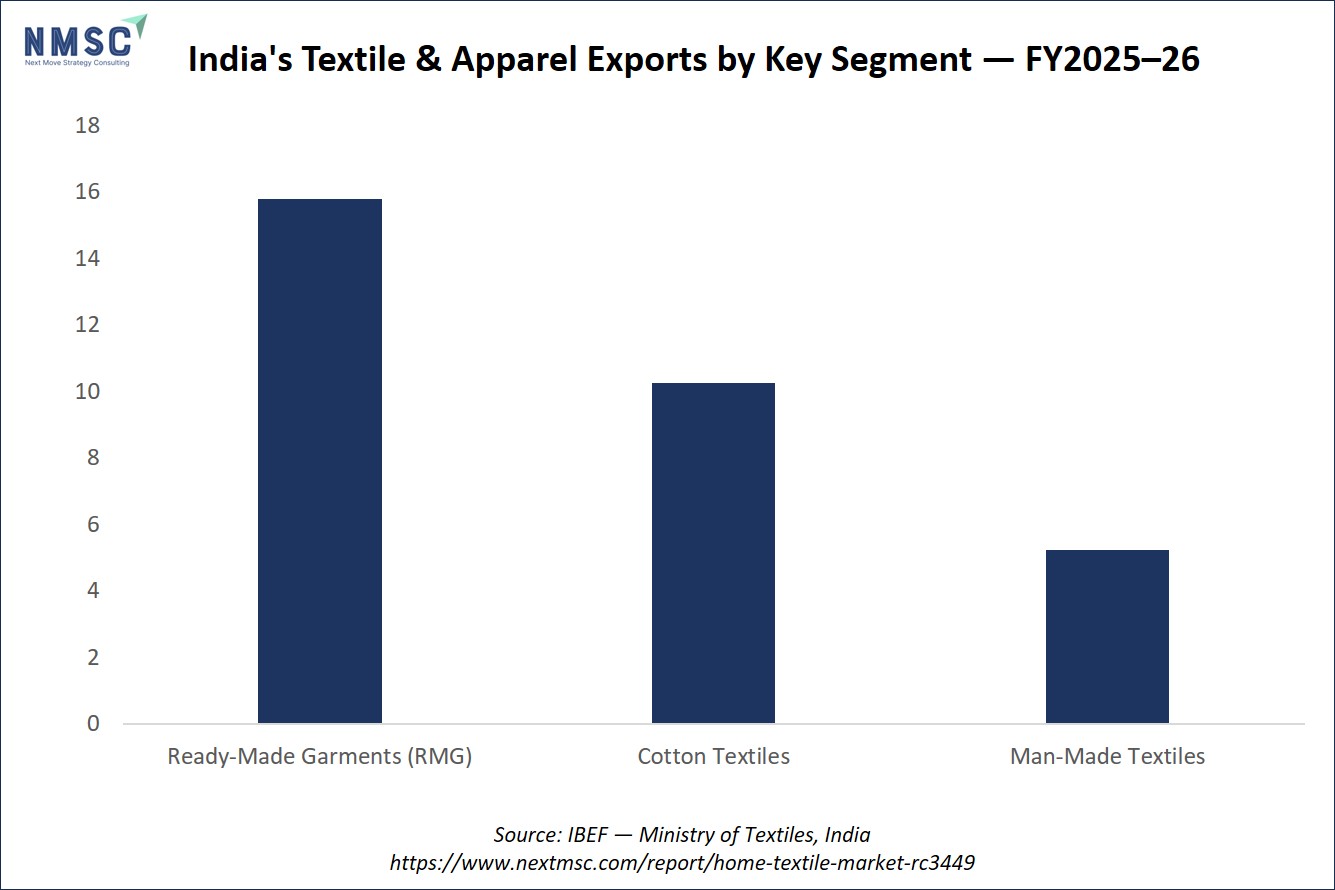
Leading industry players are responding with decisive strategic action. Trident Limited, one of India's foremost home textile manufacturers, announced plans to triple its home textile business by 2027, with a focus on expanding manufacturing capacity and broadening its product range. Sutlej Textiles and Industries Ltd. has actively explored new export markets in the UK and EU, leveraging emerging trade agreements to increase premium home textile exports. Welspun Living, a global leader in home textiles, has reported that 76% of its cotton is now sourced sustainably, positioning the company ahead of anticipated regulatory thresholds.
Impact on Retail and E-Commerce Channels
The structural shift toward online retail is accelerating at a pace that is materially altering the competitive dynamics of the home textile market. According to the US Census Bureau, e-commerce sales in Q2 2026 increased 12.4% compared to Q2 2025, reflecting sustained momentum in digital consumer spending. The International Trade Administration projects global B2C e-commerce revenue to reach USD 5.5 trillion by 2027, growing at a 14.4% CAGR — a trajectory that is directly expanding the addressable market for home textile brands with robust digital retail capabilities.
Enhanced digital experiences — including mobile shopping applications, virtual room visualization tools, and AI-driven personalization engines — are enabling both established brands and niche manufacturers to reach global audiences with significantly lower distribution overhead. This democratization of market access is intensifying competition while simultaneously expanding the total consumer base for premium and customized home textile products.
Impact on Raw Material Supply Chains
The raw material dimension of the home textile market is under simultaneous pressure from multiple directions. Fossil-based polyester production increased from approximately 71 million tonnes in 2023 to around 78 million tonnes in 2024, yet its dominance is increasingly at odds with regulatory and consumer sustainability expectations. The share of recycled polyester in total fiber production declined slightly from 12.5% in 2023 to 12% in 2024, highlighting the gap between industry sustainability commitments and actual production realities.
Fluctuating raw material prices — driven by unpredictable weather patterns, supply chain disruptions, and geopolitical trade tensions — remain a significant restraint on market stability, particularly for price-sensitive manufacturing regions.
Key Takeaways:
-
Indian home textile exporters are actively diversifying away from US market dependence, targeting EU and UK markets through emerging trade agreements.
-
E-commerce growth of 12.4% in Q2 2026 (US Census Bureau) is structurally expanding the digital retail channel for home textile brands globally.
-
Fossil-based polyester's dominance (59% of global fiber output) is increasingly misaligned with regulatory and consumer sustainability expectations.
-
Leading manufacturers such as Trident and Welspun Living are making decisive capacity and sustainability investments to capture long-term market share.
Key Industry Data Points — Home Textile Market 2025–2026
|
Data Point |
Figure |
|
Global fiber production (2024) |
132 million tonnes |
|
Global fiber production forecast (2030) |
~169 million tonnes |
|
Polyester share of global fiber output |
59% (88% fossil-based) |
|
Recycled polyester market share (2024) |
12% of total polyester |
|
Certified cotton share of global production |
34% |
|
Textile industry global employment |
~90 million people |
|
Bangladesh apparel share of export earnings (2024/25) |
81.5% |
|
India home textile export growth (9M FY2025) |
10% YoY |
|
US e-commerce growth (Q2 2026 vs Q2 2025) |
+12.4% |
|
Global B2C e-commerce revenue forecast (2027) |
USD 5.5 trillion (14.4% CAGR) |
|
Smart textile market current valuation |
USD 9.61 billion |
|
Welspun Living sustainable cotton sourcing |
76% of total cotton |
Future Outlook & Forecast
NMSC Market Forecast: A USD 245 Billion Opportunity by 2030
According to Next Move Strategy Consulting, the global home textile market is projected to grow from USD 173.09 billion in 2025 to USD 245.04 billion by 2030, representing a CAGR of 7.2% over the forecast period. This growth trajectory is underpinned by three structural pillars: rising disposable incomes in emerging economies, the consumer shift toward comfort-driven and personalized home environments, and the accelerating penetration of e-commerce platforms that are expanding market access for both established and niche brands.
Regional Outlook
North America remains a high-value market, driven by sustained home renovation and remodelling activity, rising disposable incomes, and strong social media-driven design inspiration. The US home textiles market was valued at USD 24.1 billion in 2025, with a projected CAGR of 5.4% through the forecast period.
Europe is characterized by robust demand for premium and luxury home textiles, supported by high purchasing power, a strong tradition of textile craftsmanship in countries such as Italy, France, and Portugal, and an increasingly eco-conscious consumer base. The EU's ESPR and EPR mandates will simultaneously raise compliance standards and create competitive advantages for brands with established sustainability credentials.
Asia-Pacific represents the most dynamic growth frontier, driven by rapid urbanization and an expanding middle-class population. According to the World Bank, the urban population accounts for 66% in China and 37% in India, reflecting significant urban growth that is fueling demand for modern, stylish, and functional home furnishings. The region's booming real estate sector and rising homeownership rates are further accelerating market expansion.
Rest of the World — encompassing Latin America, the Middle East, and Africa — is experiencing growth driven by the penetration of international retail brands through malls, specialty stores, and e-commerce platforms, improving product accessibility and exposing consumers to diverse design options.
The Sustainability Premium: A Long-Term Value Creation Opportunity
The convergence of regulatory mandates (EU ESPR, WFD), institutional research (Chatham House water footprint findings), and consumer preference evolution is creating a durable premium segment within the home textile market for brands that can credibly demonstrate sustainable production credentials. Certifications such as GOTS (Global Organic Textile Standard) and OEKO-TEX are increasingly functioning as market access requirements rather than optional differentiators, particularly in European and North American retail channels.
Section Summary: The home textile market's USD 245 billion forecast by 2030 is supported by structural demand drivers across all major geographies, with sustainability compliance and e-commerce capability emerging as the two most critical determinants of long-term competitive positioning.
Key Takeaways:
-
NMSC projects the global home textile market to reach USD 245.04 billion by 2030 at a CAGR of 7.2% from 2025.
-
Asia-Pacific is the fastest-growing regional market, driven by urbanization, middle-class expansion, and a booming real estate sector.
-
Europe's regulatory environment (ESPR, EPR) is creating a structural premium for sustainability-certified home textile brands.
-
E-commerce expansion — with global B2C revenues projected at USD 5.5 trillion by 2027 — is the single most transformative distribution channel shift in the home textile market.
Next Steps for Stakeholders
For C-level executives, institutional investors, and strategic procurement leaders operating in or evaluating the home textile market, the following action priorities are recommended based on the current market intelligence:
1. Conduct a Water Footprint Audit Across the Value Chain
In light of the Chatham House July 2026 findings, organizations should commission comprehensive water footprint assessments across their textile supply chains. This is no longer solely a reputational exercise — it is a prerequisite for compliance with emerging trade policy frameworks and investor ESG disclosure requirements.
2. Accelerate EU ESPR Compliance Roadmaps
Manufacturers and brands with European market exposure must treat the ESPR ecodesign requirements and EPR obligations as immediate operational priorities. Organizations that establish compliance infrastructure ahead of mandatory deadlines will gain first-mover advantages in premium retail positioning.
3. Diversify Export Market Exposure
Home textile exporters — particularly those with concentrated US market dependence — should actively evaluate the India-UK Free Trade Agreement and EU market access pathways as strategic hedges against ongoing US tariff volatility.
4. Invest in Digital Retail Infrastructure
With US e-commerce growing at 12.4% year-on-year in Q2 2026, organizations that have not yet built robust digital retail capabilities — including mobile commerce, virtual visualization tools, and AI-driven personalization — risk ceding significant market share to digitally native competitors.
5 .Prioritize Certified Fiber Sourcing
Transitioning raw material procurement toward GOTS-certified cotton, recycled polyester, and other certified sustainable fibers is both a regulatory compliance strategy and a consumer demand response. With 34% of global cotton already from certified sources, the industry benchmark is rising rapidly.
6. Evaluate Smart Textile Investment Opportunities
The USD 9.61 billion smart textile market represents a high-growth adjacency for home textile manufacturers seeking to differentiate in an increasingly commoditized product landscape. Strategic R&D investment or partnership with smart fabric innovators can open premium product categories with significantly higher margin profiles.
Conclusion
The global home textile market in 2026 is not simply growing — it is being structurally transformed. The Chatham House water footprint report, the EU's ESPR and EPR mandates, the reconfiguration of trade flows driven by US tariff escalation, and the emergence of smart fabric technologies are collectively redefining the competitive parameters of this USD 173 billion industry. For organizations that treat these forces as isolated compliance or operational challenges, the risks are substantial. For those that recognize them as interconnected strategic imperatives, the home textile market's projected expansion to USD 245.04 billion by 2030 — at a CAGR of 7.2% — represents a compelling and well-supported growth opportunity.
The organizations that will lead this market through 2030 are those that invest today in supply chain transparency, sustainability certification, digital retail capability, and geographic market diversification. The data is clear; the strategic direction is defined. The remaining variable is the speed and conviction of execution.
About the Author
 Sanyukta Deb
— Sanyukta Deb is Digital Marketing Team Lead at Next Move Strategy Consulting, where she has led content strategy and technical SEO for the firm's B2B market research publications for over 2 years. Her editorial process translates NextMSC's primary and secondary research — spanning technology, industrial, and consumer sectors — into commercial narratives, backed by search-intent, keyword, and competitive analysis. She brings 5 years of overall experience in digital marketing and content strategy.
Sanyukta Deb
— Sanyukta Deb is Digital Marketing Team Lead at Next Move Strategy Consulting, where she has led content strategy and technical SEO for the firm's B2B market research publications for over 2 years. Her editorial process translates NextMSC's primary and secondary research — spanning technology, industrial, and consumer sectors — into commercial narratives, backed by search-intent, keyword, and competitive analysis. She brings 5 years of overall experience in digital marketing and content strategy.
About the Reviewer
 Debashree Dey
— Debashree Dey is Assistant Manager at Next Move Strategy Consulting, where she supports cross-vertical market content and communications across diverse industries for 6 years. Her professional background includes senior content writing, communications, and published manuscript authorship, with experience developing audience-focused business narratives and maintaining clear, consistent messaging. Her role supports research-led content development and editorial quality across NextMSC publications.
Debashree Dey
— Debashree Dey is Assistant Manager at Next Move Strategy Consulting, where she supports cross-vertical market content and communications across diverse industries for 6 years. Her professional background includes senior content writing, communications, and published manuscript authorship, with experience developing audience-focused business narratives and maintaining clear, consistent messaging. Her role supports research-led content development and editorial quality across NextMSC publications.


















Add Comment