Counter-Drone Technologies Market: Key Defence Shifts
Introduction
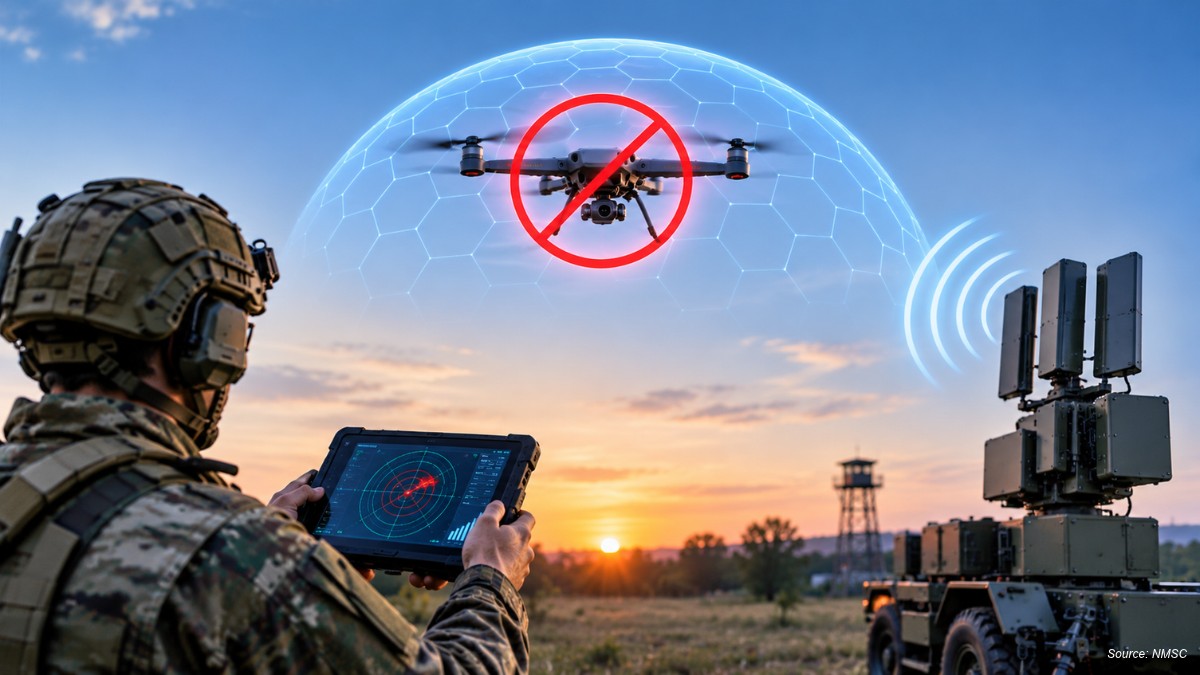
Counter-drone technologies are moving from isolated detection tools toward integrated systems that identify, track and respond to unauthorised unmanned aircraft. The shift is being driven by the need to protect military installations, deployed forces, airports, energy assets, ports and public spaces against drones that can be inexpensive, numerous and difficult to classify. On 13 October 2026, Raytheon announced a USD 729 million award to supply components of the U.S. Army’s Low, slow, small, unmanned aircraft Integrated Defeat System (LIDS) to the U.S. Army, Qatar and Jordan. The award includes Ku-band Radio Frequency Sensor (KuRFS) equipment and Coyote effectors; the company described the Qatar and Jordan sales as the first international sales of both products.
According to Next Move Strategy Consulting (NMSC), the global Counter-Drone Technologies Market was valued at USD 5.40 billion in 2025 and is estimated at USD 7.60 billion in 2026. It is forecast to reach USD 48.00 billion by 2035, representing a compound annual growth rate (CAGR) of 22.7% from 2026 to 2035. These are NMSC market estimates and should not be mixed with external market-research valuations that may use different definitions or methodologies.
How is counter-drone defence changing?
Earlier deployments often used standalone radar, radio-frequency (RF) detection or jamming equipment. Modern programmes increasingly combine several sensors and response options through command-and-control software. A radar can identify and track an object, RF sensors can help detect control or telemetry signals, and electro-optical or infrared cameras can support visual classification. The resulting sensor picture can inform an authorised response selected for the threat, location and operating environment.
A layered architecture does not mean that every system uses the same equipment or that every operator has authority to defeat a drone. The mix depends on the threat profile, available infrastructure, rules governing spectrum use and the legal powers of the organisation responsible for the site.
Layered command systems and procurement integration
On 13 March 2026, the U.S. Army announced a 10-year enterprise contract with Anduril to consolidate procurement and management of the company’s commercially available technologies. The contract has a maximum potential value of up to USD 20 billion; this is a ceiling, not an amount already obligated. Army officials described the arrangement as a step toward a common framework for counter-UAS interoperability and foundational command-and-control capability. The contract covers a broader range of Anduril technologies and support, so it should not be described as a USD 20 billion counter-drone-only purchase or as proof that all third-party sensors and effectors already interoperate through one network.
Edge AI and software-led upgrades
Software is becoming more important after installation because classification, sensor fusion and threat libraries can be updated without replacing the entire hardware platform. DroneShield reported that fixed-site solutions accounted for 61% of its revenue in the first half of 2025, compared with 19% in FY2024. The figure is a company-reported revenue mix, not a measure of the total market.
On 14 October 2026, DroneShield announced a Q4 software release covering detection, identification, tracking and defeat functions. The company said the update could flag unfamiliar drone-like signals and improve threat identification across compatible fielded systems supported by its Mission Ready Services subscription, which it said covered more than 4,200 software-enabled devices. These are vendor-reported capabilities and deployment figures; actual performance depends on equipment compatibility, configuration and operating conditions.
Lower-cost defeat options and system selection
The cost of an engagement is a procurement consideration when inexpensive drones are used in volume. Buyers may combine electronic defeat, guns, interceptors and other effectors so that a high-cost interceptor is not the default response to every low-end threat. The appropriate option still depends on the target, proximity to people and aircraft, collateral-risk tolerance, rules of engagement and legal authority. No single effector is suitable for every environment.
Raytheon’s October 2026 LIDS award illustrates demand for integrated detection and defeat components. The company said KuRFS provides 360-degree threat detection and that the Coyote family includes kinetic and non-kinetic effectors. These product descriptions and performance statements are attributable to Raytheon.
Directed energy moves through different stages of deployment
Directed-energy systems are attracting attention because lasers and high-power microwaves may offer lower marginal engagement costs in some scenarios, particularly where repeated engagements are required. Their practical use remains dependent on power availability, line of sight, range, weather, cooling, system integration and rules governing deployment.
The maturity of individual programmes should be distinguished. On 28 December 2025, Israel’s Ministry of Defense and Rafael announced delivery of the first Iron Beam high-power laser system to the Israel Defense Forces. BAE Systems unveiled High Power Microwave and kinetic demonstrators at AUSA on 12 October 2026. On 13 October 2026, Epirus announced a Cooperative Research and Development Agreement (CRADA) with the U.S. Army’s DEVCOM Ground Vehicle Systems Center to explore integration of Leonidas-based high-power microwave technology onto Army ground vehicles. The Epirus announcement describes a collaborative research effort, not a completed operational deployment or the same type of contract as a production order.
Where is the Counter-Drone Technologies Market creating operational impact?
NMSC identifies military and defence organisations as the largest end-user segment. The segment is estimated to expand from USD 3.78 billion in 2025 to USD 31.20 billion by 2035. Hardware remains the dominant offering, accounting for approximately 67% of 2026 market revenue, while software is the fastest-growing offering, with a forecast CAGR of 25.2% from 2026 to 2035.
Critical infrastructure and airports are the fastest-growing end-user category in NMSC’s analysis, with a projected CAGR of 26.4% over 2026–2035. This points to demand for detection, monitoring and coordinated response around airports, energy facilities, ports and other sensitive sites. It does not mean that private infrastructure operators have a general right to use jamming or kinetic mitigation equipment; active response must comply with the law in the relevant jurisdiction.
Applications and operational requirements
|
Application area |
Typical system focus |
Operational consideration |
|
Military bases and deployed forces |
Radar, RF sensing, electro-optical tracking, command software and layered effectors. |
System selection follows threat assessment, force-protection requirements and rules of engagement. |
|
Airports and aviation environments |
Detection, tracking, camera confirmation, airspace monitoring and response coordination. |
Civil aviation safety and legal authority are central; detection capability does not itself confer mitigation powers. |
|
Energy, ports and critical infrastructure |
Fixed-site sensors, sensor fusion, alerting, secure command networks and incident procedures. |
Coverage, false-alarm management, cybersecurity and coordination with authorised agencies require planning. |
|
Public events and temporary sites |
Portable detection, RF monitoring, electro-optical confirmation and a documented escalation process. |
Any active mitigation must be carried out only by an agency or operator with the required legal authority. |
What do recent company developments indicate?
Recent announcements show activity across procurement, production, system demonstration and research, but these milestones should not be treated as equivalent. On 13 October 2026, L3Harris said it had begun delivering VAMPIRE counter-unmanned systems to the U.S. Army following a USD 106 million order. The company describes VAMPIRE as a self-contained reconnaissance and precision-strike system for drones and other remotely piloted aircraft. Its announcement confirms initial deliveries; it does not establish that those units were manufactured at a particular facility. [9]
Rheinmetall disclosed on 2 July 2026 that it had booked a first-time international order for four complete Skynex systems during the second quarter of 2026. The contract includes vehicles, ammunition and logistics support. Rheinmetall describes Skynex as a gun-based very-short-range air-defence system capable of counter-UAS and counter-rocket, artillery and mortar missions. The order is an air-defence procurement that includes counter-UAS capability, rather than a purchase limited solely to counter-drone technology.
Taken together, these announcements show a mix of fielded deliveries, new orders, demonstrators and collaborative development. The market implication is increased supplier activity, but an announcement or prototype should not be presented as evidence of broad operational adoption.
Industry impact: who needs to adapt?
-
Defence organisations: Procurement teams need to define mission requirements, threat classes, coverage areas, response authority and acceptable cost per engagement before selecting a combination of sensors and effectors.
-
System integrators: Integrators must make interfaces, data exchange, timing, cybersecurity and maintenance responsibilities explicit. Interoperability should be demonstrated through testing rather than assumed from a vendor claim or enterprise contract.
-
Airports and infrastructure operators: Operators can assess detection coverage, alert workflows, evidence retention and coordination agreements with competent authorities. They should obtain legal review before procuring or deploying active mitigation equipment.
-
Technology manufacturers: Suppliers need to scale production while managing specialist components, software updates, product assurance and export-control obligations. NMSC identifies constraints involving seekers, batteries and RF components in North America and Europe as a modeled market restraint during 2026–2028.
-
Service providers: Installation, training, maintenance, monitoring and software subscriptions can extend the value of installed equipment, but service claims should specify supported devices, service levels and measurable performance indicators.
Pros and challenges of recent market developments
Potential opportunities
-
Layered protection: Combining complementary sensors and effectors can give operators more response options than a standalone detection or mitigation device.
-
Software-led improvement: Updates to classification, sensor fusion and command systems can improve deployed capability without requiring every site to replace its hardware.
-
Broader infrastructure demand: Airports, energy facilities, ports and public-event environments create opportunities for detection, monitoring and response-coordination services.
-
Directed-energy development: Laser and high-power microwave programmes may add options for repeated engagements where power, range, safety and operating conditions can be managed.
Key challenges
-
Legal and spectrum controls: Jamming, spoofing and kinetic mitigation can engage aviation, telecommunications, privacy and criminal-law restrictions. Authority differs by country and by operator type.
-
Integration and false alarms: Urban clutter, radio-frequency congestion, birds and overlapping sensor outputs can complicate classification and increase operator workload.
-
Supply-chain resilience: NMSC’s market model identifies seekers, batteries and RF components as potential constraints in North America and Europe over 2026–2028. It assigns this restraint a modeled impact of -1.0 percentage point on CAGR; this is an NMSC estimate, not a quantified shortage survey for every supplier.
-
Mitigation authority: Private operators cannot assume that purchasing equipment gives them legal authority to interfere with a drone or its communications. The applicable approval, agency coordination and reporting requirements must be established before deployment.
Regulation: why detection and mitigation must be separated
Legal rules are a material constraint on civilian deployment, but the position is not identical across jurisdictions. In the United States, the SAFER SKIES framework and the July 2026 Department of Justice and Department of Homeland Security interim final rule establish a pathway for eligible state, local, Tribal and territorial law-enforcement or correctional agencies to conduct defined counter-UAS activities. The framework includes training and certification, authorised technologies, spectrum coordination, airspace approval, air-traffic-control notification, reporting and privacy requirements. It does not grant private airport, stadium or infrastructure operators a general independent right to jam or kinetically defeat drones.
In the European Union, the European Commission’s 11 February 2026 Action Plan proposed a coordinated approach covering preparedness, detection, response and defence readiness. The Commission said it would begin discussions with Member States; the proposed National Drone Security Coordinator role should therefore be described as part of a policy and coordination plan, not as an already implemented procurement channel.
NMSC’s market-dynamics model assigns legal and spectrum limits on civil jamming and kinetic defeat a negative 2.3 percentage-point impact on CAGR for 2026–2030. This is a modeled market restraint, not a statutory penalty or a measured reduction applied uniformly across all countries and customer groups.
Key data and statistics
The following figures are from NMSC’s Counter-Drone Technologies Market analysis. Segment growth rates, market shares and regional estimates describe different cuts of the market and should not be added together.
|
Metric |
NMSC estimate |
Period / context |
|
Global market size |
USD 5.40 billion |
2025 |
|
Global market size |
USD 7.60 billion |
2026 |
|
Global market forecast |
USD 48.00 billion |
2035 |
|
Global market CAGR |
22.7% |
2026–2035 |
|
Military and defence end-user segment |
USD 3.78 billion to USD 31.20 billion |
2025–2035 |
|
Hardware share |
Approximately 67% |
2026 revenue |
|
Software offering CAGR |
25.2% |
2026–2035 |
|
Directed-energy technology CAGR |
32.0% |
2026–2035 |
|
Critical infrastructure and airports CAGR |
26.4% |
2026–2035 |
|
North America market share |
Approximately 42% |
2026 |
|
Asia-Pacific market CAGR |
25.3% |
2026–2035 |
Source: Next Move Strategy Consulting, Counter-Drone Technologies Market report page. The market’s 22.7% published CAGR is rounded to one decimal place. The calculation using the displayed USD 7.60 billion 2026 estimate and USD 48.00 billion 2035 forecast is approximately 22.73% per year.
Future outlook and forecast
NMSC’s forecast places the Counter-Drone Technologies Market at USD 48.00 billion by 2035, with growth supported by military procurement, the need to protect critical assets and the increasing role of software-led detection and command systems. The report identifies software and directed energy as faster-growing areas than the overall market, while critical infrastructure and airports are projected to expand faster than other end-user categories.
The pace of adoption will depend on whether programmes move from trials and demonstrations into funded procurement, whether suppliers can deliver at scale, and whether systems can operate safely within the relevant legal and spectrum frameworks. Directed energy may complement kinetic and electronic options, but should not be presented as a universal replacement. Similarly, software improvements can strengthen installed systems, but their value depends on sensor quality, data integration, training and maintenance.
For civil infrastructure, the nearer-term opportunity is likely to include detection, tracking, incident management and coordination with authorised agencies. Broader active mitigation will depend on changes in law, certification processes and local operating rules. The 2035 outlook is therefore a market forecast, not a guarantee that every application or technology will be adopted at the same rate.
Next steps for stakeholders
-
Defence buyers: Specify the threats and operating conditions to be addressed; assess layered options; test interoperability; and compare lifecycle cost and cost per engagement rather than relying only on equipment purchase price.
-
Airport and infrastructure operators: Map sensor coverage, establish alert and escalation procedures, document interfaces with aviation or law-enforcement authorities, and confirm the legal basis for every mitigation capability before procurement.
-
Manufacturers and integrators: Publish clear interface and cybersecurity documentation, validate performance in representative environments, diversify critical component sourcing and distinguish fielded products from prototypes and demonstrators.
-
Investors and strategic planners: Track contract awards, funded orders, delivery schedules, capacity utilisation and recurring software revenue separately. Announced contract ceilings, production targets and research agreements should not be treated as recognised revenue or completed deployments.
Conclusion
The Counter-Drone Technologies Market is moving toward layered architectures that connect sensors, software and multiple response options. NMSC estimates that the market will grow from USD 7.60 billion in 2026 to USD 48.00 billion by 2035, with software, directed energy and critical-infrastructure applications among the faster-growing areas. Company announcements in 2026 demonstrate activity across procurement, production, demonstrations and research, but these milestones represent different levels of maturity. For buyers, the central task is to match technology to the threat while validating interoperability, lifecycle cost, cybersecurity and legal authority. The Next Move Strategy Consulting Counter-Drone Technologies Market report provides further market sizing, segmentation and forecast analysis.
Want strategic insights into the Counter-Drone Technologies Market? Access a FREE Sample Instantly
Frequently asked questions
-
What is the size of the Counter-Drone Technologies Market in 2026?: NMSC estimates the global market at USD 7.60 billion in 2026, up from USD 5.40 billion in 2025.
-
How fast is the market expected to grow?: NMSC forecasts a 22.7% CAGR from 2026 to 2035, with the market reaching USD 48.00 billion by 2035.
-
Which offering segment is growing fastest?: Software is the fastest-growing offering in NMSC’s analysis, with a projected CAGR of 25.2% from 2026 to 2035. Hardware remains the dominant offering, at approximately 67% of 2026 revenue.
-
Which technology is projected to grow fastest?: Directed energy is the fastest-growing technology category in NMSC’s analysis, with a projected CAGR of 32.0% over 2026–2035.
-
Can private airports or event organisers use counter-drone jammers?: They should not assume they can. Authority varies by jurisdiction. In the United States, the SAFER SKIES framework provides defined powers to eligible state, local, Tribal and territorial law-enforcement or correctional agencies subject to training, certification and other conditions; it does not create a general independent mitigation right for private operators.
-
What technologies are used in counter-drone systems?: Common elements include radar, RF detection, electro-optical or infrared sensors, command-and-control software, electronic defeat, kinetic interceptors, lasers and high-power microwave systems. The configuration depends on the threat and operating environment.
About the Author
 Sanyukta Deb
— Sanyukta Deb is Digital Marketing Team Lead at Next Move Strategy Consulting, where she has led content strategy and technical SEO for the firm's B2B market research publications for over 2 years. Her editorial process translates NextMSC's primary and secondary research — spanning technology, industrial, and consumer sectors — into commercial narratives, backed by search-intent, keyword, and competitive analysis. She brings 5 years of overall experience in digital marketing and content strategy.
About the Reviewer
 Debashree Dey
— Debashree Dey is Assistant Manager at Next Move Strategy Consulting, where she supports cross-vertical market content and communications across diverse industries for 6 years. Her professional background includes senior content writing, communications, and published manuscript authorship, with experience developing audience-focused business narratives and maintaining clear, consistent messaging. Her role supports research-led content development and editorial quality across NextMSC publications.















Add Comment