Drone Inspection Industry: AI, Docks and BVLOS Accelerate Growth | NextMSC

Introduction
On June 22, 2026, Percepto announced the launch of its next-generation inspection intelligence platform for energy infrastructure from Austin, Texas — a platform purpose-built to embed expert-level inspection logic directly into autonomous drone systems, enabling oil and gas operators and electric utilities to capture, contextualize, and act on asset data at scale without expanding field headcount. The announcement arrived at a moment of compounding regulatory and technological pressure: the U.S. Federal Aviation Administration's proposed Part 108 rule — which would normalize Beyond Visual Line of Sight drone operations across the national airspace — had drawn more than 900,000 public comments by the time its comment period reopened on January 28, 2026, signaling the scale of commercial and industrial interest in routine autonomous flight authorization.
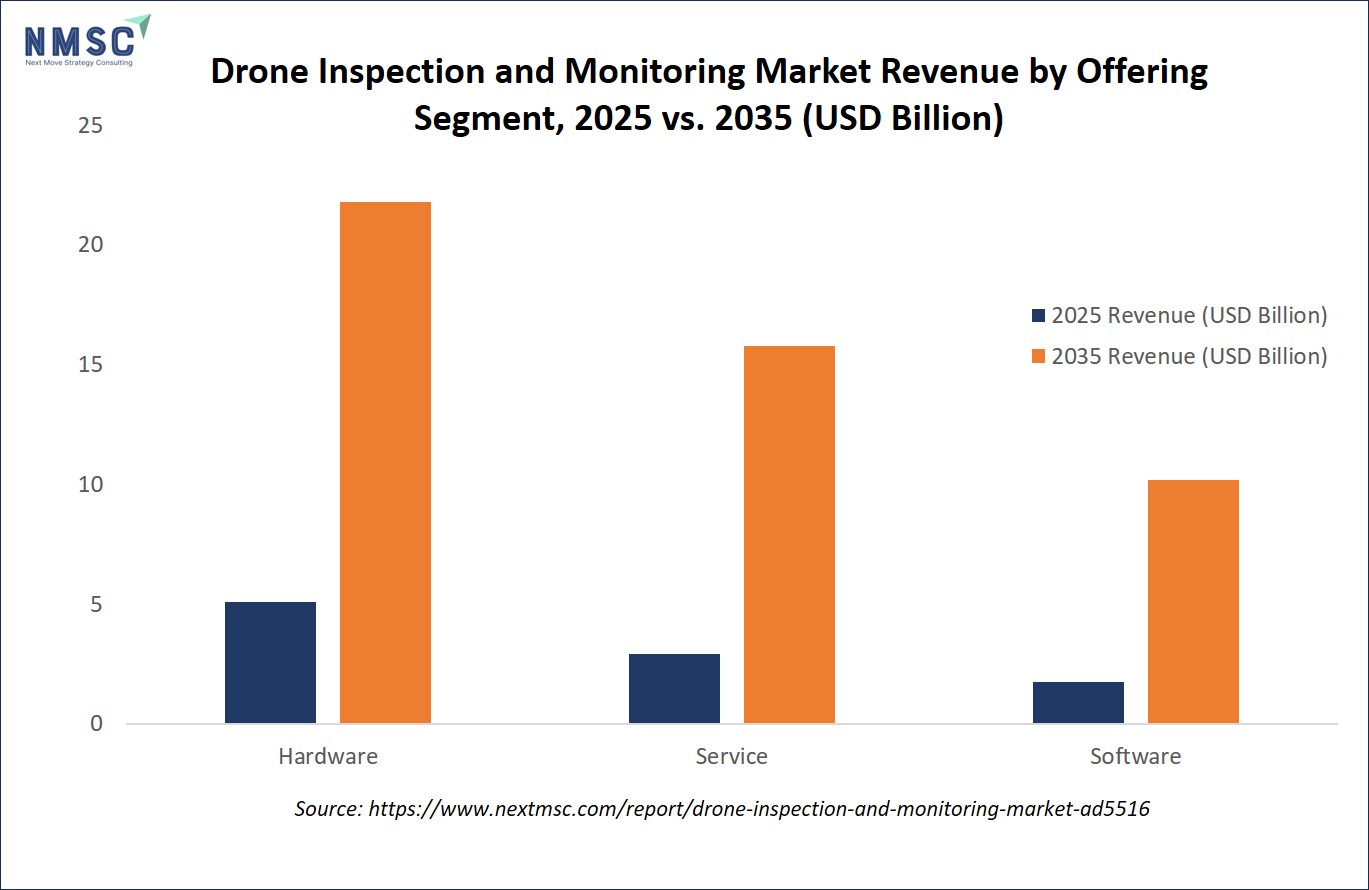
According to Next Move Strategy Consulting's Drone Inspection and Monitoring Market report, the global drone inspection and monitoring market was valued at USD 9.80 billion in 2025 and is estimated at USD 11.50 billion in 2026, projected to reach USD 47.80 billion by 2035, expanding at a compound annual growth rate of 17.2% between 2026 and 2035. North America leads with approximately 36% revenue share, while Hardware — encompassing drone platforms and sensor payloads — accounts for approximately 52% of 2025 revenue. The market's USD 36.30 billion absolute dollar opportunity between 2026 and 2035 is concentrated in three structural shifts: autonomous docking network deployment, AI-based defect detection software, and expanding BVLOS regulatory authorization — each of which is now being accelerated by the regulatory and commercial events of 2026.
For More Information: Download FREE Sample on Drone Inspection and Monitoring Market Report
Percepto's June 2026 Platform: From Data Collection to Asset Intelligence
The Percepto launch is not an incremental product update. The company's next-generation platform combines its Percepto Air drone hardware, inspection-grade onboard autonomy, contextual AI, and AIM asset intelligence software into a unified system designed to replicate how experienced inspectors evaluate assets in the field — knowing what to capture, how to capture it, and how findings connect to specific assets within an operator's infrastructure portfolio.
"The next phase of industrial autonomy is about unlocking more value from the infrastructure energy companies already operate," said Dor Abuhasira, CEO of Percepto, in the company's June 22, 2026 press release. "Percepto's next generation was built for exactly this moment, bringing expert inspection logic into autonomy so energy companies can capture the right data, understand it in context, and act with confidence at scale."
The commercial significance of this launch extends beyond a single product announcement. According to NextMSC primary research and analysis, utilities and energy operators are increasingly consolidating drone inspection programs around persistent, dock-based fleets rather than one-off contractor flights — a structural shift that favors vertically integrated hardware-software providers over single-service drone operators as recurring asset intelligence contracts scale through 2035. Percepto's platform is explicitly engineered for this model: its managed remote operations capability enables large-scale deployment at Fortune 500 organizations globally from day one, without requiring on-site pilot presence.
The platform's commercial timing is reinforced by a parallel regulatory development. In October 2025, the U.S. Environmental Protection Agency approved Percepto's autonomous optical gas imaging drone system — the Air Max OGI — as an Alternative Test Method under Subparts OOOOa and OOOOb of federal methane emissions regulations. The system detects emissions under 1 kilogram per hour, with field-proven performance down to 100 grams per hour at 90% reliability — validated through controlled testing at the METEC facility across more than 200 adjustable emission points and confirmed in real-world Permian Basin deployments. In one early deployment, operators identified more than 130 potential emission events in three months, saving more than 1,000 field work hours and redeploying two operators to other priority roles.
FAA Part 108: The Regulatory Architecture Behind Autonomous Inspection Scale
The commercial momentum behind Percepto's launch and the broader autonomous inspection market is structurally dependent on the FAA's proposed Part 108 rulemaking — the most consequential regulatory action in the history of U.S. commercial drone operations. Published in the Federal Register on August 7, 2025, the proposed rule would establish performance-based regulations enabling the design and operation of unmanned aircraft systems at low altitudes beyond visual line of sight, including UAS Traffic Management provisions for third-party services supporting these operations.
The FAA reopened the comment period on January 28, 2026, specifically to address unresolved questions on electronic conspicuity and right-of-way rules — areas where the original NPRM generated substantial industry disagreement. "FAA wants to ensure that it fully understands these comments and the relevant policy implications," stated Brandon Roberts, Executive Director of the FAA's Office of Rulemaking, in the January 28, 2026 Federal Register notice.
For the drone inspection and monitoring market, Part 108's finalization would convert the current waiver-by-waiver BVLOS authorization model into a scalable, performance-based framework — eliminating the site-specific approval bottleneck that currently constrains autonomous fleet deployment across pipeline corridors, transmission lines, and remote industrial facilities. According to NextMSC primary research and analysis, BVLOS regulatory expansion contributes an estimated +2.4% to the market's CAGR, making it the second-largest structural growth driver after rising utility and energy infrastructure inspection demand (+3.1%).
FCC Covered List: The Supply Chain Constraint Reshaping Hardware Procurement
While regulatory expansion is accelerating demand, a parallel regulatory action is compressing supply-side flexibility. On December 22, 2025, the Federal Communications Commission added all foreign-manufactured unmanned aircraft systems and foreign-produced UAS critical components to the FCC Covered List, prohibiting new FCC equipment authorizations for any foreign-made drone hardware on a prospective basis. The action was triggered by a National Security Determination received on December 21, 2025, finding that all foreign-manufactured UAS and UAS critical components pose a national security risk unless cleared by the U.S. Department of War or Department of Homeland Security.
The practical consequence for the inspection market is significant: utilities and government-linked operators with existing foreign-made drone fleets face a procurement migration timeline that is now being compressed by compliance mandates. Even minor hardware or firmware changes to foreign-made platforms after the Covered List addition may require new FCC equipment authorization — authorization that is no longer available for covered equipment — effectively blocking system updates and accelerating fleet replacement cycles toward domestically compliant platforms.
According to NextMSC primary research and analysis, this Covered List constraint carries an estimated −1.4% impact on the market's CAGR — the single largest restraint in the market's growth catalyst and risk assessment matrix — concentrated in North America, where government-linked utility contracts carry the most stringent hardware compliance requirements.
DroneDeploy and Skydio: Dock-Based Autonomy Enters Industrial Scale
The competitive landscape is simultaneously being reshaped by platform-level expansions from DroneDeploy and Skydio. In April 2026, DroneDeploy announced broader deployment of its Inspection AI capability, autonomous robotics integration, and dock-based drone inspection workflows across industrial facilities — extending its platform beyond mapping and construction into persistent, AI-analyzed industrial asset monitoring. The company's robotics missions had already grown 160% year over year, and its platform had surpassed 20 trillion square feet of visual site data, the largest visual dataset in construction.
Skydio's Dock for X10, which began shipping to early-access customers in January 2025, enables a single operator to manage multiple pre-positioned drones across substations and infrastructure sites — getting airborne in 20 seconds and operating remotely from any location. The system expanded to Japan in September 2025, broadening its geographic footprint into Asia-Pacific — the fastest-growing regional market in the NMSC forecast at a 21.7% CAGR from 2026 to 2035.
NMSC Strategic Perspective: The Structural Inflection Point
NextMSC primary research and analysis identifies 2026 as the year in which the drone inspection and monitoring market crosses from a project-based procurement model into a recurring-revenue infrastructure model. Three concurrent developments — Percepto's contextual AI platform launch, the FAA's Part 108 BVLOS rulemaking, and the FCC's Covered List hardware restrictions — are not independent events. They are converging forces that are simultaneously expanding the addressable market for autonomous inspection software while compressing the competitive window for foreign-hardware-dependent service providers.
The Software segment's 19.2% CAGR — the fastest among all offering categories — reflects this structural shift. As operators move from one-off contractor flights to persistent dock-based inspection programs, the recurring value migrates from the drone platform itself to the analytics layer that converts flight data into asset-level maintenance intelligence. Providers that can demonstrate contextual AI capability — connecting captured data to specific assets, prioritizing maintenance decisions, and supporting capital planning — are increasingly positioned to command premium pricing and long-term contract retention over commodity hardware suppliers.
The Public Safety and Emergency Response application segment's 24.4% CAGR — the fastest among all application categories — reflects a second structural shift: the expansion of BVLOS authorization into law enforcement, fire response, and border surveillance. As police and fire agencies deploy dock-based drones for rapid situational awareness, the inspection market's addressable base is expanding beyond industrial asset owners into government procurement channels that carry multi-year contract structures and higher switching costs.
NMSC's analysis indicates that the suppliers best positioned to capture above-market growth through 2035 are those combining NDAA-compliant hardware sourcing with vertically integrated analytics platforms and validated BVLOS regulatory credentials — a combination that currently describes a small number of providers, creating a meaningful first-mover advantage in utility and government request-for-proposal processes.
Application Segment Deep Dive: Energy Leads, Public Safety Accelerates
According to NextMSC primary research and analysis, Energy and Utilities Inspection remained the leading application within the market, valued at USD 2.55 billion in 2025, anchored by sustained transmission line, substation, and wind turbine inspection demand. The U.S. Federal Energy Regulatory Commission's continued emphasis on transmission reliability standards requires regular asset condition monitoring, sustaining utility demand for recurring drone-based inspection programs across North America and Europe.
Public Safety and Emergency Response is the fastest-growing application at a 24.4% CAGR from 2026 to 2035 — a trajectory directly linked to BVLOS waiver expansion enabling police, fire, and border agencies to deploy dock-based drones for rapid situational awareness. The Skydio Dock for X10's Drone as First Responder capability, which enables faster response times and situational awareness for public safety call response, exemplifies the hardware architecture driving this segment's above-market growth.
Oil and Gas Inspection, valued at USD 1.96 billion in 2025, is being structurally transformed by the EPA's October 2025 approval of autonomous OGI drones for federal methane emissions compliance — a regulatory milestone that converts drone inspection from an operational convenience into a compliance-mandated procurement category for upstream and midstream operators.
Competitive Landscape: Two Archetypes, One Structural Divide
According to NextMSC primary research and analysis, the drone inspection and monitoring market features a moderately fragmented competitive landscape organized around two dominant archetypes. Diversified hardware manufacturers — including SZ DJI Technology and Parrot — serve cost-sensitive service providers with broad platform portfolios. Specialized autonomous inspection providers — including Skydio and Percepto — compete on docking infrastructure and AI-based asset intelligence for utility and government customers requiring persistent, regulatory-compliant monitoring.
The FCC Covered List action of December 2025 is accelerating the divergence between these archetypes. Hardware manufacturers with significant foreign-production exposure face procurement migration pressure from government-linked utility customers, while domestically compliant autonomy providers are positioned to capture the resulting contract reallocation. Teledyne Technologies' acquisition of FLIR Systems — which broadened its thermal and inspection sensor payload portfolio — exemplifies the M&A logic of vertically integrating hardware and sensing capability to serve premium inspection contracts.
Investment capital is tracking this structural divide. Percepto's Series C funding round, led by Koch Disruptive Technologies and Zimmer Partners, brought its total funding raised to more than USD 139 million. Skydio's Series E round raised USD 230 million alongside its Remote Ops software launch. According to NextMSC primary research and analysis, investors favor providers demonstrating validated regulatory waivers as a proxy for long-term contract retention — a criterion that increasingly distinguishes fundable autonomy platforms from commodity hardware suppliers.
Bottom Line
The drone inspection and monitoring market is undergoing a structural transition in 2026 that is simultaneously expanding its addressable base and concentrating competitive advantage among a small number of vertically integrated providers. Percepto's June 2026 next-generation AI platform launch, the FAA's Part 108 BVLOS proposed rulemaking drawing over 900,000 public comments, the FCC's December 2025 Covered List expansion to all foreign-made drone hardware, and the EPA's October 2025 approval of autonomous OGI drones for federal methane compliance are not isolated events — they are converging forces reshaping sourcing criteria, contract structures, and investment theses across the market. According to NextMSC primary research and analysis, the global drone inspection and monitoring market is projected to expand from USD 11.50 billion in 2026 to USD 47.80 billion by 2035 at a 17.2% CAGR, generating a USD 36.30 billion absolute dollar opportunity concentrated in autonomous docking infrastructure, AI analytics software, and public safety drone programs. Suppliers that combine NDAA-compliant hardware sourcing with contextual AI analytics and validated BVLOS credentials are positioned to capture premium pricing and long-term contract retention — while those dependent on foreign hardware face an accelerating compliance migration timeline that is compressing their competitive window.
About Next Move Strategy Consulting
Next Move Strategy Consulting is a premier market research and management consulting firm that has been committed to provide strategically analysed well documented latest research reports to its clients. The research industry is flooded with many firms to choose from, what makes NMSC different from the rest is its top-quality research and the obsession of turning data into knowledge by dissecting every bit of it and providing fact-based research recommendation that is supported by information collected from over 500 million websites, paid databases, industry journals and one on one consultations with industry experts across a diverse range of industry sectors. The high-quality customized research reports with actionable insights and excellent end-to-end customer service help our clients to take critical business decisions that enables them to move beyond time and have competitive edge in the industry.
We have been servicing over 1000 customers globally that includes 90% of the Fortune 500 companies over a decade. Our analysts are constantly tracking various high growth markets and identifying hidden opportunities in each sector or the industry. We provide one of the industry's best quality syndicate as well as custom research reports across 10 different industry verticals. We are committed to deliver high quality research solutions in accordance to your business needs. Our industry standard delivery solutions that ranges from the pre consultation to after-sales services, provide an excellent client experience and ensure right strategic decision making for businesses.
For more information, please contact:
Next Move Strategy Consulting
5th Floor 867 Boylston St, STE 500,
Boston, MA 02116, U.S.
E-Mail: [email protected]
Direct: +1-217-650-7991
Website: www.nextmsc.com
About the Author
 Sanyukta Deb
— Sanyukta Deb is Digital Marketing Team Lead at Next Move Strategy Consulting, where she has led content strategy and technical SEO for the firm's B2B market research publications for over 2 years. Her editorial process translates NextMSC's primary and secondary research — spanning technology, industrial, and consumer sectors — into commercial narratives, backed by search-intent, keyword, and competitive analysis. She brings 5 years of overall experience in digital marketing and content strategy.
Sanyukta Deb
— Sanyukta Deb is Digital Marketing Team Lead at Next Move Strategy Consulting, where she has led content strategy and technical SEO for the firm's B2B market research publications for over 2 years. Her editorial process translates NextMSC's primary and secondary research — spanning technology, industrial, and consumer sectors — into commercial narratives, backed by search-intent, keyword, and competitive analysis. She brings 5 years of overall experience in digital marketing and content strategy.
About the Reviewer
 Debashree Dey
— Debashree Dey is Assistant Manager at Next Move Strategy Consulting, where she supports cross-vertical market content and communications across diverse industries for 6 years. Her professional background includes senior content writing, communications, and published manuscript authorship, with experience developing audience-focused business narratives and maintaining clear, consistent messaging. Her role supports research-led content development and editorial quality across NextMSC publications.
Debashree Dey
— Debashree Dey is Assistant Manager at Next Move Strategy Consulting, where she supports cross-vertical market content and communications across diverse industries for 6 years. Her professional background includes senior content writing, communications, and published manuscript authorship, with experience developing audience-focused business narratives and maintaining clear, consistent messaging. Her role supports research-led content development and editorial quality across NextMSC publications.

















Add Comment