Autonomous Underwater Vehicles Market: 7 Trends for 2026
Introduction
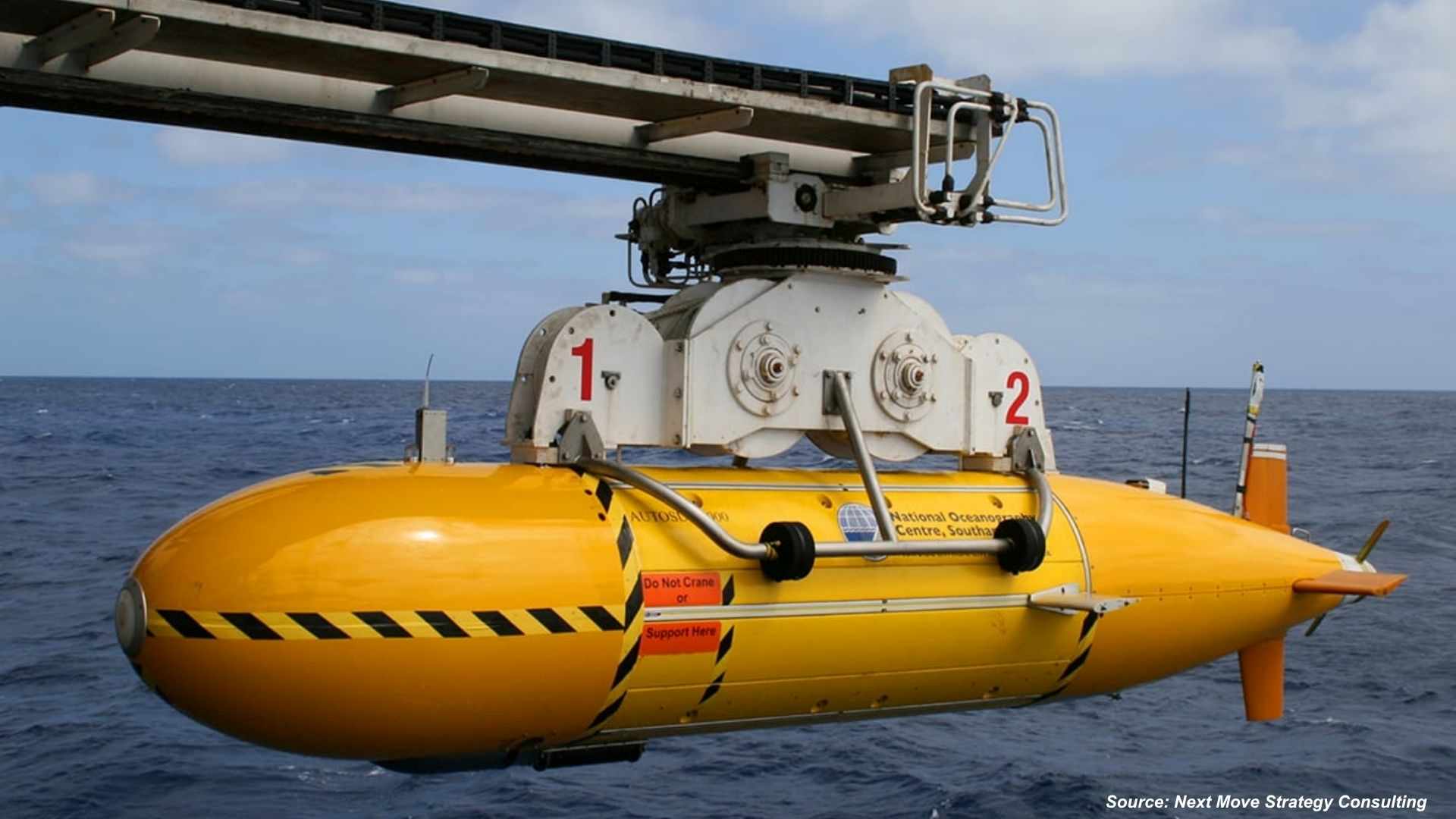
In July 2026, the U.S. Navy completed a 1,000 nautical mile autonomous transit across the East Pacific using its Boeing-built Orca Extra Large Uncrewed Undersea Vehicle (XLUUV) — a first in the program's history and a defining moment for the global autonomous underwater vehicles (AUVs) market. This milestone was not an isolated event. It arrived alongside NATO's deployment of unmanned underwater vehicles in the Baltic Sea, a USD 1.1 billion sovereign manufacturing contract in Australia, and accelerating offshore wind seabed survey demand across Europe and Asia-Pacific — all converging to reshape the competitive and strategic landscape of the autonomous underwater vehicles market.
The Autonomous Underwater Vehicles (AUVs) Market is no longer a niche defense technology segment. It has evolved into a multi-billion-dollar strategic asset class spanning naval modernization, subsea critical infrastructure protection, offshore energy inspection, and marine science. According to Next Move Strategy Consulting, the global AUVs market was valued at USD 3.85 billion in 2025 and is estimated at USD 4.30 billion in 2026, forecast to reach USD 14.20 billion by 2035, expanding at a 14.2% CAGR between 2026 and 2035. For C-level executives, institutional investors, and defense procurement leaders, understanding the structural forces behind this trajectory is no longer optional — it is a strategic imperative.
For More Information: Download FREE Sample on Autonomous Underwater Vehicles (AUVs) Market Report
7 Powerful Trends Driving the Autonomous Underwater Vehicles Market in 2026
1.The U.S. Navy's Pacific Milestone Signals a New Era of Long-Range AUV Operations
In August 2026, the U.S. Navy's Program Executive Office for Unmanned Small Combatants confirmed that the Orca XLUUV had completed its first-ever 1,000 nautical mile autonomous transit in the Pacific theater. Rear Admiral Chris Cavanaugh, Commander of the U.S. Submarine Force, Pacific Fleet, stated: "The Pacific Submarine Force is heavily investing in unmanned capabilities to augment our manned submarines and preserve our undersea advantage across the full spectrum of submarine operations."
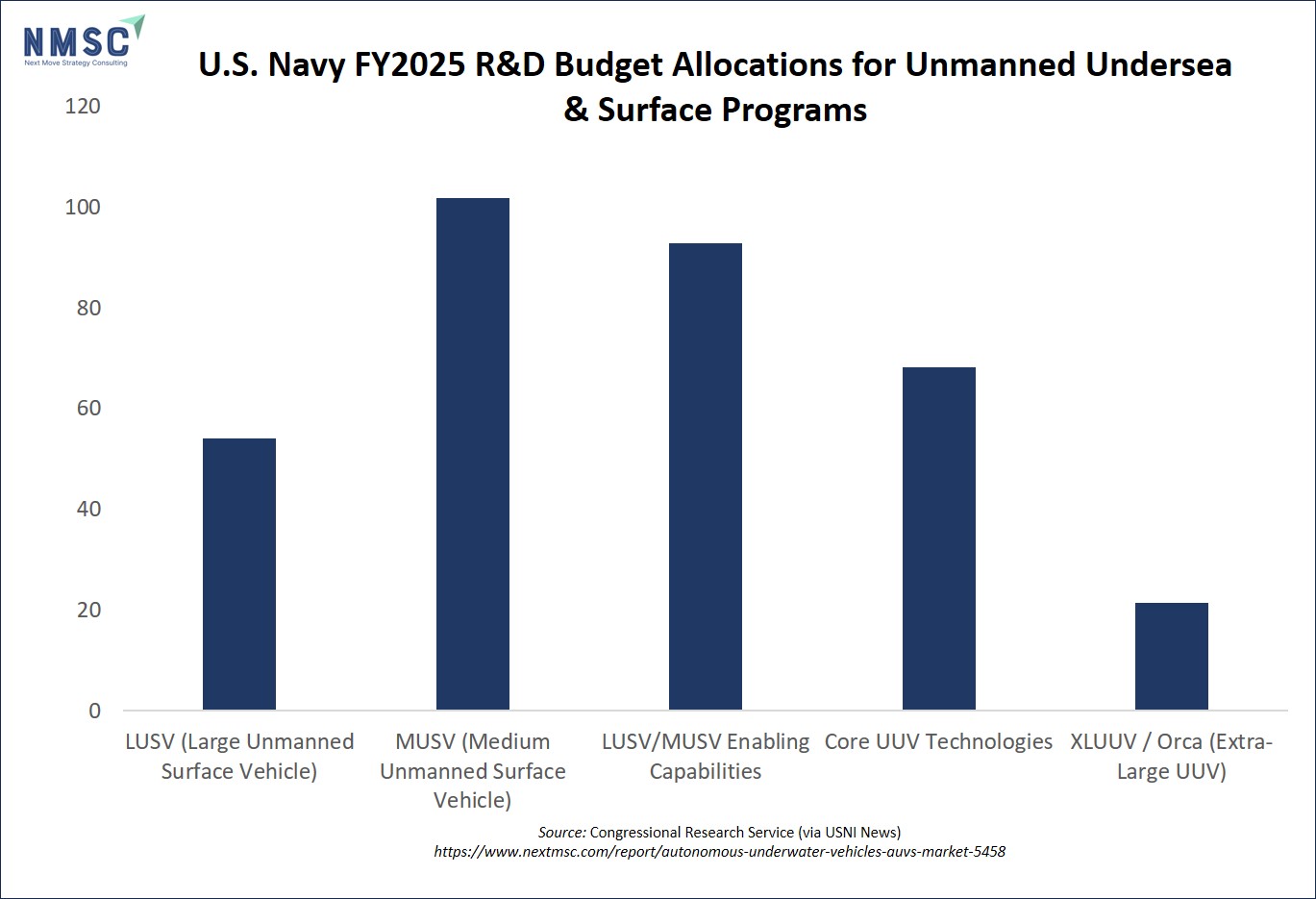
The Orca is designed for Intelligence, Surveillance, and Reconnaissance (ISR), mine warfare, seabed warfare, and expeditionary support missions. The vehicle is also being integrated with the Hunter payload module for advanced undersea payload delivery in contested environments, with DARPA's acquisition strategy to be formalized in late 2027 or early 2028. A Congressional Research Service report from March 2025 confirmed that the U.S. Navy's FY2025 budget allocated USD 21.5 million in R&D funding for the XLUUV program and an additional USD 68.2 million for core UUV technologies, with procurement of additional Orca units planned at approximately USD 113.3 million per unit in FY2026.
This operational validation is compressing traditional multi-year AUV acquisition timelines and accelerating the transition from prototype to program-of-record procurement across allied navies.
2.NATO's Baltic Sentry and Task Force X: Underwater Drones as Alliance Infrastructure
In January 2025, NATO launched Operation Baltic Sentry — a maritime surveillance and deterrence initiative designed to protect critical undersea infrastructure, including cables and pipelines, following a series of suspected sabotage incidents in the Baltic Sea. Simultaneously, NATO Allied Command Transformation (ACT) established Task Force X, deploying Uncrewed Underwater Vehicles (UUVs), Uncrewed Surface Vehicles (USVs), and Uncrewed Aerial Vehicles (UAVs) in an integrated maritime surveillance framework.
French Admiral Pierre Vandier, Supreme Allied Commander Transformation, noted that 70 manufacturers responded to the ACT call for tenders, with approximately EUR 15 million invested and 22 nations participating in the experimental phase. The UUV component of Task Force X is specifically tasked with silently patrolling beneath the waves to detect mines and submarines and defend undersea cables and pipelines — a mission profile that directly validates the strategic case for persistent AUV deployment at alliance scale.
3.Sovereign Manufacturing Mandates Are Restructuring the AUV Supply Chain
Government-backed domestic production requirements are fundamentally reshaping where AUV manufacturing capacity is built. Australia's Royal Australian Navy awarded Anduril Australia an approximately USD 1.1 billion program-of-record contract for Ghost Shark extra-large AUVs, with a dedicated Sydney manufacturing facility opened shortly thereafter. In July 2025, Kongsberg Discovery announced the establishment of domestic manufacturing capabilities for its HUGIN AUV series in the United States, expanding production at its Lynnwood, Washington facility to serve rising U.S. government, defense, and commercial market demands.
This trend is not limited to the Indo-Pacific. Across Europe, regional navies and energy operators are requiring domestic-content compliance as a condition of defense procurement, redirecting capital toward local platform and component sourcing.
4.AI-Enabled Autonomy Is Redefining Mission Capability
AI-enabled navigation and onboard object recognition are reducing AUV dependence on real-time links to surface support vessels, extending mission autonomy in communication-denied subsea environments. NOAA Ocean Exploration's Deployable Artificial Intelligence project has tested an onboard detector-and-agent imaging system on a long-range AUV, validating autonomous decision-making before fleet-scale deployment.
According to Next Move Strategy Consulting, AI-enabled autonomy is the fastest-growing autonomy segment at a 21.9% CAGR through 2035, driven by defense and research programs demonstrating autonomous object detection and classification that reduces dependence on pre-scripted missions and real-time human oversight.
5.Offshore Wind Expansion Is Creating a New AUV Service Economy
The offshore wind sector is emerging as one of the most structurally significant demand drivers for AUV survey and inspection services. AUVs and ROVs play critical roles in safe and efficient underwater surveys, pipeline inspections, and seabed evaluations in deepwater locations, with the offshore AUV and ROV market projected to expand from USD 3.73 billion in 2025 to USD 6.7 billion by 2030 at a 12.4% CAGR.
According to Next Move Strategy Consulting, renewable energy is the fastest-growing AUV application segment at a 22.5% CAGR through 2035, driven by expanding offshore wind farm seabed survey and inspection demand as installed offshore wind capacity continues to scale globally.
6.Modular Payload Integration Is Extending Platform Endurance and Flexibility
Modular sonar and battery payload integration is allowing existing AUV platforms to gain capability without full redesign, extending operational endurance and mission flexibility. Kraken Robotics has supplied synthetic aperture sonar and SeaPower battery systems for integration on Teledyne Marine's Gavia and SeaRaptor AUVs, demonstrating how stakeholders are decoupling sensor innovation from platform manufacturing. In March 2026, Teledyne Marine secured a major contract from the UK Royal Navy to deliver advanced AUVs, oceanographic gliders, and persistent profiling floats, enhancing long-endurance subsea data collection and Atlantic tactical operations.
7.Lean-Crewed Robotic Support Fleets Are Transforming Offshore Operating Models
Lean-crewed robotic support vessels are reducing the crewed-vessel cost burden associated with deploying and recovering AUVs on extended offshore missions. Ocean Infinity completed a fourteen-vessel Armada fleet of lean-crewed offshore support vessels designed to carry and deploy robotic survey systems, illustrating how operators are restructuring offshore operating models around vehicle fleets rather than traditional fully crewed research ships. In July 2026, Exail expanded its strategic partnership with KNDS to mass-produce advanced autonomous mine neutralization systems, combining robotics capabilities to accelerate the delivery of subsea defense solutions for naval forces.
NMSC Strategic Perspective: What These Trends Mean for Market Participants
Next Move Strategy Consulting's analysis indicates that the convergence of these seven trends is not cyclical — it reflects a structural realignment of how navies, energy operators, and infrastructure managers source and deploy subsea capability. The shift from pre-programmed waypoint navigation toward AI-enabled autonomy, combined with sovereign manufacturing investment and lean-crewed fleet operations, is redefining the competitive basis of the AUV industry. Manufacturers combining defense-grade endurance with commercial-survey payload flexibility are best positioned to capture demand across both dual-use customer bases through 2035. Investors evaluating the space should weigh program-of-record concentration among a small number of defense customers, which limits revenue diversification relative to broader industrial robotics categories, while recognizing that the absolute dollar opportunity of USD 9.90 billion between 2026 and 2035 is structurally supported by simultaneous demand from three independent end-use sectors.
Section Summary: The autonomous underwater vehicles market is being reshaped by seven concurrent structural forces — from the U.S. Navy's Pacific operational milestones to NATO's Baltic surveillance deployments, sovereign manufacturing mandates, AI-enabled autonomy, offshore wind demand, modular payload innovation, and lean-crewed fleet models.
Key Takeaways:
-
The U.S. Navy's Orca XLUUV completed a 1,000 nautical mile autonomous Pacific transit in July 2026, validating long-range AUV operational capability at scale.
-
NATO's Task Force X deployed UUVs in the Baltic Sea under Operation Baltic Sentry, with 70 manufacturers and 22 nations participating in the experimental phase.
-
Sovereign manufacturing mandates are redirecting AUV production capacity to Australia, the U.S., and Europe, converting single-program contracts into sustained domestic industrial capacity.
-
AI-enabled autonomy is the fastest-growing autonomy segment at 21.9% CAGR, while renewable energy is the fastest-growing application at 22.5% CAGR through 2035.
Industry Impact Analysis
Defense Procurement Acceleration and the Distributed Fleet Doctrine
The U.S. Navy's strategic rationale for investing in XLUUVs and large unmanned undersea vehicles is explicitly tied to a distributed fleet architecture — spreading capability across a greater number of platforms to avoid concentrating strategic assets in a small number of high-value ships. This doctrine is directly translating into accelerated procurement timelines. The U.S. Department of Defense's Defense Innovation Unit awarded a 24-month frame contract for large-displacement unmanned underwater vehicles, under which Kongsberg Discovery delivered its first HUGIN Superior AUV within a single year — compressing what were previously multi-year acquisition cycles.
Subsea Infrastructure Protection: A New Regulatory and Commercial Imperative
The suspected sabotage of Baltic Sea undersea cables and pipelines in 2024 and early 2025 triggered a fundamental reassessment of subsea infrastructure vulnerability across NATO member states. This has translated into rising subsea critical-infrastructure protection mandates that Next Move Strategy Consulting estimates contribute an additional +1.5% impact on AUV market CAGR, particularly across Europe and North America through 2032.
Infrastructure operators managing subsea cables and pipelines are increasingly evaluating AI-enabled AUV fleets capable of autonomous, recurring inspection without dedicated support-vessel mobilization — a shift that could substantially lower the cost of continuous infrastructure monitoring relative to periodic crewed inspection campaigns.
Offshore Energy: Tariffs, Localization, and the AUV Supply Chain
Trade dynamics and tariffs on electronic components and specialty metals are influencing AUV production and integration costs, particularly in the manufacturing of heavyweight deepwater platforms. These pressures are driving localization efforts, encouraging regional sourcing and domestic technology investments. For commercial operators in the oil and gas sector, AUVs are increasingly preferred over ROVs for large-area survey and mapping operations, with the market showing a clear shift toward modular, multi-mission payload architectures and service-based leasing models for subsea robotics.
Export Controls and Regulatory Complexity
U.S. export-control classifications on dual-use autonomous underwater technology and International Maritime Organization guidance on autonomous maritime systems shape cross-border deployment and technology transfer. Next Move Strategy Consulting estimates that export-control restrictions on dual-use underwater technology restrain CAGR by approximately 0.5 percentage points, particularly affecting North American and European manufacturers seeking to expand into Middle Eastern and Asia-Pacific markets.
Section Summary: The AUV industry impact is being shaped by four converging forces: accelerated defense procurement under distributed fleet doctrine, rising subsea infrastructure protection mandates, offshore energy localization pressures, and export-control regulatory complexity.
Key Takeaways:
The U.S. Navy's distributed fleet doctrine is compressing AUV acquisition timelines from multi-year cycles to single-year delivery, as demonstrated by Kongsberg Discovery's HUGIN Superior delivery under a Defense Innovation Unit contract.
NATO's Baltic Sentry has elevated subsea infrastructure protection from a niche concern to a core alliance priority, directly expanding AUV demand across European navies and infrastructure operators.
Tariff pressures on electronic components and specialty metals are accelerating AUV supply chain localization, creating new domestic manufacturing opportunities in Asia-Pacific and Europe.
Export-control restrictions on dual-use AUV technology represent a manageable but real constraint on cross-border market expansion, estimated to restrain CAGR by approximately 0.5 percentage points.
Pros and Cons of Recent Market Developments
|
Recent Development |
Pros |
Cons |
|
U.S. Navy Orca XLUUV 1,000-mile Pacific transit |
Validates long-range autonomous capability; accelerates program-of-record procurement; attracts allied navy investment |
High per-unit cost (~USD 113M); program concentration risk among a small number of defense primes |
|
NATO Baltic Sentry / Task Force X deployment |
Creates sustained demand for persistent UUV surveillance; validates multi-domain autonomous integration; opens EUR 15M+ procurement pipeline |
Experimental phase limits near-term commercial revenue; interoperability standards across 22 nations remain complex |
|
Australia Ghost Shark sovereign manufacturing program |
USD 1.1B program-of-record provides multi-year revenue certainty; establishes domestic industrial base; catalyzes regional supply chain |
Domestic-content requirements restrict international supplier participation; qualification timelines for new entrants remain extended |
|
AI-enabled autonomy adoption |
Reduces surface support vessel dependency; lowers total mission cost; enables communication-denied operations |
Subsea communication bandwidth limitations constrain real-time autonomy; cybersecurity and autonomous decision-making governance remain evolving |
|
Offshore wind AUV survey demand growth |
Diversifies AUV revenue beyond defense; creates recurring inspection service contracts; supports ESG-aligned investment narratives |
Regional service capacity gaps require upfront infrastructure investment; mobilization costs from distant bases remain elevated |
|
Modular payload architectures |
Extends platform lifecycle; enables multi-mission flexibility; reduces per-mission hardware cost |
Payload-agnostic design increases integration complexity; proprietary legacy systems create switching barriers for established operators |
|
Lean-crewed robotic support fleet models |
Reduces offshore personnel exposure; lowers crewed-vessel operating costs; enables persistent AUV deployment |
Regulatory frameworks for lean-crewed vessels remain inconsistent across jurisdictions; remote monitoring infrastructure requires significant capital investment |
Key Data & Statistics
Future Outlook & Forecast
Market Size and CAGR: A USD 14.20 Billion Opportunity by 2035
According to Next Move Strategy Consulting, the global autonomous underwater vehicles (AUVs) market is estimated at USD 4.30 billion in 2026 and is forecast to reach USD 14.20 billion by 2035, expanding at a 14.2% CAGR. The market is expected to create an absolute dollar opportunity of USD 9.90 billion between 2026 and 2035, presenting significant investment potential across defense mine-countermeasure programs, offshore wind seabed survey, and subsea critical-infrastructure protection.
Three Structural Growth Pathways Through 2035
-
Naval Mine-Countermeasure Modernization: Defense & Security remains the dominant application at approximately 42% market share in 2025, with North America leading at approximately 38% regional share. The U.S. leads country-level demand at approximately USD 1.20 billion in 2025, projected to reach USD 3.84 billion by 2035 at a 12.4% CAGR.
-
Offshore Wind Seabed Survey: Renewable energy is the fastest-growing application at 22.5% CAGR, driven by expanding offshore wind farm development across Europe and Asia-Pacific. Europe's market is shaped by expanding offshore wind farm development and subsea critical-infrastructure protection mandates, with regional navies and energy operators as early adopters of AI-enabled autonomy for persistent infrastructure monitoring.
-
Subsea Critical Infrastructure Protection: Infrastructure Operators is the fastest-growing end-user segment at 22.5% CAGR through 2035, reflecting the structural shift toward persistent autonomous monitoring of subsea cables and pipelines rather than periodic crewed inspection campaigns.
Regional Spotlight: Australia and the Middle East & Africa
Australia is the fastest-growing country in the AUV market at a 23.7% CAGR, driven by the Royal Australian Navy's sovereign extra-large AUV production program. The market is projected to grow from approximately USD 0.09 billion in 2025 to approximately USD 0.68 billion by 2035. The Middle East & Africa region is the fastest-growing region at 17.9% CAGR, expanding from USD 0.23 billion in 2025 to USD 1.14 billion by 2035, driven by Gulf state investment in maritime security and offshore energy infrastructure protection.
Key Risks to Monitor
Export-control classification changes affecting cross-border transfer of dual-use autonomous underwater technology, program-timing risk tied to national defense budget cycles, and subsea communication bandwidth limitations represent the primary structural constraints on market growth through 2035.
Section Summary: The autonomous underwater vehicles market is on a structurally positive long-term trajectory, with three simultaneous demand drivers — naval modernization, offshore wind, and subsea infrastructure protection — sustaining above-average CAGR through 2035.
Key Takeaways:
-
The global AUV market is forecast to reach USD 14.20 billion by 2035 at a 14.2% CAGR, creating an absolute dollar opportunity of USD 9.90 billion between 2026 and 2035.
-
AI-enabled autonomy (21.9% CAGR), renewable energy applications (22.5% CAGR), and infrastructure operator end-users (22.5% CAGR) are the three fastest-growing segments, each growing well above the market average.
-
Australia (23.7% CAGR) and the Middle East & Africa region (17.9% CAGR) represent the highest-growth geographic opportunities through 2035.
-
Export-control restrictions and subsea communication bandwidth limitations are the primary structural constraints requiring active monitoring by market participants.
Next Steps for Stakeholders
For Defense Procurement Leaders and Naval Commanders:
Prioritize program-of-record contracts that include domestic manufacturing requirements, as sovereign-content mandates are increasingly determining program eligibility ahead of pure technical differentiation. Evaluate AI-enabled autonomy integration roadmaps for existing AUV fleets to reduce surface support vessel dependency and extend mission endurance in communication-denied environments. The U.S. Navy's Orca XLUUV Pacific transit and NATO's Task Force X deployment provide validated operational frameworks for accelerating fleet-scale adoption.
For C-Level Executives in Offshore Energy and Infrastructure:
Assess the total cost of ownership differential between persistent AI-enabled AUV monitoring and periodic crewed inspection campaigns for subsea cable and pipeline assets. Localize AUV survey and inspection service capacity near expanding offshore wind clusters in Europe and Asia-Pacific to reduce mobilization costs and capture recurring inspection contract revenue ahead of installed capacity growth.
For Institutional Investors and Private Equity:
Capital inflows should concentrate on AI-enabled autonomy software, extra-large platform manufacturing capacity, and modular sonar and battery subsystems — the three segments commanding above-average CAGR through 2035. Evaluate sovereign manufacturing facility investments in Asia-Pacific and Europe, where government-backed demand guarantees are providing multi-year revenue certainty. Weigh program-of-record concentration risk among a small number of defense customers when assessing portfolio diversification relative to broader industrial robotics categories.
For Platform Manufacturers and Technology Vendors:
Invest in payload-agnostic platform design to capture disproportionate share of both defense and commercial survey applications. Establish regional operating hubs near offshore wind clusters before installed capacity growth drives mobilization cost competition. Align product roadmaps with the three highest-CAGR pathways: naval mine-countermeasure modernization, offshore wind seabed survey, and subsea critical-infrastructure protection.
Conclusion
The autonomous underwater vehicles (AUVs) market has entered a period of structural acceleration that is simultaneously driven by geopolitical imperatives, energy transition demands, and technological maturation. The U.S. Navy's 1,000-mile Orca XLUUV Pacific transit, NATO's Baltic Sentry UUV deployments, Australia's USD 1.1 billion Ghost Shark sovereign manufacturing program, and the rapid scaling of offshore wind seabed survey demand are not isolated events — they are converging signals of a market undergoing fundamental transformation.
According to Next Move Strategy Consulting, the global AUV market is forecast to expand from USD 4.30 billion in 2026 to USD 14.20 billion by 2035 at a 14.2% CAGR, with AI-enabled autonomy, renewable energy applications, and infrastructure protection emerging as the highest-growth segments. For defense procurement leaders, offshore energy operators, and institutional investors, the strategic window to position ahead of this demand curve is open — but it will not remain so indefinitely. Manufacturers, operators, and capital allocators who align with sovereign manufacturing mandates, AI-enabled platform roadmaps, and offshore wind service localization will be best positioned to capture the USD 9.90 billion absolute dollar opportunity that the autonomous underwater vehicles market is set to deliver through 2035.
About the Author
 Sanyukta Deb
— Sanyukta Deb is Digital Marketing Team Lead at Next Move Strategy Consulting, where she has led content strategy and technical SEO for the firm's B2B market research publications for over 2 years. Her editorial process translates NextMSC's primary and secondary research — spanning technology, industrial, and consumer sectors — into commercial narratives, backed by search-intent, keyword, and competitive analysis. She brings 5 years of overall experience in digital marketing and content strategy.
Sanyukta Deb
— Sanyukta Deb is Digital Marketing Team Lead at Next Move Strategy Consulting, where she has led content strategy and technical SEO for the firm's B2B market research publications for over 2 years. Her editorial process translates NextMSC's primary and secondary research — spanning technology, industrial, and consumer sectors — into commercial narratives, backed by search-intent, keyword, and competitive analysis. She brings 5 years of overall experience in digital marketing and content strategy.
About the Reviewer
 Debashree Dey
— Debashree Dey is Assistant Manager at Next Move Strategy Consulting, where she supports cross-vertical market content and communications across diverse industries for 6 years. Her professional background includes senior content writing, communications, and published manuscript authorship, with experience developing audience-focused business narratives and maintaining clear, consistent messaging. Her role supports research-led content development and editorial quality across NextMSC publications.
Debashree Dey
— Debashree Dey is Assistant Manager at Next Move Strategy Consulting, where she supports cross-vertical market content and communications across diverse industries for 6 years. Her professional background includes senior content writing, communications, and published manuscript authorship, with experience developing audience-focused business narratives and maintaining clear, consistent messaging. Her role supports research-led content development and editorial quality across NextMSC publications.















Add Comment