Dairy Free Food Market Statistics, Trends & Forecasts for 2026
Introduction
The global food industry is undergoing one of its most consequential structural shifts in decades, and the dairy free food market sits at the center of it. What was once a niche category catering to lactose-intolerant consumers and committed vegans has evolved into a mainstream dietary segment attracting flexitarians, health-conscious professionals, and sustainability-driven institutional buyers alike. From oat milk on café menus to precision-fermented dairy proteins in premium ice cream, the breadth and sophistication of dairy-free innovation have reached a scale that demands serious strategic attention.
According to Next Move Strategy Consulting (NMSC), the global Dairy Free Food Market is projected to reach USD 67.55 billion by 2030, registering a CAGR of 10.3% from 2025 to 2030. This trajectory is not incidental. It is being shaped by converging forces: regulatory reform, evolving consumer values, institutional procurement shifts, and a wave of product innovation that is redefining what dairy-free can deliver in terms of taste, nutrition, and functionality. For C-level executives and institutional investors, understanding the structural drivers behind this growth is no longer optional — it is a prerequisite for competitive positioning.
For More Information: Download FREE Sample on Dairy Free Food Market Report
Regulatory Disruption and Institutional Momentum: The Forces Reshaping the Dairy Free Food Market
The FDA Labeling Debate and the Return of the Dairy Pride Act
One of the most consequential regulatory developments affecting the dairy free food market in 2025 has been the renewed legislative push around product labeling. In January 2025, the U.S. Food and Drug Administration released a draft guidance document recommending best practices for naming and labeling plant-based alternatives to animal-derived foods, including dairy. The guidance recommended that plant-based milk brands voluntarily include a nutrition statement highlighting differences in nutrient composition compared to conventional dairy milk, enabling consumers to make more informed dietary choices.
Critically, the FDA stopped short of mandating that plant-based alternatives abandon dairy descriptors such as "milk," "yogurt," or "cheese." The agency's own consumer research, drawn from over 13,000 public comments and multiple focus group studies, confirmed that consumers generally understand that plant-based milk alternatives do not contain conventional dairy.
However, the regulatory environment grew more complex in mid-2025 when the Dairy Pride Act was reintroduced in the U.S. Senate by a bipartisan coalition comprising Senators Peter Welch, Tammy Baldwin, Jim Risch, and Susan Collins. The bill seeks to prohibit the use of dairy descriptors on any product not derived from a hooved animal, and if enacted, would require the FDA to issue enforcement guidance within 90 days. The bill's prospects remain uncertain, particularly given the FDA's current operational constraints and staffing reductions, but its reintroduction signals a sustained political pressure point that dairy-free manufacturers must monitor closely.
Simultaneously, the broader political climate — shaped in part by the Make America Healthy Again (MAHA) initiative championed by U.S. Health Secretary Robert F. Kennedy Jr. — has elevated traditional dairy as a nutritional cornerstone, creating a more contested regulatory environment for plant-based alternatives.
USDA WIC Program Reform: A Structural Institutional Gateway
Counterbalancing the labeling debate is a landmark institutional development that has materially expanded the addressable market for dairy-free producers. In April 2024, the U.S. Department of Agriculture revised its Special Supplemental Nutrition Program for Women, Infants, and Children (WIC) to permit fortified plant-based milk, yogurt, and cheese alternatives that meet specific nutrient standards to substitute for conventional dairy items. This program serves nearly seven million beneficiaries across the United States.
This policy shift represents more than regulatory recognition — it signals growing institutional confidence in the nutritional adequacy of fortified plant-based formulations and opens a stable, government-supported distribution channel for compliant brands.
NMSC Strategic Perspective: Navigating the Dual Regulatory Landscape
From NMSC's analytical standpoint, the current regulatory environment presents a dual dynamic that companies in the dairy free food market must navigate with precision. On one hand, the FDA's labeling guidance and the Dairy Pride Act create compliance uncertainty that could increase operational costs and require reformulation or relabeling investments. On the other hand, the USDA WIC program revision and the EU's broader agricultural sustainability agenda are actively expanding institutional demand for fortified, plant-based alternatives.
NMSC's assessment is that companies best positioned to capitalize on this environment are those that proactively align their product formulations with evolving federal nutrient standards, invest in transparent and scientifically validated nutrition labeling, and engage directly with state-level procurement programs. Brands that treat regulatory compliance as a strategic asset — rather than a compliance burden — will gain preferential access to institutional channels and strengthen their credibility with mainstream retail partners. The regulatory headwinds are real, but they are navigable for companies with robust quality infrastructure and proactive stakeholder engagement strategies.
Section Summary: The dairy free food market is operating within a rapidly evolving regulatory environment defined by the FDA's January 2025 labeling draft guidance, the reintroduction of the Dairy Pride Act in mid-2025, and the landmark USDA WIC program revision that opened institutional procurement channels to fortified plant-based alternatives.
Key Takeaways:
-
The FDA's January 2025 draft guidance recommends voluntary nutrition labeling for plant-based milk alternatives but does not mandate removal of dairy descriptors.
-
The Dairy Pride Act, reintroduced in mid-2025, seeks to restrict dairy terminology on plant-based products and could require FDA enforcement action within 90 days if enacted.
-
The USDA WIC program revision (April 2024) has opened a government-supported distribution channel serving nearly seven million beneficiaries to compliant dairy-free brands.
-
Companies that align product formulations with federal nutrient standards and invest in transparent labeling are best positioned to capture institutional procurement opportunities.
Industry Impact Analysis
European Market Dynamics: Price Competitiveness Drives Mainstream Adoption
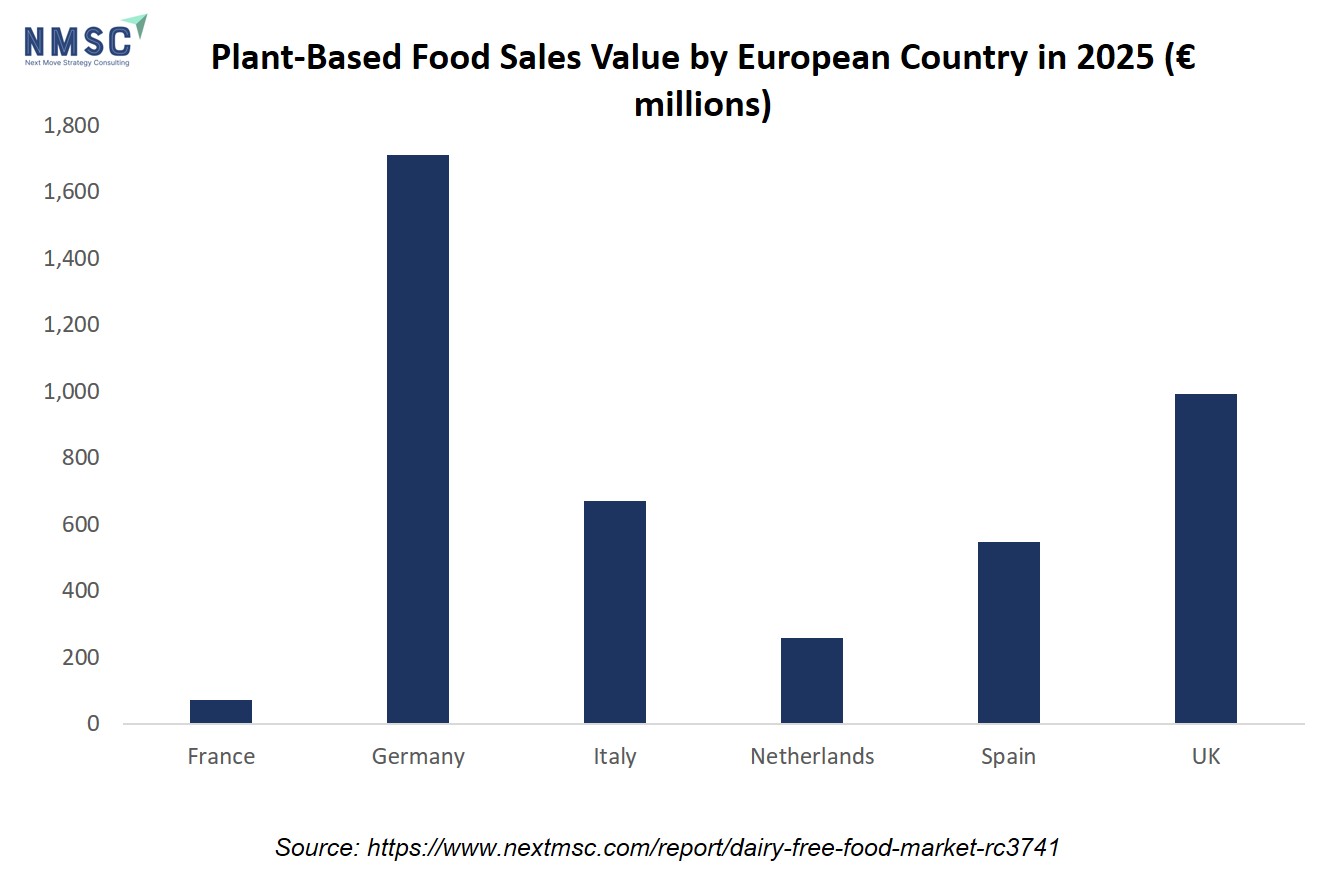
The European plant-based food market provides some of the most instructive data points for understanding the structural conditions that enable dairy-free products to achieve mainstream penetration. According to GFI Europe's analysis of Circana retail sales data across six major European markets, Germany remains the continent's largest plant-based food market, with total sales across six categories reaching €1.71 billion in 2025, up 6.2% in volume year-on-year.
France demonstrated particularly strong momentum, with plant-based food sales growing 13% in volume in 2025 to reach €572 million, driven by a 16.8% volume increase in plant-based meat and a 14.8% volume increase in plant-based milk and drinks. Spain's market reached €546 million in 2025, with plant-based milk purchased by nearly half (47.6%) of Spanish households — a penetration rate that reflects the category's transition from specialty to staple.
The data reveals a consistent pattern across European markets: price competitiveness is the primary determinant of volume growth. In Spain, plant-based milk's success is directly attributable to its low price premium — private-label options cost just 7% more per litre than conventional dairy milk. In Italy, falling prices for plant-based meat and milk drove simultaneous volume growth across both categories.
U.S. Market: Structural Maturity and Category Divergence
The U.S. plant-based retail market reached $7.9 billion in 2025, according to GFI's analysis of SPINS retail sales data — more than double the $3.9 billion recorded in 2017. However, the market's maturation has introduced category divergence that demands nuanced strategic interpretation.
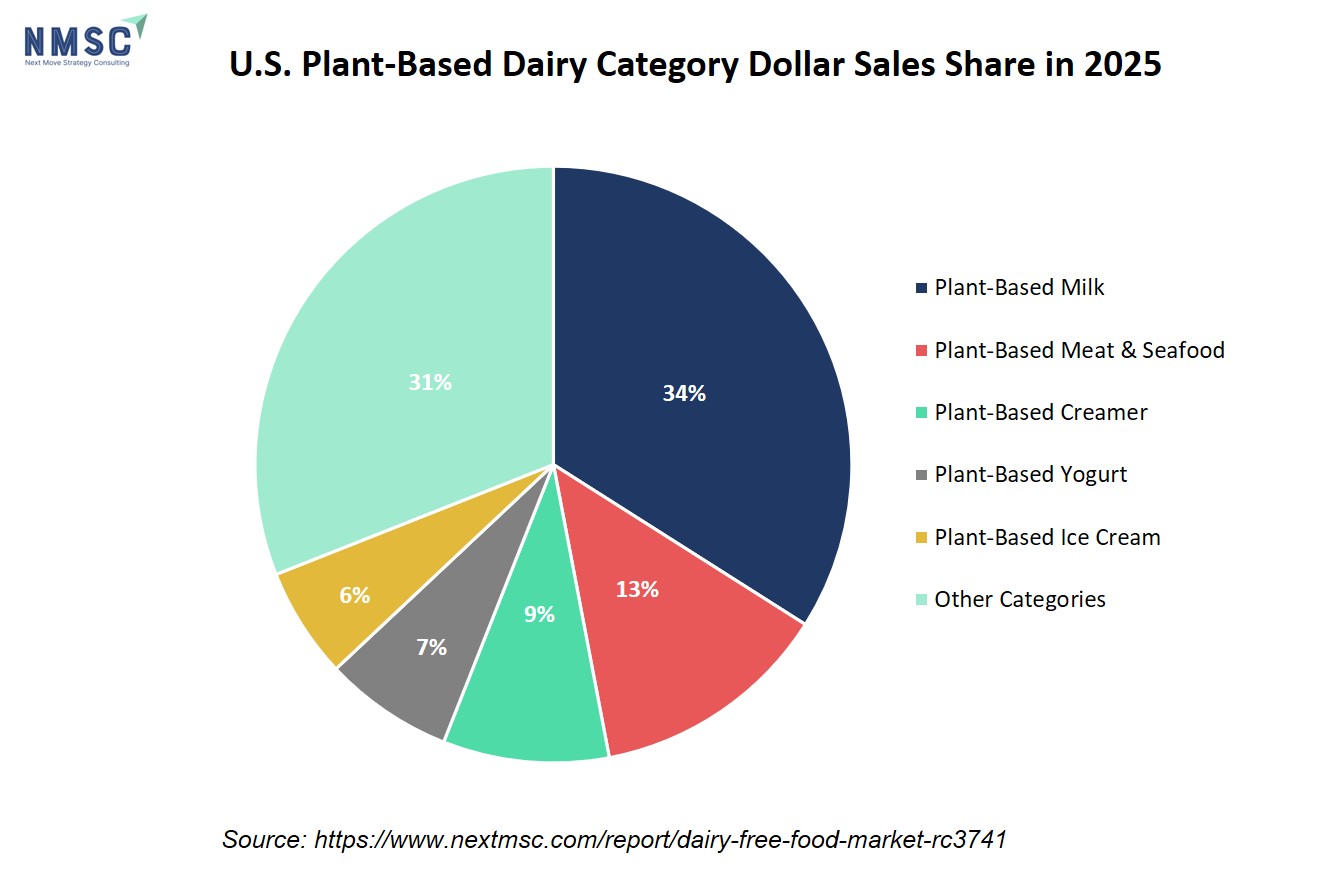
Plant-based milk remains the dominant category at $2.7 billion in dollar sales, holding a 13% share of total milk dollar sales in 2025. Household penetration for plant-based milk stood at 38%, with 75% of purchasing households buying more than once — a repeat rate that signals habitual consumption rather than trial behavior.
Meanwhile, several adjacent categories demonstrated robust growth. Plant-based yogurt recorded 7% dollar sales growth in 2025, driven by consumer interest in protein and gut health benefits. Plant-based bars achieved the highest dollar sales growth of any tracked category at 16%, reflecting consumer demand for convenient, plant-based nutrition formats. Plant-based ready-to-drink beverages also experienced double-digit growth, building on 3% growth in 2024.
The demographic profile of plant-based food buyers in the U.S. is instructive for brand positioning: households aged 35–44, those with incomes exceeding $100,000, and post-college-educated consumers overindex significantly on plant-based food spending.
Sustainability as a Competitive Differentiator
Environmental positioning has become a material competitive advantage in the dairy free food market. Research published in MDPI indicates that a standard 250 mL serving of plant-based beverages produces 59% to 71% fewer greenhouse gas emissions than conventional milk, reinforcing the category's value proposition in climate-conscious procurement and consumer decision-making.
The UK Government's recent recognition of alternative proteins as a "major opportunity" within its Good Food Cycle strategy, and the EU's broader agricultural sustainability agenda, are creating policy tailwinds that favor brands with verified, low-carbon supply chains.
Section Summary: The dairy free food market is experiencing category-level divergence, with plant-based milk maintaining dominant market share while adjacent categories such as yogurt, bars, and ready-to-drink beverages demonstrate accelerating growth. European markets confirm that price competitiveness is the primary driver of mainstream adoption, while sustainability credentials are emerging as a structural competitive differentiator.
Key Takeaways:
-
Germany is Europe's largest plant-based food market at €1.71 billion in 2025; France recorded 13% volume growth, the strongest among tracked European markets.
-
U.S. plant-based milk holds a 13% share of total milk dollar sales, with 38% household penetration and a 75% repeat purchase rate.
-
Plant-based bars recorded 16% dollar sales growth in the U.S. in 2025 — the highest growth rate of any tracked plant-based category.
-
Plant-based beverages produce 59%–71% fewer greenhouse gas emissions per serving than conventional milk, strengthening the category's ESG positioning.
U.S. Plant-Based Dairy Category Performance (2025)
|
Category |
2025 Dollar Sales |
Dollar Sales Change (YoY) |
Household Penetration |
Repeat Purchase Rate |
|
Plant-Based Milk |
$2.7 Billion |
-2% |
38% |
75% |
|
Plant-Based Creamer |
N/A (3rd largest category) |
+2% |
14% |
65% |
|
Plant-Based Yogurt |
N/A |
+7% |
7% |
57% |
|
Plant-Based Butter |
N/A |
-4% |
10% |
48% |
|
Plant-Based Cheese |
N/A |
-10% |
4% |
52% |
|
Plant-Based Ice Cream |
N/A |
Declined |
9% |
52% |
|
Plant-Based Bars |
N/A |
+16% |
N/A |
N/A |
Future Outlook & Forecast
NMSC Market Forecast: A Decade of Structural Expansion
According to NMSC's proprietary analysis, the global dairy free food market is projected to expand from USD 41.38 billion in 2025 to USD 67.55 billion by 2030, at a CAGR of 10.3%. This growth trajectory is underpinned by four structural pillars: rising health consciousness and lactose intolerance awareness, expanding institutional procurement channels, accelerating product innovation across premium and functional segments, and the growing alignment between plant-based nutrition and global sustainability mandates.
The Asia-Pacific region represents a particularly compelling growth frontier. India's dairy free food market is supported by a structural demand driver that few other markets can match: according to the India Brand Equity Foundation, nearly 60% of the Indian population experiences some level of lactose intolerance, creating an inherent consumer base for plant-based alternatives. Across the broader Asia-Pacific region, urbanization, rising disposable incomes, and the cultural compatibility of soy, coconut, and rice-based ingredients are accelerating market development.
In Europe, GFI Europe's analysis projects that the EU's plant-based market could be worth €45.5 billion by 2040, supporting 350,000 jobs, provided that policymakers and industry invest in the research and infrastructure needed to improve taste and reduce price premiums.
Innovation Trajectories Defining the Next Phase of Growth
The next phase of dairy free food market growth will be defined by three innovation trajectories. First, precision fermentation and bioprocessing — exemplified by Perfect Day's partnership with Breyers to launch a lactose-free chocolate ice cream using animal-free dairy proteins (February 2024) — is enabling plant-based products to replicate the functional and sensory properties of conventional dairy with unprecedented fidelity.
Second, strategic co-branding and channel partnerships are accelerating market penetration. Oatly's January 2025 partnership with Nespresso to launch a limited-edition oat milk coffee capsule line for Nespresso Vertuo machines demonstrates how dairy-free brands can leverage established consumer ecosystems to reach new segments without bearing the full cost of market development.
Third, nutritional fortification and clean-label positioning are becoming non-negotiable competitive requirements. The UK's Scientific Advisory Committee on Nutrition has highlighted that almond, oat, and soy drinks currently available in the market do not match cow's milk in key nutrients such as vitamin A, iodine, riboflavin, and protein — a finding that has intensified regulatory scrutiny and raised consumer concerns, particularly in sensitive categories such as early childhood nutrition. Companies that invest in advanced fortification and third-party nutritional validation will be best positioned to capture institutional procurement and premium retail opportunities.
Key Takeaways:
-
NMSC projects the global dairy free food market will reach USD 67.55 billion by 2030 at a CAGR of 10.3% from 2025 to 2030.
-
India's market is structurally supported by a ~60% lactose intolerance prevalence rate among the population.
-
GFI Europe projects the EU plant-based market could reach €45.5 billion by 2040, supporting 350,000 jobs.
-
Precision fermentation, strategic co-branding partnerships, and advanced nutritional fortification are the three primary innovation trajectories defining the next phase of market growth.
Next Steps for Stakeholders
For C-Level Executives:
-
Prioritize Regulatory Intelligence: The concurrent evolution of FDA labeling guidance, the Dairy Pride Act, and USDA WIC program standards creates a complex compliance landscape. Establish a dedicated regulatory affairs function or engage specialized counsel to monitor legislative developments and ensure product portfolios remain compliant across all relevant jurisdictions.
-
Invest in Nutritional Fortification Infrastructure: The nutritional equivalence gap identified by the UK's Scientific Advisory Committee on Nutrition is not merely a reputational risk — it is a structural barrier to institutional procurement and premium retail positioning. Companies that invest in advanced fortification technologies and secure third-party nutritional validation will gain preferential access to government-supported distribution channels and health-conscious consumer segments.
-
Accelerate Private-Label and Co-Branding Strategies: European market data confirms that private-label plant-based products are gaining significant volume share as price competitiveness improves. Branded players should evaluate strategic co-manufacturing or co-branding partnerships — as demonstrated by Oatly's Nespresso collaboration — to expand distribution reach without proportional increases in marketing expenditure.
-
Target Asia-Pacific Expansion with Culturally Adapted Formulations: The structural demand drivers in India, China, South Korea, and Indonesia — including high lactose intolerance prevalence, urbanization, and rising disposable incomes — represent a multi-decade growth opportunity. Market entry strategies should prioritize locally sourced ingredients (soy, coconut, rice) and culturally resonant flavor profiles to accelerate consumer adoption.
For Institutional Investors:
-
Focus Capital on Fortification and Precision Fermentation: Companies with proprietary fortification technologies or precision fermentation capabilities — such as Perfect Day — represent the highest-conviction investment opportunities in the dairy-free sector, as these capabilities directly address the nutritional equivalence gap that constrains institutional adoption.
-
Evaluate Regional Market Maturity: Germany (€1.71 billion), France (13% volume growth), and Spain (47.6% plant-based milk household penetration) represent Europe's most mature and highest-conviction markets. Investment theses should differentiate between markets at different stages of the adoption curve.
-
Monitor U.S. Regulatory Outcomes: The resolution of the Dairy Pride Act and the FDA's final labeling guidance will materially affect the competitive dynamics of the U.S. dairy-free market. Investors should stress-test portfolio companies' exposure to labeling compliance costs and assess their capacity to adapt brand naming conventions if required.
Conclusion
The dairy free food market has crossed a critical inflection point. It is no longer a category defined by dietary restriction — it is a mainstream food segment driven by health consciousness, environmental accountability, and institutional policy reform. The NMSC forecast of USD 67.55 billion by 2030 at a 10.3% CAGR reflects a market that has achieved sufficient scale, consumer trust, and regulatory legitimacy to sustain compounding growth across multiple geographies and product categories.
The regulatory developments of 2025 — the FDA's labeling guidance, the Dairy Pride Act's reintroduction, and the USDA WIC program's expanded inclusion of plant-based alternatives — collectively define a market at a pivotal juncture. Companies that navigate this environment with proactive compliance strategies, robust nutritional fortification, and transparent supply chains will not merely survive the regulatory transition — they will emerge as the category leaders of the next decade.
For executives and investors, the strategic imperative is clear: the dairy free food market rewards those who invest ahead of the curve in innovation, institutional relationships, and regional expansion. The window for establishing durable competitive positions in this high-growth sector is open — but it will not remain so indefinitely.
About the Author
 Sanyukta Deb
— Sanyukta Deb is Digital Marketing Team Lead at Next Move Strategy Consulting, where she has led content strategy and technical SEO for the firm's B2B market research publications for over 2 years. Her editorial process translates NextMSC's primary and secondary research — spanning technology, industrial, and consumer sectors — into commercial narratives, backed by search-intent, keyword, and competitive analysis. She brings 5 years of overall experience in digital marketing and content strategy.
Sanyukta Deb
— Sanyukta Deb is Digital Marketing Team Lead at Next Move Strategy Consulting, where she has led content strategy and technical SEO for the firm's B2B market research publications for over 2 years. Her editorial process translates NextMSC's primary and secondary research — spanning technology, industrial, and consumer sectors — into commercial narratives, backed by search-intent, keyword, and competitive analysis. She brings 5 years of overall experience in digital marketing and content strategy.
About the Reviewer
 Debashree Dey
— Debashree Dey is Assistant Manager at Next Move Strategy Consulting, where she supports cross-vertical market content and communications across diverse industries for 6 years. Her professional background includes senior content writing, communications, and published manuscript authorship, with experience developing audience-focused business narratives and maintaining clear, consistent messaging. Her role supports research-led content development and editorial quality across NextMSC publications.
Debashree Dey
— Debashree Dey is Assistant Manager at Next Move Strategy Consulting, where she supports cross-vertical market content and communications across diverse industries for 6 years. Her professional background includes senior content writing, communications, and published manuscript authorship, with experience developing audience-focused business narratives and maintaining clear, consistent messaging. Her role supports research-led content development and editorial quality across NextMSC publications.















Add Comment