Data Localization in 2026 Is Reshaping Cloud and Compliance

According to International Data Corporation (IDC), worldwide sovereign cloud spending is expected to exceed USD 400 billion by 2029, reflecting growing demand for data sovereignty, technological autonomy, and operational control. IDC also reports increasing adoption of sovereign public cloud solutions among organizations globally. That surge is happening alongside a wave of new data localization rules. India notified its Digital Personal Data Protection Rules in November 2025, and Vietnam's new privacy law took effect in January 2026. China has eased parts of its export regime, while a legal challenge to EU-US data transfers is still working its way through the courts. Data localization is no longer a single rule that applies everywhere. It has become a patchwork of storage, transfer and access requirements that differ by country and by sector.
This blog explains how the rules work, which countries have changed them, and what they may cost businesses. It also covers how companies are responding and what to prepare for in 2027. The latest global tallies of localization measures predate many of these changes, so every count here carries its date.
What Is Data Localization and How Does It Differ from Data Protection?
Data localization refers to laws that require data to be stored or processed inside a country's borders. The OECD sorts these laws by how strict they are. Some only require a local copy of the data, while the strictest combine local storage with a ban on transferring the data abroad. By early 2023, the OECD had counted 100 localization measures across 40 countries, and more than two-thirds of them fell into that strictest group.
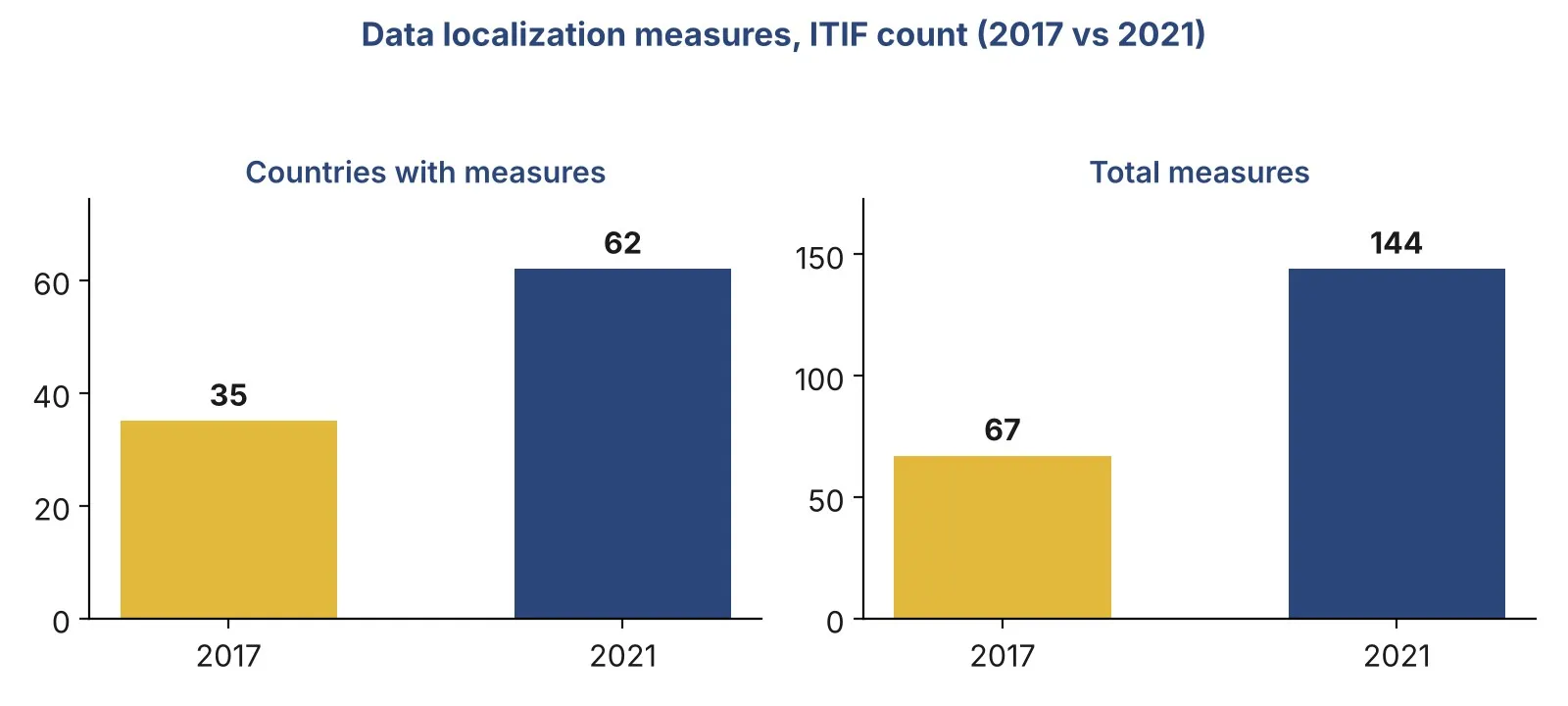
Earlier counts show the same upward trend. The Information Technology and Innovation Foundation (ITIF) found 144 measures in 62 countries in 2021, up from 67 measures in 35 countries in 2017. Neither tally includes India's 2025 rules or Vietnam's 2026 law, so the true total is likely higher today. ITIF also counts de facto measures, while the OECD uses its own inventory, so the two sets of figures should not be added together.
Data protection laws follow a different logic from localization rules. Most of them allow data to leave a country as long as specific safeguards are met. UNCTAD's tracker lists 137 of 194 countries as having data protection or privacy legislation. That shows how widespread these laws have become, even where data is free to move.
Table 1. Latest published counts of data localization measures
|
Source |
Period |
Measures |
Countries |
Note |
|
ITIF |
2017 |
67 |
35 |
Explicit and de facto measures |
|
ITIF |
2021 |
144 |
62 |
A further 38 measures proposed or under consideration |
|
OECD |
2021 |
92 |
39 |
Preliminary mapping of measures |
|
OECD |
Early 2023 |
100 |
40 |
More than two-thirds pair local storage with a transfer ban |
Figure 1. Latest ITIF count of measures and countries (2017 vs 2021)
Source: ITIF (July 2021).
Growth: countries +77% (35 to 62), measures +115% (67 to 144).
How India, China, Vietnam and the EU Are Rewriting Cross-Border Data Rules
The four jurisdictions summarized in Table 2 show how differently governments now approach cross-border data.
Table 2. How four jurisdictions treat cross-border data
|
Jurisdiction |
Key measure |
Status and date |
|
India (payments) |
RBI directive: payment system data stored only in India; foreign processing allowed if data is deleted abroad and returned within one business day or 24 hours |
Issued 6 April 2018 |
|
India (privacy) |
DPDP Rules 2025: transfers subject to government conditions; some Significant Data Fiduciaries may keep specified data in India |
Notified 13 Nov 2025; transfer provisions from 13 May 2027 |
|
China |
CAC provisions: exemptions and revised thresholds; security assessment still required for important data |
Dated 22 March 2024, immediate effect |
|
Vietnam |
PDPL and Decree 356: foreign cloud storage counts as transfer; impact assessment filed within 60 days |
In force 1 January 2026 |
|
EU |
GDPR transfer rules; EU-US Data Privacy Framework upheld by General Court, appeal pending |
Judgment 3 Sep 2025; appeal lodged 31 Oct 2025 |
Source: Reserve Bank of India (2018); Hogan Lovells Cadwalader (Nov 2025); Freshfields (Mar 2024); EY Vietnam (Mar 2026); Official Journal of the EU (2025); IAPP (2026).
India pairs payments rule with a new privacy regime
India now regulates data location through two layers. A 2018 Reserve Bank of India (RBI) directive requires payment system data to be stored only in India. Processing abroad is still allowed, provided the data is deleted offshore and returned within one business day or 24 hours, whichever is earlier. On top of that, the Digital Personal Data Protection (DPDP) Rules were notified on 13 November 2025. They allow cross-border transfers subject to conditions the government may set, and some Significant Data Fiduciaries may have to keep specified data in India. Those fiduciaries must also appoint an India-based data protection officer and run annual impact assessments. The cross-border transfer provisions take effect on 13 May 2027.
China eases its export rules but keeps tight control of important data
China has moved toward easing its regime. The Cyberspace Administration of China issued new provisions on 22 March 2024, and they took effect immediately. They added exemptions and revised the thresholds that trigger export mechanisms. Even so, exports of important data still require a security assessment. Companies must therefore work out whether their data counts as important data before sending it abroad.
Vietnam adds new filing duties for companies
Vietnam's Personal Data Protection Law and Decree 356 took effect on 1 January 2026. Under the new rules, storing Vietnamese data on servers or foreign cloud services counts as a cross-border transfer. Companies must file a transfer impact assessment within 60 days unless an exemption applies. Small enterprises and start-ups receive a five-year grace period for preparing their impact assessment dossiers.
The EU regulates transfers instead of mandating local storage
Inside the EU, the GDPR limits how personal data can leave, but it does not require data to stay within EU borders. The EU General Court upheld the EU-US Data Privacy Framework on 3 September 2025. A later appeal, filed on 31 October 2025 as Case C-703/25 P, is pending. Recent coverage still describes a Court of Justice ruling as pending. The stakes are real, because the Court of Justice invalidated two earlier EU-US frameworks in 2015 and 2020.
Sovereign Cloud Spending Is Surging as Companies Move Data Closer to Home
Governments and companies are putting real money behind local infrastructure. Gartner forecasts worldwide sovereign cloud IaaS spending of USD 80 billion in 2026, up 35.6% from 2025. It also expects 20% of current workloads to move from global to local providers. Governments remain the main buyers, followed by regulated industries and critical infrastructure operators.
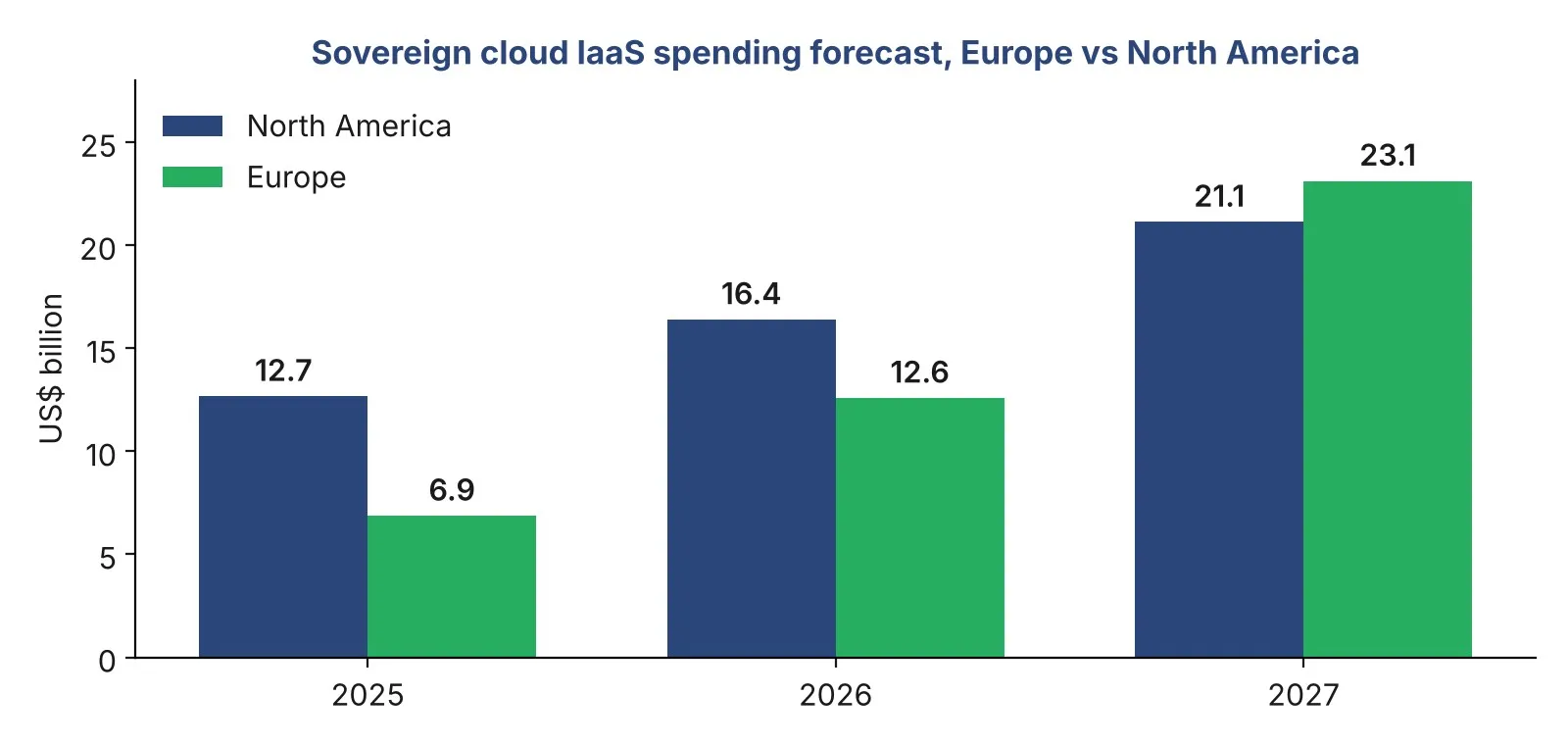
The regional picture is shifting quickly. China (USD47.4 billion) and North America (USD16.4 billion) lead in 2026. Europe, meanwhile, is forecast to grow 83% this year and pass North America in 2027, as Figure 2 shows. Sovereign cloud is a wider category than legal localization, so these figures show the direction of travel rather than compliance spend alone.
Figure 2. Sovereign cloud IaaS spending forecast, Europe vs North America
Source: Gartner (February 2026).
Values in USD billion. Europe is forecast to pass North America in 2027.
Table 3. Sovereign cloud IaaS spending by region, 2025 to 2027 (USD million)
|
Region |
2025 |
2026 |
2027 |
|
China |
37,539 |
47,379 |
54,854 |
|
North America |
12,667 |
16,394 |
21,127 |
|
Europe |
6,868 |
12,587 |
23,118 |
|
Mature Asia/Pacific |
851 |
1,593 |
3,155 |
|
Japan |
519 |
932 |
1,816 |
|
Emerging Asia/Pacific |
430 |
755 |
1,326 |
|
Latin America |
278 |
506 |
946 |
|
Middle East and North Africa |
132 |
250 |
515 |
|
Sub-Saharan Africa |
16 |
31 |
61 |
|
Sum of listed rows |
59,300 |
80,427 |
106,918 |
|
Total as published by Gartner |
59,300 |
80,427 |
110,609 |
Source: Gartner (February 2026).
Does Data Localization Raise Business Costs?
The evidence points in both directions. Drawing on business input from e-payments, cloud computing, and air travel, the OECD concluded that localization can raise operating costs, with effects on downstream users. Its analysis also links the rules to greater fraud and cybersecurity exposure. The OECD's cross-border data flows page estimates that localization can raise data management costs by 15% to 55%. ITIF goes further by arguing that restrictions make digital business costlier and more complicated.
Supporters of localization point to oversight and sovereignty. The RBI said it needs unfettered supervisory access to payment data, and Gartner analysts describe a wider goal of keeping wealth generation inside national borders.
What to Watch in 2027 as Localization Rules Take Effect
Three developments matter most for the year ahead. India's cross-border and Significant Data Fiduciary obligations start on 13 May 2027. The Court of Justice, meanwhile, has yet to rule on the EU-US Data Privacy Framework. In addition, Gartner forecasts sovereign cloud IaaS spending of USD110.6 billion in 2027, with Europe at USD23.1 billion. Forecasts can change. The 2027 regional rows in Gartner's table also do not add up to its stated total, as the note under Table 3 explains.
How Can Companies Prepare for Stricter Data Localization Rules?
Preparation starts with knowing where data sits and which rule applies to it. These steps give legal, security, and engineering teams a shared starting point.
-
Map data flows by country, data type, and system. Payment data, personal data, and important data each face different rules, so one inventory underpins every later decision.
-
Check sector rules before general privacy law. India's payment storage rule already applies today, regardless of how the DPDP Rules evolve.
-
Decide where processing can happen. Under the RBI rule, foreign processing remains possible if the data returns to India within one business day.
-
Prepare filings early. Vietnam requires a transfer impact assessment within 60 days, and China requires an export mechanism unless an exemption applies, so legal and engineering teams should plan these steps together.
-
Monitor pending decisions. India's government notifications and the EU court appeal could change transfer conditions, so keep fallback transfer tools ready for EU-US flows.
Readers tracking adjacent markets can explore NextMSC research on cloud, cyber security and BFSI security.
Key Takeaways for Compliance and Cloud Teams
Localization has become more varied rather than simply stricter. China has eased parts of its regime, while India and Vietnam have added new obligations that reach deeper into everyday operations. Companies are spending more on local infrastructure, according to Gartner, but the evidence on net economic benefit remains contested. The practical response is to track each jurisdiction, classify data carefully, and plan filings well before deadlines take effect.
Frequently Asked Questions:
1. What is data localization?
Data localization is a legal requirement to store or process data inside a specific country.
2. Is data localization the same as the GDPR?
No. The GDPR sets conditions for transfers, such as adequacy decisions, rather than requiring storage inside the EU. Localization laws, by contrast, dictate where data physically sits.
3. Why do governments require data localization?
Regulators usually cite supervisory access, as the RBI did for payment data. Gartner analysts also describe a goal of keeping wealth generation inside national borders, although the evidence on net economic benefit is still contested.
4. Does India require all data to stay in India?
No. The DPDP Rules allow transfers subject to government conditions, while the RBI rule covers payment data specifically.
About the Author
 Sanyukta Deb
— Sanyukta Deb is Digital Marketing Team Lead at Next Move Strategy Consulting, where she has led content strategy and technical SEO for the firm's B2B market research publications for over 2 years. Her editorial process translates NextMSC's primary and secondary research — spanning technology, industrial, and consumer sectors — into commercial narratives, backed by search-intent, keyword, and competitive analysis. She brings 5 years of overall experience in digital marketing and content strategy.
About the Reviewer
 Debashree Dey
— Debashree Dey is Assistant Manager at Next Move Strategy Consulting, where she supports cross-vertical market content and communications across diverse industries for 6 years. Her professional background includes senior content writing, communications, and published manuscript authorship, with experience developing audience-focused business narratives and maintaining clear, consistent messaging. Her role supports research-led content development and editorial quality across NextMSC publications.


















Add Comment