Digital Payment Solutions Market Size, Share, Trends and Growth Analysis, By Offering (Solutions and Services), By Payment Mode (Card Payments, Digital Wallets, Bank Transfers, Buy Now Pay Later, QR Code Payments, and Cryptocurrency Payments), By Deployment, By Enterprise Size, By End User Industry (Retail and E-Commerce, BFSI, Healthcare, Travel and Hospitality, Media and Entertainment, Government, and Other Industries), and Region — Global Industry Report and Forecast, 2026–2035
Industry: BFSI | Publishing Date: August 1, 2026 | Last Updated: August 1, 2026 | No of Pages: N/A | No. of Tables: N/A | No. of Figures: N/A | Format: PDF | Report Code: BF5510
What Is the Digital Payment Solutions Market Size?
The global digital payment solutions market size was valued at USD 145.80 billion in 2025 and is estimated at USD 169.10 billion in 2026, forecast to reach USD 725.40 billion by 2035, expanding at a 17.6% CAGR between 2026 and 2035. Asia-Pacific leads with approximately a 37% share, while Solutions dominates the Services offering with approximately a 68% share.
We observed that growth is broad-based across every segmentation axis, with cloud-native deployment and agentic, AI-enabled commerce driving the dominant structural shifts through 2035.
|
Key Takeaways |
|
By Offering: Solutions held the largest share of approximately 68% (USD 99.14 billion) in 2025; Services is the fastest-growing sub-segment at 19.5% CAGR from 2026–2035. |
|
By Payment Mode: Card Payments held the largest share of approximately 34% (USD 49.57 billion) in 2025; Cryptocurrency Payments is the fastest-growing sub-segment at 27.0% CAGR from 2026–2035. |
|
By Deployment: Cloud held the largest share of approximately 71% (USD 103.52 billion) in 2025; Cloud is also the fastest-growing sub-segment at 19.3% CAGR from 2026–2035. |
|
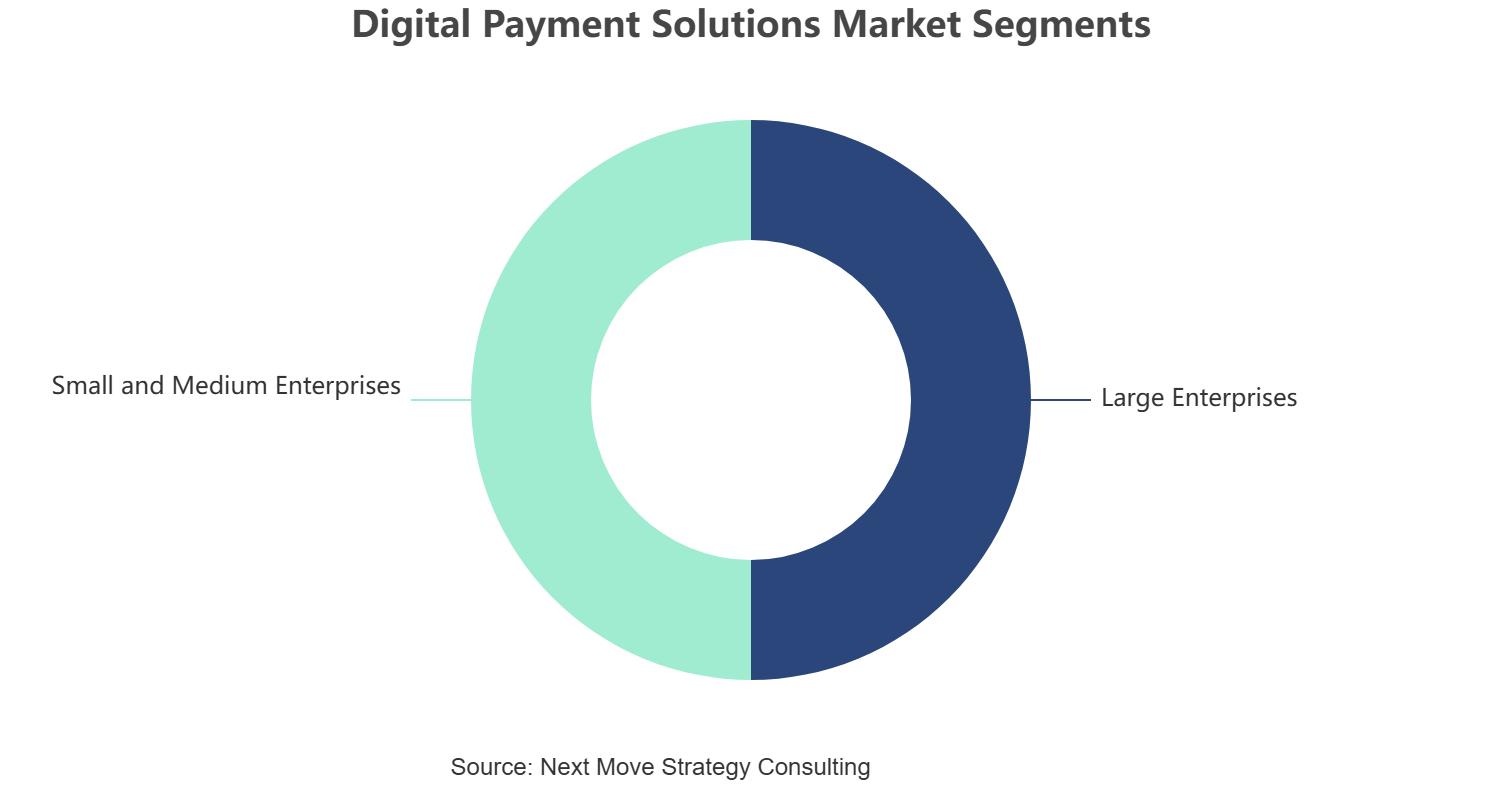
By Enterprise Size: Large Enterprises held the largest share of approximately 63% (USD 91.85 billion) in 2025; Small and Medium Enterprises is the fastest-growing sub-segment at 19.8% CAGR from 2026–2035. |
|
By End User Industry: Retail and E-Commerce held the largest share of approximately 31% (USD 45.20 billion) in 2025; Other Industries is the fastest-growing sub-segment at 21.4% CAGR from 2026–2035. |
|
Dominant Region: Asia-Pacific dominated with approximately 37% revenue share (USD 53.95 billion) in 2025. |
|
Fastest-Growing Region: Middle East & Africa is expected to register the highest CAGR of 20.9% during 2026–2035. |
|
Dominant Country: The U.S. led with approximately USD 35.09 billion in 2025. |
|
Fastest-Growing Country: India is the fastest-growing country at approximately 23.0% CAGR from 2026–2035. |
Market Opportunity: The digital payment solutions market is expected to create an absolute dollar opportunity of USD 556.30 billion between 2026 and 2035, presenting significant investment potential across the cloud-native payment infrastructure and agentic commerce value chain.
According to NMSC analysis, payment networks and processors are increasingly embedding stablecoin settlement and AI agent authentication directly into core payment rails rather than treating them as adjacent pilots, a shift that favors diversified providers offering unified card, wallet, and blockchain-based settlement capability over single-rail specialists as autonomous commerce scales through 2035.
What Does the Digital Payment Solutions Market Encompass?
The digital payment solutions market encompasses software platforms, processing infrastructure, and associated services that enable businesses and consumers to initiate, authorize, and settle transactions electronically across cards, digital wallets, bank transfers, and emerging blockchain-based rails. Our assessment indicates that the scope spans payment gateways, processing platforms, digital wallet infrastructure, fraud and risk management software, and payment orchestration tools delivered through cloud and on-premises deployment models to enterprises of all sizes across retail, BFSI, healthcare, and travel end markets.
Regulatory frameworks such as the U.S. GENIUS Act governing stablecoin issuance and the EU's Instant Payments Regulation shape settlement infrastructure investment, while evolving card network tokenization standards increasingly influence platform architecture decisions. We observed that technology adoption is shifting toward AI-enabled fraud detection and prevention and agent-aware authentication protocols, a structural change that NMSC's analysis indicates is redefining platform sourcing criteria across the market.
|
Parameter |
Details |
|
Market Size in 2025 |
USD 145.80 Billion |
|
Market Size in 2026 |
USD 169.10 Billion |
|
Revenue Forecast in 2035 |
USD 725.40 Billion |
|
Growth Rate |
CAGR of 17.6% from 2026 to 2035 |
|
Analysis Period |
2025–2035 |
|
Base Year Considered |
2025 |
|
Forecast Period |
2026–2035 |
|
Market Size Estimation |
USD Billion |
|
Companies Profiled |
20 |
|
Countries Covered |
38 |
|
Market Share |
Available for Top 10 Companies |
Key Emerging Trends
Based on research conducted by NMSC, we found that four structural trends are reshaping platform development, rail adoption, and stakeholder engagement across the industry.
How Is Agentic Commerce Transforming Payment Authentication?
Payment networks are embedding identity, permissions, and behavioral signals directly into transaction credentials to authenticate purchases initiated autonomously by AI agents rather than human users. We observed that Visa's Agent Scoring and Agentic Registry capabilities, announced at its 2026 Payments Forum, extend trust signals across devices and channels for AI-initiated transactions, while Mastercard's Agent Pay for Machines supports high-frequency, low-latency machine-driven payments, reflecting how card networks are racing to define standards before fintech challengers do.
Why Are Payment Networks Building Stablecoin Settlement Infrastructure?
Card networks and processors are constructing parallel stablecoin settlement rails alongside traditional card infrastructure to capture faster, programmable money movement. Our findings suggest that Visa's expansion of stablecoin settlement pilots across multiple blockchains and Mastercard's agreement to acquire stablecoin platform BVNK for up to USD 1.8 billion illustrate how incumbents are positioning to control both card and blockchain-based settlement rails rather than cede tokenized value transfer to standalone crypto infrastructure providers.
How Is Usage-Based Billing Reshaping Payment Platform Architecture?
Payment platforms are extending beyond transaction processing into usage-based billing infrastructure to serve AI-native software companies with complex, consumption-driven pricing models. We found that Stripe's acquisition of Metronome, the usage-based billing platform behind several major AI companies, reflects growing demand for cloud computing-native billing infrastructure capable of handling AI-scale usage pricing and ramped enterprise contracts beyond native payment processing capability.
What Role Does Unified Omnichannel Processing Play in Enterprise Adoption?
Large enterprise merchants are consolidating online, in-store, and mobile payment acceptance onto single unified platforms rather than maintaining separate channel-specific systems. Our analysis shows that Adyen's unified commerce platform, which processed more than 800 million transactions across the 2025 Black Friday to Cyber Monday period at high uptime, exemplifies how omnichannel processing capability is becoming a decisive factor in enterprise platform selection over point-solution alternatives.
Growth Drivers and Restraints
|
Factors |
Type |
(+/−) % Impact on CAGR |
Geographic Relevance |
Impact Timeline |
|
Rising e-commerce penetration and digital transaction volume |
Driver |
+3.0% |
Global |
2026–2035 |
|
Expanding stablecoin settlement and tokenized deposit infrastructure |
Driver |
+2.4% |
North America, Europe |
2026–2033 |
|
Growing agentic and AI-initiated commerce adoption |
Driver |
+2.0% |
Global |
2026–2034 |
|
Rising smartphone and digital wallet penetration across Asia-Pacific |
Driver |
+1.8% |
Asia-Pacific |
2026–2035 |
|
Expanding real-time and cross-border payment infrastructure |
Driver |
+1.4% |
Global |
2026–2035 |
|
Growing Buy Now Pay Later adoption among younger consumers |
Driver |
+1.1% |
North America, Europe, Asia-Pacific |
2026–2032 |
|
Fragmented global regulatory requirements across payment rails |
Restraint |
−1.6% |
Global |
2026–2035 |
|
Rising payment fraud and cybersecurity compliance costs |
Restraint |
−1.2% |
Global |
2026–2033 |
|
Interchange fee regulation and merchant pricing pressure |
Restraint |
−0.8% |
Europe, North America |
2026–2032 |
|
Legacy banking infrastructure integration complexity |
Restraint |
−0.5% |
Middle East & Africa, Latin America |
2028–2035 |
What Is the Primary Growth Driver of the Digital Payment Solutions Market?
Rising e-commerce penetration and digital transaction volume are the primary drivers of the market. Stripe's 2025 annual letter disclosed that the company processed USD 1.9 trillion in total payment volume during 2025, up 34% year over year, reflecting sustained enterprise and consumer migration toward digital payment rails. We observed that this transaction volume growth, reinforced by expanding merchant acceptance networks, continues to anchor baseline demand for payment gateway and processing software across developed and emerging markets alike.
How Is Agentic Commerce Driving Market Growth?
Growing adoption of AI agent-initiated purchasing is accelerating demand for identity, authentication, and settlement infrastructure purpose-built for autonomous transactions. Visa's prediction that agentic commerce will become mainstream in 2026, combined with its joint research with Artemis on stablecoin-based micropayment rails for AI agents, reflects the pace at which networks are contracting new blockchain-based settlement capability. Our assessment indicates that this demand-side pressure is compressing platform modernization timelines across payment providers.
What Is Restraining Digital Payment Solutions Market Expansion?
Fragmented global regulatory requirements across payment rails restrain broader platform standardization, particularly as stablecoin regulation under frameworks such as the U.S. GENIUS Act and the EU's Markets in Crypto-Assets Regulation continue to evolve at different paces across jurisdictions. The European Union's Instant Payments Regulation, which mandates structured payment addresses for SEPA Instant Payments starting November 2026, illustrates the compliance timeline pressure providers face. We found that rising payment fraud and cybersecurity compliance costs further slow platform expansion for smaller providers.
Segmentation Analysis
|
Segment |
2025 (USD) |
2035 (USD) |
CAGR% (2026–2035) |
|
Solutions |
USD 99.14 Billion |
USD 457.00 Billion |
16.6% |
|
Services |
USD 46.66 Billion |
USD 268.40 Billion |
19.5% |
|
Total |
USD 145.80 Billion |
USD 725.40 Billion |
17.6% |
Which Offering Segment Dominates the Digital Payment Solutions Market?
Solutions led the market with USD 99.14 billion in 2025, supported by sustained enterprise investment in payment gateway, processing, and digital wallet platform software. Our findings suggest that Services is the fastest-growing segment, registering a 19.5% CAGR from 2026 to 2035, as merchants increasingly rely on implementation, consulting, and managed services to navigate multi-rail integration and evolving stablecoin and agentic commerce compliance requirements.
|
Segment |
2025 (USD) |
2035 (USD) |
CAGR% (2026–2035) |
|
Card Payments |
USD 49.57 Billion |
USD 174.10 Billion |
13.1% |
|
Digital Wallets |
USD 39.37 Billion |
USD 217.62 Billion |
18.9% |
|
Bank Transfers |
USD 26.24 Billion |
USD 123.32 Billion |
16.8% |
|
Buy Now Pay Later |
USD 13.12 Billion |
USD 79.79 Billion |
20.2% |
|
QR Code Payments |
USD 11.67 Billion |
USD 72.54 Billion |
20.5% |
|
Cryptocurrency Payments |
USD 5.83 Billion |
USD 58.03 Billion |
27.0% |
|
Total |
USD 145.80 Billion |
USD 725.40 Billion |
17.6% |
Which Payment Mode Segment Leads Digital Payment Solutions Market Demand?
Card Payments remained the leading payment mode within the market, valued at USD 49.57 billion in 2025 on sustained global acceptance network scale and established merchant infrastructure. Based on research conducted by NMSC, we found that Cryptocurrency Payments is the fastest-growing payment mode, registering a 27.0% CAGR from 2026 to 2035, as buy now pay later-adjacent stablecoin rails gain traction for cross-border and machine-to-machine settlement use cases.
|
Segment |
2025 (USD) |
2035 (USD) |
CAGR% (2026–2035) |
|
Retail and E-Commerce |
USD 45.20 Billion |
USD 203.11 Billion |
16.2% |
|
BFSI |
USD 34.99 Billion |
USD 159.59 Billion |
16.4% |
|
Healthcare |
USD 13.12 Billion |
USD 79.79 Billion |
20.2% |
|
Travel and Hospitality |
USD 17.50 Billion |
USD 87.05 Billion |
17.6% |
|
Media and Entertainment |
USD 14.58 Billion |
USD 72.54 Billion |
17.6% |
|
Government |
USD 11.66 Billion |
USD 65.29 Billion |
19.1% |
|
Other Industries |
USD 8.75 Billion |
USD 58.03 Billion |
21.4% |
|
Total |
USD 145.80 Billion |
USD 725.40 Billion |
17.6% |
Which End User Industry Segment Is Most Significant in the Digital Payment Solutions Market?
Retail and E-Commerce remained the dominant end user industry across the market, reaching USD 45.20 billion in 2025 as online merchants continue to represent the largest concentration of digital transaction volume globally. Our analysis shows that Other Industries is the fastest-growing end user category at a 21.4% CAGR from 2026 to 2035, reflecting expanding digital payment adoption among real estate, utilities, and professional services businesses previously reliant on manual invoicing and check-based payment.
Porter’s Five Forces Analysis of the Digital Payment Solutions Industry
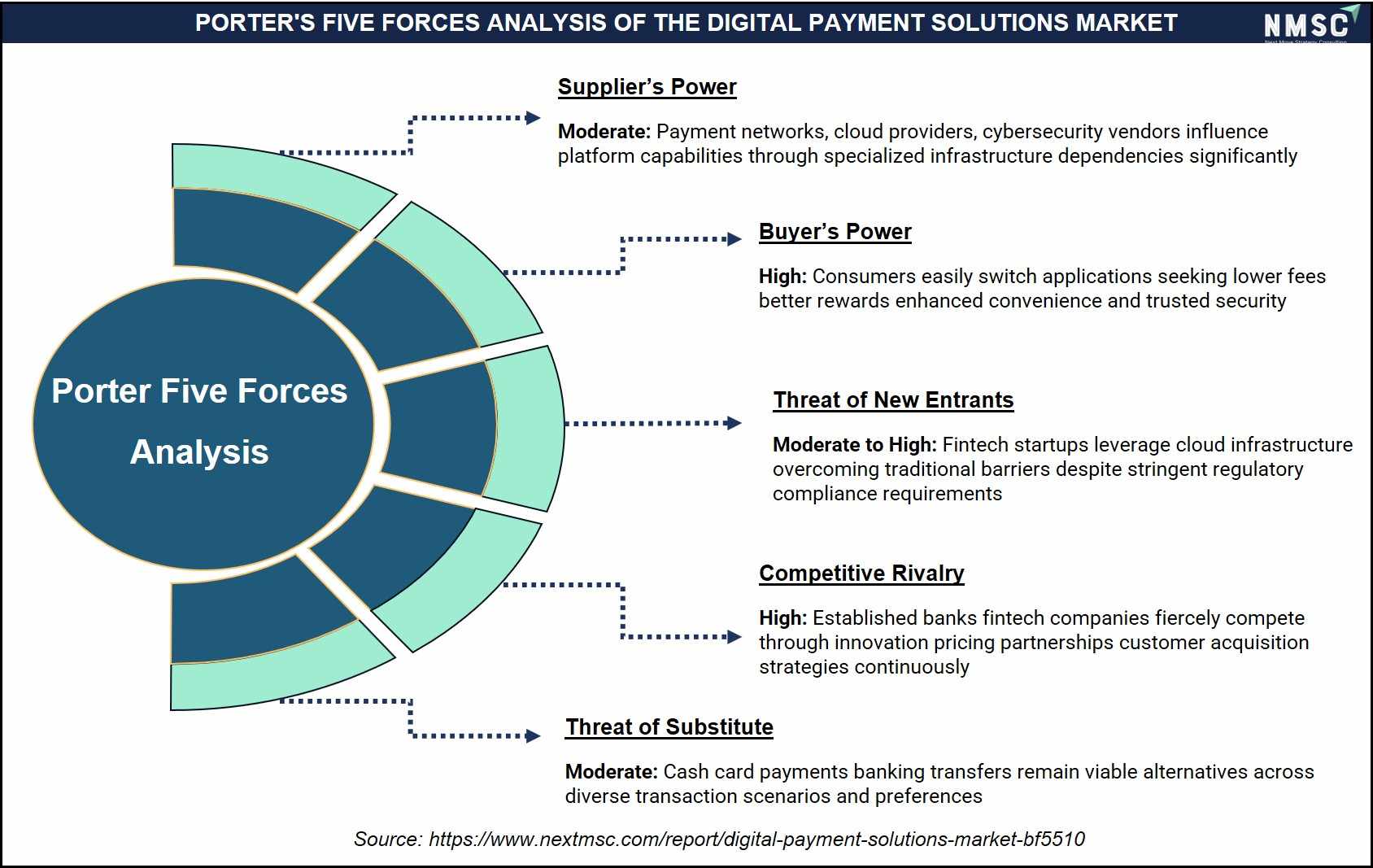
The above infographic presents a Porter's Five Forces analysis of the digital payment solutions market, where supplier power remains moderate due to reliance on payment networks, cloud providers, and cybersecurity vendors. At the same time, buyer power is high as consumers easily switch applications for lower fees and better rewards. The threat of new entrants is moderate to high, as fintech startups leverage cloud infrastructure to overcome traditional barriers, though regulatory compliance remains a challenge. Competitive rivalry is intense among established banks and fintech companies competing through innovation, pricing, and customer acquisition. Looking ahead, we observed that the threat of substitutes stays moderate, as cash, cards, and bank transfers remain viable alternatives across diverse transaction scenarios.
Growth Opportunities
Our analysis shows that three forward-looking opportunities stand out for stakeholders positioning within the digital payment solutions market over the 2026–2035 forecast period.
How Can Providers Capture Agentic Commerce Authentication Demand?
Agent-initiated commerce represents a whitespace opportunity for providers developing identity, permissions, and trust infrastructure purpose-built for AI agents rather than human shoppers. Vendors that commercialize standardized agent scoring and authentication protocols stand to capture recurring platform revenue as autonomous purchasing volume scales across enterprise procurement and consumer commerce through 2035.
Where Does Small and Medium Enterprise Digital Wallet Adoption Create New Demand?
Small and medium enterprise digital wallet adoption represents an underpenetrated opportunity for providers offering simplified, low-cost onboarding compared with traditional card acquiring relationships. Companies that qualify affordable payment gateway and wallet integration for smaller merchants can secure long-term platform relationships as SME digital payment adoption accelerates across emerging markets.
How Can Stablecoin Settlement Infrastructure Expand Cross-Border Revenue?
Stablecoin-based settlement infrastructure creates a sustained opportunity for providers seeking to reduce cross-border payment costs and settlement times compared with correspondent banking rails. Early movers that build compliant, multi-currency stablecoin settlement capability can secure durable platform relationships with enterprises scaling B2B payouts and remittance flows across emerging market corridors through 2035.
Regional Outlook
Geographic Performance Snapshot
|
Region |
2025 (USD) |
2035 (USD) |
CAGR% (2026–2035) |
Key Driver |
|
North America |
USD 42.28 Billion |
USD 174.10 Billion |
15.1% |
Enterprise digital transformation and agentic commerce platform investment |
|
Europe |
USD 30.62 Billion |
USD 130.57 Billion |
15.6% |
Instant payments regulation and open banking infrastructure expansion |
|
Asia-Pacific |
USD 53.95 Billion |
USD 311.92 Billion |
19.5% |
Mobile wallet penetration and expanding digital commerce ecosystems |
|
Middle East & Africa |
USD 10.21 Billion |
USD 65.29 Billion |
20.9% |
Financial inclusion initiatives and mobile-first payment adoption |
|
Latin America |
USD 8.74 Billion |
USD 43.52 Billion |
17.6% |
Expanding instant payment rails and cross-border remittance demand |
|
Total |
USD 145.80 Billion |
USD 725.40 Billion |
17.6% |
— |
North America
North America's digital payment solutions market is shaped by enterprise digital transformation and rapid agentic commerce platform investment among leading card networks and processors. Regulatory influence from the GENIUS Act's stablecoin framework is substantial, technology adoption favors AI-enabled fraud detection and agent authentication platforms, and competitive intensity remains high given the concentration of global payment technology leaders headquartered domestically.
Europe Digital
Europe's market is shaped by Instant Payments Regulation compliance deadlines and expanding open banking infrastructure across member states. Regulatory influence from structured payment address mandates and the Markets in Crypto-Assets Regulation is notable; technology adoption is advancing across unified commerce platforms, and competitive intensity remains high among established European processors and global technology vendors.
Asia-Pacific
Asia-Pacific is the fastest-growing major region, driven by mobile wallet penetration and expanding digital commerce ecosystems across China, India, and Southeast Asia. Regulatory influence varies significantly by market maturity, technology adoption is accelerating through domestic super-app and QR code payment infrastructure, and competitive intensity is rising as regional platform providers expand alongside established global payment networks.
Middle East & Africa
The Middle East & Africa digital payment solutions market is the fastest-growing region overall, shaped by financial inclusion initiatives and mobile-first payment adoption across Gulf and Sub-Saharan African markets. Regulatory influence remains developing, technology adoption favors mobile wallet and QR code payment infrastructure suited to underbanked populations, and competitive intensity is rising as international providers expand regional partnerships.
Latin America
Latin America's market is supported by expanding instant payment rail adoption and growing cross-border remittance demand across Brazil and Argentina. Regulatory influence stems from national instant payment infrastructure mandates, technology adoption favors QR code and digital wallet platforms aligned with high mobile penetration, and competitive intensity remains moderate among regional and global platform providers.
U.S.
Based on our estimates, the U.S. market was valued at approximately USD 35.09 billion in 2025, projected to reach USD 143.21 billion by 2035 at a 15.1% CAGR. Demand is supported by enterprise digital transformation and rapid agentic commerce platform investment among leading card networks and processors headquartered domestically. Regulatory influence from the GENIUS Act's stablecoin framework is developing, technology penetration is advanced, and competitive intensity remains high given the concentration of global payment technology leaders headquartered domestically.
Canada
The market in Canada was valued at roughly USD 4.65 billion in 2025, projected to reach USD 19.82 billion by 2035 at a 15.6% CAGR. Demand is driven by expanding e-commerce merchant adoption and growing enterprise investment in unified payment platforms. Regulatory influence stems from national financial technology guidelines, technology penetration favors cloud-based processing platforms, and competitive intensity remains moderate among domestic and North American providers.
UK
As per our estimate, the UK market was valued at around USD 6.74 billion in 2025, projected to reach USD 29.97 billion by 2035 at a 16.1% CAGR. Demand structure reflects the UK's established open banking framework and growing enterprise adoption of unified commerce platforms. Regulatory influence from the Financial Conduct Authority's payment services guidance is notable, and technology penetration favors AI-enabled fraud prevention among financial institutions and merchants.
Germany
According to our analysis, Germany's market was valued at close to USD 5.51 billion in 2025, projected to reach USD 23.49 billion by 2035 at a 15.6% CAGR. Demand is fueled by Germany's expanding e-commerce sector and growing enterprise investment in Instant Payments Regulation compliance infrastructure. Regulatory influence is well established under European Union payment rules, technology penetration is advancing, and competitive intensity remains high among domestic and pan-European providers.
France
The market in France was valued at approximately USD 4.29 billion in 2025, projected to reach USD 19.07 billion by 2035 at a 16.1% CAGR. Demand is supported by France's established digital commerce base and growing enterprise adoption of instant payment infrastructure. Regulatory influence from national and European Union payment standards is notable, and competitive intensity remains moderate given a concentrated base of domestic and regional providers.
China
The market in China was valued at roughly USD 19.42 billion in 2025, projected to reach USD 125.36 billion by 2035 at a 20.5% CAGR. Demand is fueled by extensive mobile wallet penetration and dominant domestic super-app payment ecosystems integrated into daily commerce. Regulatory influence is well established through national digital currency and payment oversight, technology penetration is advanced, and competitive intensity remains concentrated among leading domestic technology platforms.
India
As per our estimate, India's market was valued at about USD 10.79 billion in 2025, projected to reach USD 85.52 billion by 2035 at a 23.0% CAGR. Demand structure reflects India's expanding Unified Payments Interface ecosystem and rapid smartphone-driven digital commerce growth. Regulatory influence remains supportive under national digital payment infrastructure initiatives, while technology penetration is rising quickly as domestic and multinational providers scale platform capacity.
Japan
According to our analysis, Japan's market was valued at USD 7.01 billion in 2025, projected to reach USD 39.94 billion by 2035 at a 19.0% CAGR. Demand is supported by Japan's gradual cashless payment transition and growing enterprise adoption of QR code and digital wallet infrastructure. Regulatory influence is well established, technology penetration is advancing steadily, and competitive intensity remains high among domestic and multinational payment technology providers.
South Korea
Based on our estimates, South Korea's market was valued at approximately USD 5.40 billion in 2025, projected to reach USD 34.82 billion by 2035 at a 20.5% CAGR. Demand structure benefits from South Korea's advanced mobile payment infrastructure and high smartphone penetration among consumers. Technology penetration is high, with domestic providers scaling digital wallet capability, and competitive intensity remains pronounced amid rapid platform innovation cycles.
Australia
The digital payment solutions market in Australia was valued at USD 3.24 billion in 2025, projected to reach USD 20.04 billion by 2035 at a 20.0% CAGR. Demand is supported by expanding e-commerce adoption and growing enterprise investment in real-time payment infrastructure. Regulatory influence stems from national payment system reforms, while technology penetration favors cloud-based platforms amid moderate competitive intensity among domestic and international providers.
UAE
As per our estimate, the UAE market was valued near was valued at USD 2.35 billion in 2025, projected to reach USD 16.33 billion by 2035 at a 21.4% CAGR. Demand structure is shaped by the UAE's role as a regional digital commerce and financial technology hub. Regulatory influence remains moderate, technology penetration is improving through central bank digital payment initiatives, and competitive intensity is rising as global providers expand regional operations.
Saudi Arabia
According to our analysis, Saudi Arabia's market was valued at roughly USD 2.55 billion in 2025, projected to reach USD 18.49 billion by 2035 at a 21.9% CAGR. Demand is driven by Vision 2030-linked financial inclusion initiatives and growing investment in cashless payment infrastructure. Regulatory influence is developing under national payment sector guidelines, and technology penetration is advancing as domestic and international providers build regional capacity.
South Africa
Based on our estimates, South Africa's market was valued at USD 1.43 billion in 2025, projected to reach USD 10.36 billion by 2035 at a 21.9% CAGR. Demand structure reflects South Africa's expanding mobile-first financial inclusion initiatives serving underbanked populations. Regulatory influence remains moderate, technology penetration is gradually improving, and competitive intensity is limited given reliance on international provider partnerships.
Brazil Digital
The market in Brazil was valued at approximately USD 4.03 billion in 2025, projected to reach USD 21.25 billion by 2035 at a 18.1% CAGR. Demand is underpinned by Brazil's expanding Pix instant payment infrastructure and high mobile wallet adoption. Regulatory influence stems from national central bank payment rail mandates, technology penetration favors QR code and instant payment platforms, and competitive intensity remains moderate among regional and global providers.
Argentina
As per our estimate, Argentina's market was valued at USD 1.49 billion in 2025, projected to reach USD 8.54 billion by 2035 at a 19.1% CAGR. Demand structure is supported by steady digital wallet adoption despite macroeconomic volatility and currency instability. Regulatory influence remains limited, technology penetration is modest, and competitive intensity is centered on a small number of regional and global providers serving domestic merchants.
Competitive Landscape
We observed that the digital payment solutions market features a moderately consolidated competitive landscape, with global card networks competing alongside cloud-native processors and regional super-app platforms on rail breadth, developer experience, and settlement speed.
|
Key Takeaways |
|
|
Market Structure |
Moderately consolidated; the top companies profiled in this report collectively account for a majority of global digital payment solutions market revenue, while numerous regional processors serve localized merchant demand. |
|
Innovation Focus |
Agentic commerce authentication, stablecoin settlement infrastructure, and usage-based billing platforms dominate current innovation pipelines across leading providers. |
|
M&A Activity |
Selective capability acquisitions, exemplified by Mastercard's agreement to acquire stablecoin platform BVNK for up to USD 1.8 billion and Stripe's acquisition of usage-based billing platform Metronome. |
How Do Companies Compete in the Digital Payment Solutions Market?
Companies compete primarily on rail breadth, developer experience, and settlement infrastructure scale across the industry. Global card networks such as Visa Inc. and Mastercard Incorporated leverage decades of acceptance network scale to serve financial institution and merchant customers, while cloud-native processors such as Stripe, Inc. and Adyen N.V. compete by offering unified developer-first platforms spanning online, in-store, and cross-border payment acceptance.
Which Competitive Archetypes Dominate the Market?
Two archetypes dominate the market: global card network incumbents extending into stablecoin and agentic commerce infrastructure, and cloud-native processors offering unified developer-first platforms. Visa Inc. and Mastercard Incorporated exemplify the network incumbent archetype through tokenization and agent authentication capability, while Stripe, Inc. and Adyen N.V. exemplify the cloud-native archetype through unified omnichannel processing platforms serving global enterprise merchants.
How Are Companies Differentiating Through Innovation in Digital Payment Solutions?
Innovation and differentiation strategy increasingly center on agentic commerce authentication and stablecoin settlement capability beyond traditional card processing. Visa's Agent Scoring and Mastercard's Agent Pay for Machines both illustrate how networks extend platform relevance into AI-initiated transaction authentication. Our analysis shows that providers unable to demonstrate credible agentic commerce and stablecoin settlement capability risk exclusion from enterprise platform shortlists through 2035.
What M&A and Expansion Activity Is Shaping the Digital Payment Solutions Market?
Mergers, acquisitions, and infrastructure expansion continue to reshape competitive positioning within the industry. Mastercard's planned acquisition of BVNK strengthens its stablecoin settlement capability, while Stripe's acquisition of Metronome extends its platform into AI-scale usage-based billing infrastructure. These moves illustrate how leading providers pursue capability diversification to defend platform relevance against both traditional competitors and emerging stablecoin-native challengers.
Key Market Players
Our assessment indicates that the following companies are actively shaping platform innovation, settlement infrastructure investment, and enterprise partnership strategy within the global digital payment solutions market.
-
Visa Inc.
-
Mastercard Incorporated
-
PayPal Holdings, Inc.
-
Fidelity National Information Services, Inc.
-
Block, Inc.
-
Global Payments Inc.
-
Adyen N.V.
-
ACI Worldwide, Inc.
-
Worldline SA
-
Ant Group Co., Ltd.
-
Tencent Holdings Limited
-
Klarna Group plc
-
Shift4 Payments, Inc.
-
Nuvei Corporation
-
Marqeta, Inc.
-
Wise plc
-
One97 Communications Limited (Paytm)
-
PayU
Latest Developments
We found that recent activity within the digital payment solutions market is concentrated on agentic commerce authentication, stablecoin settlement infrastructure, and usage-based billing capability, reflecting the industry's response to accelerating AI-driven commerce.
|
Date |
Event |
|
June 2025 |
PayPal announced the expansion of flexible payment solutions in Germany, including enhanced installment payment options and Buy Now, Pay Later capabilities for consumers and merchants. |
|
June 2026 |
Mastercard launched Agent Pay for Machines, supporting high-frequency, low-latency automated payments across cards, accounts, and stablecoins. |
|
January 2025 |
Adyen launched Adyen Uplift, an AI-powered payment optimization suite that helps merchants improve payment authorization rates, reduce fraud, and enhance checkout performance across digital channels. |
Expert Insights
 “We're heading toward an economy where most transactions never involve a person at all - machines paying each other, constantly, for things too small to bother a human with. That unlocks business models nobody can build today, but only once the payment layer can keep up.”
— Joe Lau, co-founder and president of Alchemy
Statement made during Mastercard's launch of Agent Pay for Machines, highlighting the need for next-generation payment infrastructure.
Market Interpretation
The insight highlights the evolution of the Digital Payment Solutions Market beyond consumer-initiated transactions toward autonomous, machine-driven payments. As AI agents, connected devices, and IoT ecosystems become increasingly capable of conducting transactions independently, payment infrastructure will need to support secure, real-time, high-frequency, and low-value payments. This shift is expected to drive innovation in payment networks, programmable payment systems, and interoperable digital payment infrastructure, enabling new business models across commerce, mobility, logistics, and connected industries.
Consumer Behavior Analysis of the Digital Payment Solutions Industry
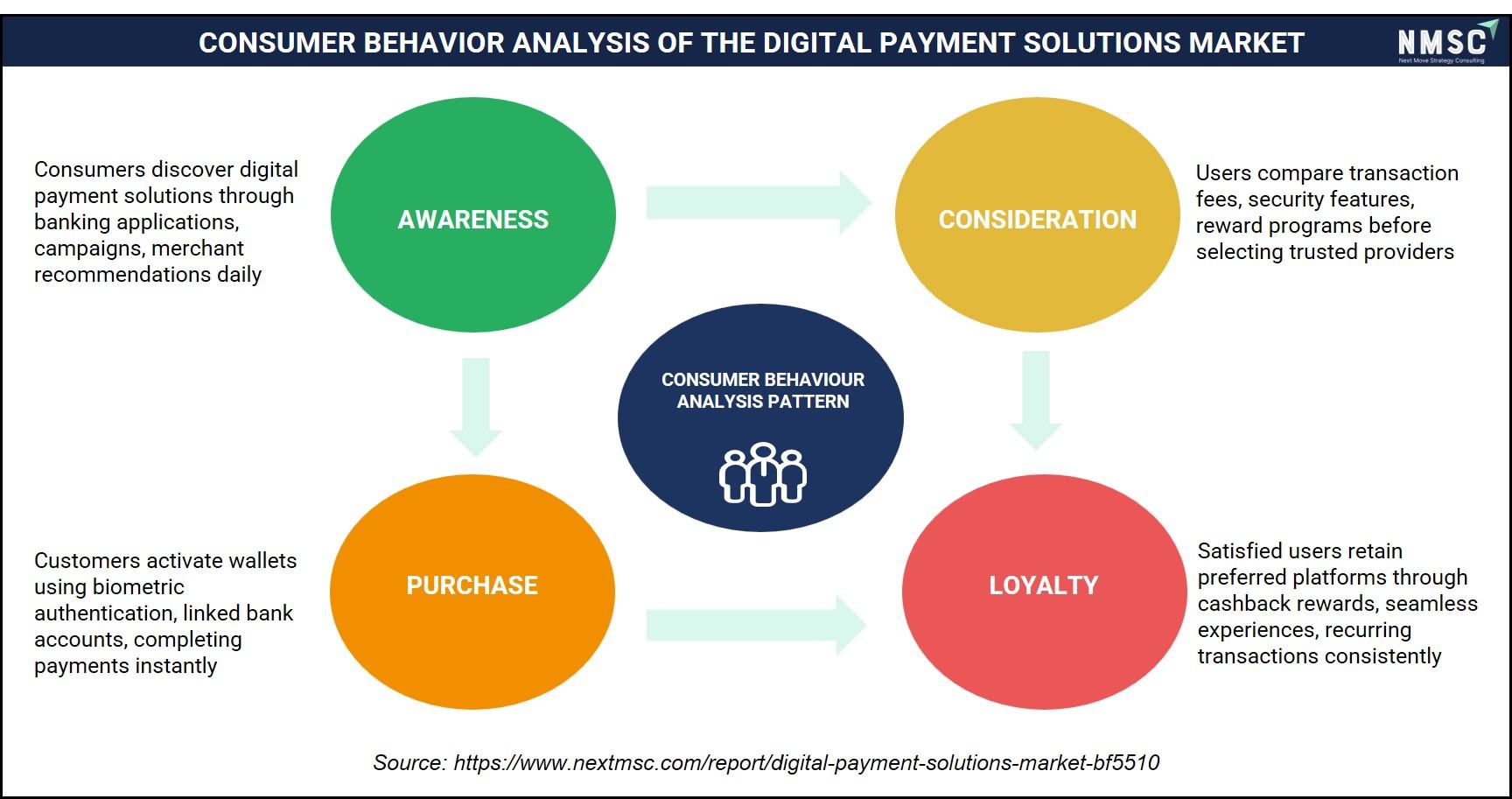
The above infographic presents a consumer behavior analysis of the digital payment solutions market, mapping the journey from awareness to loyalty. Consumers discover payment solutions through banking apps, campaigns, and merchant recommendations, leading them to compare transaction fees, security features, and reward programs before selecting trusted providers. Customers then activate wallets using biometric authentication and linked bank accounts for instant payments. Looking ahead, we observed that loyalty is reinforced by cashback rewards, seamless experiences, and recurring transactions, encouraging sustained platform engagement and retention across the market.
Investment Opportunities
What Capital Inflows Are Fueling Digital Payment Solutions Market Development?
Capital investment is flowing into stablecoin settlement and agentic commerce infrastructure, exemplified by Mastercard's up to USD 1.8 billion agreement to acquire BVNK and Stripe's internal valuation reaching over USD 100 billion in early 2026. Our findings suggest that this capital inflow is validating agentic and stablecoin-enabled payment infrastructure as durable, investment-grade technology categories rather than speculative pilots.
How Is Infrastructure Investment Shaping Digital Payment Solutions Market Expansion?
Settlement infrastructure investment, including Visa's expansion of stablecoin settlement pilots across multiple blockchains and currencies, is shaping how payment providers scale programmable money movement globally. We observed that this infrastructure investment reflects sustained commitment to reducing settlement times and costs without requiring merchants to integrate separate blockchain-native payment stacks.
What ESG Considerations Influence Digital Payment Solutions Market Investment?
Environmental, social, and governance considerations increasingly influence digital payment investment as providers prioritize financial inclusion infrastructure for underbanked populations across emerging markets. Our analysis shows that mobile wallet and QR code payment platforms expanding access in Middle East & Africa and Latin America align with social inclusion goals alongside reduced-carbon digital infrastructure, strengthening the investment case for providers with demonstrated emerging market deployment track records.
Key Benefits for Stakeholders
How Does This Report Benefit Industry Leaders?
This report equips financial services and technology industry leaders with segmented revenue forecasts, payment mode adoption trends, and competitive benchmarking needed to prioritize platform investment across enterprise and merchant segments. Our findings suggest that leaders can use the segmentation analysis and regional outlook to align product roadmaps with the fastest-growing offering, payment mode, and end-user segments identified in this report.
How Does This Report Benefit Investors and Financial Analysts?
Investors and financial analysts gain a data-driven view of market sizing, CAGR trajectories, and company-level competitive positioning to evaluate capital allocation across the digital payment solutions value chain. We found that the investment opportunities and competitive landscape sections provide the forecast granularity needed to assess processor and network M&A opportunities.
How Does This Report Benefit Technology Vendors and Product Teams?
Technology vendors and product teams benefit from detailed segmentation across offering, payment mode, and end user industry axes that clarify where product development investment will generate the strongest returns. Our assessment indicates that the growth opportunities and emerging trends sections help product teams prioritize agentic commerce and stablecoin settlement roadmaps ahead of competitors.
Key Market Segments
By Offering
-
Solutions
-
Services
By Payment Mode
-
Card Payments
-
Digital Wallets
-
Bank Transfers
-
Buy Now Pay Later
-
QR Code Payments
-
Cryptocurrency Payments
By Deployment
-
Cloud
-
On-Premises
By Enterprise Size
-
Large Enterprises
-
Small and Medium Enterprises
By End User Industry
-
Retail and E-Commerce
-
BFSI
-
Healthcare
-
Travel and Hospitality
-
Media and Entertainment
-
Government
-
Other Industries
By Region
-
North America: U.S., Canada, Mexico
-
Europe: UK, Germany, France, Italy, Spain, Sweden, Denmark, Finland, Netherlands, Rest of Europe
-
Asia-Pacific: China, India, Japan, South Korea, Taiwan, Indonesia, Vietnam, Australia, Philippines, Malaysia, Rest of APAC
-
Middle East & Africa: Saudi Arabia, UAE, Egypt, Israel, Turkey, Nigeria, South Africa, Rest of MEA
-
Latin America: Brazil, Argentina, Chile, Colombia, Rest of LATAM
Conclusion and Recommendations
What Is the Long-Term Outlook for the Digital Payment Solutions Market?
The long-term outlook remains strongly positive, with the market projected to expand from USD 169.10 billion in 2026 to USD 725.40 billion by 2035 at a 17.6% CAGR. We observed that sustained e-commerce growth and agentic, AI-driven commerce adoption provide durable, structural tailwinds that extend well beyond the current forecast window, supporting continued provider investment across solutions, services, and settlement infrastructure segments.
What Strategic Positioning Should Providers Pursue?
Providers should prioritize unified platforms spanning card, wallet, and stablecoin settlement capability that reduce merchant integration complexity across multiple payment rails. Our assessment indicates that providers combining card network scale with credible agentic commerce authentication will be best positioned to win recurring enterprise contracts, particularly as merchants consolidate vendor relationships to simplify long-term platform management.
How Attractive Is the Digital Payment Solutions Market for New Investment?
The digital payment solutions industry presents an attractive investment case, supported by a USD 556.30 billion absolute dollar opportunity between 2026 and 2035 and above-average growth in Middle East & Africa and cryptocurrency payment categories. We found that investment attractiveness is highest for providers combining acceptance network scale with stablecoin settlement depth, positioning them to serve both established card payment customers and emerging agentic commerce programs simultaneously.
What Market Shifts and Key Risks Should Stakeholders Monitor?
Stakeholders should monitor fragmented global stablecoin regulation, rising fraud and cybersecurity compliance costs, and interchange fee pricing pressure as key risks to the digital payment solutions market. Our analysis shows that providers unable to demonstrate credible fraud prevention and multi-jurisdiction regulatory compliance risk losing enterprise platform shortlist positions, particularly as Instant Payments Regulation deadlines take effect across Europe in late 2026.
What Are the Key Growth Pathways for the Digital Payment Solutions Market?
Key growth pathways include expanding agentic commerce authentication infrastructure, scaling stablecoin settlement capability, and deepening penetration into small and medium enterprise digital wallet adoption. NMSC's analysis indicates that providers pursuing these pathways while maintaining cost competitiveness in core card payment processing will be best positioned to capture the digital payment solutions market's projected growth through 2035.
About the Author
 Mayurima Roy
— Mayurima Roy is Research Analyst at Next Move Strategy Consulting, where she has spent 4 years working across the firm's full industry coverage rather than a single fixed vertical. Her work centers on structured research, ongoing trend tracking, competitive assessment, and insight-led content development, translating complex market data into clear, decision-ready narratives that support informed client decision-making across diverse global industries, market sectors, and world regions every day.
Mayurima Roy
— Mayurima Roy is Research Analyst at Next Move Strategy Consulting, where she has spent 4 years working across the firm's full industry coverage rather than a single fixed vertical. Her work centers on structured research, ongoing trend tracking, competitive assessment, and insight-led content development, translating complex market data into clear, decision-ready narratives that support informed client decision-making across diverse global industries, market sectors, and world regions every day.
About the Reviewer
 Supradip Baul
— Supradip Baul is an accomplished business consultant and strategist with over a decade of rich experience in market intelligence, strategy, technology, and business transformation. His work has included rigorous qualitative and quantitative analysis across multiple industries, helping clients shape investment decisions and long-term roadmaps. Earlier in his career, he was associated with Gartner, where he contributed to industry-leading reports and market share analyses. He has worked with leading global companies and holds an MBA with a dual specialization in Marketing and Finance.
Supradip Baul
— Supradip Baul is an accomplished business consultant and strategist with over a decade of rich experience in market intelligence, strategy, technology, and business transformation. His work has included rigorous qualitative and quantitative analysis across multiple industries, helping clients shape investment decisions and long-term roadmaps. Earlier in his career, he was associated with Gartner, where he contributed to industry-leading reports and market share analyses. He has worked with leading global companies and holds an MBA with a dual specialization in Marketing and Finance.
At Next Move Strategy Consulting, we understand that insightful market research is the cornerstone of successful business decisions. That's why we employ a robust and multifaceted approach, combining various methodologies to deliver the most accurate and actionable data for our clients.

Research Landscape
We navigate the world of research with two primary approaches:
Qualitative Approach
Our qualitative research methodologies involve immersive techniques such as in-depth interviews, focus groups, and observational studies. By engaging directly with individuals and stakeholders, we uncover valuable insights that quantitative data alone may overlook.

Quantitative Research
In tandem with qualitative methodologies, NMSC leverages the power of Quantitative Research to provide a robust foundation of numerical insights. Through systematic data collection and analysis, we quantify patterns, preferences, and market trends, offering a comprehensive view of the business landscape.
Our quantitative research approach employs diverse tools, including surveys, experiments, and statistical modelling. These methodologies enable us to gather data from a large and representative sample, ensuring the statistical significance of our findings. By employing structured questionnaires and standardized data collection methods, we guarantee the reliability and validity of the information we present to our clients.
Quantitative research is particularly effective in measuring the prevalence of trends, assessing market size, and gauging the impact of various factors on consumer behavior. The numerical precision attained through this approach equips our clients with actionable insights, facilitating data-driven decision-making and strategy formulation.


Our Specialized Toolbox for Industry-Specific Market Research
We deploy a specialized arsenal of techniques tailored to meet your unique requirements. Here's a glimpse into our comprehensive toolbox:

Information Procurement
The stage entails acquiring market data or relevant information through various sources and methodologies.


Market Research Approach
We utilize both top-down and bottom-up approaches in market research analysis to achieve a comprehensive understanding of the market dynamics, leveraging the broad perspective of industry trends and macroeconomic factors alongside detailed insights from specific segments and individual companies.

Porters Five Forces Analysis
We conduct Porter's Five Forces analysis to evaluate the competitive landscape of an industry, providing us with insights into factors that affect profitability and strategic positioning.

SWOT Analysis

Forecasting
We utilize a forecasting model to predict future consumption by considering parameters like population, economics, regulations, market competition, drivers, constraints, technology, and pricing. We also employ statistical techniques such as multilinear regression, exponential smoothing, moving average, ARIMA, and Monte Carlo simulations for accurate predictions. In econometric forecasting, we analyzed short-term and long-term event impacts, attributing values based on regulatory frameworks, economic factors, and market events.





 Speak to Our Analyst