Driving the Electric Transition: Innovation and Scale in 2026
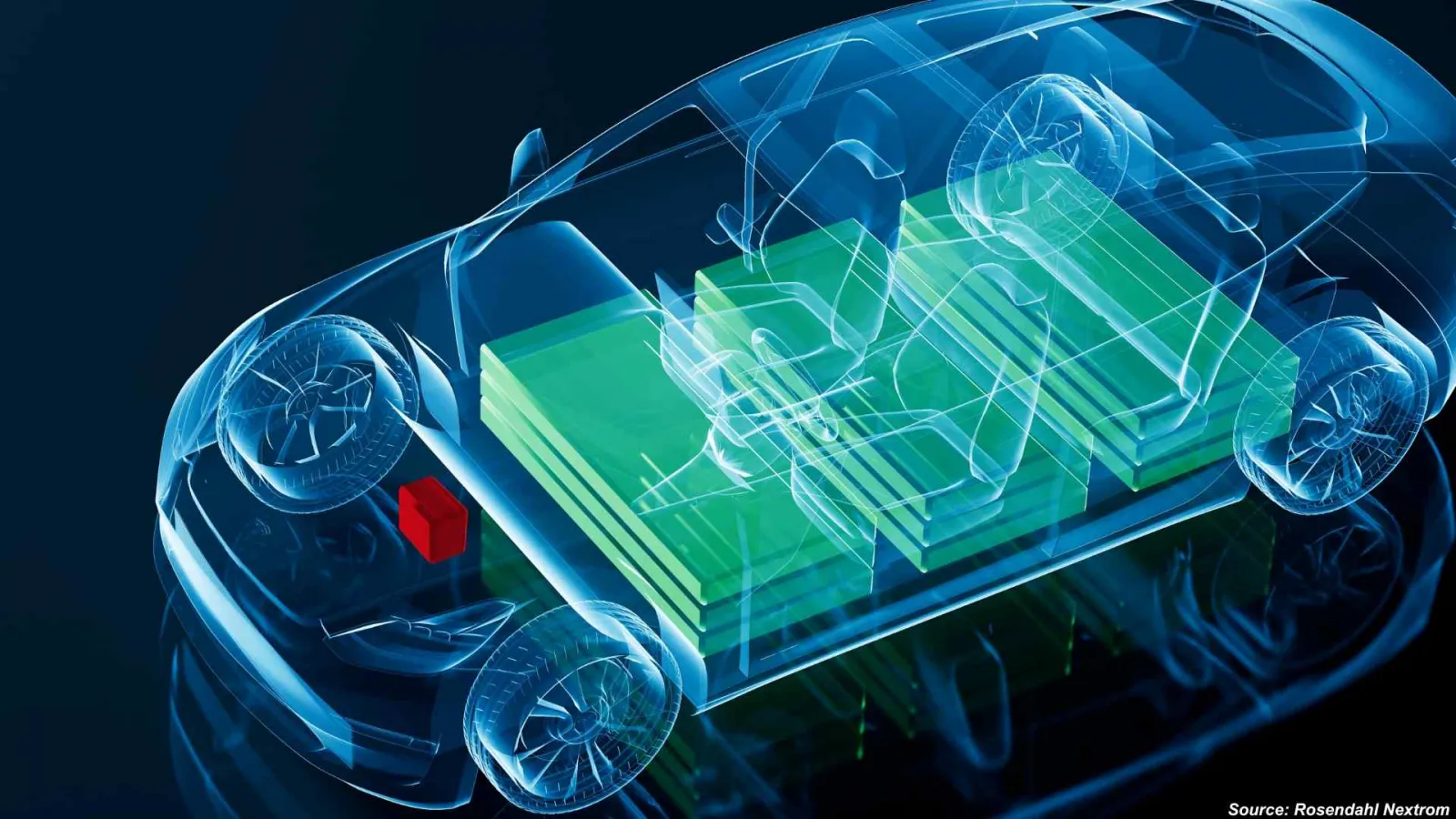
The Battery Electric Vehicle (BEV) market is currently undergoing a pivotal transformation. As the industry moves from early adoption to mass-market integration, automotive leaders are prioritizing two distinct yet complementary strategies: radical battery chemistry innovation and the aggressive localization of manufacturing infrastructure. Two major developments in February 2026-the partnership between Renault Ampere and Basquevolt, and Škoda’s significant expansion in Mladá Boleslav-illustrate exactly how the market is evolving to address range, cost, and supply chain resilience.
How Will Lithium-Metal Technology Redefine Battery Efficiency?
Innovation in battery chemistry is the primary driver for overcoming the next set of barriers to EV adoption, specifically energy density and cost. Ampere, the electric vehicle and software unit of the Renault Group, has entered into a Joint Development Agreement with the battery developer Basquevolt to accelerate the development and validation of lithium-metal-based battery technology.
This partnership focuses on the integration of polymer electrolyte technology combined with an advanced anode architecture. This approach aims to move beyond traditional liquid-electrolyte lithium-ion batteries.
Key Benefits of Lithium-Metal Technology:
-
Energy Density: Enables more compact and lightweight battery packs.
-
Thermal Stability: Offers superior resistance to high temperatures.
-
Charging Speed: Supports faster charging capabilities, a critical factor for long-term consumer convenience.
Market Impact: According to the companies, after more than a year of collaboration, this technology has already demonstrated that it can achieve high energy density while lowering overall pack costs. The simpler manufacturing process enabled by the polymer electrolyte is estimated to reduce capital investment per gigawatt-hour by approximately 30% and reduce energy consumption per kilowatt-hour produced by 30%.
Why Is Localized "Cell-to-Pack" Manufacturing a Strategic Imperative?
While R&D focuses on the future, manufacturing scale defines current competitiveness. On February 27, 2026, Škoda Auto officially opened a new battery system assembly hall at its main plant in Mladá Boleslav, Czech Republic. With an investment of €205 million, this facility now serves as the Volkswagen Group’s largest producer of battery electric vehicle systems.
This move underscores a broader shift toward "cell-to-pack" manufacturing, where battery cells are integrated directly into the pack, bypassing the need for intermediate modules.
Manufacturing Metrics at Mladá Boleslav:
-
Output: Capable of producing over 1,100 battery units per day, totaling up to 335,000 units per year.
-
Efficiency: Features an 84% automation rate using 131 industrial robots, achieving a cycle time of 60 seconds per battery system.
Market Insight: By fully insourcing the cell-to-pack process and adopting standardized lithium iron phosphate (LFP) chemistry, Škoda has achieved a 30% reduction in battery product costs compared with previous Modular Electric Drive Toolkit batteries.
Leading Players of the Market
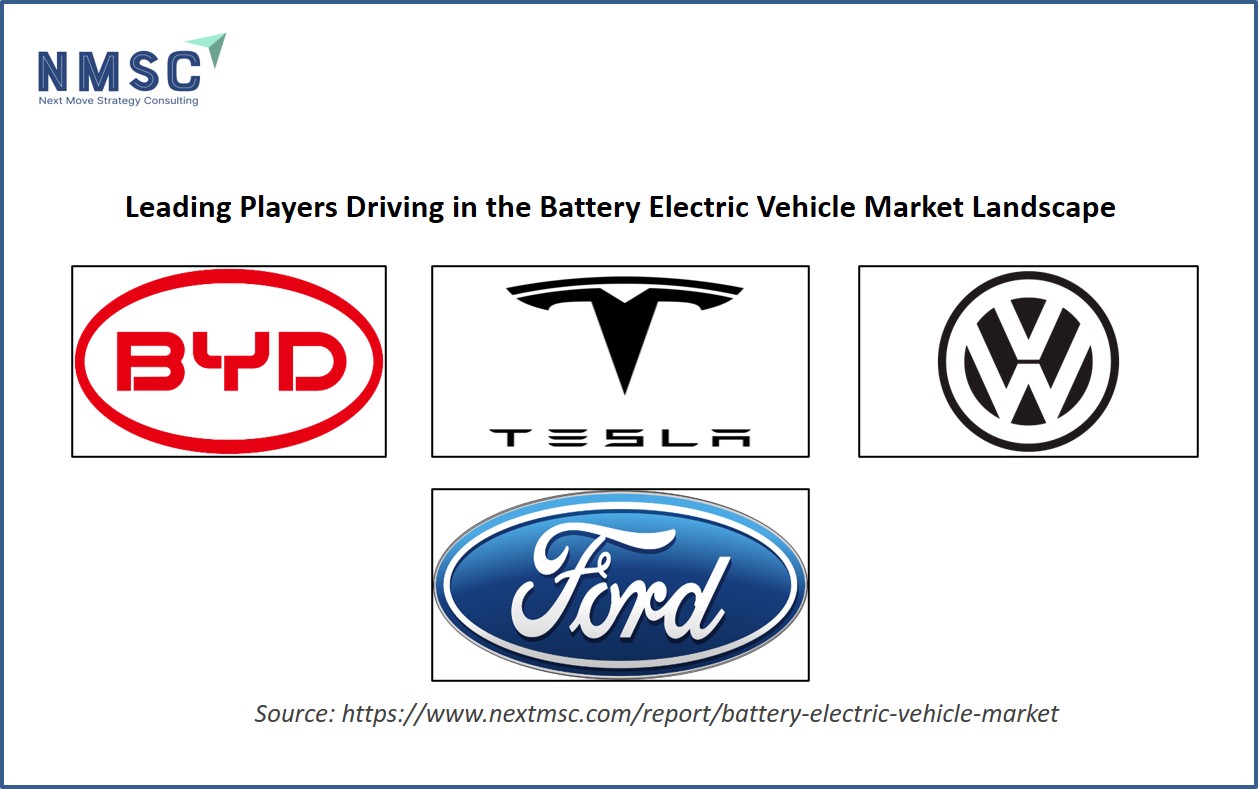
The global battery electric vehicle (BEV) market is characterized by intense competition among several dominant industry players, including BYD Company Limited, Tesla, Inc., the BMW Group, Volkswagen Group, and various other established automotive manufacturers such as General Motors, Ford, and Hyundai-Kia. These companies are currently vying for market share by scaling production, enhancing vertical supply chain integration, and expanding their global manufacturing footprints to satisfy the rapidly increasing demand for sustainable mobility solutions.
This competitive environment is being further accelerated by strategic product developments and significant capital investments aimed at long-term electrification. Major automakers are continuously expanding their BEV portfolios—ranging from compact sedans to high-performance SUVs—to target a broader consumer base and comply with tightening global emissions regulations. These efforts, supported by advancements in battery energy density and manufacturing automation, are essential for achieving the industry-wide goal of reaching price parity with internal combustion engine vehicles.
NMSC Viewpoint: Assessing the Market Maturation
From the perspective of Next Move Strategy Consulting, the Battery Electric Vehicle market in 2026 has transitioned from an incentive-driven growth phase to a period defined by operational maturity and strategic manufacturing efficiency. The industry is currently prioritizing the "commercialization of efficiency," where the primary competitive advantage is no longer just the introduction of new models, but the ability to drive down costs through vertical integration, standardized battery architectures, and localized production.
NMSC analysts note that the dual focus on next-generation chemistry- such as the lithium-metal advancements pursued by Renault Ampere-and large-scale localized assembly, as seen with Škoda, represents the most viable path toward achieving long-term price parity with internal combustion engines. By controlling the battery value chain and utilizing highly automated "cell-to-pack" processes, manufacturers are effectively insulating themselves against global supply chain volatility while simultaneously building the necessary infrastructure to scale electric mobility to meet mass-market demand.
Next Steps for Stakeholders
If you are tracking the progress of the electric vehicle market, consider the following actionable takeaways:
-
Analyze Production Efficiency Gains: Monitor whether other manufacturers adopt similar "cell-to-pack" and automation strategies to achieve the 30% cost reduction benchmark set by Škoda.
-
Evaluate Battery Chemistry Shifts: Watch for the transition of lithium-metal technology from "Pre-A" prototypes to full-scale A-sample validation as a leading indicator of future energy density shifts.
-
Assess Regional Manufacturing Capabilities: Track the geographic distribution of battery system assembly plants, as localization will remain a key defense against global supply chain volatility in 2026.
-
Monitor LFP Adoption Rates: Observe the increasing use of LFP chemistry in entry-level EV segments, as it plays a crucial role in lowering the barrier to entry for consumers.
About the Author
 Sanyukta Deb
— Sanyukta Deb is Digital Marketing Team Lead at Next Move Strategy Consulting, where she has led content strategy and technical SEO for the firm's B2B market research publications for over 2 years. Her editorial process translates NextMSC's primary and secondary research — spanning technology, industrial, and consumer sectors — into commercial narratives, backed by search-intent, keyword, and competitive analysis. She brings 5 years of overall experience in digital marketing and content strategy.
Sanyukta Deb
— Sanyukta Deb is Digital Marketing Team Lead at Next Move Strategy Consulting, where she has led content strategy and technical SEO for the firm's B2B market research publications for over 2 years. Her editorial process translates NextMSC's primary and secondary research — spanning technology, industrial, and consumer sectors — into commercial narratives, backed by search-intent, keyword, and competitive analysis. She brings 5 years of overall experience in digital marketing and content strategy.
About the Reviewer
 Debashree Dey
— Debashree Dey is Assistant Manager at Next Move Strategy Consulting, where she supports cross-vertical market content and communications across diverse industries for 6 years. Her professional background includes senior content writing, communications, and published manuscript authorship, with experience developing audience-focused business narratives and maintaining clear, consistent messaging. Her role supports research-led content development and editorial quality across NextMSC publications.
Debashree Dey
— Debashree Dey is Assistant Manager at Next Move Strategy Consulting, where she supports cross-vertical market content and communications across diverse industries for 6 years. Her professional background includes senior content writing, communications, and published manuscript authorship, with experience developing audience-focused business narratives and maintaining clear, consistent messaging. Her role supports research-led content development and editorial quality across NextMSC publications.















Add Comment