Liquid Hydrogen Storage Market Hits Commercial Scale in 2026
Introduction
The global energy transition has long promised a hydrogen economy, but 2025 and 2026 mark the moment that promise began to materialize in steel, concrete, and cryogenic engineering. In November 2025, Kawasaki Heavy Industries, Ltd. and Japan Suiso Energy, Ltd. broke ground on the Kawasaki LH2 Terminal at Ogishima — the world's first commercial-scale liquefied hydrogen import facility, anchored by what will be the world's largest 50,000 cubic meter liquid hydrogen storage tank. This single milestone encapsulates the structural shift now reshaping the liquid hydrogen storage market: the industry is no longer operating at pilot scale.
For C-level executives, institutional investors, and energy infrastructure strategists, the implications are significant. The liquid hydrogen storage market is transitioning from demonstration-phase economics to commercial-scale procurement, carrier vessel contracts, and cross-industry supply chain partnerships. According to Next Move Strategy Consulting (NMSC), the global liquid hydrogen storage market was valued at USD 2.98 billion in 2025 and is projected to reach USD 7.73 billion by 2035, expanding at a 10.0% CAGR from 2026 to 2035. Understanding the forces driving this expansion — and the risks that could constrain it — is essential for stakeholders positioning capital and strategy in this sector.
For More Information: Download FREE Sample on Liquid Hydrogen Storage Market Report
From Pilot Projects to Commercial Corridors: The Defining Trends of 2025–2026
The Kawasaki LH2 Terminal: A Commercial-Scale Inflection Point
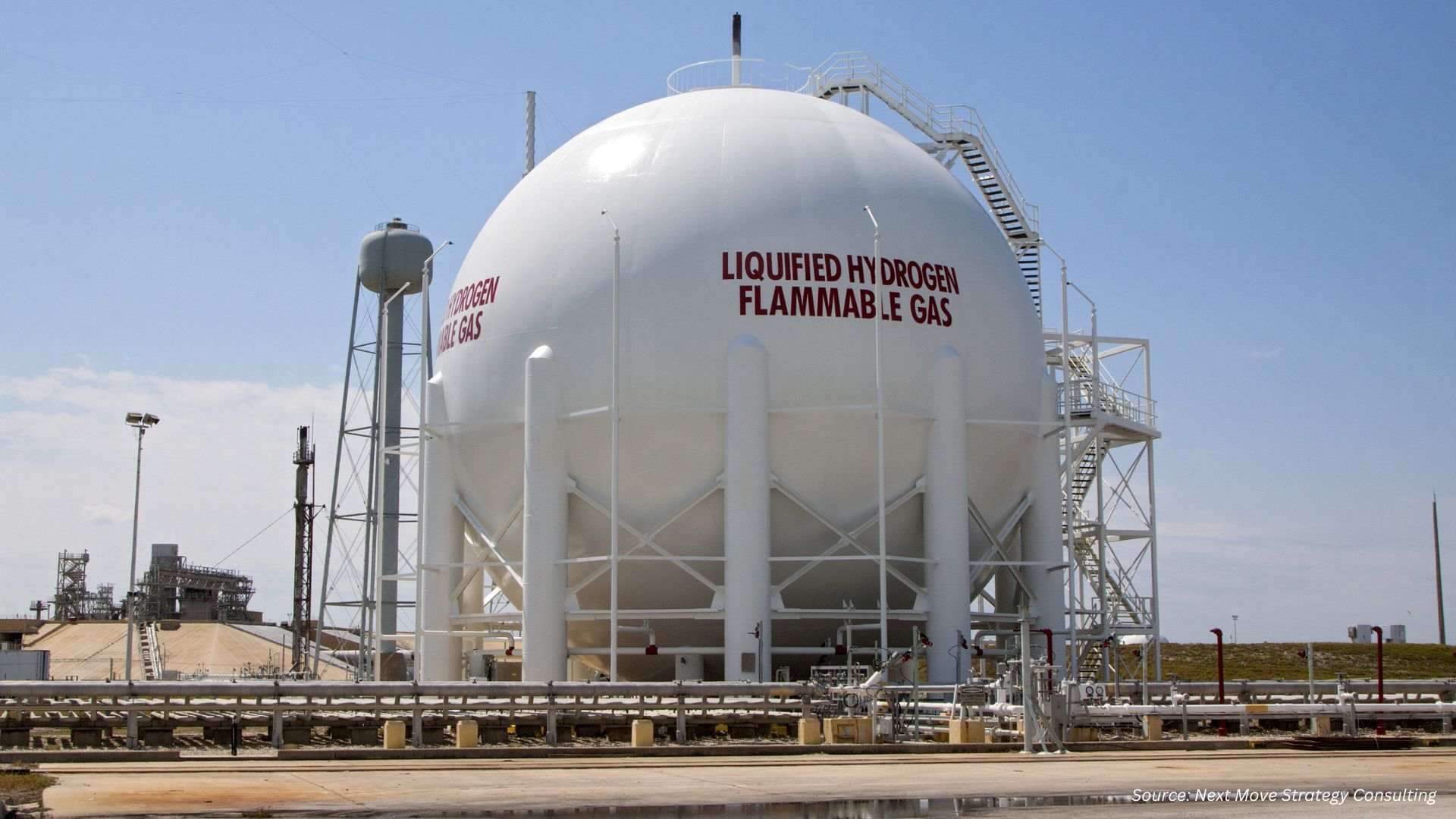
The most consequential development in the liquid hydrogen storage market over the past twelve months is the groundbreaking of the Kawasaki LH2 Terminal at Ogishima, Japan. In November 2025, Kawasaki Heavy Industries, Ltd. and Japan Suiso Energy, Ltd. formally commenced construction of what will be the world's first commercial-scale liquefied hydrogen import terminal. The terminal's centerpiece is a 50,000 cubic meter above-ground flat-bottom cylindrical liquefied hydrogen storage tank — fabricated at Kawasaki's Harima Works — representing a tenfold increase over existing commercial cryogenic hydrogen storage capacity.
This terminal development is not an isolated project. It is the physical anchor of Japan's Liquefied Hydrogen Supply Chain Commercialization Demonstration project, supported by Japan's New Energy and Industrial Technology Development Organization (NEDO) through its Green Innovation Fund. The project targets commercial operation by fiscal year 2030, establishing Japan as the world's first nation to operate a fully integrated commercial-scale liquid hydrogen import infrastructure.
Complementing the terminal, Kawasaki Heavy Industries signed a contract in January 2026 to build a 40,000 cubic meter liquefied hydrogen carrier vessel — more than 30 times the capacity of the pioneering 1,250 cubic meter Suiso Frontier vessel that completed the world's first international liquid hydrogen shipment in 2022. This capacity scaling — from pilot vessel to commercial carrier in under four years — signals that the supply chain infrastructure required to support large-volume liquid hydrogen trade is advancing at a pace that few anticipated.
The Daimler–HHLA–Kawasaki Partnership: Cross-Industry Collaboration Reshaping European Supply Chains
In October 2025, Daimler Truck, Hamburger Hafen und Logistik AG (HHLA), and Kawasaki Heavy Industries, Ltd. launched a strategic partnership to establish a liquid hydrogen supply chain for Europe, centered on the Port of Hamburg. The partnership brings together a heavy commercial vehicle manufacturer, a major port logistics operator, and the world's leading liquefied hydrogen carrier developer — a combination that reflects the multi-stakeholder coordination required to establish viable hydrogen import corridors.
This collaboration is significant for the liquid hydrogen storage market because it elevates demand for coordinated storage, transport, and onboard system development across the full supply chain. For port operators, it signals the need for marine bunkering storage infrastructure. For vehicle OEMs, it accelerates the specification of onboard liquid hydrogen storage systems for heavy-duty trucks. For cryogenic equipment manufacturers, it creates a pipeline of integrated storage package contracts spanning terminal, transport, and vehicle applications simultaneously.
The IEA's Global Hydrogen Review 2026 confirms that trade remains a key driver of low-emissions hydrogen projects, with trade-oriented offtake agreements overtaking domestic-use agreements for the first time in 2025. This structural shift toward international supply chain development directly underpins the storage infrastructure investment thesis.
Composite Tank Technology: The Enabling Innovation for Mobile Applications
Beyond large-scale stationary and marine storage, composite tank technology is emerging as a critical enabler for onboard liquid hydrogen storage in heavy transport, aerospace, and marine vessel applications. Composite construction offers significant weight advantages over conventional stainless steel and vacuum-insulated metallic designs, directly improving vehicle range and payload capacity for hydrogen-powered commercial vehicles and aircraft.
In early 2026, SpaceX's acquisition of Hexagon Purus' aerospace composite tank business underscored the strategic value of cryogenic composite tank expertise across both aerospace and commercial transport applications. Separately, a Netherlands-based consortium has been advancing cryogenic composites testing and tank designs for commercial aircraft demonstrators, reflecting the breadth of composite tank development activity across sectors.
NMSC Strategic Perspective: The Commercial-Scale Inflection and Its Market Implications
According to Next Move Strategy Consulting's analysis, the structural shift from pilot-scale demonstration to commercial-scale terminal and carrier vessel development is the defining market dynamic of the 2026–2035 forecast period. NMSC identifies expanding commercial-scale liquid hydrogen import terminal development as the primary growth driver, contributing an estimated +2.6% to the market's CAGR, followed by rising liquefied hydrogen carrier vessel capacity scaling at +2.0%.
NMSC's assessment indicates that cryogenic equipment manufacturers and hydrogen carrier developers are increasingly scaling storage tank and vessel capacity by an order of magnitude beyond pilot-project volumes — a shift that favors vendors with proven large-scale fabrication and marine cargo handling expertise over suppliers limited to smaller industrial gas applications. Suppliers unable to demonstrate credible large-scale fabrication capability and safety certification risk exclusion from commercial-scale terminal and carrier vessel contracts, which are expected to represent the highest-value procurement activity in the market through 2035.
The firm further identifies Onboard Storage Systems as the fastest-growing product segment at a 15.0% CAGR from 2026 to 2035, and Hydrogen Refueling as the fastest-growing end user industry at a 15.1% CAGR — both reflecting the downstream demand pull created by expanding hydrogen mobility infrastructure and the cross-industry partnerships now being established across Europe and Asia-Pacific.
Section Summary: The liquid hydrogen storage market is undergoing a structural transition from pilot-scale demonstration to commercial-scale infrastructure deployment, anchored by landmark milestones in Japan and cross-industry partnerships in Europe.
Key Takeaways:
-
Kawasaki Heavy Industries broke ground on the world's first commercial-scale LH2 import terminal in November 2025, featuring a 50,000 m³ storage tank — a tenfold increase over existing commercial cryogenic capacity.
-
A 40,000 m³ liquefied hydrogen carrier vessel contract was signed in January 2026, representing more than 30 times the capacity of the Suiso Frontier pilot vessel.
-
Daimler Truck, HHLA, and Kawasaki launched a strategic partnership in October 2025 to establish a European liquid hydrogen supply chain via the Port of Hamburg.
-
Composite tank technology is gaining strategic importance across aerospace and heavy transport, with SpaceX's acquisition of Hexagon Purus' aerospace composite tank business in early 2026 signaling sector-wide recognition of its value.
Industry Impact Analysis
Investment Momentum Accelerates Amid Geopolitical Pressures
The IEA's Global Hydrogen Review 2026 reports that capital spending on low-emissions hydrogen projects reached nearly USD 7 billion in 2025, nearly double the 2024 level and equivalent to 0.7% of global investment in energy supply. Investment in electrolysis is expected to account for approximately 70% of nearly USD 10 billion in projected hydrogen investment in 2026, reflecting accelerating electrolyzer deployment and the growing pipeline of green hydrogen production projects that will require liquid hydrogen storage infrastructure downstream.
The geopolitical context is also shaping investment priorities. The IEA's 2026 review highlights that the ongoing conflict in the Middle East has disrupted global production and trade of hydrogen-based products, with the region accounting for more than one-quarter of global ammonia trade and close to 45% of methanol trade. These supply chain disruptions are accelerating government interest in diversifying hydrogen supply through new international trade corridors — a dynamic that directly supports investment in liquid hydrogen storage and transport infrastructure as an alternative to ammonia and methanol-based carrier pathways.
Global Hydrogen Demand Surpasses 100 Million Tonnes
Global hydrogen demand surpassed 100 million tonnes in 2025, driven primarily by growth in traditional industrial and refining applications. Low-emissions hydrogen production grew by 20% in 2025 to reach almost 1 Mt, and is expected to exceed 1% of global production for the first time in 2026. Global installed electrolysis capacity doubled in 2025 to exceed 4 GW, with China accounting for nearly three-quarters of new installations.
This production growth trajectory has direct implications for the liquid hydrogen storage market. As green hydrogen production scales, the need for efficient, large-volume storage and transport solutions intensifies. Liquid hydrogen offers a volumetric energy density advantage over compressed gas storage at ambient temperature, making it the preferred carrier for long-distance international trade — particularly for routes where pipeline infrastructure is not viable.
Regulatory Frameworks and Policy Support
Japan's High Pressure Gas Safety Act and national hydrogen strategy roadmaps are increasingly shaping large-scale storage tank certification and terminal development requirements. In Europe, the EU Renewable Energy Directive's targets for renewable fuels of non-biological origin (RFNBO) in transport are driving forward projects, particularly for use in refining, though implementation has been slow.
The IEA recommends that governments expedite deployment of hydrogen infrastructure by removing regulatory barriers, introducing efficient permitting processes, and improving coordination among authorities to reduce lead times. For the liquid hydrogen storage market, regulatory harmonization — particularly around cryogenic tank certification standards and marine cargo handling safety codes — remains a critical enabler of commercial-scale deployment.
Section Summary: The liquid hydrogen storage market is being shaped by accelerating investment, surging global hydrogen demand, geopolitical supply chain disruptions, and evolving regulatory frameworks that collectively reinforce the strategic case for commercial-scale liquid hydrogen infrastructure.
Key Takeaways:
-
Capital spending on low-emissions hydrogen projects nearly doubled to USD 7 billion in 2025, per the IEA Global Hydrogen Review 2026, with investment expected to approach USD 10 billion in 2026.
-
Global hydrogen demand exceeded 100 Mt in 2025, with low-emissions hydrogen production growing 20% year-on-year to approach 1 Mt.
-
Middle East supply chain disruptions — affecting over 25% of global ammonia trade and 45% of methanol trade — are accelerating government interest in diversifying hydrogen trade through liquid hydrogen corridors.
-
Regulatory harmonization around cryogenic tank certification and marine safety codes remains a critical enabler for commercial-scale deployment across all major regions.
Pros and Cons of Recent Market Developments
|
Development |
Pros |
Cons |
|
Commercial-scale LH2 terminal development (Kawasaki Ogishima, Nov 2025) |
Establishes world-first commercial import infrastructure; anchors long-term large-volume storage demand; validates large-scale cryogenic tank fabrication at 50,000 m³ |
High capital expenditure; long development timelines to FY2030 operation; dependent on sustained government subsidy programs such as Japan's Green Innovation Fund |
|
40,000 m³ carrier vessel contract (Kawasaki, Jan 2026) |
Scales international LH2 trade capacity by more than 30x; compresses supply chain development timelines; creates large-volume onboard and integrated storage demand |
High liquefaction energy penalty exceeding 30% of hydrogen's energy content; competing carrier technologies (ammonia, LOHC) offer more mature, lower-cost transport alternatives |
|
Daimler–HHLA–Kawasaki European supply chain partnership (Oct 2025) |
Accelerates European LH2 corridor development; creates integrated demand across terminal, transport, and onboard storage segments; strengthens OEM procurement pipelines |
Regulatory fragmentation across EU member states; slow RFNBO policy implementation; infrastructure permitting delays in key European markets |
|
Composite tank technology adoption for onboard applications |
Reduces onboard storage weight; improves vehicle range and payload capacity; enables aerospace and marine vessel applications |
Low technology readiness for large-scale composite cryotanks; extended safety certification timelines; higher unit cost compared with conventional metallic designs |
|
IEA-confirmed investment doubling in 2025 |
Signals institutional confidence in the sector; accelerates project pipelines; supports cost reduction through scale |
Venture capital for hydrogen fell to 4% of energy VC in 2025 (down from 13% peak in 2023); offtake agreements remain insufficient to unlock large-scale investment; demand creation remains the critical missing piece |
Key Data & Statistics
Liquid Hydrogen Storage Market – Segment Sizing by Product (2025 vs. 2035)
|
Product Segment |
2025 Market Size |
2035 Market Size |
CAGR (2026–2035) |
|
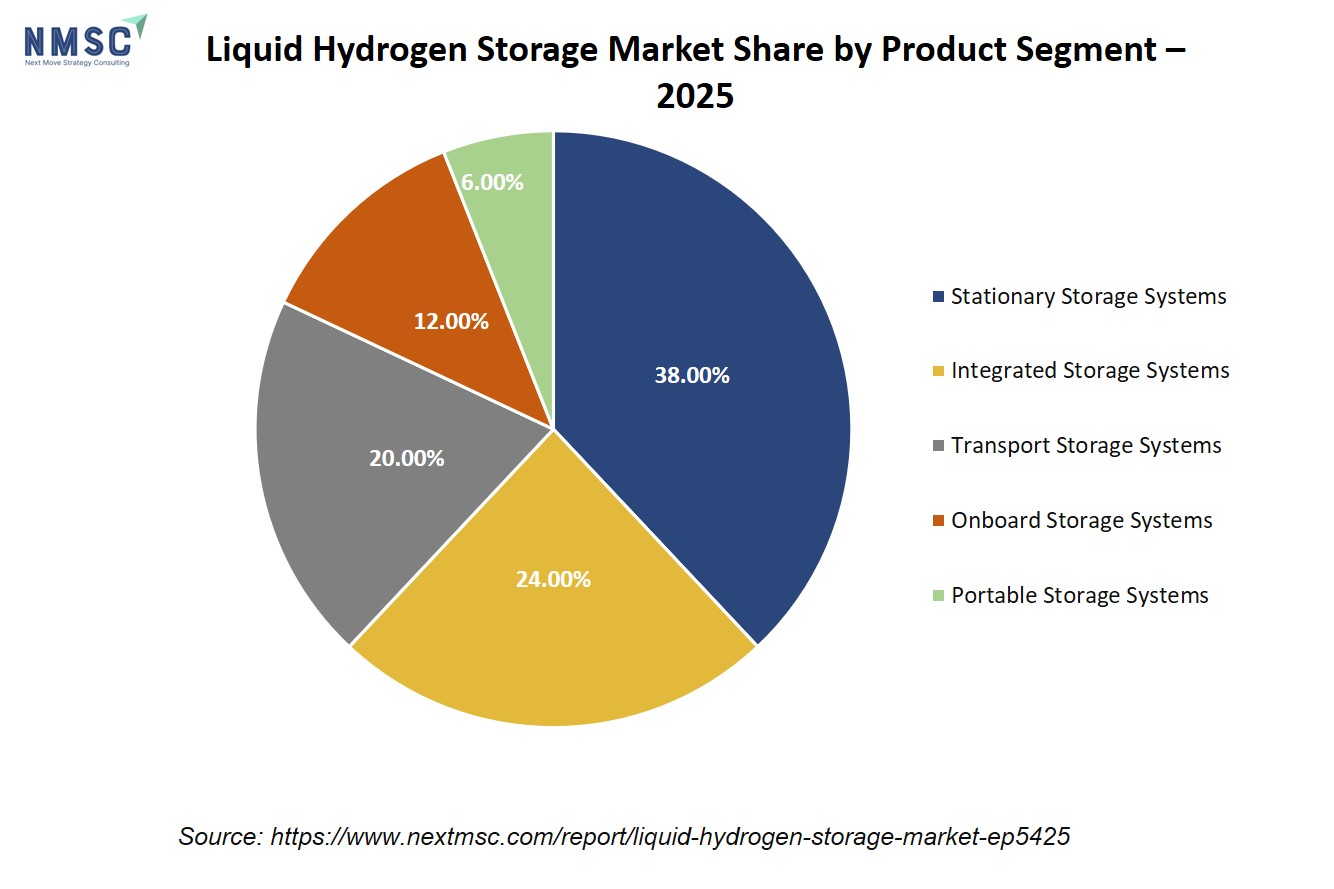
Stationary Storage Systems |
USD 1.13 Billion |
USD 2.68 Billion |
9.0% |
|
Integrated Storage Systems |
USD 0.72 Billion |
USD 1.84 Billion |
10.0% |
|
Transport Storage Systems |
USD 0.60 Billion |
USD 1.46 Billion |
9.4% |
|
Onboard Storage Systems |
USD 0.36 Billion |
USD 1.37 Billion |
15.0% |
|
Portable Storage Systems |
USD 0.18 Billion |
USD 0.38 Billion |
7.7% |
|
Total |
USD 2.98 Billion |
USD 7.73 Billion |
10.0% |
Liquid Hydrogen Storage Market – Regional Outlook (2025 vs. 2035)
|
Region |
2025 Market Size |
2035 Market Size |
CAGR (2026–2035) |
Key Driver |
|
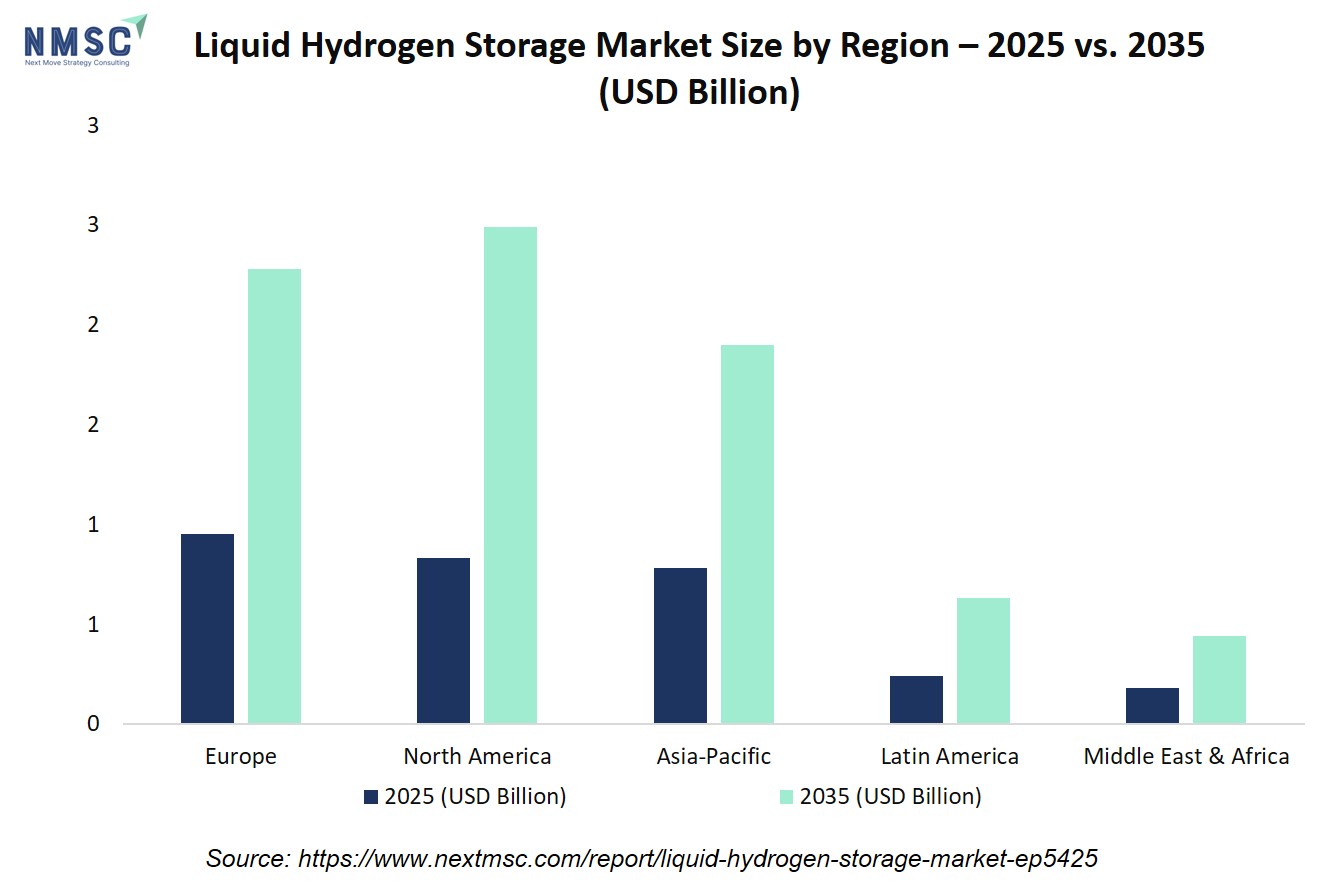
North America |
USD 0.95 Billion |
USD 2.28 Billion |
9.1% |
Established industrial gas infrastructure and growing hydrogen refueling investment |
|
Asia-Pacific |
USD 0.83 Billion |
USD 2.49 Billion |
11.8% |
Commercial-scale terminal and carrier vessel development in Japan and China |
|
Europe |
USD 0.78 Billion |
USD 1.90 Billion |
9.4% |
National hydrogen strategy programs and cross-industry supply chain partnerships |
|
Middle East & Africa |
USD 0.24 Billion |
USD 0.63 Billion |
10.4% |
Government-backed hydrogen export ambitions and industrial diversification investment |
|
Latin America |
USD 0.18 Billion |
USD 0.44 Billion |
9.4% |
Expanding industrial gas demand and emerging hydrogen infrastructure investment |
|
Total |
USD 2.98 Billion |
USD 7.73 Billion |
10.0% |
— |
Future Outlook & Forecast
NMSC Market Forecast: USD 7.73 Billion by 2035
According to Next Move Strategy Consulting, the global liquid hydrogen storage market is projected to expand from USD 3.25 billion in 2026 to USD 7.73 billion by 2035, at a 10.0% CAGR. This represents an absolute dollar opportunity of USD 4.48 billion between 2026 and 2035, with above-average growth concentrated in Asia-Pacific (11.8% CAGR), Onboard Storage Systems (15.0% CAGR), and Hydrogen Refueling end users (15.1% CAGR).
Asia-Pacific is the fastest-growing region, propelled by Japan's commercial-scale terminal and carrier vessel development and China's expanding hydrogen production investment. Japan is the fastest-growing country at a 13.5% CAGR, supported by Kawasaki Heavy Industries' Ogishima terminal project and the well-established regulatory framework of Japan's High Pressure Gas Safety Act. India follows closely at a 12.5% CAGR, driven by expanding industrial gas capacity and government hydrogen mission support, including domestic cryogenic manufacturers such as INOX India Limited.
By tank construction, Composite is the fastest-growing sub-segment at a 14.9% CAGR from 2026 to 2035, as weight-sensitive onboard applications increasingly specify composite construction over conventional metallic designs. Multi-Layer Vacuum Insulated construction retains the largest share, valued at USD 894 million in 2025, on its superior thermal performance for minimizing boil-off across both stationary and transport applications.
IEA Outlook: Infrastructure Investment as the Critical Enabler
The IEA's Global Hydrogen Review 2026 identifies infrastructure deployment as the critical enabler for hydrogen trade scale-up. Announced hydrogen pipeline projects exceed 40,000 km by 2035, though only 9% of this length is operational or has committed investment. For liquid hydrogen specifically, the IEA notes that shipping implies minimum costs of approximately USD 2/kg H₂ and energy use above 10 kWh/kg H₂ — equivalent to over 30% of hydrogen's energy content — due to intensive liquefaction and reconversion steps. Reducing this energy penalty through technological innovation in liquefaction efficiency and boil-off management is a key priority for the industry through 2035.
The IEA further projects that committed low-emissions hydrogen projects with strong potential to be operational by 2030 stand at just above 6 Mt, with around 80% targeting chemicals, refining, and low-emissions fuel production — applications where liquid hydrogen storage infrastructure will be essential.
Key Risks to Monitor
NMSC identifies three primary risks to the liquid hydrogen storage market's growth trajectory through 2035:
-
High liquefaction energy penalty limiting cost competitiveness versus alternative hydrogen carriers such as ammonia and liquid organic hydrogen carriers (LOHC), contributing an estimated -1.4% drag on CAGR.
-
Low technology readiness of large-scale composite cryotanks, which could slow commercial-scale deployment timelines for onboard and marine applications, contributing an estimated -1.0% drag on CAGR.
-
Competition from alternative hydrogen carrier technologies, particularly ammonia, which offers more mature, lower-cost transport infrastructure for long-distance trade, contributing an estimated -0.6% drag on CAGR.
Section Summary: The liquid hydrogen storage market is on a sustained growth trajectory through 2035, anchored by commercial-scale terminal development in Japan, expanding onboard storage adoption, and growing hydrogen refueling infrastructure globally — with Asia-Pacific leading regional growth and composite tank technology driving the fastest segment expansion.
Key Takeaways:
-
NMSC projects the market to reach USD 7.73 billion by 2035 at a 10.0% CAGR, representing a USD 4.48 billion absolute dollar opportunity from 2026 to 2035.
-
Asia-Pacific is the fastest-growing region at 11.8% CAGR; Japan leads country-level growth at 13.5% CAGR, driven by the Kawasaki LH2 Terminal project.
-
Onboard Storage Systems (15.0% CAGR) and Hydrogen Refueling (15.1% CAGR) are the fastest-growing product and end-user segments respectively, reflecting expanding hydrogen mobility infrastructure.
-
The IEA estimates liquid hydrogen shipping costs at a minimum of USD 2/kg H₂, with energy use exceeding 30% of hydrogen's energy content — reducing this penalty through liquefaction efficiency innovation is a critical technology priority through 2035.
Next Steps for Stakeholders
For Cryogenic Equipment Manufacturers and Tank Fabricators:
Prioritize investment in large-scale fabrication capability and marine cargo handling expertise. The commercial-scale terminal and carrier vessel procurement cycle now underway in Japan — and anticipated in Europe — will favor suppliers with demonstrated capacity to fabricate 10,000–50,000 m³ storage tanks and validated safety certification under national regulatory frameworks. Early positioning in terminal equipment package contracts will be critical to capturing premium contract value as national hydrogen strategy programs move terminal projects from demonstration toward commercial operation.
For Heavy Transport OEMs and Vehicle Manufacturers:
Accelerate composite onboard tank certification programs. The Daimler–HHLA–Kawasaki European supply chain partnership signals that liquid hydrogen will be a viable fuel pathway for heavy-duty commercial vehicles within this decade. OEMs that validate composite tank safety and durability performance for heavy-duty applications will differentiate with fleet operators and benefit from expanding hydrogen truck adoption as refueling infrastructure scales. NMSC identifies Vehicle OEMs as the fastest-growing customer type at a 14.2% CAGR from 2026 to 2035.
For Port Operators and Logistics Companies:
Evaluate marine bunkering storage system requirements and engage with terminal developers early. The Port of Hamburg's involvement in the Daimler–HHLA–Kawasaki partnership illustrates the strategic value of port operators in liquid hydrogen supply chain development. Ports that develop validated ship-to-shore transfer and bunkering storage capability can secure first-mover positioning as maritime decarbonization regulations accelerate hydrogen fuel adoption. NMSC identifies the Marine end-user segment as growing at a 12.0% CAGR from 2026 to 2035.
For Institutional Investors and Financial Analysts:
Focus capital allocation on suppliers combining large-scale fabrication capability with proven safety certification, as these vendors are best positioned to capture above-market growth in the Onboard Storage Systems and Hydrogen Refueling categories. Monitor Japan's Green Innovation Fund disbursements and NEDO project milestones as leading indicators of commercial-scale terminal procurement activity. The IEA's confirmation that capital spending on low-emissions hydrogen projects nearly doubled to USD 7 billion in 2025 supports a constructive medium-term investment thesis for the sector.
For Policy Makers and Regulatory Authorities:
Prioritize regulatory harmonization around cryogenic tank certification standards and marine cargo handling safety codes. The IEA recommends expediting hydrogen infrastructure deployment by removing regulatory barriers, introducing efficient permitting processes, and improving coordination among authorities to reduce lead times. Governments should also update hydrogen strategies and long-term deployment targets to reflect changing market realities and the new opportunities arising from heightened energy security concerns — particularly in the context of Middle East supply chain disruptions.
Conclusion
The liquid hydrogen storage market has reached a defining inflection point in 2026. The groundbreaking of the Kawasaki LH2 Terminal at Ogishima, the signing of a 40,000 m³ carrier vessel contract, and the launch of the Daimler–HHLA–Kawasaki European supply chain partnership collectively signal that the industry has moved beyond demonstration-phase economics into commercial-scale infrastructure development. These milestones are not isolated events — they are the leading edge of a structural transformation that will reshape cryogenic equipment procurement, marine cargo handling, and hydrogen mobility infrastructure through 2035.
According to Next Move Strategy Consulting, the global liquid hydrogen storage market is projected to grow from USD 3.25 billion in 2026 to USD 7.73 billion by 2035 at a 10.0% CAGR, with the highest growth concentrated in Asia-Pacific, Onboard Storage Systems, and Hydrogen Refueling applications. The IEA's confirmation that global hydrogen investment nearly doubled to USD 7 billion in 2025 reinforces the institutional momentum behind this trajectory. For stakeholders across the value chain — from cryogenic equipment manufacturers and port operators to vehicle OEMs and institutional investors — the strategic imperative is clear: position now for commercial-scale procurement cycles that are already underway, and build the fabrication, certification, and partnership capabilities required to compete in a market that is scaling rapidly and with structural permanence.
About the Author
 Sanyukta Deb
— Sanyukta Deb is Digital Marketing Team Lead at Next Move Strategy Consulting, where she has led content strategy and technical SEO for the firm's B2B market research publications for over 2 years. Her editorial process translates NextMSC's primary and secondary research — spanning technology, industrial, and consumer sectors — into commercial narratives, backed by search-intent, keyword, and competitive analysis. She brings 5 years of overall experience in digital marketing and content strategy.
Sanyukta Deb
— Sanyukta Deb is Digital Marketing Team Lead at Next Move Strategy Consulting, where she has led content strategy and technical SEO for the firm's B2B market research publications for over 2 years. Her editorial process translates NextMSC's primary and secondary research — spanning technology, industrial, and consumer sectors — into commercial narratives, backed by search-intent, keyword, and competitive analysis. She brings 5 years of overall experience in digital marketing and content strategy.
About the Reviewer
 Debashree Dey
— Debashree Dey is Assistant Manager at Next Move Strategy Consulting, where she supports cross-vertical market content and communications across diverse industries for 6 years. Her professional background includes senior content writing, communications, and published manuscript authorship, with experience developing audience-focused business narratives and maintaining clear, consistent messaging. Her role supports research-led content development and editorial quality across NextMSC publications.
Debashree Dey
— Debashree Dey is Assistant Manager at Next Move Strategy Consulting, where she supports cross-vertical market content and communications across diverse industries for 6 years. Her professional background includes senior content writing, communications, and published manuscript authorship, with experience developing audience-focused business narratives and maintaining clear, consistent messaging. Her role supports research-led content development and editorial quality across NextMSC publications.
















Add Comment