IoT Energy Management Market: 5 Powerful Trends Shaping 2026 and Beyond
Introduction
The global energy economy is undergoing one of its most consequential structural shifts in decades — and the IoT Energy Management Market sits at the precise intersection of every force driving that transformation. From binding regulatory mandates and surging AI-driven electricity demand to the accelerating digitalization of power grids and the proliferation of connected devices, the conditions for sustained, high-velocity market growth have never been more firmly established.
Organizations across every sector — industrial manufacturers, commercial real estate operators, data center hyperscalers, and utilities — are confronting a shared imperative: manage energy consumption with greater precision, transparency, and automation than legacy systems can deliver. IoT-enabled energy management platforms, combining real-time sensor data, cloud-based analytics, artificial intelligence, and edge computing, are emerging as the definitive operational response to this challenge.
According to Next Move Strategy Consulting (NMSC), the global IoT energy management market is projected to reach USD 157.21 billion by 2030, expanding at a CAGR of 15.83% between 2025 and 2030. This trajectory is not speculative — it is anchored in verifiable regulatory timelines, measurable technology adoption curves, and the documented energy demands of the AI era. The following analysis examines the five most consequential trends shaping this market in 2026 and the strategic implications for enterprise decision-makers and institutional investors.
For More Information: Download FREE Sample on IoT Energy Management Market Report
Five Powerful Forces Reshaping the IoT Energy Management Market in 2026
1. The EU Energy Efficiency Directive Enters Its Most Consequential Enforcement Phase
The single most impactful regulatory development for the global IoT energy management market in 2026 is the active enforcement of the revised EU Energy Efficiency Directive (EU/2023/1791). Having been transposed into national law across EU member states by October 2025, the directive's most material corporate obligations are now legally enforceable — and they are directly accelerating enterprise adoption of IoT-based energy management systems at scale.
The directive sets a binding target of reducing the EU's final energy consumption by at least 11.7% compared to 2020 projections for 2030. In 2024, the EU used 20% less energy than it did in 2006, according to Eurostat — a benchmark that underscores the effectiveness of sustained policy intervention, while simultaneously raising the bar for what must be achieved in the years ahead.
From October 2026, companies with annual energy consumption above 10 terajoules (TJ) are required to conduct mandatory, independent energy audits. By October 2027, organizations consuming above 85 TJ annually must implement certified energy management systems — such as ISO 50001 — or an equivalent nationally recognized scheme. The directive also enshrines the "energy efficiency first" principle as a legally binding obligation, requiring companies to document that energy efficiency solutions were assessed before any major capital investment or capacity expansion.
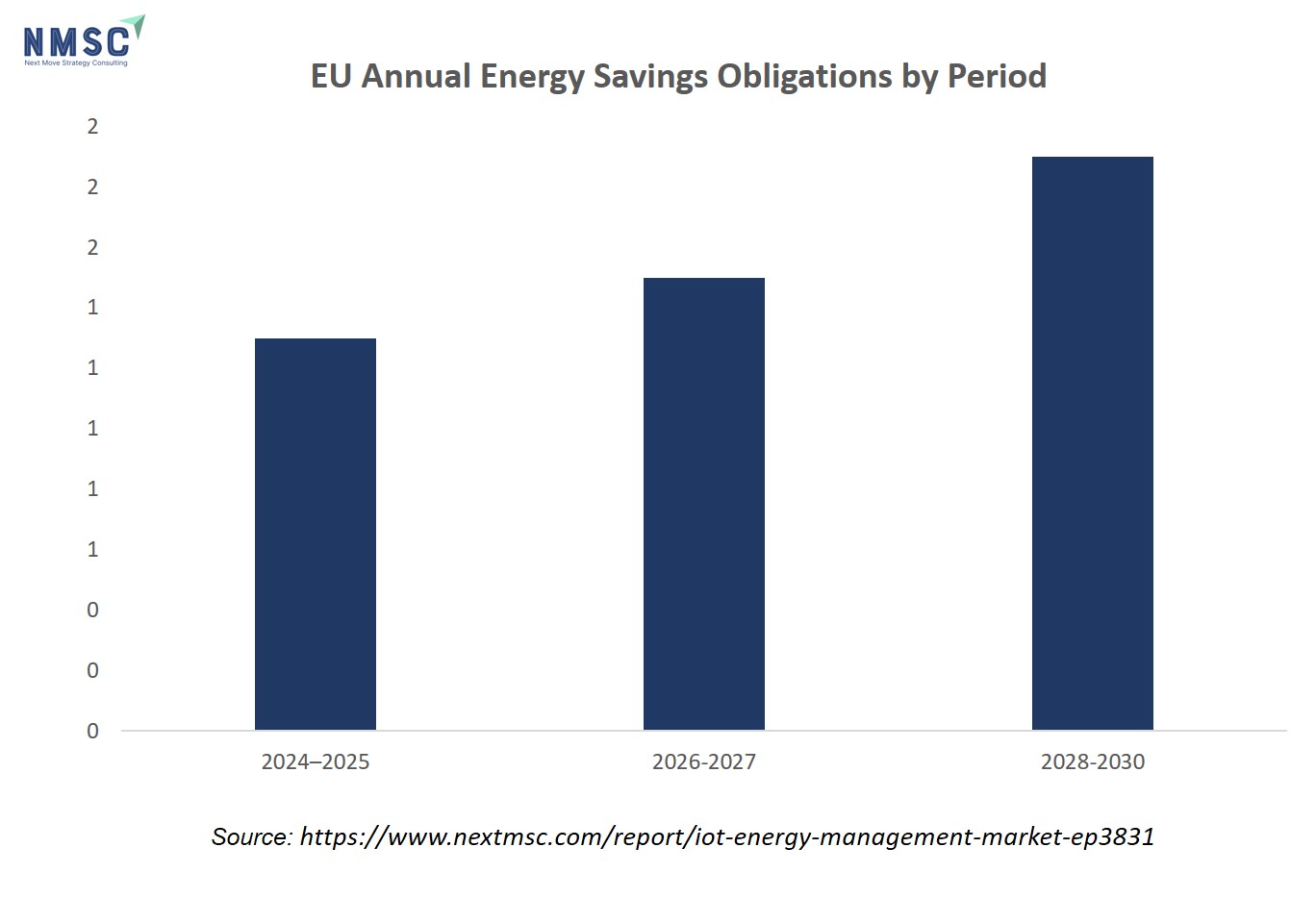
Annual energy savings obligations are structured as follows: member states must achieve 1.3% annual final energy savings in 2024–2025, rising to 1.5% in 2026–2027, and 1.9% in 2028–2030. Industries most directly affected include manufacturing, chemicals, food processing, logistics, data centers, and utilities — precisely the sectors where IoT-based energy monitoring and automation deliver the most measurable returns.
Additionally, the European Commission has confirmed that a Data Centre Energy Efficiency Package is planned for the third quarter of 2026, which will introduce further reporting and performance requirements for digital infrastructure operators across the EU.
2. Schneider Electric's EcoCare Launch Signals a New Era of AI-Driven Building Energy Management
In a landmark product development that directly reflects the maturation of the IoT energy management market, Schneider Electric on June 5, 2026, launched EcoCare for Building Management Systems (BMS) — an AI-driven continuous monitoring service designed to deliver real-time operational intelligence for modern commercial and institutional facilities.
EcoCare combines continuous IoT-based monitoring, AI-driven analytics, and both remote and on-site technical support to enable facility teams to identify and resolve operational issues before they escalate into disruptions. According to Schneider Electric, the service can reduce facility energy use by 25%, improve system operational efficiency by 30%, reduce occupant complaints by 60%, and reduce system downtime by 45% compared to traditional reactive maintenance operations.
The launch is strategically significant for several reasons. First, it demonstrates that the world's leading energy management companies are now embedding AI as a core operational layer within IoT platforms — not as an add-on feature, but as the primary intelligence engine. Second, it validates the commercial viability of continuous, data-driven energy management as a service model, which lowers the barrier to adoption for mid-sized commercial operators who lack in-house technical expertise. Third, it signals that the competitive frontier in the IoT energy management market is shifting from hardware connectivity to AI-powered analytics and managed service delivery.
"The old model of reactive maintenance just doesn't work anymore," said Tyler Haak, Vice President of Services and Digital Buildings in the U.S. for Schneider Electric. "Facility teams are expected to keep buildings running, manage issues as they arise and do more with fewer resources — they need real-time visibility and predictive insights to stay ahead."
3. Grid Investment Must Rise 50% by 2030 — IoT Is the Enabling Technology
The IEA's Electricity 2026 report identifies grid infrastructure as an emerging critical bottleneck in the global energy transition. Over 2,500 GW of renewable, large-load, and storage projects are currently stalled in grid connection queues worldwide. Meeting electricity demand through 2030 will require annual grid investment to increase by approximately 50% by 2030 from today's USD 400 billion.
Global electricity demand is forecast to increase at an average annual rate of 3.6% over the 2026–2030 period — faster than any comparable period in recent history. IoT-enabled grid-enhancing technologies — including dynamic line rating (DLR), advanced power flow control (APFC), topology optimization, and storage as a transmission asset — are identified by the IEA as near-term solutions capable of unlocking 450–700 GW of additional grid capacity from projects currently stalled in connection queues, at significantly lower cost and lead time than new infrastructure construction.
4. AI-Driven Data Center Energy Demand Creates an Urgent New Market Segment
The explosive growth of artificial intelligence infrastructure is creating an entirely new category of energy management urgency. The IEA projects that electricity consumption from data centers will roughly double from 485 TWh in 2025 to approximately 950 TWh by 2030. Global data center electricity demand grew 17% in 2025, with AI-focused facilities surging 50% in the same period. The largest technology companies contributed to data center investment exceeding USD 400 billion in 2025 alone.
For hyperscalers and enterprise data center operators, IoT-enabled energy management systems are no longer optional — they are operationally essential. Real-time power usage monitoring, automated cooling optimization, and AI-driven load balancing are becoming standard requirements for facilities seeking to manage both cost and regulatory exposure simultaneously.
5. Connected Device Proliferation Expands the Addressable Market at Scale
The global IoT device ecosystem is expanding at a pace that directly amplifies the addressable market for energy management solutions. The number of globally connected IoT devices is projected to grow from 18.8 billion in 2024 to 36.5 billion by 2029 — nearly doubling within five years. In the United States alone, the number of smart homes grew steadily from 54.1 million in 2021 to 58.4 million in 2025, reflecting sustained consumer adoption of connected energy management devices at the residential level. Each additional connected device represents both a data source and a controllable energy asset, expanding the scope and granularity of what IoT energy management platforms can monitor and optimize.
NMSC Strategic Perspective: Convergence as the Defining Market Dynamic
From NMSC's analytical standpoint, the five trends outlined above are not independent forces — they are converging into a single, self-reinforcing growth dynamic. Regulatory mandates create a compliance-driven baseline of demand. AI infrastructure growth creates an innovation-driven premium segment. Grid modernization requirements create a capital-intensive infrastructure deployment cycle. Connected device proliferation expands the addressable market continuously. And industry leaders such as Schneider Electric are demonstrating, through concrete product launches, that the technology to serve all of these demand vectors simultaneously is commercially available today.
NMSC's research indicates that the hardware segment — encompassing energy meters, sensors, gateways, and control devices — is expected to lead market growth in 2025, driven by the accelerating deployment of smart grid infrastructure and building automation systems. The cellular connectivity segment, particularly 5G-enabled architectures, is emerging as the backbone for real-time data transfer between distributed energy assets and cloud management platforms. The energy monitoring and automation application segment dominates the market due to growing demand for real-time visibility and intelligent control of energy use across all end-user categories.
Section Summary: The IoT energy management market in 2026 is being shaped by five concurrent, mutually reinforcing forces: EU regulatory enforcement, AI-driven product innovation from market leaders, grid investment imperatives, data center energy urgency, and connected device proliferation. Together, these dynamics are compressing the adoption timeline for IoT energy management solutions across all geographies and end-user segments.
Key Takeaways:
-
From October 2026, EU companies consuming above 10 TJ annually face mandatory independent energy audits; those above 85 TJ must implement certified energy management systems by October 2027.
-
Schneider Electric's EcoCare (launched June 2026) demonstrates that AI-driven continuous BMS monitoring can reduce facility energy use by 25% and downtime by 45%.
-
IEA projects annual grid investment must rise ~50% by 2030 from today's USD 400 billion, with IoT-based grid-enhancing technologies unlocking 450–700 GW of stalled capacity.
-
Global data center electricity demand is projected to double from 485 TWh (2025) to ~950 TWh by 2030, creating a high-urgency new segment for IoT energy management.
Industry Impact Analysis
Smart Grid Modernization: IoT as the Operational Backbone
The proliferation of IoT sensors and connected metering infrastructure is fundamentally transforming how electricity grids are managed. The IEA's Electricity 2026 report confirms that grid-enhancing technologies — many of which are IoT-dependent — represent the most cost-effective and rapidly deployable tools available to system operators facing record-level connection queue backlogs. Dynamic line rating, for example, can increase grid capacity by 20–30% with an implementation lead time of just one to two years, at a fraction of the cost of new transmission infrastructure.
Demand response and load management — a core application segment in the IoT energy management market — enables utilities and large industrial consumers to dynamically adjust energy consumption in response to grid signals, price fluctuations, and renewable energy availability. This capability is becoming increasingly critical as the share of variable renewable energy sources in national grids continues to expand.
Industrial Automation and Predictive Asset Management
In the industrial sector, IoT energy management is delivering measurable operational value through asset and equipment optimization. Connected sensors embedded in manufacturing equipment, HVAC systems, and industrial motors enable predictive maintenance — identifying inefficiencies and potential failures before they result in costly downtime or energy waste. Siemens' energy flexibility services, powered by AI and IoT technology, have demonstrated up to 30% peak demand reduction in industrial deployments.
For industrial operators facing mandatory energy audits under the EU directive, IoT-based asset monitoring provides the granular, real-time data required to satisfy compliance documentation requirements while simultaneously generating operational cost savings.
Renewable Energy Integration and Virtual Power Plants
The integration of distributed renewable energy resources — rooftop solar, battery storage, and wind assets — into broader grid management frameworks is creating a new frontier for IoT energy management. Platforms capable of aggregating and optimizing distributed energy resources (DERs) in real time are enabling the emergence of virtual power plants (VPPs), which can participate in wholesale energy markets and provide grid balancing services.
In May 2025, Enel X Taiwan announced a collaboration with Micron Technology to support Taiwan's renewable energy transition through Enel X's commercial and industrial VPP platform — a concrete example of how IoT-enabled energy management is being deployed at the enterprise level to advance both sustainability and energy security objectives.
Smart Cities and Urban Energy Infrastructure
Governments across Asia-Pacific, the Middle East, and Europe are investing heavily in smart city programs that place IoT-based energy management at their operational core. India's Smart Cities Mission and Digital India programs are driving adoption of IoT monitoring and control systems across urban infrastructure. China's large-scale smart city initiatives, combined with national carbon neutrality goals, are accelerating deployment of AI-integrated energy management platforms across industrial and commercial sectors.
Cybersecurity: The Primary Adoption Constraint
Despite the strong growth trajectory, data privacy and cybersecurity concerns remain a material constraint on adoption velocity. IoT energy systems collect and transmit large volumes of sensitive operational data across interconnected networks. The absence of universally standardized security protocols, combined with the inherent vulnerabilities of legacy connected devices, creates risk exposure that is deterring some organizations — particularly in critical infrastructure sectors — from accelerating deployment. The EU Cybersecurity Act and related regulatory frameworks are beginning to address this gap, but full harmonization across member states remains a work in progress.
Section Summary: The IoT energy management market is generating measurable impact across smart grid modernization, industrial automation, renewable energy integration, and smart city development. Cybersecurity remains the primary structural constraint, but regulatory frameworks are progressively closing the gap.
Key Takeaways:
-
IEA-identified grid-enhancing IoT technologies can unlock 450–700 GW of stalled renewable capacity globally at significantly lower cost than new infrastructure.
-
Siemens' AI and IoT-powered energy flexibility services have demonstrated up to 30% peak demand reduction in industrial environments.
-
VPP platforms are enabling enterprises to participate directly in wholesale energy markets through aggregated DER management.
-
Smart city programs in India, China, and the Middle East are creating large-scale, government-backed demand for IoT energy management infrastructure.
EU Energy Efficiency Directive — Key Corporate Compliance Milestones (2026–2030)
|
Timeline |
Obligation |
Consumption Threshold |
Primary Affected Sectors |
|
October 2026 |
Mandatory independent energy audits |
Annual consumption > 10 TJ |
Manufacturing, logistics, food processing, data centers, utilities |
|
October 2027 |
Certified energy management systems (ISO 50001 or equivalent) |
Annual consumption > 85 TJ |
Heavy industry, data centers, large logistics, utilities |
|
2026–2027 |
Annual final energy savings obligation |
1.5% per year (member state level) |
All regulated industries; cascades to industrial and commercial users |
|
2028–2030 |
Elevated annual energy savings obligation |
1.9% per year (member state level) |
All regulated industries; intensified enforcement expected |
|
2026 onward |
Energy efficiency first principle (legally binding) |
All major investment decisions |
All regulated industries and publicly funded projects |
|
Q3 2026 |
Data Centre Energy Efficiency Package (planned) |
IT power demand thresholds |
Data centers and digital infrastructure operators across the EU |
Future Outlook & Forecast
Market Trajectory: From USD 75.40 Billion in 2025 to USD 157.21 Billion by 2030
According to NMSC's proprietary research, the global IoT energy management market is positioned for sustained, high-velocity growth over the forecast period of 2025 to 2030. The market, valued at USD 75.40 billion in 2025, is projected to more than double to USD 157.21 billion by 2030, representing a CAGR of 15.83%. This growth trajectory is underpinned by three structural forces: regulatory mandates, technological convergence, and the accelerating digitalization of energy infrastructure across all major geographies.
Regional Growth Dynamics
North America remains a leading market, driven by federal and state-level clean energy initiatives, significant investment in smart grid modernization, and the presence of major technology providers including Schneider Electric, Honeywell, Microsoft, and IBM. The U.S. smart home market grew from 54.1 million units in 2021 to 58.4 million in 2025, reflecting sustained consumer adoption of connected energy management devices at the residential level.
Europe is experiencing regulatory-driven acceleration, with the EU Energy Efficiency Directive creating a compliance-based demand floor across industrial, commercial, and data center sectors. The European Green Deal and ongoing smart city programs are further reinforcing investment in grid digitalization and IoT-enabled monitoring infrastructure. The Commission's post-2030 energy efficiency framework, scheduled for publication in Q4 2026, signals that regulatory pressure will intensify further beyond the current directive's scope.
Asia-Pacific represents the highest-growth regional opportunity, driven by rapid urbanization, industrial expansion, and government-led smart city programs in China, India, Japan, South Korea, and Australia. China's national carbon neutrality goals and India's Smart Cities Mission are creating large-scale, policy-backed demand for IoT energy management infrastructure.
Middle East & Africa is gaining momentum through rapid urbanization, infrastructure development, and government initiatives promoting renewable energy and smart city projects in the UAE, Saudi Arabia, and South Africa.
Competitive Landscape: Platform Consolidation and AI Integration
The competitive landscape is dominated by global technology conglomerates and specialized energy management innovators. Schneider Electric's EcoStruxure, Siemens' Building X and MindSphere, and Honeywell's Connected Buildings platform represent the leading integrated IoT energy management offerings, combining hardware, software, and AI-driven analytics in end-to-end solutions. In September 2025, Siemens was recognized as a Leader in the 2025 Gartner Magic Quadrant for Industrial IoT Platforms, reflecting the company's strong execution in IIoT, edge computing, AI, and energy digitalization.
Mergers and acquisitions are emerging as a primary growth strategy, with leading firms acquiring AI analytics startups, cloud-based monitoring platforms, and smart grid technology providers to accelerate portfolio expansion and market reach. Technology giants including Microsoft (Azure IoT), IBM (Watson IoT), Intel, and Cisco are strengthening the competitive landscape through cloud computing, edge analytics, cybersecurity infrastructure, and AI-powered decision-making platforms.
Section Summary: The IoT energy management market is on a clear, data-supported trajectory toward USD 157.21 billion by 2030. Regional growth is broad-based, with Europe driven by regulatory compliance, Asia-Pacific by urbanization and smart city investment, and North America by technology innovation and clean energy policy. The competitive landscape is consolidating around integrated AI-IoT platform providers while remaining open to specialized innovators.
Key Takeaways:
-
The global IoT energy management market will grow at a CAGR of 15.83% between 2025 and 2030, per NMSC, reaching USD 157.21 billion.
-
Global IoT connected devices will nearly double from 18.8 billion (2024) to 36.5 billion by 2029, continuously expanding the addressable market.
-
Europe's post-2030 energy efficiency framework, scheduled for Q4 2026, signals that regulatory demand for IoT energy management will intensify beyond the current directive's scope.
-
M&A activity is accelerating as market leaders seek to consolidate AI analytics, cloud platforms, and grid-edge capabilities into unified, scalable offerings.
Next Steps for Stakeholders
For C-Level Executives and Enterprise Decision-Makers:
1. Conduct an immediate energy consumption audit. Organizations operating in EU member states with annual energy consumption above 10 TJ face mandatory audit obligations from October 2026. Proactive compliance preparation reduces regulatory risk and identifies efficiency opportunities ahead of enforcement deadlines. Companies should map their consumption against directive thresholds now and schedule independent audits well in advance.
2. Prioritize ISO 50001 certification readiness. Large energy consumers approaching the 85 TJ threshold should begin assessing their readiness for certified energy management system implementation well in advance of the October 2027 deadline. Early adoption provides a competitive advantage and reduces compliance bottlenecks as enforcement intensifies across EU member states.
3. Integrate IoT energy management into capital expenditure governance. The EU's "energy efficiency first" principle now requires documented assessment of energy efficiency solutions before major investment decisions. Embedding IoT-based monitoring and analytics into the capital planning process ensures both regulatory compliance and long-term cost optimization.
4. Evaluate AI-integrated energy management platforms. The convergence of AI, edge computing, and IoT connectivity is enabling a new generation of predictive, autonomous energy management capabilities. Executives should assess vendor offerings from established leaders — including Schneider Electric (EcoCare, EcoStruxure), Siemens (Building X), Honeywell, and IBM — as well as emerging innovators in demand response and VPP management.
5. Address cybersecurity as a strategic prerequisite. Before scaling IoT energy management deployments, organizations must ensure that connected systems are protected by standards-aligned security architectures. Cybersecurity investment should be treated as a foundational requirement, not an afterthought, particularly in critical infrastructure and utility environments.
For Institutional Investors:
6. Target high-growth application segments. Smart buildings, industrial automation, and renewable energy integration represent the highest-return application areas within the IoT energy management market. Investment theses should prioritize companies with scalable, cloud-native platforms and demonstrated interoperability with existing grid infrastructure.
7. Monitor regulatory developments in Asia-Pacific. As China, India, and South Korea intensify their smart city and carbon neutrality programs, the regulatory environment in Asia-Pacific is expected to increasingly mirror the EU's compliance-driven demand model — creating a second wave of policy-accelerated market growth.
8. Assess cybersecurity capabilities as a valuation differentiator. Companies with robust, standards-aligned security architectures will command premium valuations and stronger enterprise customer retention in a market where data privacy concerns remain the primary adoption barrier.
Conclusion
The IoT energy management market stands at a decisive inflection point in 2026. The simultaneous activation of the EU Energy Efficiency Directive's enforcement obligations, the exponential growth of AI-driven energy demand, the IEA-documented imperative to increase global grid investment by 50% by 2030, and the near-doubling of globally connected IoT devices are creating a structural demand environment that is both durable and accelerating. Industry leaders such as Schneider Electric are already delivering commercially proven AI-IoT solutions — EcoCare's June 2026 launch being the most recent evidence — that demonstrate the technology's capacity to deliver measurable, quantifiable operational value.
Organizations that treat IoT-based energy management as a strategic capability — rather than a compliance checkbox — will be best positioned to capture the operational, financial, and reputational benefits that intelligent energy optimization delivers. With the market projected to reach USD 157.21 billion by 2030 at a CAGR of 15.83%, the investment case is compelling across the entire value chain — from hardware manufacturers and connectivity providers to software platform developers and energy service integrators.
The convergence of regulatory pressure, technological innovation, and sustainability imperatives is not a temporary market condition. It is the defining architecture of the global energy economy for the decade ahead.
About the Author
 Sanyukta Deb
— Sanyukta Deb is Digital Marketing Team Lead at Next Move Strategy Consulting, where she has led content strategy and technical SEO for the firm's B2B market research publications for over 2 years. Her editorial process translates NextMSC's primary and secondary research — spanning technology, industrial, and consumer sectors — into commercial narratives, backed by search-intent, keyword, and competitive analysis. She brings 5 years of overall experience in digital marketing and content strategy.
Sanyukta Deb
— Sanyukta Deb is Digital Marketing Team Lead at Next Move Strategy Consulting, where she has led content strategy and technical SEO for the firm's B2B market research publications for over 2 years. Her editorial process translates NextMSC's primary and secondary research — spanning technology, industrial, and consumer sectors — into commercial narratives, backed by search-intent, keyword, and competitive analysis. She brings 5 years of overall experience in digital marketing and content strategy.
About the Reviewer
 Debashree Dey
— Debashree Dey is Assistant Manager at Next Move Strategy Consulting, where she supports cross-vertical market content and communications across diverse industries for 6 years. Her professional background includes senior content writing, communications, and published manuscript authorship, with experience developing audience-focused business narratives and maintaining clear, consistent messaging. Her role supports research-led content development and editorial quality across NextMSC publications.
Debashree Dey
— Debashree Dey is Assistant Manager at Next Move Strategy Consulting, where she supports cross-vertical market content and communications across diverse industries for 6 years. Her professional background includes senior content writing, communications, and published manuscript authorship, with experience developing audience-focused business narratives and maintaining clear, consistent messaging. Her role supports research-led content development and editorial quality across NextMSC publications.

















Add Comment