Medical Drones in 2026: Redefining Healthcare Delivery Systems
Introduction: A New Era for Medical Drones Market
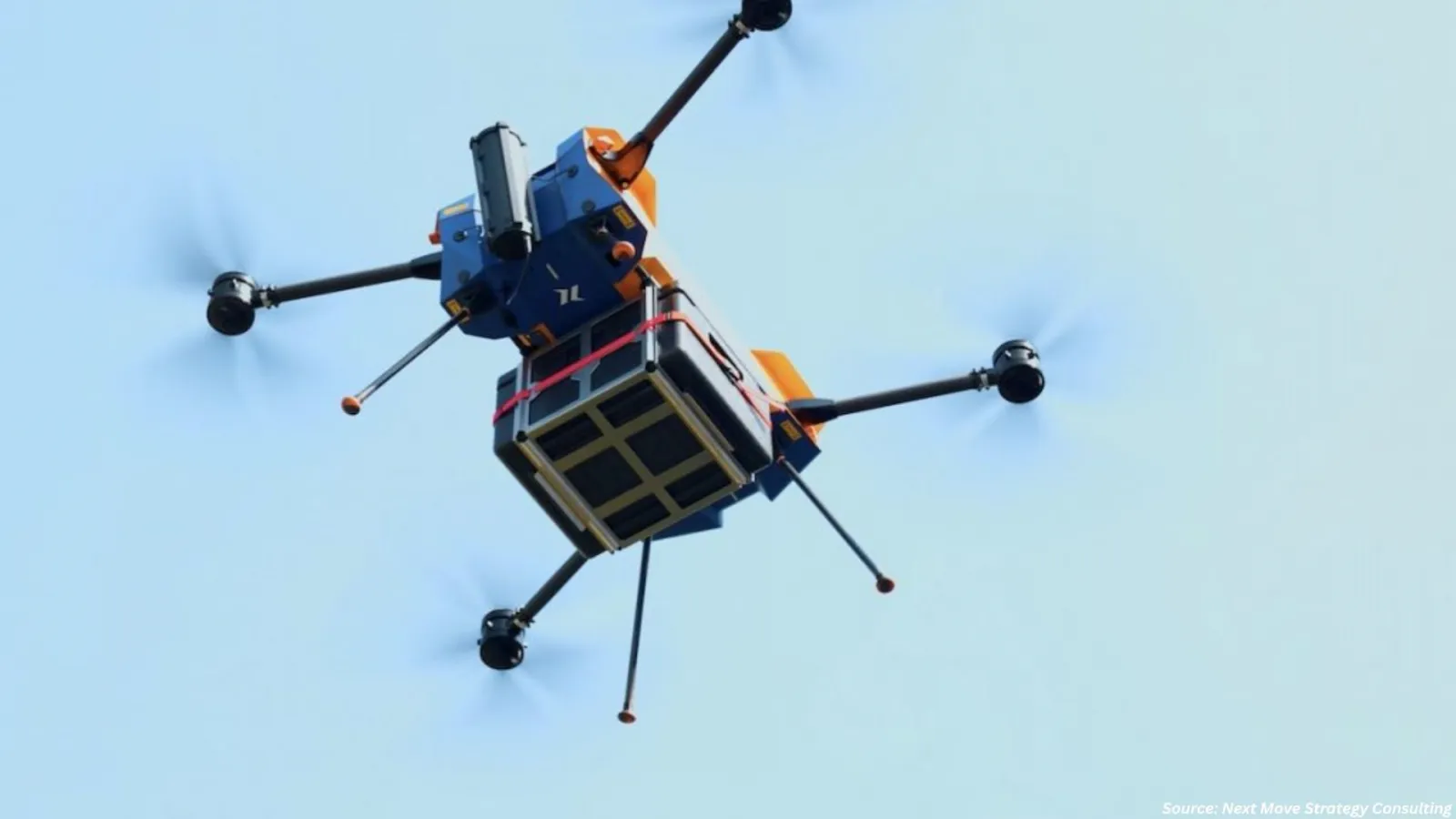
The Medical Drones Market is entering a practical deployment phase in 2026, shifting from pilot projects to real-world healthcare logistics. Recent developments in the United States and Africa demonstrate how drone-based delivery is improving access to medicines, reducing delivery time, and strengthening healthcare infrastructure.
Two major developments highlight this transition:
-
Drone delivery routes between Springfield and St. Louis in the United States
-
Medicine delivery programs launched in Uganda to reach underserved areas
These initiatives signal a growing reliance on unmanned aerial systems for critical healthcare supply chains.
The medical drones market is moving beyond experimentation into operational deployment. This transition indicates a shift toward scalable, infrastructure-backed drone ecosystems, particularly in regions where traditional logistics face limitations.
Medical Drones Market Expansion Through Urban Connectivity
One of the most notable 2026 developments is the launch of medical drone operations between Springfield and St. Louis.
Key Highlights
-
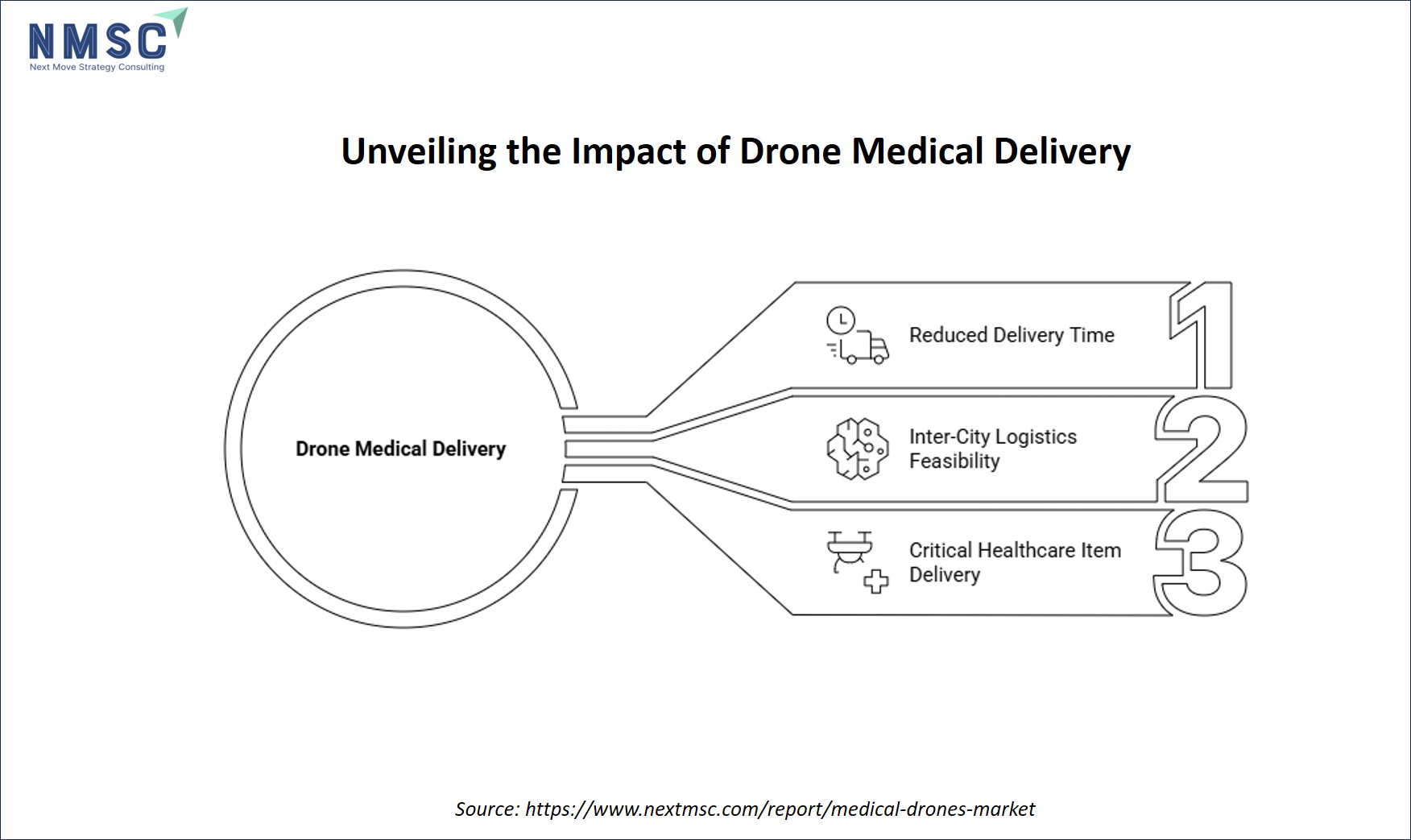
Drones are being used to transport medical supplies between cities
-
The initiative focuses on reducing delivery time for critical healthcare items
-
The route demonstrates the feasibility of inter-city drone logistics
Why It Matters
Traditional ground transport often faces delays due to traffic, infrastructure limitations, and distance. Drone-based delivery offers:
-
Faster response times
-
Reduced dependency on road networks
-
Increased efficiency for time-sensitive deliveries
Use Case Table: Urban Drone Delivery Benefits
|
Factor |
Traditional Logistics |
Medical Drones |
|
Delivery Time |
High variability |
Significantly reduced |
|
Accessibility |
Road dependent |
Air-based access |
|
Emergency Response |
Limited speed |
Rapid deployment |
Urban drone corridors represent a foundational shift in healthcare logistics, and analysis from Next Move Strategy Consulting indicates that the ability to establish reliable inter-city routes reflects the simultaneous maturation of regulatory frameworks and operational technologies.
Medical Drones Market Driving Rural Healthcare Access
Another major development in 2026 is the use of drones to deliver medicines in Uganda, particularly in remote and underserved areas.
Key Highlights
-
Drones are actively delivering medicines to communities with limited healthcare access
-
The initiative addresses logistical challenges in rural regions
-
It supports faster delivery of essential medical supplies
Impact on Healthcare Systems
Rural healthcare systems often struggle with:
-
Poor infrastructure
-
Long delivery times
-
Limited access to essential medicines
Drone deployment helps overcome these barriers by:
-
Bypassing difficult terrain
-
Ensuring consistent supply chains
-
Enhancing healthcare reach
The adoption of drones in rural healthcare highlights their role as equalizers in global healthcare access, and our observations at Next Move Strategy Consulting indicate that markets with infrastructure gaps are likely to adopt drone technology faster than developed regions due to immediate value realization.
Technology Enablers Behind Medical Drone Growth
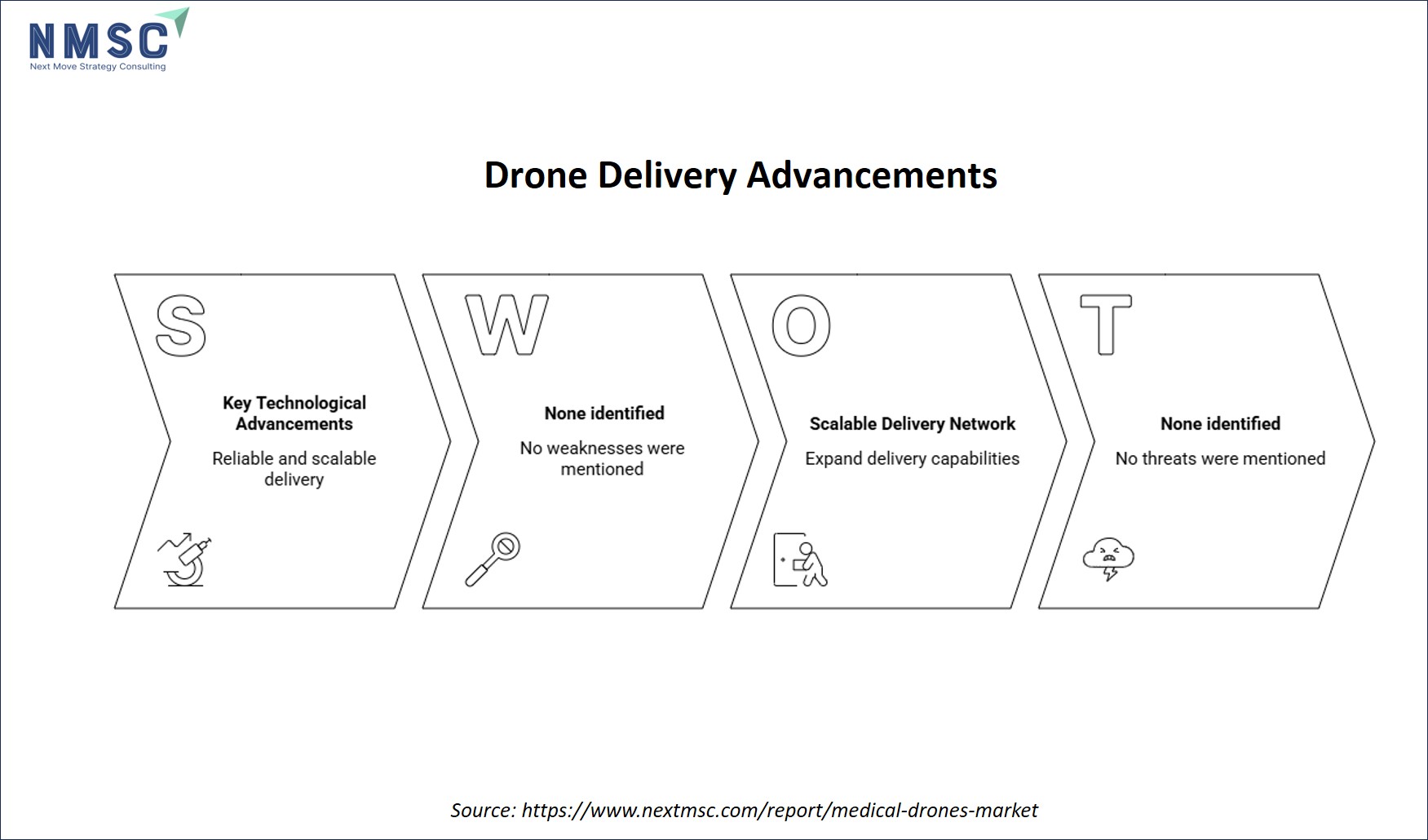
The success of these initiatives is supported by advancements in drone technology and ecosystem integration.
Key Enablers
-
Improved battery efficiency enabling longer flight ranges
-
Enhanced navigation systems for precise delivery
-
Integration with healthcare supply chain systems
These advancements make drone delivery more reliable and scalable.
Operational Workflow
-
Medical supplies are prepared at a central facility
-
Drone is programmed with delivery coordinates
-
Autonomous or semi-autonomous flight is executed
-
Supplies are delivered to designated drop points
Technology is no longer the primary constraint in the medical drones market, and our observations at Next Move Strategy Consulting indicate that the focus is now shifting toward operational scalability, regulatory alignment, and integration with existing healthcare systems.
Challenges in the Medical Drones Market
Despite strong progress, several challenges remain:
Key Challenges
-
Regulatory approvals across regions
-
Airspace management and safety concerns
-
High initial investment costs
-
Weather-related operational risks
These factors can slow down large-scale adoption if not addressed effectively.
Regulatory harmonization will be a critical determinant of market growth. Regions that establish clear policies and airspace frameworks will lead in drone-based healthcare innovation.
According to Next Move Strategy Consulting: Industry Impact
According to Next Move Strategy Consulting, these 2026 developments indicate a strong transformation in the medical drones market characterized by:
-
Transition from pilot projects to operational deployment
-
Expansion of drone logistics across both urban and rural environments
-
Increasing role of drones in strengthening healthcare supply chains
-
Growing investment interest in drone-based healthcare infrastructure
The combined impact of these trends suggests that medical drones are becoming an essential component of modern healthcare delivery systems rather than a supplementary solution.
Next Steps for Stakeholders
To capitalize on emerging opportunities in the medical drones market, stakeholders should focus on:
-
Invest in Infrastructure: Develop drone hubs and logistics networks to support scalable operations
-
Strengthen Regulatory Collaboration: Work with authorities to create clear and supportive drone policies
-
Focus on High-Impact Use Cases: Prioritize emergency delivery and rural healthcare applications
-
Integrate with Healthcare Systems: Ensure seamless connection between drone operations and hospital supply chains
-
Enhance Technology Reliability: Invest in weather-resistant and long-range drone capabilities
Conclusion
The medical drones market in 2026 is witnessing a clear shift toward real-world implementation. From inter-city delivery routes in the United States to rural healthcare support in Uganda, drones are redefining how medical supplies are transported.
As technology matures and regulatory frameworks evolve, medical drones are expected to play a critical role in building faster, more resilient, and more inclusive healthcare systems worldwide.
The market is entering a phase where execution matters more than innovation. Companies that focus on scalability, partnerships, and regulatory alignment will emerge as leaders in the evolving medical drones ecosystem.
About the Author
 Sanyukta Deb
— Sanyukta Deb is Digital Marketing Team Lead at Next Move Strategy Consulting, where she has led content strategy and technical SEO for the firm's B2B market research publications for over 2 years. Her editorial process translates NextMSC's primary and secondary research — spanning technology, industrial, and consumer sectors — into commercial narratives, backed by search-intent, keyword, and competitive analysis. She brings 5 years of overall experience in digital marketing and content strategy.
Sanyukta Deb
— Sanyukta Deb is Digital Marketing Team Lead at Next Move Strategy Consulting, where she has led content strategy and technical SEO for the firm's B2B market research publications for over 2 years. Her editorial process translates NextMSC's primary and secondary research — spanning technology, industrial, and consumer sectors — into commercial narratives, backed by search-intent, keyword, and competitive analysis. She brings 5 years of overall experience in digital marketing and content strategy.
About the Reviewer
 Debashree Dey
— Debashree Dey is Assistant Manager at Next Move Strategy Consulting, where she supports cross-vertical market content and communications across diverse industries for 6 years. Her professional background includes senior content writing, communications, and published manuscript authorship, with experience developing audience-focused business narratives and maintaining clear, consistent messaging. Her role supports research-led content development and editorial quality across NextMSC publications.
Debashree Dey
— Debashree Dey is Assistant Manager at Next Move Strategy Consulting, where she supports cross-vertical market content and communications across diverse industries for 6 years. Her professional background includes senior content writing, communications, and published manuscript authorship, with experience developing audience-focused business narratives and maintaining clear, consistent messaging. Her role supports research-led content development and editorial quality across NextMSC publications.

















Add Comment