Expert Insights: Where Will Acne Medication Market Be in 5 Years? | NextMSC
Introduction
On May 22, 2026, the U.S. Food and Drug Administration approved Differin Epiduo Acne Gel, a fixed combination of adapalene 0.1% and benzoyl peroxide 2.5%, for over-the-counter use by people aged 12 years and older. In its statement of the same day, the agency described the gel as the first FDA-approved over-the-counter acne treatment with two active ingredients. Galderma, the manufacturer, stated in its press release of May 22, 2026 that the product was the first stable, fixed-dose prescription acne treatment to pair benzoyl peroxide with a retinoid. Medscape reported on May 27, 2026 that U.S. availability was planned for the summer of 2026, while the product remains prescription-only outside the United States.
According to Next Move Strategy Consulting's Acne Medication Market report, the global acne medication market was valued at USD 10.08 billion in 2021 and is projected to reach USD 14.26 billion by 2030, growing at a CAGR of 3.02%. A market advancing at that measured pace is not short of demand. The question for executives is where, and through which channel, that demand will be served as a prescription-strength regimen moves onto the pharmacy shelf.
For More Information: Download FREE Sample on Acne Medication Market Report
That question frames the five-year view in this analysis. NextMSC's modelled horizon ends in 2030, so the outlook below stays inside that period and does not extrapolate a figure beyond it. Within that window, the acne medication market is being reshaped by four developments from the last several months: the over-the-counter switch, the European launch of a first-in-class topical, the relaxation of isotretinoin dispensing rules in the United States, and a rising global disease burden. The sections that follow set out the evidence and its implications.
From Prescription to Pharmacy Shelf: How the Acne Medication Market Is Being Rebalanced After the FDA's OTC Decision
The Over-the-Counter Switch: What Changed on May 22, 2026
The approval moves a regimen that dermatology guidelines favour into a retail setting. Galderma stated in its May 22, 2026 press release that the retinoid and benzoyl peroxide combination aligns with guidelines that strongly recommend using both together as a first-line, multimodal approach. Medscape, citing Galderma, reported on May 27, 2026 that phase 3 studies found the combination superior to each ingredient alone, including a 2009 study of 1,670 individuals in which once-daily use outperformed either ingredient and the vehicle at 12 weeks. Epiduo Forte, the higher-strength version with 0.3% adapalene and 2.5% benzoyl peroxide approved in July 2015, remains prescription-only, according to the same Medscape report.
Clinical performance data published after the approval point the same way. The Skin Therapy Letter, in its July-August 2026 drug update, reported that inflammatory lesions fell by up to 70% by week 12 and that a reduction of about 65% in total lesions was maintained over 12 months in long-term studies, with improvement visible as early as week 1.
The commercial mechanism is access. Before the switch, a teenager or adult who wanted a retinoid and benzoyl peroxide in a single tube needed a clinic visit and a prescription, and the FDA's own description of the new product as the first approved over-the-counter option with two active ingredients shows how narrow the retail range had been. Removing the prescription step moves the first purchase decision from the dermatologist's office to the pharmacy aisle and the online basket.
Galderma placed the approval inside a wider lifecycle strategy. In its first-half 2026 results of July 23, 2026, the company reported Therapeutic Dermatology net sales of USD 848 million, up 67.9% at constant currency, and stated that it remains committed to its mature Therapeutic Dermatology portfolio through geographic launches and lifecycle management of its molecules, even in the face of strong generic pressures. It named the over-the-counter approval of Differin Epiduo as a recent example of that approach. The same release recorded group net sales of USD 3.134 billion, growth of 24.6% at constant currency, and a raised full-year guidance of 19% to 21%.
A First-in-Class Topical Reaches Europe
A second development runs in the opposite direction, toward novelty rather than access. On June 11, 2026, Cosmo Pharmaceuticals announced that its partner Glenmark Specialty, a subsidiary of Glenmark Pharmaceuticals, had begun direct launches of Winlevi (clascoterone 10 mg/g cream) in several European markets, including the Nordics, Central and Eastern Europe and Spain. Cosmo noted that the cream is authorised in the European Union for acne vulgaris in adults and adolescents, that Cosmo remains its exclusive manufacturer, and that the company regards it as the first topical acne therapy in more than 40 years with a first-in-class mechanism of action.
The commercial signal is already visible. In its half-year report of July 23, 2026, Cosmo stated that recurring revenues from Winlevi rose 38% year on year, and that it is advancing a 5% clascoterone topical solution for androgenetic alopecia toward regulatory submission after completing its Phase III programme. The extension of an acne molecule into hair loss shows how a single dermatology approval can anchor a wider franchise.
Isotretinoin Dispensing Rules Ease in August 2026
For severe acne, the relevant change concerns isotretinoin. The FDA approved modifications to the iPLEDGE risk evaluation and mitigation strategy on February 9, 2026, with the changes taking effect 180 days later, in August 2026, according to the National Community Pharmacists Association bulletin of February 17, 2026. Under the revised programme, prescribers may allow patients to complete pregnancy testing at home during and after treatment, although the pre-treatment test must still take place in a medical setting. A patient who misses the seven-day prescription pickup window can repeat the pregnancy test immediately instead of waiting, monthly counselling documentation is no longer required for patients who cannot become pregnant, and pharmacies must complete annual staff training and keep records of it.
The FDA also stated that prescribers must put processes in place to limit misinterpretation or falsification of patient-performed tests, a condition that keeps clinical oversight in the loop even as logistics become lighter.
NMSC Strategic Perspective: Value Is Migrating Along Two Axes
NextMSC primary research and analysis reads these three developments as one pattern: the acne medication market is being rebalanced along two axes at the same time. The first is channel. NextMSC's segmentation of the market separates sales through dermatologists and aestheticians, pharmacies and drug stores, and e-commerce, and an over-the-counter combination gel moves volume out of the first channel and into the second and third. Galderma's first-half report supports the direction of travel in adjacent skincare: the company stated that e-commerce remained the fastest-growing channel for its Dermatological Skincare portfolio, which grew 16.4% at constant currency to USD 848 million, and it cited Cetaphil Purifying Acne serum in China among the innovations it is scaling.
The second axis is clinical severity. Retail access broadens the base of mild and moderate acne treated with a proven combination, which compresses the pricing power of branded prescription products in that tier. Prescription value therefore concentrates in the tiers that still require supervision: severe and recalcitrant disease, isotretinoin pathways, and mechanisms such as clascoterone that have no over-the-counter equivalent. NextMSC's segmentation by acne severity, formulation and therapeutic class captures exactly these tiers, which is why the report tracks retinoids, antibiotics, salicylic acid and benzoyl peroxide as separate therapeutic classes.
The strategic reading for the five-year view follows. A CAGR of 3.02% describes a mature market whose composition is changing faster than its size. Companies that hold positions in both retail combinations and supervised, differentiated therapies are better placed than those concentrated in off-patent prescription products facing generic pressure, the exposure Galderma itself identified for its mature portfolio. The signal to track is the share of acne treatment decisions made at the pharmacy counter rather than in the clinic, because that share determines which of the three distribution channels carries growth.
Section Summary:
Three regulatory and commercial events between February and August 2026 changed how acne medicines reach patients: a retail combination gel, a first-in-class cream launched across Europe, and lighter isotretinoin logistics.
-
The FDA approved Differin Epiduo for over-the-counter use from age 12 on May 22, 2026, the first FDA-approved over-the-counter acne treatment with two active ingredients.
-
Winlevi launched across key European markets on June 11, 2026, and its recurring revenues rose 38% in the first half of 2026, according to Cosmo Pharmaceuticals.
-
The iPLEDGE changes effective in August 2026 permit at-home pregnancy testing during and after isotretinoin treatment.
Industry Impact Analysis: Regulators, Manufacturers and Patients in the Acne Medication Market
Regulators are acting at both ends of the severity range. The FDA widened retail access for mild-to-moderate disease in May 2026 and, in the same year, reduced administrative friction for severe disease through the iPLEDGE changes. Both moves lower the cost of reaching treatment, and neither removes the clinical gatekeeping that remains for the most severe cases, since Epiduo Forte stays prescription-only and pre-treatment pregnancy testing for isotretinoin must still occur in a medical setting.
Manufacturers face different pressures depending on scale. Galderma's half-year release does not report acne revenue as a separate line, which shows how scale players fold acne brands into diversified dermatology portfolios. Bausch Health Companies, a key player profiled in NextMSC's report, reported on July 29, 2026 that Diversified segment revenue was USD 219 million in the second quarter of 2026, flat against the second quarter of 2025, and its release noted that neuroscience results balanced softer performance in dermatology. Cosmo, by contrast, reported 38% growth in Winlevi recurring revenues, a brand built on a differentiated mechanism rather than a legacy prescription position.
Demand-side evidence is strong and geographically uneven. An analysis of Global Burden of Disease 2021 data by Yan and colleagues, published in the International Journal of Dermatology on June 30, 2025, found that among women aged 15 to 49, acne incidence rose 34%, prevalence 38% and disability-adjusted life years 37% between 1990 and 2021. The largest increases occurred in low sociodemographic index regions, where incidence rose 180% and prevalence 182%, and in South Asia, where prevalent cases rose 102%, from 9.1 million to 18.5 million. Adolescents aged 15 to 19 carried the highest burden, and the authors attribute most of the rise in case numbers to population growth rather than to higher age-standardised rates.
For the acne medication market, that geography matters. The authors link the steepest increases in low and lower-middle sociodemographic index regions to rapid population growth and limited healthcare infrastructure. Products that can be dispensed without a specialist visit are therefore better matched to where new patients are appearing than products that depend on a prescriber, although the over-the-counter approval described above applies to the United States only. NextMSC's report profiles 15 companies across 26 countries, including Almirall, Bausch Health, Galderma, Mayne Pharma, GSK, Pfizer, Johnson & Johnson, Sun Pharmaceutical Industries, Teva, AbbVie, Botanix, Bayer, Kenvue, Roche and Cosmo Pharmaceuticals, which gives executives a defined peer set against which to benchmark these moves.
Section Summary:
The impact of recent events differs by stakeholder: regulators are lowering access barriers at both ends of the severity range, diversified manufacturers are absorbing the shift inside larger portfolios, and patient growth is concentrated outside high-income regions.
-
Prescription-only status remains for Epiduo Forte and for pre-treatment isotretinoin pregnancy testing.
-
Galderma, Bausch Health and Cosmo reported contrasting second-quarter and first-half 2026 results, from raised guidance to a flat segment to 38% Winlevi growth.
-
Acne prevalence among women aged 15 to 49 rose most steeply in low sociodemographic index regions and South Asia between 1990 and 2021.
Pros and Cons of Recent Market Developments
The developments above carry benefits and constraints. The table compares each advantage with the limitation its source reported.
|
Pros |
Cons |
|
Prescription-strength retinoid and benzoyl peroxide combination now available over the counter from age 12 (FDA, May 22, 2026) |
Over-the-counter status applies to the United States only; the product remains prescription-only elsewhere (Galderma) |
|
First-in-class topical Winlevi launched across key European markets, with recurring revenues up 38% in the first half of 2026 (Cosmo Pharmaceuticals) |
NextMSC analysis: a new mechanism must build prescriber familiarity market by market before volumes scale |
|
iPLEDGE changes allow at-home pregnancy testing during and after isotretinoin treatment (FDA, effective August 2026) |
Pre-treatment testing must still occur in a medical setting, and prescribers must guard against falsified home tests (FDA) |
|
Galderma raised 2026 full-year net sales growth guidance to 19% to 21% at constant currency (July 23, 2026) |
Galderma cited strong generic pressures on its mature Therapeutic Dermatology portfolio |
|
Acne prevalence among women aged 15 to 49 rose from 65.0 million to 89.3 million cases between 1990 and 2021 (Yan et al., 2025) |
The sharpest increases occurred in low sociodemographic index regions, with limited healthcare infrastructure (Yan et al., 2025) |
Key Data & Statistics
The data below separate three layers of evidence: the financial scale of the dermatology companies that sell acne brands, the epidemiological burden that sustains demand, and the dated sequence of 2026 milestones.
Galderma Net Sales by Product Category, First Half 2026 (USD Million)
|
Category |
H1 2025 |
H1 2026 |
Growth at constant currency |
|
Injectable Aesthetics |
1,240 |
1,437 |
12.1% |
|
Dermatological Skincare |
719 |
848 |
16.4% |
|
Therapeutic Dermatology |
489 |
848 |
67.9% |
|
Group total |
2,448 |
3,134 |
24.6% |
On the demand side, the Global Burden of Disease analysis published in the International Journal of Dermatology in 2025 provides the most recent global series on acne among women aged 15 to 49. The chart and table below present its published values.
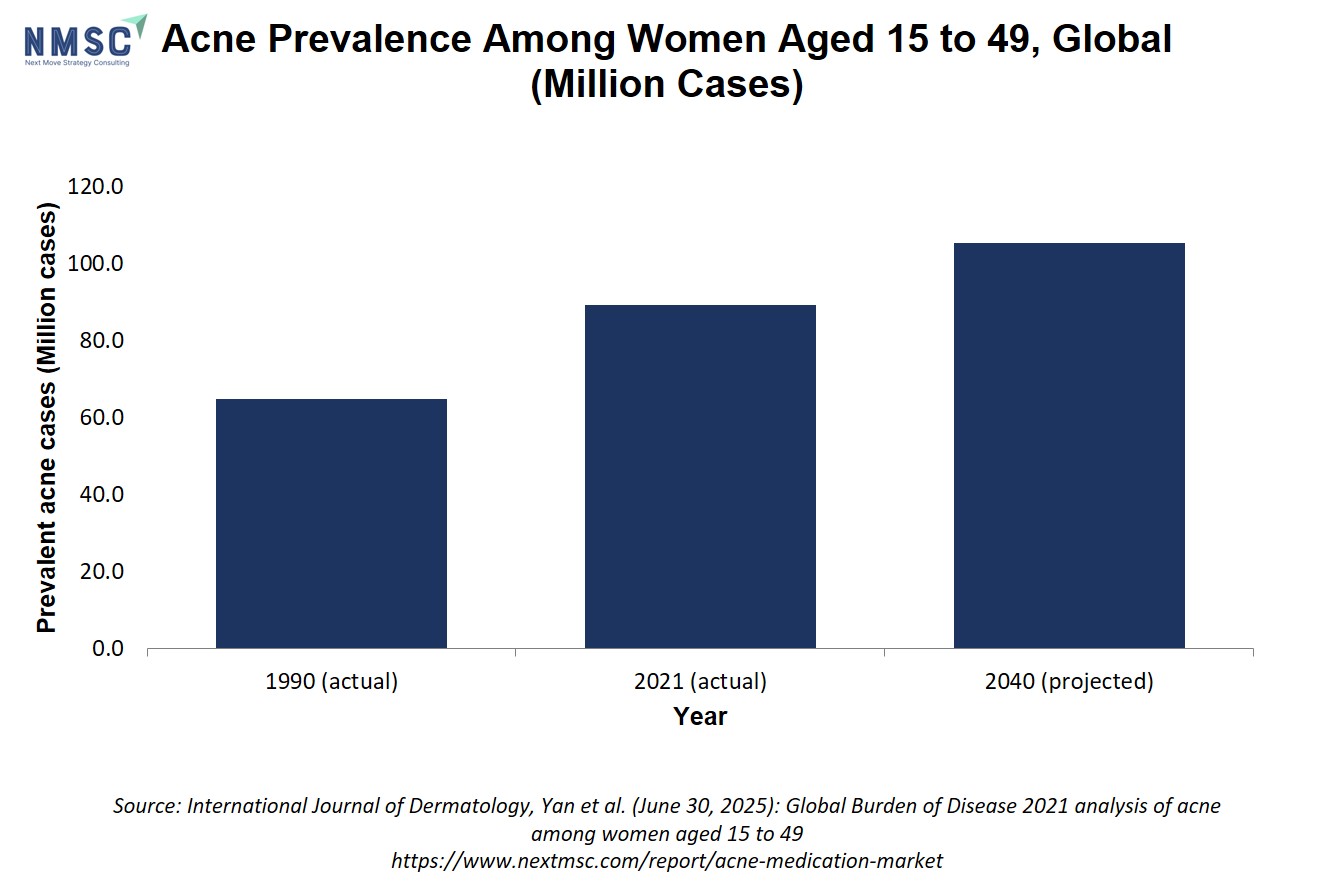
Yan and colleagues, using Global Burden of Disease 2021 data and reporting in the International Journal of Dermatology on June 30, 2025, give prevalent acne cases among women aged 15 to 49 of 65.0 million in 1990 and 89.3 million in 2021, and a projection of 105.3 million for 2040. The 1990 and 2021 values are historical model outputs, while the 2040 value comes from a Bayesian age-period-cohort projection that the authors say carries uncertainty.
Acne Burden Among Women Aged 15 to 49, Global, 1990 vs 2021
|
Indicator |
1990 |
2021 |
Change |
|
Incidence (million cases) |
23.1 |
31.0 |
+34% |
|
Prevalence (million cases) |
65.0 |
89.3 |
+38% |
|
Disability-adjusted life years (million) |
1.38 |
1.90 |
+37% |
Acne-Related Milestones, 2026
|
Date |
Development |
Named source |
|
February 9, 2026 |
iPLEDGE modifications approved; effective August 2026 |
U.S. Food and Drug Administration |
|
May 22, 2026 |
Differin Epiduo approved for over-the-counter use from age 12 |
U.S. Food and Drug Administration; Galderma |
|
June 11, 2026 |
Winlevi launched in key European markets |
Cosmo Pharmaceuticals |
|
July 29, 2026 |
Diversified segment revenue flat at USD 219 million |
Bausch Health Companies |
Future Outlook & Forecast: Where the Acne Medication Market Stands on the Road to 2030
NextMSC's forecast places the global acne medication market at USD 14.26 billion by 2030, from USD 10.08 billion in 2021, at a CAGR of 3.02%. The five-year question in this article therefore extends one year past the modelled horizon. The analysis below identifies the signposts that will determine whether the market tracks, exceeds or trails the forecast, and it assigns no value to 2031.
Four signposts deserve monitoring. The first is the geographic spread of the over-the-counter model: Galderma stated that Differin Epiduo remains prescription-only outside the United States, so any extension of the switch to Europe or Asia would move volume between the dermatologist and pharmacy channels. The second is the performance of first-in-class topicals; after the June 2026 European launch, the next data points are Cosmo's reported Winlevi growth in the second half of 2026 and the regulatory submission it has said it is advancing for clascoterone in alopecia. The third is isotretinoin persistence: the August 2026 iPLEDGE changes lower the logistical cost of each treatment course, and any effect would appear in dispensing volumes. The fourth is disease burden: the Global Burden of Disease analysis projects prevalence among women aged 15 to 49 rising from 91.6 million in 2022 to 105.3 million in 2040, although its authors caution that projection models carry inherent uncertainty.
Risks sit on the supply and pricing side. Galderma flagged strong generic pressures on its mature prescription portfolio and described its exposure to announced U.S. tariffs as manageable, while Bausch Health Companies noted softer dermatology performance in the second quarter of 2026. Both data points argue for caution in assuming that retail access alone lifts value, because moving a molecule from prescription to shelf can increase units while changing the price per unit.
NextMSC primary research and analysis therefore frames the outlook as a story of composition. A modest headline CAGR is consistent with three concurrent shifts: volume migration toward pharmacies and e-commerce for mild and moderate acne, value concentration in supervised and differentiated therapies, and geographic expansion toward regions where case counts are rising fastest.
Section Summary:
Within NextMSC's forecast period to 2030, composition matters more than pace, and four observable signposts will show which way the acne medication market is moving.
-
NextMSC projects USD 14.26 billion by 2030 at a CAGR of 3.02%; no value is assigned beyond that horizon.
-
Watch the extension of over-the-counter switches outside the United States, Winlevi's second-half growth and isotretinoin dispensing volumes.
-
Generic pressure and softer dermatology results at some companies show that unit growth and value growth can diverge.
Next Steps for Stakeholders
The evidence supports specific actions over the next twelve months for each group with exposure to acne therapy.
-
Manufacturers of prescription acne brands: review portfolios for products where an over-the-counter route or a differentiated mechanism is realistic, and stress-test pricing in the mild-to-moderate tier where a retail combination now exists.
-
Retailers and pharmacy chains: plan shelf space, pharmacist-led counselling and digital content for a two-active acne gel, given Galderma's stated U.S. availability from the summer of 2026.
-
Dermatology practices and clinics: rebalance toward moderate-to-severe disease and isotretinoin management under the revised iPLEDGE rules, and build processes to validate at-home pregnancy test results, as the FDA requires.
-
Investors: track Winlevi's reported growth, Galderma's guidance and Bausch Health Companies' dermatology trend each quarter, and examine exposure to generic pressure in mature prescription portfolios.
-
Strategists targeting emerging regions: map low sociodemographic index regions and South Asia, where the burden is rising fastest, against affordable formats and distribution partners.
Conclusion
The acne medication market in 2026 is best read as a market in transition rather than a market in rapid expansion. NextMSC projects USD 14.26 billion by 2030 at a CAGR of 3.02%, and the events of recent months explain why the composition of that value matters more than its pace: a retail combination gel, a first-in-class topical entering Europe, and lighter isotretinoin logistics. The answer to the five-year question is a market that is larger, more retail-led in its mild-to-moderate tiers and more specialised in its prescription tiers, with the outcome depending on how quickly the over-the-counter model spreads beyond the United States.
About the Author
 Sanyukta Deb
— Sanyukta Deb is Digital Marketing Team Lead at Next Move Strategy Consulting, where she has led content strategy and technical SEO for the firm's B2B market research publications for over 2 years. Her editorial process translates NextMSC's primary and secondary research — spanning technology, industrial, and consumer sectors — into commercial narratives, backed by search-intent, keyword, and competitive analysis. She brings 5 years of overall experience in digital marketing and content strategy.
About the Reviewer
 Debashree Dey
— Debashree Dey is Assistant Manager at Next Move Strategy Consulting, where she supports cross-vertical market content and communications across diverse industries for 6 years. Her professional background includes senior content writing, communications, and published manuscript authorship, with experience developing audience-focused business narratives and maintaining clear, consistent messaging. Her role supports research-led content development and editorial quality across NextMSC publications.














Add Comment