Food Safety Testing Statistics, Trends & Forecasts for 2026

Introduction
On June 4, 2026, the World Health Organization (WHO) released its most comprehensive update to global foodborne disease burden estimates in over a decade — and the findings are unambiguous in their urgency. Contaminated food caused an estimated 866 million illnesses and 1.52 million deaths in 2021 alone, generating a staggering $647 billion in lost productivity globally when adjusted for purchasing power parity. The burden of foodborne disease now rivals that of tuberculosis, HIV/AIDS, and malaria — diseases that command billions in annual global health investment.
For C-level executives, institutional investors, and policymakers operating across the food and beverage value chain, this data is not merely a public health statistic. It is a structural market signal. The mounting pressure of foodborne disease, combined with a wave of sweeping regulatory mandates from the U.S. Food and Drug Administration (FDA) and the European Union (EU), is fundamentally reshaping the demand landscape for food safety testing solutions. From advanced pathogen detection in food and microbiological food testing to food allergen testing and food authenticity testing, the global food safety testing market is entering a period of accelerated, compliance-driven growth. This article examines the most consequential trends, regulatory developments, and market forecasts defining the food safety testing industry in 2026.
For More Information – Download FREE Sample on Food Safety Testing Market Report
WHO's 2026 Wake-Up Call: A Defining Moment for Food Safety Testing
The Landmark WHO Report and Its Market Implications
The WHO's updated global burden of foodborne disease estimates, published in The Lancet Global Health on June 4, 2026, represents the first comprehensive reassessment of this burden since 2015. Produced by WHO's Foodborne Disease Burden Epidemiology Reference Group (FERG) 2021–2025, the 2026 edition expanded its scope from 31 to 42 foodborne hazards, incorporating for the first time the burden from heavy metal contamination — including inorganic arsenic and lead — and their links to cardiovascular disease, cancers, and intellectual disability.
The scale of the problem is sobering. In 2021, foodborne diseases caused 57.1 million disability-adjusted life years (DALYs) lost globally. Chemical foodborne hazards — despite accounting for only approximately 7% of all foodborne illnesses globally — were responsible for 73% of all deaths from contaminated food. Inorganic arsenic alone accounted for 42% of those deaths, and lead for 31%.
Critically, WHO found that every $1 invested in food safety infrastructure yields an estimated $46 return in public health value — a return-on-investment ratio that makes a compelling case for institutional capital allocation toward food safety testing infrastructure.
In the United States, the scale of the domestic burden is equally significant. The U.S. Department of Agriculture's Food Safety and Inspection Service (USDA/FSIS) estimates that foodborne illness causes approximately 48 million illnesses and 3,000 deaths each year in the United States. The USDA's Economic Research Service (ERS) calculated the total cost of foodborne illness in the United States at $74.7 billion in 2023 U.S. dollars, with non-typhoidal Salmonella alone accounting for $17.1 billion of that burden.
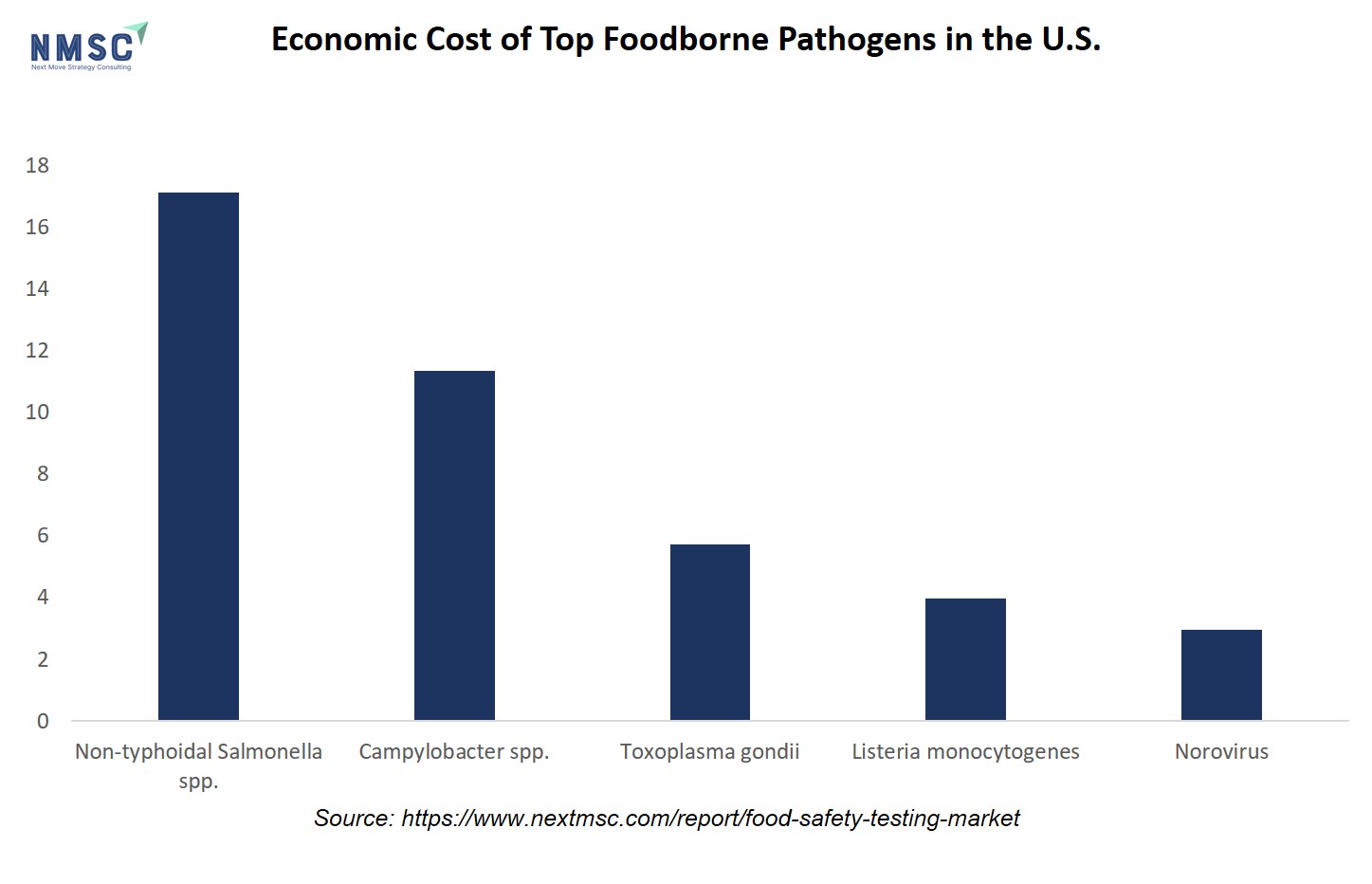
Simultaneously, active outbreaks are reinforcing the urgency of robust food safety testing. As of mid-July 2026, the FDA is investigating a significant Cyclospora outbreak linked to iceberg lettuce served at Taco Bell restaurants across five states, alongside a separate Listeria outbreak under active traceback. These concurrent outbreaks underscore the persistent vulnerability of the food supply chain and the critical role of rapid food testing technologies in outbreak response.
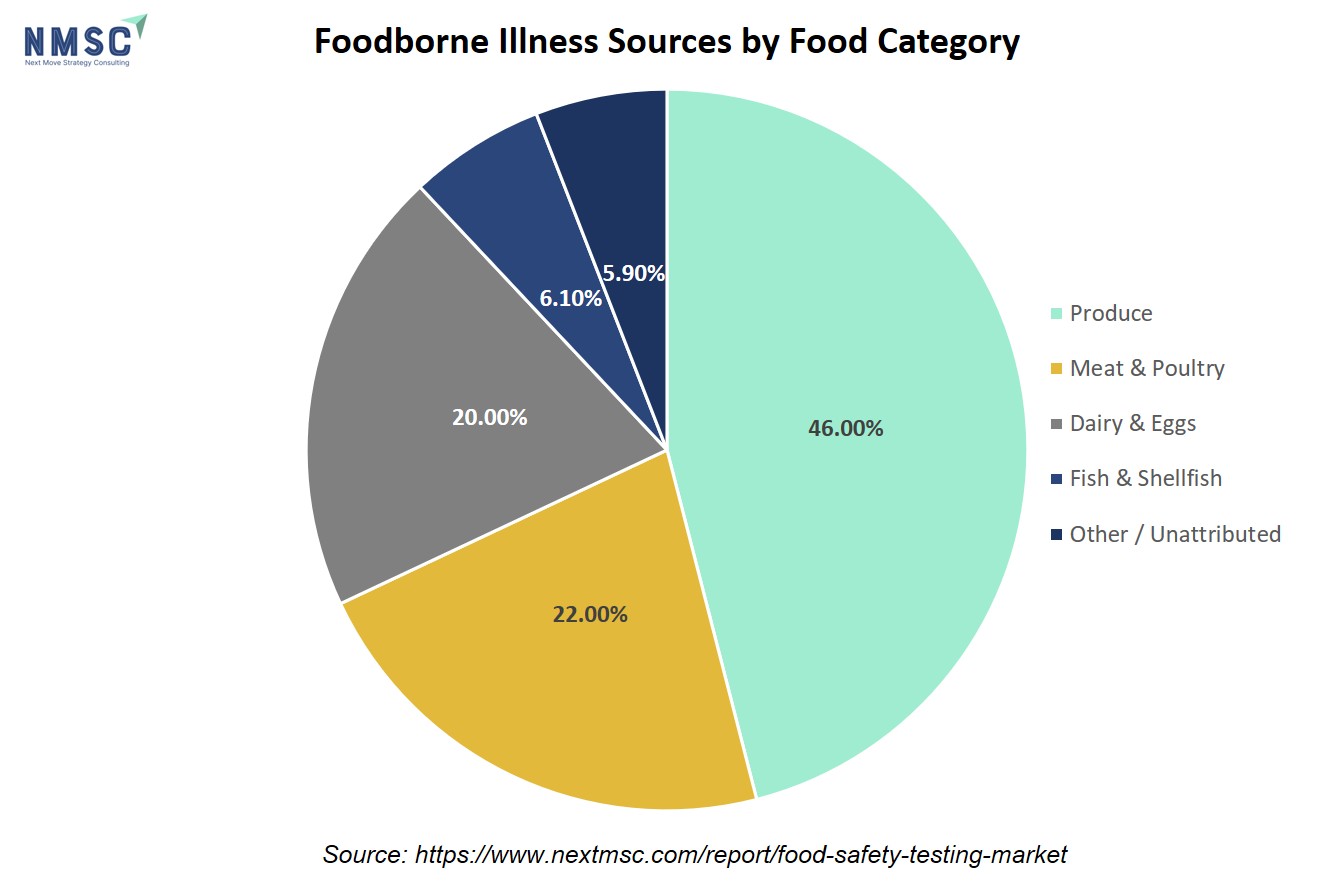
NMSC Strategic Perspective: Interpreting the Market Shift
The WHO's June 2026 report is not merely a public health document — it is a pivotal market catalyst. NMSC's analysis identifies several structural forces converging to sustain this trajectory. The WHO's updated burden estimates provide governments and food industry stakeholders with granular, country-level data for the first time, enabling targeted investment in food safety surveillance systems. This data-driven policy environment is expected to accelerate procurement of advanced food contaminant testing platforms, particularly in regions where the burden has been historically underestimated. The expansion of chemical hazard testing — encompassing PFAS, heavy metals, mycotoxins, and pesticide residues — represents a significant incremental revenue opportunity for food testing laboratories and analytical instrument manufacturers. Furthermore, the WHO's call for a "One Health" approach — integrating human, animal, plant, and environmental health — is expected to drive cross-sector demand for comprehensive food quality assurance solutions that extend beyond traditional microbiological food testing into environmental monitoring and supply chain traceability.
Section Summary: The WHO's 2026 landmark report has fundamentally recalibrated the global understanding of foodborne disease burden, establishing a powerful evidence base for accelerated investment in food safety testing infrastructure.
Key Takeaways:
-
WHO estimates 866 million foodborne illnesses and 1.52 million deaths annually, generating $647 billion in productivity losses globally.
-
Chemical hazards account for 73% of all foodborne deaths despite causing only ~7% of illnesses — driving demand for advanced contaminant testing.
-
The USDA ERS estimates the domestic U.S. cost of foodborne illness at $74.7 billion, with Salmonella alone costing $17.1 billion.
-
Every $1 invested in food safety infrastructure yields an estimated $46 in public health value, presenting a compelling ROI case for institutional stakeholders.
Industry Impact Analysis
FDA's 2026 Regulatory Agenda: Reshaping Compliance Requirements
The FDA's Human Foods Program (HFP) has outlined an ambitious set of 2026 priority deliverables that will materially expand the scope and complexity of food safety compliance requirements across the U.S. food supply.
Among the most consequential developments for the food safety testing industry:
-
GRAS Reform: The FDA will publish a proposed regulation requiring mandatory submission of "Generally Recognized as Safe" (GRAS) notices for all new food substances, ending the current voluntary notification system. This reform will substantially increase the volume of pre-market chemical safety assessments required, creating direct demand for food contaminant testing and chemical analysis services.
-
Post-Market Safety Reviews: The FDA will conduct systematic safety reviews of chemicals currently used in food, beginning with phthalates, propylparaben, butylated hydroxyanisole (BHA), and butylated hydroxytoluene (BHT). These reviews will require validated analytical methods and laboratory capacity to assess consumer exposure levels.
-
Microplastics Research: The FDA will initiate research to identify methods that accurately detect, quantify, and characterize microplastics in human food — a nascent but rapidly expanding area of food safety testing.
-
Closer to Zero Initiative: The FDA will advance action levels for cadmium and inorganic arsenic in baby and toddler foods, directly expanding the scope of mandatory heavy metal testing for infant food manufacturers.
-
AI/ML for Risk Management: The FDA will develop a plan for using AI-predictive models to analyze large datasets generated across the food supply chain — from growth and harvest through transportation, manufacturing, and distribution — to improve risk management accuracy.
-
Food Traceability Rule: The FDA will engage covered entities to ensure compliance with the Food Traceability Rule, enabling faster identification and removal of contaminated food from the marketplace.
EU's PFAS Packaging Ban: A New Testing Imperative
In Europe, the Packaging and Packaging Waste Regulation (PPWR), EU Regulation 2025/40, entered into force in February 2025 and generally applies from August 12, 2026 — the date on which PFAS limit values for food-contact packaging also take effect.
The regulation establishes clear analytical thresholds: 25 parts per billion (ppb) for any individual PFAS measured through targeted analysis, 250 ppb for the sum of targeted PFAS, and 50 parts per million (ppm) for total fluorine. These thresholds are creating immediate demand for validated LC-MS/MS and GC-MS/MS analytical workflows across European food-contact material testing laboratories. Brands and converters are simultaneously accelerating reformulation to remove fluorinated chemistries from grease- and water-resistant packaging, requiring practical testing strategies to demonstrate compliance.
Rising Food Recalls: A Persistent Market Driver
Food recall activity continues to trend upward, reinforcing the commercial case for proactive food safety testing investment. In 2025, a total of 320 food recalls were issued by the FDA and USDA combined, compared to 296 in 2024. The total number of recalls grew from 505 to 613 between 2021 and 2025 — an increase of 21.4% over four years.
AI and Automation: The Technological Transformation of Food Testing
The integration of artificial intelligence into food safety testing workflows is accelerating across the industry. bioMérieux, a global leader in in-vitro diagnostics, identified three defining food safety trends for 2026: Environmental Monitoring Risk Models, Smarter Spoilage Investigations, and AI-powered food safety tools.
AI is enabling the food safety industry to transition from reactive to proactive safety measures through predictive analytics, AI-powered pathogen detection, and enhanced supply chain traceability. The combination of AI with blockchain is emerging as a particularly powerful approach for farm-to-fork traceability, providing verifiable, tamper-resistant records across complex supply chains.
Section Summary: A convergence of regulatory mandates, rising recall volumes, and technological innovation is reshaping the food safety testing landscape, creating both compliance obligations and commercial opportunities across the value chain.
Key Takeaways:
-
The FDA's 2026 agenda introduces GRAS reform, mandatory PFAS/microplastics research, and AI/ML-driven risk management — each expanding the scope of required food safety testing.
-
The EU's PPWR mandates PFAS-free food packaging by August 12, 2026, creating immediate demand for validated analytical testing workflows across European laboratories.
-
U.S. food recalls grew 21.4% from 2021 to 2025, underscoring the persistent market need for proactive food contaminant testing.
-
AI-powered environmental monitoring and predictive analytics are redefining food safety quality assurance solutions from reactive to proactive paradigms.
Pros and Cons of Recent Market Developments
|
Development |
Pros |
Cons |
|
WHO 2026 Burden Report & Policy Response |
Provides governments with country-level data to target food safety investment; accelerates procurement of testing infrastructure globally |
Highlights severe inequalities in testing capacity between high-income and low/middle-income countries; may strain public health budgets in resource-limited settings |
|
FDA GRAS Reform & Post-Market Reviews |
Strengthens pre-market chemical safety oversight; drives demand for validated analytical testing methods and laboratory services |
Increases regulatory burden and compliance costs for food manufacturers; may slow innovation in food ingredient development |
|
EU PPWR PFAS Packaging Ban (August 2026) |
Creates clear, enforceable testing thresholds; drives investment in advanced LC-MS/MS and GC-MS/MS laboratory capabilities |
Requires significant capital investment in new analytical workflows; complex compliance requirements for multi-market food producers |
|
AI & Automation in Food Safety Testing |
Reduces time-to-result for pathogen detection; enables predictive risk management; lowers long-term operational costs |
High upfront technology investment; requires specialized data science expertise; raises data security and validation concerns |
|
Rising Food Recall Activity |
Heightens industry awareness of testing gaps; drives demand for rapid food testing technologies and real-time monitoring |
Increases reputational and financial risk for food manufacturers; exposes supply chain vulnerabilities; erodes consumer trust |
|
FDA Food Traceability Rule Implementation |
Enables faster identification and removal of contaminated food; supports farm-to-fork accountability |
Imposes significant digital recordkeeping requirements on small and mid-sized food businesses; requires technology infrastructure investment |
|
Rapid Testing Technology Adoption |
Delivers faster results than traditional culture-based methods; supports real-time production line monitoring |
Rapid tests may have lower sensitivity for certain pathogens; regulatory acceptance of rapid methods varies by jurisdiction |
Key Data & Statistics
Major Regulatory Milestones in Food Safety Testing (2025–2026)
|
Regulation / Initiative |
Jurisdiction |
Key Requirement |
Effective Date |
Testing Impact |
|
EU Packaging & Packaging Waste Regulation (PPWR) — Regulation 2025/40 |
European Union |
PFAS limits in food-contact packaging (25 ppb individual PFAS; 250 ppb sum; 50 ppm total fluorine) |
August 12, 2026 |
Mandatory PFAS analytical testing for all food-contact packaging manufacturers and importers |
|
FDA GRAS Reform (Proposed Rule) |
United States |
Mandatory pre-market notification for all new GRAS food substances |
2026 (Proposed) |
Expanded pre-market chemical safety assessment and testing requirements |
|
FDA Food Traceability Rule |
United States |
Enhanced traceability records for high-risk foods across the supply chain |
Compliance engagement ongoing 2026 |
Digital traceability and food safety testing integration across supply chain nodes |
|
FDA Closer to Zero Initiative |
United States |
Action levels for cadmium and inorganic arsenic in baby and toddler foods |
2026 (Action levels to be established) |
Mandatory heavy metal testing for infant and toddler food manufacturers |
|
FDA Microplastics Research Program |
United States |
Development of validated detection methods for microplastics in human food |
2026 (Research phase) |
Creation of new analytical testing standards and laboratory capabilities |
|
FDA Human Foods Program — AI/ML Risk Management |
United States |
AI-predictive models for food supply chain risk analysis |
2026 (Proof of concept) |
Integration of AI-powered analytics with food safety testing data systems |
Economic Cost of Top Foodborne Pathogens in the United States (2023 USD)
|
Pathogen |
Estimated Annual Cases |
Total Annual Cost (USD) |
Mean Per-Case Cost (USD) |
|
Non-typhoidal Salmonella spp. |
1,027,561 |
$17.13 billion |
$16,668 |
|
Campylobacter spp. |
845,024 |
$11.33 billion |
$13,405 |
|
Toxoplasma gondii |
86,753 |
$5.72 billion |
$65,926 |
|
Listeria monocytogenes |
1,583 |
$3.96 billion |
$2,504,296 |
|
Norovirus |
5,461,731 |
$2.97 billion |
$543 |
|
Shiga toxin-producing E. coli (STEC) |
175,905 |
$503.9 million |
$2,865 |
|
Vibrio vulnificus |
96 |
$438.4 million |
$4,566,667 |
|
Clostridium botulinum |
55 |
$115.6 million |
$2,101,818 |
Future Outlook & Forecast
NMSC Market Forecast: Sustained Growth Through 2030
According to Next Move Strategy Consulting's proprietary research, the global food safety testing market is predicted to reach USD 36.94 billion, advancing at a compound annual growth rate (CAGR) of 7.7% by 2030.
This growth trajectory is underpinned by several structural demand drivers: the surge in chemical contamination cases across global food supply chains, rising consumer awareness of food safety risks, the rapid advancement of rapid food testing technologies, and the implementation of increasingly stringent regulatory frameworks by leading food safety authorities — including the European Food Safety Authority (EFSA), the Food Safety and Standards Authority of India (FSSAI), the Food Standards Agency (FSA), and the Canadian Food Inspection Agency (CFIA).
Segment Dynamics: Pathogens, Technology, and Food Categories
By Contaminant: Pathogen testing remains the dominant contaminant segment, driven by mandatory regulatory requirements for Salmonella, Listeria, E. coli, and Campylobacter across meat, poultry, seafood, and produce categories. The allergen and mycotoxin segments are expected to demonstrate above-average growth rates as regulatory frameworks for allergen labeling and mycotoxin limits are tightened in major markets.
By Technology: Traditional testing methods continue to account for the majority of market revenue, reflecting their established regulatory acceptance and widespread laboratory infrastructure. However, rapid food testing technologies — including PCR-based testing, immunoassay platforms, and chromatography and spectrometry — are gaining significant market share as food manufacturers seek to reduce time-to-result and enable real-time production monitoring. PCR-based testing accounts for approximately 34.9% of the rapid food safety testing market.
By Food Tested: Meat and meat products, processed foods, and fruits and vegetables represent the highest-volume testing categories, reflecting both the regulatory intensity and the inherent contamination risk profiles of these food groups. Seafood is expected to see accelerated testing demand as the FDA advances its imported seafood safety program and establishes Regulatory Partnership Arrangements with leading shrimp-exporting countries, including India and Ecuador.
By Geography: North America holds the leading position in the global food safety testing market, driven by the adoption of advanced testing technologies, stringent FDA regulatory requirements, and high consumer awareness of food safety risks. The region is expected to maintain its dominant position through the forecast period. Asia Pacific is projected to record the fastest growth rate, supported by the rapid expansion of the food and beverage industry in China and India, increasing regulatory stringency, and growing investment in food testing laboratory infrastructure.
Emerging Technologies Shaping the Decade Ahead
Beyond the near-term forecast horizon, several emerging technologies are positioned to reshape the food safety testing landscape:
-
CRISPR-based pathogen detection platforms are advancing toward commercial deployment, offering the potential for highly specific, rapid, and low-cost point-of-care testing for foodborne pathogens.
-
Lab-on-a-chip technologies are enabling miniaturized, portable testing devices capable of delivering laboratory-grade results in field and production-line settings.
-
Blockchain-integrated traceability systems, combined with AI analytics, are creating end-to-end supply chain visibility that enables proactive contamination risk management rather than reactive recall response.
-
Environmental monitoring risk models, as identified by bioMérieux, are enabling food manufacturers to shift from point-in-time testing to continuous, data-driven risk assessment frameworks.
Section Summary: The food safety testing market is on a sustained growth trajectory, driven by regulatory expansion, technological innovation, and the growing recognition of foodborne disease as a material economic and public health risk.
Key Takeaways:
-
NMSC projects the global food safety testing market to reach USD 36.94 billion by 2030, at a CAGR of 7.7% from 2022–2030.
-
Pathogen testing remains the dominant contaminant segment; rapid testing technologies — particularly PCR-based platforms — are gaining significant market share.
-
Asia Pacific represents the highest-growth regional market, driven by food industry expansion and increasing regulatory stringency.
-
CRISPR-based detection, lab-on-a-chip platforms, and AI-integrated environmental monitoring are the most consequential emerging technologies for the decade ahead.
Next Steps for Stakeholders
For C-level executives and institutional investors operating across the food safety testing value chain, the current environment demands both strategic clarity and operational urgency. The following actions are recommended:
1. Align Compliance Roadmaps with the 2026 Regulatory Calendar
The EU PPWR's PFAS packaging limits took effect August 12, 2026. Organizations with exposure to European food-contact packaging supply chains should conduct immediate gap assessments of their analytical testing capabilities against the regulation's defined thresholds. Similarly, U.S. food manufacturers should engage proactively with the FDA's evolving GRAS reform and Closer to Zero frameworks to anticipate expanded testing requirements before they become mandatory.
2. Invest in Rapid Testing Technology Capabilities
The shift from traditional culture-based methods to PCR-based, immunoassay, and chromatography platforms is accelerating. Food manufacturers and food testing laboratories that have not yet invested in rapid food testing technologies risk competitive disadvantage as regulatory timelines compress and consumer expectations for supply chain transparency intensify. Capital allocation toward validated rapid testing platforms should be prioritized in 2026 operational budgets.
3. Leverage AI and Environmental Monitoring Risk Models
The integration of AI-powered predictive analytics and environmental monitoring risk models into food safety quality assurance programs represents a structural shift from reactive to proactive risk management. Organizations should evaluate vendor partnerships and technology investments that enable continuous, data-driven environmental monitoring — particularly for high-risk production environments where Listeria, Salmonella, and Campylobacter contamination risks are elevated.
4. Develop a Chemical Contaminant Testing Strategy
The WHO's 2026 findings on chemical hazards — particularly inorganic arsenic, lead, PFAS, and mycotoxins — signal a material expansion of the food safety testing agenda beyond traditional microbiological food testing. Food manufacturers should conduct comprehensive chemical hazard assessments of their raw material supply chains and establish validated testing protocols for the most consequential chemical contaminants in their product categories.
5. Prioritize Supply Chain Traceability Infrastructure
The FDA's Food Traceability Rule implementation and the growing use of blockchain-integrated traceability systems represent both a compliance obligation and a competitive differentiator. Investors should evaluate food safety technology companies developing traceability platforms as high-growth opportunities within the broader food safety testing market.
6. Monitor the NMSC Food Safety Testing Market Report for Proprietary Intelligence
For detailed segment-level market sizing, competitive landscape analysis, and regional growth forecasts, stakeholders are encouraged to access Next Move Strategy Consulting's proprietary Food Safety Testing Market report, which provides quantitative analysis and strategic intelligence through 2030.
Conclusion
The food safety testing market in 2026 is operating at a critical inflection point. The WHO's landmark June 2026 report has placed the global burden of foodborne disease — 866 million illnesses, 1.52 million deaths, and $647 billion in economic losses annually — in sharper focus than at any previous point in history. Simultaneously, the FDA's ambitious 2026 regulatory agenda, the EU's PFAS packaging ban, and the rapid adoption of AI-powered food safety testing technologies are collectively reshaping the compliance and commercial landscape for every participant in the food value chain.
According to Next Move Strategy Consulting, the global food safety testing market is growing rapidly and this growth is not speculative — it is anchored in the structural reality that food safety compliance is no longer optional, and that the cost of inadequate testing is measured not only in regulatory penalties and recall expenses, but in human lives and long-term brand equity.
For institutional decision-makers, the message is clear: investment in advanced food safety testing infrastructure, rapid detection technologies, and AI-integrated quality assurance systems is not a discretionary expenditure. It is a strategic imperative for sustainable, compliant, and responsible participation in the global food economy.
About the Author
 Sanyukta Deb
— Sanyukta Deb is Digital Marketing Team Lead at Next Move Strategy Consulting, where she has led content strategy and technical SEO for the firm's B2B market research publications for over 2 years. Her editorial process translates NextMSC's primary and secondary research — spanning technology, industrial, and consumer sectors — into commercial narratives, backed by search-intent, keyword, and competitive analysis. She brings 5 years of overall experience in digital marketing and content strategy.
Sanyukta Deb
— Sanyukta Deb is Digital Marketing Team Lead at Next Move Strategy Consulting, where she has led content strategy and technical SEO for the firm's B2B market research publications for over 2 years. Her editorial process translates NextMSC's primary and secondary research — spanning technology, industrial, and consumer sectors — into commercial narratives, backed by search-intent, keyword, and competitive analysis. She brings 5 years of overall experience in digital marketing and content strategy.
About the Reviewer
 Debashree Dey
— Debashree Dey is Assistant Manager at Next Move Strategy Consulting, where she supports cross-vertical market content and communications across diverse industries for 6 years. Her professional background includes senior content writing, communications, and published manuscript authorship, with experience developing audience-focused business narratives and maintaining clear, consistent messaging. Her role supports research-led content development and editorial quality across NextMSC publications.
Debashree Dey
— Debashree Dey is Assistant Manager at Next Move Strategy Consulting, where she supports cross-vertical market content and communications across diverse industries for 6 years. Her professional background includes senior content writing, communications, and published manuscript authorship, with experience developing audience-focused business narratives and maintaining clear, consistent messaging. Her role supports research-led content development and editorial quality across NextMSC publications.

















Add Comment