From Fuji Electric to Godrej & Boyce – How Global Leaders Are Shaping the Future of Vending Machines
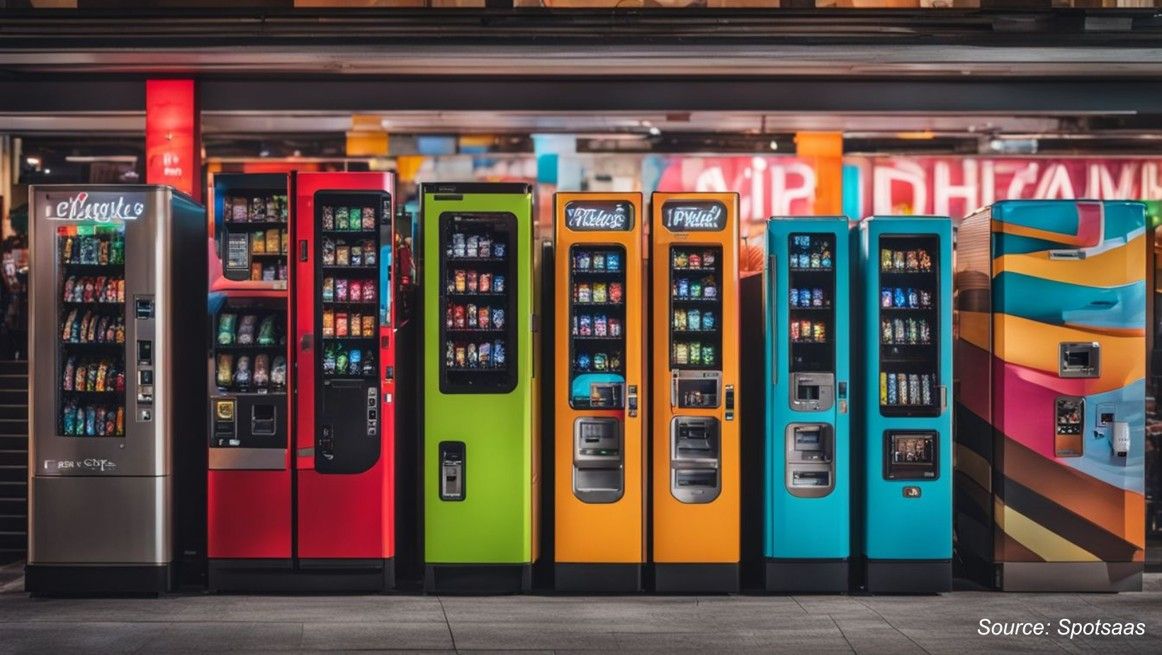
As per NMSC analysis, the Vending Machine Industry is set to maintain strong growth momentum, with the market size expected to reach around USD 34.96 billion by 2030, marking a solid CAGR of 6.20%. Valued at USD 23.07 billion in 2024, the Vending Machine Market is projected to rise to USD 25.88 billion by 2025. In terms of volume, the market recorded 13 million units in 2024, with forecasts indicating growth to 15 million units by 2025 and further to 23 million units by 2030, reflecting a CAGR of 9.30% over the same period.
The global vending machine market is experiencing a significant transformation driven by rapid automation, technological advancements, and the expansion of retail and service hubs worldwide. Once confined mainly to snacks and beverages, vending machines have evolved into smart, multi-category retail systems serving sectors such as healthcare, electronics, food service, and transportation. Demand is rising for AI-powered, cashless, and IoT-connected vending solutions that enhance convenience, operational efficiency, and user experience. While Asia-Pacific remains a dominant market, regions like Europe and North America are witnessing strong growth, and emerging economies are quickly adopting automated retail technologies. Collectively, these developments are reshaping modern retail and redefining consumer interaction across industries.
Vending Machine Market Overview
The Vending Machine Market has evolved from a simple snack-and-beverage dispensing model into a dynamic, technology-driven retail ecosystem. Modern vending machines now integrate advanced technologies such as AI, IoT, and data analytics to deliver seamless, contactless, and personalized consumer experiences. These innovations have expanded their applications beyond traditional environments like offices and transportation hubs to hospitals, educational institutions, and public spaces. Moreover, the adoption of smart payment systems and real-time inventory tracking has enhanced operational efficiency for businesses while meeting the growing consumer demand for convenience and 24/7 accessibility.
Globally, the market is witnessing strong growth due to increasing urbanization, shifting consumer preferences toward on-the-go consumption, and the proliferation of cashless payment methods. Asia-Pacific remains a leading region driven by technological innovation and a high density of urban consumers, while Europe and North America continue to modernize their vending infrastructure through digital upgrades and eco-friendly models. Meanwhile, emerging economies are embracing automated retail solutions as part of their broader push toward digital transformation. As sustainability and energy efficiency gain importance, manufacturers are focusing on environmentally conscious designs and smart energy management systems. Overall, the vending machine industry is transitioning into a critical component of the automated retail landscape, bridging the gap between convenience, technology, and consumer engagement.

Want Insights on the Vending Machine Market? Access a FREE Sample Instantly
Highlights Of Crane Payment Innovations
Crane Payment Innovations (CPI) is a U.S.-based company headquartered in Malvern, Pennsylvania, that provides payment technology solutions globally. Its core specialization spans coin and currency validators, recyclers, dispensers, cashless and self-service payment systems, software platforms and integration services for unattended retail environments. In the vending machine market, CPI’s solutions power unattended payment and cash‐handling needs for machine operators, meaning growth in the vending machine market supports CPI’s product demand, service opportunities and strategic positioning.
In recent activity, CPI opened its first Depot Service Center in November 2024, enabling customers to ship CPI components for repair, maintenance or servicing at a central facility. In May 2025, CPI announced a partnership with PEAC Solutions to provide its vending solutions via a rental-program model, allowing operators to adopt CPI’s systems through low monthly payments rather than upfront capital expenditure. These developments directly support CPI’s strategy in the vending machine market by lowering adoption barriers and improving service/support infrastructure, which is likely to strengthen its competitive position and expand its addressable market.
Highlights Of Fuji Electric Co., Ltd.

Fuji Electric Co., Ltd. is a Japanese electrical equipment manufacturer headquartered at Japan. Founded in 1923, the company specializes in power electronics, semiconductors, power generation and the food & beverage distribution business. In its food & beverage distribution segment, Fuji Electric manufactures vending machines and related systems, meaning the expanding vending machine market directly influences the company’s product development, sales strategy and growth potential.
In recent developments, Fuji Electric and Coca Cola Bottlers Japan Inc. jointly unveiled the world’s first hydrogen-cartridge-powered vending machine at the EXPO 2025 Osaka, Kansai, capable of operating independently of the power grid, positioning the company at the forefront of next-generation vending machine innovation. In parallel, Fuji Electric launched a refrigerated locker-type vending machine in March 2025 aimed at expanding sales into fresh produce, confectionery and agricultural products, highlighting its strategic move to broaden applications of vending technology. These initiatives reinforce Fuji Electric’s leadership in the vending machine market by leveraging energy-efficient, versatile solutions, and are likely to strengthen its competitive position and open new revenue streams.
Highlights Of Godrej And Boyce Mfg Co Ltd.
Godrej & Boyce Mfg Co Ltd. is an Indian engineering and manufacturing conglomerate headquartered in Mumbai, Maharashtra, India. The company offers a wide range of consumer appliances, industrial equipment and engineering solutions. Within its commercial appliances portfolio, G&B produces vending machines under its Godrej Vending division, meaning that growth in the global vending machine market directly affects its product development, market strategy and revenue potential.
In October 2024, G&B highlighted its commitment to quality in vending machines by detailing how it’s hot- and cold-beverage machines maintain consistent taste via precision engineering, advanced temperature control, automatic cleaning systems and customizable user-experience features. Earlier in March 2024 it also announced an investment of roughly USD 4.8 million over three years to expand its distribution network into more than 400 smaller towns across India, thereby broadening the reach of its appliance and vending-machine business into tier II/III markets. These developments strengthen G&B’s positioning in the vending machine segment by aligning product quality with geographic expansion and offer an improved platform to capture growth as vending-machine demand increases in emerging markets.
Highlights Of Azkoyen Group

Azkoyen Group, headquartered in Spain, is a multinational that specialises in the design, manufacture and commercialisation of advanced automated solutions in the coffee & vending systems, payment technologies and time & security sectors. Through its vending division, it delivers machines and systems across more than 100 countries, meaning the global vending machine market serves as a direct driver of its product development, international growth and competitive positioning.
In 2024 the Azkoyen Group delivered its most successful year to date, achieving consolidated revenues of USD 214.9 million and a net profit of USD 20.3 million, then approving a dividend payout of USD 10.2 million in mid-2025. The company reported that its Coffee & Vending Systems business contributed approximately 31.7% of its total sales, while its payment solutions division also saw strong growth with deployments in Latin America and IoT-connected systems.
Highlights Of Evoca Group
Evoca Group is a multinational company headquartered at Italy. With a heritage spanning about a century, the company specialises in professional coffee machines, automatic dispensers and vending solutions under its brands such as Necta. In the context of the vending machine market, Evoca Group’s Necta-branded machines address the vending channel (self-service coffee, snacks, beverages), and growth in that vending machine market directly supports Evoca’s demand for vending-capable equipment, driving their product innovation and market reach.
In June 2025, Evoca Group announced at the Vending Show 2025 the launch of new ranges under Necta, specifically the Barista line (hot beverages) and Gusto line (snacks and food items), aimed at workplaces, public and semi-public locations. This development underscores the company’s commitment to expanding its offering within the vending machine market by broadening product scope, beyond standard coffee and reinforcing its competitiveness in unattended retail settings. The move is likely to strengthen Evoca’s position in the vending segment by enabling entry into snack/food-vending adjacent markets and enhancing its ability to serve a broader range of customer locations.
Highlights Of Aucma International
AUCMA Co., Ltd., established in 1987 and listed on the Shanghai Stock Exchange in 2000, is headquartered in China. The company specialises in manufacturing refrigeration and cold-chain equipment, including freezers, refrigerators, and display coolers, and has also expanded into automatic vending machines as part of its product portfolio. In the context of the vending machine market, AUCMA’s involvement in vending-machine manufacturing means that growth in the broader vending machine market directly impacts its product demand, distribution opportunities and strategic positioning.
AUCMA states that its automatic vending machines form part of its cold-chain and appliance output segments, alongside refrigeration equipment. This embedded capability positions AUCMA to leverage rising vending-machine adoption globally, particularly in markets seeking integrated cold-chain vending solutions, thus potentially strengthening its competitive stance and opening new growth avenues within the vending-machine market.
Summary Of Vending Machine Market
The global vending machine market is steadily expanding as automation, digitalization, and consumer convenience converge to reshape retail distribution. Driven by the growing adoption of cashless transactions, smart technologies, and IoT-enabled management systems, vending machines are becoming more efficient, data-driven, and adaptable to diverse settings. The industry’s scope has widened from traditional snack and beverage dispensing to include fresh food, personal care, electronics, and even healthcare products, reflecting changing consumer lifestyles and the demand for instant access to goods.
Regionally, Asia-Pacific leads in deployment and innovation, supported by strong infrastructure and consumer acceptance of automated systems. North America and Europe are catching up with increased focus on smart, sustainable, and customizable vending solutions, while emerging markets are adopting these systems to enhance retail reach and reduce labor dependency. As automation continues to redefine retail interaction, the vending machine market is set to evolve into a key enabler of self-service convenience and smart retail operations globally.
About the Author
 Mayurima Roy is a research analyst delivering data-driven insights that support strategic planning and market understanding. She combines analytical rigor with strong content development skills, translating complex information into clear, actionable narratives for diverse audiences. Her work includes structured research, trend tracking, competitive assessment, and insight-led content creation that supports informed decision-making. Curious and detail-oriented by nature, she continually deepens her understanding of evolving markets while pursuing creative interests such as crafting and video creation.
About the Reviewer
 Supradip Baul is an accomplished business consultant and strategist with over a decade of rich experience in market intelligence, strategy, technology, and business transformation. His work has included rigorous qualitative and quantitative analysis across multiple industries, helping clients shape investment decisions and long-term roadmaps. Earlier in his career, he was associated with Gartner, where he contributed to industry-leading reports and market share analyses. He has worked with leading global companies and holds an MBA with a dual specialization in Marketing and Finance.













Add Comment