Fuel Cell Market: Why AI Data Centers Now Set the Growth Pace | NextMSC
Introduction
On November 5, 2026, NTT DATA announced an agreement with Bloom Energy to deploy 900 MW of onsite fuel cell power across its global data center projects, the largest international project in Bloom Energy's history. Initial shipments begin in 2027, and both companies plan to extend the relationship across NTT's global portfolio toward gigawatt scale. The announcement matters for the fuel cell market because it shows who now writes the largest purchase orders: infrastructure operators that cannot wait for grid interconnection, rather than the vehicle makers that defined the sector's first commercial decade.
According to Next Move Strategy Consulting's Fuel Cell Market report, the global fuel cell market was valued at USD 8.73 billion in 2024 and is projected to reach USD 38.25 billion by 2030, growing at a CAGR of 28.0% from 2025 to 2030. NextMSC primary research and analysis segments the market by product type (solid oxide, proton exchange membrane, molten carbonate, phosphoric acid and others), by application (portable, stationary and transport) and by end user (residential, military and defense, automotive and others), and identifies North America as the largest regional market.
For More Information: Download FREE Sample on Fuel Cell Market Report
This analysis tests that shift against evidence from the last six months, drawing on Bloom Energy Corporation, FuelCell Energy, Inc. and Plug Power Inc. disclosures, the International Energy Agency (IEA) Global Hydrogen Review 2026, S&P Global Energy reporting on South Korea's hydrogen power auction, and S&P Dow Jones Indices. The evidence points to a fuel cell market whose pace is increasingly set by power-constrained data centers.
Fuel Cell Market Trends: When AI Power Demand Outran the Grid
NTT DATA and Bloom Energy: 900 MW Changes the Procurement Logic
The NTT DATA agreement matters less for its headline capacity than for the reason behind it. Doug Adams, CEO of NTT Global Data Centers, stated in the NTT DATA announcement of November 5, 2026: "Our clients are building AI capabilities at a pace the grid alone cannot always match." The statement reframes the fuel cell purchase as a schedule decision. Modular onsite generation that can be expanded in phases lets a data center energize capacity while a utility interconnection is still in the queue. Aman Joshi, Executive Vice President and Chief Commercial Officer at Bloom Energy, stated in the same announcement: "Companies that can secure power quickly will have a differentiated advantage and accelerated path to revenue."
Scale explains why this is a structural signal. The IEA's Global Hydrogen Review 2026 reports that data centers already use fuel cells as a backup power option, with around 400 MW of installed capacity, almost all of it running on natural gas rather than hydrogen. A single 900 MW agreement is therefore more than double that installed base, although the NTT DATA volume is contracted capacity with shipments starting in 2027, not capacity in operation today. The comparison shows fuel cells moving from backup duty to primary power in this application, a role the NTT DATA announcement describes explicitly.
Bloom Energy's third-quarter 2026 results, released on October 22, 2026, quantify how that demand converts into revenue. Revenue reached USD 1,235.8 million, up 138.1% from USD 519.0 million in the third quarter of 2025, while product revenue rose 179.4% to USD 1,073.6 million. GAAP operating income was USD 225.4 million and GAAP gross margin was 33.8%, up 453 basis points. Chief Financial Officer Simon Edwards said in the release that year-to-date performance and customer demand gave Bloom Energy Corporation confidence to raise its 2026 outlook "for the third time this year," with revenue guidance now at USD 4.4 billion to USD 4.6 billion.
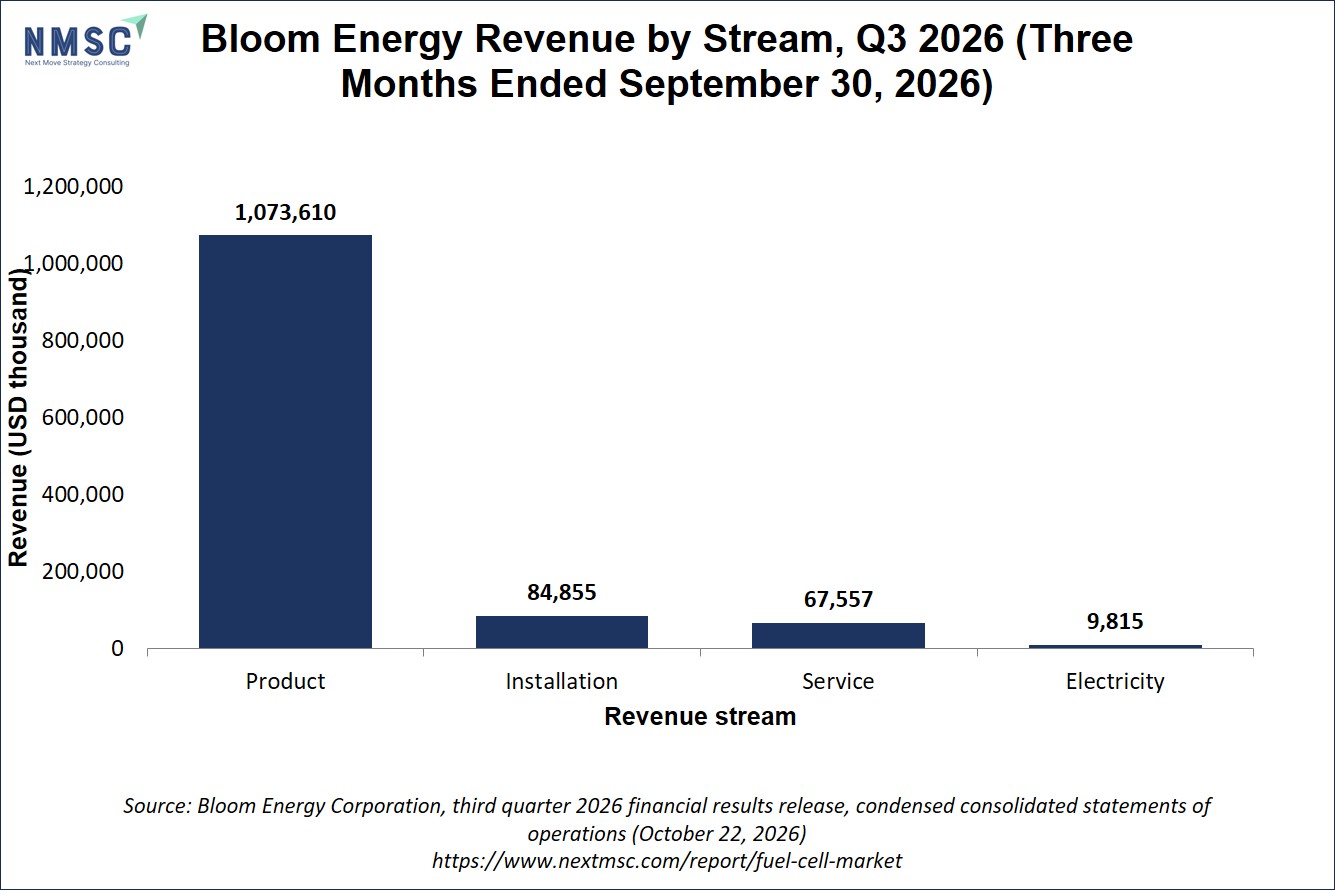
Bloom Energy Corporation's statements of operations for the three months ended September 30, 2026 report product revenue of USD 1,073,610 thousand, installation revenue of USD 84,855 thousand, service revenue of USD 67,557 thousand and electricity revenue of USD 9,815 thousand, for total revenue of USD 1,235,837 thousand. Product sales are the dominant stream, which is consistent with a hardware-led ramp in which customers are buying systems for onsite power.
Capital markets have registered the shift. S&P Dow Jones Indices announced on September 4, 2026 that Bloom Energy would join the S&P 500, effective before the open of trading on September 21, 2026, replacing Molson Coors Beverage. Index inclusion does not alter fuel cell engineering, but it widens the pool of institutional capital that can finance manufacturing capacity, which Bloom Energy builds in the United States with more than 2,000 employees worldwide.
Quarterly Evidence: Who Is Converting the Data Center Opportunity
The same demand signal is reaching smaller manufacturers, but conversion is uneven. FuelCell Energy, Inc. reported on September 2, 2026 that revenue for its fiscal third quarter, which ended July 31, 2026, fell 29% to USD 33.0 million from USD 46.7 million, with a net loss of USD 45.3 million compared with USD 91.9 million a year earlier. Alongside those results the company disclosed its first data center power agreement, a Capacity Reservation Agreement for a planned 75 MW data center in Texas using six 12.5 MW systems, backed by an upfront reservation payment. President and CEO Jason Few said the agreement "accelerated the commercial execution of our data center strategy."
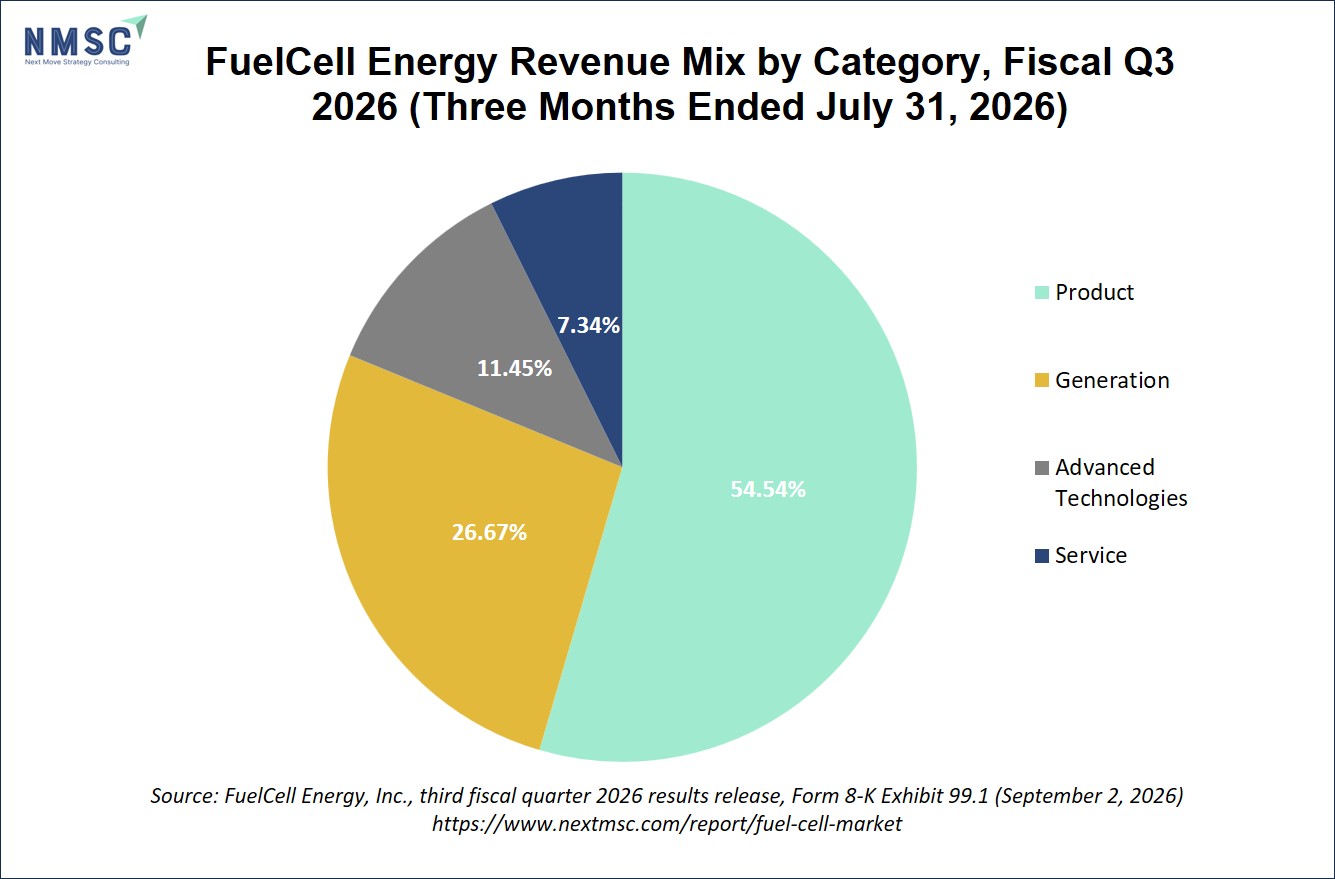
FuelCell Energy, Inc. reported fiscal third quarter 2026 revenue of USD 33,001 thousand: product USD 18,000 thousand, generation USD 8,801 thousand, advanced technologies USD 3,778 thousand and service USD 2,422 thousand. Shares shown are each category's published amount divided by the published total (NextMSC calculation), which sum to 100.0%. Product sales form the largest category.
Backlog and capacity figures explain why investors look through weak current revenue. FuelCell Energy reported committed backlog of USD 1.30 billion and awarded capacity backlog of USD 2.35 billion at July 31, 2026, a combined USD 3.65 billion, against annualized production of 37.1 MW during the quarter. The company set a target of 100 MW of annualized production by October 2026 and a 500 MW expansion of its Torrington, Connecticut facility by June 2028. Combined backlog equal to more than 110 times quarterly revenue (a NextMSC calculation from the reported figures) is a commitment to future volume rather than current earnings, and delivery depends on how quickly the factory ramps.
Plug Power Inc. illustrates a different business model, in which fuel cells serve material handling and electrolyzers serve industrial hydrogen. Its November 9, 2026 results showed third-quarter net revenue of USD 200.6 million, up about 13% from USD 177.1 million, and GenDrive fuel cell deployments of 1,136 units against 540 a year earlier, an increase of 110%. Gross margin improved to negative 3% from negative 68%. Reported net income of USD 99.0 million reflected about USD 192 million of non-cash mark-to-market gains on equity instruments, so operating profitability remains the open question. Chief Executive Officer Jose Luis Crespo said the results reflected "continued progress toward a stronger, more profitable Plug."
Mobility's Slower Lane: What the IEA Global Hydrogen Review 2026 Shows
The vehicle side of the fuel cell market is growing, but at a measured pace. The IEA's Global Hydrogen Review 2026 puts the global fuel cell electric vehicle stock at almost 130,000 in 2025, up 20%, driven by truck sales in China and a rebound in car sales in Korea. The agency expects that stock to triple by 2030, with fuel cell trucks accounting for over 60% of hydrogen use in road transport. Driven by its target of 100,000 fuel cell vehicles in operation by 2030, China could capture nearly two-thirds of global road hydrogen demand.
Fuel supply constrains this lane. The same review reports that global hydrogen demand surpassed 100 Mt in 2025, while low-emissions hydrogen production reached almost 1 Mt, still below 1% of the total. The IEA also finds that low-emissions hydrogen remains more expensive than fossil-based hydrogen in most regions, and that committed and strong-potential projects for 2030 fell from 10 Mt to just above 6 Mt compared with the previous edition. For fleet operators, hydrogen availability and price are therefore the binding variables.
NMSC Strategic Perspective: Stationary Power Becomes the Anchor Application
NextMSC primary research and analysis reads this evidence as a change in the anchor application of the fuel cell market. The NMSC report already identifies stationary power, including backup power, telecom towers and remote industrial sites, as a forward opportunity alongside hydrogen fuel cell electric vehicle demand as a growth driver. The 2026 company disclosures add a third and larger use case, data center primary power, with a different commercial logic: the buyer is a well-capitalized infrastructure operator, the purchase decision is set by time to power, and a single contract can cover hundreds of megawatts rather than individual vehicles.
Three implications follow from NMSC's analysis. First, competition between product types will be decided by the ability to ship modular units at volume. Bloom Energy's product revenue of USD 1,073.6 million in one quarter and FuelCell Energy's planned move from 37.1 MW to 100 MW of annualized production show that manufacturing throughput, not announced backlog, separates revenue from reservations. Second, fuel flexibility becomes a regulatory exposure. Because the IEA reports that almost all data center fuel cells run on natural gas, operators and their financiers will face questions on emissions accounting and on the pathway to hydrogen or other low-carbon fuels. Third, regional dynamics diverge. North America, which NMSC identifies as the largest regional market, hosts the Texas data center project that FuelCell Energy disclosed, while Asia Pacific demand depends more heavily on government-designed schemes such as South Korea's hydrogen power auctions.
Section Summary:
The fuel cell market has gained a new anchor customer. Data center operators are contracting hundreds of megawatts of onsite power for speed of delivery, while vehicle and hydrogen-fueled segments grow within the limits of fuel cost and subsidy design.
-
NTT DATA's 900 MW agreement is more than double the IEA's reported data center fuel cell base of around 400 MW.
-
Bloom Energy's Q3 2026 revenue rose 138.1%, while FuelCell Energy's fell 29%, so conversion depends on manufacturing scale.
-
Low-emissions hydrogen remains below 1% of global supply, which limits vehicle growth.
Industry Impact Analysis: Policy, Capital and Supply Chains Behind the Fuel Cell Market
Policy is the second force. South Korea, which the IEA credits with a rebound in fuel cell car sales, is reopening its clean hydrogen power auction after cancelling the 2025 round. S&P Global Energy reported on June 16, 2026 that the government plans an auction for 500 GWh per year of clean hydrogen power and a separate 930 GWh per year of general hydrogen power, with bids expected in the second half of 2026 and coal-ammonia co-firing excluded from the clean category. The 2024 round sought 6,500 GWh per year and awarded 750 GWh per year, all to state-run Korea Southern Power for ammonia-coal co-firing. The combined 1,430 GWh per year now offered is 22% of the 2024 volume (a NextMSC calculation), a smaller and more targeted scheme. The S&P Global Energy coverage does not discuss fuel cells, so eligibility of fuel cell plants is a point for bidders to confirm with the ministry.
Project finance is the third force. The IEA's Global Hydrogen Review 2026 reports that installed electrolyser capacity doubled in 2025 to more than 4 GW, with China accounting for nearly three-quarters of new installations. New offtake agreements in 2025 were about 1.7 Mt, yet only around 20% were backed by firm contracts. The agency also warns that 22 Mt of potential production could lose its chance to start by 2030 if final investment decisions are not taken by early 2027. For fuel cell makers that depend on hydrogen-fueled demand, each delay pushes back the date at which low-cost hydrogen can supply large fleets and stationary plants.
The competitive consequence is a split in business models. Bloom Energy and FuelCell Energy sell electricity-producing equipment against a time-to-power requirement that does not depend on hydrogen supply, while Plug Power's electrolyzer orders, including a 280 MW supply agreement with Arcadia eFuels for Project ENDOR in Denmark and a 50 MW order from Orica in Australia, depend on hydrogen project finance. Plug Power's 2026 revenue growth guidance of 15% to 16%, set beside Bloom Energy's guidance that implies 122% growth at the midpoint, quantifies the gap.
Section Summary:
Policy and financing set the pace outside the data center segment. South Korea's reopened auction is smaller than the 2024 round, and the IEA documents a shrinking 2030 hydrogen project pipeline, while onsite power buyers are not waiting for either.
-
South Korea plans 500 GWh per year of clean and 930 GWh per year of general hydrogen power.
-
Only around 20% of 2025 hydrogen offtake agreements were backed by firm contracts, per the IEA.
-
Plug Power guides to 15% to 16% revenue growth in 2026, against 122% at the midpoint for Bloom Energy.
Pros and Cons of Recent Market Developments
The table below sets the favorable and unfavorable developments of the last six months side by side, using only figures from the named companies and the IEA.
Table 1: Pros and Cons of Recent Fuel Cell Developments
|
Pros |
Cons |
|
NTT DATA's 900 MW agreement with Bloom Energy confirms primary-power demand from data centers |
Shipments under the NTT DATA agreement begin in 2027, so revenue trails the announcement |
|
Bloom Energy's Q3 2026 revenue rose 138.1% with GAAP gross margin of 33.8% |
FuelCell Energy's fiscal Q3 2026 revenue fell 29% to USD 33.0 million |
|
FuelCell Energy holds USD 3.65 billion in committed and awarded capacity backlog |
Plug Power's net income relied on about USD 192 million of non-cash gains, with gross margin still negative |
|
Fuel cell electric vehicle stock grew 20% to almost 130,000 in 2025 (IEA) |
South Korea's 2024 hydrogen power round awarded 750 GWh of 6,500 GWh sought |
Key Data & Statistics
Two tables consolidate the reported figures behind this analysis: company disclosures from September to November 2026, and the IEA indicators that frame hydrogen supply and vehicle demand.
Table 2: Company Disclosures, September to November 2026
|
Company |
Disclosure date |
Reported metric |
Value |
|
Bloom Energy |
Oct 22, 2026 |
Q3 2026 revenue |
USD 1,235.8 million (up 138.1%) |
|
NTT DATA and Bloom Energy |
Nov 5, 2026 |
Onsite fuel cell agreement |
900 MW; shipments from 2027 |
|
FuelCell Energy |
Sep 2, 2026 |
Fiscal Q3 2026 revenue |
USD 33.0 million (down 29%) |
|
FuelCell Energy |
Sep 2, 2026 |
Committed plus awarded backlog |
USD 3.65 billion |
|
Plug Power |
Nov 9, 2026 |
Q3 2026 net revenue |
USD 200.6 million (up about 13%) |
Table 3: Hydrogen and Fuel Cell Indicators, IEA Global Hydrogen Review 2026
|
Indicator |
Reported value |
|
Global hydrogen demand, 2025 |
Above 100 Mt (up almost 3%) |
|
Low-emissions hydrogen production, 2025 |
Almost 1 Mt (up 20%) |
|
Fuel cell electric vehicle stock, 2025 |
Almost 130,000 (up 20%) |
|
Fuel cell capacity installed at data centers |
Around 400 MW, almost all on natural gas |
|
Committed and strong-potential 2030 projects |
Just above 6 Mt (from 10 Mt) |
Future Outlook & Forecast: Where the Fuel Cell Market Goes Next
NextMSC primary research and analysis projects the global fuel cell market to expand from USD 8.73 billion in 2024 to USD 38.25 billion by 2030, a CAGR of 28.0% over the 2025 to 2030 forecast period. That path adds USD 29.52 billion of annual market value in six years and implies a 4.4-fold expansion (NextMSC calculation). The 2026 evidence indicates where the increments are most likely to originate and which dated milestones will confirm or challenge the trajectory.
The near-term calendar is specific. South Korea's clean and general hydrogen power bids are expected in the second half of 2026, according to S&P Global Energy. NTT DATA's first shipments from Bloom Energy begin in 2027, the same period in which the IEA says final investment decisions must be taken to keep 22 Mt of potential hydrogen production in play for 2030. FuelCell Energy's Torrington expansion to 500 MW is scheduled for completion by June 2028, and the IEA expects fuel cell electric vehicle stock to triple by 2030.
Three variables will decide whether the 28.0% trajectory holds. The first is manufacturing throughput, since backlog converts to revenue only at the pace factories ship. The second is fuel pathway, because the natural gas base of current data center fuel cells must eventually be matched by credible hydrogen or low-carbon fuel supply, which the IEA's cost findings suggest will not arrive cheaply. The third is policy design, as shown by the contraction of South Korea's auction volume from 6,500 GWh to 1,430 GWh per year. Dated disclosures such as shipments, firm offtake contracts and awarded capacity are the leading indicators; announced pipelines are options rather than commitments.
Section Summary:
NextMSC projects the fuel cell market to grow from USD 8.73 billion in 2024 to USD 38.25 billion by 2030, and 2026 company data shows data center power adding volume fastest.
-
Milestones to watch: Korea's bids in late 2026, NTT DATA shipments in 2027, FuelCell Energy's 500 MW plant by June 2028.
-
Manufacturing throughput, fuel pathway and policy design decide whether the 28.0% CAGR is realized.
-
Firm contracts and shipments are stronger indicators than announced pipelines.
Next Steps for Stakeholders
The evidence supports different actions for each decision-maker group.
-
Investors: Track conversion from backlog to revenue, comparing FuelCell Energy's USD 3.65 billion backlog with its 37.1 MW annualized production, and test whether Plug Power's profit persists without non-cash gains.
-
Data center operators: Contract onsite power early enough to align shipment slots, such as the 2027 start in the NTT DATA agreement, with construction schedules, and document the fuel pathway for emissions reporting.
-
Fuel cell manufacturers: Publish annualized production and deliveries alongside bookings, and qualify products for natural gas and hydrogen operation where feasible.
-
Fleet and industrial buyers: Anchor deployments to secured hydrogen supply and price terms.
-
Policy teams and bidders: Seek written clarification on fuel cell eligibility in South Korea's auction, and monitor the early 2027 investment decision deadline highlighted by the IEA.
Conclusion
The fuel cell market entered the final quarter of 2026 with a clear change in its center of gravity. NTT DATA's 900 MW agreement, Bloom Energy's 138.1% revenue increase and FuelCell Energy's first data center reservation show that power-constrained infrastructure now drives the largest orders, while the IEA's data places vehicles and hydrogen-fueled generation on a slower path set by fuel cost and policy. NextMSC's projection of USD 38.25 billion by 2030 depends on converting backlog into shipped megawatts and on a credible hydrogen pathway. Stakeholders that follow dated, contracted evidence rather than announced ambition will read the fuel cell market most accurately.
About the Author
 Priyanshu Das
— Priyanshu Das is SEO Executive at Next Move Strategy Consulting, where he has led on-page and off-page SEO, keyword research, and SEO audits for the firm's B2B market research publications for 2 years. His audit process combines technical crawl analysis, backlink profile review, and competitor keyword gap mapping — using tools including Screaming Frog and Google Search Console — to prioritize fixes by organic search-visibility impact, informed by his own prior in-house and agency SEO experience.
About the Reviewer
 Debashree Dey
— Debashree Dey is Assistant Manager at Next Move Strategy Consulting, where she supports cross-vertical market content and communications across diverse industries for 6 years. Her professional background includes senior content writing, communications, and published manuscript authorship, with experience developing audience-focused business narratives and maintaining clear, consistent messaging. Her role supports research-led content development and editorial quality across NextMSC publications.














Add Comment