Home Healthcare Services Market Size & Share: $418Bn, 8.93% CAGR | NextMSC

Introduction
The global home healthcare services market stands at a pivotal inflection point — shaped simultaneously by an accelerating demographic transition, a tightening reimbursement environment, and a wave of AI-driven care delivery innovation that is fundamentally redefining what "clinical-grade care" means outside a hospital setting. According to Next Move Strategy Consulting's Home Healthcare Services Market report, the global home healthcare services market was valued at USD 384.8 billion in 2024 and is projected to reach USD 641.0 billion by 2030, growing at a CAGR of 8.93% from 2025 to 2030. The market reached USD 418.0 billion in 2025, reflecting the compounding effect of aging demographics, rising chronic disease burden, and sustained growth in healthcare expenditure across both developed and emerging economies.
What distinguishes the current growth trajectory from prior cycles is the convergence of structural demand — driven by an irreversible demographic shift — with a regulatory and technological environment that is actively redirecting care delivery from institutional settings to the home. For C-level executives, institutional investors, and healthcare system strategists, understanding the specific mechanisms behind this convergence is essential to positioning capital and operational capacity ahead of the market's next phase.
For More Information: Download FREE Sample on Home Healthcare Services Market Report
When Regulation and Robotics Collide: The Forces Reshaping Home-Based Care
The CMS CY 2026 Final Rule: A Structural Stress Test for Home Health Agencies
On November 28, 2025, the Centers for Medicare & Medicaid Services (CMS) issued the Calendar Year 2026 Home Health Prospective Payment System Final Rule (CMS-1828-F), finalizing a net aggregate payment reduction of an estimated 1.3%, or USD 220 million, to home health agencies (HHAs) compared to CY 2025. The rule combines a 2.4% statutory payment update (approximately USD 405 million increase) with a permanent prospective adjustment of -1.023% and a temporary adjustment of -3.0%, the latter designed to recoup estimated overpayments from the 2020 implementation of the Patient-Driven Groupings Model (PDGM).
The cumulative weight of this rule is significant. When combined with payment reductions of 3.925%, 2.890%, and 1.975% applied in CY 2023, CY 2024, and CY 2025 respectively, the sector has absorbed an estimated 8.8% in aggregate payment reductions since CY 2023, according to LeadingAge. For smaller, independent HHAs operating on thin margins, this compounding pressure is accelerating consolidation — a dynamic that is simultaneously concentrating market share among well-capitalized operators and creating acquisition opportunities for private equity-backed platforms.
Critically, the CY 2026 rule also expands the Home Health Value-Based Purchasing (HHVBP) Model's applicable measure set, adding four new measures — including three OASIS-based measures related to bathing and dressing and a Medicare Spending per Beneficiary measure for post-acute care — effective April 2026. This signals CMS's long-term intent to shift reimbursement from volume-based to outcomes-based models, a structural change that rewards agencies with robust data infrastructure and care coordination capabilities.
Looking ahead, CMS's CY 2027 proposed rule signals a reversal: the agency estimates Medicare payments to HHAs would increase in the aggregate by 2.4%, or USD 420 million, compared to CY 2026 — providing a potential reimbursement tailwind for agencies that survive the current consolidation cycle.
Cera's GenieConnect Acquisition: AI Robotics Enters the Home Care Mainstream
In November 2025, UK-based health technology company Cera acquired the GenieConnect robotics platform and announced plans to scale its AI-powered home care robots following successful pilot deployments. The GenieConnect robots — droid-like assistants powered by Cera's proprietary AI software — assist elderly and frail individuals with daily reminders (eating, drinking, medication adherence) while continuously collecting health data to enable predictive care interventions. According to Health Tech World, a single GenieConnect robot can deliver annual cost savings of more than £11,500 per patient per year, and Cera was signing up one new local government client every week at the height of its rollout.
This development is not an isolated proof-of-concept. It represents the first commercially scaled deployment of AI-powered care robotics within a regulated home healthcare framework, and it directly addresses the sector's most persistent structural constraint: the caregiver workforce shortage. The U.S. Bureau of Labor Statistics projects that employment of home health and personal care aides will grow 18% from 2025 to 2035 — one of the fastest growth rates of any occupation — yet the supply of qualified workers is not keeping pace with this demand. AI-assisted care delivery, as demonstrated by Cera's model, offers a scalable mechanism to extend the capacity of existing caregivers rather than replace them — a distinction that is critical for regulatory acceptance and public trust.
Telehealth Infrastructure: The Federal Investment Accelerating Home-Based Care
On September 30, 2026, the Trump Administration announced USD 20 million to expand telehealth access and upgrade healthcare technology across rural North Carolina — a direct investment in the infrastructure that underpins remote home healthcare delivery. This announcement follows Congress's February 2026 extension of Medicare telehealth policy through December 31, 2027, which allows Medicare beneficiaries to receive telehealth services anywhere in the United States — removing the geographic restrictions that previously limited home-based virtual care to rural designations.
The financial trajectory of remote patient monitoring (RPM) within this framework is instructive: Medicare payments for RPM services jumped 31% from USD 408 million in 2023 to USD 536 million in 2024, according to a 2025 analysis reported by Fierce Healthcare — a growth rate that substantially outpaces the broader home health reimbursement environment and signals where payer investment is concentrating.
NMSC Strategic Perspective: Navigating the Dual-Speed Market
NextMSC primary research and analysis identifies a dual-speed dynamic within the global home healthcare services market that is not fully captured by aggregate CAGR figures. On one track, the North American market — which dominates global market share — is experiencing a reimbursement-driven consolidation cycle that is compressing margins for smaller operators while creating scale advantages for integrated platforms with diversified payer mixes (Medicare, Medicaid, Medicare Advantage, and commercial insurance). On the second track, the Asia-Pacific region is experiencing demand-side acceleration driven by demographic aging that is structurally unconstrained by the reimbursement pressures affecting the U.S. market.
The strategic implication is that capital allocation decisions in this market require a geographic disaggregation that aggregate market-size figures obscure. Operators and investors focused on North America must prioritize value-based care capabilities, technology-enabled care coordination, and scale — while those targeting Asia-Pacific should focus on market entry and capacity-building ahead of the demographic inflection that WHO projects will see the proportion of individuals aged 60 and above in the region rise from 12.2% in 2024 to 22.9% by 2050.
Section Summary:
-
The CMS CY 2026 Final Rule imposes a net 1.3% ($220M) payment reduction on HHAs, compounding cumulative cuts of approximately 8.8% since CY 2023 and accelerating sector consolidation.
-
Cera's acquisition of the GenieConnect robotics platform in November 2025 marks the first commercially scaled deployment of AI-powered care robots in a regulated home healthcare framework, delivering £11,500+ in annual cost savings per patient.
-
Medicare RPM payments grew 31% from 2023 to 2024, and Congress extended telehealth access through December 2027, reinforcing the structural shift toward technology-enabled home-based care.
-
NMSC analysis identifies a dual-speed market: reimbursement-driven consolidation in North America versus demand-driven expansion in Asia-Pacific — requiring distinct strategic responses from operators and investors.
Industry Impact Analysis
The Demographic Imperative: An Irreversible Demand Engine
The foundational demand driver for the home healthcare services market is a demographic transition that no policy cycle can reverse. According to the World Health Organization, by 2030, one in six people globally will be aged 60 years or over, with the total population in this cohort rising from 1 billion in 2020 to 1.4 billion. By 2050, the global population aged 60 and older will reach 2.1 billion, and the number of persons aged 80 and above is expected to triple between 2020 and 2050 to reach 426 million. This is not a trend — it is a structural condition that will define healthcare demand for the next three decades.
The chronic disease burden that accompanies this demographic shift is equally consequential. The WHO reports that noncommunicable diseases — including heart disease, stroke, cancer, diabetes, and chronic lung conditions — now account for 74% of all deaths worldwide, and the majority of these conditions require continuous, long-term management that is increasingly being delivered in the home setting.
The Alzheimer's Association's 2026 Facts and Figures report provides a particularly stark illustration of this burden's financial scale: health and long-term care costs for people living with dementia are projected to reach USD 409 billion in 2026. A separate USC-led study published in 2026 estimated the total cost of dementia in the United States — including quality-of-life losses — at USD 818 billion for the year, The USC-led 2026 study estimated total U.S. dementia costs at USD 818 billion; reduced quality of life was the largest component at USD 320 billion, while unpaid caregiving was valued at USD 237 billion. This scale of unmet need — and the inadequacy of institutional care capacity to absorb it — is the structural argument for home-based care that no reimbursement adjustment can neutralize.
In July 2026, the WHO published new guidelines indicating that up to 45% of dementia risk could be prevented or delayed through modifiable risk factor interventions — a finding that directly expands the addressable market for preventive home healthcare services, including remote monitoring, medication management, and lifestyle coaching delivered in the home setting.
Healthcare Expenditure Growth: Expanding the Affordability Frontier
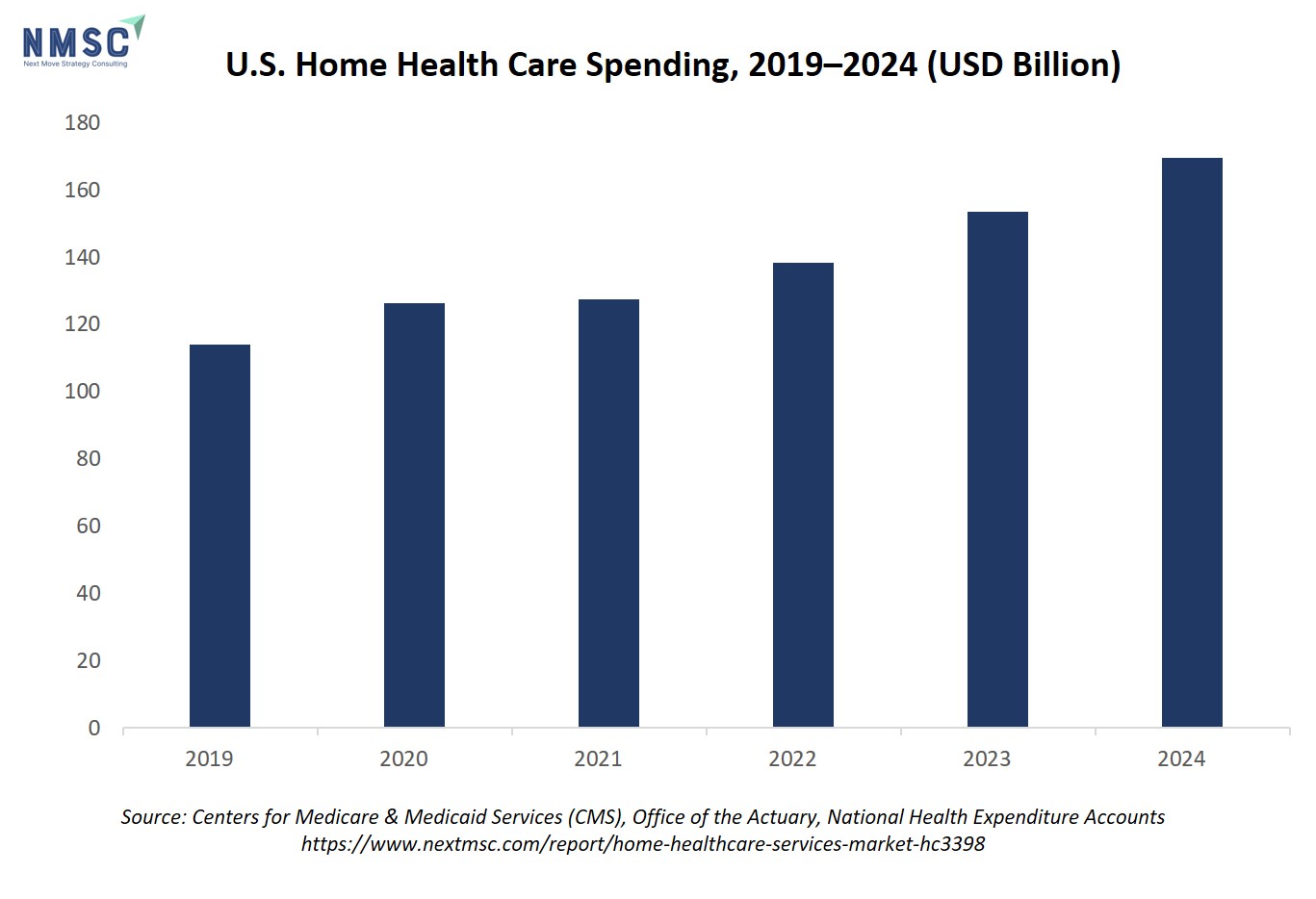
Rising healthcare expenditure across major economies is directly expanding the financial capacity of payers — both public and private — to fund home-based care. According to a report published by the Centers for Medicare & Medicaid Services in December 2024, healthcare spending in the United States rose by 7.5% in 2023, reaching USD 4.9 trillion. In the United Kingdom, provisional estimates from the Office for National Statistics in 2024 placed nominal healthcare spending at approximately USD 343.11 billion. In the Netherlands, healthcare spending reached approximately USD 123 billion in 2024 — an 8.1% increase from the prior year, with healthcare expenditure rising from 9.8% to 10.0% of GDP.
These expenditure increases are not simply inflating hospital budgets. They are funding a structural shift toward patient-centered, cost-efficient care models — of which home healthcare is the primary beneficiary. The U.S. FDA's Home as a Health Care Hub initiative, introduced in 2024, explicitly frames the home as a vital component of the healthcare system and promotes the integration of medical devices within the home setting to support health and enhance wellness.
Competitive Landscape: Strategic Moves by Key Operators
The competitive dynamics of the home healthcare services market are being shaped by a combination of technology investment, service line expansion, and geographic consolidation:
-
CVS Health launched a redesigned mobile application in 2025 featuring AI-powered search, personalized health to-do lists, conversational chat, and integrated access to Aetna insurance and Caremark pharmacy services — positioning the company's home health offering within a broader consumer health ecosystem.
-
Amedisys, in collaboration with CMS, launched the Contessa model for dementia care in 2024 — a hospital-at-home program specifically designed to manage one of the highest-cost chronic conditions in the home setting.
-
Air Liquide Health Care announced plans in 2025 to expand its German home healthcare operations through the acquisition of two outpatient intensive care companies — intensivLeben GmbH and AP-Sachsen GmbH — reflecting the consolidation trend in European home-based care.
Section Summary:
-
WHO projects the global population aged 60+ will reach 2.1 billion by 2050, with the 80+ cohort tripling to 426 million — creating an irreversible structural demand base for home-based care.
-
Dementia care costs alone are projected at USD 409 billion in the U.S. in 2026 (Alzheimer's Association), with a USC-led study estimating total dementia costs at USD 818 billion when quality-of-life losses are included.
-
New WHO guidelines (July 2026) indicate up to 45% of dementia risk is preventable, expanding the addressable market for preventive home healthcare services.
-
Key operators — CVS Health, Amedisys, and Air Liquide — are deploying AI-integrated platforms, hospital-at-home models, and geographic consolidation strategies to capture share in a tightening reimbursement environment.
Pros and Cons of Recent Market Developments
|
Development |
Pros |
Cons |
|
CMS CY 2026 HH PPS Final Rule (Net -1.3% Payment Reduction) |
Accelerates consolidation, rewarding well-capitalized, technology-enabled operators; HHVBP expansion incentivizes quality improvement |
Compresses margins for smaller and rural HHAs; cumulative 8.8% cuts since 2023 threaten access to care in underserved markets |
|
Cera's GenieConnect AI Robotics Deployment (Nov 2025) |
Delivers £11,500+ annual cost savings per patient; extends caregiver capacity without replacing human care; enables predictive care models |
High upfront capital cost for technology adoption; regulatory frameworks for AI-assisted care remain nascent in most markets |
|
Medicare Telehealth Extension Through December 2027 |
Removes geographic restrictions on home-based virtual care; RPM payments grew 31% (2023–2024), signaling payer confidence |
Proposed CMS restrictions on third-party RPM providers could limit service delivery models; digital literacy gaps persist among elderly populations |
|
FDA Home as a Health Care Hub Initiative (2024) |
Legitimizes home as a clinical care setting; accelerates medical device integration in home environments |
Regulatory pathway for novel home-based devices remains complex; liability frameworks for home-based clinical events are still evolving |
|
Rising Global Healthcare Expenditure |
Expands payer capacity to fund home-based care; supports value-based contracting models |
Inflationary pressures on labor and supply costs may offset expenditure gains; fiscal consolidation in some markets could reverse spending trends |
Key Data & Statistics
Key Industry Data Points from Primary Institutional Sources
|
Indicator |
Value |
Year |
|
Global population aged 60+ by 2050 |
2.1 billion |
2025 |
|
Global population aged 80+ by 2050 |
426 million (triple 2020 level) |
2025 |
|
NCDs as share of global deaths |
74% |
2025 |
|
U.S. healthcare spending (2023) |
USD 4.9 trillion (+7.5% YoY) |
Dec 2024 |
|
U.S. dementia care costs (2026) |
USD 409 billion |
2026 |
|
Total U.S. dementia cost incl. quality-of-life losses (2026) |
USD 818 billion |
2026 |
|
Medicare RPM payment growth (2023–2024) |
+31% (USD 408M → USD 536M) |
2025 |
|
CMS CY 2026 net HHA payment change |
-1.3% (-USD 220 million) |
Nov 2025 |
|
CMS CY 2027 proposed HHA payment change |
+2.4% (+USD 420 million) |
2026 |
|
BLS projected growth: home health & personal care aides |
+18% (2025–2035) |
2026 |
|
Cera GenieConnect annual cost savings per patient |
£11,500+ |
2026 |
|
Asia-Pacific population aged 60+ by 2050 |
22.9% (from 12.2% in 2024) |
2025 |
|
Netherlands healthcare spending (2024) |
USD 123 billion (+8.1% YoY) |
2024 |
Future Outlook & Forecast
The Path to USD 641 Billion: Structural Drivers and Strategic Inflection Points
NextMSC primary research and analysis projects the global home healthcare services market will reach USD 641.0 billion by 2030, sustained by a CAGR of 8.93% from 2025 to 2030. This trajectory is underpinned by three structural forces that are self-reinforcing rather than cyclical.
First, the demographic transition is accelerating, not plateauing. The WHO's UN Decade of Healthy Ageing (2021–2030) has catalyzed coordinated government action across 194 member states to build long-term care infrastructure — with home-based care as the preferred delivery model. The proportion of the global population aged 60 and above will reach 22% by 2050, up from 12% in 2015, according to WHO data. Each percentage point of this demographic shift translates directly into incremental demand for home-based chronic disease management, post-acute recovery, and palliative care.
Second, the technology stack enabling home-based clinical care is maturing rapidly. The convergence of AI-powered remote monitoring, robotics-assisted daily care (as demonstrated by Cera's GenieConnect deployment), and interoperable health data platforms (accelerated by CMS's FHIR-based digital quality measurement initiative in the CY 2026 rule) is progressively closing the clinical capability gap between home and hospital settings. As this gap narrows, the clinical and economic case for home-based care strengthens — expanding the range of conditions that can be safely and cost-effectively managed outside institutional settings.
Third, the reimbursement environment, while currently constrained in the U.S., is structurally supportive of home-based care globally. The CY 2027 proposed rule's projected 2.4% payment increase signals that the current period of Medicare payment compression is approaching its end. Meanwhile, European markets — where healthcare spending as a share of GDP is rising (Netherlands: 10.0% of GDP in 2024) — are actively investing in home-based care as a cost-containment strategy relative to hospital-based alternatives. In Asia-Pacific, the absence of mature institutional long-term care infrastructure in many markets means that home-based care is not a supplement to hospital care — it is the primary care delivery model for the elderly population.
The workforce dimension remains the most significant execution risk to this outlook. The BLS projects 18% employment growth for home health and personal care aides from 2025 to 2035, but supply constraints — driven by low median wages, high turnover, and limited career mobility — mean that demand will consistently outpace supply in the near term. This constraint is the primary commercial rationale for AI-assisted care delivery and is likely to accelerate technology adoption across the sector regardless of regulatory pace.
Section Summary:
-
NMSC projects the global home healthcare services market will reach USD 641.0 billion by 2030 at an 8.93% CAGR, driven by demographic aging, chronic disease prevalence, and technology-enabled care delivery.
-
The WHO's UN Decade of Healthy Ageing (2021–2030) is coordinating government investment in home-based care infrastructure across 194 member states, providing a policy tailwind that extends beyond any single reimbursement cycle.
-
The CY 2027 proposed rule's projected +2.4% Medicare payment increase signals the approaching end of the current U.S. reimbursement compression cycle.
-
Workforce supply constraints — with demand projected to grow 18% from 2025 to 2035 (BLS) while supply lags — represent the primary execution risk and the strongest commercial driver for AI-assisted care technology adoption.
Next Steps for Stakeholders
-
For Home Health Agency Operators and Healthcare System Executives: The CMS CY 2026 payment environment demands immediate action on two fronts: cost structure optimization and payer mix diversification. Agencies that remain predominantly dependent on Medicare fee-for-service reimbursement are exposed to continued payment compression. Operators should accelerate contracting with Medicare Advantage plans and value-based care arrangements, where per-member-per-month payment structures provide more predictable revenue and reward care coordination capabilities. The HHVBP model's expansion — adding outcomes-based measures effective April 2026 — means that agencies without robust OASIS data infrastructure and quality improvement programs will face compounding financial penalties as the model matures.
-
For Technology Investors and Health Tech Developers: The Cera-GenieConnect deployment model provides a commercially validated template for AI-assisted home care at scale. The addressable market for care robotics, remote monitoring platforms, and AI-powered care coordination software is expanding precisely because the workforce shortage is structural and the reimbursement environment is incentivizing technology substitution. Investors should focus on platforms that can demonstrate measurable cost savings per patient (the £11,500 annual savings benchmark set by GenieConnect is a credible reference point) and that have a clear pathway to regulatory acceptance in multiple jurisdictions.
-
For Institutional Investors and Private Equity: The current consolidation cycle in U.S. home health — driven by CMS payment compression — is creating acquisition opportunities at compressed valuations. However, the investment thesis must be built on post-consolidation operational efficiency and technology integration, not simply on scale. The CY 2027 proposed payment increase suggests a potential reimbursement recovery that would reward well-positioned platforms. In parallel, Asia-Pacific market entry — particularly in Japan, South Korea, Australia, and India — offers exposure to demand-driven growth unconstrained by the U.S. reimbursement cycle.
-
For Policymakers and Healthcare System Planners: The WHO's July 2026 finding that up to 45% of dementia risk is preventable through modifiable risk factors represents a significant policy opportunity. Investing in preventive home healthcare services — including remote monitoring, medication adherence programs, and lifestyle intervention delivered in the home — has the potential to reduce the long-term cost burden of dementia care, which the Alzheimer's Association projects at USD 409 billion in the U.S. alone in 2026. Aligning reimbursement policy with preventive home-based care models is both a fiscal and a public health imperative.
Conclusion
The global home healthcare services market is not simply growing — it is being structurally reconfigured by the simultaneous pressure of demographic inevitability, reimbursement reform, and technological disruption. NextMSC primary research and analysis projects the market will expand from USD 418.0 billion in 2025 to USD 641.0 billion by 2030 at a CAGR of 8.93%, reflecting a demand base that is demographically anchored and a supply-side that is being reshaped by AI-powered care delivery, telehealth infrastructure investment, and sector consolidation.
The CMS CY 2026 Final Rule's net payment reduction is a near-term headwind, but it is also a catalyst for the operational and technological transformation that will define the sector's next competitive order. Agencies, investors, and policymakers that treat the current period of compression as a consolidation opportunity — rather than a contraction signal — are best positioned to capture the structural growth that the market's demographic and technological fundamentals guarantee. For a comprehensive analysis of market sizing, segment dynamics, regional forecasts, and competitive positioning, access NMSC's full Home Healthcare Services Market report.
About the Author
 Sanyukta Deb
— Sanyukta Deb is Digital Marketing Team Lead at Next Move Strategy Consulting, where she has led content strategy and technical SEO for the firm's B2B market research publications for over 2 years. Her editorial process translates NextMSC's primary and secondary research — spanning technology, industrial, and consumer sectors — into commercial narratives, backed by search-intent, keyword, and competitive analysis. She brings 5 years of overall experience in digital marketing and content strategy.
Sanyukta Deb
— Sanyukta Deb is Digital Marketing Team Lead at Next Move Strategy Consulting, where she has led content strategy and technical SEO for the firm's B2B market research publications for over 2 years. Her editorial process translates NextMSC's primary and secondary research — spanning technology, industrial, and consumer sectors — into commercial narratives, backed by search-intent, keyword, and competitive analysis. She brings 5 years of overall experience in digital marketing and content strategy.
About the Reviewer
 Debashree Dey
— Debashree Dey is Assistant Manager at Next Move Strategy Consulting, where she supports cross-vertical market content and communications across diverse industries for 6 years. Her professional background includes senior content writing, communications, and published manuscript authorship, with experience developing audience-focused business narratives and maintaining clear, consistent messaging. Her role supports research-led content development and editorial quality across NextMSC publications.
Debashree Dey
— Debashree Dey is Assistant Manager at Next Move Strategy Consulting, where she supports cross-vertical market content and communications across diverse industries for 6 years. Her professional background includes senior content writing, communications, and published manuscript authorship, with experience developing audience-focused business narratives and maintaining clear, consistent messaging. Her role supports research-led content development and editorial quality across NextMSC publications.


















Add Comment