Biologics Growth and EU PPWR Reshape Pharma Packaging
Biologics Growth Reshaping Packaging Architecture
The most consequential structural shift currently redefining the Pharmaceutical Packaging Market is the rapid expansion of biologics, vaccines, and advanced therapeutics. As reported by the European Pharmaceutical Review in June 2026, growing demand for biologics, vaccines, and injectable therapies is expected to drive continued growth across the pharmaceutical packaging sector, with pharmaceutical manufacturers increasingly seeking packaging solutions that can support sterility, product stability, and regulatory compliance as more complex therapies move through development and into commercial production.
Unlike conventional oral solid dosage forms, biologics require highly controlled environments and specialised sterile packaging systems — including glass vials, prefilled syringes, cartridges, and advanced barrier technologies. The biopharmaceutical packaging market was valued at USD 22.9 billion in 2025 and is expected to grow from USD 24.8 billion in 2026, reflecting the accelerating pace of biologics adoption across global pharmaceutical pipelines.
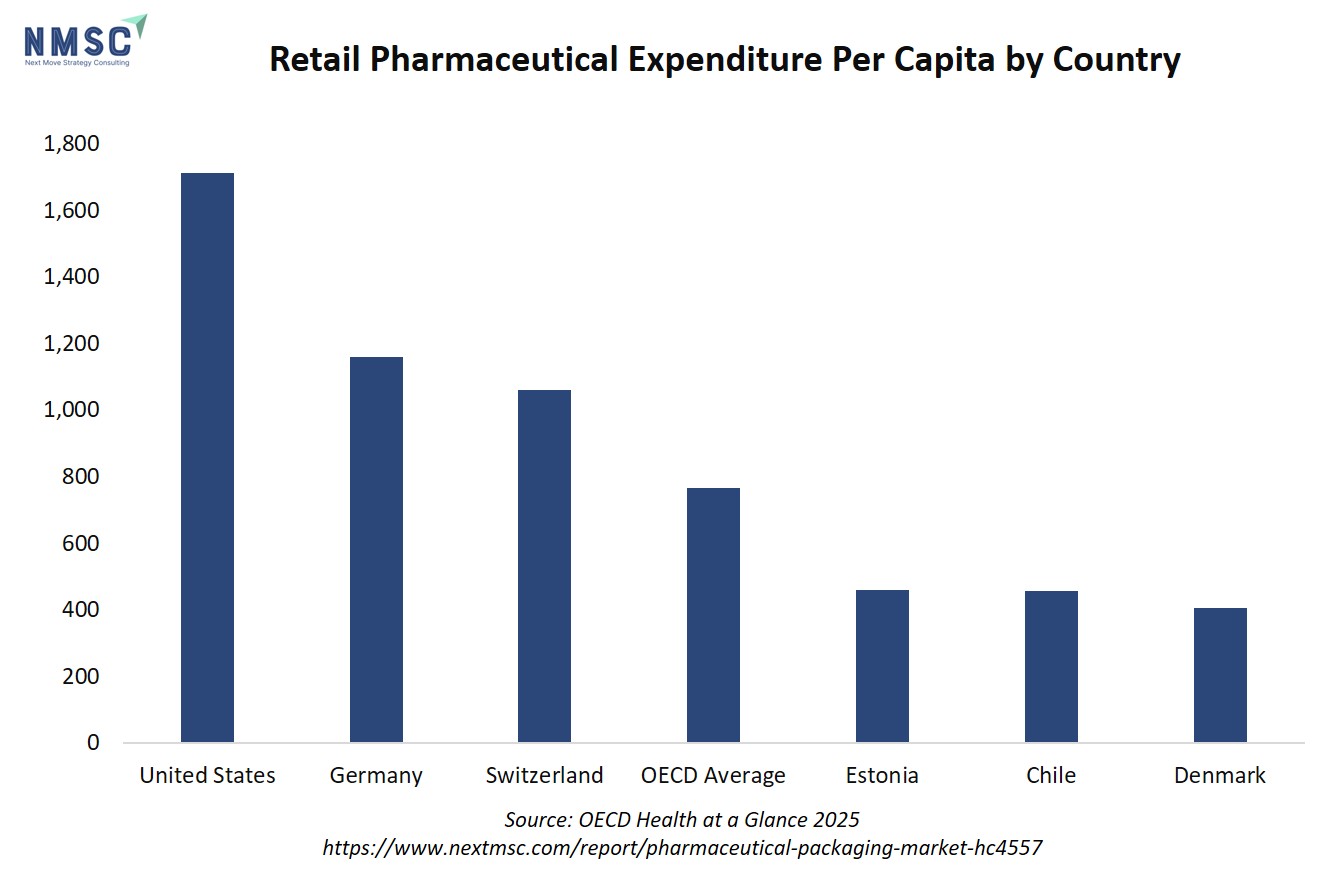
According to the OECD, non-retail pharmaceuticals accounted for 25% of total pharmaceutical expenditure in 2023, up from 21% in 2013, driven by rising hospital-based drug use and the increasing adoption of high-cost therapies. Additionally, global vaccine production stands at approximately 14.5 billion doses annually, reflecting sustained large-scale immunisation activity and continuous demand for sterile, temperature-sensitive packaging systems.
The shift is also being described as a move "from containment to protection," as manufacturers seek to safeguard increasingly sensitive biologic products. This paradigm shift is fundamentally elevating the strategic importance of packaging design within pharmaceutical development and commercialisation processes.
For More Information: Download FREE Sample on Pharmaceutical Packaging Market Report
The EU PPWR: A Regulatory Watershed for Pharmaceutical Packaging
Simultaneously, the European Union's Packaging and Packaging Waste Regulation — Regulation (EU) 2025/40 (PPWR) — entered into force on 11 February 2025 and began applying from 12 August 2026, representing the most significant regulatory overhaul of packaging compliance in the EU in decades.
The PPWR mandates that all packaging placed on the EU market must be designed for material recycling, with recyclability performance grades applicable from 2030 and stricter obligations from 2038. The regulation also establishes extended producer responsibility (EPR) frameworks, requiring producers to cover the full lifecycle costs of packaging, including collection, sorting, and recycling.
For pharmaceutical companies, the PPWR creates a structurally complex compliance environment. While the regulation recognises safety and supply concerns for certain medicinal and medical device packaging — particularly around minimum recycled content obligations — pharmaceutical packaging is not broadly exempt from PPWR pressure. Primary packaging in direct contact with medicinal products, secondary cartons, and tertiary transport packaging all face varying degrees of compliance obligation, requiring pharmaceutical companies to build structured readiness programmes rather than treating PPWR as a peripheral sustainability update.
The European Commission has noted that the EU generates approximately 186.5 kg of packaging waste per person, intensifying redesign requirements and lifecycle compliance costs across all sectors, including pharmaceuticals. Member States are required to achieve a 65% recycling rate by 2025 for all packaging waste, increasing to 70% by 2030.
NMSC Strategic Perspective: Navigating the Dual Disruption
From NMSC's analytical standpoint, the convergence of biologics-driven demand and PPWR-driven compliance pressure represents a defining structural duality for the pharmaceutical packaging market through 2035. These two forces are not merely parallel trends — they are creating a dual-pressure environment where companies must simultaneously invest in high-performance sterile packaging systems for biologics while redesigning conventional packaging formats to meet recyclability and sustainability mandates.
NMSC's analysis indicates that companies that treat these two imperatives as separate workstreams risk operational fragmentation and cost escalation. The most strategically positioned organisations are those integrating sustainability compliance into their packaging innovation roadmaps from the outset — developing hybrid materials, recyclable polymers, and lightweight structures that meet both pharmaceutical-grade safety requirements and environmental performance benchmarks. The PPWR's phased timeline — with key milestones in 2026, 2028, 2030, and 2035 — provides a structured window for proactive adaptation, but only for organisations that begin building packaging data infrastructure and compliance governance frameworks immediately.
Section Summary: The pharmaceutical packaging market is being simultaneously reshaped by the biologics revolution and the EU PPWR regulatory mandate, creating both high-value growth opportunities and structural compliance challenges.
Key Takeaways:
-
Biologics and vaccines are driving demand for sterile, temperature-controlled packaging formats including prefilled syringes, vials, and cartridges.
-
The EU PPWR (Regulation EU 2025/40), effective 12 August 2026, mandates recyclability and EPR compliance across all packaging placed on the EU market.
-
Pharmaceutical packaging is not broadly exempt from PPWR, requiring structured compliance programmes across primary, secondary, and tertiary packaging.
-
NMSC identifies the integration of sustainability compliance into packaging innovation roadmaps as the defining strategic differentiator for market leaders through 2035.
Industry Impact Analysis
Serialisation and Anti-Counterfeiting: A Global Public Health Imperative
The pharmaceutical packaging market is also being fundamentally reshaped by the global enforcement of serialisation and track-and-trace frameworks. The scale of the counterfeit medicine crisis provides the clearest justification for this transformation: the annual value of the global counterfeit medicine market is estimated at up to USD 432 billion, and the World Health Organization (WHO) estimates that 1 in 10 medical products in low- and middle-income countries are either substandard or falsified. Africa bears the heaviest burden, with a prevalence rate of approximately 18.7%, nearly double the global average for developing nations.
In response, regulatory agencies have institutionalised serialisation requirements across major markets. The EU's Falsified Medicines Directive (FMD) requires 2D barcodes and anti-tampering devices, while the U.S. Drug Supply Chain Security Act (DSCSA) mandates electronic, interoperable tracking at the package level. As R. Chandi Prasad, Head of Packaging Development at Aurobindo Pharma, has noted: "Track and trace regulations by most countries by serialisation at different packaging levels is one of the biggest projects that the pharma industry has implemented in recent years, involving a lot of investment and changes in packaging materials."
In January 2026, Gerresheimer AG launched Gx InMonit at Pharmapack Paris — a smart add-on for autoinjectors that uses sensors and cloud connectivity to track patient adherence in real-time, exemplifying the convergence of smart packaging and digital health.
Ageing Demographics and Chronic Disease: The Structural Demand Engine
The WHO projects that the global population aged 60 and above will rise from 1 billion in 2020 to 1.4 billion by 2030, while non-communicable diseases (NCDs) account for 75% of global deaths. These demographic realities are creating a sustained, long-term demand backbone for pharmaceutical packaging, particularly for patient-centric formats such as unit-dose systems, calendar blister packs, and senior-friendly closures designed to improve medication adherence and reduce dosing errors.
Manufacturing Capacity Expansion and Supply Chain Localisation
Policy-driven expansion of pharmaceutical manufacturing is directly amplifying packaging demand. According to Eurostat, the EU pharmaceutical manufacturing sector recorded approximately USD 309 billion in production value in 2024, reflecting sustained industrial output growth. India's Production Linked Incentive (PLI) scheme for pharmaceuticals, valued at INR 15,000 crore, has exceeded investment expectations as of 2025, significantly strengthening domestic manufacturing capacity and driving demand for compliant packaging formats across export-oriented supply chains.
In April 2025, Amcor plc opened a USD 35 million advanced coating facility in Malaysia, marking a strategic shift toward localised, high-precision sterile packaging production in the Asia-Pacific region. In the same month, Amcor commercially launched its AmSky blister system, signalling a structural shift toward recyclable, mono-material formats in pharmaceutical packaging.
Section Summary: The pharmaceutical packaging market is being driven by a convergence of serialisation mandates, demographic pressures, and manufacturing capacity expansion, while simultaneously facing compliance complexity from sustainability regulations.
Key Takeaways:
-
The global counterfeit medicine market is estimated at up to USD 432 billion annually, making serialisation a critical public health and packaging imperative.
-
WHO projects the global population aged 60+ will reach 1.4 billion by 2030, sustaining long-term demand for patient-centric packaging formats.
-
EU pharmaceutical manufacturing recorded approximately USD 309 billion in production value in 2024, directly amplifying packaging demand.
-
Smart packaging innovations such as Gerresheimer's Gx InMonit (January 2026) are integrating digital health capabilities into packaging systems.
Key Market Drivers, Geographic Relevance & CAGR Impact
|
Driver / Restraint |
CAGR Impact |
Geographic Relevance |
Impact Timeline |
|
Rising global pharmaceutical consumption driven by ageing populations and chronic disease burden |
+3.12% |
North America, Europe, Japan, China, India |
Long term (4–8 years) |
|
Expansion of pharmaceutical manufacturing capacity driven by policy support and supply chain localisation |
+2.78% |
Asia-Pacific (India, China), Europe (Germany, France), North America (U.S.) |
Medium to Long term (3–7 years) |
|
Rapid expansion of biologics and vaccine production driving demand for sterile, temperature-controlled packaging |
+2.45% |
Global (strong in North America, Europe, India, China, Africa vaccine corridors) |
Medium term (3–6 years) |
|
Stringent environmental regulations and sustainability compliance increasing costs and slowing material transition |
-2.34% |
Europe (PPWR-driven), North America, Japan, selected APAC regulated markets |
Medium term (3–6 years) |
Future Outlook & Forecast
Market Trajectory: From USD 199.49 Billion to USD 628.54 Billion
According to NMSC's proprietary analysis, the global pharmaceutical packaging market is projected to grow from USD 199.49 billion in 2026 to USD 628.54 billion by 2035, at a CAGR of 13.6% during the forecast period. This trajectory reflects the convergence of multiple structural growth forces: the sustained expansion of biologics and vaccine pipelines, the digitisation of supply chains through serialisation and smart packaging, the policy-driven expansion of pharmaceutical manufacturing capacity, and the long-term demographic tailwinds of ageing populations and rising chronic disease prevalence.
Segment-Level Outlook
By Packaging Level: Primary packaging will continue to dominate value creation, driven by its direct role in drug protection, regulatory compliance, and product performance — particularly for biologics and injectables requiring highly specialised and sterile systems. Secondary packaging is gaining strategic relevance due to serialisation and regulatory labelling requirements, while tertiary packaging supports supply chain efficiency.
By Material: Plastic will maintain its dominant position due to scalability, cost efficiency, and adaptability across primary and secondary formats. However, glass remains indispensable in high-value injectable and biologics segments, while paper and paperboard are gaining importance driven by sustainability regulations. Elastomers and metals serve specialised but essential roles in closures and sealing applications.
By End-User: Pharmaceutical companies lead demand through large-scale production needs. However, biopharmaceutical companies and CDMOs are the fastest-evolving segments, supported by the growth of biologics and increasing outsourcing trends. The CDMO segment is gaining particular importance as pharmaceutical companies seek flexible, compliance-driven manufacturing partnerships.
Regional Outlook
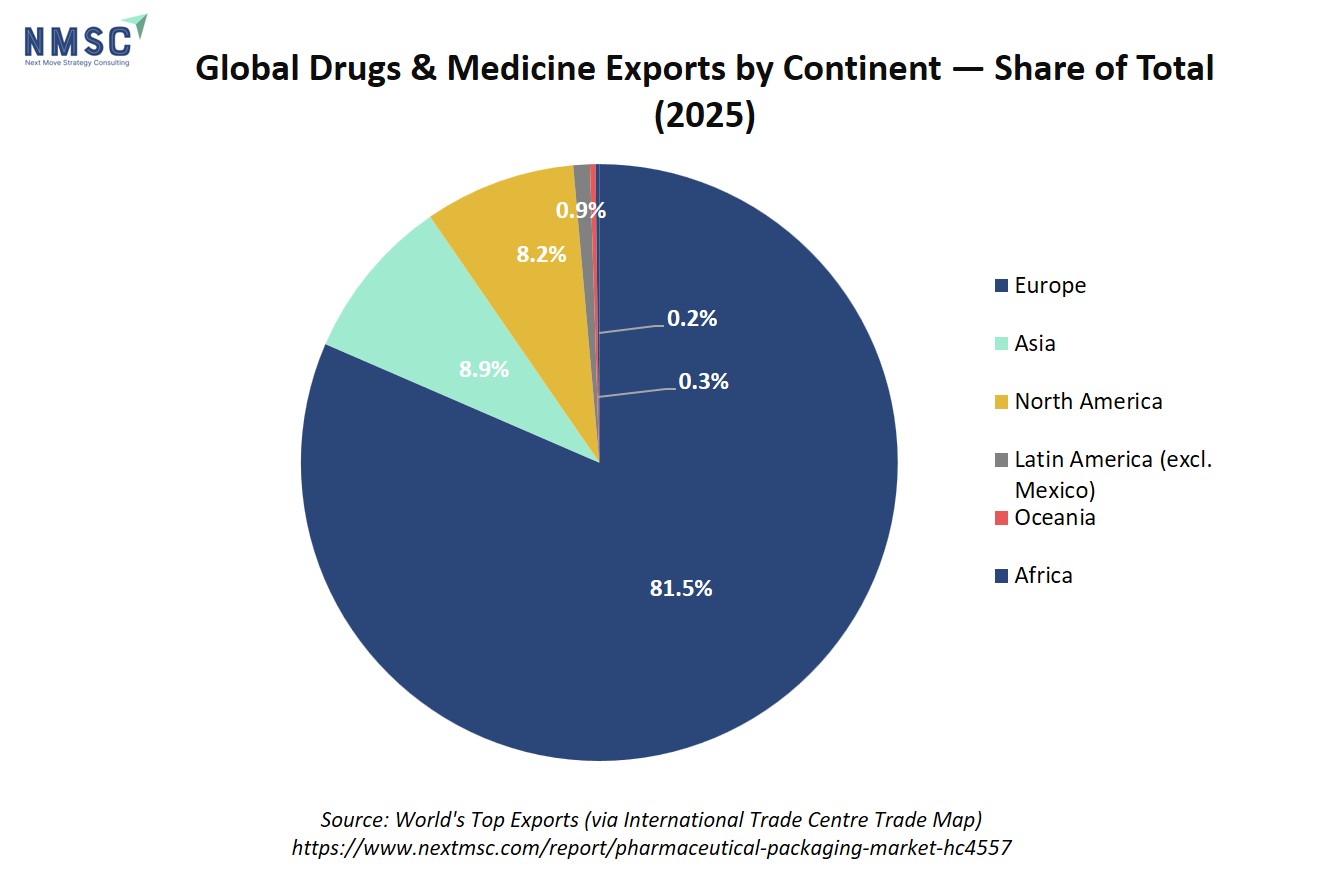
Asia-Pacific is the fastest-growing pharmaceutical packaging market, driven by expanding pharmaceutical production, rising healthcare demand, and export-oriented manufacturing across China, India, Japan, and South Korea. India's position as a leading global supplier of generic medicines — with exports supplying over 200 countries — significantly shapes packaging demand and drives the need for formats meeting stringent international regulatory requirements.
North America remains the most technologically advanced and innovation-driven market, with the U.S. Drug Supply Chain Security Act institutionalising end-to-end serialisation as a baseline requirement. The rapid expansion of biologics and personalised medicine pipelines is reshaping packaging needs toward prefilled syringes, vials, and cold-chain solutions.
Europe is defined by regulatory harmonisation and sustainability leadership, with the PPWR and the Falsified Medicines Directive (FMD) collectively shaping packaging material choices, serialisation requirements, and supply chain security standards across member states.
Innovation Horizon: Smart Packaging, Sustainable Materials, and Digital Traceability
Looking ahead, innovation is concentrating around three strategic pillars: smart packaging systems integrating RFID, IoT sensors, and real-time monitoring capabilities; advanced barrier materials and hybrid polymer solutions that balance pharmaceutical-grade safety with sustainability compliance; and digital traceability platforms that link physical packaging with end-to-end supply chain data infrastructure. The PPWR's phased compliance timeline — with critical milestones in 2028 (harmonised sorting labels), 2030 (recyclability grades and reuse targets), and 2035 (recycled-at-scale requirements) — provides a structured but demanding roadmap for material innovation and packaging redesign.
Section Summary: The pharmaceutical packaging market is on a sustained high-growth trajectory toward USD 628.54 billion by 2035, driven by biologics expansion, serialisation mandates, and manufacturing localisation, with innovation concentrated in smart packaging, sustainable materials, and digital traceability.
Key Takeaways:
-
NMSC projects the pharmaceutical packaging market to reach USD 628.54 billion by 2035 at a CAGR of 13.6% from 2026 to 2035.
-
Primary packaging and sterile formats will capture the highest value growth, driven by biologics and injectable drug demand.
-
Asia-Pacific is the fastest-growing regional market, with India and China as primary growth engines.
-
The PPWR's phased compliance timeline through 2035 creates a structured but demanding roadmap for sustainable packaging innovation.
Next Steps for Stakeholders
For Pharmaceutical Manufacturers and C-Level Executives:
-
Initiate PPWR Compliance Programmes Immediately. With the EU PPWR now in application as of 12 August 2026, pharmaceutical companies must conduct SKU-level packaging audits, map producer responsibility by country, and build defensible compliance positions across primary, secondary, and tertiary packaging portfolios. Waiting for regulatory pressure to peak will result in simultaneous design, legal, and data quality challenges that are significantly more costly to resolve under time pressure.
-
Prioritise Investment in Sterile and High-Barrier Packaging Capabilities. The biologics and vaccine pipeline expansion is a structural, multi-decade growth driver. Organisations that build or acquire capabilities in prefilled syringes, glass vials, and cold-chain-compatible packaging systems will be positioned to capture the highest-value segments of the pharmaceutical packaging market.
-
Integrate Serialisation Infrastructure as a Competitive Asset. Track-and-trace compliance should be treated as a supply chain intelligence platform, not merely a regulatory obligation. Organisations with robust serialisation systems gain real-time supply chain visibility, improved inventory management, and the ability to execute precise product recalls — capabilities that directly reduce operational risk and build regulatory trust.
-
Build a Structured Packaging Data Backbone. As PPWR and serialisation mandates both depend on accurate, SKU-level, component-level packaging data, organisations must consolidate packaging information from ERP systems, supplier specifications, and artwork files into a unified, auditable data infrastructure.
For Institutional Investors:
Focus Capital Allocation on High-Value Sterile Packaging and Smart Packaging Providers. Investment opportunities are most compelling in companies with strong capabilities in biologics-compatible packaging, serialisation-enabled systems, and sustainable material innovation. Valuations are increasingly tied to innovation intensity and exposure to high-growth therapeutic segments, particularly injectables and biologics.
Monitor M&A Activity in Specialty Packaging. The pharmaceutical packaging competitive landscape is consolidating around capability-driven acquisitions in niche technology providers — particularly in vials, prefilled syringes, and containment systems for biologics and vaccines. Strategic acquisitions by global leaders such as Amcor plc, Gerresheimer AG, and AptarGroup, Inc. are reinforcing market concentration while accelerating innovation transfer.
Conclusion
The pharmaceutical packaging market in 2026 is defined by structural complexity and exceptional growth potential in equal measure. The convergence of the biologics revolution, the EU PPWR regulatory mandate, global serialisation enforcement, and demographic-driven pharmaceutical demand is collectively repositioning pharmaceutical packaging as a strategically indispensable component of global healthcare infrastructure — not a peripheral supply chain function.
NMSC's forecast of a USD 628.54 billion market by 2035, growing at a CAGR of 13.6%, reflects the depth and durability of these structural drivers. For pharmaceutical manufacturers, packaging providers, and institutional investors, the organisations that will capture disproportionate value in this market are those that treat packaging as a strategic asset — integrating compliance, innovation, and patient-centric design into a unified, forward-looking operational framework. The window for proactive positioning is open. The organisations that act with strategic clarity today will define the competitive landscape of pharmaceutical packaging for the decade ahead.
About the Author
 Sanyukta Deb
— Sanyukta Deb is Digital Marketing Team Lead at Next Move Strategy Consulting, where she has led content strategy and technical SEO for the firm's B2B market research publications for over 2 years. Her editorial process translates NextMSC's primary and secondary research — spanning technology, industrial, and consumer sectors — into commercial narratives, backed by search-intent, keyword, and competitive analysis. She brings 5 years of overall experience in digital marketing and content strategy.
Sanyukta Deb
— Sanyukta Deb is Digital Marketing Team Lead at Next Move Strategy Consulting, where she has led content strategy and technical SEO for the firm's B2B market research publications for over 2 years. Her editorial process translates NextMSC's primary and secondary research — spanning technology, industrial, and consumer sectors — into commercial narratives, backed by search-intent, keyword, and competitive analysis. She brings 5 years of overall experience in digital marketing and content strategy.
About the Reviewer
 Debashree Dey
— Debashree Dey is Assistant Manager at Next Move Strategy Consulting, where she supports cross-vertical market content and communications across diverse industries for 6 years. Her professional background includes senior content writing, communications, and published manuscript authorship, with experience developing audience-focused business narratives and maintaining clear, consistent messaging. Her role supports research-led content development and editorial quality across NextMSC publications.
Debashree Dey
— Debashree Dey is Assistant Manager at Next Move Strategy Consulting, where she supports cross-vertical market content and communications across diverse industries for 6 years. Her professional background includes senior content writing, communications, and published manuscript authorship, with experience developing audience-focused business narratives and maintaining clear, consistent messaging. Her role supports research-led content development and editorial quality across NextMSC publications.


















Add Comment