Site Management Organisation Market: Trends & Forecasts

Introduction
The global clinical research ecosystem is undergoing a period of profound structural transformation. Regulatory authorities across major trial geographies are simultaneously modernizing their oversight frameworks, decentralized trial models are reshaping how investigator sites operate, and pharmaceutical sponsors are intensifying their reliance on outsourced site management expertise to navigate an increasingly complex operational environment. At the center of this convergence stands the Site Management Organisation (SMO) market — a sector that has evolved from a fragmented collection of local coordinators into a professionally organized, technology-enabled industry of scaled service providers.
According to Next Move Strategy Consulting (NMSC), the global Site Management Organisation Market is projected to reach USD 6.80 billion in 2026, advancing toward USD 16.69 billion by 2035 at a compound annual growth rate (CAGR) of 10.5%. This trajectory reflects the convergence of accelerating global trial volumes, regulatory harmonization, and the structural shift toward professional, technology-enabled site management that is expanding the addressable scope of SMO service engagements worldwide. For C-level executives, institutional investors, and pharmaceutical decision-makers, understanding the forces reshaping this market is no longer optional — it is a strategic imperative.
For More Information: Download FREE Sample on Site Management Organisation Market Report
Landmark Regulatory Reforms Redefine the Site Management Organisation Market
The UK's Most Significant Clinical Trial Regulatory Overhaul in Over Two Decades
On 28 April 2026, the United Kingdom enacted the most comprehensive package of clinical trial regulatory reforms in more than 20 years. The Health Research Authority (HRA) and the Medicines and Healthcare products Regulatory Agency (MHRA) jointly introduced the updated Medicines for Human Use (Clinical Trials) (Amendment) Regulations 2025, which came into force following a 12-month implementation period after being signed into law in April 2025.
The reforms are designed to protect trial participants, strengthen patient safety, and accelerate approvals by reducing unnecessary administrative burdens on researchers. Key changes include the introduction of a streamlined notification scheme for lowest-risk clinical trials, a new legal requirement for all clinical trials involving medicines to be registered in a public registry, and a mandate to publish a summary of trial results within 12 months of completion. The updated regulations also align the UK's Research Ethics Committee framework with international Good Clinical Practice standards under ICH E6, and introduce simplified arrangements for informed consent in low-intervention trials.
For SMOs operating within the UK and managing cross-European trial portfolios, these reforms carry direct operational implications. The alignment of UK definitions and terminology with EU standards — including the adoption of the term "modification" in place of "amendment" — reduces friction in multi-country submission processes. The new transparency requirements, including mandatory public registration and results disclosure, expand the compliance coordination scope that SMOs must manage on behalf of sponsors and investigators.
The HRA's own Public Perceptions of Research report found that 88% of respondents believe clinical trials should involve a diverse group of participants, with 70% supporting this even if it increases costs and 74% in favour even if it extends timelines. This public mandate is now being operationalized through new Inclusion and Diversity Plan guidance developed jointly by the HRA and MHRA, creating additional service demand for SMOs capable of designing and executing diversity-focused patient recruitment strategies.
FDA's ICH E6(R3) Publication: A Paradigm Shift in GCP Compliance
Preceding the UK reforms, on September 9, 2025, the U.S. Food and Drug Administration published the final version of ICH E6(R3) Good Clinical Practice in the Federal Register — a milestone that the Association of Clinical Research Professionals (ACRP) described as representing "a paradigm shift in how clinical trials are designed, conducted, and overseen."
The FDA described the updated guideline as incorporating "flexible, risk-based approaches" that "embrace innovations in trial design, conduct, and technology," with a strong focus on quality by design, participant protection, and the reliability of trial results. The guideline introduces Quality by Design (QbD) principles, requiring that quality be built into trial design from inception rather than verified retrospectively. It mandates Risk-Based Quality Management (RBQM), moving away from one-size-fits-all monitoring toward proportionate, centralized oversight. Enhanced data integrity expectations — including audit trails, metadata traceability, and secure system validation — reflect the growing role of digital tools in modern trial execution. Critically, ICH E6(R3) places sharper focus on sponsor oversight of delegated tasks, reinforcing that sponsors remain accountable even when outsourcing trial activities to CROs or SMO vendors.
While the European Medicines Agency made E6(R3) effective on July 23, 2025, the FDA has not yet set a formal compliance date for U.S. organizations. However, the ACRP has noted that "the time to prepare is now," as organizations that delay risk falling behind in SOP alignment, training, and quality system readiness.
For the Site Management Organisation Market, ICH E6(R3) directly expands the accountability scope of SMOs managing site operations. The explicit provisions for risk-based quality management, vendor oversight governance, and digital platform validation create sustained demand for SMO partners with robust quality assurance infrastructure, SOP management capabilities, and inspection readiness programs.
NMSC's Strategic Perspective: Regulatory Convergence as a Market Catalyst
From NMSC's analysis, the simultaneous operationalization of ICH E6(R3) across major trial geographies and the enactment of the UK's reformed clinical trial regulations represent a structural demand catalyst for the Site Management Organisation Market. Regulatory harmonization — while reducing submission complexity for multi-country trials — simultaneously raises the baseline compliance standard that investigator sites must maintain. This dynamic creates a durable outsourcing imperative: sponsors and investigators increasingly require professional SMO partners with the regulatory expertise, quality infrastructure, and technology capabilities to navigate a more demanding and more transparent compliance environment.
NMSC's research indicates that the regulatory environment reinforces sponsor demand for SMO partners with robust quality assurance and SOP management infrastructure. As ICH E6(R3) provisions for risk-based quality management are operationalized across North America, Europe, and Asia-Pacific, SMOs that have invested in centralized monitoring platforms, real-time site performance dashboards, and audit-ready documentation systems are positioned to capture a disproportionate share of the expanding outsourcing opportunity.
Section Summary: The Site Management Organisation Market is being reshaped by two landmark regulatory developments: the UK's most comprehensive clinical trial regulatory reform in over 20 years (effective 28 April 2026) and the FDA's publication of ICH E6(R3) GCP guidelines (September 2025). Both frameworks raise compliance expectations at the site level, directly expanding the service scope and demand for professional SMO partners.
Key Takeaways:
-
The UK's updated clinical trial regulations, effective 28 April 2026, introduce mandatory public trial registration, results disclosure within 12 months, and streamlined approval processes — all of which expand SMO compliance coordination responsibilities.
-
The FDA's ICH E6(R3) publication introduces Quality by Design, Risk-Based Quality Management, and enhanced data integrity requirements that directly increase the accountability scope of SMOs.
-
Regulatory harmonization across the UK, EU, and U.S. is reducing multi-country submission friction while simultaneously raising baseline compliance standards, creating a durable outsourcing imperative.
-
SMOs with centralized monitoring platforms, audit-ready documentation systems, and RBQM-aligned quality infrastructure are best positioned to capture the expanding regulatory compliance service opportunity.
Industry Impact Analysis
Decentralized Clinical Trials: Expanding the SMO Service Scope
The accelerating adoption of decentralized and hybrid clinical trial designs is fundamentally restructuring the operational model of SMOs. Rather than concentrating all study activities at a single investigator site, sponsors increasingly deploy SMOs to coordinate activities distributed across home visits, local laboratory networks, and telemedicine platforms. This shift requires SMOs to develop competencies in remote Clinical Research Coordinator (CRC) deployment, wearable device data management, and virtual patient engagement.
The FDA's guidance on decentralized clinical trials provided regulatory clarity that has since accelerated sponsor adoption of distributed trial designs. SMOs that can deploy remote CRC resources, coordinate home-visit nursing services, and manage electronic consent processes are accessing a materially expanded scope of outsourcing opportunity. According to NMSC's analysis, the Decentralized Trial SMO business model is the fastest-growing segment within the market, registering a CAGR of 12.7% from 2026 to 2035, rising from USD 0.62 billion to USD 1.82 billion. Virtual Support is also the fastest-growing delivery model, advancing at a CAGR of 12.4% from USD 0.66 billion in 2025 to USD 1.89 billion by 2035, reflecting the regulatory acceptance and sponsor adoption of fully virtual study elements.
Artificial Intelligence Integration: Reducing Screen Failure Rates
Artificial intelligence and machine learning tools are being integrated into patient identification, protocol feasibility assessment, and site performance monitoring workflows within the Site Management Organisation Market. AI-driven patient screening algorithms applied against electronic health record databases at network sites are reducing pre-enrollment screening failure rates and accelerating recruitment timelines. Site network operators, including Headlands Research and Flourish Research, are piloting AI-assisted matching systems that link protocol eligibility criteria with identified patient populations, with documented reductions in screen-failure rates reported in partner communications.
The Clinical Trials Arena has noted that in 2026, clinical trial teams are identifying high-impact areas for AI adoption to remain competitive, with targeted AI applications in patient recruitment and site performance monitoring emerging as priority investment areas.
Therapeutic Area Specialization: Oncology Leads Demand
Therapeutic area specialization is emerging as a primary competitive differentiator among SMOs competing for complex, high-value study contracts. Oncology holds the largest therapeutic area share within the Site Management Organisation Market at USD 1.22 billion in 2025, projected to reach USD 3.30 billion by 2035 at a CAGR of 11.6%, driven by the growing number of oncology clinical trials and the protocol complexity of basket and umbrella study designs. Hematology and Ophthalmology are the fastest-growing therapeutic areas, each registering a CAGR of 12.1% during 2026–2035.
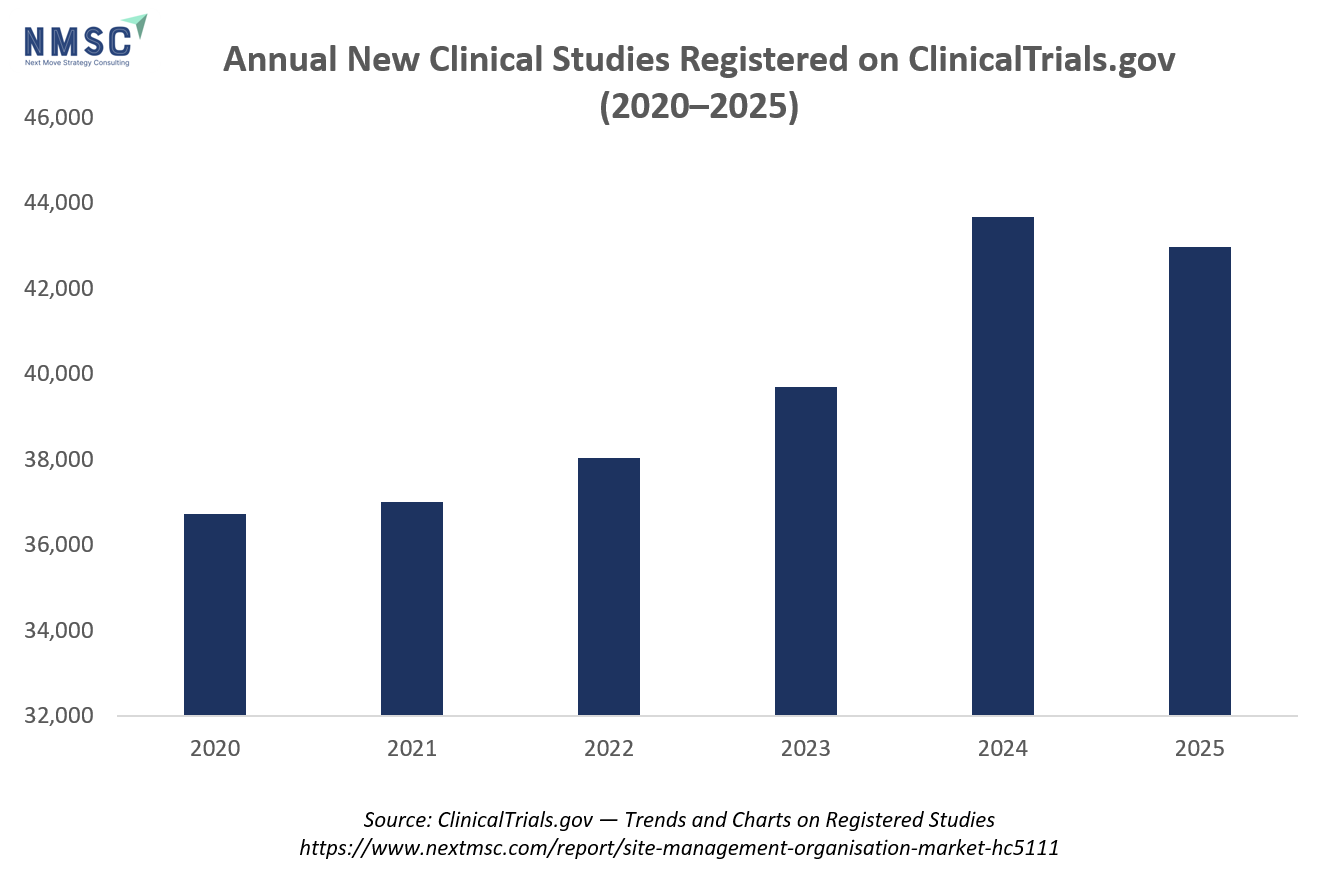
The U.S. National Institutes of Health reports that the ClinicalTrials.gov registry has surpassed 500,000 registered studies, reflecting sustained sponsor investment in clinical evidence generation across therapeutic areas. As trial volumes increase, the operational burden on investigator sites intensifies, creating sustained demand for SMO services that provide dedicated CRC staffing, protocol coordination, and regulatory maintenance support.
Workforce Constraints: A Structural Restraint on Market Expansion
The persistent shortage of trained and experienced clinical research coordinators represents a structural constraint on SMO capacity expansion, particularly across emerging trial geographies in Asia-Pacific, Latin America, and the Middle East. The Association of Clinical Research Professionals has documented sustained demand-supply imbalances in the clinical research workforce, driven by high attrition rates, competition from adjacent healthcare roles, and insufficient accredited training programs in several key markets. This shortage limits the speed at which SMOs can activate new sites, scale coordination capacity, and fulfill expanding sponsor demand for dedicated CRC deployment services.
Section Summary: The Site Management Organisation Market is experiencing simultaneous demand expansion across multiple dimensions: decentralized trial adoption, AI-driven patient recruitment, therapeutic area specialization, and regulatory compliance complexity. However, a structural CRC workforce shortage constrains the pace of capacity expansion, particularly in emerging markets.
Key Takeaways:
-
The Decentralized Trial SMO business model is the fastest-growing segment, advancing at a CAGR of 12.7% from 2026 to 2035, driven by regulatory acceptance of remote and hybrid trial elements.
-
AI-assisted patient identification and protocol eligibility matching are reducing screen failure rates and accelerating enrollment timelines across SMO-managed site networks.
-
Oncology is the dominant therapeutic area at USD 1.22 billion in 2025, with Hematology and Ophthalmology emerging as the fastest-growing indications at a CAGR of 12.1%.
-
The CRC workforce shortage remains a structural constraint, limiting site activation speed and coordination capacity in Asia-Pacific, Latin America, and the Middle East.
Pros and Cons of Recent Market Developments
|
Development |
Pros |
Cons |
|
UK Clinical Trial Regulations Reform (April 2026) |
Streamlines multi-country submission processes; reduces administrative burden; aligns UK with ICH standards; mandatory transparency builds public trust |
Requires significant SOP and system updates for SMOs; new compliance obligations increase operational costs; 2-year recruitment deadline creates pressure on site activation timelines |
|
FDA ICH E6(R3) GCP Publication (September 2025) |
Modernizes GCP framework; supports decentralized and digital trial elements; promotes risk-based, proportionate oversight; reduces unnecessary monitoring burden |
No formal U.S. compliance date creates planning uncertainty; requires cultural and mindset shift; system validation burden for digital tools; vendor readiness gaps may delay implementation |
|
Decentralized Clinical Trial Adoption |
Expands geographic reach of SMO-managed programs; reduces participant burden; increases enrollment pool; creates new service revenue streams |
Requires significant technology investment; wearable data management complexity; regulatory acceptance varies by geography; remote CRC deployment logistics |
|
AI Integration in Patient Recruitment |
Reduces screen failure rates; accelerates enrollment timelines; improves protocol-patient matching; enhances site performance monitoring |
High implementation costs; data privacy and EHR access constraints; algorithm validation requirements; uneven adoption across SMO providers |
|
Performance-Based Contract Models |
Aligns SMO incentives with sponsor outcomes; rewards operational excellence; creates measurable accountability |
Increases financial risk for SMOs; requires advanced analytics infrastructure; complex contract negotiation; enrollment volatility affects revenue predictability |
Key Data & Statistics
Site Management Organisation Market — Segmentation by Service Type (2025–2035)
|
Service Type |
2025 (USD Billion) |
2035 (USD Billion) |
CAGR% (2026–2035) |
|
Site Management Services |
1.45 |
3.95 |
11.8% |
|
Clinical Research Coordinator Services |
1.18 |
3.12 |
11.4% |
|
Patient Recruitment and Retention Services |
1.02 |
2.78 |
11.8% |
|
Site Start-Up Services |
0.72 |
1.85 |
11.1% |
|
Regulatory and Compliance Services |
0.68 |
1.82 |
11.6% |
|
Data and Site Operations Support Services |
0.62 |
1.72 |
12.0% |
|
Study Close-Out Services |
0.48 |
1.45 |
13.0% |
Site Management Organisation Market — Regional Outlook (2025–2035)
|
Region |
2025 (USD Billion) |
2035 (USD Billion) |
CAGR% (2026–2035) |
Key Driver |
|
North America |
2.42 |
6.42 |
11.5% |
High clinical trial density and regulatory maturity |
|
Europe |
1.52 |
4.05 |
11.5% |
ICH harmonization and EU CTR multi-country trial adoption |
|
Asia-Pacific |
1.22 |
3.42 |
12.1% |
Large patient populations and cost-advantaged site operations |
|
Middle East & Africa |
0.52 |
1.48 |
12.3% |
Expanding regulatory infrastructure and sponsor diversification |
|
Latin America |
0.47 |
1.32 |
12.2% |
Treatment-naive patient population access and competitive site costs |
Future Outlook & Forecast
NMSC Market Forecast: USD 16.69 Billion by 2035
According to Next Move Strategy Consulting, the global Site Management Organisation Market is projected to expand from USD 6.80 billion in 2026 to USD 16.69 billion by 2035, advancing at a CAGR of 10.5%. This sustained growth trajectory is underpinned by durable demand fundamentals: increasing global clinical trial activity, adoption of decentralized trial technologies, therapeutic area portfolio expansion among sponsors, and progressive regulatory harmonization across North America, Europe, Asia-Pacific, the Middle East & Africa, and Latin America.
North America will maintain its dominant regional position, growing from USD 2.42 billion in 2025 to USD 6.42 billion by 2035 at a CAGR of 11.5%, supported by the highest global concentration of pharmaceutical and biotechnology R&D investment and a mature regulatory framework anchored by FDA oversight. Asia-Pacific is the fastest-growing region, advancing at a CAGR of 12.1% from USD 1.22 billion in 2025 to USD 3.42 billion by 2035, driven by large and genetically diverse patient populations, cost-advantaged site operations, and expanding regulatory harmonization with ICH standards.
Performance-Based Contracts: The Fastest-Growing Revenue Model
Performance-Based Contracts are the fastest-growing revenue model within the Site Management Organisation Market, projected at a CAGR of 13.9% from USD 0.33 billion in 2025 to USD 1.06 billion by 2035. This growth reflects a structural shift in sponsor procurement behavior toward outcome-aligned compensation that ties SMO remuneration directly to enrollment velocity, screen failure rates, data quality, and subject retention metrics. SMOs that invest in real-time site performance dashboards, predictive analytics for enrollment forecasting, and patient retention technologies are best positioned to accept and profit from outcome-aligned contract structures that reward operational excellence.
Study Close-Out Services: The Fastest-Growing Service Segment
Study Close-Out Services is the fastest-growing service type within the Site Management Organisation Market, advancing at a CAGR of 13.0% from USD 0.48 billion in 2025 to USD 1.45 billion by 2035. The above-average growth rate reflects the accumulating backlog of historical trial portfolios requiring systematic archiving, audit support, final documentation management, and site close-out coordination as the global clinical trial base continues to expand.
M&A Activity and Competitive Consolidation
The Site Management Organisation Market has experienced sustained M&A activity driven by private equity investment in integrated site network consolidation and strategic acquisition by larger CRO and SMO operators seeking geographic and therapeutic expansion. The integration of Javara into established network structures and WCG Clinical's continued site portfolio expansion illustrate the consolidation dynamics reshaping mid-tier competitive positioning. Acquirers are primarily targeting site networks with high-quality investigator relationships, established patient recruitment pipelines, and standardized GCP-compliant operational infrastructure that can be efficiently integrated into broader service platforms.
Section Summary: The Site Management Organisation Market is on a sustained growth trajectory toward USD 16.69 billion by 2035, driven by regulatory modernization, decentralized trial adoption, and increasing pharmaceutical outsourcing. Performance-Based Contracts and Study Close-Out Services are the fastest-growing revenue model and service segment, respectively, while Asia-Pacific leads regional growth at a CAGR of 12.1%.
Key Takeaways:
The global Site Management Organisation Market is projected to reach USD 16.69 billion by 2035, advancing at a CAGR of 10.5% from 2026 to 2035, according to NMSC.
Performance-Based Contracts are the fastest-growing revenue model at a CAGR of 13.9%, reflecting the structural shift toward outcome-aligned sponsor procurement.
Asia-Pacific is the fastest-growing region at a CAGR of 12.1%, driven by large patient populations, cost advantages, and ICH regulatory harmonization.
Sustained M&A activity is consolidating the competitive landscape, with private equity-backed integrated site networks emerging as the dominant competitive archetype.
Next Steps for Stakeholders
For C-Level Executives at SMO Providers:
-
Conduct a comprehensive gap analysis of current SOPs, quality management systems, and vendor oversight frameworks against ICH E6(R3) requirements. Organizations that delay preparation risk competitive disadvantage as sponsors increasingly require E6(R3)-compliant partners.
-
Invest in decentralized trial delivery capabilities — including remote CRC deployment, telehealth infrastructure, and wearable data integration — to capture the fastest-growing business model segment (Decentralized Trial SMO, CAGR 12.7%).
-
Develop AI-assisted patient identification and protocol eligibility matching capabilities to reduce screen failure rates and strengthen competitive positioning in performance-based contract negotiations.
-
Build therapeutic area specialization in oncology, hematology, and rare diseases, where protocol complexity and enrollment challenges create the highest per-subject service intensity and premium pricing opportunities.
For Pharmaceutical and Biotechnology Sponsors:
-
Evaluate SMO partners' ICH E6(R3) readiness — including their RBQM frameworks, centralized monitoring capabilities, and audit-ready documentation systems — as a primary vendor selection criterion.
-
Consider transitioning a portion of site management contracts to performance-based structures to align SMO incentives with enrollment velocity and data quality outcomes.
-
Prioritize SMO partners with established diversity and inclusion recruitment capabilities, particularly in light of the UK's new Inclusion and Diversity Plan requirements and growing regulatory expectations for representative trial populations.
For Investors and Private Equity:
-
The Site Management Organisation Market's 10.5% CAGR through 2035 and sustained M&A consolidation dynamics present compelling long-term investment opportunities in integrated site network operators, AI-enabled patient recruitment platforms, and decentralized trial technology providers.
-
Target acquisitions in Asia-Pacific (CAGR 12.1%), Middle East & Africa (CAGR 12.3%), and Latin America (CAGR 12.2%), where regulatory infrastructure expansion and sponsor diversification are creating new market entry opportunities.
-
Assess portfolio companies' CRC workforce development programs as a key operational risk factor, given the structural demand-supply imbalance documented by the Association of Clinical Research Professionals.
Conclusion
The Site Management Organisation Market stands at a pivotal inflection point, shaped by the convergence of landmark regulatory reforms, accelerating decentralized trial adoption, and deepening pharmaceutical outsourcing trends. The UK's most comprehensive clinical trial regulatory overhaul in over 20 years, effective 28 April 2026, and the FDA's publication of ICH E6(R3) GCP guidelines in September 2025 have collectively raised the compliance baseline at the investigator site level — creating a durable, structurally reinforced demand for professional SMO partners with robust quality infrastructure and regulatory expertise.
According to NMSC, the global Site Management Organisation Market is projected to advance from USD 6.80 billion in 2026 to USD 16.69 billion by 2035 at a CAGR of 10.5%, underpinned by expanding global trial volumes, therapeutic area portfolio growth, and the structural shift toward technology-enabled, outcome-aligned site management. For C-level executives, investors, and institutional decision-makers, the strategic imperative is clear: organizations that invest in ICH E6(R3) compliance readiness, decentralized trial capabilities, AI-assisted patient recruitment, and therapeutic area specialization will be best positioned to capture the expanding opportunity within this high-growth sector.
About the Author
 Sanyukta Deb
— Sanyukta Deb is Digital Marketing Team Lead at Next Move Strategy Consulting, where she has led content strategy and technical SEO for the firm's B2B market research publications for over 2 years. Her editorial process translates NextMSC's primary and secondary research — spanning technology, industrial, and consumer sectors — into commercial narratives, backed by search-intent, keyword, and competitive analysis. She brings 5 years of overall experience in digital marketing and content strategy.
Sanyukta Deb
— Sanyukta Deb is Digital Marketing Team Lead at Next Move Strategy Consulting, where she has led content strategy and technical SEO for the firm's B2B market research publications for over 2 years. Her editorial process translates NextMSC's primary and secondary research — spanning technology, industrial, and consumer sectors — into commercial narratives, backed by search-intent, keyword, and competitive analysis. She brings 5 years of overall experience in digital marketing and content strategy.
About the Reviewer
 Debashree Dey
— Debashree Dey is Assistant Manager at Next Move Strategy Consulting, where she supports cross-vertical market content and communications across diverse industries for 6 years. Her professional background includes senior content writing, communications, and published manuscript authorship, with experience developing audience-focused business narratives and maintaining clear, consistent messaging. Her role supports research-led content development and editorial quality across NextMSC publications.
Debashree Dey
— Debashree Dey is Assistant Manager at Next Move Strategy Consulting, where she supports cross-vertical market content and communications across diverse industries for 6 years. Her professional background includes senior content writing, communications, and published manuscript authorship, with experience developing audience-focused business narratives and maintaining clear, consistent messaging. Her role supports research-led content development and editorial quality across NextMSC publications.


















Add Comment