Virtual Fitness Market Statistics & Forecasts for 2026

Introduction
In June 2025, Apple unveiled Workout Buddy — a first-of-its-kind AI-powered fitness coaching feature embedded directly into watchOS 26 — marking one of the most consequential product launches in the history of digital health. The feature analyzes real-time workout data alongside a user's fitness history — including heart rate, pace, distance, Activity rings, and personal milestones — to generate personalized, spoken motivational coaching during live sessions. This is not a marginal product update. It is a signal that the world's most valuable technology company has placed a strategic bet on the Virtual Fitness Market as a defining pillar of its health ecosystem.
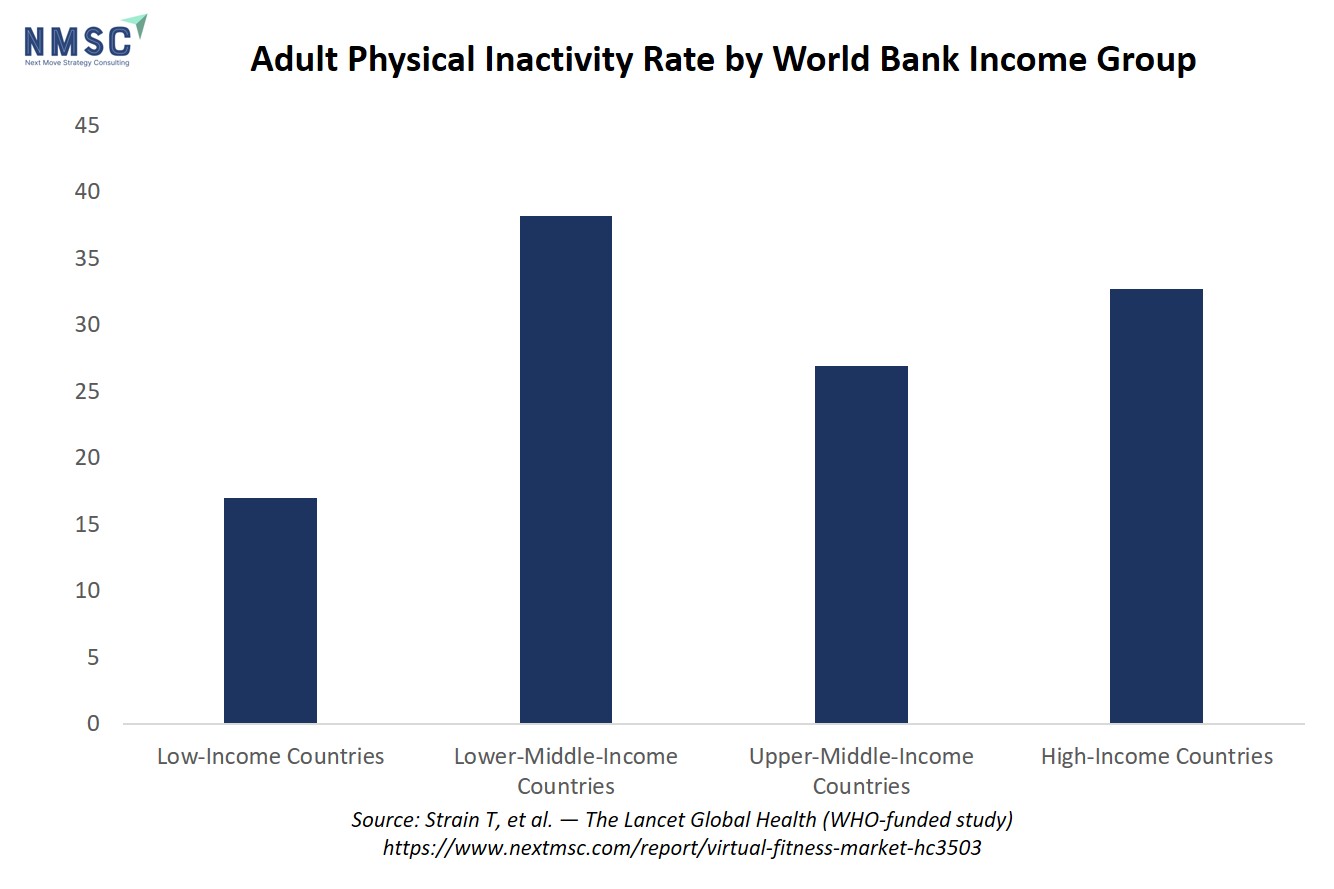
The timing is not coincidental. According to the World Health Organization, 31% of the world's adult population — approximately 1.8 billion people — are physically inactive, failing to meet the global recommendation of at least 150 minutes of moderate-intensity physical activity per week. This figure has increased by 5 percentage points since 2010, and if current trends persist, global physical inactivity is projected to rise to 35% by 2030. The economic cost of this inaction is staggering: WHO estimates the cost of physical inactivity to public healthcare systems between 2020 and 2030 at approximately USD 300 billion — roughly USD 27 billion per year.
Against this backdrop, the virtual fitness market is experiencing structural, demand-driven growth that extends well beyond pandemic-era behavioral shifts. According to Next Move Strategy Consulting, the global virtual fitness is predicted to reach USD 68.09 billion by the end of 2025, before expanding to USD 286.04 billion by 2030 at a CAGR of 33.25% from 2025 to 2030. This report examines the forces driving that trajectory — from Apple's AI-powered fitness breakthrough and landmark platform partnerships to WHO's escalating inactivity data and the global connectivity revolution — and delivers actionable intelligence for C-level executives, institutional investors, and strategic decision-makers.
For More Information: Download FREE Sample on Virtual Fitness Market Report
AI, Connectivity, and Convergence: The Forces Reshaping the Virtual Fitness Market
Apple's Workout Buddy: The AI Inflection Point for Virtual Fitness
The launch of Workout Buddy at Apple's WWDC 2025 event on June 9, 2025, represents the most significant AI integration into consumer fitness technology to date. Built on Apple Intelligence — Apple's proprietary generative AI framework — Workout Buddy delivers real-time, personalized spoken coaching during workouts by processing a user's fitness history, heart rate, pace, distance, and Activity ring progress simultaneously.
What distinguishes Workout Buddy from prior fitness coaching tools is its generative voice architecture. Apple developed a new text-to-speech model that translates AI-generated insights into a dynamic voice built using voice data from Apple Fitness+ trainers — ensuring the coaching tone, energy, and style are calibrated for an active workout environment. The feature is available across Outdoor and Indoor Run, Outdoor and Indoor Walk, Outdoor Cycle, HIIT, and Functional and Traditional Strength Training — covering the most commercially significant workout categories in the virtual fitness market.
Critically, all data analysis occurs privately and securely on-device via Apple Intelligence, addressing one of the most persistent consumer concerns in digital health: data privacy. This positions Apple Fitness+ as a premium, privacy-first virtual fitness platform at a moment when regulatory scrutiny of health data practices is intensifying globally.
Platform Convergence: BODi–Hello Alpha and the Integrated Health Model
In March 2025, BODi — formerly The Beachbody Company — announced a strategic partnership with Hello Alpha, a virtual healthcare platform, integrating BODi's fitness and nutrition programs with Hello Alpha's licensed medical provider services. The partnership specifically targets hormone health and weight management — two of the fastest-growing consumer health categories — by combining personalized fitness programming with clinical-grade medical oversight from licensed providers.
This partnership exemplifies a structural shift underway across the virtual fitness market: the convergence of fitness platforms with virtual healthcare services. As consumers increasingly seek holistic, medically informed wellness solutions, virtual fitness providers that integrate clinical services are positioned to command higher subscription values, lower churn rates, and access to employer wellness program procurement channels.
In January 2025, Apple Fitness+ deepened its integration with Strava — the world's leading fitness community platform — offering more detailed workout summaries, featuring Strava athletes in Fitness+ content, and providing Strava subscribers with a complimentary three-month trial of the service. This cross-platform integration strategy reflects a broader industry movement toward ecosystem lock-in: virtual fitness providers are building interconnected content, community, and data networks that increase switching costs and deepen user engagement.
The Connectivity Imperative: ITU's 2025 Internet Access Data
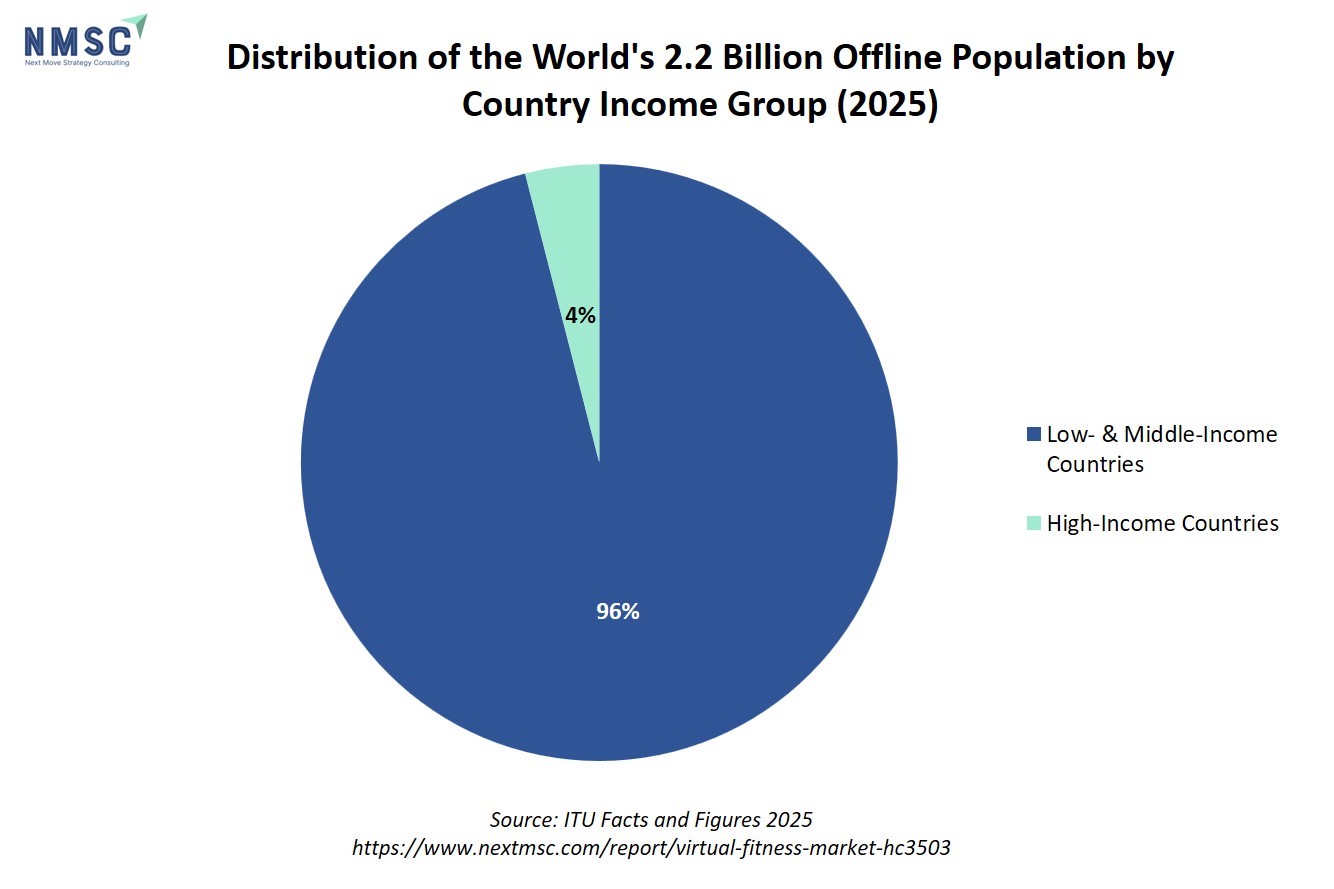
The structural enabler underpinning all virtual fitness market growth is internet connectivity. According to the International Telecommunication Union (ITU), approximately 6 billion people — or 74% of the world's population — are using the Internet in 2025, representing an increase from 60% in 2020, with 1.3 billion people estimated to have come online during that five-year period. However, 2.2 billion people remain offline — a figure that simultaneously represents the primary market access constraint and the largest untapped growth opportunity for virtual fitness platforms in emerging markets.
NMSC Strategic Perspective: Four Structural Shifts Defining the 2025–2030 Forecast Period
According to Next Move Strategy Consulting's analysis, four structural trends are reshaping product development, platform strategy, and competitive positioning across the virtual fitness market through 2030:
-
AI-Driven Personalization as the Primary Retention Lever: The integration of generative AI into virtual fitness platforms — exemplified by Apple's Workout Buddy — is transforming personalization from a feature into a core retention mechanism. Platforms that deliver contextually relevant, real-time coaching will demonstrate materially lower churn rates than those offering static content libraries.
-
Healthcare-Fitness Platform Convergence: The BODi–Hello Alpha model signals a broader industry shift toward integrated wellness platforms that combine fitness programming with clinical services. This convergence is expanding the addressable market beyond fitness enthusiasts to include chronic disease management, preventive care, and employer wellness programs.
-
Immersive Technology Adoption: AR and VR-enabled fitness experiences are transitioning from novelty to mainstream as hardware costs decline and content libraries expand. Immersive Tech Platforms represent the highest-growth platform segment in the NMSC forecast, driven by increasing consumer demand for engaging, gamified workout environments.
-
Corporate and Institutional End-User Expansion: Virtual fitness adoption is accelerating beyond individual consumers into corporate wellness programs, sports institutes, defense institutions, and educational facilities — creating new B2B revenue streams with higher contract values and longer retention cycles.
Section Summary: The virtual fitness market is being propelled by a convergence of AI-powered product innovation, platform ecosystem consolidation, and the structural tailwind of rising global physical inactivity. Apple's Workout Buddy launch, the BODi–Hello Alpha partnership, and the Apple Fitness+–Strava integration collectively signal that the market has entered a phase of accelerated, technology-led maturation.
Key Takeaways:
-
Apple's Workout Buddy (June 2025) represents the most advanced AI integration into consumer fitness technology to date, using generative AI and real-time biometric data to deliver personalized spoken coaching.
-
WHO confirms 1.8 billion adults are physically inactive globally — a figure projected to rise to 35% by 2030 — creating an expanding structural demand base for virtual fitness solutions.
-
ITU confirms 6 billion people (74% of the global population) are online in 2025, providing the connectivity infrastructure for virtual fitness platform scale.
-
Platform convergence — combining fitness programming with clinical healthcare services — is the defining competitive strategy for market leaders through 2030.
Industry Impact Analysis
The Physical Inactivity Crisis as a Structural Demand Driver
The WHO's physical inactivity data is not merely a public health statistic — it is the foundational demand driver for the virtual fitness market. Physically inactive individuals have a 20% to 30% increased risk of death compared to those who are sufficiently active, and physical inactivity is directly linked to the rising incidence of cardiovascular disease, type 2 diabetes, and site-specific cancers. The WHO's Global Action Plan on Physical Activity targets a 15% relative reduction in physical inactivity by 2030 from the 2010 baseline — a policy mandate that is driving government investment in digital health infrastructure and creating regulatory tailwinds for virtual fitness platform adoption.
The adolescent inactivity crisis is particularly acute: 80% of adolescents aged 11–17 years globally do not meet WHO's recommended physical activity levels, with adolescent girls less active than boys at 85% versus 78% respectively. This demographic represents a high-priority growth segment for virtual fitness platforms offering gamified, social, and mobile-first workout experiences — particularly as smartphone penetration among adolescents continues to expand globally.
Smartphone Penetration: The Hardware Foundation of Virtual Fitness Scale
According to Pew Research Center data cited in the NMSC report, 98% of Americans now own a cellphone, with 91% specifically using smartphones — a penetration rate that enables near-universal access to mobile-first virtual fitness platforms in the United States. Globally, the ITU estimates that smartphone and mobile device ownership is expanding rapidly across both developed and developing economies, with internet user growth of 1.3 billion people between 2020 and 2025 providing the connectivity infrastructure for virtual fitness platform scale.
This hardware foundation is enabling virtual fitness platforms to deliver real-time health metric tracking — heart rate, calories burned, activity levels, sleep data — through devices that consumers already own, dramatically reducing the adoption barrier compared to dedicated fitness equipment.
Gender Disparities in Physical Activity: An Underserved Market Opportunity
WHO data reveals a persistent and commercially significant gender gap in physical activity: women are less active than men by an average of 5 percentage points globally, a disparity that has remained unchanged since 2000. This gap represents a structural market opportunity for virtual fitness platforms that develop targeted programming for women — including hormone health integration (as demonstrated by the BODi–Hello Alpha partnership), prenatal and postnatal fitness content, and flexible scheduling formats that accommodate caregiving responsibilities.
Virtual fitness platforms that address this underserved segment with clinically informed, gender-specific programming are positioned to capture a disproportionate share of the growing female subscriber base — particularly in markets where access to traditional gym facilities is constrained by safety, cultural, or logistical factors.
The Asia-Pacific Urbanization Catalyst
In the Asia-Pacific region, rapid urbanization is functioning as a structural accelerator for virtual fitness adoption. According to World Bank data cited in the NMSC report, urban populations in China and India account for 66% and 37% of their total populations respectively — reflecting significant urban concentration that drives demand for time-efficient, location-flexible fitness solutions. As disposable incomes rise among the expanding middle class and smartphone penetration deepens, Asia-Pacific is positioned as the highest-growth regional market in the NMSC forecast through 2030.
Section Summary: The virtual fitness market's growth is anchored in three converging structural forces: the WHO-documented global physical inactivity crisis creating an expanding demand base, ITU-confirmed internet connectivity expansion enabling platform scale, and Asia-Pacific urbanization driving the highest-growth regional opportunity. Gender disparities in physical activity represent a commercially significant and underserved market segment.
Key Takeaways:
-
WHO estimates the cost of physical inactivity to global healthcare systems at approximately USD 300 billion between 2020 and 2030 — creating a compelling economic case for preventive virtual fitness adoption.
-
80% of adolescents globally fail to meet WHO physical activity recommendations, representing a high-priority growth segment for mobile-first and gamified virtual fitness platforms.
-
ITU confirms 74% of the global population is online in 2025, with 2.2 billion people still offline representing the largest untapped growth opportunity in emerging markets.
-
Women's physical inactivity rates exceed men's by 5 percentage points globally — a persistent gap that represents a structurally underserved market segment for targeted virtual fitness programming.
Global Physical Inactivity & Digital Connectivity — Key Institutional Data Points
|
Indicator |
Data Point |
Source |
Year |
|
Global adult physical inactivity rate |
31% (1.8 billion adults) |
WHO Physical Activity Fact Sheet |
2024 |
|
Increase in adult inactivity since 2010 |
+5 percentage points (from ~26% to 31%) |
WHO Physical Activity Fact Sheet |
2024 |
|
Projected adult inactivity rate by 2030 |
35% |
WHO Physical Activity Fact Sheet |
2024 |
|
Adolescent physical inactivity rate (aged 11–17) |
80% globally |
WHO Physical Activity Fact Sheet |
2024 |
|
Adolescent girls' inactivity rate |
85% (vs. 78% for boys) |
WHO Physical Activity Fact Sheet |
2024 |
|
Gender gap in physical inactivity |
Women less active than men by 5 percentage points |
WHO Physical Activity Fact Sheet |
2024 |
|
Cost of physical inactivity to healthcare systems |
~USD 300 billion (2020–2030); ~USD 27 billion/year |
WHO Physical Activity Fact Sheet |
2024 |
|
Increased mortality risk from physical inactivity |
20%–30% higher risk of death vs. active individuals |
WHO Physical Activity Fact Sheet |
2024 |
|
Global internet users |
~6 billion people (74% of world population) |
ITU ICT Statistics |
2025 |
|
Growth in internet users (2020–2025) |
+1.3 billion new users |
ITU ICT Statistics |
2025 |
|
Global population still offline |
2.2 billion people |
ITU ICT Statistics |
2025 |
|
U.S. smartphone ownership |
91% of Americans |
Pew Research Center |
2024 |
Future Outlook & Forecast
NMSC Market Forecast: USD 286.04 Billion by 2030
According to Next Move Strategy Consulting, the global virtual fitness market is projected to expand from USD 68.09 billion in 2025 to USD 286.04 billion by 2030, at a CAGR of 33.25% — representing an absolute dollar opportunity of approximately USD 217.95 billion over the five-year forecast period. This growth rate positions the virtual fitness market as one of the fastest-expanding segments within the broader digital health ecosystem.
The growth trajectory is driven by three primary pathways:
-
AI-Enabled Personalization Platforms: The integration of generative AI into virtual fitness — exemplified by Apple's Workout Buddy — is establishing a new performance benchmark for the industry. Platforms that deliver real-time, contextually relevant coaching will command premium subscription pricing and demonstrate materially superior retention metrics. This capability is expected to become a baseline competitive requirement rather than a differentiator by 2027.
-
Immersive Tech Platform Expansion: AR and VR-enabled fitness experiences represent the highest-growth platform segment in the NMSC forecast. As hardware costs decline and content libraries expand, immersive fitness platforms are expected to transition from early adopter to mainstream consumer segments — particularly among younger demographics seeking gamified, socially connected workout experiences.
-
B2B and Institutional End-User Expansion: The expansion of virtual fitness into corporate wellness programs, sports institutes, defense institutions, and educational facilities represents a structurally new revenue stream with higher contract values, longer retention cycles, and lower customer acquisition costs than direct-to-consumer channels. This segment is expected to grow at an above-market rate through 2030 as employers increasingly integrate virtual fitness into employee health benefit packages.
Key Risks to Monitor
Limited internet accessibility in rural and underdeveloped areas remains the primary structural constraint on global virtual fitness market expansion. With 2.2 billion people still offline globally per ITU data, the market's growth potential in high-population emerging markets is directly contingent on connectivity infrastructure investment. Additionally, the WHO's projection that global physical inactivity will rise to 35% by 2030 — despite two decades of policy interventions — indicates that reaching the most sedentary populations remains a fundamental engagement challenge that virtual fitness platforms must address through accessibility, affordability, and culturally relevant content strategies.
Section Summary: The virtual fitness market presents a USD 217.95 billion absolute dollar opportunity between 2025 and 2030, anchored by AI-enabled personalization, immersive technology adoption, and B2B institutional expansion. The 33.25% CAGR reflects a market in structural acceleration — driven by rising physical inactivity, expanding internet connectivity, and technology platform convergence.
Key Takeaways:
-
The global virtual fitness market is forecast to reach USD 286.04 billion by 2030, growing at a 33.25% CAGR from 2025, per NMSC.
-
The absolute dollar opportunity between 2025 and 2030 is approximately USD 217.95 billion — one of the largest growth opportunities in the digital health sector.
-
AI-enabled personalization, immersive tech platforms, and B2B institutional end-users are the three highest-growth vectors through 2030.
-
Connectivity gaps — 2.2 billion people still offline per ITU — represent both the primary market constraint and the largest long-term growth opportunity in emerging markets.
Next Steps for Stakeholders
For C-Level Executives and Product Leaders:
-
Invest in generative AI coaching capabilities as a core platform differentiator. Apple's Workout Buddy has established a new industry benchmark for AI-powered personalization. Executives at competing virtual fitness platforms must accelerate AI integration roadmaps or risk competitive displacement in the premium subscription segment.
-
Pursue healthcare platform partnerships modeled on the BODi–Hello Alpha framework. Integrating clinical services — particularly in hormone health, weight management, and chronic disease prevention — expands addressable market, increases subscription value, and opens access to employer wellness program procurement channels.
-
Develop dedicated B2B product lines for corporate, educational, and institutional end-users. The shift from individual consumer to institutional procurement represents a structurally superior revenue model with higher contract values and lower churn — and is the fastest-growing end-user segment in the NMSC forecast.
For Institutional Investors and Financial Analysts:
-
Prioritize platforms with integrated AI personalization and healthcare convergence capabilities. These two strategic attributes — demonstrated by Apple Fitness+ and BODi respectively — are the strongest predictors of long-term subscriber retention and premium pricing power in the virtual fitness market.
-
Monitor Asia-Pacific market developments closely. Rapid urbanization, expanding middle-class disposable income, and improving internet infrastructure in China and India are creating the conditions for above-market growth in the region through 2030.
-
Assess connectivity infrastructure investment as a leading indicator of emerging market virtual fitness adoption. ITU's data on internet user growth — 1.3 billion new users between 2020 and 2025 — provides a reliable proxy for addressable market expansion in Latin America, Southeast Asia, and Sub-Saharan Africa.
For Government and Regulatory Bodies:
-
Integrate virtual fitness platforms into national physical activity policy frameworks. WHO's Global Action Plan on Physical Activity targets a 15% relative reduction in inactivity by 2030. Virtual fitness platforms — particularly mobile-first and on-demand streaming services — are among the most scalable and cost-effective tools available to governments seeking to meet this target.
-
Invest in rural and underserved connectivity infrastructure to unlock virtual fitness adoption in populations currently excluded by the digital divide. The 2.2 billion people still offline represent both a public health challenge and a market access barrier that requires coordinated public investment to address.
-
Develop data privacy frameworks specific to AI-powered health applications. As generative AI becomes embedded in virtual fitness platforms, clear regulatory standards for biometric data processing, storage, and consent will be essential to maintaining consumer trust and enabling responsible platform innovation.
Conclusion
The virtual fitness market has moved decisively beyond its pandemic-era origins. What began as a necessity-driven behavioral shift has matured into a structurally supported, technology-accelerated growth market anchored by three converging forces: the WHO-documented global physical inactivity crisis affecting 1.8 billion adults, the ITU-confirmed expansion of internet connectivity to 6 billion people globally, and the AI-powered product innovation exemplified by Apple's Workout Buddy launch in June 2025.
The market's projected expansion from USD 68.09 billion in 2025 to USD 286.04 billion by 2030 — at a 33.25% CAGR per Next Move Strategy Consulting — reflects not speculative optimism but structural necessity. As physical inactivity costs global healthcare systems approximately USD 27 billion per year and WHO projects inactivity rates to rise further by 2030, virtual fitness platforms are increasingly positioned as a critical component of preventive health infrastructure — not merely a consumer lifestyle product.
For executives, investors, and policymakers, the strategic imperative is clear: the virtual fitness market is entering its highest-growth phase, and the competitive positions established between 2025 and 2027 will define market leadership through 2030 and beyond.
About the Author
 Sanyukta Deb
— Sanyukta Deb is Digital Marketing Team Lead at Next Move Strategy Consulting, where she has led content strategy and technical SEO for the firm's B2B market research publications for over 2 years. Her editorial process translates NextMSC's primary and secondary research — spanning technology, industrial, and consumer sectors — into commercial narratives, backed by search-intent, keyword, and competitive analysis. She brings 5 years of overall experience in digital marketing and content strategy.
Sanyukta Deb
— Sanyukta Deb is Digital Marketing Team Lead at Next Move Strategy Consulting, where she has led content strategy and technical SEO for the firm's B2B market research publications for over 2 years. Her editorial process translates NextMSC's primary and secondary research — spanning technology, industrial, and consumer sectors — into commercial narratives, backed by search-intent, keyword, and competitive analysis. She brings 5 years of overall experience in digital marketing and content strategy.
About the Reviewer
 Debashree Dey
— Debashree Dey is Assistant Manager at Next Move Strategy Consulting, where she supports cross-vertical market content and communications across diverse industries for 6 years. Her professional background includes senior content writing, communications, and published manuscript authorship, with experience developing audience-focused business narratives and maintaining clear, consistent messaging. Her role supports research-led content development and editorial quality across NextMSC publications.
Debashree Dey
— Debashree Dey is Assistant Manager at Next Move Strategy Consulting, where she supports cross-vertical market content and communications across diverse industries for 6 years. Her professional background includes senior content writing, communications, and published manuscript authorship, with experience developing audience-focused business narratives and maintaining clear, consistent messaging. Her role supports research-led content development and editorial quality across NextMSC publications.


















Add Comment