How Aviation’s Lightweighting Revolution Powered by Aerospace Foams Driving Fuel Efficiency and Emissions Reduction?
The aviation industry is undergoing a structural engineering shift where weight reduction is now directly tied to profitability and decarbonization performance. Based on industry analysis, we observed that aircraft manufacturers such as Airbus and Boeing are increasingly integrating advanced lightweight materials, including aerospace foams, as part of broader strategies to reduce fuel burn and lifecycle emissions. Modern aircraft programs are no longer designed around structural strength alone; instead, they are optimised for per-seat efficiency, emissions per flight hour, and operational cost per kilometer, where even small weight reductions create exponential economic and environmental benefits.
According to Next Move Strategy Consulting, the Aerospace Foam Market size was valued at USD 6.65 billion in 2025, and is expected to be valued at USD 7.70 billion by the end of 2026. The industry is projected to grow, hitting USD 12.73 billion by 2035, with a CAGR of 5.74% between 2026 and 2035.
Want Insights on the Aerospace Foam Market? Access a FREE Sample Instantly
The Growing Role of Aerospace Foams in Advancing Lightweight Aircraft Design and Fuel Efficiency
According to Pioneering sustainable aerospace report by Airbus, we observed that fleet modernisation programs across commercial aviation confirm that next-generation aircraft deliver 20-30% better fuel efficiency than older models, largely driven by lightweight materials and aerodynamic improvements. While composite airframes and advanced alloys receive significant attention, aerospace foams play a less visible but equally critical role in reducing cabin and system-level weight.
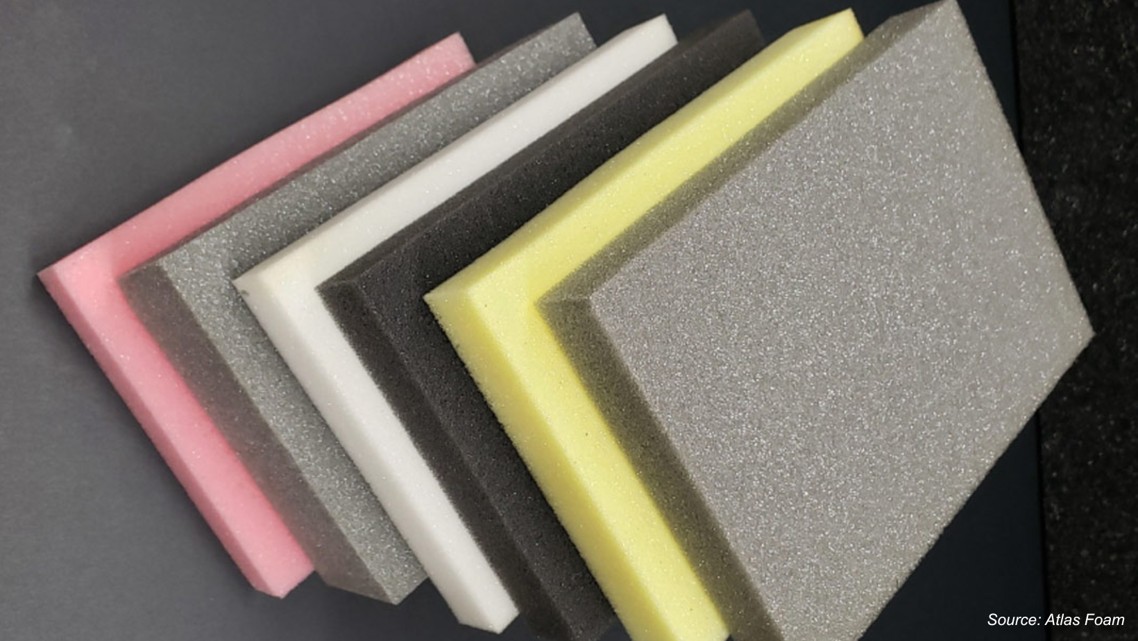
Aerospace foams, primarily polyurethane (PU), polyethylene (PE), and specialty engineered foams, are widely used in seating systems, cabin panels, insulation layers, and vibration-damping components. Industry analysis shows that aircraft seats alone represent the largest application segment, accounting for roughly one-third of foam usage due to continuous demand for lightweight seating structures in both commercial and business aviation.
The importance of this substitution becomes clearer when viewed at the aircraft level and across operational scale. In a single aircraft, replacing heavier legacy materials with high-performance foams reduces cumulative structural mass across hundreds of components. This reduction in weight directly lowers thrust demand, which in turn decreases fuel consumption across every flight cycle.

How Aerospace Foams Are Driving Fuel Efficiency and Emissions Reduction with Latest Industry Innovations?
The aerospace industry is now deeply embedded in a material efficiency race, where fuel economy, emissions reduction, and cabin optimization are directly influenced by lightweight engineering materials. Among these, aerospace foams are emerging as a critical enabler across commercial aviation, defense aircraft, and next-generation mobility platforms.
Aircraft OEMs such as Airbus and Boeing continue to prioritize structural and interior weight reduction as a key lever for improving fuel efficiency. According to Airbus's sustainability communications, next-generation aircraft programs are targeting significant fuel burn reductions through combined aerodynamic and material innovation strategies, where interior weight optimization plays a measurable role in lifecycle emissions reduction.
In parallel, industry data confirms that aerospace manufacturers are increasingly integrating lightweight foams across seating, insulation, and cabin systems to reduce aircraft mass and improve efficiency per flight cycle.
One of the most important shifts in 2026 is that material science companies and Tier-1 aerospace suppliers are actively redefining foam performance standards, as illustrated by the following key industry players:
-
Zotefoams- Structural insulation foams for Airbus and Boeing programs: UK-based Zotefoams is another major player advancing aerospace foam innovation. Its Zotek aerospace foam range is widely used in aircraft insulation systems, with Airbus, Boeing, and Embraer listed as key customers.
-
Evonik- Structural foam cores replacing metallic aircraft components: German specialty chemicals company Evonik has developed ROHACELL high-performance foam cores, which are increasingly used in structural aerospace applications. hese foams are designed for sandwich composite structures, replacing heavier metal-based cores while maintaining rigidity and fatigue resistance.
-
Rogers Corporation- Bio-based aerospace foams for low-carbon aircraft interiors: A major 2025 development is the introduction of a bio-based high-performance aerospace foam by Rogers Corporation. This material reduces carbon footprint by over 30%, targets aircraft interior applications, and is designed for OEM integration in next-gen cabin systems
Fuel Efficiency Pressures Accelerating the Adoption of Aerospace Foams in Modern Aviation
Fuel efficiency pressure is emerging as the dominant force accelerating the adoption of aerospace foams. Our analysis indicates that fuel efficiency is no longer viewed merely as an operational objective but has become both a regulatory requirement and a financial imperative. With aviation contributing a significant portion of global emissions, airlines are facing increasing compliance pressure under frameworks such as ICAO carbon reduction mechanisms. In this context, lightweight materials have evolved into a direct and practical lever for meeting emissions reduction targets.
Industry evidence further suggests that the global aerospace foam market is witnessing steady expansion, driven by a strong shift toward lightweight material integration to enhance fuel efficiency and reduce emissions. This growth is being reinforced by OEM-level initiatives and tightening regulatory expectations. In practical terms, reducing aircraft weight leads to lower fuel burn per flight, which subsequently reduces CO₂ emissions per passenger-kilometer. From an operational standpoint, even marginal reductions in weight generate cascading efficiency benefits. These include lower thrust requirements during take-off, reduced secondary fuel load due to lighter aircraft weight, decreased engine wear and maintenance intensity over time, and improved payload-to-fuel efficiency ratios.
This effect becomes especially critical in high-utilization aircraft platforms such as the Airbus A320 and Boeing 737 families, where small efficiency gains are amplified across thousands of daily flight cycles, translating into substantial cumulative fuel and emissions savings.

Manufacturing Innovation and Next-Generation Aircraft Programs are Reinforcing Demand
OEM-level developments indicate that lightweight materials are embedded in future aircraft design strategies. Airbus and Boeing are actively exploring next-generation aircraft concepts that rely more heavily on composites and lightweight polymers to support faster production and improved fuel efficiency.
At the same time, aerospace suppliers are investing in advanced material processing techniques, including automated moulding and thermoplastic-based systems, which enable lighter structures and faster manufacturing cycles. Industry reporting highlights that composites and thermoplastics are being evaluated not only for weight savings but also for production scalability in high-volume aircraft manufacturing.
In this broader ecosystem, aerospace foams act as a complementary material layer, bridging structural composites with interior systems and ensuring overall aircraft weight optimization without compromising safety or comfort.
How Is Lightweighting Becoming a Permanent Structural Constraint in Aerospace Design?
Our analysis suggests that lightweighting has evolved from a design trend into a structural engineering constraint that is now embedded in modern aircraft design philosophy. Therefore, aerospace foams are expected to become increasingly significant as airlines continue to prioritize fuel cost optimization, emissions compliance, fleet modernization efficiency, and enhanced cabin experience.
From a forward development perspective, material innovation is likely to concentrate on hybrid foam-composite architectures, recyclable material systems, and bio-based polymer formulations that align sustainability objectives with stringent performance requirements. As aircraft production volumes increase and retrofit cycles accelerate, aerospace foams are set to remain a critical enabler in balancing economic efficiency with environmental performance across the aviation sector.
About the Author
 Mayurima Roy
— Mayurima Roy is Research Analyst at Next Move Strategy Consulting, where she has spent 4 years working across the firm's full industry coverage rather than a single fixed vertical. Her work centers on structured research, ongoing trend tracking, competitive assessment, and insight-led content development, translating complex market data into clear, decision-ready narratives that support informed client decision-making across diverse global industries, market sectors, and world regions every day.
Mayurima Roy
— Mayurima Roy is Research Analyst at Next Move Strategy Consulting, where she has spent 4 years working across the firm's full industry coverage rather than a single fixed vertical. Her work centers on structured research, ongoing trend tracking, competitive assessment, and insight-led content development, translating complex market data into clear, decision-ready narratives that support informed client decision-making across diverse global industries, market sectors, and world regions every day.
About the Reviewer
 Supradip Baul
— Supradip Baul is an accomplished business consultant and strategist with over a decade of rich experience in market intelligence, strategy, technology, and business transformation. His work has included rigorous qualitative and quantitative analysis across multiple industries, helping clients shape investment decisions and long-term roadmaps. Earlier in his career, he was associated with Gartner, where he contributed to industry-leading reports and market share analyses. He has worked with leading global companies and holds an MBA with a dual specialization in Marketing and Finance.
Supradip Baul
— Supradip Baul is an accomplished business consultant and strategist with over a decade of rich experience in market intelligence, strategy, technology, and business transformation. His work has included rigorous qualitative and quantitative analysis across multiple industries, helping clients shape investment decisions and long-term roadmaps. Earlier in his career, he was associated with Gartner, where he contributed to industry-leading reports and market share analyses. He has worked with leading global companies and holds an MBA with a dual specialization in Marketing and Finance.
















Add Comment