How Is Antenna in Package Technology Transforming Wireless Communication?
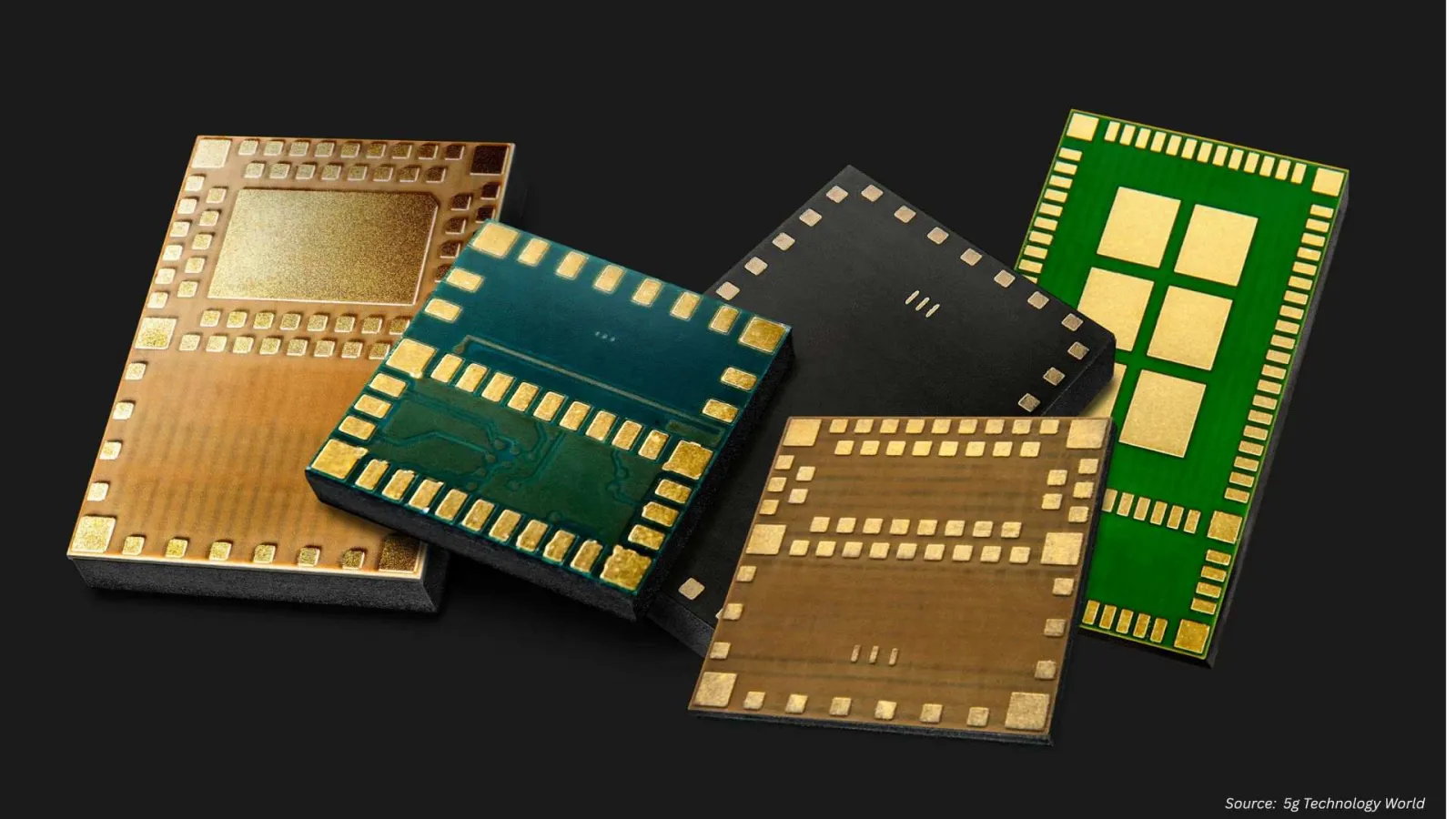
The antenna ecosystem is advancing at a measured yet decisive pace, and Antenna in Package (AiP) technology is increasingly central to this evolution. By integrating antenna elements directly within semiconductor packaging, AiP enables compact, high-frequency, and performance-driven wireless systems. Developments in 2025 demonstrate how this approach is influencing both satellite communications and professional broadcast equipment.
C-COM Satellite Systems Inc. Secures U.S. Patent for Ka-Band AiP Innovation
In August 2025, C-COM Satellite Systems Inc. was granted U.S. Patent No. 12,381,318 B2 for its Ka-band 2D Phased-Array Antenna in Package technology. The patented system was developed in partnership with the University of Waterloo, with support from the Ontario Centres of Excellence, the Canadian Space Agency, and the Natural Sciences and Engineering Research Council of Canada.
The AiP solution integrates an antenna array with a passive beamformer network and at least one actuation mechanism. The passive beamformer includes a phase shifter using a transmission line with a slow-wave structure and ceramic material. According to the company announcement, the design is intended to deliver a low-cost and efficient millimeter-wave phased-array solution suitable for hybrid passive and active configurations.
This innovation supports next-generation electronically steerable antennas operating in the Ka-band spectrum. Such systems are critical for modern satellite communication, particularly in applications that demand high data throughput and dynamic beam steering.
Scalable Ka-Band Deployment
From an industry perspective, this patent represents validation of integrated beamforming within compact packaging architectures. AiP in Ka-band frequencies can reduce structural complexity while maintaining performance.
In strategic terms:
-
It strengthens intellectual property positioning in phased-array development.
-
It enhances prospects for scalable satellite terminal deployments.
-
It supports cost-efficient high-frequency communication networks.
The conclusion is clear: Ka-band AiP integration is moving from research to structured commercialization pathways.
Integration Principles Behind Ultra-Wideband and Compact Antenna Systems
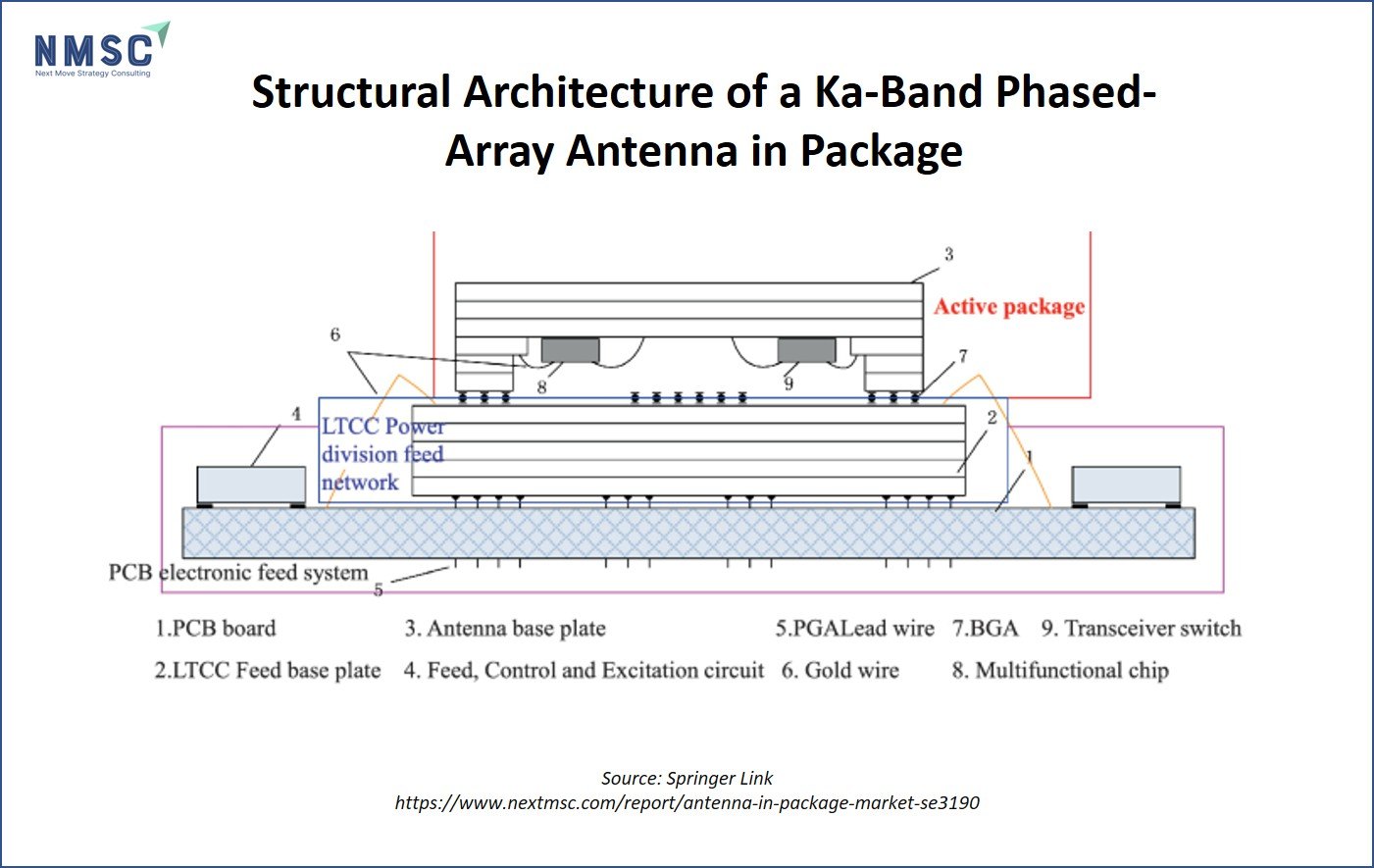
It structurally oriented toward a phased-array satellite configuration, the same integration philosophy is reflected in the April 2025 product releases from Deity Microphones. In that announcement, Deity introduced the THEOS DIFB featuring a tunable ultra-wideband range of 550MHz–960MHz and the Sharkfin SF1 antenna covering 470MHz–1GHz, along with active RF amplification and integrated control and coordination capabilities. The architectural layering shown in the image comprising feed networks, control circuits, active electronic packaging, and a PCB interface mirrors the same compact and performance-driven design logic applied in these ultra-wideband IFB systems. The “active package” section in the diagram conceptually aligns with multifunctional chip integration and transceiver switching functions, while the feed and excitation layers reflect coordinated RF management and signal routing similar to the THEOS DIFB’s frequency scanning and pairing functionality.
Deity Microphones Expands Ultra-Wideband Capabilities with THEOS DIFB and SF1
In April 2025, Deity Microphones announced the release of the THEOS DIFB and the Sharkfin SF1 antenna. The THEOS DIFB incorporates Global OneBand™ Technology and offers a tunable ultra-wideband frequency range from 550MHz to 960MHz. The system uses smartphone GPS functionality to conform to local RF regulations in different countries. It can scan for other compatible transmitters in proximity and automatically pair with them.
Additional features include dual SMA ports enabling true diversity reception, Bluetooth application support, a 20-preset frequency library, a metal rotary encoder, and battery life of up to 17 hours. The device includes a large color screen for operational clarity.
Alongside the DIFB, the Sharkfin SF1 antenna provides directional coverage from 470MHz to 1GHz, includes an active RF amplifier, and features IP54-rated metal housing. A pair of SF1 antennas is priced at USD 499, with shipping announced for late Summer 2025.
Although not positioned explicitly as satellite-grade AiP hardware, these products reflect similar integration principles: compact, frequency-agile, and performance-focused antenna architectures.
Ultra-Wideband Signal Flow and Integrated RF Control Architecture
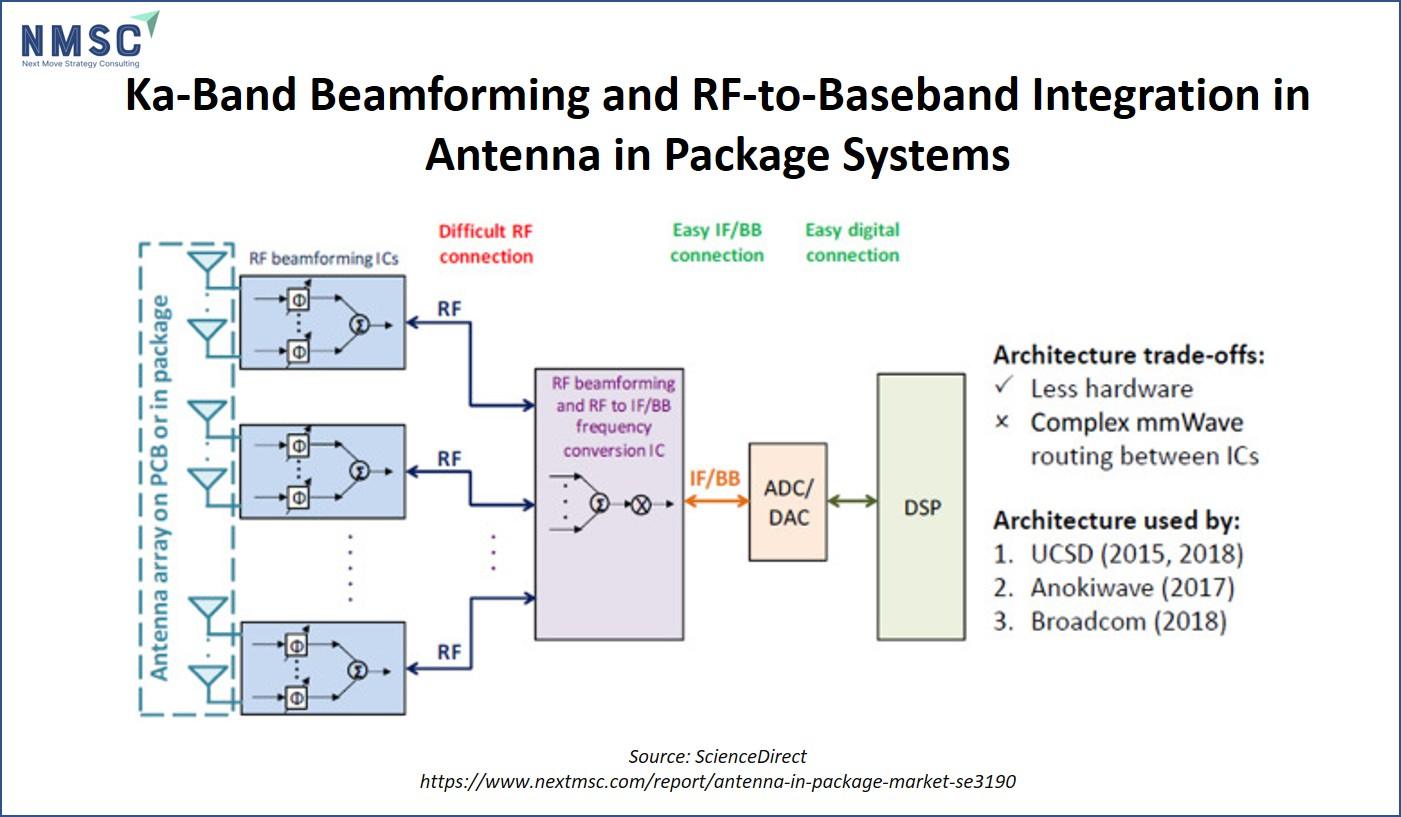
It emphasizes phased-array beamforming, its system flow from antenna array to RF beamforming ICs, then to frequency conversion and digital processing also reflects the integration philosophy demonstrated in April 2025 by Deity Microphones. Deity’s THEOS DIFB operates across a tunable 550MHz–960MHz ultra-wideband range, while the Sharkfin SF1 antenna covers 470MHz–1GHz and incorporates active RF amplification. The image’s progression from RF beamforming blocks to IF/baseband and digital signal processing parallels the DIFB’s integrated RF management, frequency scanning, and automatic pairing functions. In practical terms, the diagram demonstrates how placing RF control and conversion stages close to the antenna simplifies external interconnections while enabling advanced frequency coordination. The “easy IF/BB connection” and “easy digital connection” labels in the image conceptually align with Deity’s Bluetooth app support and digital coordination capabilities, which reduce workflow complexity in professional environments. While Deity’s systems are not Ka-band phased arrays, they embody the same Antenna in Package principle illustrated here: tightly integrating antenna elements, RF amplification, frequency control, and digital processing into a compact architecture to enhance performance, efficiency, and portability.
Mobility Meets Integration
This development highlights how integrated antenna packaging concepts are influencing professional broadcast and field production equipment.
Strategically, the implications include:
-
Enhanced workflow efficiency through automated frequency coordination.
-
Greater mobility enabled by compact antenna integration.
-
Improved signal reliability in crowded RF environments.
The conclusion is that AiP-driven design thinking is extending beyond infrastructure into professional-grade portable systems.
Sectoral Impact of Antenna in Package Technology
The influence of AiP technology across 2025 deployments can be summarized below:
|
Sector |
AiP-Driven Capability |
2025 Development |
Strategic Implication |
|
Satellite |
Integrated phased- |
C-COM Ka-band |
Accelerates scalable, |
|
Broadcast & |
Ultra-wideband |
THEOS DIFB |
Improves RF coordination |
|
High-Frequency |
Compact millimeter |
Hybrid passive/ |
Reduces system complexity |
|
Mobility-Focused |
Integration within |
Long battery life |
Enables durable, portable, |
Leading Companies Strengthening Their Position in Antenna in Package Industry
Several prominent companies are actively shaping the Antenna in Package (AiP) industry, including PCB Technologies Ltd., Amkor Technology, ASE Technology Holding Co., Ltd., Powertech Technology Inc., Texas Instruments Incorporated, LitePoint, TMY Technology Inc., Murata Manufacturing Co., Ltd., Insight SiP, and MixComm Inc., among others. These companies are increasingly focusing on strategic initiatives such as partnerships and collaborative development agreements to strengthen their technological capabilities and sustain their competitive positioning within the Antenna in Package landscape.

Next Steps for Industry Stakeholders
-
Evaluate phased-array AiP solutions for Ka-band satellite terminal deployments.
-
Integrate ultra-wideband antenna systems in professional RF workflows to enhance coordination efficiency.
-
Strengthen R&D partnerships with academic and governmental institutions to accelerate patent-backed innovation.
-
Prioritize hybrid passive and active antenna architectures to optimize beam steering performance.
-
Align product development with regional RF compliance requirements through GPS-assisted frequency management systems.
Final Thoughts
The Antenna in Package Market landscape in 2025 demonstrates measurable transformation rather than speculative promise. The Ka-band phased-array patent granted to C-COM Satellite Systems Inc. confirms progress in satellite-grade integration. Meanwhile, ultra-wideband advancements from Deity Microphones illustrate how compact antenna architectures enhance professional mobility and signal control. Antenna in Package technology is redefining how antennas are engineered, packaged, and deployed. As integration depth increases, the emphasis will shift from standalone performance metrics to system-level efficiency and scalability.
About the Author
 Sanyukta Deb
— Sanyukta Deb is Digital Marketing Team Lead at Next Move Strategy Consulting, where she has led content strategy and technical SEO for the firm's B2B market research publications for over 2 years. Her editorial process translates NextMSC's primary and secondary research — spanning technology, industrial, and consumer sectors — into commercial narratives, backed by search-intent, keyword, and competitive analysis. She brings 5 years of overall experience in digital marketing and content strategy.
Sanyukta Deb
— Sanyukta Deb is Digital Marketing Team Lead at Next Move Strategy Consulting, where she has led content strategy and technical SEO for the firm's B2B market research publications for over 2 years. Her editorial process translates NextMSC's primary and secondary research — spanning technology, industrial, and consumer sectors — into commercial narratives, backed by search-intent, keyword, and competitive analysis. She brings 5 years of overall experience in digital marketing and content strategy.
About the Reviewer
 Debashree Dey
— Debashree Dey is Assistant Manager at Next Move Strategy Consulting, where she supports cross-vertical market content and communications across diverse industries for 6 years. Her professional background includes senior content writing, communications, and published manuscript authorship, with experience developing audience-focused business narratives and maintaining clear, consistent messaging. Her role supports research-led content development and editorial quality across NextMSC publications.
Debashree Dey
— Debashree Dey is Assistant Manager at Next Move Strategy Consulting, where she supports cross-vertical market content and communications across diverse industries for 6 years. Her professional background includes senior content writing, communications, and published manuscript authorship, with experience developing audience-focused business narratives and maintaining clear, consistent messaging. Her role supports research-led content development and editorial quality across NextMSC publications.


















Add Comment