How Is the Construction Chemicals Market Evolving in 2025?
Introduction
On October 23, 2026, Sika AG reported nine-month sales of CHF 8.71 billion, up 4.8% in local currencies, with third-quarter growth of 6.1%. Chief Executive Officer Thomas Hasler credited market share gains in what the company's media release called a "muted market environment". Days earlier, the National Bureau of Statistics of China had reported real estate development investment down 20.6% for January to September 2026. A supplier growing near 5% inside a weak build cycle is the defining feature of the construction chemicals market this year.
According to Next Move Strategy Consulting's Construction Chemicals Market report, the global construction chemicals market was valued at USD 58.35 billion in 2023 and is projected to reach USD 93.49 billion by 2030, growing at a CAGR of 6.9% from 2024 to 2030. The gap between that trajectory and the weak construction backdrop explains why this year's evidence centers on who captures share rather than on how much concrete is poured.
For More Information: Download FREE Sample on Construction Chemicals Market Report
This analysis draws on 2026 releases from Sika AG, Saint-Gobain and RPM International and on public statistics from the National Bureau of Statistics of China, the U.S. Census Bureau and Germany Trade & Invest. NextMSC proprietary estimates are kept separate from externally reported facts.
Construction Chemicals Market Trends: Why Specification-Led Share Gains Are Outrunning Weak Demand
Sika's Nine-Month Results: 4.8% Growth in a Muted Market
Sika AG's media release of October 23, 2026 contains the clearest recent evidence. Net sales reached CHF 8,711.8 million, compared with CHF 8,578.1 million a year earlier. Growth in local currencies was 4.8%, of which organic growth contributed 3.5% and acquisitions 1.3%. A currency effect of -3.2% reduced growth in Swiss francs to 1.6%. The material margin rose 40 basis points to 55.4%, and EBITDA increased 1.9% to CHF 1.68 billion, a margin of 19.2%.
The regional split matters more than the headline. In EMEA, Sika grew 8.3% in local currencies, against 2.1% in 2025, and the company linked its German acceleration to federal funding for large infrastructure projects. The Middle East delivered double-digit growth on large infrastructure builds. The Americas grew 4.1%, with the third quarter accelerating to 6.7% and data center sales expanding at a double-digit pace. Asia/Pacific declined 2.3% because Chinese construction posted a double-digit decline; adjusted for China, the region's organic growth was 7.7%, led by India's infrastructure business and new commercial projects in Southeast Asia.
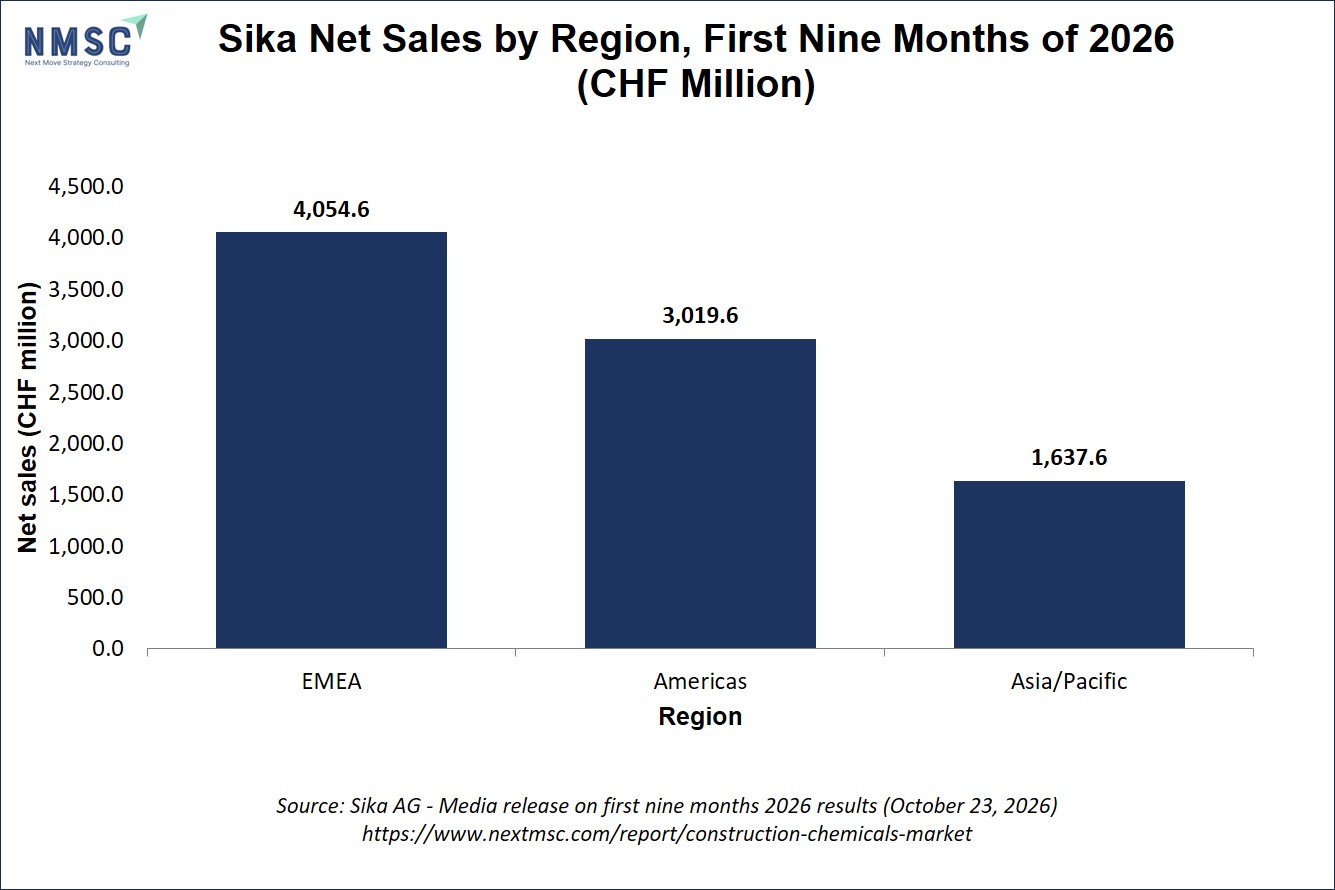
Sika AG's release reports nine-month net sales of CHF 4,054.6 million in EMEA, CHF 3,019.6 million in the Americas and CHF 1,637.6 million in Asia/Pacific for January 1 to September 30, 2026. The three regions total CHF 8,711.8 million, matching the group figure in the same release.
During the third quarter Sika completed the acquisition of Akkim, a Turkish adhesives and sealants manufacturer with CHF 220 million of 2025 net sales, and it expects to double Akkim's revenue within five years. Management reiterated 2026 guidance of 3% to 6% local currency growth, raised on July 28, 2026 from 1% to 4% after second-quarter growth of 6.8%. In October it acquired the Azpects Group, a United Kingdom producer of polymeric sands, and it agreed to take over the adhesives business of Resonac Corporation in Japan, with closing expected in mid 2027. Sika's July 28, 2026 half-year presentation also lists new concrete admixture plants in Florida and Belgium and an admixture and mortar plant in Bangladesh, placing production close to the projects it serves.
Saint-Gobain: Construction Chemicals Moves to the Center of the Group
Saint-Gobain's first-half 2026 results, published on July 30, 2026, show the same divergence inside a larger industrial group. Group sales were EUR 23.6 billion, with like-for-like growth of 0.7% for the half year and 3.5% in the second quarter. Construction chemicals grew 5.3% organically in the half and 8.5% in the second quarter, which Chairman and Chief Executive Officer Benoit Bazin described as the clearest illustration of the group's outperformance.
The release ties that growth to specific projects and regions. In North America, construction chemicals delivered double-digit growth in the second quarter even though new construction and industrial solutions declined. In India, the FOSROC brand supplied the Mumbai to Ahmedabad high-speed rail link and Noida international airport, and the country posted double-digit growth. Brazil's launch of an AI-powered tool for construction chemicals sales representatives generated three percentage points of outperformance, and Mexico and Central America grew at a double-digit rate through Cemix. The group's data center pipeline reached 1,085 projects under specification in 32 countries, almost double the prior year, including 250 projects in North America against 80 a year earlier.
Capital allocation confirms the priority. Saint-Gobain rotated about EUR 3 billion of sales through 14 acquisitions and 9 disposals in the year to date, including the sale of its German dry mortar and off-site construction businesses, and it opened 14 plants and production lines in the first half, 13 of them in high-growth markets. Its stated investment focus includes construction chemicals. The regional mix shown below explains why emerging markets matter: Asia-Pacific contributes 10.9% of group sales yet delivered 7.0% organic growth in the half year.
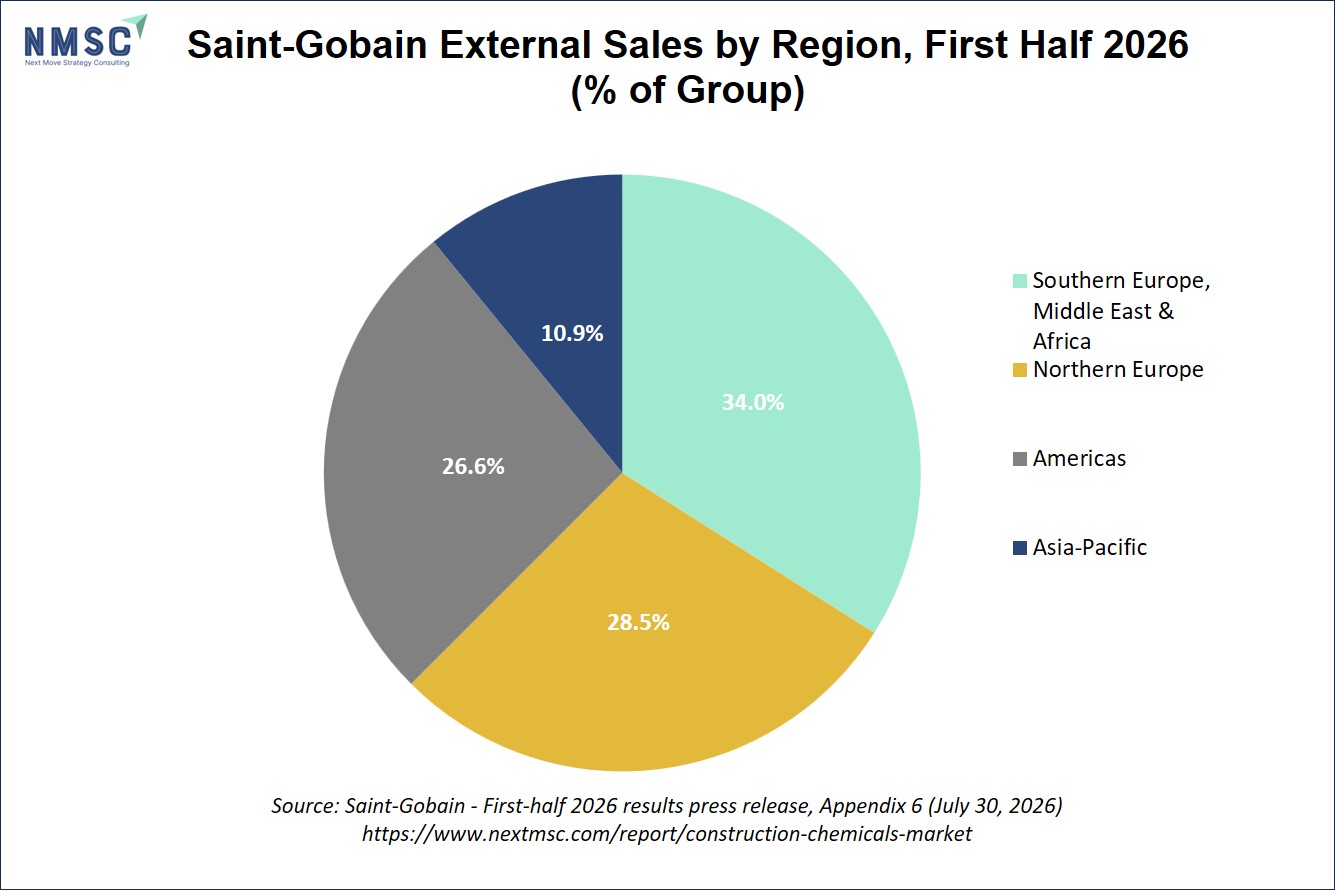
Saint-Gobain's first-half 2026 results list each region's share of external group sales: Southern Europe, Middle East & Africa 34.0%, Northern Europe 28.5%, Americas 26.6% and Asia-Pacific 10.9%. The shares total 100.0% and cover the whole group rather than construction chemicals alone.
RPM International: A Counter-Signal From North American Institutional Construction
Not every supplier is outperforming. On October 6, 2026, RPM International reported fiscal 2027 first-quarter results for the period ended August 31, 2026. Its Construction Products Group, which includes concrete admixtures, roofing restoration systems and waterproofing, recorded net sales of USD 859.2 million, up 0.8%, but organic sales fell 1.7% and adjusted EBITDA declined 9.7% to USD 166.2 million. RPM attributed the shortfall to a slowdown in healthcare and education markets and to supplier raw material availability issues, while acquisitions added 2.5% to growth.
The contrast with Sika is instructive. RPM's weakness sits in two institutional end uses rather than in infrastructure, and the company kept buying into waterproofing by completing the acquisition of Volteco, an Italy-based supplier of below-grade waterproofing products with EUR 28 million of 2025 sales. RPM still projects mid-single-digit sales growth for fiscal 2027.
China's Property Slump and the Asia-Pacific Divide
The National Bureau of Statistics of China reported in October 2026 that real estate development investment for January to September totaled CNY 5,336.4 billion, down 20.6% year on year, with residential investment at CNY 4,112.5 billion, down 20.5%. Sika quantifies the transmission: excluding the decline of its Chinese construction business, group local currency growth over nine months would have been 6.2% rather than 4.8%. Saint-Gobain reports the opposite experience at group level, with Asia-Pacific organic growth of 7.0% and another outperformance in China. The two vendors agree that regional demand has split between a contracting residential segment and expanding infrastructure and commercial segments.
NMSC Strategic Perspective: Why Specification Now Outweighs Volume
NextMSC primary research and analysis reads these datasets as one signal: revenue in the construction chemicals market is migrating from volume-linked new housing toward specification-linked infrastructure, data centers and refurbishment, and vendors that already hold specifications capture that migration first. Specification matters because an admixture, membrane or grout is chosen at the design stage by an engineer or consultant, so a supplier approved on a bridge, tunnel or data center slab keeps the order when the surrounding build cycle weakens. Sika's 8.3% EMEA growth and Saint-Gobain's double-digit North American construction chemicals growth, both achieved while new construction declined, are the measurable result.
The second element is regional production. NextMSC's reading is that liquid admixtures and ready-mixed mortars carry high weight relative to their value, so plants close to demand lower delivered cost and shorten technical response times. Sika's admixture plants in Florida and Belgium and Saint-Gobain's 14 new plants and lines in the first half fit that pattern. The third element is portfolio breadth: Akkim, Volteco, Cemix and Azpects each add distribution access or a product family that cross-sells through the same contractor channel.
The report data supports the regional emphasis. NMSC's Construction Chemicals Market report identifies Asia-Pacific as the largest regional pool, attributing it to urbanization and construction activity in China and India, and attributes North America's steady rise to federal and state funding for public works. The 2026 evidence refines both findings: Asia-Pacific growth now comes from India and Southeast Asia rather than Chinese housing, and North American growth comes from data centers and public works rather than residential spending.
Section Summary:
Specification, regional production and portfolio breadth separate the vendors growing in 2026 from those holding flat.
Sika AG's 4.8% nine-month local currency growth and Saint-Gobain's 5.3% first-half organic growth in construction chemicals contrast with RPM International's 1.7% organic decline in its Construction Products Group.
China's 20.6% fall in property investment removes volume from housing, while India and Southeast Asia replace part of it through infrastructure.
Acquisitions such as Akkim and Volteco, and new regional plants, are the main tools for converting specification wins into share.
Industry Impact Analysis: How Public Capital and Data Centers Are Redirecting Construction Chemicals Market Demand
Germany's EUR 500 Billion Fund Moves From Plan to Orders
Germany Trade & Invest published an interview on June 5, 2026 with Teresa Schildmann, macroeconomics expert at DIW Berlin, who stated that the government has earmarked about EUR 500 billion for infrastructure and climate investment by 2037, over and above regular spending. Schildmann said an additional EUR 14 billion was disbursed from the special fund in 2025, forecast that figure to reach EUR 24 billion in 2026 and expected a further increase of about EUR 10 billion in 2027. She named building materials manufacturers among the primary beneficiaries and described Germany as being "at the beginning of a long-term infrastructure investment boom".
The mechanism reaches construction chemicals through rail, bridge and road maintenance, which consume concrete admixtures, repair mortars, waterproofing and expansion-joint systems. Sika's German acceleration in the nine months to September 30, 2026, which the company attributes to federal infrastructure funding, is the first company-level sign that the fund has begun to convert into orders.
United States: Data Centers Offset a Weak Residential Base
The U.S. Census Bureau reported on October 1, 2026 that total construction spending for August 2026 was USD 2,203.1 billion at a seasonally adjusted annual rate, 0.9% above the revised July figure, although the Bureau noted that the 90% confidence interval for the change includes zero. The National Association of Home Builders calculated from the same release that private residential spending was USD 882.3 billion, down 4.8% from a year earlier. Bloomberg Government reported on June 1, 2026 that Census figures showed U.S. data center construction spending exceeding USD 50 billion in April for the first time, ahead of public spending on transportation-related structures.
That composition explains the vendor results. Sika's Americas data center sales grew at a double-digit pace, and Saint-Gobain's North American data center pipeline rose from 80 to 250 projects. Sika's July 28, 2026 presentation lists roofing, flooring, joint sealing, admixtures and fibers, fire protection and waterproofing among the data center solutions it supplies. Suppliers with high-specification product families gain from this segment while housing-linked demand stays soft.
Input Costs, Currency and Supply: The Margin Filter
Demand does not translate into profit without cost control. Saint-Gobain reports that prices rose in the second quarter as inflationary conditions returned, although it still expects a slightly positive price-cost spread for the year. RPM cited raw material inflation and supplier availability issues in its Construction Products Group, where adjusted EBITDA fell 9.7%. Sika offset higher costs through disciplined pricing and its Fast Forward program, which is on track to deliver CHF 80 million of benefits in 2026, and its material margin rose to 55.4%. Currency also matters: Sika's -3.2% currency effect turned 4.8% local currency growth into 1.6% in Swiss francs.
Section Summary:
Public capital and data center construction are replacing housing as the main source of high-specification demand, while input costs and currency decide who converts it into earnings.
-
Germany's special fund is forecast by DIW Berlin to deliver EUR 24 billion in 2026, against EUR 14 billion in 2025.
-
U.S. private residential construction spending was down 4.8% year on year in August 2026, while data center spending passed USD 50 billion in April.
-
Sika's 55.4% material margin and RPM's 9.7% EBITDA decline in its Construction Products Group show pricing power and cost control as the differentiators.
Pros and Cons of Recent Market Developments
|
Pros |
Cons |
|
Sika's 4.8% nine-month growth shows that specification-led share gains can lift sales in a muted market. |
China's 20.6% fall in property investment cut Sika's Asia/Pacific sales by 2.3% in local currencies. |
|
Saint-Gobain's construction chemicals grew 8.5% organically in the second quarter on infrastructure and data center projects. |
RPM's Construction Products Group shrank 1.7% organically as healthcare and education demand slowed. |
|
Germany's special fund is forecast to reach EUR 24 billion in 2026, supporting rail, bridge and road maintenance. |
U.S. private residential construction spending fell 4.8% year on year in August 2026. |
|
U.S. data center construction passed USD 50 billion in April 2026 and specifies waterproofing and roofing. |
Currency translation cut Sika's 4.8% local currency growth to 1.6% in Swiss francs. |
|
Acquisitions such as Akkim, Volteco and Azpects broaden product families and distribution. |
Raw material inflation returned in the second quarter, pressuring margins. |
Key Data & Statistics
The two tables below consolidate the company results and public demand indicators discussed above, so that readers can compare supplier performance with the construction activity those suppliers serve.
Table 1: Recent Company Results in Construction Chemicals
|
Company |
Reporting period |
Headline result |
Supporting detail |
|
Sika AG |
Nine months to September 30, 2026 |
Net sales CHF 8.71 billion; +4.8% in local currencies |
Organic growth 3.5%; EBITDA margin 19.2% |
|
Saint-Gobain |
First half 2026 |
Construction chemicals organic growth 5.3% |
Second-quarter growth 8.5%; group like-for-like +0.7% |
|
RPM International |
Fiscal 2027 first quarter to August 31, 2026 |
Construction Products Group net sales USD 859.2 million; +0.8% |
Organic sales -1.7%; adjusted EBITDA USD 166.2 million, down 9.7% |
Table 2: Public Construction Demand Indicators, 2026
|
Indicator |
Latest reading |
Reporting body |
|
China property investment, January to September 2026 |
CNY 5,336.4 billion; -20.6% year on year |
National Bureau of Statistics of China |
|
U.S. total construction spending, August 2026 |
USD 2,203.1 billion annual rate; +0.9% month on month |
U.S. Census Bureau |
|
U.S. private residential spending, August 2026 |
USD 882.3 billion; -4.8% year on year |
National Association of Home Builders |
|
Germany special fund investment |
EUR 14 billion in 2025; EUR 24 billion forecast for 2026 |
DIW Berlin, via Germany Trade & Invest |
Future Outlook & Forecast: The Construction Chemicals Market Beyond 2026
NextMSC's model projects the construction chemicals market to expand from USD 58.35 billion in 2023 to USD 93.49 billion by 2030, a CAGR of 6.9% over 2024 to 2030 and an absolute increase of USD 35.14 billion. Reported industry sizes differ by scope, so comparisons need care. In its July 28, 2026 half-year presentation, Sika AG describes a CHF 100 billion industry in which it holds a 12% share and the top 30 competitors account for 50% of sales, using its own target-market definition that includes roofing, flooring and industrial segments. NextMSC sizes the market by product type, covering concrete admixtures, waterproofing chemicals, adhesives and sealants, repair materials, flooring compounds and protective coatings, and by application, so the two figures are not directly comparable. The Sika framing does confirm fragmentation: half of industry sales sit with suppliers outside the top 30, which keeps consolidation active.
Company guidance for the remaining months is positive but measured. Sika expects 3% to 6% local currency growth in 2026. Saint-Gobain expects second-half sales growth in Europe, the Americas and Asia-Pacific, led by India and Southeast Asia, with an EBITDA margin above 15.0%. RPM projects mid-single-digit sales growth for fiscal 2027 and expects second-quarter trends to resemble the first.
Against those run-rates, NextMSC's 6.9% CAGR assumes acceleration. Sika's 3.5% organic growth and Saint-Gobain's 5.3% organic growth in construction chemicals sit below it, and RPM's Construction Products Group is contracting organically. The forecast therefore depends on three conditions: conversion of Germany's special fund into orders at the pace DIW Berlin projects, continued data center and infrastructure construction, and a recovery in housing outside China. The 2026 evidence already points to waterproofing, admixtures and repair materials gaining weight relative to decorative and residential segments.
Section Summary:
NMSC's forecast remains the reference trajectory, but the 2026 run-rates at the largest suppliers show that reaching it requires faster infrastructure and data center conversion.
-
NextMSC projects USD 58.35 billion in 2023 rising to USD 93.49 billion by 2030 at a 6.9% CAGR for 2024 to 2030.
-
Reported organic growth of 3.5% at Sika and 5.3% in Saint-Gobain's construction chemicals sits below that CAGR, while RPM's Construction Products Group is contracting.
-
Sika's statement that the top 30 suppliers hold 50% of industry sales points to continued fragmentation and acquisition activity.
Next Steps for Stakeholders
For chief executives, chief financial officers and institutional investors, the 2026 evidence translates into five actions.
-
Audit revenue by specification channel. Separate sales won through engineers, architects and consultants on infrastructure, data center and refurbishment projects from sales tied to housing volume. Saint-Gobain reports that India generates over a quarter of its sales through specification.
-
Localize production where projects are funded. Sika's admixture plants in Florida and Belgium, and Saint-Gobain's 14 new plants and lines in the first half, show the capital needed to stay close to infrastructure spending.
-
Treat acquisitions as distribution purchases. Akkim brings CHF 220 million of 2025 net sales, Volteco EUR 28 million, and Sika's Resonac adhesives agreement is due to close in mid 2027.
-
Stress-test margins for currency and inputs. Sika's -3.2% currency effect and RPM's raw material inflation show that local currency growth can be eroded in reported results.
-
Calendar the next confirmations. Sika's full-year results on February 19, 2027 and its Capital Markets Day on March 11, 2027 will show whether third-quarter growth of 6.1% was sustained.
Conclusion
The construction chemicals market in 2026 is being decided by specification, geography and execution rather than by aggregate building volume. Sika's 4.8% nine-month growth, Saint-Gobain's 8.5% second-quarter organic growth in construction chemicals and the contrast with RPM's 1.7% organic decline show that exposure matters more than the cycle. NMSC's forecast of USD 93.49 billion by 2030 at a 6.9% CAGR remains the reference trajectory, and the stakeholders best placed to meet it hold specifications in infrastructure, data centers and refurbishment, produce near demand and fund growth through disciplined acquisitions. For readers tracking the construction chemicals market, the next confirmation arrives with Sika's full-year results on February 19, 2027.
About the Author
 Sanyukta Deb
— Sanyukta Deb is Digital Marketing Team Lead at Next Move Strategy Consulting, where she has led content strategy and technical SEO for the firm's B2B market research publications for over 2 years. Her editorial process translates NextMSC's primary and secondary research — spanning technology, industrial, and consumer sectors — into commercial narratives, backed by search-intent, keyword, and competitive analysis. She brings 5 years of overall experience in digital marketing and content strategy.
About the Reviewer
 Debashree Dey
— Debashree Dey is Assistant Manager at Next Move Strategy Consulting, where she supports cross-vertical market content and communications across diverse industries for 6 years. Her professional background includes senior content writing, communications, and published manuscript authorship, with experience developing audience-focused business narratives and maintaining clear, consistent messaging. Her role supports research-led content development and editorial quality across NextMSC publications.















Add Comment