How Restaurants Fill Dead Air Between the Kitchen and the Guest
Wait times at full-service restaurants have stretched long enough that diners now time them on their phones. I sat at a 14-seat counter in Providence on a Tuesday and watched four separate tables pull up a browser to check how long the ticket had been open. The food was fine. The waiting was the product, and nobody had designed it.
That's the gap worth talking about. Dead air is every minute a guest spends with nothing to look at, nothing to order, and no signal that anything is happening. You can fix most of it without hiring anyone, without a remodel, and without a budget that makes your accountant flinch. Here's how I'd do it if I owned the place.
Dead Air Is a Menu Problem Before It's a Screen Problem
Most operators jump straight to buying panels. I'd argue that's backwards. The first question is what you want a person to do during minute two, minute nine, minute twenty-two. If you can't answer that on a napkin, a bigger TV won't save you.
My own rule, and I'll call it the Three-Minute Rule, is simple: no guest should go more than three minutes without something new entering their field of view or their hands. That could be a drink, a card, a bowl of olives, a screen flipping from the specials board to a shot of the pastry case. Three minutes is roughly how long a hungry person will tolerate a static environment before the mood turns. Restaurants that ignore it get the classic complaint that has nothing to do with food: "It just felt slow in there."
Write down your own timing. Sit at table six on a Friday at 7:20 p.m. with a stopwatch running on your phone. Note every minute where nothing changes. You'll find two or three dead zones you never noticed, and they're usually the same two or three every night.
What the Labor Numbers Already Tell You
Independent restaurants can't staff their way out of this. According to the Bureau of Labor Statistics, food services and drinking places employ millions of Americans, yet the industry's turnover remains among the highest of any sector in the economy. That churn matters here: the server who would have chatted up table six in 2015 is now training on their third job this year. You can't build a waiting experience that depends on a person's availability to stand there and improvise. You need some of it baked into the room.
That's the honest case for screens in a restaurant. Not as decoration. As labor-absorbing infrastructure. A looping board that tells guests what's coming, what's running out, and what pairs with the entree takes pressure off a two-person floor team that's already sprinting.
Give the Room a Beat
Think about the last great meal you had. It had rhythm. Something arrived, then a pause, then something else. High-volume chains understand this and beat it to death with synchronized timers. Independents usually have no rhythm at all, so guests fill the silence themselves, usually with their phones, which means they're not looking at your menu or your room.
You can build a beat with almost nothing:
-
A table card that changes angle every few weeks
-
Mounted screens cycling between specials, a producer story, and a full-screen clock
-
A chalkboard that gets a genuine update twice a week, not once a season
-
An open kitchen window where a guest can actually see a plate going out
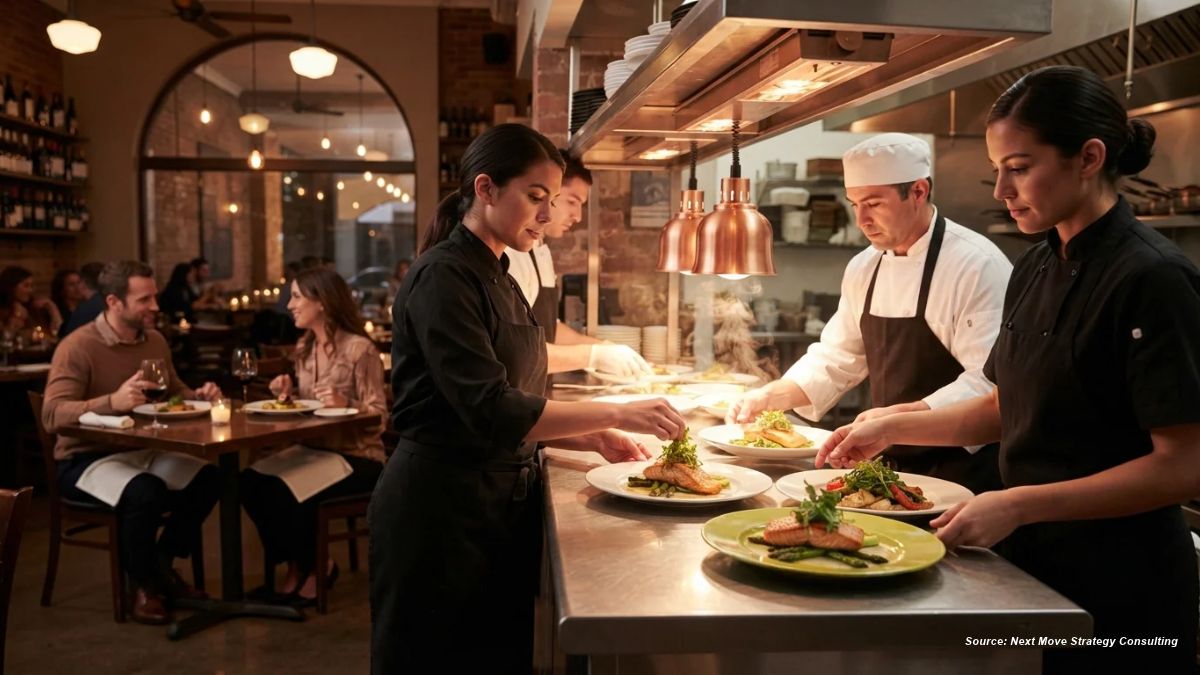
The open kitchen is the cheapest option and the most overlooked. Guests will watch a line cook work with more attention than they'll give any screen. If your kitchen is already semi-visible, stop hiding it.
Screen Placement Beats Screen Size
I've walked into dozens of restaurants with a 65-inch panel bolted at the wrong height and the wrong brightness, and it looks worse than an empty wall. Get the fundamentals right before you spend a dollar.
|
Placement spot |
What guests actually do there |
What belongs on the screen
|
|
Above the wait station |
Stand, check phones, order a drink |
Drink specials, wait-time honesty, short clips |
|
Over the bar back |
Sit, watch bartenders, decide on round two |
Rotating menu, sports, branded motion loops |
|
Near the restroom corridor |
Walk past with nothing else to see |
Dessert, next-day specials, loyalty signup |
|
Private event wall |
Wait for a toast or a speech |
Custom welcome slides, event logo, schedule |
Keep panels out of sightlines where people are actively eating and talking. Nobody wants a bright rectangle competing with the person across the table. And match brightness to the room: a dim dining floor at 8 p.m. wants a warmer, dimmer image than a bright brunch service.
Choosing the Gear Without Getting Burned
Here's where most owners make the expensive mistake: they buy a consumer television with a stick plugged into the back, then discover six months later that a restaurant is a hostile environment for consumer electronics. Grease, heat, humidity, and 14-hour days kill hardware that was designed for a living room.
If you're pricing out digital signage hardware, look at three things and ignore everything else on the spec sheet. Continuous operation rating, since your screens will run from open to close without a break. Local storage for offline playback, because your router will drop during a Friday rush and you can't have a black screen. And mounting flexibility, because a stick player hidden behind a TV is worth more than a beautiful metal box sitting in a closet.
One opinion I'll defend: buy one good commercial player before you buy three cheap ones. Most restaurant operators I've talked to end up replacing the cheap units within a year, and the labor of climbing a ladder twice is worse than the price difference. The International Organization for Standardization publishes widely adopted benchmarks covering equipment durability and operating conditions; they're a useful sanity check when a vendor claims "commercial grade" without saying what that means.
A Tuesday Launch Plan You Can Actually Run
Pick the slowest day of the week. You want a night where a mistake costs you three tables, not thirty.
-
Map the room. Stand at the door and walk your own floor. Mark every spot where a guest waits.
-
Choose one screen location. Just one. Add more only after the first one earns its keep.
-
Write five slides. Specials, a staff photo, a full-screen clock, a loyalty ask, a producer or farmer note. Rotate them on a 30-second loop.
-
Set the brightness and volume low. If anyone mentions the screen unprompted, it's too loud or too bright.
-
Run it for two weeks and ask your servers what guests say. They hear the honest version before you do.
Track three numbers after launch: average check, drink attachment rate, and how often a server has to explain what's on the screen. That third one is your real signal. If staff are answering questions about the display, it's not doing its job.
Where This Goes Wrong
The failure mode isn't technical. It's neglect. A screen that still shows the same seasonal salad in February tells guests that nobody's paying attention, which is the exact opposite of what you wanted. According to the National Restaurant Association, competition for guests is as intense as it has ever been, and diners are choosing on experience as much as food. A stale loop is a small insult repeated all night.
So put a recurring appointment on your calendar: every second Monday, refresh the content. Ten minutes. Change the special. Swap one photo. Rotate the loyal slide in and out. That habit is worth more than any upgrade you'll ever buy.
Dead air isn't a design flaw you inherited. It's a choice you're making by leaving it alone. Sit your own bar tonight, start a timer, and count how many minutes pass before something new shows up. That number tells you exactly where to start.
About the Author
 Sanyukta Deb
— Sanyukta Deb is Digital Marketing Team Lead at Next Move Strategy Consulting, where she has led content strategy and technical SEO for the firm's B2B market research publications for over 2 years. Her editorial process translates NextMSC's primary and secondary research — spanning technology, industrial, and consumer sectors — into commercial narratives, backed by search-intent, keyword, and competitive analysis. She brings 5 years of overall experience in digital marketing and content strategy.
About the Reviewer
 Debashree Dey
— Debashree Dey is Assistant Manager at Next Move Strategy Consulting, where she supports cross-vertical market content and communications across diverse industries for 6 years. Her professional background includes senior content writing, communications, and published manuscript authorship, with experience developing audience-focused business narratives and maintaining clear, consistent messaging. Her role supports research-led content development and editorial quality across NextMSC publications.
















Add Comment