How Sepsis, AMR and Diagnostics Are Reshaping Blood Cultures
Introduction
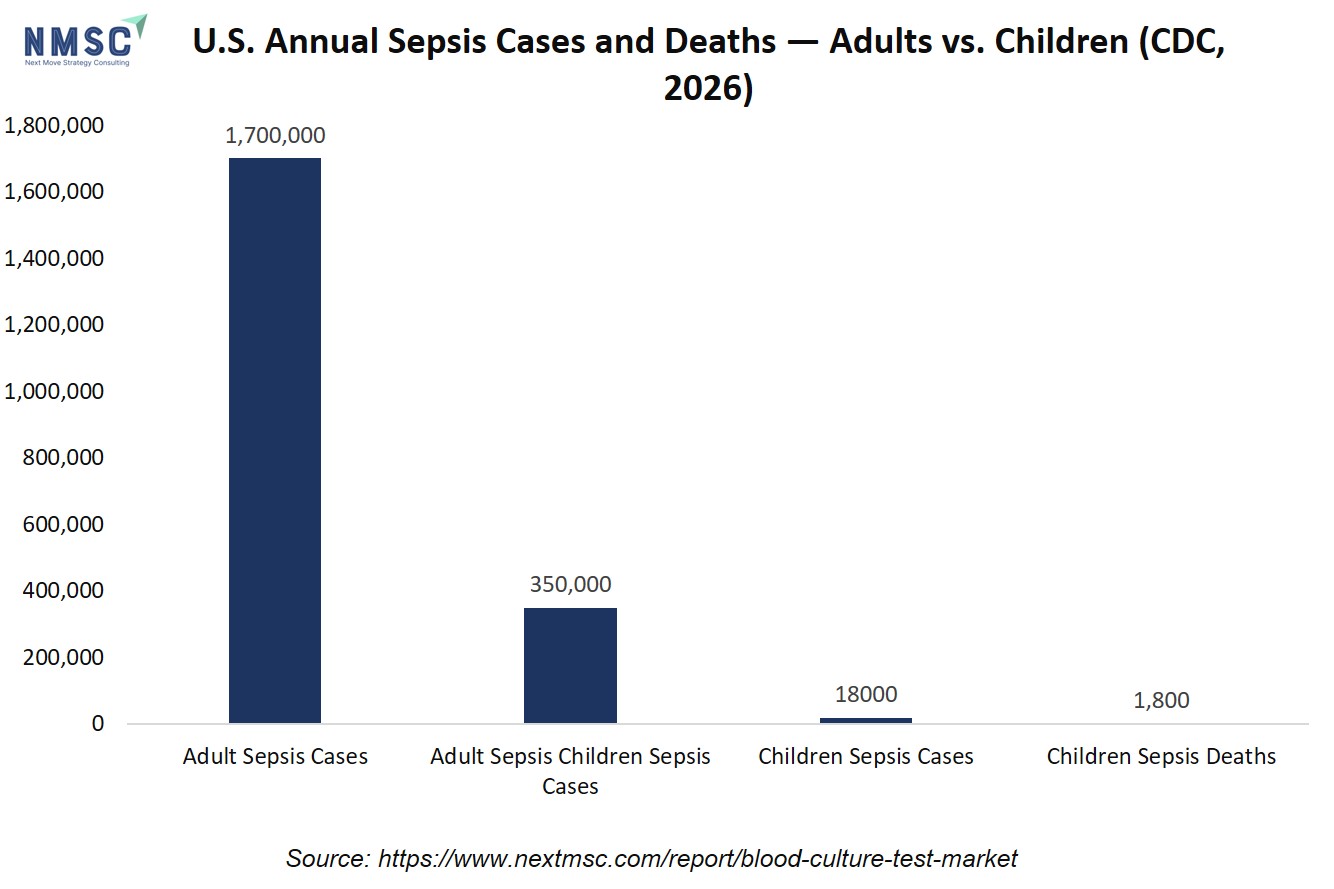
Sepsis kills more people globally each year than most cancers. According to the World Health Organization (WHO), there were 48.9 million sepsis cases and 11 million sepsis-related deaths worldwide — representing 20% of all global deaths — based on data published in 2020. In the United States alone, the Centers for Disease Control and Prevention (CDC) confirms that at least 1.7 million adults and more than 18,000 children develop sepsis every year, with at least 350,000 adults dying during hospitalization or being discharged to hospice. At the center of every sepsis response protocol is a single, indispensable diagnostic tool: the blood culture test.
The global blood culture test market is now at a critical inflection point. Three concurrent forces — a landmark CDC report on healthcare-associated infections (HAIs) published in July 2026, the World Health Assembly's adoption of a new 10-year global action plan on antimicrobial resistance (AMR) in May 2026, and a wave of rapid diagnostic innovations receiving regulatory clearance — are collectively reshaping the clinical, regulatory, and commercial landscape for blood culture diagnostics. For investors, healthcare executives, and diagnostic manufacturers, understanding the forces driving this trajectory is no longer optional — it is a strategic imperative.
For More Information – Download FREE Sample on Blood Culture Test Market Report
The Convergence of Three Market-Defining Forces in 2026
Breaking Development 1: CDC's July 2026 HAI Report — Progress and Persistent Gaps
On July 15, 2026, the CDC released landmark new data on healthcare-associated infections (HAIs) in U.S. hospitals, published simultaneously in The New England Journal of Medicine. The findings confirmed meaningful progress: in 2023, approximately 1 in 38 hospitalized patients had at least one HAI on any given day, a significant improvement from 1 in 31 patients recorded in 2015. The survey, conducted across 218 hospitals in 10 states and covering 13,653 patients, found significant reductions in central line-associated bloodstream infections (CLABSIs) — one of the most critical application areas for blood culture testing.
However, the report simultaneously underscored the scale of the remaining challenge. An estimated 518,000 HAIs still occurred in U.S. hospitals in 2023, and critically, 61% of all HAIs were not associated with medical devices or procedures — meaning they cannot be addressed through device-focused interventions alone. Surgical site infections and pneumonia showed little improvement, highlighting areas where diagnostic speed and accuracy remain insufficient. This dual narrative — progress alongside persistent burden — is a direct demand catalyst for the blood culture test market: the reduction in CLABSIs validates the clinical value of blood culture diagnostics, while the remaining 518,000 annual HAIs confirm that demand for faster, more accurate testing remains structurally elevated.
Breaking Development 2: WHA Adopts New 10-Year Global AMR Action Plan (May 2026)
In May 2026, WHO Member States at the World Health Assembly approved a new 10-year global action plan to combat antimicrobial resistance — one of the most consequential multilateral health policy decisions of the decade. The WHO has confirmed that antimicrobial resistance is a major factor determining clinical unresponsiveness to treatment and rapid evolution to sepsis and septic shock, with an estimated 4.95 million deaths associated with AMR in 2019, including 1.27 million deaths directly attributable to it. The new action plan places rapid, accurate diagnostics — including blood culture testing — at the center of AMR stewardship strategies, as timely pathogen identification is the prerequisite for appropriate antibiotic selection and the prevention of resistance escalation.
Breaking Development 3: Rapid Diagnostic Innovation — FDA Clearances and New Submissions
The diagnostic technology landscape is advancing rapidly. bioMérieux received U.S. FDA 510(k) clearance for its Vitek Reveal AST System, which reports antimicrobial susceptibility testing (AST) results directly from positive blood cultures — dramatically compressing the time-to-result compared to conventional culture-based workflows. Simultaneously, Accelerate Diagnostics submitted its WAVE system and gram-negative/positive blood culture menu to the FDA for 510(k) clearance, designed to provide rapid AST directly from positive blood cultures. Furthermore, on August 6, 2025, the WHO released a new target product profile (TPP) for diagnostic tests to detect serious bacterial infections in young infants — a direct signal of institutional commitment to expanding blood culture diagnostic capacity in the most vulnerable patient populations.
NMSC Strategic Perspective: A Market Shaped by Urgency and Innovation
From Next Move Strategy Consulting's analytical standpoint, the blood culture test market is being driven by a rare alignment of clinical urgency, regulatory momentum, and technological disruption. The CDC's July 2026 HAI report validates the clinical indispensability of blood culture diagnostics while simultaneously identifying the performance gaps — particularly in non-device-associated infections — that next-generation molecular and rapid AST platforms are designed to address. The WHA's new AMR action plan creates a durable policy tailwind that will sustain institutional investment in diagnostic infrastructure across both high-income and lower-middle-income countries (LMICs). NMSC's analysis identifies the transition from conventional culture-based methods to automated and molecular platforms as the single most consequential technology shift in the market, with the automated method segment expected to command a dominant and growing share of the market through 2030.
Section Summary: The blood culture test market is being reshaped by three concurrent forces: the CDC's July 2026 HAI report confirming both progress and persistent burden, the WHA's adoption of a new 10-year AMR action plan, and a wave of rapid diagnostic innovations receiving FDA clearance. Together, these developments are accelerating the transition from conventional to automated and molecular blood culture testing.
Key Takeaways:
-
The CDC confirmed ~518,000 HAIs in U.S. hospitals in 2023, with CLABSIs showing significant reduction — validating blood culture diagnostics while sustaining demand for faster, more accurate testing.
-
The WHA's new 10-year AMR action plan (May 2026) places rapid blood culture diagnostics at the center of global antimicrobial stewardship strategies.
-
WHO released a new target product profile for diagnostic tests for serious bacterial infections in young infants (August 2025), signaling institutional commitment to expanding diagnostic capacity.
-
FDA clearances for bioMérieux's Vitek Reveal AST System and Accelerate Diagnostics' WAVE system submission are accelerating the shift toward rapid, culture-dependent molecular diagnostics.
Industry Impact Analysis
The Sepsis Burden: A Structural and Sustained Demand Driver
The epidemiological burden of sepsis is the foundational demand driver for the blood culture test market. The CDC confirms that 1 in 3 adults who dies in a hospital had sepsis during their hospital stay, and 1 in 5 children who dies in a hospital had sepsis during their hospital stay. The WHO estimates that the average hospital-wide cost of sepsis exceeds USD 32,000 per patient in high-income countries — a figure that underscores the economic imperative for early, accurate diagnosis. A 2025 study published in The Lancet Global Health further confirmed that the global burden of sepsis increased in 2020 and 2021, reversing progress from 1990, with a 26.3% increase in mortality among adults older than 15 years — particularly those aged 70 and above. This reversal in progress, driven in part by the COVID-19 pandemic's disruption of healthcare systems, has reinforced the urgency of investing in diagnostic infrastructure capable of detecting bloodstream infections earlier and more accurately.
AMR and Antibiotic Stewardship: Elevating the Diagnostic Standard
Antimicrobial resistance is fundamentally changing the clinical requirements for blood culture testing. When pathogens are resistant to standard antibiotic regimens, the speed and specificity of pathogen identification become life-or-death variables. The WHO has explicitly identified AMR as a major factor in the rapid evolution from infection to septic shock, and the new 10-year global AMR action plan adopted by the WHA in May 2026 mandates strengthened diagnostic capacity as a core pillar of national AMR strategies. This policy environment is directly elevating the clinical and procurement standard for blood culture diagnostics: conventional culture-based methods that require 24–72 hours for results are increasingly inadequate in AMR-affected cases, driving adoption of rapid molecular platforms capable of delivering actionable results within hours.
North America: Dominant Market, Sustained Investment
North America holds the predominant share of the global blood culture test market, underpinned by the presence of major manufacturers including Thermo Fisher Scientific and Merck, a high burden of sepsis cases, and a well-developed healthcare infrastructure with strong institutional investment in diagnostic quality. The CDC's ongoing investment in HAI prevention — including millions of dollars deployed across every U.S. state through its Division of Healthcare Quality Promotion — sustains institutional demand for blood culture diagnostics as a core component of infection surveillance and control programs.
Asia-Pacific: The High-Growth Frontier
Asia-Pacific is expected to demonstrate steady and accelerating growth in the blood culture test market, driven by high prevalence of infectious diseases including dengue, malaria, and HIV/AIDS, rising disposable incomes, and increasing healthcare expenditure. The OECD identifies Asia as the second region with the highest HIV prevalence globally, following sub-Saharan Africa — a disease burden that significantly elevates the risk of opportunistic bloodstream infections and the corresponding demand for blood culture diagnostics. The WHO's commitment to supporting member states in LMICs to build laboratory capacity for sepsis diagnosis — a key pillar of Resolution WHA70.7 — is further expected to drive diagnostic infrastructure investment across the Asia-Pacific region.
Key Takeaways:
-
A 2025 Lancet Global Health study confirmed a 26.3% increase in sepsis mortality among adults over 15 years, reversing decades of progress and reinforcing diagnostic urgency.
-
AMR is elevating the clinical standard for blood culture testing, driving adoption of rapid molecular platforms over conventional 24–72 hour culture methods.
-
North America maintains market dominance, supported by CDC institutional investment and the presence of major diagnostic manufacturers.
-
Asia-Pacific's high infectious disease burden and rising healthcare expenditure position it as the most significant growth frontier through 2030.
Key Data & Statistics
Global and U.S. Sepsis & Bloodstream Infection Burden — Key Institutional Statistics
|
Metric |
Figure |
Year |
|
Global annual sepsis cases |
48.9 million |
2020 (published) |
|
Global annual sepsis-related deaths |
11 million |
2020 (published) |
|
Share of global deaths attributable to sepsis |
20% |
2020 (published) |
|
Sepsis cases in children under 5 globally |
~20 million (est.) |
2020 (published) |
|
Average hospital cost of sepsis per patient (high-income countries) |
>USD 32,000 |
Current |
|
Deaths associated with AMR globally (2019) |
4.95 million |
2019 |
|
Deaths directly attributable to AMR (2019) |
1.27 million |
2019 |
|
U.S. adults developing sepsis annually |
≥1.7 million |
2026 (updated) |
|
U.S. children developing sepsis annually |
>18,000 |
2026 (updated) |
|
U.S. adult sepsis deaths (hospitalization/hospice) |
≥350,000 |
2026 (updated) |
|
1 in 3 adults dying in U.S. hospitals |
Had sepsis during stay |
2026 (updated) |
|
Estimated U.S. HAIs in 2023 |
~518,000 |
July 2026 |
|
HAI rate improvement (2015 vs. 2023) |
1 in 31 → 1 in 38 patients |
July 2026 |
|
HAIs not associated with devices/procedures |
61% |
July 2026 |
Future Outlook & Forecast
NMSC Market Forecast: A Decade of Double-Digit Growth
According to Next Move Strategy Consulting, the global blood culture test market is forecast to grow from USD 5.86 billion in 2023 to USD 11.61 billion by 2030, at a CAGR of 10.3% over the 2024–2030 forecast period. This growth trajectory is among the most robust in the broader in-vitro diagnostics sector, underpinned by the structural and growing burden of sepsis, the AMR-driven elevation of diagnostic standards, and the accelerating adoption of automated and molecular blood culture platforms.
The rise in sepsis cases — which the WHO identifies as responsible for 11 million deaths annually — continues to be the primary demand driver. High incidences of bloodstream infections including osteomyelitis, urinary tract infections, and pneumonia further support sustained market growth. The NMSC report identifies the introduction of innovative products by key market players — including automated systems that enable rapid and accurate microbial identification for positive blood cultures — as a significant growth accelerator.
Technology Trajectory: From Culture to Molecular and Beyond
The technology roadmap for the blood culture test market is defined by a clear directional shift: from conventional, manual culture-based methods toward automated, molecular, and PCR-based platforms. The NMSC report identifies molecular-based technologies — including single-plex and multiplex PCR assays and other DNA amplification techniques — as the most significant opportunity for market expansion in the coming years. These platforms address the most critical clinical limitation of conventional blood culture testing — time-to-result — by delivering pathogen identification and antimicrobial susceptibility data within hours rather than days.
The WHA's new 10-year AMR action plan will further accelerate this technology transition by mandating that member states strengthen diagnostic laboratory capacity and implement antimicrobial stewardship programs that depend on rapid, accurate blood culture results. The Lancet Global Health's 2025 finding of a 26.3% increase in sepsis mortality among adults over 15 years further reinforces the clinical urgency of investing in faster diagnostic technologies.
Market Restraints: Cost and Workforce Challenges
The primary restraints on market growth are the high cost of automated blood culture instruments and the shortage of skilled laboratory professionals and technicians — challenges that are particularly acute in LMICs where the infectious disease burden is highest. Addressing these barriers will require coordinated investment from governments, multilateral institutions, and the private sector — investment that the WHA's new AMR action plan is designed to catalyze.
Section Summary: The blood culture test market is on a sustained double-digit growth trajectory to USD 11.61 billion by 2030, driven by the structural sepsis burden, AMR-driven diagnostic standards elevation, and rapid technology innovation. The shift from conventional to automated and molecular platforms is the defining technology transition of the forecast period.
Key Takeaways:
-
NMSC projects the global blood culture test market to reach USD 11.61 billion by 2030 at a CAGR of 10.3% — one of the highest growth rates in the in-vitro diagnostics sector.
-
Molecular and PCR-based blood culture platforms represent the most significant near-term technology opportunity, addressing the critical clinical limitation of time-to-result.
-
The WHA's new 10-year AMR action plan will sustain institutional investment in blood culture diagnostic infrastructure globally through 2035 and beyond.
-
High instrument costs and laboratory workforce shortages remain the primary restraints, particularly in LMICs where the infectious disease burden is most acute
Next Steps for Stakeholders
For C-Level Executives, Investors, and Healthcare Decision-Makers:
-
Align product and procurement strategies with the automated and molecular technology transition. The clinical and regulatory environment is unambiguously shifting toward rapid, automated blood culture platforms. Manufacturers should accelerate R&D investment in molecular and PCR-based systems; hospital procurement teams should evaluate the total cost of ownership — including reduced length of stay and antibiotic costs — when assessing automated platform investments.
-
Leverage the WHA AMR action plan as a market access catalyst. The new 10-year global AMR action plan adopted in May 2026 creates a structured policy framework for diagnostic investment across member states. Manufacturers and distributors should engage proactively with national health ministries and multilateral procurement programs to position blood culture diagnostic solutions within AMR stewardship program frameworks.
-
Prioritize LMIC market development with fit-for-purpose solutions. The WHO's new target product profile for infant diagnostics (August 2025) and the AMR action plan's focus on LMIC laboratory capacity signal a significant long-term market opportunity in Asia-Pacific, sub-Saharan Africa, and Latin America. Manufacturers should evaluate tiered pricing models and simplified platform designs that address the cost and workforce constraints specific to these markets.
-
Integrate blood culture diagnostics into hospital sepsis program frameworks. The CDC's Hospital Sepsis Program Core Elements provide a structured framework for implementing, monitoring, and optimizing sepsis programs. Diagnostic manufacturers should position their blood culture solutions as integral components of these programs, supported by clinical evidence demonstrating impact on time-to-appropriate-antibiotic-therapy and patient outcomes.
-
Monitor FDA clearance pipeline for competitive intelligence. The rapid AST platform segment — exemplified by bioMérieux's Vitek Reveal clearance and Accelerate Diagnostics' WAVE system submission — is the most dynamic area of competitive activity. Investors and strategic planners should track the FDA 510(k) clearance pipeline closely as a leading indicator of competitive positioning shifts.
-
Access NMSC's proprietary market intelligence for granular strategic planning. For detailed market sizing, segment-level forecasts, competitive benchmarking, and regional analysis across 28 countries, the full NMSC Blood Culture Test Market report provides the proprietary data infrastructure required for informed investment and strategic decisions.
Conclusion
The global blood culture test market in 2026 is defined by a convergence of clinical urgency, regulatory momentum, and technological transformation that is without precedent in the sector's history. The CDC's July 2026 confirmation of 518,000 annual HAIs in U.S. hospitals — alongside meaningful reductions in CLABSIs — validates the clinical indispensability of blood culture diagnostics while identifying the performance gaps that next-generation platforms must address. The WHA's adoption of a new 10-year AMR action plan in May 2026 creates a durable, multilateral policy framework that will sustain institutional investment in diagnostic infrastructure globally. And a wave of FDA-cleared rapid AST platforms is fundamentally compressing the time-to-result that has historically been the most critical limitation of blood culture testing.
Against this backdrop, NMSC projects the global blood culture test market to nearly double from USD 5.86 billion in 2023 to USD 11.61 billion by 2030, at a CAGR of 10.3%. For manufacturers, the imperative is clear: invest in automated and molecular platforms that meet the clinical demands of an AMR-affected world. For investors, the structural growth drivers — sepsis burden, AMR policy tailwinds, and technology adoption — are durable and compounding. For healthcare executives, the question is not whether to upgrade blood culture diagnostic capabilities, but how quickly. The cost of delay is measured not in dollars, but in lives.
About the Author
 Sanyukta Deb
— Sanyukta Deb is Digital Marketing Team Lead at Next Move Strategy Consulting, where she has led content strategy and technical SEO for the firm's B2B market research publications for over 2 years. Her editorial process translates NextMSC's primary and secondary research — spanning technology, industrial, and consumer sectors — into commercial narratives, backed by search-intent, keyword, and competitive analysis. She brings 5 years of overall experience in digital marketing and content strategy.
Sanyukta Deb
— Sanyukta Deb is Digital Marketing Team Lead at Next Move Strategy Consulting, where she has led content strategy and technical SEO for the firm's B2B market research publications for over 2 years. Her editorial process translates NextMSC's primary and secondary research — spanning technology, industrial, and consumer sectors — into commercial narratives, backed by search-intent, keyword, and competitive analysis. She brings 5 years of overall experience in digital marketing and content strategy.
About the Reviewer
 Debashree Dey
— Debashree Dey is Assistant Manager at Next Move Strategy Consulting, where she supports cross-vertical market content and communications across diverse industries for 6 years. Her professional background includes senior content writing, communications, and published manuscript authorship, with experience developing audience-focused business narratives and maintaining clear, consistent messaging. Her role supports research-led content development and editorial quality across NextMSC publications.
Debashree Dey
— Debashree Dey is Assistant Manager at Next Move Strategy Consulting, where she supports cross-vertical market content and communications across diverse industries for 6 years. Her professional background includes senior content writing, communications, and published manuscript authorship, with experience developing audience-focused business narratives and maintaining clear, consistent messaging. Her role supports research-led content development and editorial quality across NextMSC publications.


















Add Comment