How to Measure AI Search Visibility Across ChatGPT, Gemini, and Perplexity
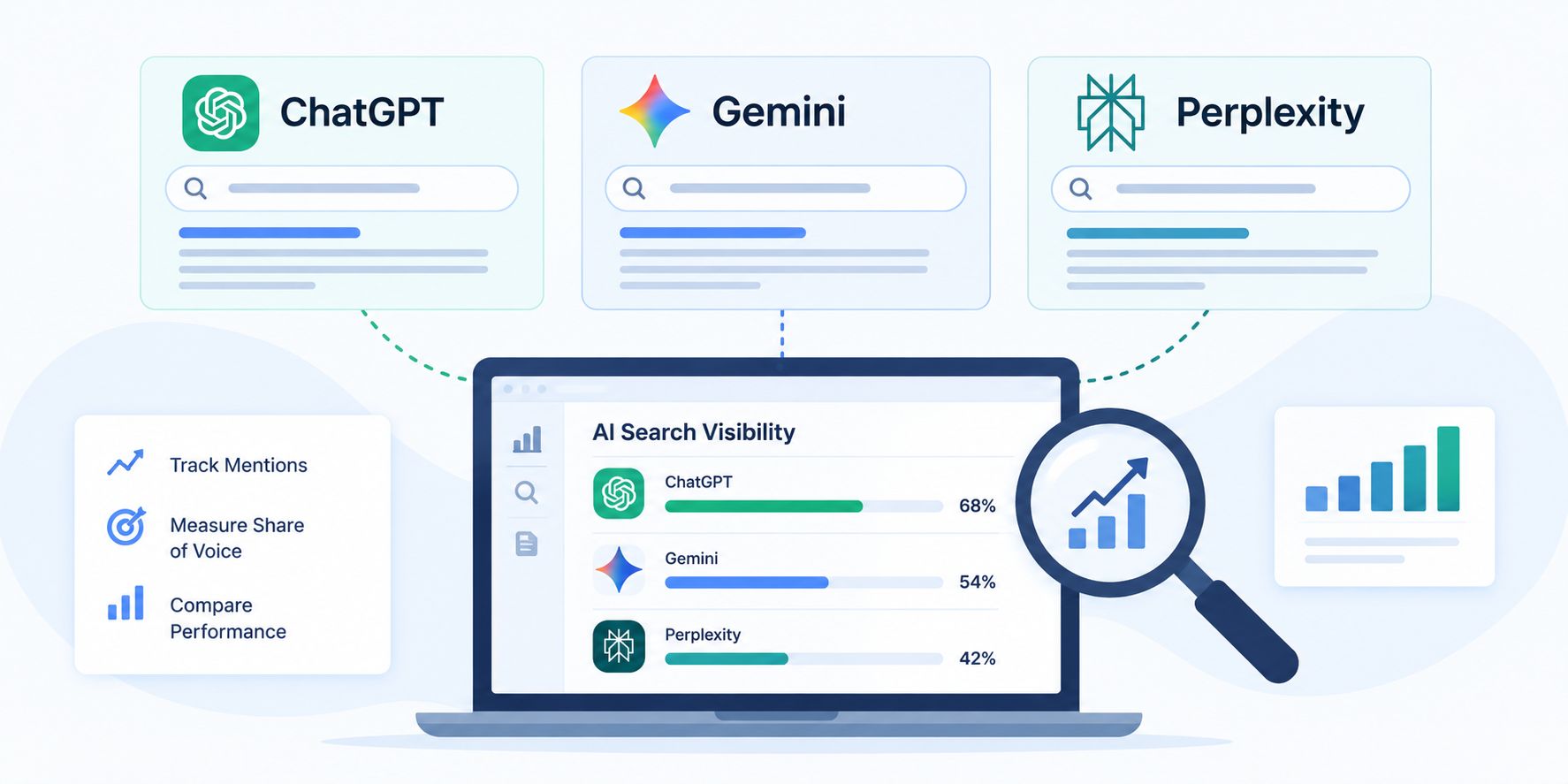
AI search visibility can be measured with a spreadsheet, a well chosen list of questions, and a few hours each month, long before you need specialized software. The catch is that AI answers change from one session to the next, so the goal is to track patterns over time rather than react to any single response.
This guide walks through a repeatable method that works for businesses of any size, whether you sell software, run a clinic, or manage an online store.
Why Is Measuring AI Answers Tricky?
Traditional rank tracking checks a fairly stable list of results. AI assistants generate fresh text every time, and the output can shift depending on wording, conversation history, location, and whether the tool searched the web before answering. Asking once and saving a screenshot tells you very little.
Reliable measurement depends on sampling. You ask a consistent set of prompts, repeat them, and look at averages. It works more like a customer survey than a thermometer reading.
Step 1: Build a Prompt Library That Mirrors Real Customers
Start with 30 to 60 prompts grouped by intent. Include category questions ("What are the best accounting tools for freelancers?"), problem questions ("How do I keep my basement dry during heavy rain?"), comparison questions that name you and a rival, and brand questions ("Is [your brand] a good fit for small teams?").
Pull the wording from real sources: sales call notes, support tickets, site search logs, and the questions people raise in reviews. Write prompts the way customers speak, in full sentences, because that is how people actually talk to these tools.
Aim for a balanced mix. If most prompts include your brand name, your results will look better than reality, since unbranded category questions are where new customers discover their options.
Step 2: Run the Prompts the Same Way Every Time
Consistency is what makes your data comparable from month to month. Open a fresh chat for each prompt so earlier questions do not influence the answer. Use the same account settings, switch off memory or personalization features where possible, and note your location.
Run each prompt two or three times per platform and record every result, including the ones where your brand is absent.
Step 3: Record Five Signals for Each Answer
For every response, log the following in your spreadsheet:
-
Mention: was your brand named?
-
Citation: was your website linked or listed as a source?
-
Position: were you named first, somewhere in the middle, or near the end?
-
Accuracy: were prices, features, locations, and other facts correct?
-
Sentiment: was the description positive, neutral, or negative?
Add one more column for competitors named in the same answer. Over a few months, this shows which brands the AI tools treat as leaders in your space.
Step 4: Calculate Your Share of Voice
Share of voice turns hundreds of scattered answers into one trackable number. Divide the number of answers that mention your brand by the total number of answers collected, then multiply by 100.
Here is a simple illustration. Fifty prompts, run three times on three platforms, produce 450 answers. If your brand appears in 72 of them, your share of voice is 16%. Calculate the same figure for each competitor and for each platform separately, since results often differ widely between tools.
Citation rate works the same way, using answers that link to your website instead of simple mentions.
How Do the Three Platforms Compare?
Each tool shows its sources differently, which affects what you can measure.
|
Platform |
How sources usually appear |
What to watch |
Referral domain in analytics |
|
ChatGPT |
Linked sources appear when it searches the web; answers from its built in knowledge may show no links |
Whether a web search is triggered, and how your brand is described either way |
chatgpt.com |
|
Gemini |
Draws on Google's ecosystem, with links shown in some answers |
Consistency with your Google Business Profile and website |
gemini.google.com |
|
Perplexity |
Numbered citations shown alongside most answers |
Which of your pages get cited and how often |
perplexity.ai |
Report results platform by platform before combining them. An average can hide the fact that you are strong in one tool and nearly invisible in another.
Step 5: Connect Visibility to Website Traffic
Mentions matter, but you also want to know whether they send visitors. In Google Analytics 4, create a custom channel group that captures referrals from domains such as chatgpt.com, perplexity.ai, gemini.google.com, and copilot.microsoft.com. Links clicked inside ChatGPT often carry a utm_source=chatgpt.com tag, which makes those visits easier to spot.
Keep in mind that some AI influence stays hidden. Clicks from Google's AI Overviews are reported as ordinary Google organic traffic. Many people also read an AI answer, then search your brand name later or type your address directly. Watching branded search volume and direct traffic alongside AI referrals gives a fuller picture.
Step 6: Set a Review Rhythm
Monthly tracking suits most businesses. Rerun the full prompt library, update share of voice by platform, and log any factual errors you find so they can be corrected at the source.
Each quarter, review the prompt list itself. Add new questions customers have started asking and retire the ones that have stopped mattering.
When the spreadsheet grows hard to manage, dedicated tracking tools can automate prompt runs at a larger scale. The method stays the same, and the manual stage teaches you what to look for. Treat AI search visibility as a trend line, and judge progress over three to six months rather than week to week.
Frequently Asked Questions
-
How many prompts are enough to start?
-
Thirty well chosen prompts give you a useful baseline. Larger brands with many product lines often track several hundred.
-
Why do I get different answers to the same prompt?
-
AI tools generate each response fresh and may pull from different sources each time. That variation is normal, which is exactly why repeated runs and averages matter.
-
Should Google AI Overviews be tracked too?
-
Yes, if Google is an important channel for your business. Run your prompt list as regular Google searches and record whether an AI Overview appears and whether it cites your site.
Conclusion
Measuring your presence in AI answers is less about perfect precision and more about disciplined repetition. A consistent prompt library, five simple signals, share of voice by platform, and a clear link to analytics will show you where you stand and whether your efforts are paying off. Build your first prompt list this week, run a baseline across ChatGPT, Gemini, and Perplexity, and you will have a solid starting point for improving AI search visibility in the months ahead.
About the Author
 Sanyukta Deb
— Sanyukta Deb is Digital Marketing Team Lead at Next Move Strategy Consulting, where she has led content strategy and technical SEO for the firm's B2B market research publications for over 2 years. Her editorial process translates NextMSC's primary and secondary research — spanning technology, industrial, and consumer sectors — into commercial narratives, backed by search-intent, keyword, and competitive analysis. She brings 5 years of overall experience in digital marketing and content strategy.
About the Reviewer
 Debashree Dey
— Debashree Dey is Assistant Manager at Next Move Strategy Consulting, where she supports cross-vertical market content and communications across diverse industries for 6 years. Her professional background includes senior content writing, communications, and published manuscript authorship, with experience developing audience-focused business narratives and maintaining clear, consistent messaging. Her role supports research-led content development and editorial quality across NextMSC publications.

















Add Comment