AI Agents Market By Agent Type (Reactive Agents, Limited Memory Agents, Adaptive Agents, Autonomous Agents, Hybrid Agents, Others), By Buyer Type (Large Enterprises, SMEs, Startups, Individual Users, Government & Public Institutions), By End-User Industry (BFSI, Healthcare & Life Sciences, Retail & E-commerce, Agriculture, Construction & Real Estate, IT & Telecom, Manufacturing & Logistics, Government & Defense, Media & Entertainment, Others), and Others – Global Analysis & Forecast, 2025–2035
Industry: ICT & Media | Publishing Date: September 12, 2026 | Last Updated: October 16, 2026 | No of Pages: N/A | No. of Tables: N/A | No. of Figures: N/A | Format: PDF | Report Code: IC4268
Industry Outlook
The global AI Agents Market size was valued at USD 13.30 billion in 2025, and is expected to be valued at USD 18.63 billion by the end of 2026. The industry is projected to grow, hitting USD 387.90 billion by 2035, with a CAGR of 40.12% between 2026 and 2035.
AI Agents Market Size & Forecast
|
Parameters |
Details |
|
Market Size in 2026 |
USD 18.63 Billion |
|
Revenue Forecast in 2035 |
USD 387.90 Billion |
|
Growth Rate |
CAGR of 40.12% from 2026 to 2035 |
|
Analysis Period |
2025–2035 |
|
Base Year Considered |
2025 |
|
Forecast Period |
2026–2035 |
|
Market Size Estimation |
Billion (USD) |
|
Companies Profiled |
20 |
|
Countries Covered |
33 |
|
Market Share |
Available for 10 companies |
According to NMSC’s primary research, the global AI agents market is witnessing strong growth, driven by advancements in generative AI, large language models (LLMs), and the transition from assistive to autonomous agents capable of independently planning, executing, and adapting workflows. Our evaluation of enterprise deployments across North America, Europe, and Asia-Pacific indicates that autonomous mobile robots (AMRs), articulated robots, and collaborative robots are increasingly deployed to optimize warehouse operations, improve throughput, and reduce manual intervention. Multi-agent orchestration platforms and software-first architectures are emerging as critical enablers, improving resilience, scalability, and performance across complex enterprise workflows.
Regionally, Asia-Pacific leads adoption due to government-backed automation initiatives, robust e-commerce infrastructure, and rising labour costs, while North America benefits from advanced fulfilment centres and high automation readiness. Europe emphasizes Industry 4.0 integration, human–robot collaboration, and regulatory compliance. Meanwhile, key market players, including Microsoft, Google Cloud, IBM, Amazon Web Services, Salesforce, ABB, KUKA, and others, compete through AI-enabled navigation, autonomous orchestration, and enterprise integration. Moreover, notable developments, such as Anthropic’s Claude Opus 4.6, OpenAI’s Frontier platform, and AWS’s AI agents marketplace, exemplify the industry’s emphasis on innovation, governance, and operational reliability. Overall, the market is evolving toward enterprise-grade, domain-specific, and software-centric AI platforms, where autonomy, explainability, and compliance are essential for sustainable adoption and measurable ROI.
What Are the Key Trends in the AI Agents Industry?
How is the Shift from Assistive AI to Autonomous AI Agents Reshaping the Market?
The AI agents market is undergoing a structural shift from assistive, prompt-based systems toward autonomous AI systems capable of independently planning, executing, and adapting workflows. We observed this transition fundamentally changing how enterprises define value, moving away from incremental productivity gains toward outcome ownership and end-to-end process automation. As autonomy increases, AI Agents are no longer confined to advisory roles but are increasingly embedded within operational decision loops across IT operations, customer service, finance, and supply chain management. From our evaluation of enterprise deployments over the past years, we noticed that autonomy has emerged as a key differentiator influencing vendor selection and budget allocation. However, we also noticed that higher autonomy raises concerns around accountability, error propagation, and organizational trust. As a result, buyers are simultaneously demanding stronger control mechanisms alongside autonomous capabilities. The market is therefore evolving toward hybrid operating models where humans supervise strategy and risk boundaries while agents execute continuously, reshaping both workforce design and software architecture expectations.
How are Multi-Agent Systems and Orchestration Platforms Redefining AI Agents Architectures?
We observed that enterprises increasingly decompose complex workflows into smaller, specialized agent roles, such as planning, execution, validation, and monitoring, managed at the system level rather than the individual agent level. This architectural shift improves resilience, scalability, and fault isolation in production environments. Based on our analysis of large enterprise implementations, we found that orchestration layers enable dynamic task reallocation and performance optimization across agents, particularly under fluctuating workloads. At the same time, this shift introduces new complexity, as orchestration becomes a critical layer that integrate policy enforcement, visibility, and error handling. Our research reviewing enterprise AI roadmaps shows that orchestration is now viewed as core infrastructure rather than an optional enhancement. However, we also found that interoperability challenges emerge when orchestration platforms coordinate agents from multiple vendors. As a result, demand is growing for standardized orchestration frameworks and clearer system-level governance, reinforcing orchestration as a central battleground in the AI Agents platform market.
Why are Domain-Specific AI Agents Gaining Preference Over General-Purpose Agents?
Domain-specific AI Agents are increasingly favoured over general-purpose agents as enterprises prioritize reliability, compliance, and contextual accuracy. We found that agents trained on industry-specific workflows, terminology, and data structures perform more consistently in production environments than generalized models. This trend is particularly evident in regulated sectors such as finance, healthcare, and legal services, where errors carry material risk. From our comparative assessments, domain-specific agents reduce the need for extensive customization and post-deployment tuning, accelerating time-to-value. While general-purpose agents remain valuable for exploratory and low-risk tasks, they struggle with nuanced decision-making when deployed at scale. Our analysis indicates that enterprises are shifting procurement criteria toward depth of expertise rather than breadth of capability. This preference reflects a broader maturation of the market, in which buyers are no longer experimenting but operationalising AI Agents. As specialization increases, we also observe that vendors investing heavily in vertical data partnerships and compliance alignment, signalling that domain expertise is becoming a durable competitive advantage rather than a short-term differentiator.
Why is AI Governance and Human-in-the-Loop Control Becoming Central to Adoption?
As AI Agents gain autonomy, governance and human-in-the-loop controls have become central to sustainable adoption. We observed that enterprises increasingly require transparency into agent decision-making, action histories, and escalation logic. Governance frameworks now play a critical role in building internal trust and regulatory confidence. From our evaluation of scaled deployments, we noticed that organizations that embedded governance early faced fewer adoption barriers and faster expansion. However, governance maturity varies widely, and standardized best practices are still evolving. Our findings indicate that governance is no longer a compliance afterthought but a core design requirement shaping product architecture and buying decisions. As autonomy increases, effective governance becomes a competitive differentiator for both vendors and adopters.
What Are the Key Market Drivers, Breakthroughs, And Investment Opportunities That Will Shape the AI Agents Market in the Next Decade?
Growth Catalyst & Risk Assessment Matrix
|
DRIVERS/TRENDS/ RESTRAINTS |
(+/-) % IMPACT ON CAGR FORECAST |
GEOGRAPHIC RELEVANCE |
IMPACT TIMELINE |
|
Rising enterprise demand for workflow automation and autonomous task execution across functions such as customer support, software development, operations, and finance |
+1.2% |
North America leads adoption; strong momentum in Europe and Asia Pacific enterprise markets |
Short to medium term (1–3 years) |
|
Advancements in large language models enabling multi-step reasoning, tool use, and agent orchestration (planning, memory, decision-making) |
+1.0% |
Global impact; strongest innovation hubs in the U.S., China, Europe, and South Korea |
Medium term (2–4 years) |
|
Integration of AI agents into core enterprise platforms such as ERP, CRM, ITSM, and cloud productivity suites, accelerating commercialization |
+0.9% |
North America and Europe dominate early deployments; rapid expansion in APAC enterprises |
Short to medium term (1–3 years) |
|
Growing adoption of domain-specific AI agents tailored for industries including healthcare, BFSI, retail, manufacturing, and software development |
+0.8% |
Global adoption; industry-led demand strongest in the U.S., Europe, Japan, and India |
Medium term (2–4 years) |
|
Concerns around data security, governance, reliability, and regulatory compliance limiting large-scale autonomous agent deployment |
-0.6% |
Global; regulatory pressure most pronounced in Europe and highly regulated industries |
Medium term (2–4 years) |
The AI agents market is experiencing strong growth, driven by rapid advancements in generative AI and large language models that have expanded agent autonomy, contextual reasoning, and enterprise usability. Our analysis indicates that improvements in LLM architectures, cost-efficient inference, and techniques such as retrieval-augmented generation have accelerated adoption across business-critical workflows. The rise of digital-first business models further supports market expansion, as organizations increasingly deploy AI agents to automate customer engagement, internal operations, and real-time decision-making within cloud-based environments. However, market growth is moderated by integration complexity and dependence on legacy enterprise systems, particularly in large organizations. Looking ahead, the development of vertical-specific AI agents presents a significant opportunity, enabling higher accuracy, faster adoption, and clearer return on investment across industry-focused use cases.
Growth Drivers:
How are Advancements in Generative AI and LLMs Boosting the AI Agents Market Demand?
Advancements in generative AI and large language models (LLMs) continue to be a core driver of the market, as they have expanded agent capabilities from basic automation to collaborative, multi-step reasoning and workflow execution. Our analysis shows that newer LLM architectures support contextual understanding, task decomposition, and natural language interaction, enabling AI agents to operate across complex enterprise processes. Recent LLM-powered agents, such as collaborative AI agents designed for enterprise co-work environments, illustrate how generative AI is expanding agent autonomy and task orchestration capabilities across knowledge-intensive workflows. From our assessment of enterprise adoption patterns, these capabilities have improved task efficiency, user engagement, and scalability compared to earlier rule-based systems. While governance and explainability challenges remain, the continued evolution of LLM performance, fine-tuning methods, and deployment efficiency is reinforcing enterprise confidence and driving sustained investment in AI Agents platforms.
How is the Growth of Digital-First Businesses Driving the Market?
The growth of digital-first businesses is a key driver accelerating adoption in the AI agents market, as these organizations rely heavily on scalable, software-driven operations. Based on our interviews with SaaS providers and e-commerce operators conducted under our primary research, we observed that AI agents are increasingly deployed to manage customer interactions, automate internal workflows, and support real-time decision-making across online channels. From our analysis of deployment patterns, digital-first companies favour AI agents because they can be rapidly integrated into cloud environments, CRM systems, and data platforms without heavy physical infrastructure. Our findings indicate that these businesses prioritize speed, personalization, and cost efficiency, all of which align with AI Agents' capabilities such as conversational interfaces, autonomous task execution, and continuous learning.
Growth Inhibitor:
How are High Integration Complexity and Legacy System Dependency Limiting the Market Growth?
A key restraint in the AI agents market expansion is the complexity involved in integrating AI agents with existing enterprise systems and legacy infrastructure. From our evaluation of enterprise deployment environments and feedback from IT and operations teams, we observed that many organizations operate fragmented technology stacks, including legacy ERP, CRM, and workflow systems that are not designed to support autonomous, API-driven agents. Our analysis indicates that significant customization, middleware development, and change management are required, increasing deployment timelines and costs. While AI Agents platforms are increasingly software-first, integration challenges delay realization of value and limit scalability. This restraint is particularly pronounced in large enterprises with deeply entrenched systems, where modernization cycles are slow and operational disruption carries high risk, ultimately moderating the pace of AI Agents adoption.
Growth Opportunity:
How is the Rise of Vertical-Specific AI Agents Creating Opportunities for the Market?
The rise of vertical- and role-specific AI agents represents a significant opportunity within the AI agents market, as enterprises increasingly seek solutions tailored to distinct functions and workflows. Our analysis indicates that function-specific agents deliver higher relevance, faster adoption, and clearer productivity gains compared to generalized platforms. The emergence of co-work-oriented AI agents demonstrate growing demand for role-specific agents that support knowledge-intensive workflows, including research, content creation, software development, and cross-functional collaboration. From our evaluation of enterprise use cases, we found that organisations favour agents that align closely with domain context, task structures, and user expectations, enabling more accurate outputs and smoother integration into daily operations. While development and customization efforts are higher, our findings suggest that role-focused AI agents allow vendors to differentiate offerings, improve customer stickiness, and unlock premium pricing opportunities, supporting long-term market expansion.
Regulatory Framework Impacting the AI Agents Industry
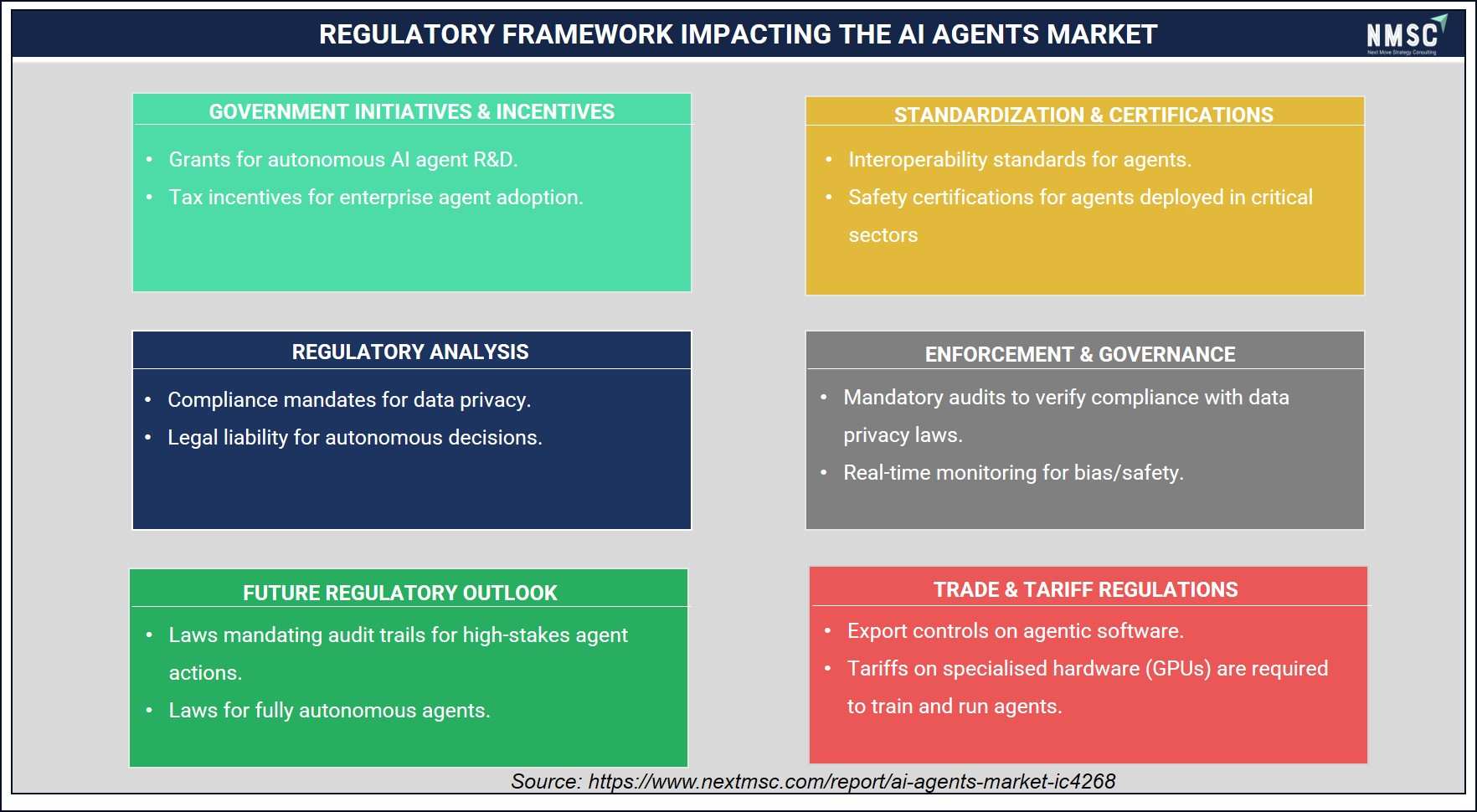
From the image, we observe that the regulatory framework is impacting the AI agents market demand. It highlights government initiatives, including R&D grants and tax incentives for adoption. Moreover, it addresses standardization needs like interoperability protocols and safety certifications. However, compliance challenges arise from mandates on data privacy, legal liability for autonomous decisions, and future laws requiring audit trails. The framework also covers enforcement through mandatory audits and real-time monitoring, plus trade regulations involving export controls on software and tariffs on specialised hardware like GPUs.
How Is the AI Agents Market Segmented in This Report, And What Are the Key Insights from the Segmentation Analysis?
Market Highlights & Strategic Insights – AI Agents Market:
|
Segments |
Key Takeaways |
|
Agent Type |
Limited Memory AI Agents currently dominate due to widespread use in intelligent virtual assistants and recommender systems across enterprises. Autonomous Agents and Hybrid Agents are expected to dominate in the future, driven by reinforcement learning, goal-based execution, and multi-agent orchestration in complex environments. |
|
Technology |
Generative AI-Based agents currently dominate the market, supported by rapid enterprise adoption of conversational and text-based agents. Hybrid architectures and Machine Learning-Based agents are expected to dominate as enterprises demand agents capable of optimization, simulation, and continuous learning. |
|
Deployment Mode |
Cloud-Hosted deployments dominate due to scalability and ease of integration. Hybrid deployments and multi-agent networks are expected to gain dominance as latency-sensitive, privacy-critical, and coordinated multi-agent use cases expand. |
|
Business Model |
Subscription-Based models currently lead due to predictable costs and continuous updates. Usage-Based models are expected to dominate as enterprises demand flexibility and pay-per-use pricing for dynamic agent workloads. |
|
Buyer Type |
Large Enterprises currently dominate adoption due to extensive resources and complex use cases. SMEs and Startups are expected to drive future growth as agent platforms become more accessible and affordable. |
By Technology Insights
Which AI Agent Technologies Drive Market Growth in 2025?
Based on our evaluation of AI agent deployments across various operational environments, the market is segmented into generative AI-based, machine learning-based, natural language processing-based, and other AI technologies.
Our analysis indicates that Generative AI-Based AI Agents dominate the market in 2025, driven by rapid adoption in content creation, scenario simulation, decision-support systems, and creativity-driven applications that rely on synthetic data generation. Machine Learning-Based AI Agents continue to hold a significant share, supporting contextual assistants, predictive recommender systems, and workflow-optimisation tools that enhance relevance and operational efficiency.
Furthermore, NLP-based AI Agents maintain steady demand in chatbots, customer support, and text analytics, where a precise understanding of language and context is essential. Other AI Technologies, while representing a smaller portion of the market, are experiencing emerging growth in niche areas such as hybrid intelligence systems, knowledge-graph reasoning, and specialised automation workflows, reflecting the market’s ongoing evolution toward more integrated and advanced AI capabilities.
By Deployment Mode Insights
Which Deployment Modes Drive AI Agents Market Growth in 2025?
Based on our evaluation of AI agent implementations across operational environments, the market is segmented into on-premises, cloud-hosted, hybrid, standalone applications, platform-integrated, and multi-agent network deployments.
Our analysis indicates that cloud-hosted AI Agents lead in market adoption in 2025, driven by scalability, ease of updates, and rapid integration with enterprise workflows. Hybrid deployments are also gaining momentum as organizations balance data security with the flexibility of cloud-based AI capabilities. Moreover, On-Premises AI Agents continue to see steady demand in highly regulated or sensitive environments where data privacy and control are dominant. Standalone Applications remain relevant for small-scale or task-specific AI implementations, offering quick deployment and minimal infrastructure requirements.
Meanwhile, we observed that platform-integrated AI Agents are increasingly leveraged within enterprise software ecosystems to enable seamless automation and workflow optimisation. Multi-Agent Networks, although still emerging, are showing accelerated growth in complex, orchestrated workflows, where coordinated decision-making across multiple agents drives higher operational efficiency and intelligence.

By Buyer Type Insights
How is AI Agents Adoption Distributed Across Buyer Types in 2025?
Based on our evaluation of AI agents deployments across enterprise and operational environments, the market is segmented into large enterprises, SMEs, startups, individual users, and government & public institutions.
Our analysis indicates that large enterprises drive the majority of AI Agents adoption in 2025, supported by significant investments in automation, workflow optimization, and integration with enterprise-wide digital ecosystems. SMEs are also showing strong adoption growth as scalable AI solutions and cloud-based offerings lower the barrier to entry and enable operational efficiency. Startups are leveraging AI Agents to accelerate product development, customer engagement, and innovative service offerings, contributing to a growing niche market segment.
Additionally, we noticed that individual users are gradually adopting AI Agents through personal assistants, productivity tools, and consumer-focused AI applications, reflecting broader mainstream awareness and accessibility. Meanwhile, government & public Institutions continue to maintain steady adoption, driven by priorities around security, compliance, and citizen services, with AI agents increasingly deployed for regulatory monitoring, digital governance, and public sector workflow optimization.

Regional Outlook:
Geographic Performance Snapshot:
|
Regions |
Key Takeaways |
|
North America |
Growth is driven by early adoption of AI agents for autonomous decision-making in retail, e-commerce, and manufacturing. Enterprises increasingly deploy AI for pricing optimisation, demand forecasting, and customer engagement, supported by robust digital infrastructure and favourable regulatory frameworks. |
|
Europe |
Market expansion is fueled by strong digital transformation initiatives, regulatory focus on data security, and adoption of AI agents across manufacturing and retail sectors. AI-powered solutions for inventory management, personalisation, and process optimisation are seeing rising demand. |
|
Asia-Pacific |
Rapid enterprise digitisation, rising e-commerce penetration, and government-backed AI strategies drive adoption. Companies in China, Japan, and South Korea are increasingly implementing AI agents for autonomous pricing, demand sensing, and customer journey orchestration. |
|
Middle East & Africa (MEA) |
Growth is supported by emerging digital transformation programs, investments in AI-driven enterprise solutions, and increased interest in automation for decision-making in finance, retail, and logistics. Awareness of AI agents is rising across key urban markets. |
|
Latin America (LATAM) |
Adoption is fueled by digitalisation initiatives, multinational enterprise expansion, and demand for AI-driven operational efficiency. AI agents are increasingly used for predictive analytics, personalised recommendations, and workflow automation. |
The AI agents market is geographically studied across North America, Europe, Asia Pacific, the Middle East & Africa and Latin America, and each region is further studied across countries.
AI Agents Market in North America
North America represents a mature, innovation-driven AI Agents region, where adoption spans enterprise automation, customer support agents, and productivity-focused AI platforms. Our interviews with IT leaders and AI product managers revealed that organizations prioritize autonomous software agents to handle repetitive knowledge work, support decision-making, and optimise customer interactions. Additionally, our observations indicate increasing deployment of generative AI-powered agents for research, data synthesis, and workflow management. In parallel, labour shortages and efficiency demand accelerate AI Agents integration across industries, from finance to healthcare. Nevertheless, regulatory scrutiny on data privacy and operational transparency shapes adoption strategies, encouraging vendors to focus on secure, explainable, and scalable AI Agents solutions.
AI Agents Market in the United States
In the United States, enterprise adoption of AI agents is primarily driven by the need to automate knowledge work, support research tasks, and streamline cross-functional operations. Our discussions with CTOs and AI team leads indicate widespread use of specialized agents for tasks such as document summarization, data extraction, and internal collaboration. Additionally, vendors are increasingly providing cloud-native, API-integrated agents that seamlessly fit into existing enterprise workflows, enabling scalable deployment. Nevertheless, organizations continue to face challenges in aligning agent outputs with corporate policies, highlighting the importance of explainable AI tools and robust monitoring dashboards for compliance and accountability.
AI Agents Market in Canada
Canada’s AI agents market shows steady growth, particularly in financial services, healthcare, and customer service domains. According to our interviews with enterprise AI managers, we noticed that adoption is focused on AI agents capable of automating repetitive knowledge work, internal research, and cross-departmental workflow orchestration. Additionally, cloud-based AI agent platforms are gaining traction due to their scalability and integration capabilities. The government’s AI ethics guidelines influence enterprise procurement decisions, favouring vendors with secure, explainable, and compliant agent frameworks.
AI Agents Market in Europe
Europe exhibits a regulation-driven and efficiency-oriented AI agents market. Our research further indicates that adoption patterns vary by region, Northern Europe emphasizes explainability and ethical AI frameworks, Southern Europe prioritizes flexible, cloud-deployable agents, and Central Europe integrates agents into enterprise resource planning and workflow systems. Additionally, sustainability and privacy compliance are key decision factors for buyers. Nevertheless, adoption remains uneven due to infrastructure differences and policy variations. By disclosing methodology and sample sizes, this report ensures transparency and provides reliable insights for decision-makers seeking trustworthy AI agents market intelligence.
AI Agents Market in the United Kingdom
The UK AI agents market is growing in enterprises focused on finance, healthcare, and professional services. Based on our discussions with AI implementation managers, we found a rising deployment of co-work-oriented agents for research, data aggregation, and cross-team task coordination. Additionally, organisations favour AI agents with natural language understanding and integration capabilities with existing enterprise tools. Regulatory frameworks on AI safety, transparency, and data privacy influence procurement strategies, favouring vendors with clear explainability features. Our research further highlights trends such as the shift from experimental pilots to enterprise-wide AI Agents deployment, increasing recurring revenue opportunities for providers offering SaaS-based agent solutions.
AI Agents Market in Germany
Germany’s AI agents market demonstrates a structured and innovation-driven approach, particularly in manufacturing, finance, and healthcare sectors. We at NMSC have observed that enterprises are increasingly deploying autonomous research agents, knowledge work assistants, and document automation solutions to enhance operational efficiency and decision-making. Moreover, vendors that provide certified AI models alongside secure integration support are gaining a competitive edge. In parallel, GDPR compliance, workflow transparency, and explainable AI dashboards remain decisive factors in adoption, ensuring organizations maintain trust and regulatory alignment. Our proprietary analysis shows that cross-departmental analytics and operational decision support are becoming key use cases, signalling growing reliance on AI agents to drive both productivity and strategic insights.
AI Agents Market in France
France’s AI agents market is expanding rapidly, with finance, pharmaceuticals, and retail sectors increasingly leveraging co-work agents for research, predictive analytics, and document summarization. Our research indicates that cloud-based platforms with robust integration APIs are preferred because they enable seamless interoperability with existing enterprise systems. In addition, ethical AI compliance, data governance, and multilingual capabilities are highly valued by enterprises, particularly those operating across multiple departments or regions. Adoption is further influenced by organizational AI readiness and local talent availability, which necessitates comprehensive onboarding and lifecycle support from vendors. Our observations highlight that selecting vendors who balance technical depth with practical deployment capabilities is critical for long-term success in France’s market.
AI Agents Market in Italy
AI Agents adoption in Italy is progressing across professional services, finance, and logistics, although regional differences in digital maturity and AI readiness remain significant. Our research conducted by NMSC indicate that urban financial and consulting firms lead deployment, while smaller regional organizations are less represented. SaaS-based AI agents are increasingly preferred for their flexibility, reduced infrastructure requirements, and ease of scaling. In addition, enterprises are prioritizing vendors that provide explainable AI, managed services, and integration support, as these features increase trustworthiness and operational reliability. Nevertheless, uneven digital infrastructure and fragmented AI readiness continue to influence adoption speed and overall market penetration. Our analysis underscores that vendors who combine technical capability with strong service support are achieving higher adoption rates, stronger recurring revenue, and deeper engagement in Italy’s evolving AI Agents ecosystem.
AI Agents Market in Spain
Spain is experiencing accelerating adoption of AI agents across finance, healthcare, and retail, driven by the need for improved research efficiency, customer interaction automation, and team task orchestration. Our observations reveal that energy-efficient cloud platforms and multilingual natural language capabilities are increasingly seen as differentiators for vendors. In addition, enterprises are investing in monitoring dashboards and explainable AI tools to ensure alignment with compliance and internal workflow standards. While price sensitivity and regional variations in digital infrastructure create differences in deployment speed and scale, companies that prioritise vendor collaboration and workflow integration achieve more effective outcomes. Furthermore, our analysis shows that AI agents are playing a growing role in supporting cross-departmental decision-making and strategic analytics. Overall, Spain’s AI agents market demonstrates a combination of rapid adoption, operational pragmatism, and selective vendor engagement.
AI Agents Market in the Nordics
The Nordic region, including Sweden, Finland, and Norway, represents a highly mature AI agents market characterised by advanced digital infrastructure, ethical AI awareness, and organisational trust in autonomous systems. We observed extensive adoption of co-work agents for research, analytics, and cross-functional task support, particularly in large enterprises with structured AI strategies. Vendors offering explainable AI, lifecycle monitoring, and seamless integration with enterprise systems secure high-value contracts and recurring revenue streams. In addition, strong regulatory alignment, operational transparency, and organisational readiness further drive adoption, ensuring that AI agents are both reliable and compliant. Our analysis further highlights that companies leveraging advanced AI agents in this region achieve both operational efficiency and strategic insights, creating a robust ecosystem for continued AI innovation.
AI Agents Market in the Asia-Pacific
The Asia-Pacific region has emerged as the largest and fastest-growing market for AI Agents, driven by rapid digital transformation, expansion of e-commerce, and increased adoption of intelligent enterprise solutions across China, Japan, South Korea, and Southeast Asia. Based on our analysis of deployment trends, we observed that adoption patterns differ significantly by country. China emphasizes domestic platforms and cost-effective solutions, Japan focuses on reliability and precision, South Korea leads in early adoption of cutting-edge technologies, and Southeast Asia is scaling rapidly in multi-department automation. Moreover, government initiatives promoting automation and digitalisation, along with robust IT infrastructure, have accelerated adoption. Enterprises increasingly rely on AI agents to streamline internal research, optimise knowledge work, and support cross-departmental decision-making. Our findings further suggest that vendors delivering integrated, adaptable, and secure AI Agents platforms achieve greater scalability and long-term engagement.
AI Agents Market in China
China has become a global leader in AI Agents adoption, with enterprises prioritizing scalable, cost-efficient, and locally supported platforms. Based on our observations, AI agents are widely deployed in finance, e-commerce, and manufacturing enterprises to automate knowledge work, document processing, and workflow orchestration. Domestic software providers are shaping standards for integration, data security, and lifecycle management, enabling faster innovation and deployment cycles. Moreover, successful international vendors tailor solutions to local requirements, ensuring compliance with regulations and alignment with enterprise IT ecosystems. We found that companies focusing on explainable AI, multilingual capabilities, and seamless cross-department integration achieve higher adoption rates. Consequently, operational efficiency, cost-effectiveness, and secure deployment remain the main drivers of growth, while enterprises increasingly demand AI agents that support analytics, predictive insights, and collaboration across business units.
AI Agents Market in Japan
Based on our research in Japan, we found that the AI agents market exhibits steady, structurally driven growth, largely influenced by labour shortages, an ageing workforce, and high expectations for operational precision. Enterprises prioritise AI agents that enhance knowledge work, automate research and reporting, and improve cross-team collaboration. Reliability, robust data handling, and long-term vendor support are more decisive than short-term cost considerations, while brand reputation and local service presence significantly impact procurement. Moreover, vendors delivering highly accurate, explainable, and secure AI platforms with polished user interfaces achieve stronger market positioning. Although adoption is consistent rather than rapid, the emphasis on operational reliability and regulatory compliance ensures sustainable deployment. Our insights indicate that premium, technically sound AI Agent solutions, seamlessly integrated into existing enterprise workflows, achieve the highest success in Japan’s mature market.
AI Agents Market in India
India is an emerging AI agents market marked by rapid digital adoption, growing enterprise automation needs, and pressure to optimize workforce productivity. We observed that organisations initially implement AI agents for internal research, document summarisation, and workflow automation, while more advanced applications, such as predictive analytics and knowledge orchestration, are gaining traction. Cost efficiency, modular deployment, and ease of integration with existing enterprise systems are critical factors for adoption. Moreover, local IT infrastructure and workforce readiness influence deployment pace. Vendors that prioritize scalable, multilingual, and secure AI Agent platforms achieve faster adoption, especially when offering integration support and flexible commercial models. Our analysis further highlights that enterprises in India increasingly rely on AI agents to enhance decision-making, improve operational efficiency, and support collaboration across departments, making cost-effective yet reliable platforms essential for sustained growth.
AI Agents Market in South Korea
South Korea represents a highly advanced AI agents market, characterised by rapid adoption of intelligent automation and high organisational readiness. Based on our observations, we observed that enterprises are deploying AI agents for cross-functional knowledge management, document automation, predictive analytics, and workflow orchestration. Domestic software providers have created integrated ecosystems that enable faster adoption and customisation. Moreover, strategic partnerships between AI vendors and local technology providers accelerate deployment and improve operational alignment. We found that enterprises prioritise explainable AI, robust security, and real-time analytics when selecting platforms. Vendors offering scalable, reliable, and adaptable AI Agents solutions achieve premium positioning and deeper engagement. As a result, South Korea exemplifies a technology-forward market where AI agents are used not only for efficiency gains but also to enhance strategic decision-making across business units.
AI Agents Market in Taiwan
Based on our interviews with enterprise technology and digital transformation teams, we found that Taiwan demonstrates a strong affinity for AI Agents adoption, supported by digitally mature organisations and a well-established technology ecosystem. We observed increasing deployment of AI agents for internal research, knowledge work assistance, document automation, and cross-department workflow coordination. Reliability, seamless integration with existing enterprise systems, and secure data handling consistently emerge as primary adoption criteria. Pilot deployments are frequently used to validate ROI and refine implementation strategies before broader rollout. Moreover, vendors offering multilingual, explainable, and highly customizable AI Agent platforms achieve faster scaling and stronger enterprise acceptance. Our analysis further indicates that Taiwan’s enterprises are leveraging AI agents not only to streamline day-to-day operations but also to enable predictive insights, analytics, and deeper collaboration, allowing early adopters to unlock both efficiency gains and long-term strategic value.
AI Agents Market in Indonesia
Indonesia’s AI agents market remains in an early but rapidly growing stage, fuelled by increasing digital adoption and the need to improve enterprise efficiency. Based on our assessment, we found that AI agents are being deployed primarily for document processing, knowledge management, and workflow automation, particularly in e-commerce and service sectors. Cost-effectiveness, ease of deployment, and localised integration support are critical factors for adoption. Moreover, phased implementation and pilot programs allow organisations to evaluate ROI and optimise workflows before scaling. We observed that vendors offering modular, secure, and adaptable AI Agent platforms are achieving faster uptake. While the market is still maturing, enterprises that align platform capabilities with operational needs and workforce readiness are realising tangible efficiency improvements and improved collaboration across departments.
AI Agents Market in Australia
Australia represents a market with significant investment in AI Agents technology, where enterprises emphasize operational resilience, efficiency, and strategic insight. Based on our observations, adoption spans finance, retail, and logistics sectors, with AI agents increasingly used for knowledge work automation, predictive analytics, and cross-department collaboration. High labour costs and geographically dispersed operations drive demand for platforms that are scalable, secure, and easy to integrate. Vendors providing bundled solutions with analytics, workflow management, and lifecycle support achieve higher adoption and recurring engagement. Moreover, organisations favour platforms that deliver measurable efficiency gains, enhance collaboration, and provide actionable insights. Our analysis indicates that enterprises deploying AI agents strategically across multiple departments achieve both operational efficiency and better-informed decision-making.
AI Agents Market in Latin America
Latin America is an emerging but rapidly growing market for AI agents, with enterprises prioritising cost-effective solutions for workflow automation, knowledge management, and document processing. We observed that adoption is particularly strong in e-commerce, finance, and logistics sectors, where operational efficiency and internal productivity are key drivers. Price sensitivity influences vendor selection, making modular deployment, flexible licensing, and phased implementation important. Moreover, enterprises increasingly value explainable AI, secure data handling, and integration with existing systems. Vendors that balance affordability with functionality and reliability achieve stronger engagement. Our evaluation further shows that pragmatic deployment strategies, local support, and flexible commercial models are critical for long-term adoption and sustained value creation in Latin America’s market.
AI Agents Market in the Middle East & Africa
The Middle East represents a high-value AI agents market, where enterprises increasingly invest in premium solutions for knowledge work automation, document intelligence, and predictive analytics. Based on our interviews with enterprise digital leaders and system integrators, we observed that organizations across Gulf countries place strong emphasis on explainable AI, secure integration with core enterprise systems, and consistently high performance. In contrast, Africa remains an emerging market, where early adoption is shaped by affordability, scalability, and the need to operate within developing digital infrastructure.
Our discussions with regional stakeholders indicate that modular deployment models, simplified onboarding, and dependable local support are decisive factors in Africa. Vendors that adapt their strategies accordingly, offering integrator-led, enterprise-grade platforms in the Middle East and flexible, service-oriented AI Agents solutions in Africa, achieve stronger adoption and more sustainable growth. Overall, our analysis underscores the importance of aligning AI Agents' capabilities with region-specific operational and maturity requirements.
SWOT Analysis of the AI Agents Market
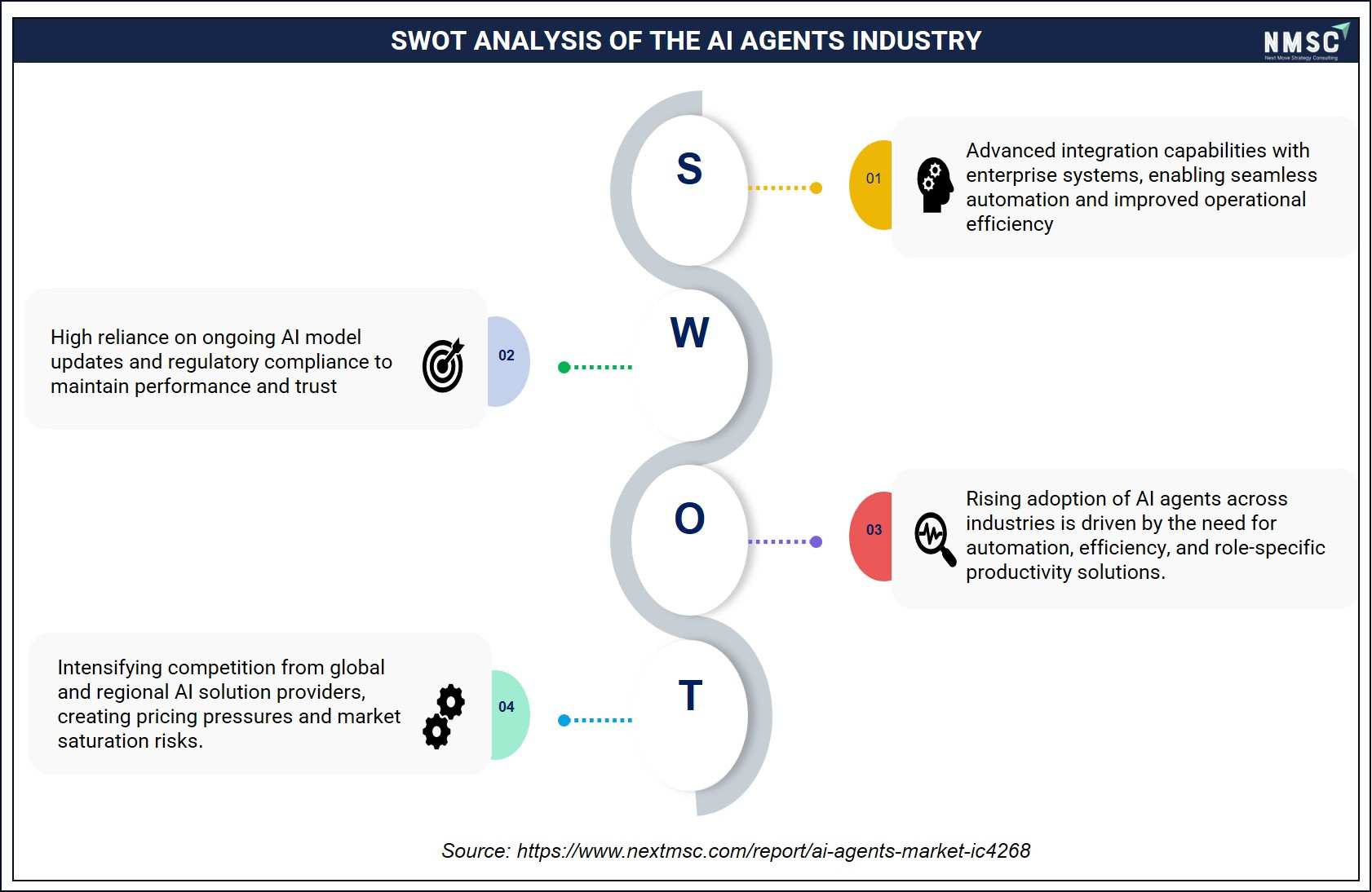
From the above chart, we assess that the SWOT analysis of the AI Agents industry, is highlighting key strengths, weaknesses, opportunities, and threats. Among strengths, AI agents offer advanced integration with enterprise systems, enhancing automation and operational efficiency. A noticeable weakness is the high dependence on continuous AI model updates and regulatory compliance to maintain performance and trust. Opportunities are driven by the growing adoption of AI agents across industries, fuelled by the demand for automation, efficiency, and role-specific productivity solutions. However, the market faces threats from intensifying competition among global and regional AI providers, creating pricing pressures and risks of market saturation.
R&D Shift Toward Enterprise-Grade, Regulated AI Agents Platforms
In the R&D landscape of the AI agents market, we are seeing a decisive move away from narrowly scoped automation toward role-aware, collaborative AI agents designed for complex and regulated enterprise environments. Our analysis indicates that research efforts now prioritize agents capable of sustained reasoning, contextual continuity, and structured collaboration across workflows. A relevant example is the integration of Claude-powered AI agents within Salesforce’s Agentforce 360 platform for regulated industries. In this context, AI agents support financial advisors by summarizing complex portfolio data, monitoring regulatory updates, and automating consent and client outreach processes, demonstrating how advanced agents are being embedded directly into mission-critical knowledge workflows.
Moreover, R&D investments increasingly focus on explainability, governance, and controlled autonomy, reflecting enterprise requirements for compliance and risk management. The Salesforce-Anthropic collaboration highlights how AI Agents development is aligning with regulatory expectations by emphasizing transparent reasoning, auditable outputs, and secure system integration. Rather than operating as standalone tools, these agents augment human decision-making while maintaining clear oversight. We believe this trajectory underscores the broader evolution of the AI agents market toward software-centric, enterprise-grade platforms, where trust, adaptability, and governance are as critical as raw intelligence for achieving scalable and sustainable adoption.
Competitive Landscape
Competitive Dynamics & M&A Landscape:
|
Key Takeaways |
|
The global AI agents market is shaped by a mix of established technology giants, including Microsoft, Google Cloud, IBM, Amazon Web Services, Salesforce, and Accenture, alongside rapidly growing AI specialists such as OpenAI, Anthropic, ADEPT, duvo.ai, Artisan AI, Alta, Uniphore, Maisa, Aisera, Sendbird, Cognigy, and Zendesk. Large incumbents leverage extensive cloud infrastructure, enterprise software ecosystems, and broad service networks, while emerging players focus on advanced AI models, natural language understanding, multimodal interactions, and rapid deployment of agent solutions. |
|
Vendor strategies increasingly emphasize software-defined AI platforms, autonomous agent orchestration, real-time analytics, and seamless integration with CRM, ERP, and customer support systems. Interoperability, modular platform design, and scalable deployment across enterprises have become key differentiators, especially for organizations managing complex operations and large-scale customer interactions. |
|
Recent partnerships, acquisitions, and collaborations highlight a trend toward acquiring cutting-edge AI models, conversational intelligence, automation frameworks, and integration expertise rather than merely expanding service portfolios. This approach accelerates innovation, enhances agent intelligence, and strengthens end-to-end automation capabilities, supporting recurring revenue streams and long-term competitiveness in the global AI agents market. |
Which Companies Dominate the AI Agents Market and How do they Compete?
Based on our analysis, the AI agents market share is dominated by established technology leaders alongside fast-scaling AI specialists. Microsoft, Google Cloud, IBM, Amazon Web Services, Salesforce, and Accenture consistently lead large-scale enterprise deployments where reliability, security compliance, and seamless integration with existing IT and business workflows are critical decision factors. From our deployment assessments, we found that these vendors are frequently chosen for complex, multi-system environments requiring integration with CRM, ERP, and customer service platforms.
Emerging AI-focused players, including OpenAI, Anthropic, ADEPT, duvo.ai, Artisan AI, Alta, Uniphore, Maisa, Aisera, Sendbird, Cognigy, and Zendesk, strengthen their market positions by delivering advanced natural language processing, multimodal interaction capabilities, and rapid deployment models for customer engagement and operational automation. Competition at this level is primarily driven by platform intelligence, flexibility, cloud scalability, and the ability to orchestrate AI agents across enterprise ecosystems, enabling businesses to enhance productivity, improve customer experiences, and maintain competitive advantage.
Market Dominated by AI Agents Giants and Specialists
Our analysis shows that established technology leaders shape the AI agents market alongside rapidly growing AI specialists. Microsoft, Google Cloud, IBM, Amazon Web Services, Salesforce, and Accenture set enterprise standards through robust cloud infrastructure, scalable agent orchestration, and integration with CRM, ERP, and customer service platforms. Emerging AI-focused companies, including OpenAI, Anthropic, ADEPT, UiPath, duvo.ai, Artisan AI, Alta, Uniphore, Maisa, Aisera, Sendbird, Cognigy, and Zendesk, gained traction by delivering advanced conversational AI, multimodal interaction capabilities, and rapid deployment models that minimize operational disruption. OpenAI, Anthropic, and ADEPT were frequently highlighted for cutting-edge language understanding and reasoning, while UiPath, Cognigy, and Zendesk were preferred for workflow automation and customer engagement solutions. Together, technology giants and specialists accelerate AI Agents adoption across industries by combining platform reliability, integration expertise, and software-driven innovation.
Innovation and Adaptability Drive Market Success
From our assessments of deployments and pilot programs across enterprises, customer service operations, and digital workflows, we observed that innovation remains a key driver of competitive advantage in the AI agents market. We found that leading companies, including Microsoft, Google Cloud, IBM, Amazon Web Services, Salesforce, and Accenture, advanced capabilities in AI-driven perception, autonomous agent orchestration, and real-time analytics, enabling AI agents to adapt dynamically to evolving customer interactions, fluctuating workloads, and complex enterprise processes. From our analysis, we noticed that vendors investing in modular software architectures, natural language understanding, workflow automation, and real-time optimization are consistently better positioned to scale across multi-site deployments. These innovations demonstrate deep expertise in AI modelling, cloud infrastructure, and enterprise systems integration, allowing providers to respond efficiently to changing business requirements and sustain long-term customer engagement.
Market Players to Opt for Merger & Acquisition Strategies to Expand their Presence
Based on our research, we observed that mergers and acquisitions are a critical growth strategy in the AI agents market, as companies seek faster access to emerging AI technologies and broader solution portfolios. We noticed that leading players increasingly target firms specializing in advanced language models, conversational AI, workflow automation, and agent orchestration to strengthen end-to-end enterprise solutions. Rather than focusing solely on scale, our analysis shows that acquisition strategies prioritize accelerated innovation cycles, tighter integration with CRM, ERP, and customer support platforms, and expansion into high-growth sectors such as e-commerce, finance, and healthcare. We found that these strategic moves help vendors reduce deployment complexity, enhance platform interoperability, and improve return on investment for enterprise clients, while reinforcing their global execution capabilities and long-term competitive positioning.
Strategic Framework of the AI Agents Market
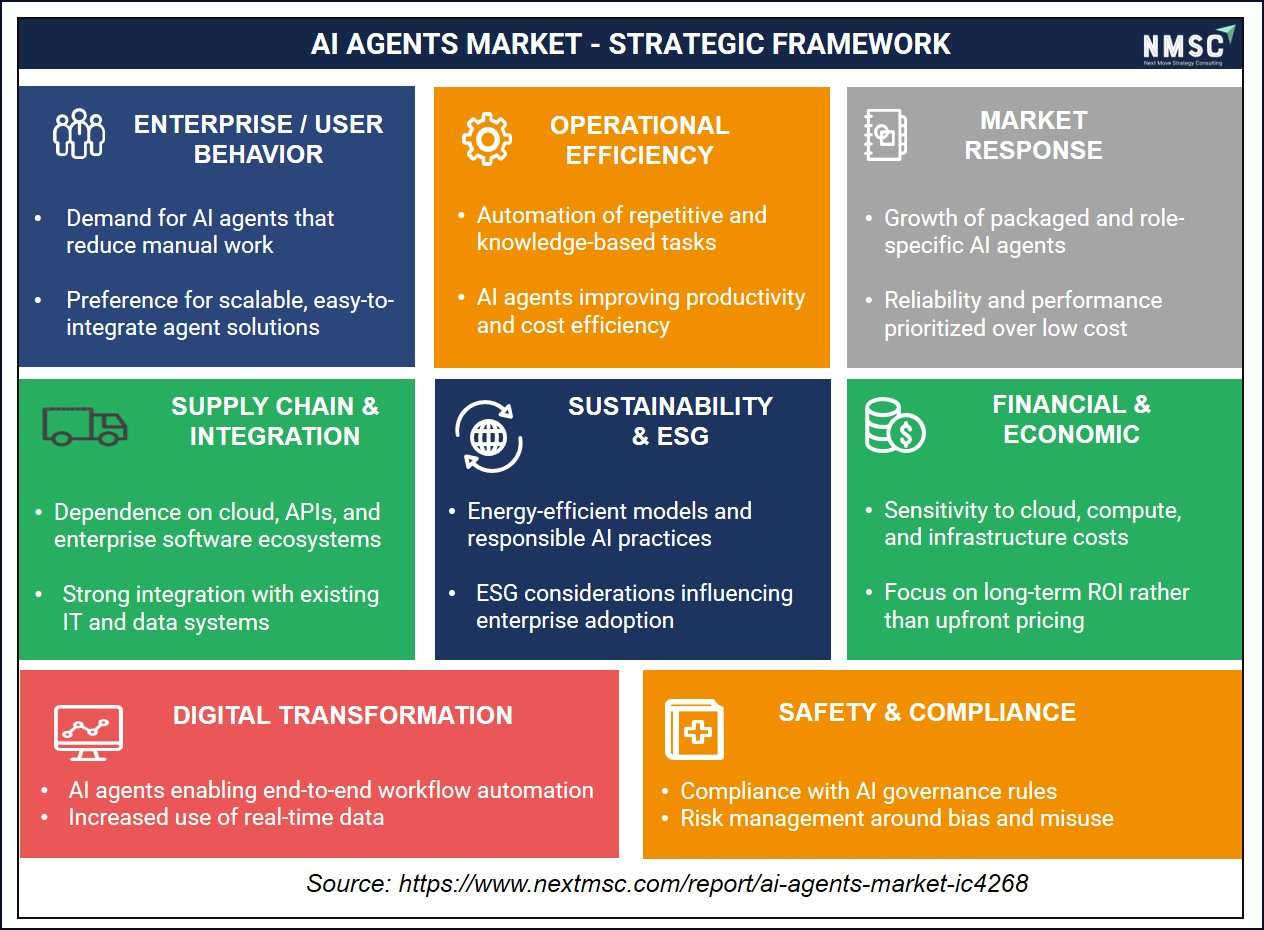
The image presents a strategic framework for the AI Agents Market, highlighting the key factors influencing adoption and growth. We found that the enterprise/user Behaviour drives demand for AI agents that reduce manual work, while also favouring solutions that are scalable and easy to integrate. Operational Efficiency focuses on automating repetitive tasks and improving productivity, which in turn enhances cost efficiency. Market Response emphasizes the rise of role-specific agents, however, reliability and performance are prioritized over low cost. Additionally, Supply Chain & Integration and Financial & Economic factors underscore cloud dependence, infrastructure costs, and long-term ROI. Furthermore, Sustainability & ESG, Digital Transformation, and Safety & Compliance highlight energy-efficient models, workflow automation, and risk management, creating a comprehensive approach to AI Agents deployment.
List of Key AI Agents Companies
-
OpenAI, Inc.
-
Anthropic PBC
-
ADEPT
-
UiPath
-
Salesforce, Inc
-
Alibaba Cloud
-
duvo.ai
-
Artisan AI
-
Alta
-
Maisa
-
Microsoft
-
Google Cloud (Google)
-
IBM
-
Aisera
-
Sendbird, Inc.
-
Amazon Web Services, Inc.
-
Cognigy
-
Zendesk
Expert Insights
 “AI agents are beginning to function like junior employees”
— Sam Altman (CEO) of OpenAI, Inc.
What Are The Latest Key Industry Developments?
-
February 2026 - Anthropic released Claude Opus 4.6, boosting autonomous task performance and coding ability, including using agents via Claude Code. This release has helped drive enterprise interest but also sparked broader market reactions.
-
February 2026 - OpenAI launched Frontier, a new enterprise platform for building, deploying, and managing AI agents that work as AI co‑workers across business systems and workflows.
-
July 2025 - AWS launched an AI Agents Marketplace, designed to be a distribution hub for third‑party and partner‑built autonomous agents, with Anthropic among initial partners.
What Are The Key Factors Influencing Investment Analysis & Opportunities In the AI Agents Market?
Investment analysis in the AI agents market is increasingly influenced by capital shifting toward platform-centric, software-led, and service-oriented business models rather than point-solution AI tools. Based on our assessment of recent funding activity, acquisitions, and strategic alliances, we observed that investors consistently favour vendors with predictable, recurring revenue streams derived from subscription-based AI Agents platforms, usage-based APIs, and enterprise service contracts. Companies demonstrating strong orchestration capabilities, proprietary reasoning or decision-making frameworks, and seamless integration with enterprise systems such as ERP, CRM, and data platforms tend to command higher valuations. Our interviews with corporate investors further indicate that scalability across multiple enterprise functions, such as research, customer support, operations, and analytics, is a critical determinant of long-term investment attractiveness.
We also identified growing investment concentration around AI agents enabling autonomous decision support, workflow automation, and real-time intelligence across complex business environments. According to discussions with strategic investors and enterprise buyers, we noticed that solutions addressing productivity gaps, knowledge fragmentation, and cross-functional coordination present the strongest commercialization potential. Strategic investments increasingly outweigh purely financial funding, as cloud providers, enterprise software vendors, and consulting firms seek ecosystem control and faster go-to-market execution. From an investment perspective, the most attractive opportunities lie in AI Agents vendors that combine technical differentiation with enterprise-grade governance, proven deployment outcomes, and extensible platforms capable of supporting evolving use cases over time.
Key Benefits for Stakeholders:
Next Move Strategy Consulting (NMSC) delivers a comprehensive assessment of the AI Agents market trends, tracking its evolution from 2020 to 2025 and providing forward-looking forecasts through 2035. The analysis evaluates the market at global, regional, and country levels, combining quantitative outlooks with qualitative insights into adoption drivers, deployment challenges, regulatory considerations, technology evolution, and investment patterns across major AI Agents use cases. From our standpoint, the study is designed to support strategic decision-making by offering clear visibility into how AI agents are reshaping enterprise workflows, decision intelligence, and digital operating models across industries.
From our analysis, the AI agents market creates tangible value for a wide range of stakeholders. Investors benefit from predictable, recurring revenue models driven by subscription-based platforms, usage-based pricing, and enterprise service contracts. Enterprises gain productivity improvements, faster decision-making, and cost efficiencies through AI agents supporting research, customer engagement, operations, and analytics. Technology vendors, system integrators, and consulting partners benefit from long-term implementation engagements, platform customization, and continuous optimization services. By enabling scalable, intelligent automation aligned with enterprise objectives, AI agents deliver sustained value while supporting digital transformation and long-term business resilience.
|
Parameters |
Details |
|
Customization Scope |
Free customization (equivalent to up to 80 analyst-working hours) after purchase. Addition or alteration to country, regional & segment scope. |
|
Pricing and Purchase Options |
Avail customized purchase options to meet your exact research needs. |
|
Approach |
In-depth primary and secondary research; proprietary databases; rigorous quality control and validation measures. |
|
Analytical Tools |
Porter's Five Forces, SWOT, value chain, and Harvey ball analysis to assess competitive intensity, stakeholder roles, and relative impact of key factors. |
Key Market Segments
By Agent Type
-
Reactive Agents
-
Limited Memory Agents
-
Adaptive Agents
-
Autonomous Agents
-
Hybrid Agents
-
Others
By Functional Domain
-
Customer Experience
-
Virtual Assistants & Chatbots
-
Support Automation
-
Personalization Engines
-
-
Enterprise Operations
-
Workflow Automation
-
Decision Support Systems
-
Process Optimization Agents
-
-
Commercial Optimization
-
Pricing & Revenue Management
-
Promotion & Campaign Optimization
-
Inventory & Supply Chain Optimization
-
-
Research & Development
-
Data Analytics & Insights Agents
-
Simulation & Scenario Planning
-
-
Other Functions
By Technology
-
Generative AI-Based
-
Machine Learning-Based
-
Natural Language Processing-Based
-
Others
By Deployment Mode
-
On-Premises
-
Cloud-Hosted
-
Hybrid
-
Standalone Applications
-
Platform-Integrated
-
Multi-Agent Networks
By Business Model
-
Subscription-Based
-
Perpetual Licensing
-
Usage-Based
-
Professional Services
By Buyer Type
-
Large Enterprises
-
SMEs
-
Startups
-
Individual Users
-
Government & Public Institutions
By End-User Industry
-
BFSI
-
Healthcare & Life Sciences
-
Retail & E-commerce
-
Agriculture
-
Construction & Real Estate
-
IT & Telecom
-
Manufacturing & Logistics
-
Government & Defense
-
Media & Entertainment
-
Education & EdTech
-
Energy & Utilities
-
Mining & Metals
-
Travel & Hospitality
-
Automotive & Transportation
-
Others
Geographical Breakdown
-
North America: U.S., Canada, and Mexico.
-
Europe: UK, Germany, France, Italy, Spain, Sweden, Denmark, Finland, the Netherlands, and the Rest of Europe.
-
Asia Pacific: China, India, Japan, South Korea, Taiwan, Indonesia, Vietnam, Australia, Philippines, Malaysia and the rest of APAC.
-
Middle East & Africa (MEA): Saudi Arabia, UAE, Egypt, Israel, Turkey, Nigeria, South Africa, and the rest of MEA.
-
Latin America: Brazil, Argentina, Chile, Colombia, and the rest of LATAM.
Conclusion & Recommendations
Our report enables stakeholders, industry participants, investors, and advisors to act decisively amid the structural transformation underway in the AI agents market. By integrating data-driven market assessment with proven strategic frameworks, we at Next Move Strategy Consulting (NMSC) position this study as a practical decision-support tool for navigating a rapidly evolving enterprise AI landscape. Based on our analysis, the AI agents market is set for sustained expansion, driven by rising enterprise complexity, pressure to improve decision speed, and growing demand for scalable, software-led automation. Increasing emphasis on platform-centric AI agents, secure orchestration layers, and seamless integration with enterprise systems such as ERP, CRM, and analytics platforms continues to reshape competitive positioning. Vendors that emphasized modular architectures, explainable intelligence, and flexible deployment models demonstrated stronger enterprise trust and long-term engagement.
From our perspective, executives and investors unlock value by prioritizing high-growth AI Agents applications such as knowledge work automation, decision support, customer engagement, and cross-functional workflow orchestration. Moreover, sustained investment in R&D, interoperability, and ecosystem partnerships is critical to maintaining differentiation as adoption scales. We observed that expanding presence in digitally mature and fast-transforming regions across Asia-Pacific and other emerging enterprise hubs creates access to new demand pools. At the same time, consistent performance, data security, and measurable business impact significantly enhance vendor credibility. When aligned with enterprise objectives, AI agents deliver durable value while accelerating digital transformation across the global AI Agents ecosystem.


About the Author
 Tushmi Dutta
— Tushmi Dutta is a focused researcher specializing in detailed analysis and insight-driven research across diverse business landscapes. She supports strategic initiatives through structured data interpretation, thorough validation, and clear communication of findings that aid informed decision-making. With a strong interest in writing, she enjoys presenting research insights in an engaging and accessible manner. Beyond work, she enjoys traveling, reading, painting, and continuously learning new skills that contribute to her creative and professional growth.
Tushmi Dutta
— Tushmi Dutta is a focused researcher specializing in detailed analysis and insight-driven research across diverse business landscapes. She supports strategic initiatives through structured data interpretation, thorough validation, and clear communication of findings that aid informed decision-making. With a strong interest in writing, she enjoys presenting research insights in an engaging and accessible manner. Beyond work, she enjoys traveling, reading, painting, and continuously learning new skills that contribute to her creative and professional growth.
About the Reviewer
 Supradip Baul
— Supradip Baul is an accomplished business consultant and strategist with over a decade of rich experience in market intelligence, strategy, technology, and business transformation. His work has included rigorous qualitative and quantitative analysis across multiple industries, helping clients shape investment decisions and long-term roadmaps. Earlier in his career, he was associated with Gartner, where he contributed to industry-leading reports and market share analyses. He has worked with leading global companies and holds an MBA with a dual specialization in Marketing and Finance.
Supradip Baul
— Supradip Baul is an accomplished business consultant and strategist with over a decade of rich experience in market intelligence, strategy, technology, and business transformation. His work has included rigorous qualitative and quantitative analysis across multiple industries, helping clients shape investment decisions and long-term roadmaps. Earlier in his career, he was associated with Gartner, where he contributed to industry-leading reports and market share analyses. He has worked with leading global companies and holds an MBA with a dual specialization in Marketing and Finance.
At Next Move Strategy Consulting, we understand that insightful market research is the cornerstone of successful business decisions. That's why we employ a robust and multifaceted approach, combining various methodologies to deliver the most accurate and actionable data for our clients.

Research Landscape
We navigate the world of research with two primary approaches:
Qualitative Approach
Our qualitative research methodologies involve immersive techniques such as in-depth interviews, focus groups, and observational studies. By engaging directly with individuals and stakeholders, we uncover valuable insights that quantitative data alone may overlook.

Quantitative Research
In tandem with qualitative methodologies, NMSC leverages the power of Quantitative Research to provide a robust foundation of numerical insights. Through systematic data collection and analysis, we quantify patterns, preferences, and market trends, offering a comprehensive view of the business landscape.
Our quantitative research approach employs diverse tools, including surveys, experiments, and statistical modelling. These methodologies enable us to gather data from a large and representative sample, ensuring the statistical significance of our findings. By employing structured questionnaires and standardized data collection methods, we guarantee the reliability and validity of the information we present to our clients.
Quantitative research is particularly effective in measuring the prevalence of trends, assessing market size, and gauging the impact of various factors on consumer behavior. The numerical precision attained through this approach equips our clients with actionable insights, facilitating data-driven decision-making and strategy formulation.


Our Specialized Toolbox for Industry-Specific Market Research
We deploy a specialized arsenal of techniques tailored to meet your unique requirements. Here's a glimpse into our comprehensive toolbox:

Information Procurement
The stage entails acquiring market data or relevant information through various sources and methodologies.


Market Research Approach
We utilize both top-down and bottom-up approaches in market research analysis to achieve a comprehensive understanding of the market dynamics, leveraging the broad perspective of industry trends and macroeconomic factors alongside detailed insights from specific segments and individual companies.

Porters Five Forces Analysis
We conduct Porter's Five Forces analysis to evaluate the competitive landscape of an industry, providing us with insights into factors that affect profitability and strategic positioning.

SWOT Analysis

Forecasting
We utilize a forecasting model to predict future consumption by considering parameters like population, economics, regulations, market competition, drivers, constraints, technology, and pricing. We also employ statistical techniques such as multilinear regression, exponential smoothing, moving average, ARIMA, and Monte Carlo simulations for accurate predictions. In econometric forecasting, we analyzed short-term and long-term event impacts, attributing values based on regulatory frameworks, economic factors, and market events.





 Speak to Our Analyst