Is Sensor Fusion Becoming the Core of Modern Defense Strategy in 2026?

The global defense ecosystem is entering a decisive transformation phase. Military agencies are no longer focused solely on developing advanced standalone sensors. The priority has shifted toward integrating diverse sensing technologies into cohesive, decision-enabling systems.
Two major developments between 2025 and 2026 clearly demonstrate this shift:
The United States Department of the Air Force launching comprehensive Ringleader exercises. India’s Paras Anti-Drone Technologies advancing multimodal sensor fusion for future warfare. Together, these initiatives signal structural evolution in how modern defense forces approach situational awareness, targeting, and response.
Why Is the U.S. Air Force Accelerating Sensor Fusion Through Ringleader?
In February 2026, the Department of the Air Force announced a new series of exercises known as “Ringleader” during the Warfare Symposium. Secretary of the Air Force Troy Meink stated that the focus has shifted from developing advanced weapon system sensors to closing the kill chain by fusing diverse data streams and executing operations effectively. The Ringleader initiative is designed to integrate air, ground, and space-based military sensors into a unified operational framework. It also incorporates intelligence community inputs and evaluates how commercial data sources can support military operations. The exercises leverage the evolving DAF Battle Network, which forms a critical part of the broader Combined Joint All Domain Command and Control effort. A significant financial indicator reinforces the seriousness of this initiative. Prior budget requests reflected a shift in funding allocations, including a $1 billion budget for Ground Moving Target Indicator applications in fiscal year 2026. This allocation reflects tangible institutional commitment to advanced sensing and data integration capabilities.
Space Force General Michael Guetlein indicated that establishing a robust command and control network is a priority, with interceptor integration targeted for the following summer. Chief of Space Operations General Chance Saltzman further emphasized that Ringleader aims to collect and analyze data on a global scale, translating it rapidly into actionable battle management decisions.
How Is India Advancing Multi-Sensor Fusion for Counter-Drone Warfare?
In November 2025, Paras Anti-Drone Technologies, a subsidiary of Paras Defence and Space Technologies, outlined its strategy for building advanced multi-sensor fusion systems to meet evolving security demands. CEO Ashutosh Baheti explained that multi-layer autonomy involves combining radar systems, electro-optics, and other detection technologies to identify drones, including those that operate without emitting radio signals. When drones function without radio communication, electronic warfare systems alone cannot detect them. Multimodal sensor fusion therefore creates a comprehensive detection environment capable of handling increasingly sophisticated threats. The company distinguishes between soft-kill and hard-kill countermeasures. Soft kill includes jamming and spoofing, while hard kill involves physical destruction through interceptors, lasers, or microwaves. Jamming operations can be conducted from two to three kilometres away, whereas precision physical engagement at that distance is extremely difficult. This makes soft-kill systems more cost-efficient for many operational scenarios. Paras Anti-Drone Technologies also reported that imported components constitute approximately 20–30% of its systems, with plans to further indigenise production. This reflects both current supply realities and strategic intent to strengthen domestic manufacturing capability.
What Structural Patterns Are Emerging in the Sensor Fusion Market?
When comparing developments in the United States and India, several structural themes become visible. First, both approaches prioritize integration across multiple domains. The U.S. initiative combines military, intelligence, and commercial data, while the Indian system integrates radar, electro-optics, and electronic warfare inputs. Second, both emphasize decision speed. Ringleader aims to translate global-scale data into actionable commands rapidly, while Paras focuses on immediate detection and response to drone threats. Third, funding allocations validate strategic seriousness. The $1 billion GMTI allocation for fiscal year 2026 and the Rs 46-crore Ministry of Defence order received by Paras signal concrete institutional backing.
The Evolution of Multi-Sensor Fusion in Defense and Future Warfare
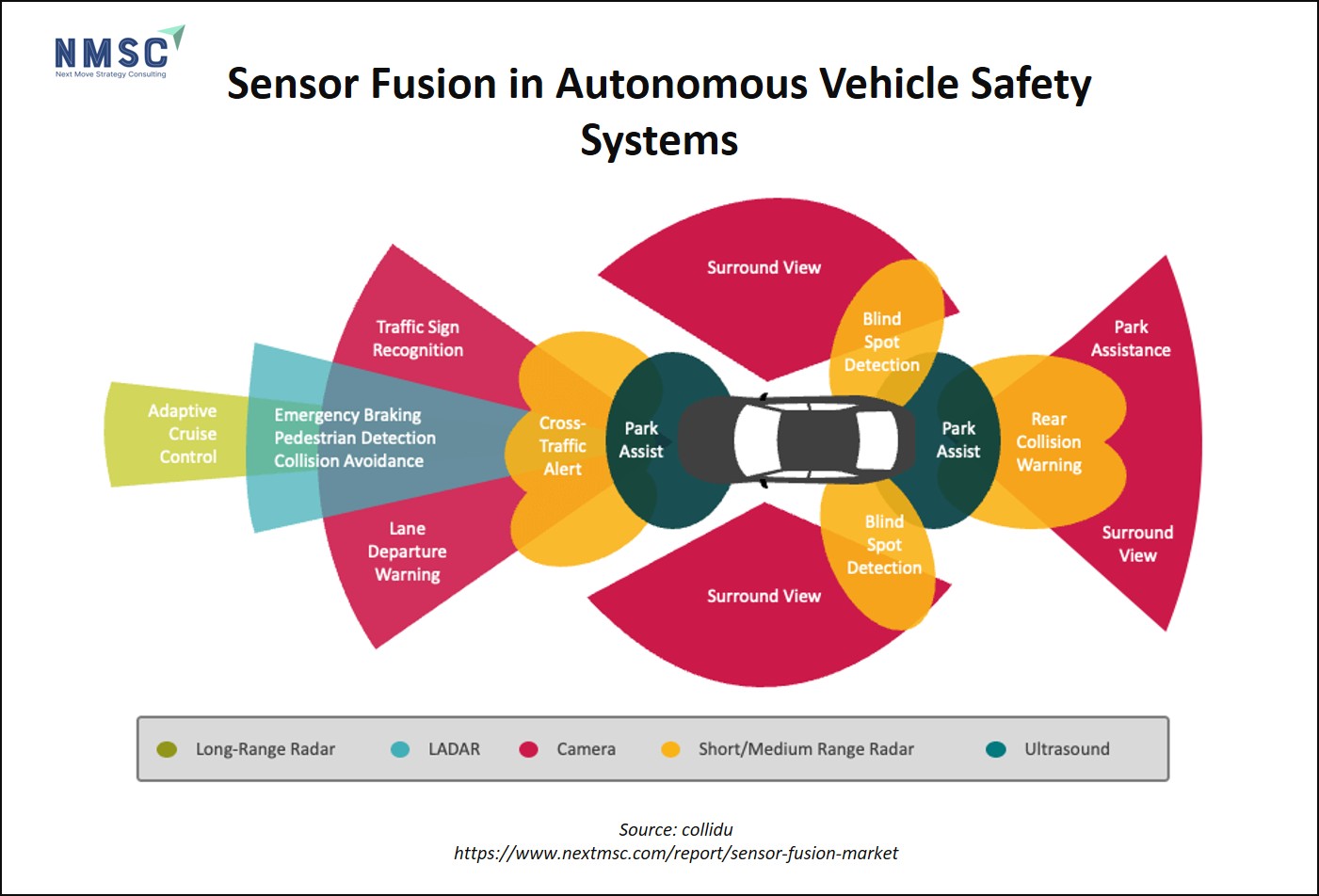
Beyond the automotive sector, the concept of sensor fusion is becoming a cornerstone of national security and military modernization. According to reports from the Department of the Air Force and industry leaders like Paras Anti-Drone, the focus is shifting toward "comprehensive sensor fusion experiments" to maintain a competitive edge. In the context of future warfare and anti-drone systems, relying on a single detection method is no longer sufficient against sophisticated threats. Advanced multi-sensor fusion systems integrate RF (radio frequency) detectors, electro-optical sensors, and thermal imaging to identify, track, and neutralize targets with high precision. These systems are designed to process massive amounts of data in real-time, allowing for faster decision-making on the battlefield. Whether it is a car navigating a busy intersection or an anti-drone system protecting a military installation, the goal remains the same: combining multiple sensory inputs to create a singular, accurate, and actionable "truth" of the surrounding environment.
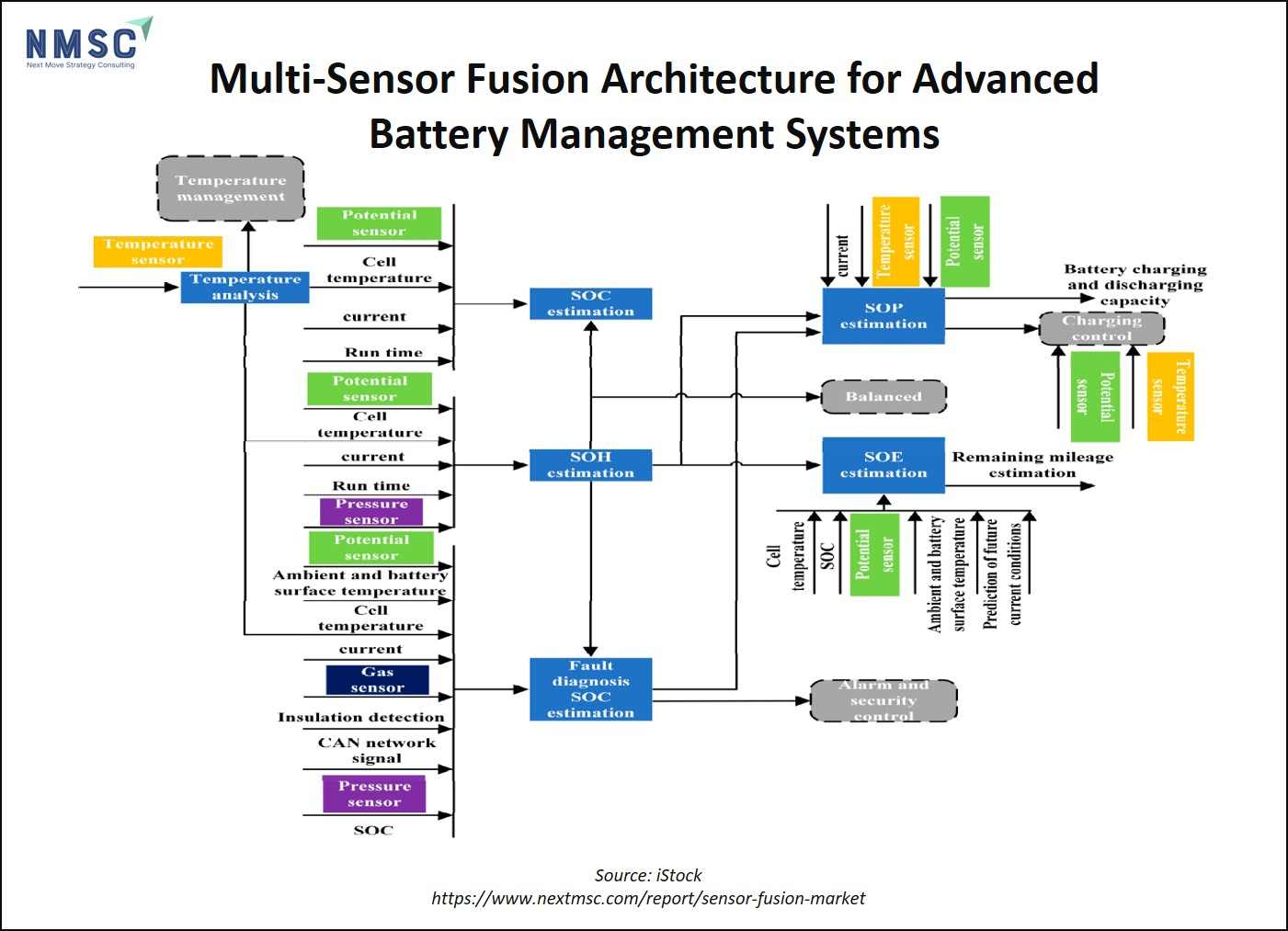
Integrated Data Flow and Estimation Logic in Sensor Fusion Systems
Data flows vertically from physical sensing layers into analytical modules, where temperature management and pressure analysis feed into SOC and SOH estimation blocks. These estimations interact with SOP and SOE modules to determine charging control strategies, battery balancing, and remaining driving range calculations. Simultaneously, fault diagnosis modules assess irregularities and activate alarm and security controls to prevent system failure. The architecture emphasizes layered autonomy, where each estimation module operates both independently and collaboratively, ensuring redundancy and resilience. This mirrors contemporary multi-sensor fusion strategies observed in defense systems, where integration across multiple sensing domains strengthens situational awareness and accelerates actionable decision-making. The image therefore represents a practical application of multimodal sensor fusion, demonstrating how integrated analytics transform fragmented data into reliable operational intelligence within complex technical ecosystems.
Is Integration the Core Differentiator?
From an Experience, Expertise, Authoritativeness, and Trust standpoint, the developments observed in 2025–2026 reveal a consistent pattern. Operational validation has replaced laboratory experimentation. Structured exercises such as Ringleader demonstrate real-world stress testing of integrated networks. Meanwhile, multi-layer autonomy in India reflects practical deployment in response to active security challenges.
Budget commitments reinforce credibility. A $1 billion allocation for GMTI in fiscal year 2026 represents a measurable commitment rather than aspirational planning. Similarly, documented Ministry of Defence orders indicate tangible procurement activity. The evidence suggests that sensor fusion is transitioning into a foundational layer of command and control systems. Integration capability, rather than sensor quantity, is becoming the defining differentiator.
Leading Companies Strengthening Their Position in the Sensor Fusion Industry
Key players operating in the sensor fusion industry include Analog Devices Inc., NXP Semiconductors, Renesas Electronics Corporation, Bosch Sensortec GmbH, InvenSense Inc., Infineon Technologies AG, STMicroelectronics, Asahi Kasei Microdevices, BASELABS, Maxim Integrated, TDK Corporation, ROHM Co., Ltd., Ceva, Inc., NVIDIA Corporation, and Murata Manufacturing Co., Ltd., among others. These companies are actively implementing strategic initiatives, including new product introductions and technological advancements, to strengthen their competitive positioning and sustain long-term dominance within the industry.
Next Steps for Industry Stakeholders
-
Invest in interoperable architectures that integrate air, ground, space, and commercial data streams.
-
Develop multimodal detection systems capable of identifying non-radio-emitting threats.
-
Align research and development strategies with structured government funding allocations such as GMTI programs.
-
Reduce dependency on imported components by strengthening domestic deep-technology manufacturing capabilities.
-
Build scalable fusion engines that prioritize speed and real-time decision translation.
Is the Sensor Fusion Market Reaching Institutional Maturity?
The coordinated efforts by the Department of the Air Force and Paras Anti-Drone Technologies suggest that the sensor fusion market is no longer defined by experimental prototypes. It is now characterized by operational exercises, structured funding commitments, and real-world deployment strategies.
The emphasis on global-scale data integration, multi-layer autonomy, and rapid decision translation reflects a maturation process shaped by national security imperatives. The defining question for the coming years will not be how many sensors are deployed, but how effectively they are integrated into unified operational networks.6
Next Move Strategy Consulting’s View
From a strategic standpoint, Next Move Strategy Consulting observes that the sensor fusion market is entering a structurally validated growth phase driven by defense-led integration programs in 2025–2026. The structured Ringleader exercises initiated by the Department of the Air Force and the advancement of multi-layer autonomy systems by Paras Anti-Drone Technologies indicate that sensor fusion is evolving from a technology enabler into a core command-and-control architecture. Budget-backed initiatives, including the $1 billion allocation for Ground Moving Target Indicator in fiscal year 2026 and documented Ministry of Defence procurements, reinforce that integration, speed, and multi-domain interoperability are becoming central to defense modernization strategies. The firm concludes that future competitive differentiation will depend on scalable data fusion engines capable of translating multi-sensor inputs into rapid, operationally actionable intelligence.
Overall Conclusion:
The sensor fusion market in 2026 is demonstrating measurable institutional commitment, operational validation, and funding-backed growth. Integration has become the strategic core of modern defense intelligence systems.
About the Author
 Sanyukta Deb
— Sanyukta Deb is Digital Marketing Team Lead at Next Move Strategy Consulting, where she has led content strategy and technical SEO for the firm's B2B market research publications for over 2 years. Her editorial process translates NextMSC's primary and secondary research — spanning technology, industrial, and consumer sectors — into commercial narratives, backed by search-intent, keyword, and competitive analysis. She brings 5 years of overall experience in digital marketing and content strategy.
Sanyukta Deb
— Sanyukta Deb is Digital Marketing Team Lead at Next Move Strategy Consulting, where she has led content strategy and technical SEO for the firm's B2B market research publications for over 2 years. Her editorial process translates NextMSC's primary and secondary research — spanning technology, industrial, and consumer sectors — into commercial narratives, backed by search-intent, keyword, and competitive analysis. She brings 5 years of overall experience in digital marketing and content strategy.
About the Reviewer
 Debashree Dey
— Debashree Dey is Assistant Manager at Next Move Strategy Consulting, where she supports cross-vertical market content and communications across diverse industries for 6 years. Her professional background includes senior content writing, communications, and published manuscript authorship, with experience developing audience-focused business narratives and maintaining clear, consistent messaging. Her role supports research-led content development and editorial quality across NextMSC publications.
Debashree Dey
— Debashree Dey is Assistant Manager at Next Move Strategy Consulting, where she supports cross-vertical market content and communications across diverse industries for 6 years. Her professional background includes senior content writing, communications, and published manuscript authorship, with experience developing audience-focused business narratives and maintaining clear, consistent messaging. Her role supports research-led content development and editorial quality across NextMSC publications.
















Add Comment