Is Sovereign Cloud the Future of Secure Digital Growth?

As businesses accelerate digital transformation, many are asking a critical question: how can they use cloud technology without losing control of sensitive data? The answer increasingly lies in sovereign cloud.
A sovereign cloud is a cloud environment designed to ensure that data remains within a specific country or region while meeting local legal, regulatory, and security requirements. It combines the scalability of modern cloud platforms with the assurance that organizations retain jurisdictional control over their information.
Recent developments from SAP, Cohere, and Financial Software & Systems (FSS) show that Sovereign Cloud Market is no longer a niche concept. It is becoming a core strategy for enterprises, governments, and regulated industries seeking both innovation and trust.
Why Are Traditional Cloud Models Being Reassessed?
For many years, organizations often had to choose between the innovation of public cloud services and the control of on-premise infrastructure. That trade-off is becoming increasingly difficult to accept, especially in sectors where data sensitivity is high.
According to SAP Canada, many organizations need advanced AI capabilities while maintaining absolute control over critical data. Its partnership with Cohere was designed to meet this need by integrating enterprise AI tools into a secure Canadian-operated cloud environment.
This reflects a broader market shift. Businesses are no longer asking only how fast they can migrate to the cloud. They are asking whether their cloud environment aligns with national regulations, sector standards, and long-term governance needs.

How Is Artificial Intelligence Driving Demand?
Artificial intelligence depends on trusted data, secure infrastructure, and scalable computing resources. Without these foundations, many enterprise AI projects face delays or governance concerns.
SAP reported that 71% of organizations rely on data for investment decisions, while 75% identify incomplete data as a significant challenge. Embedding AI directly into enterprise systems where trusted data already exists can help solve this problem.
This is where sovereign cloud creates value. Instead of moving sensitive data across multiple environments, organizations can run advanced AI capabilities inside a controlled regional infrastructure. That reduces complexity while strengthening oversight.
Why Sovereign Cloud Is Accelerating in 2026
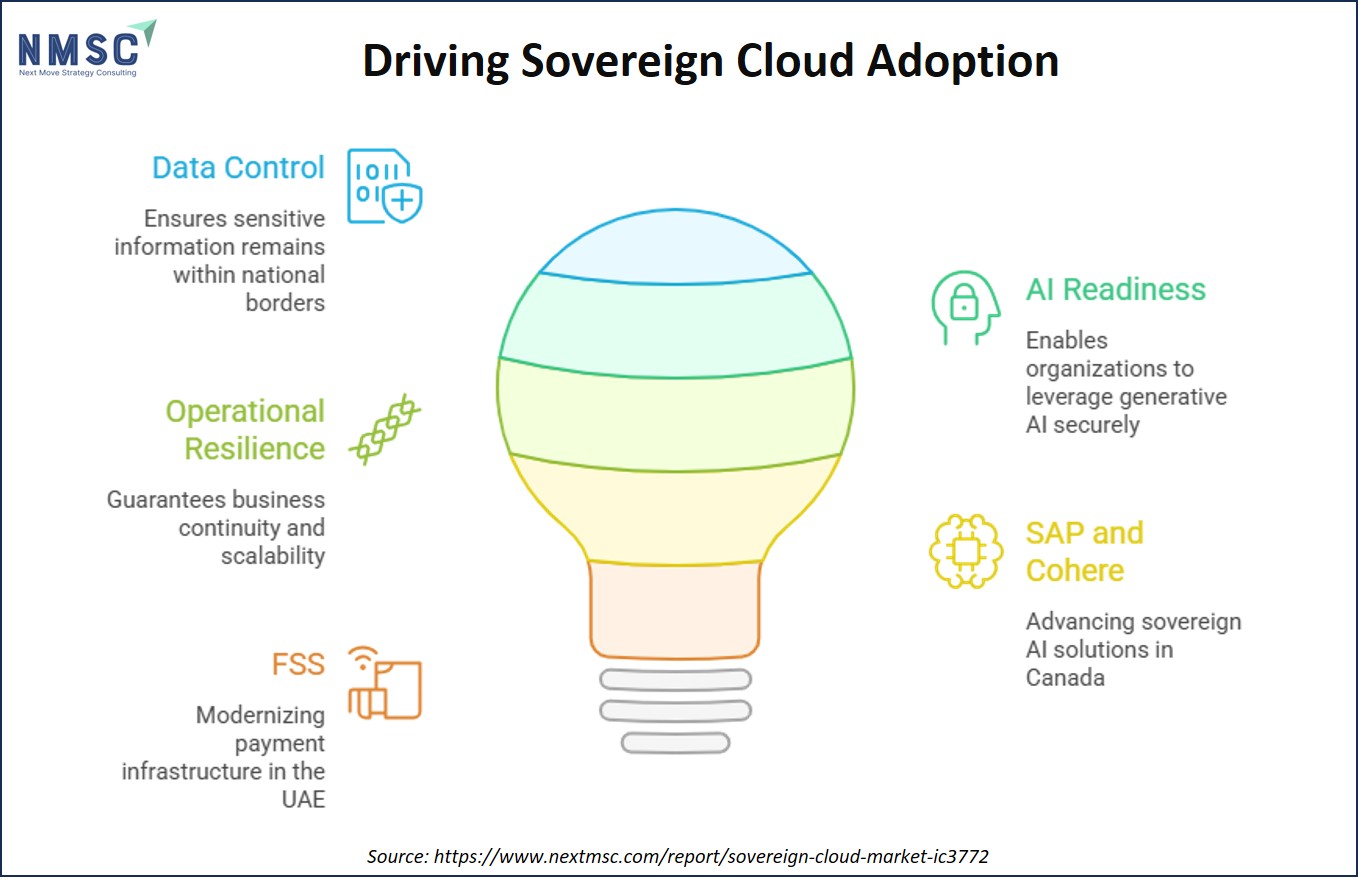
The latest market developments show that sovereign cloud is being driven by three connected priorities: data control, artificial intelligence readiness, and operational resilience. In Canada, SAP and Cohere are advancing sovereign AI solutions that allow organizations to use generative AI while keeping sensitive information secure within national borders. In the Middle East, FSS has modernized payment infrastructure through a sovereign private cloud hosted entirely within the UAE, improving scalability and continuity. Together, these examples highlight how businesses now view sovereign cloud as more than a compliance model. It is becoming a growth strategy built on trust, performance, and secure innovation.
Industry Adoption Snapshot
|
Industry |
Primary Use Case |
Key Benefit |
|
Public Sector |
Citizen data management |
Higher trust and compliance |
|
Financial Services |
Payment processing platforms |
Resilience and local data hosting |
|
Healthcare |
Sensitive records management |
Stronger privacy controls |
|
Manufacturing |
Smart operations and analytics |
Secure modernization |
|
Critical Infrastructure |
Essential service operations |
Operational continuity |
How Is the Financial Sector Responding?
The financial sector provides one of the clearest examples of why sovereign cloud matters. Payment systems must process growing transaction volumes while maintaining uptime, resilience, and regulatory compliance.
FSS recently completed a major transformation across the Middle East by migrating mission-critical customer platforms to a sovereign private cloud hosted entirely within the UAE. The environment uses geo-redundant facilities in Dubai and Abu Dhabi, helping ensure business continuity and stronger performance.
This initiative demonstrates that sovereign cloud is not only about where data is stored. It is equally about building resilient systems that can support always-on digital services.
Major Trends Shaping the Present
-
Sovereign AI Is Emerging as a New Standard: Organizations increasingly want AI services delivered inside environments that meet national data requirements. The SAP and Cohere collaboration highlights how AI and sovereignty are becoming interconnected priorities.
-
Regulated Industries Are Leading Adoption: Government agencies, financial institutions, and critical infrastructure providers are among the earliest adopters because their compliance obligations are more demanding.
-
Regional Infrastructure Is Expanding: Demand for local data centers, domestic operations, and in-country disaster recovery capabilities is rising as businesses seek stronger control.
-
Performance Is Becoming a Core Priority: Modern sovereign cloud strategies focus not only on regulation, but also on uptime, speed, resilience, and scalability.
Why Sovereign Cloud Matters in 2026
|
Key Indicator |
Insight |
|
71% |
Organizations rely on data for investment decisions |
|
75% |
Report incomplete data as a challenge |
|
Canada |
Sovereign AI rollout begins |
|
UAE |
Dual-site payment cloud deployment completed |
What Should Organizations Consider Before Adoption?
Businesses evaluating sovereign cloud should look beyond data location alone. The operating model, resilience framework, and readiness for future workloads are equally important.
Leaders should assess where data will be processed, who manages the infrastructure, how disaster recovery is structured, and whether artificial intelligence workloads can run securely in that environment.
A successful strategy depends on aligning technology decisions with both regulatory requirements and long-term growth goals.
Key Drivers of Sovereign Cloud Adoption
The pie chart highlights that Data Control is the leading factor driving sovereign cloud adoption, accounting for 28% of the total share. This reflects the growing need for organizations to keep sensitive information within national borders and maintain full governance over digital assets. Compliance follows with 24%, showing how regulatory requirements and data residency laws are influencing cloud decisions across industries.
Security represents 20%, emphasizing the importance of protecting critical systems and confidential data from cyber risks. Meanwhile, Scalability contributes 16%, indicating that businesses also value the ability to expand operations efficiently without infrastructure limitations. Finally, AI Readiness accounts for 12%, highlighting the increasing demand for secure cloud environments that can support advanced analytics and artificial intelligence workloads. Overall, the chart shows that trust, regulation, and operational growth are the main forces shaping sovereign cloud adoption.

What Is Driving and Challenging Sovereign Cloud Growth?
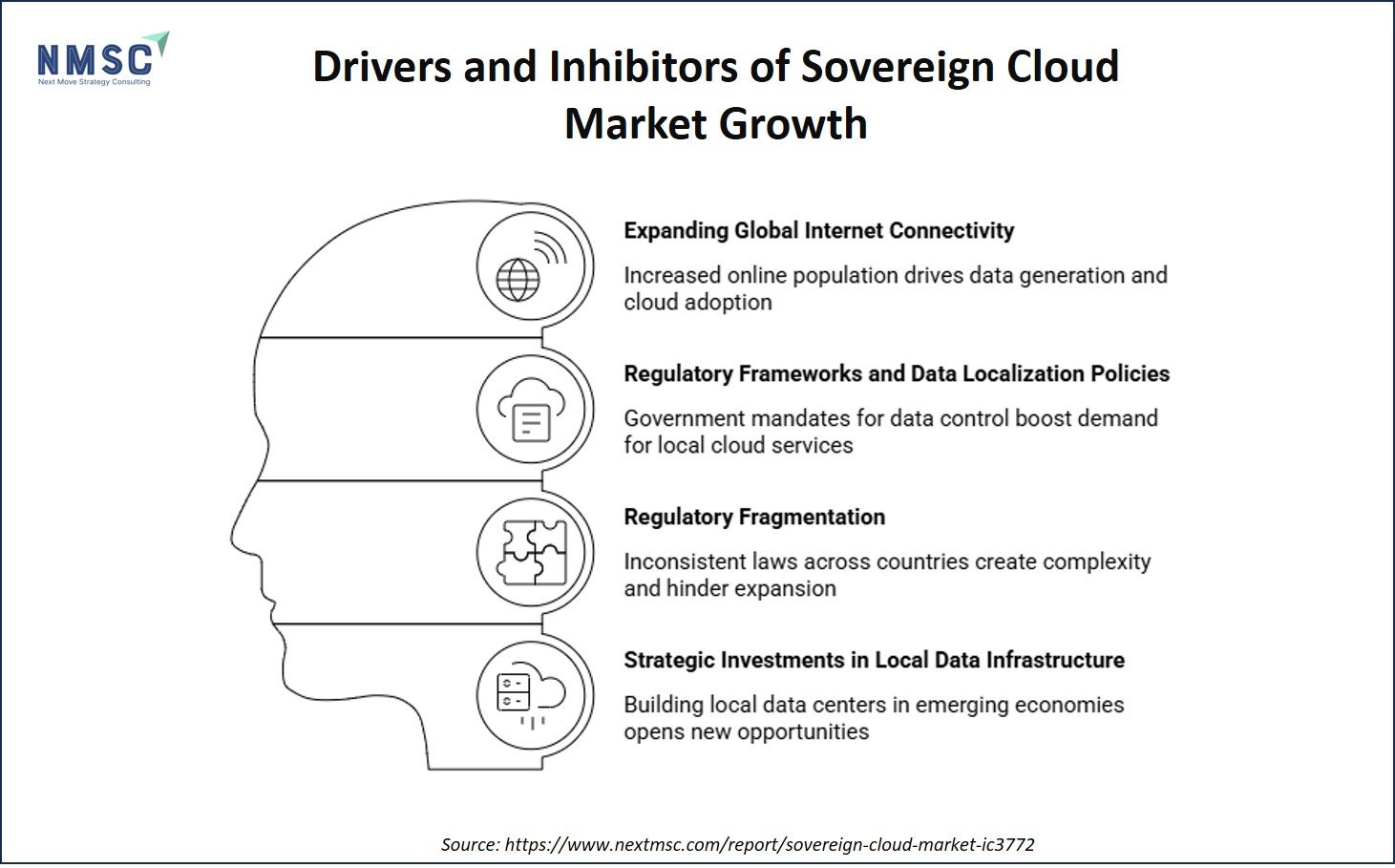
Rising internet connectivity, stricter data localization rules, and growing investment in local infrastructure are key factors driving sovereign cloud adoption. According to the ITU, nearly 68% of the global population was online in 2024, increasing demand for secure and compliant cloud environments. Governments are also introducing stronger data residency laws, encouraging businesses to adopt regionally hosted solutions.
However, regulatory differences across countries remain a challenge, increasing compliance costs and slowing cross-border expansion. Despite this, emerging markets with limited digital infrastructure offer strong growth opportunities for providers investing in local data centers and secure cloud ecosystems.
How Sovereign Cloud Balances Growth and Compliance
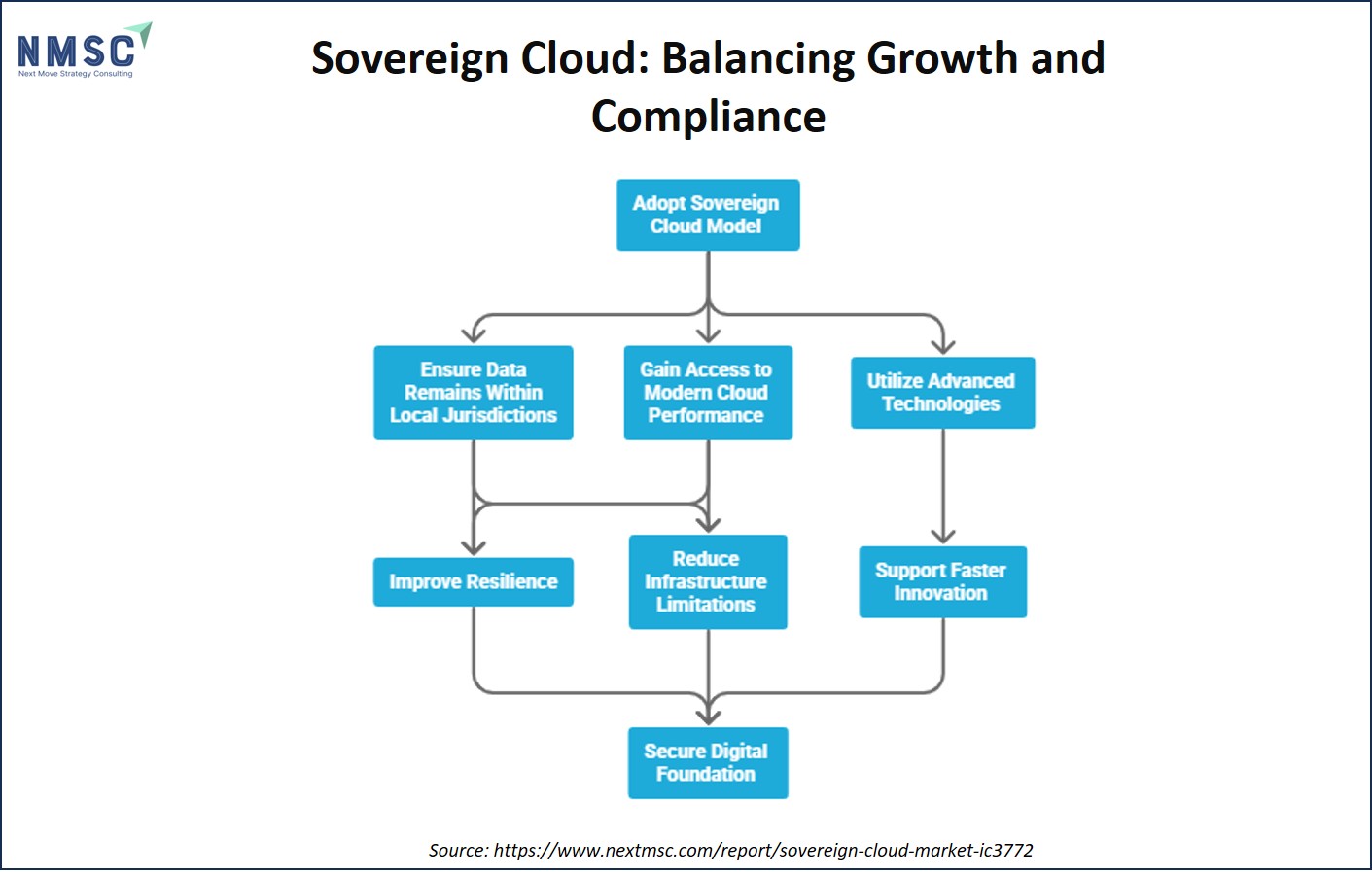
Sovereign cloud is reshaping enterprise strategy by solving a long-standing challenge: how to scale digital operations while meeting strict regulatory demands. Organizations are adopting this model to ensure that sensitive data remains within local jurisdictions, while still gaining access to modern cloud performance and advanced technologies such as artificial intelligence. Recent deployments in Canada and the UAE demonstrate that sovereign cloud can improve resilience, support faster innovation, and reduce infrastructure limitations. The result is a secure digital foundation where compliance and business growth can advance together.
What Is Driving and Challenging Sovereign Cloud Growth?
Rising internet connectivity, stricter data localization rules, and growing investment in local infrastructure are key factors driving sovereign cloud adoption. According to the ITU, nearly 68% of the global population was online in 2024, increasing demand for secure and compliant cloud environments. Governments are also introducing stronger data residency laws, encouraging businesses to adopt regionally hosted solutions.
However, regulatory differences across countries remain a challenge, increasing compliance costs and slowing cross-border expansion. Despite this, emerging markets with limited digital infrastructure offer strong growth opportunities for providers investing in local data centers and secure cloud ecosystems.
Who Is Leading Competition in the Sovereign Cloud Market?
Competition in the sovereign cloud market is shaped by a combination of global technology leaders and specialized cloud providers. Major companies such as Alibaba Cloud, Amazon Web Services, Google Cloud, Microsoft, IBM Corporation, and Oracle hold strong positions due to their vast infrastructure networks, broad service portfolios, and established market presence. These companies focus on delivering secure, scalable, and regulation-ready cloud solutions for governments and large enterprises. Their strengths in hybrid cloud, managed services, analytics, and enterprise performance continue to reinforce their leadership in the evolving sovereign cloud landscape.
Next Steps
Review where sensitive data currently resides and identify workloads with the highest compliance needs. Evaluate whether future AI projects require a trusted regional environment. Compare providers based on resilience and governance, not only price. Finally, create a phased migration roadmap for critical systems.
-
Assess where sensitive and regulated data is currently stored.
-
Identify workloads that require local residency and stronger compliance controls.
-
Evaluate sovereign cloud providers based on security, scalability, and resilience.
-
Prioritize AI and analytics projects that need trusted regional infrastructure.
-
Build a phased migration roadmap aligned with long-term business goals.
Final Thoughts
Sovereign cloud is becoming the preferred path for organizations that want to innovate responsibly. Whether enabling AI in Canada or supporting high-volume payments in the UAE, the message is clear: businesses want the flexibility of the cloud, but with security, compliance, and control built in from the start. The latest developments from Canada and the Middle East show that sovereign cloud is delivering real-world value across industries. It enables trusted AI deployment, strengthens resilience, supports local data residency, and creates a future-ready digital environment.
For businesses planning their next stage of transformation, the message is clear: cloud success is no longer defined only by speed or cost. It is increasingly defined by trust, governance, and the ability to grow securely.
About the Author
 Sanyukta Deb
— Sanyukta Deb is Digital Marketing Team Lead at Next Move Strategy Consulting, where she has led content strategy and technical SEO for the firm's B2B market research publications for over 2 years. Her editorial process translates NextMSC's primary and secondary research — spanning technology, industrial, and consumer sectors — into commercial narratives, backed by search-intent, keyword, and competitive analysis. She brings 5 years of overall experience in digital marketing and content strategy.
Sanyukta Deb
— Sanyukta Deb is Digital Marketing Team Lead at Next Move Strategy Consulting, where she has led content strategy and technical SEO for the firm's B2B market research publications for over 2 years. Her editorial process translates NextMSC's primary and secondary research — spanning technology, industrial, and consumer sectors — into commercial narratives, backed by search-intent, keyword, and competitive analysis. She brings 5 years of overall experience in digital marketing and content strategy.
About the Reviewer
 Debashree Dey
— Debashree Dey is Assistant Manager at Next Move Strategy Consulting, where she supports cross-vertical market content and communications across diverse industries for 6 years. Her professional background includes senior content writing, communications, and published manuscript authorship, with experience developing audience-focused business narratives and maintaining clear, consistent messaging. Her role supports research-led content development and editorial quality across NextMSC publications.
Debashree Dey
— Debashree Dey is Assistant Manager at Next Move Strategy Consulting, where she supports cross-vertical market content and communications across diverse industries for 6 years. Her professional background includes senior content writing, communications, and published manuscript authorship, with experience developing audience-focused business narratives and maintaining clear, consistent messaging. Her role supports research-led content development and editorial quality across NextMSC publications.


















Add Comment