Sovereign Cloud Market By Deployment Mode (Cloud-Based, On-Premises), By Functionality (Data Sovereignty, Technical Sovereignty, Operational Sovereignty), By Service Type (Infrastructure as a Service, Platform as a Service, Software as a Service and Others), By Enterprise Size (Large Enterprises, Small and Medium Enterprises), By End User Industry (Government and Defense, Banking Financial Services and Insurance, Healthcare and Others) – Global Analysis & Forecast, 2025–2030
Industry: ICT & Media | Publishing Date: June 3, 2026 | Last Updated: October 16, 2026 | No of Pages: N/A | No. of Tables: N/A | No. of Figures: N/A | Format: PDF | Report Code: IC3772
Industry Outlook
The global Sovereign Cloud Market size was valued at USD 112.58 billion in 2024, and is expected to be valued at USD 143.32 billion by the end of 2025. The industry is projected to grow, hitting USD 479.12 billion by 2030, with a CAGR of 27.3% between 2025 and 2030.
The sovereign cloud market is being increasingly shaped by the rapid expansion of digital connectivity, which is transforming how governments and enterprises manage and secure critical information. As more citizens and organizations move online, the volume of data generated is growing exponentially, creating a pressing need for secure, locally controlled cloud environments. Sectors such as public services, finance, and healthcare are prioritizing cloud solutions that provide compliance, data security, and operational resilience. In response, sovereign cloud providers are developing region-specific infrastructures, expanding local data centers, and designing solutions that align with national regulations, reinforcing the strategic importance of sovereign clouds in maintaining digital trust and autonomy.
At the same time, the strengthening of regulatory frameworks and data localization policies is driving demand for sovereign cloud services. Governments around the world are emphasizing control over sensitive digital assets, requiring that critical information be stored and processed within national borders. This focus on legal compliance and operational oversight is prompting organizations to adopt cloud solutions that meet strict data sovereignty requirements. For providers, these trends present significant opportunities to offer secure, compliant, and locally managed cloud infrastructure, catering to both government agencies and regulated industries while supporting the broader goals of national digital resilience and governance.
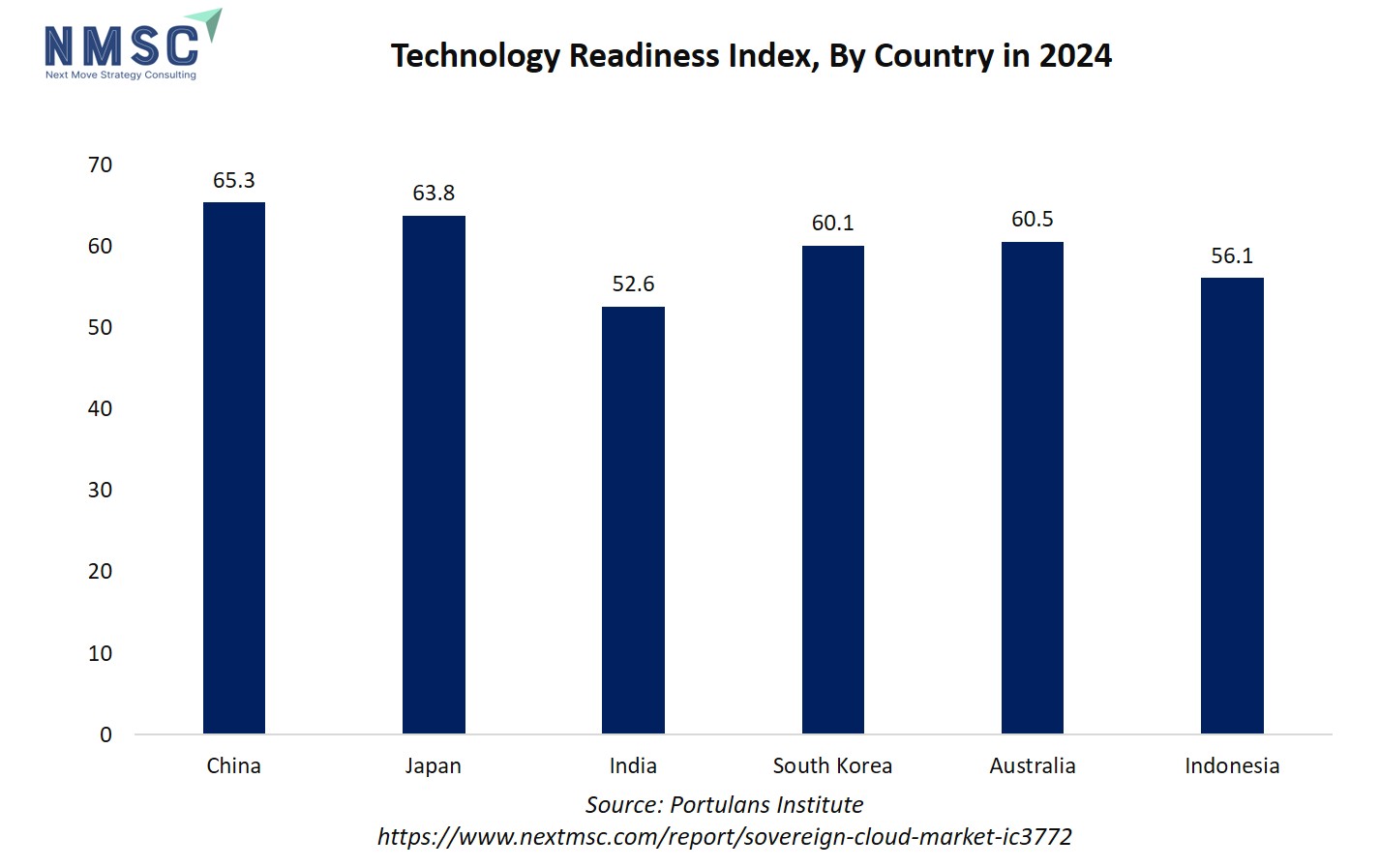
This chart highlights the 2024 Technology Readiness Index for selected Asia-Pacific countries, with China (65.3) and Japan (63.8) leading, followed by Australia (60.5), South Korea (60.1), Indonesia (56.1), and India (52.6), reflecting their relative ability to develop and adopt advanced technologies. In the context of the sovereign cloud market, higher scores indicate that countries like China and Japan are well-positioned to implement secure, locally governed cloud infrastructures, establish robust data sovereignty regulations, and accelerate the deployment of advanced cloud solutions. Conversely, nations with lower scores encounter slower adoption due to gaps in technology infrastructure, regulatory readiness, and skilled workforce availability.
What are the Key Trends in Sovereign Cloud Industry?
How is sovereign cloud market reacting to rising data localization and regulation?
Regulatory pressure has become the most powerful force shaping the trajectory of the global sovereign cloud market. As governments worldwide enforce stricter data localization mandates and national sovereignty policies, demand is rapidly shifting toward cloud infrastructures that ensure complete control over sensitive information within domestic borders. According to recent OECD and EU digital governance initiatives, there has been a marked acceleration in regulatory frameworks prioritizing data residency, legal accountability, and transparent supply chains over unrestricted data mobility. This is directly influencing how public agencies, financial institutions, and critical industries procure cloud services, favoring sovereign providers that demonstrate auditable compliance and jurisdictional clarity.
For companies operating in the market, this regulatory wave is prompting a fundamental redesign of service architecture from globalized multi-tenant systems to modular, region-specific deployments with embedded compliance automation. Providers that proactively certify their local zones, disclose clear legal assurances on data handling, and integrate automated compliance reporting tools are gaining a competitive advantage. Ultimately, treating localization as a core market requirement—not a value-added feature—is becoming essential for capturing public sector contracts and regulated enterprise workloads in markets increasingly governed by digital sovereignty laws.
How is sovereign cloud market influenced by public sector procurement and development programs in emerging markets?
Public sector investment and international policy initiatives are becoming major catalysts for growth in the global market. Recent guidance from the World Bank and IFC emphasizes vendor-neutral procurement and whole-of-government cloud strategies to build sustainable national digital infrastructures. As a result, many governments especially in emerging economies are shifting toward hybrid data sovereignty models that integrate domestic data centers, trusted local operators, and selective partnerships with global providers under strict compliance frameworks. This transition is reshaping market competition, favoring providers that align with national sovereignty objectives while supporting local capacity building. Companies entering this space are increasingly adopting collaborative models that include local partnerships, technology transfer programs, and shared infrastructure investments, which reduce political risk and enhance trust with regulators. Aligning proposals with multilateral guidelines and offering clear roadmaps for local capability development have become key differentiators for winning large-scale government contracts in the evolving sovereign cloud landscape.
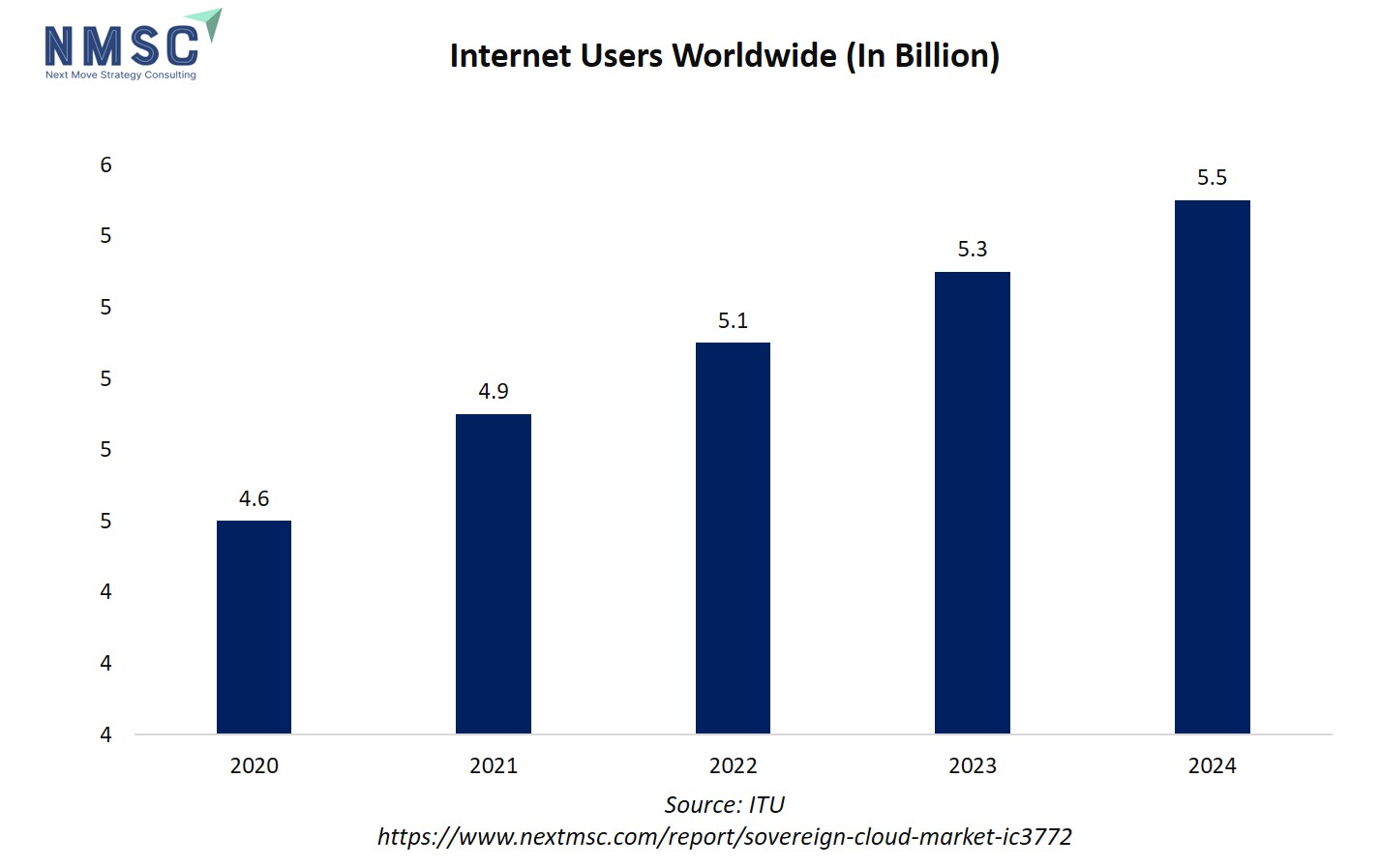
The steady increase in global internet users is driving growth in the market by expanding the volume of data generated and the demand for secure, locally managed digital infrastructure. As more individuals and organizations come online, cloud-based services become essential for storing, processing, and protecting sensitive information, particularly in sectors like government, finance, and healthcare. This expanding connectivity underpins the adoption of sovereign cloud solutions, supports the development of region-specific data centers, and reinforces the need for compliance with national data governance regulations, thereby fueling the market’s continued growth.
What are the Key Market Drivers, Breakthroughs, and Investment Opportunities that will Shape the Sovereign Cloud Industry in the Next Decade?
The market is being strongly driven by governments’ increasing emphasis on data sovereignty, regulatory compliance, and digital autonomy. Public sector organizations and enterprises are prioritizing cloud solutions that ensure sensitive data remains within national borders and meets stringent local regulations. By adopting sovereign cloud infrastructures, companies and government agencies enhance security, streamline compliance, and gain greater control over critical digital assets. This focus on secure, locally governed cloud environments is encouraging cloud providers to innovate with solutions tailored to the unique needs of each country, including secure storage, advanced access controls, and seamless integration with national IT ecosystems.
Simultaneously, the growing demand for digital transformation and advanced technologies such as artificial intelligence, big data analytics, and Internet of Things (IoT) applications is creating new opportunities for sovereign cloud providers. Organizations across sectors including finance, healthcare, defense, and smart cities are seeking cloud services that combine high performance with robust security and compliance. For providers, this trend represents a strategic opportunity to develop specialized, scalable cloud offerings that meet both technological and regulatory requirements. Companies that deliver secure, high-performance, and locally controlled cloud solutions are well-positioned to capture value in this expanding and high-growth market.
Growth Drivers:
How is Expanding Global Internet Connectivity Driving Growth in the Market?
The internet connectivity is emerging as a significant driver for the sovereign cloud market growth, reshaping how governments and enterprises manage and protect digital infrastructure. According to the International Telecommunication Union (ITU), about 5.5 billion people, nearly 68% of the global population were online in 2024, reflecting steady progress in global digital inclusion. This surge in connectivity is accelerating data generation, cross-border digital services, and cloud adoption, compelling nations to strengthen data governance and ensure that critical information remains under domestic control. As more citizens and organizations move online, the need for secure, compliant, and locally governed cloud environments becomes paramount, particularly in sectors such as public services, finance, and healthcare. In response, sovereign cloud providers are expanding their regional data centers and tailoring compliance architectures to align with national regulations. Overall, rising internet penetration is not only increasing cloud demand but also reinforcing the strategic importance of sovereign clouds in maintaining digital trust, autonomy, and resilience in an increasingly connected world.
How are Regulatory Frameworks and Data Localization Policies Driving the Growth of the Market?
Regulatory frameworks and data localization policies are emerging as key growth drivers in the global market, as governments increasingly prioritize control over critical digital assets and compliance with national laws. By early 2023, the OECD reported nearly 100 data localization measures implemented across 40 countries, with the majority combining local storage mandates with restrictions on cross-border data flows, representing the strictest form of data sovereignty enforcement. These requirements are particularly pronounced in non-OECD nations, where sensitive information, such as public sector records, health data, and financial information must remain within domestic infrastructure. For the sovereign cloud market, this trend is accelerating demand for regionally hosted cloud services, local data centers, and compliant infrastructure that guarantee legal and operational control, positioning providers who meet these regulatory demands to capture significant opportunities in both government and regulated enterprise segments.
Growth Inhibitors:
How is Regulatory Fragmentation Limiting the Growth of the Market?
The fragmentation of regulatory frameworks across different countries is a major sovereign cloud market challenge constraining its growth. As data sovereignty laws proliferate, their requirements and enforcement mechanisms differ significantly from one jurisdiction to another, creating complexity for providers operating globally. The World Bank notes that conflicts of laws and jurisdictional inconsistencies in cloud computing hinder market expansion. For example, the European Union’s GDPR enforces stringent data residency and processing rules, whereas other regions have more lenient or divergent standards. This regulatory patchwork increases compliance costs, operational challenges, and legal risks for cloud providers, making it difficult to scale services seamlessly across borders. Consequently, companies in the market must carefully navigate these varying regulations, investing heavily in localized compliance strategies, which slow overall market growth and increase barriers to entry in multiple regions.
How can Strategic Investments in Local Data Infrastructure Accelerate Growth in the Market?
A key growth opportunity for the market lies in targeted investments in local data infrastructure, especially in emerging and underserved economies. The World Bank reports that the global cloud and data infrastructure market was valued at around USD 600 billion in 2022, with an expected annual growth of approximately 20% through 2025. However, this expansion is concentrated in high-income countries, where over half already have direct cloud on-ramps, while low- and middle-income nations lack the necessary digital infrastructure to support large-scale cloud adoption. For the market, this gap creates a significant opportunity: providers establish local data centers, offer compliant and secure cloud services, and align with national data sovereignty policies to meet rising demand. Such initiatives not only open new revenue streams but also support the digital transformation goals of these countries, foster technological innovation, and create local employment, reinforcing the strategic importance of sovereign clouds in building resilient, locally governed digital ecosystems.
How is the Autonomous Commercial Vehicle Industry is Segmented in this Report, and What are the Key Insights from Segmentation Analysis?
By Deployment Mode Insights
How is the Sovereign Cloud Market Shaped by Deployment Mode?
Based on deployment mode, the market is segmented into cloud based and on premises.
The cloud-based deployment segment in the market refers to services and infrastructure hosted on remote servers and accessed over the internet, rather than being maintained locally on an organization’s premises. This model allows governments and enterprises to leverage scalable, flexible, and cost-efficient cloud resources while ensuring compliance with data sovereignty regulations. Cloud-based sovereign solutions include managed services, multi-tenant architectures, and advanced security features, enabling rapid deployment of applications and seamless updates. This segment is particularly attractive for organizations seeking agility, centralized management, and reduced capital expenditure, while still maintaining control over sensitive national or organizational data.
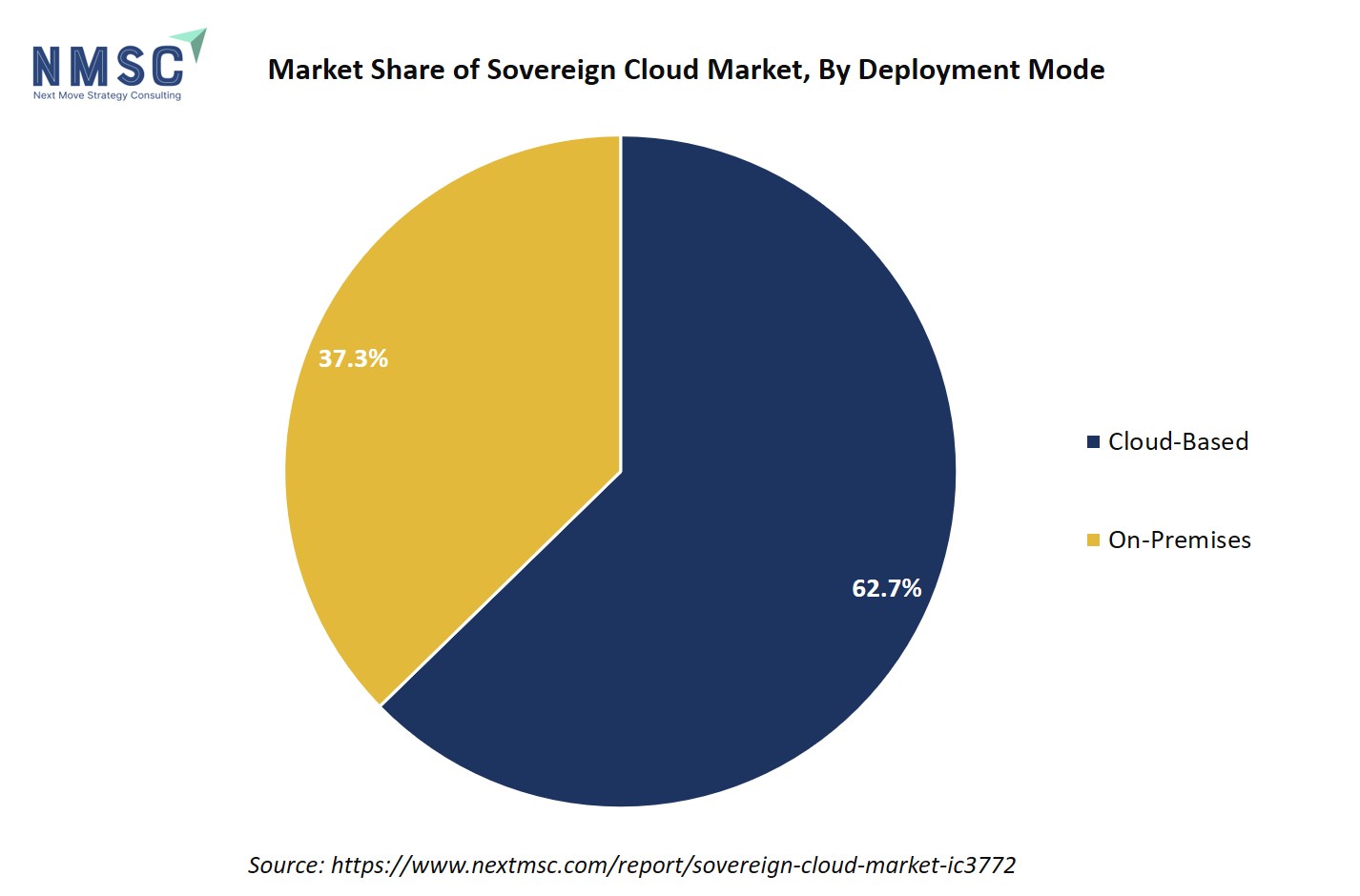
This chart represents the market distribution of the market by deployment mode. It illustrates the proportion of cloud-based versus on-premises solutions adopted by organizations. The sovereign cloud market share of cloud-based deployment indicates a growing preference for scalable, flexible, and remotely managed cloud services, while the on-premises segment reflects organizations that continue to prioritize direct control over infrastructure and data. Overall, the chart highlights how enterprises and government agencies are balancing agility, cost efficiency, and compliance requirements when choosing their deployment strategy
By Functionality Insights
Which Functionality is Emerging as the Most Flexible in the Industry?
Based on sensor technology, the market is segmented into data sovereignty, technical sovereignty and others.
The data sovereignty segment in the market focuses on ensuring that data is stored, processed, and managed in accordance with the legal and regulatory requirements of a specific country or region. This functionality emphasizes control over where data resides, who access it, and how it is handled, thereby protecting sensitive information from cross-border transfer risks and unauthorized access. Solutions in this segment enable governments and enterprises to maintain compliance with local data protection laws, strengthen privacy, and build trust in digital services, making it a critical aspect of any sovereign cloud strategy.
By Enterprise Size Insights
How is the Sovereign Cloud Market Shaped by Enterprise Size Segmentation?
Based on enterprise size, the market is segmented into large enterprises and small and medium enterprises.
The large enterprise segment in the market comprises multinational corporations, government agencies, and major organizations that require robust, secure, and scalable cloud solutions to manage vast volumes of sensitive data. These organizations prioritize high levels of compliance, advanced security protocols, and the ability to integrate complex IT infrastructures across multiple regions. Sovereign cloud solutions for large enterprises offer tailored services that ensure data sovereignty, operational continuity, and technical resilience, supporting critical business operations while adhering to national regulations and industry standards.
Regional Outlook
The market is geographically studied across North America, Europe, Asia Pacific, Latin America and the Middle East & Africa and each region is further studied across countries.
Sovereign Cloud Market in North America
The North American market is expanding as organizations and government agencies increasingly prioritize keeping sensitive data within national borders to comply with regulatory and data sovereignty requirements. Heightened concerns over cybersecurity and national security are driving the adoption of cloud solutions that provide greater control and protection over data. Furthermore, government policies and procurement strategies that favor secure, locally managed cloud infrastructure, combined with the digital transformation of public services, are fueling the demand for sovereign cloud offerings across both public and private sectors.
Sovereign Cloud Market in the United States
In the United States, the market is being driven by the federal government’s focus on modernizing IT infrastructure and improving cost efficiency. Programs that streamline technology procurement and foster partnerships with cloud providers are encouraging agencies to adopt secure, locally managed cloud solutions. By modernizing legacy systems and optimizing operational costs, these initiatives are accelerating the demand for sovereign cloud services that meet government standards for security, compliance, and reliability.
Sovereign Cloud Market in Canada
In Canada, a key driver of the sovereign cloud market is the government’s investment in secure digital services through its digital government strategy. By promoting cloud adoption for public sector workloads while emphasizing data sovereignty, these initiatives create strong demand for cloud solutions that comply with regulatory requirements. This focus on secure, locally managed digital infrastructure is encouraging public institutions to adopt sovereign cloud services, presenting significant opportunities for providers that meet Canada’s security and compliance standards.
Sovereign Cloud Market in Europe
In Europe, the sovereign cloud market is being strongly driven by the European Union’s strategic focus on enhancing digital sovereignty and reducing dependence on non-EU technology providers. The EU recognizes that secure and locally managed cloud infrastructure is critical for maintaining control over sensitive data and ensuring operational autonomy in key sectors such as government, finance, and healthcare. Initiatives like the digital decade policy, which aims for 75% of European enterprises to adopt cloud computing services by 2030, are accelerating the shift toward sovereign cloud solutions. This growing emphasis on regional control and compliance with EU regulations is creating substantial opportunities for cloud providers capable of offering secure, locally governed services that meet the unique requirements of European organizations, thereby driving significant growth in the market across the region.
Sovereign Cloud Market in the United Kingdom
In the United Kingdom, the sovereign cloud market is being driven by a strong emphasis on resilience and continuity of critical national infrastructure. Key sectors, including healthcare, finance, and public services, are increasingly adopting cloud solutions that ensure uninterrupted operations and rapid recovery from cyberattacks, system failures, or other disruptions. This focus on operational reliability and risk mitigation is boosting demand for sovereign cloud services that offer enhanced security, local control, and compliance with national standards, making them an essential component of the UK’s digital infrastructure strategy.
Sovereign Cloud Market in Germany
In Germany, the sovereign cloud market is being driven by the federal government’s strong focus on digital sovereignty and the creation of secure, locally controlled digital infrastructure. Policies outlined in the 2025 coalition agreement emphasize reducing dependence on non-European technology providers and strengthening control over critical IT systems, which is fueling demand for compliant cloud solutions. Initiatives such as the development of the "Germany Stack" and the German Administrative Cloud (DVC) provide interoperable, secure cloud platforms that meet national standards, encouraging adoption across public sector agencies and private enterprises. By promoting open-source solutions and collaboration between federal, state, and local entities, these measures are expanding opportunities for sovereign cloud providers, making Germany a key market for secure, domestically governed cloud services.
Sovereign Cloud Market in France
In France, the market is being driven by the country’s focus on enabling innovation and digital transformation across strategic industries such as healthcare, finance, and manufacturing. Businesses and public sector organizations are increasingly adopting cloud solutions that provide secure, scalable, and advanced digital capabilities while keeping sensitive data within national borders. This demand for compliant and locally controlled cloud infrastructure is expanding opportunities for sovereign cloud providers, positioning France as a growing market for secure and innovation-friendly cloud services.
Sovereign Cloud Market in Spain
In Spain, the market is being fueled by the government’s focus on enhancing public service efficiency and advancing digital citizen engagement. Public sector organizations are increasingly adopting cloud solutions that enable faster, more reliable delivery of e-government services while ensuring that sensitive citizen data remains securely within national borders. This drive to modernize administrative processes and improve service accessibility is boosting demand for sovereign cloud offerings, creating significant opportunities for providers capable of delivering secure, compliant, and locally governed cloud infrastructure in the Spanish market.
Sovereign Cloud Market in Asia Pacific
In the Asia Pacific region, the market is being driven by the growing need for robust cybersecurity and protection against rising digital threats. Both governments and enterprises are increasingly adopting cloud solutions that ensure sensitive data and critical systems are securely managed while remaining under local control. This focus on safeguarding digital assets and maintaining regulatory compliance is fueling demand for sovereign cloud services, creating strong growth opportunities across public and private sectors throughout the region.
Sovereign Cloud Market in China
In China, a significant driver of the sovereign cloud market is the government's strategic emphasis on data as a critical factor of production and its commitment to enhancing data sovereignty. In January 2024, China released a three-year action plan to promote the use of data across various sectors, including manufacturing, finance, technological innovation, and green development. The plan outlines efforts to improve data quality, circulation, and security, aiming to strengthen data governance and ensure that sensitive information remains under national control. Additionally, China aims to establish over 100 trusted data matrixes by 2028, forming a set of data matrix solutions and best practices to facilitate secure data sharing and utilization. These initiatives underscore China's commitment to developing a robust and secure digital infrastructure, driving the demand for sovereign cloud services that align with national data governance policies.
Sovereign Cloud Market in Japan
In Japan, a key driver of the market is the growing focus on supporting advanced technologies such as artificial intelligence, the Internet of Things, and smart manufacturing. Organizations across industries are seeking cloud solutions that provide high-performance computing, secure data management, and low-latency access while keeping sensitive information within national borders. This emphasis on enabling technological innovation while maintaining local control over critical data is driving the adoption of sovereign cloud services and expanding Japan’s market for secure, domestically managed cloud infrastructure.
Sovereign Cloud Market in India
In India, a key driver of the sovereign cloud market is the government’s initiative to strengthen local data management through programs like “MeghRaj” launched by the Ministry of Electronics and IT (MeitY). This program enables government departments to store and process sensitive data within the country, ensuring compliance with data sovereignty requirements and enhancing security. By providing a secure, government-managed cloud infrastructure, MeghRaj is encouraging wider adoption of cloud autonomy solutions across public sector organizations, driving growth in India’s market for locally controlled and compliant cloud services.
Sovereign Cloud Market in South Korea
In South Korea, the sovereign cloud market is being driven by the government and enterprises’ strong focus on supporting the nation’s rapidly expanding digital economy and innovation ecosystem. Organizations across sectors such as technology, finance, and public services are increasingly adopting cloud solutions that enable advanced analytics, artificial intelligence, and smart services, while ensuring that sensitive data remains securely within national borders. This emphasis on fostering technological innovation, enhancing economic competitiveness, and maintaining control over critical digital infrastructure is fueling the demand for sovereign cloud services, creating significant growth opportunities for providers capable of delivering secure, locally governed cloud solutions in the South Korean market.
Sovereign Cloud Market in Australia
In Australia, a key driver of the sovereign cloud market is the growing emphasis on regulatory compliance and industry-specific data protection requirements. Organizations across sectors such as healthcare, finance, and government are increasingly seeking cloud solutions that ensure sensitive data is stored and managed within national borders, meeting strict local regulations. This focus on safeguarding critical information and maintaining compliance is driving the adoption of sovereign cloud services, expanding opportunities for providers that offer secure and locally controlled cloud infrastructure in the Australian market.
Sovereign Cloud Market in Latin America
In Latin America, the sovereign cloud market is being driven by the growing need for robust digital infrastructure to support both economic modernization and the digital transformation of public sector services. Governments and enterprises across the region are increasingly adopting cloud solutions that enable more efficient service delivery, facilitate data-driven decision-making, and ensure sensitive information is securely managed within national borders. This focus on strengthening local IT capabilities, improving operational efficiency, and maintaining control over critical data is boosting demand for sovereign cloud services, presenting significant growth opportunities for providers that offer secure, compliant, and locally governed cloud infrastructure throughout the Latin American market.
Sovereign Cloud Market in the Middle East & Africa
In the Middle East and Africa, the sovereign cloud market is being driven by the region’s focus on developing robust digital infrastructure to support smart city projects and broader national digital transformation initiatives. Governments and enterprises are increasingly turning to cloud solutions that enable efficient management of urban services, seamless connectivity, and secure storage of sensitive data within national boundaries. This emphasis on modernizing public services, improving citizen engagement, and building resilient digital ecosystems is fueling the demand for sovereign cloud services, creating strong growth opportunities for providers that deliver secure, locally governed cloud infrastructure across the region.
Competitive Landscape
Who are the Leading Companies in the Sovereign Cloud Market and How are they Competing?
The sovereign cloud market competition is driven by a mix of established cloud service leaders and innovative, agile specialists. Companies such as Alibaba Cloud, Amazon Web Services, Google Cloud, Microsoft, IBM Corporation, and Oracle dominate the market through their extensive global infrastructure, comprehensive service portfolios, and strong brand recognition. These players focus on delivering secure, compliant, and scalable cloud solutions tailored to the needs of governments and large enterprises, including managed services, advanced analytics, and hybrid cloud offerings. Their emphasis on reliability, regulatory compliance, and enterprise-grade performance helps them maintain a strong foothold in the evolving sovereign cloud landscape.
Meanwhile, specialized and niche-focused providers such as Clever Cloud, OVHcloud, SAP SE, T-Systems, VMware, Tietoevry, TATA Consultancy Services, Orange Business, and Red Hat target specific industry needs and innovative deployment models. These companies prioritize flexible solutions, technology-enabled services, and customer-centric approaches, including cloud-native applications, private cloud deployments, and enhanced data sovereignty features. Their ability to rapidly adapt to evolving regulatory requirements, emerging technologies, and unique client demands creates competitive pressure on the larger incumbents, driving the market toward more secure, compliant, and customizable cloud solutions.
Market Dominated by Sovereign Cloud Giants and Specialists
The sovereign cloud market is increasingly shaped by a blend of established global cloud leaders and specialized innovators. Companies like Alibaba Cloud, Amazon Web Services, Google Cloud, Microsoft, IBM Corporation, and Oracle dominate the market by offering comprehensive cloud platforms that combine secure infrastructure, data sovereignty, compliance management, hybrid and multi-cloud solutions, and enterprise-grade services. These providers leverage standardized deployment processes, advanced security protocols, and integrated management tools to deliver reliable, scalable, and compliant cloud environments for governments and large organizations. Meanwhile, specialized players such as Clever Cloud, OVHcloud, SAP SE, T-Systems, VMware, Tietoevry, TATA Consultancy Services, Orange Business, and Red Hat are introducing technology-driven and niche solutions, including private and hybrid cloud models, modular services, and enhanced sovereignty features. Together, these players are driving innovation, creating competitive differentiation, and accelerating market growth by addressing evolving regulatory requirements, security expectations, and the demand for customizable, resilient, and locally governed cloud solutions.
Market Players to Opt for Expansion Strategies to Expand their Presence
Sovereign cloud market is becoming essential for expanding capabilities and accelerating adoption in the globe. For instance, Alibaba Cloud, which announced plans to launch data centers in Brazil, France, and the Netherlands in 2025, followed by additional centers in Mexico, Japan, South Korea, Malaysia, and Dubai, exemplify how market leaders are broadening their geographical presence to tap into emerging opportunities. Such expansions enable these providers to offer localized, low-latency, and secure cloud services that comply with regional data sovereignty regulations, which is a critical requirement for governments and large enterprises.
List of Sovereign Cloud Companies
-
Amazon Web Service
-
Clever Cloud
-
Microsoft
-
IBM Corporation
-
Oracle
-
OVHcloud
-
SAP SE
-
T-Systems
-
VMware, Inc.
-
Tietoevry
-
TATA Consultancy Services
-
Orange Business
-
Red Hat
What are the Latest Key Industry Developments?
-
In June 2025, Oracle launched Oracle Compute Cloud@Customer Isolated, a secure sovereign cloud service designed to operate disconnected from the internet. This offering provides governments and regulated industries with enhanced control, security, and compliance for sensitive data.
-
In May 2025, Microsoft partnered with Yotta Data Services in India to integrate Azure AI into Yotta's Shakti Cloud, a sovereign AI platform. The collaboration combines Microsoft’s AI capabilities with Yotta’s localized infrastructure, enabling secure, compliant, and innovative AI solutions. This highlights a market trend where strategic partnerships drive adoption of compliance-driven cloud services, supporting regulated enterprises and governments with scalable, region-specific cloud platforms.
What are the Key Factors Influencing Investment Analysis & Opportunities in the Market?
Investment in the sovereign cloud market is increasingly driven by the growing demand for secure, compliant, and locally governed cloud solutions. Funding trends indicate that investors are focusing on companies offering innovative, technology-enabled services such as private cloud deployments, hybrid cloud solutions, and AI-integrated cloud platforms tailored for regulated industries and government sectors. Valuations are influenced by a provider’s ability to scale infrastructure, expand into new regions, and deliver value-added services that ensure data sovereignty, operational resilience, and compliance with evolving regulations. Investors are particularly interested in businesses that combine advanced security, regulatory adherence, and flexible deployment models, reflecting the rising emphasis on data governance and digital sovereignty.
Geographically, regions with stringent data protection laws and high adoption of cloud technologies are emerging as hotspots for investment opportunities, as these markets demonstrate strong demand for sovereign cloud solutions. Startups and specialized providers are gaining attention for their agility, niche offerings, and ability to innovate rapidly in response to regulatory changes. This environment creates opportunities for strategic partnerships, mergers and acquisitions, and portfolio diversification, collectively shaping a dynamic and competitive investment landscape in the global sovereign cloud market share.
Key Benefits for Stakeholders:
Next Move Strategy Consulting (NMSC) presents a comprehensive analysis of the sovereign cloud market trends, covering historical trends from 2020 through 2024 and offering detailed forecasts through 2030. Our study examines the market at global, regional, and country levels, providing quantitative projections and insights into key growth drivers, challenges, and investment opportunities across all major market segments.
Report Scope
|
Parameters |
Details |
|
Market Size in 2025 |
USD 143.32 Billion |
|
Revenue Forecast in 2030 |
USD 479.12 Billion |
|
Growth Rate |
CAGR of 27.3% from 2025 to 2030 |
|
Analysis Period |
2024–2030 |
|
Base Year Considered |
2024 |
|
Forecast Period |
2025–2030 |
|
Market Size Estimation |
Billion (USD) |
|
Growth Factors |
|
|
Countries Covered |
33 |
|
Companies Profiled |
15 |
|
Market Share |
Available for 10 companies |
|
Customization Scope |
Free customization (equivalent up to 80 analyst-working hours) after purchase. Addition or alteration to country, regional & segment scope. |
|
Pricing and Purchase Options |
Avail customized purchase options to meet your exact research needs. |
|
Approach |
In-depth primary and secondary research; proprietary databases; rigorous quality control and validation measures. |
|
Analytical Tools |
Porter's Five Forces, SWOT, value chain, and Harvey ball analysis to assess competitive intensity, stakeholder roles, and relative impact of key factors. |
Key Market Segments
By Deployment Mode
-
Cloud-Based
-
On-Premises
By Functionality
-
Data Sovereignty
-
Technical Sovereignty
-
Operational Sovereignty
By Service Type
-
Infrastructure as a Service
-
Platform as a Service
-
Software as a Service
-
Managed Services
-
Security and Compliance Services
By Enterprise Size
-
Large Enterprises
-
Small and Medium Enterprises
By End User Industry
-
Government and Defense
-
Banking Financial Services and Insurance
-
Healthcare
-
Telecommunications
-
Energy and Utilities
-
Information Technology and IT-Enabled Services
-
Transportation
-
Retail and Consumer Goods
-
Others
Geographical Breakdown
-
North America: U.S., Canada, and Mexico.
-
Europe: U.K., Germany, France, Italy, Spain, Sweden, Denmark, Finland, Netherlands, and rest of Europe.
-
Asia Pacific: China, India, Japan, South Korea, Taiwan, Indonesia, Vietnam, Australia, Philippines, Malaysia and rest of APAC.
-
Middle East & Africa (MEA): Saudi Arabia, UAE, Egypt, Israel, Turkey, Nigeria, South Africa, and rest of MEA.
-
Latin America: Brazil, Argentina, Chile, Colombia, and rest of LATAM.
Conclusion & Recommendations
Our report equips stakeholders, industry participants, investors, policy-makers, and consultants with actionable intelligence to capitalize on the market transformative potential. By combining robust data-driven analysis with strategic frameworks, NMSC’s Sovereign Cloud Market Report serves as an indispensable resource for navigating the evolving landscape.


About the Author
 Mayurima Roy
— Mayurima Roy is Research Analyst at Next Move Strategy Consulting, where she has spent 4 years working across the firm's full industry coverage rather than a single fixed vertical. Her work centers on structured research, ongoing trend tracking, competitive assessment, and insight-led content development, translating complex market data into clear, decision-ready narratives that support informed client decision-making across diverse global industries, market sectors, and world regions every day.
Mayurima Roy
— Mayurima Roy is Research Analyst at Next Move Strategy Consulting, where she has spent 4 years working across the firm's full industry coverage rather than a single fixed vertical. Her work centers on structured research, ongoing trend tracking, competitive assessment, and insight-led content development, translating complex market data into clear, decision-ready narratives that support informed client decision-making across diverse global industries, market sectors, and world regions every day.
About the Reviewer
 Supradip Baul
— Supradip Baul is an accomplished business consultant and strategist with over a decade of rich experience in market intelligence, strategy, technology, and business transformation. His work has included rigorous qualitative and quantitative analysis across multiple industries, helping clients shape investment decisions and long-term roadmaps. Earlier in his career, he was associated with Gartner, where he contributed to industry-leading reports and market share analyses. He has worked with leading global companies and holds an MBA with a dual specialization in Marketing and Finance.
Supradip Baul
— Supradip Baul is an accomplished business consultant and strategist with over a decade of rich experience in market intelligence, strategy, technology, and business transformation. His work has included rigorous qualitative and quantitative analysis across multiple industries, helping clients shape investment decisions and long-term roadmaps. Earlier in his career, he was associated with Gartner, where he contributed to industry-leading reports and market share analyses. He has worked with leading global companies and holds an MBA with a dual specialization in Marketing and Finance.
At Next Move Strategy Consulting, we understand that insightful market research is the cornerstone of successful business decisions. That's why we employ a robust and multifaceted approach, combining various methodologies to deliver the most accurate and actionable data for our clients.

Research Landscape
We navigate the world of research with two primary approaches:
Qualitative Approach
Our qualitative research methodologies involve immersive techniques such as in-depth interviews, focus groups, and observational studies. By engaging directly with individuals and stakeholders, we uncover valuable insights that quantitative data alone may overlook.

Quantitative Research
In tandem with qualitative methodologies, NMSC leverages the power of Quantitative Research to provide a robust foundation of numerical insights. Through systematic data collection and analysis, we quantify patterns, preferences, and market trends, offering a comprehensive view of the business landscape.
Our quantitative research approach employs diverse tools, including surveys, experiments, and statistical modelling. These methodologies enable us to gather data from a large and representative sample, ensuring the statistical significance of our findings. By employing structured questionnaires and standardized data collection methods, we guarantee the reliability and validity of the information we present to our clients.
Quantitative research is particularly effective in measuring the prevalence of trends, assessing market size, and gauging the impact of various factors on consumer behavior. The numerical precision attained through this approach equips our clients with actionable insights, facilitating data-driven decision-making and strategy formulation.


Our Specialized Toolbox for Industry-Specific Market Research
We deploy a specialized arsenal of techniques tailored to meet your unique requirements. Here's a glimpse into our comprehensive toolbox:

Information Procurement
The stage entails acquiring market data or relevant information through various sources and methodologies.


Market Research Approach
We utilize both top-down and bottom-up approaches in market research analysis to achieve a comprehensive understanding of the market dynamics, leveraging the broad perspective of industry trends and macroeconomic factors alongside detailed insights from specific segments and individual companies.

Porters Five Forces Analysis
We conduct Porter's Five Forces analysis to evaluate the competitive landscape of an industry, providing us with insights into factors that affect profitability and strategic positioning.

SWOT Analysis

Forecasting
We utilize a forecasting model to predict future consumption by considering parameters like population, economics, regulations, market competition, drivers, constraints, technology, and pricing. We also employ statistical techniques such as multilinear regression, exponential smoothing, moving average, ARIMA, and Monte Carlo simulations for accurate predictions. In econometric forecasting, we analyzed short-term and long-term event impacts, attributing values based on regulatory frameworks, economic factors, and market events.





 Speak to Our Analyst